Jamie Dimon Leadership Style: Risk Discipline and the Fortress Balance Sheet Mindset
Turn this article into takeaways for your work.


Each assistant summarizes the article only for you and suggests best practices for your work.
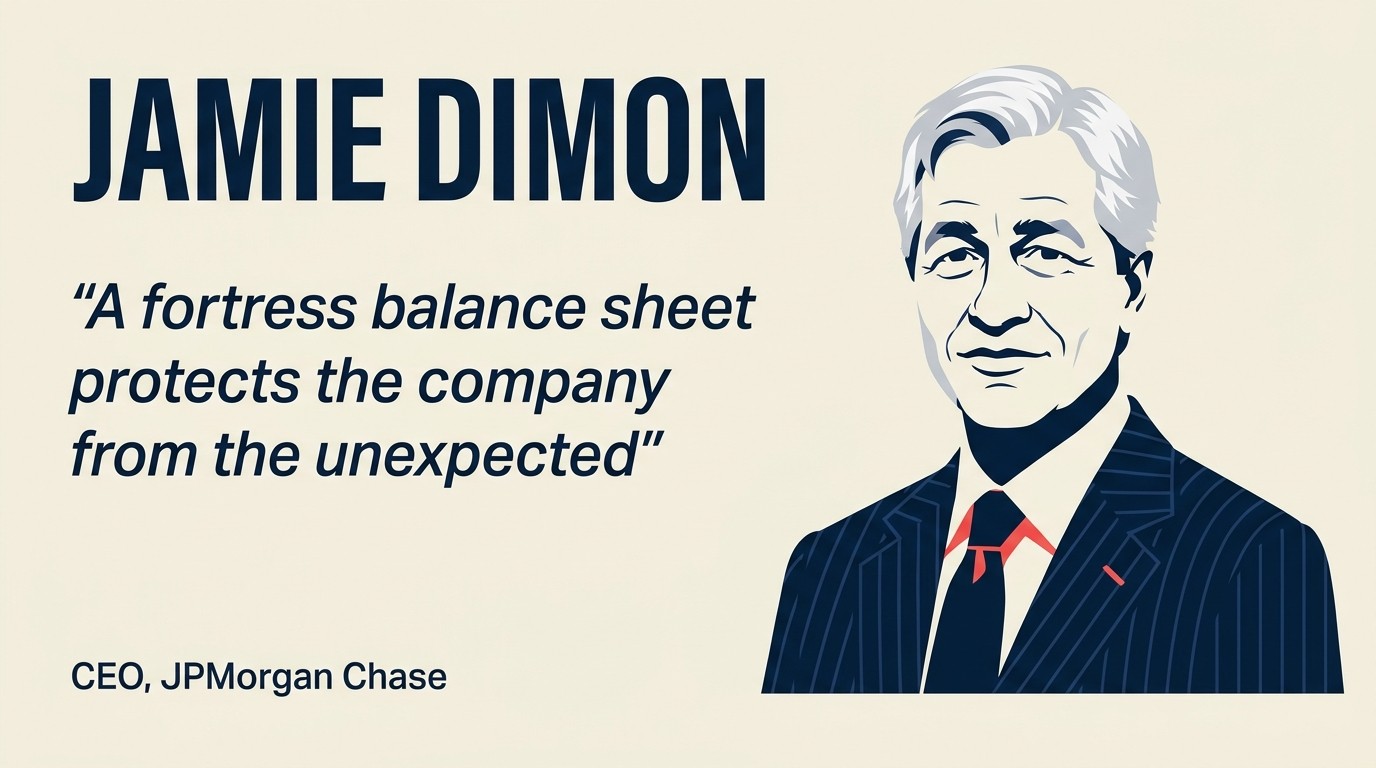
Jamie Dimon's leadership style pairs relentless risk discipline with blunt, direct communication. His "fortress balance sheet" doctrine kept capital and liquidity well above the minimum, so JPMorgan Chase entered the 2008 crisis strong enough to acquire rivals instead of needing rescue. The core lesson: build durable preparedness in calm periods so you can act decisively when conditions break.
Key Facts: Jamie Dimon (born 1956) has served as Chairman and CEO of JPMorgan Chase since 2006, making him the longest-tenured CEO among major U.S. banks. He earned his MBA from Harvard Business School in 1982 and guided JPMorgan through the 2008 financial crisis without requiring a federal bailout, the only major U.S. bank to avoid one. His "fortress balance sheet" philosophy drove emergency acquisitions of Bear Stearns and Washington Mutual in 2008, and First Republic Bank in 2023. His annual shareholder letters, running 30-40 pages, are widely read by CEOs, policymakers, and economists well beyond JPMorgan shareholders.
The Fortress Balance Sheet Doctrine
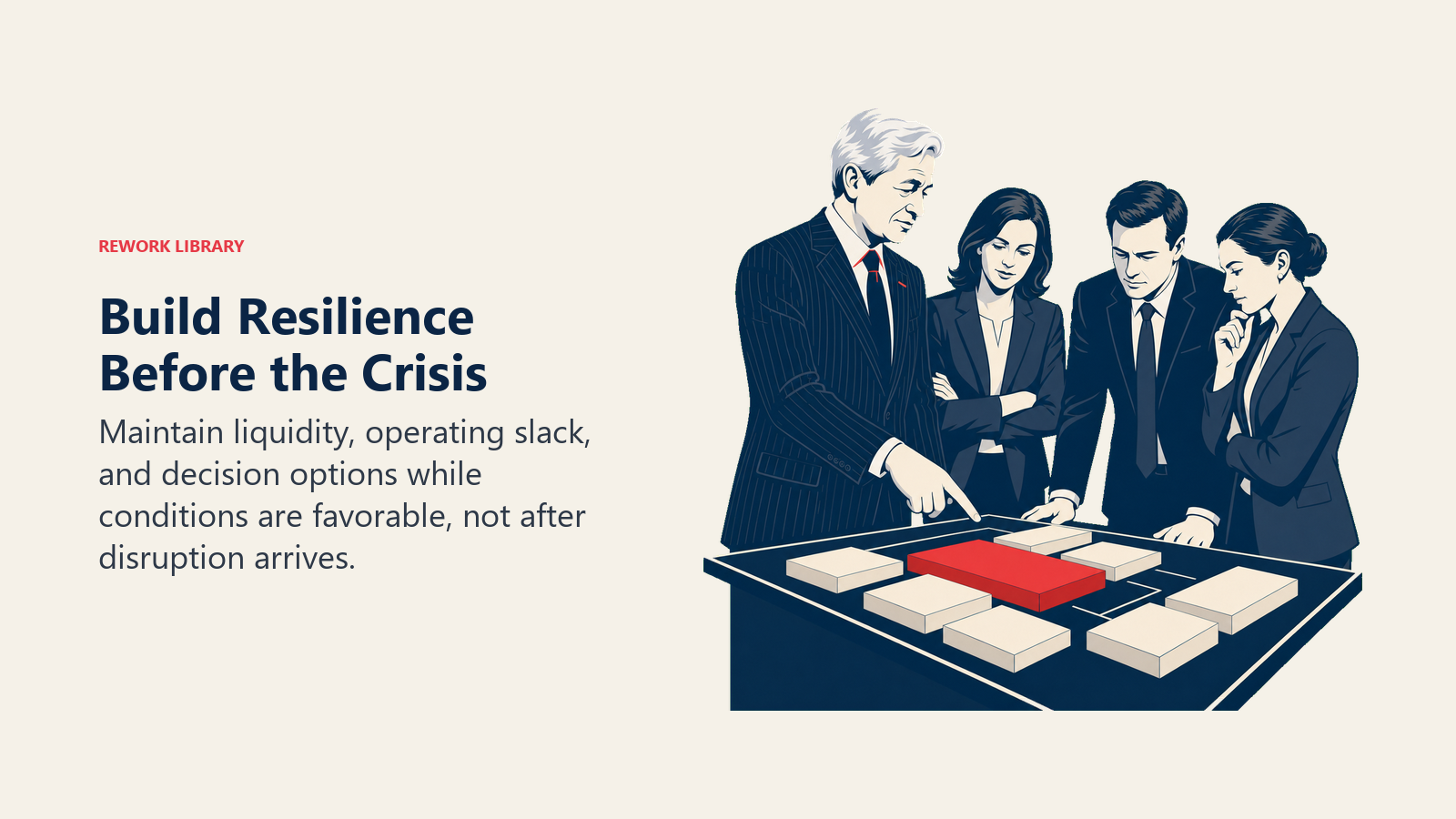
The Fortress Balance Sheet Doctrine is Jamie Dimon's operating philosophy that a financial institution should maintain capital, liquidity, and risk reserves well above regulatory minimums at all times, even at the cost of short-term returns. The doctrine treats crisis readiness as a proactive capital allocation choice made in calm markets, not a reactive response once stress hits. Its strategic payoff is optionality: a prepared institution can acquire distressed competitors at crisis prices while weaker peers are forced into survival mode.
Jamie Dimon got fired from Citigroup in 1998 by Sandy Weill, the man who'd mentored him for 16 years. Most people in that position take a year off and write a book. Dimon took two years, joined Bank One as CEO, turned around a struggling mid-tier bank, sold it to JPMorgan Chase in 2004, became president, and was running JPMorgan as CEO by 2005.
That's the résumé. What matters for you is what happened next. The 2008 financial crisis was the most destructive market event since the Great Depression. JPMorgan not only survived it, the bank came out stronger. It bought Bear Stearns in March 2008 for $2 a share (later revised to $10) and acquired Washington Mutual in September 2008. Both were Fed-facilitated distressed deals, but JPMorgan was the only major bank capable of absorbing them. Capability like that doesn't happen by accident.
Dimon has run JPMorgan for 20 years. His annual shareholder letters run 30 to 40 pages and are read by bank CEOs, fund managers, and policy makers who aren't JPMorgan shareholders. That's a different kind of influence. Understanding how he thinks about risk, capital, and communication gives you tools that apply well outside financial services.
Leadership Style Breakdown
| Style | Weight | How it showed up |
|---|---|---|
| Operational Disciplinarian | 65% | Dimon runs Sunday morning ops reviews. He tracks granular metrics across JPMorgan's retail, investment banking, commercial, and asset management divisions. He reads the internal financials in detail. The "fortress balance sheet" philosophy is a cultural product of constant operational scrutiny, not just a capital policy. |
| Direct Communicator | 35% | His shareholder letters are unusually honest about where JPMorgan made mistakes, where the industry has systemic problems, and what he thinks regulators are getting wrong. He doesn't hedge the way most public company CEOs do. Internally, he's known for walking into meetings and saying directly what he thinks, which creates a culture that respects candor. |
The 65/35 split tells you where his results come from. The direct communication makes him visible and credible. But the operational discipline is what actually built the institution. JPMorgan's ability to absorb Bear Stearns in 2008 didn't come from good PR. It came from years of capital accumulation and risk controls that his competitors had quietly relaxed.
Key Leadership Traits
| Trait | Rating | What it means in practice |
|---|---|---|
| Risk discipline | Exceptional | The "fortress balance sheet" wasn't a brand slogan. It was an operating constraint Dimon enforced even when competitors were generating higher short-term returns with more leverage. He consistently chose lower risk-adjusted returns over headline profits, and that conservatism became JPMorgan's competitive advantage when the market broke. |
| Direct communication | Very High | Most CEOs speak through PR departments. Dimon speaks directly. His shareholder letters cover topics like U.S. infrastructure, income inequality, and regulatory overcorrection, not just bank earnings. That directness creates a culture where honesty is expected, and makes it harder for problems to stay hidden. |
| Crisis opportunism | High | In 2008, most banks were in survival mode. Dimon was prepared enough to go shopping. He bought Bear Stearns and WaMu at distressed prices with Fed facilitation. In 2023, JPMorgan bought First Republic Bank when it failed. The pattern is consistent: maintain strength when others don't, then acquire when prices reflect fear rather than value. |
| Succession and personal risk blindspot | Medium | Dimon had throat cancer in 2014 and emergency heart surgery in 2020. Every time, the market asks the same question: who's next? Twenty years into his tenure, the answer is still unclear. A CEO who's irreplaceable is also a single point of failure. |
The 3 Decisions That Defined Jamie Dimon as a Leader
1. Building the Fortress Balance Sheet Before 2008
When banks were competing to maximize returns through leverage in the mid-2000s, Dimon was building capital reserves. He consistently held more equity capital relative to assets than peers. Internally, that looked conservative. Externally, it looked like JPMorgan was leaving money on the table.
Then 2008 happened. Bear Stearns held $11.8 trillion in derivatives exposure and couldn't fund itself. Lehman Brothers collapsed. Citigroup needed a $45B government bailout. JPMorgan was the institution the Federal Reserve called when they needed someone to catch the falling bodies.
The leadership decision wasn't made in 2008. It was made over the preceding three years through capital allocation choices that prioritized resilience over return. That's the actual lesson: your best crisis decisions get made before the crisis starts.
2. Acquiring Bear Stearns and WaMu During the 2008 Collapse
In March 2008, the Federal Reserve brokered an emergency sale of Bear Stearns to JPMorgan. The initial price was $2 a share, effectively pennies for what had been a $170-a-share stock months earlier. Dimon got it done over a weekend and later negotiated the price up to $10 to preserve deal certainty.
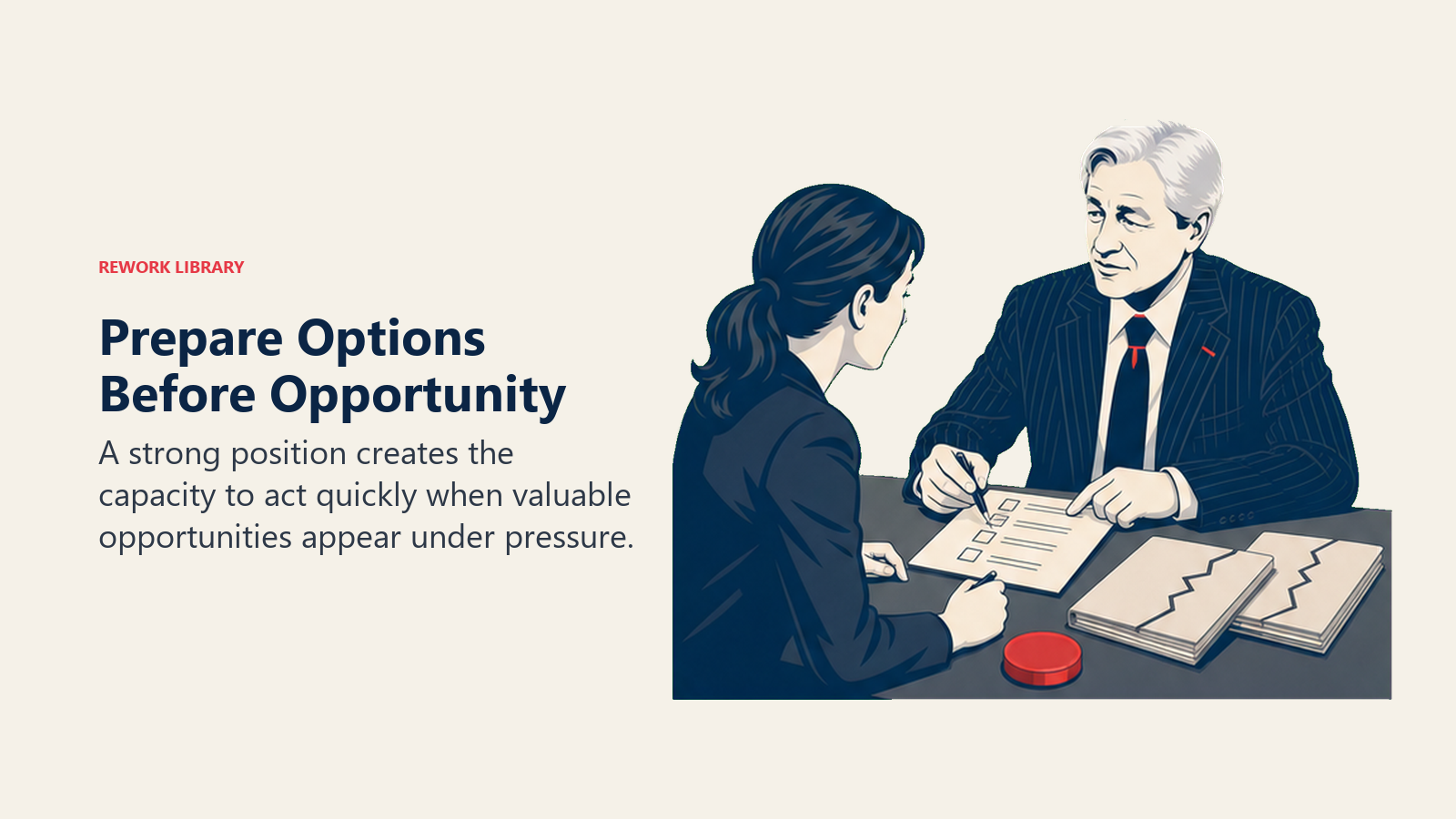
Six months later, when Washington Mutual became the largest bank failure in U.S. history, JPMorgan bought its banking operations for $1.9B. It was getting roughly $300B in assets for less than 1 cent on the dollar.
Both deals came with significant legal risk, JPMorgan eventually paid billions in settlements related to the pre-acquisition conduct of both institutions. Dimon has been vocal about how government-facilitated deals that expose the acquirer to inherited liabilities aren't as clean as they look. But the underlying thesis, that crisis creates acquisition opportunities for prepared buyers, played out exactly as intended.
3. The Annual Shareholder Letter as a Leadership Platform
Dimon's shareholder letters are not normal shareholder letters. Most are 5 to 8 pages. His run 30 to 40 pages. Most cover earnings and forward guidance. His cover macroeconomics, geopolitics, technology, talent, regulation, and specific failures JPMorgan made during the year.
The 2023 letter included a 10-page section on the global economy that was widely excerpted by economists who weren't investors. The letters function as a policy document, a management philosophy statement, and an earnings communication simultaneously.
What this shows about his leadership: Dimon treats external communication as a management tool. By being unusually candid about problems and tradeoffs, he sets an expectation inside the bank that the same candor is expected from his direct reports. You can't write publicly about your own mistakes and then punish people internally for surfacing theirs.
What Jamie Dimon Would Do in Your Role
If you're a CEO, the Dimon lesson is to do your own thinking before a crisis forces you to. The fortress balance sheet wasn't a defensive reaction, it was a proactive positioning decision made when everything was fine. Ask yourself honestly: what does your equivalent of a capital reserve look like? Cash position, customer concentration, vendor dependency, key-person risk? The time to address those is when you don't need to.
If you're a COO or operations leader, steal the Sunday review habit. Dimon reads his own metrics in detail. Not because he doesn't trust his team, but because the act of a CEO being genuinely familiar with operational numbers changes what gets reported. When leaders engage deeply with data, teams stop summarizing upward and start surfacing reality. That shift alone is worth more than most process improvements.
If you're a product leader, the 2008 crisis acquisitions offer a counterintuitive product lesson: preparation enables optionality. Dimon could buy Bear Stearns because JPMorgan had the balance sheet to absorb it. In product terms, this translates to keeping technical debt low, maintaining deployment speed, and avoiding over-commitment to a single architecture. Prepared teams can move when competitors can't.
If you're in sales or marketing, the shareholder letter model has a direct application. Dimon doesn't hide JPMorgan's problems from the outside world, he leads with them, explains the context, and describes what changed. That's a credibility-building strategy. In your market, the fastest way to build trust with sophisticated buyers isn't a polished pitch. It's showing you understand the real tradeoffs of your product and can discuss them honestly.
The Rework Angle: Preparedness as an Operating System
Dimon's edge is the pairing of deep preparedness with decisive execution when the moment arrives. JPMorgan could absorb Bear Stearns over a weekend because the operating data, capital position, and risk controls were already legible internally. Most SMBs never reach that state, not because they lack talent, but because their operational signal is scattered across spreadsheets, chat threads, and mental models held by individual managers.
That is precisely where Rework earns its place. A unified CRM, lead management, and work ops stack gives founders and CEOs one live view of pipeline health, delivery capacity, and team load, the SMB equivalent of Dimon's Sunday ops review. When a customer churn wave, a competitor collapse, or a sudden inbound demand spike arrives, operators running Rework can see the situation clearly and decide in hours, not weeks. Preparedness is not about predicting the storm. It is about building the operating system that lets you act when others are still gathering data.
Notable Quotes & Lessons Beyond the Boardroom
"The most important thing we can do is prepare for a storm we hope never comes." Dimon said some version of this repeatedly across his shareholder letters. It's not pessimism. It's the operational philosophy that explains 2008. The banks that survived were the ones that had been preparing for a scenario they hoped wouldn't happen.
"I'm not in the business of being right. I'm in the business of making good decisions." This distinction matters. Dimon got the London Whale wrong in 2012, a trading desk at JPMorgan ran up $6.2B in losses on a credit derivatives position that Dimon had earlier characterized as a "tempest in a teapot." He acknowledged the failure publicly, fired the relevant people, and returned capital to shareholders. He didn't defend the decision after the fact. He owned it and moved on.
What both quotes share is a practical orientation toward uncertainty. Dimon doesn't claim to predict outcomes. He claims to build organizations that are positioned well regardless of outcome. That's a different and more durable objective than trying to be right about the future.
Where This Style Breaks
Dimon's risk-first framework has produced one of the best-run institutions in American finance for two decades. But it has real limits.
The London Whale in 2012 showed that the very confidence that comes from a track record of good risk management can create blind spots. Dimon was late to recognize the position as dangerous because the team had earned credibility. The $6.2B loss didn't sink JPMorgan, but it would have sunk a smaller institution with the same culture.
The succession question is the bigger problem. A leader who runs 30-page annual reviews, conducts Sunday ops calls, and holds deep operational context across five major business lines is genuinely hard to replace. After 20 years with no clear successor publicly designated, JPMorgan is also the largest single-person-dependent financial institution in the world. That's a structural risk his own "fortress" philosophy would flag immediately if it appeared on someone else's balance sheet.
For a comparable study in long-tenure institutional leadership, Jack Welch's GE run offers both parallels and sharp contrasts, Welch optimized for shareholder returns where Dimon optimized for resilience. Peter Drucker's management philosophy underpins much of what Dimon practices in his ops reviews and stakeholder communication. And Bob Iger at Disney is the other CEO who turned a decades-long tenure into a compounding institutional advantage rather than a liability.
Frequently Asked Questions about Jamie Dimon's Leadership
Who is Jamie Dimon?
Jamie Dimon (born 1956) is the Chairman and CEO of JPMorgan Chase, a position he has held since 2006. A Harvard MBA, he previously ran Bank One before its 2004 merger with JPMorgan. He is widely regarded as one of the most influential banking executives of his generation.
What is the 'fortress balance sheet' concept?
The fortress balance sheet is Dimon's operating philosophy of holding capital, liquidity, and risk reserves well above regulatory minimums at all times. The goal is to make the bank resilient to severe stress scenarios and to preserve the optionality to acquire distressed competitors during crises.
How did Dimon guide JPMorgan through 2008?
JPMorgan entered the 2008 crisis with more capital relative to assets than most peers, which meant it did not require a federal bailout. During the crisis the Fed facilitated JPMorgan's acquisition of Bear Stearns in March 2008 and its purchase of Washington Mutual's banking operations in September 2008, the largest U.S. bank failure in history.
Why are Dimon's shareholder letters widely read?
Running 30 to 40 pages, Dimon's annual letters cover macroeconomics, geopolitics, regulation, and specific mistakes JPMorgan made during the year, not just earnings. Their unusual candor and breadth have made them required reading for CEOs, fund managers, and policymakers who are not JPMorgan shareholders.
What is Dimon's approach to M&A?
Dimon favors opportunistic, crisis-era acquisitions of distressed competitors where JPMorgan's balance sheet strength lets it move decisively. Bear Stearns and WaMu in 2008, and First Republic Bank in 2023, all fit the pattern: buy when competitors cannot, at prices that reflect fear rather than value.
What can CEOs learn from Jamie Dimon?
The central lesson is that great crisis decisions are made before the crisis, through sustained investment in capital reserves, operational visibility, and candid communication. CEOs should build durable preparedness, low debt, diversified customers, disciplined ops reviews, honest external communication, during calm periods so they can act decisively when the environment changes.
Want to go deeper on this approach to leadership?
- Risk-Based Decision Making for Operators: A Practical Framework
- How to Write an Annual Letter Your Team Actually Reads
- Crisis Leadership: How the Best CEOs Perform When the Market Breaks
- Jamie Dimon vs. Lloyd Blankfein: Two Approaches to Banking Leadership

On this page
- The Fortress Balance Sheet Doctrine
- Leadership Style Breakdown
- Key Leadership Traits
- The 3 Decisions That Defined Jamie Dimon as a Leader
- 1. Building the Fortress Balance Sheet Before 2008
- 2. Acquiring Bear Stearns and WaMu During the 2008 Collapse
- 3. The Annual Shareholder Letter as a Leadership Platform
- What Jamie Dimon Would Do in Your Role
- The Rework Angle: Preparedness as an Operating System
- Notable Quotes & Lessons Beyond the Boardroom
- Where This Style Breaks