David Ogilvy Leadership Style: Research First, Persuasion Second
Turn this article into takeaways for your work.


Each assistant summarizes the article only for you and suggests best practices for your work.
David Ogilvy founded Ogilvy & Mather in New York in 1948 with $6,000. He was 38 years old, had no formal advertising experience, and had spent the previous decade selling Aga cookers door-to-door in Scotland, cooking at the Hotel Majestic in Paris, and running audience research for George Gallup in New Jersey. Every one of those detours mattered.
The Aga sales job taught him what actually moves a skeptical buyer. Gallup taught him that you don't guess what an audience wants, you study it. And Paris taught him, he later said, that craft is worth obsessing over.
He brought all three convictions to advertising and built an agency that, by the 1980s, had offices in 40 countries. But what made Ogilvy remarkable wasn't scale. It was that his most famous campaigns, Rolls-Royce, Hathaway, Dove, were built on research, not inspiration. He read 186 pages of technical reports before writing a single word of the 1958 Rolls-Royce ad. The headline practically wrote itself.
This profile isn't a celebration of a past era. It's an examination of what Ogilvy actually believed about persuasion, and what's still worth using.
Key Facts About David Ogilvy
- Lived: 1911–1999 (born Surrey, England; died at Château de Touffou, France)
- Founded: Ogilvy & Mather (later Ogilvy), New York, 1948, with $6,000 in startup capital
- Major books: Confessions of an Advertising Man (1963) and Ogilvy on Advertising (1983), both still in print and standard reading in marketing programs
- Iconic campaigns: Rolls-Royce ("At 60 miles an hour…"), Hathaway shirts (the eye-patched "Man in the Hathaway Shirt"), Schweppes ("Commander Whitehead"), Dove beauty bar, American Express
- Unconventional path: Oxford dropout (Christ Church, 1931) → apprentice chef at the Hôtel Majestic in Paris → Aga cooker door-to-door salesman in Scotland → associate director at the Gallup Audience Research Institute in Princeton → tobacco farmer in Pennsylvania Amish country → ad agency founder at age 38
The Research-First Doctrine
The belief that every piece of creative work must begin with documented consumer knowledge rather than intuition, and that research teams must sit at the same organizational level as creative teams, not beneath them. Ogilvy treated audience data, purchase behavior, and category dynamics as the raw material of persuasion, with the copywriter's job being to turn that material into something readable. Creativity without research, in his view, was decoration that sold nothing.
Leadership Style Breakdown
| Style | Weight | How it showed up |
|---|---|---|
| Research-Driven Craftsman | 65% | Ogilvy's creative process always started with the consumer, not the brief. He read every available study on buying behavior, brand perception, and copy response before he wrote. He kept George Gallup's research methods close throughout his career and insisted that every Ogilvy office employ a research director with equal standing to the creative director. The 1958 Rolls-Royce headline didn't come from a clever copywriter having a flash of insight, it came from someone who had read the engineering documentation until one fact stood out. |
| Blunt Standards Setter | 35% | Ogilvy was not diplomatic about mediocrity. He published internal memos that became agency culture documents. He told his staff they could either hire people better than themselves and build giants, or hire people worse than themselves and become dwarves. He expected long copy, specific claims, and headlines that communicated information rather than entertained. He had no patience for awards-bait advertising that impressed other advertising professionals but didn't sell anything. |
That combination was unusual in an industry that romanticized creative inspiration. Ogilvy ran a research operation inside a creative agency and refused to treat that as a contradiction. The research gave the creativity a target.
Key Leadership Traits
| Trait | Rating | What it means in practice |
|---|---|---|
| Obsession with the consumer's actual words | Exceptional | Ogilvy's most quoted line, "The consumer isn't a moron, she's your wife", is a rebuke of the condescending tone that runs through most advertising. He believed you should write to a smart adult with a specific problem, not to an abstraction. That meant using the words customers actually use, not the brand's internal vocabulary. When you see ads that say "transformative synergies" and mean nothing, Ogilvy's ghost is somewhere furious. |
| Long-copy conviction | Very High | Ogilvy backed "the more you tell, the more you sell" with testing data, not aesthetics. His direct-response experience in the 1940s taught him that readers who were genuinely interested in a product would read every word, and that word count correlated with conversion rates in mail-order campaigns. He extended that principle to brand advertising in ways that most modern practitioners consider outdated, but his underlying insight about earned attention and information density is not outdated. |
| Intolerance for clever-but-ineffective work | High | Ogilvy was allergic to advertising that prioritized wit over function. He criticized campaigns that won Cannes Lions but didn't move product. He thought headline-writing that obscured the offer was a form of professional failure. This is a harder position to hold in an industry that rewards creative reputation, and it made him unpopular with copywriters who wanted to be clever. But his agency's client retention numbers supported the position. |
| Talent-density instinct | High | "If each of us hires people who are smaller than we are, we shall become a company of dwarfs. But if each of us hires people who are bigger than we are, we shall become a company of giants." That's from a memo to Ogilvy & Mather staff in 1972. He believed the agency's standard was set by its worst hire, not its best. He recruited David Abbott, Hal Riney, and other writers who went on to build their own significant careers from inside his operation. |
The 3 Frameworks That Defined David Ogilvy
1. The Big Idea
Ogilvy believed that most advertising fails not because of poor execution but because it lacks a single organizing idea that can drive a campaign for years. He called this the Big Idea, and he was specific about what it required: it had to be immediately understandable, it had to be distinctive, it had to be rooted in a genuine consumer benefit, and it had to be durable enough that it would still work five years after it launched.

The Hathaway shirt campaign, a man in a dress shirt wearing an eye patch, ran for 25 years. The mysterious figure generated curiosity without a word of explanation, and curiosity kept readers in the copy long enough for the product to sell itself. Ogilvy came up with the eye patch while riding a taxi to the photo shoot. But it worked because it was grounded in a genuine insight: men who bought Hathaway shirts wanted to project quiet confidence, not flashy status.
The Dove "femininity as mystery" positioning ran for decades too. Not because the creative was brilliant, but because the underlying idea, soap that treats women as adults rather than objects, was strong enough to survive changing executions and changing media.
For operators, the lesson is about competitive positioning, not advertising. A Big Idea in product strategy is a single defensible claim about why you exist that doesn't require constant explanation. If your positioning takes three slides to explain, it isn't a Big Idea. It's a collection of features. Ogilvy would say find the one true thing about your product that no competitor can honestly claim, and build everything around that.
2. Long-Copy Advertising: Information Sells
Ogilvy's direct-response background gave him a belief that most brand advertisers didn't share in the 1950s and 1960s: information builds trust, and trust sells products. His mail-order experience showed that longer copy outperformed shorter copy when the product required a considered purchase decision. He extended that principle to brand advertising and defended it publicly for 40 years.
His Rolls-Royce ad from 1958 is still the most cited example. The headline, "At 60 miles an hour the loudest noise in this new Rolls-Royce comes from the electric clock", appeared above a photograph of the car and 607 words of detailed copy about the engineering, the testing process, and the specific features that made the car exceptional. Rolls-Royce's sales director said it did more for the brand than any previous campaign. And Ogilvy wrote it after spending days reading engineering reports until he found the one fact that was both true and surprising.
The principle isn't about word count. It's about what you're willing to tell the customer about your product. If your copy is short because the benefit is genuinely simple and obvious, that's fine. But if your copy is short because someone thought brevity signals sophistication, Ogilvy thought you were leaving conversion on the table.
The modern analog is product pages that say "powerful, intuitive, and flexible" and then stop. Those adjectives mean nothing because they're not specific. Ogilvy would want to know the actual number, the actual comparison, the actual reason the product is better. Specificity converts because it proves you know what you're talking about.
3. Research as the Foundation of All Creative Work
Ogilvy spent three years at the Gallup Organization before founding his agency, studying what audiences actually watched, read, and remembered. He came away convinced that creative intuition, unanchored from research, produced advertising that pleased the agency and confused the consumer.
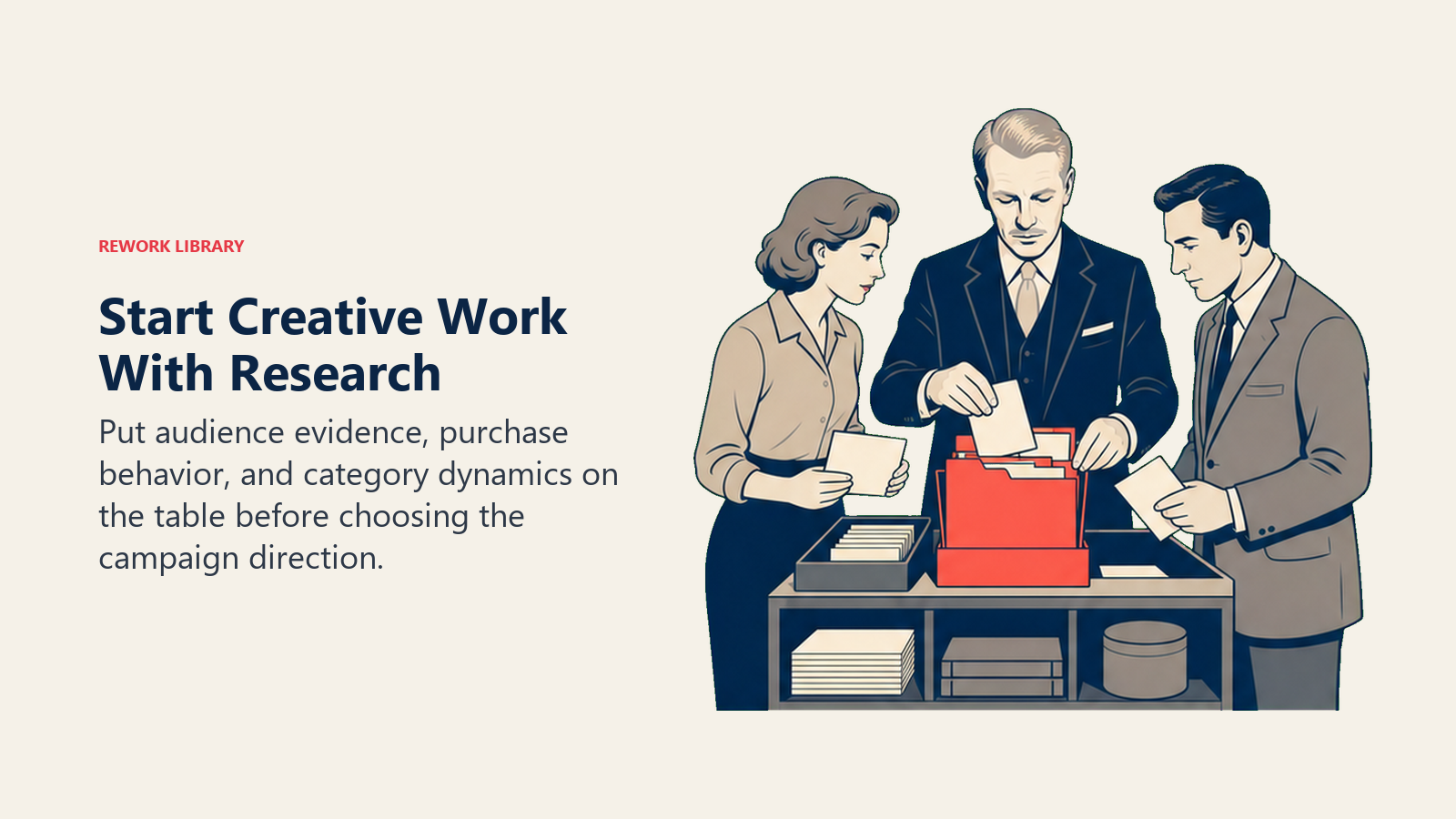
He institutionalized that conviction at Ogilvy & Mather by requiring that research directors sit at the same organizational level as creative directors, not under them, not advisory to them, but equal. That's an unusual structural choice. Most agencies treat research as a post-production validation function: you make the ad, then test whether it works. Ogilvy wanted research before the brief, not after the execution.
What that meant in practice: before writing a campaign for any new client, the team was expected to read everything available about the consumer's purchase behavior, the category dynamics, the competitive positioning, and the existing brand perception. Ogilvy read consumer research studies the way other executives read quarterly reports. He thought it was the most important part of the job, not an overhead cost.
For leaders, this maps directly to the question of how much time you invest in understanding your buyer before building anything. Most go-to-market failures aren't execution failures. They're knowledge failures, the team didn't actually understand who they were selling to or what problem those buyers prioritized. Ogilvy's research doctrine is a hiring and process decision, not just a creative one: who owns consumer knowledge in your organization, and do they have real authority?
What David Ogilvy Would Do in Your Role
If you're a CEO, Ogilvy's first question for you is about your positioning claim. What is the one true thing about your company that a competitor couldn't honestly say? Not your values, not your process, the specific, defensible, provable thing that makes your offer different. If the answer takes longer than two sentences, you don't have a position yet. You have a wish. Ogilvy spent significant client time helping companies find their Big Idea before any creative work started, because he knew a weak claim produced weak advertising no matter how good the execution was.
If you're a COO, the Ogilvy insight for you is about organizational knowledge capture. His research doctrine wasn't just a creative tool, it was a systematic effort to turn consumer knowledge into institutional memory. Who in your organization owns the data about why customers buy, why they churn, and what they actually say when you ask them why they chose you? In most companies that knowledge lives in a few sales reps' heads and disappears when they leave. Ogilvy would build a system for collecting and distributing it.
If you're a product leader, Ogilvy's most useful instinct is his obsession with specificity. He hated vague claims because they meant nothing to the buyer. When you're writing a product spec or a positioning doc, test every adjective: can you prove it with a specific number or a specific comparison? "Fast" means nothing. "Loads in under 1.2 seconds on a standard 4G connection" means something. The discipline of eliminating unsubstantiated claims from your product copy will force you to identify what's actually better, and sometimes reveal that you haven't built the differentiation you thought you had.
If you're in sales or marketing, the Ogilvy frame that applies most directly is his distinction between what you want to say and what the customer wants to know. His research discipline was really a practice of subordinating the brand's self-image to the consumer's actual questions. Before you write the next piece of content or the next email sequence, ask: what is the specific question this customer is trying to answer right now, and am I actually answering it? Most marketing content answers a different question, one the team cared about, not one the buyer was asking.
The Rework Read: Research-First Persuasion for Modern SaaS
Ogilvy's doctrine translates almost directly to how B2B SaaS teams should run content and positioning today. The categories have changed, we sell CRMs and project tools instead of soap and sedans, but the underlying bet still holds: buyers reward specificity over cleverness, and sustained brand building outperforms campaign-by-campaign opportunism. That's why Rework treats the content library as a testing ground rather than a blog. Every article is a research artifact: we publish the frameworks, then watch which ones get cited, shared, and searched. The pieces that survive tell us what buyers actually care about, and that signal feeds positioning, product marketing, and sales enablement. Ogilvy ran a research operation inside a creative agency and refused to treat it as a contradiction. A modern SaaS team should run the same operation inside its content function, let the library replace the focus group, and let the data tell you which Big Idea is worth building the company around.
Notable Quotes & Lessons Beyond the Boardroom
"Never write an advertisement which you wouldn't want your family to read. You wouldn't tell lies to your own wife. Don't tell them to mine." That's from Confessions of an Advertising Man, published in 1963 and still in print. It's a cleaner expression of his consumer-respect principle than most modern brand guidelines manage. The underlying idea is that advertising is a conversation between a company and a real person, not a broadcast into an audience-shaped void.
"I have a theory that the best ads come from personal experience." He wrote this in Ogilvy on Advertising in 1983, and it explains something about why his best work holds up. The Rolls-Royce headline wasn't clever, it was accurate. He had found something genuinely surprising in the engineering documentation, and he reported it faithfully. That kind of specificity comes from proximity to the actual product and the actual consumer, not from a strategy document.
The other lesson from Ogilvy's career is harder to systematize: he ran a great agency for 40 years, and then watched it get sold to WPP in a hostile takeover by Martin Sorrell in 1989. He resented it openly and spent his final decade at his château in France largely disconnected from the agency bearing his name. The lesson isn't about succession planning, exactly. It's that institutional culture, the research-first, long-copy, consumer-respect culture he built, is more fragile than a brand name. Ogilvy built something unusual and couldn't protect it from becoming ordinary.
Where This Style Breaks
Ogilvy's long-copy model was built for print and direct mail, where a reader who picked up a magazine had already consented to an information-dense environment. Digital attention works differently. The average time-on-page for web content is under a minute, which is not enough to read 600 words of product copy. His research-first doctrine is also slow relative to modern A/B testing at scale, you can now run 50 copy variants simultaneously and let conversion data replace pre-production research. And his brand-building patience, which operated on a timeline of years, doesn't align with the 90-day SaaS revenue cycle most operators live inside. The principles hold. The methods need translation.
Frequently Asked Questions about David Ogilvy's Advertising Philosophy
Who was David Ogilvy?
David Ogilvy (1911–1999) was a British-born advertising executive who founded Ogilvy & Mather in New York in 1948 with $6,000 in capital. He built the agency into a global network with offices in 40 countries and is widely regarded as the "Father of Advertising" for his research-driven approach to copywriting. Before advertising, he worked as an Oxford student, a Paris hotel chef, a door-to-door Aga cooker salesman in Scotland, and a research associate at George Gallup's audience research institute, each of which shaped his later methodology.
What did Ogilvy mean by 'the consumer isn't a moron'?
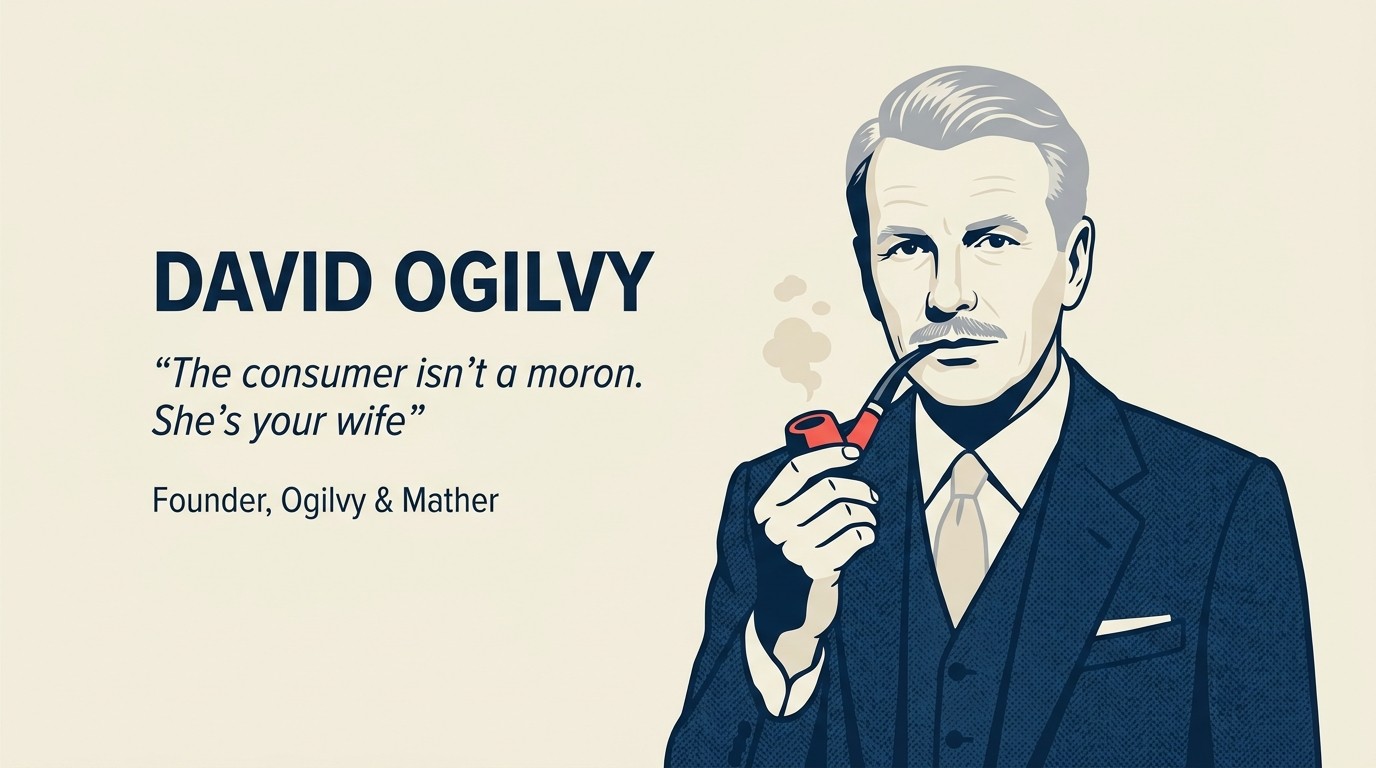
The full line, from Confessions of an Advertising Man (1963), is "The consumer isn't a moron, she's your wife." It's a rebuke of the condescending tone common in mid-century advertising, where copywriters assumed audiences needed oversimplified claims and flashy gimmicks. Ogilvy believed you should write to an intelligent adult with a specific problem, using the words customers actually use, offering genuine information, and respecting their ability to evaluate a claim on its merits.
What are Ogilvy's iconic campaigns?
The four most studied Ogilvy campaigns are the 1958 Rolls-Royce ad ("At 60 miles an hour the loudest noise in this new Rolls-Royce comes from the electric clock"), the Hathaway shirts campaign featuring a dress-shirted man wearing an eye patch (which ran for 25 years), Schweppes tonic water starring the bearded "Commander Whitehead," and the long-running Dove beauty bar positioning that treated women as adults rather than objects. He also built memorable work for American Express, Shell, and Sears.
What is 'Confessions of an Advertising Man' about?
Confessions of an Advertising Man, published in 1963, is Ogilvy's distilled guide to running an agency and writing advertising that sells. It covers how to manage clients, how to build a creative department, how to write headlines and body copy, and how to evaluate work. It's written in plain, opinionated prose, closer to a founder's memo than a textbook, and remains required reading in most marketing programs. Ogilvy on Advertising (1983) is the follow-up, with more detailed craft advice and case studies from two additional decades of work.
What is Ogilvy's approach to branding?
Ogilvy's brand-building approach rested on three pillars: a durable Big Idea that could anchor a campaign for years, long-copy advertising that gave readers real information rather than vague slogans, and a research-first process where consumer knowledge preceded creative work. He believed brands were long-term assets that compounded with consistent, honest positioning, and that most advertisers destroyed brand equity by chasing short-term cleverness and changing campaigns too frequently.
What can modern marketers learn from David Ogilvy?
Modern marketers can apply three Ogilvy principles almost unchanged: specificity beats adjectives (use real numbers and real comparisons, not words like "powerful" or "intuitive"); research precedes creativity (understand your buyer's actual language before you write a word); and brand building is a multi-year investment (resist pressure to reinvent positioning every quarter). The methods need updating for digital attention spans and modern testing tools, but the underlying convictions about consumer respect, earned attention, and information density still outperform most contemporary content strategies.
For related reading, see Philip Kotler Leadership Style, Gary Vaynerchuk Leadership Style, Neil Patel Leadership Style, Seth Godin Leadership Style, and Peter Drucker Leadership Style.

On this page
- Key Facts About David Ogilvy
- The Research-First Doctrine
- Leadership Style Breakdown
- Key Leadership Traits
- The 3 Frameworks That Defined David Ogilvy
- 1. The Big Idea
- 2. Long-Copy Advertising: Information Sells
- 3. Research as the Foundation of All Creative Work
- What David Ogilvy Would Do in Your Role
- The Rework Read: Research-First Persuasion for Modern SaaS
- Notable Quotes & Lessons Beyond the Boardroom
- Where This Style Breaks