Sam Altman Leadership Style: How OpenAI's CEO Navigated the Most Consequential Technology Bet of the Decade
Turn this article into takeaways for your work.


Each assistant summarizes the article only for you and suggests best practices for your work.
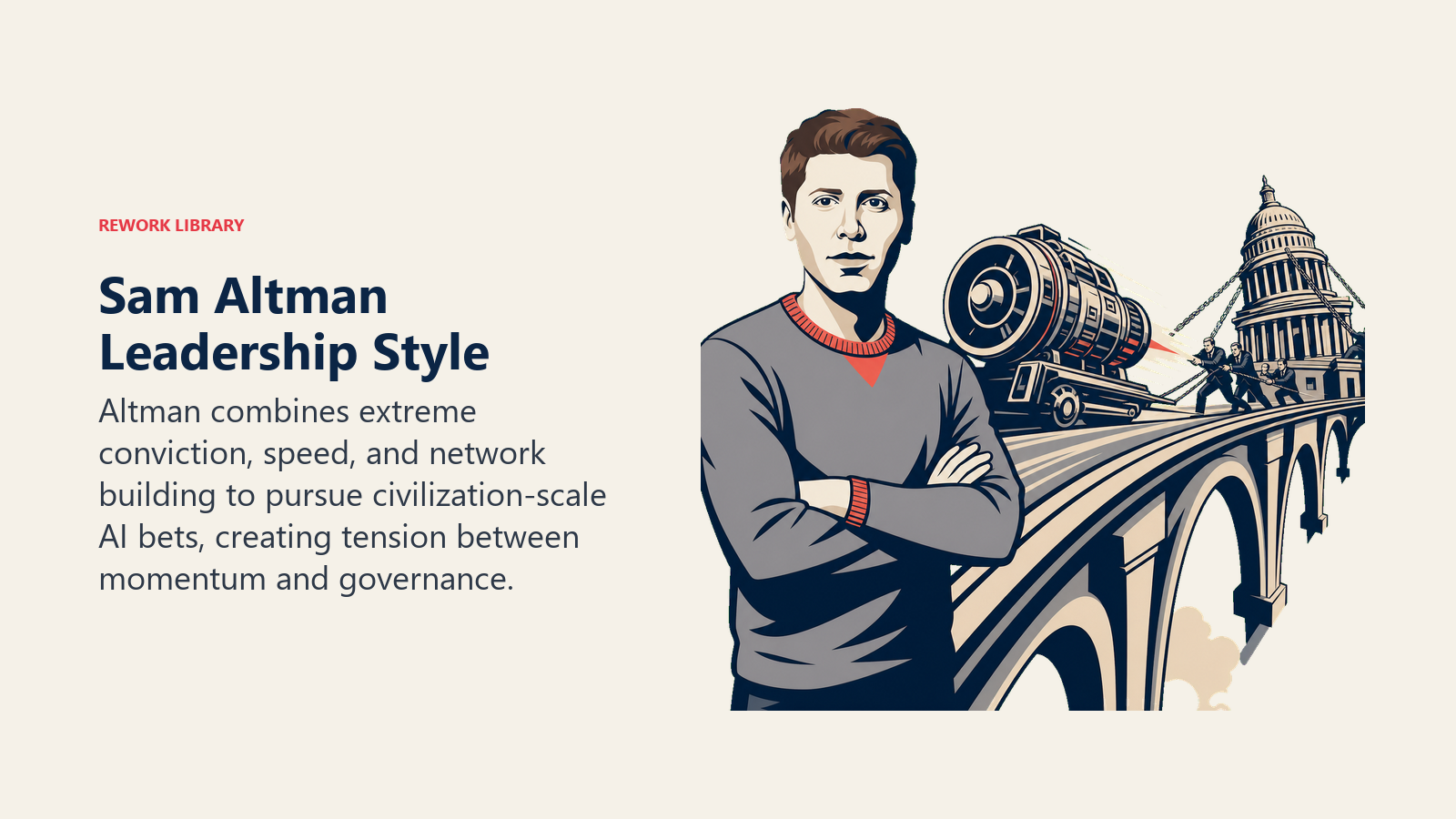
Sam Altman's public profile before November 2023 was significant but not defining. He'd run Y Combinator, backed several successful companies, and was known in Silicon Valley as an unusually clear strategic thinker. Then OpenAI released ChatGPT in November 2022. Within two months, it had 100 million users, the fastest consumer product adoption in history. Altman became one of the most consequential technology executives in the world almost overnight.
Then, in November 2023, the OpenAI board fired him. Five days later, he was reinstated. The entire board that fired him resigned. It was the most public governance crisis at a major technology company in years, and it happened to the organization responsible for the most transformative technology release in a generation.
That sequence (breakthrough, crisis, return) tells you more about Altman's leadership than any profile written during the good years. How someone navigates a board coup while their company's employees are staging a revolt on their behalf reveals something about how they've actually built loyalty and what they stand for.
The Altman Iterative Scaling Model
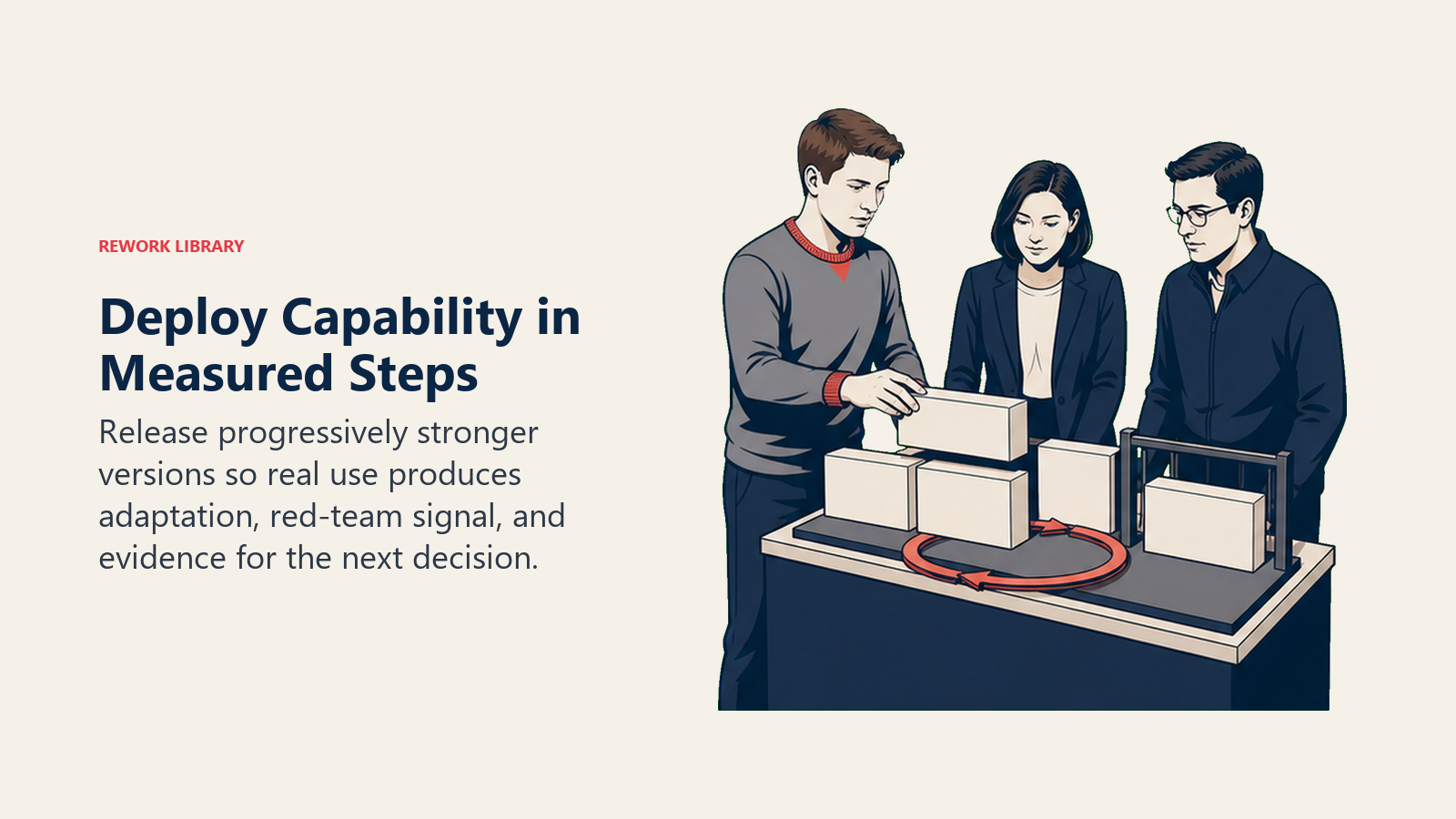
The Altman Iterative Scaling Model is a leadership doctrine that treats early public deployment as the core safety mechanism for transformative technology, not a departure from it. Under this model, a leader ships progressively more capable versions to real users (GPT-3.5 in 2022, GPT-4 in 2023, and successors on a compressed cadence) on the premise that societal adaptation and red-team signal only emerge at scale. Capital structure, partnership terms, and internal velocity are then engineered backward from the deployment tempo, not the other way around.
Leadership Style Breakdown
| Style | Weight | How it showed up |
|---|---|---|
| Visionary | 75% | Altman has held consistently that AGI, artificial general intelligence, is coming, that OpenAI should be the organization to build it, and that the potential upside justifies the risk. He's held that thesis through funding crises, safety debates, and board conflict. The vision hasn't shifted with the news cycle. |
| Pragmatic | 25% | Despite the big-swing vision, Altman is unusually operational. He knows product metrics. He does deal terms himself. He manages up to investors with unusual precision. The pragmatic layer is what makes the visionary layer executable. |
Most visionary leaders fail because they can't operationalize. Altman is different because the pragmatic 25% is genuinely strong. He can translate the long-range thesis into specific next decisions. That combination is rare and is the core of why OpenAI has executed at the speed it has.
Key Leadership Traits
| Trait | Rating | What it means in practice |
|---|---|---|
| Conviction | Very High | "Move fast and be responsible." Altman's version of conviction isn't reckless, it's calibrated to the size of the bet. He believes the potential benefits of AI development outweigh the risks of moving quickly, and he's willing to defend that publicly even when the audience is hostile. When he testified before Congress, he didn't hedge, he told senators directly that he was afraid of AI and thought regulation was necessary. That's a specific kind of conviction: saying the uncomfortable true thing even when you'd benefit from saying the comfortable false one. |
| Network Building | Very High | Altman's network is his second competitive advantage after his conviction. He built relationships at YC across thousands of founders, investors, and operators. He used that network to recruit researchers, close the Microsoft deal, and survive the board crisis, the 700+ OpenAI employees who threatened to leave if he wasn't reinstated were a function of years of investment in people relationships. |
| Speed of Execution | High | GPT-3.5, ChatGPT, GPT-4, and the Sora video model all shipped within a compressed timeline that surprised the industry. Altman runs OpenAI with a bias toward shipping over perfecting. He has said publicly that OpenAI's iterative deployment approach, releasing products earlier to learn from real-world use, is itself a safety strategy, because it builds societal familiarity with AI before the most powerful systems arrive. |
| Fundraising | High | OpenAI has raised more capital than almost any private technology company in history. The Microsoft deal, a $13 billion multi-phase commitment in exchange for Azure exclusivity and a revenue share, required navigating a corporate partner relationship while maintaining research independence. Altman structured that deal in a way that funded OpenAI's compute requirements without ceding strategic control. |
The 3 Decisions That Defined Altman as a Leader
1. The GPT-4 Launch and Iterative Deployment Strategy
When OpenAI launched ChatGPT in November 2022, it was initially positioned as a low-key research preview. The team didn't expect 1 million users in five days and 100 million in two months. But the decision to ship a consumer-facing product rather than keep GPT-3.5 as a pure API was deliberate.
Altman's thesis was that deploying AI iteratively (in products where real people use it, experience its failures, and give feedback) is how you learn what alignment and safety actually require in practice. You can't fully red-team a model in a lab because you can't fully anticipate what 100 million people will try to use it for. Deployment is the safety process.
This was a real position with real trade-offs. Critics, including some inside OpenAI, argued that releasing powerful AI to the general public before the alignment problem was solved was itself a safety risk. Altman accepted that critique and held his position anyway.
What this shows: the GPT-4 launch strategy reflects a specific theory of how to build responsibly in a domain where responsible behavior isn't fully defined. Altman isn't indifferent to safety. He's making a different claim about what safety requires. That distinction matters when you're evaluating the decision, and it matters when you're making analogous decisions in your own company about when to ship versus when to keep building.
2. The Microsoft Partnership
In 2019, OpenAI took $1 billion from Microsoft. In 2023, that grew to a multi-year, multi-billion commitment structured as a revenue share and compute access arrangement rather than a simple equity deal. Microsoft got Azure as OpenAI's exclusive cloud provider and a percentage of OpenAI's commercial revenue. OpenAI got essentially unlimited compute without needing to raise traditional equity rounds constantly.
The deal was structurally unusual. OpenAI's capped-profit structure (which limits investor returns and gives a nonprofit board ultimate control) made standard venture financing complicated. Altman built a deal that solved OpenAI's capital problem without resolving the governance question that would later explode.
The leadership decision here was to optimize for speed and scale, accepting partner dependency as the price. Microsoft now has enormous leverage over OpenAI's infrastructure and commercial trajectory. Altman accepted that trade-off because the alternative, slower capital accumulation, meant potentially losing the race to the most important technology transition of the century.
For today's leaders: the Microsoft deal is a case study in strategic partnership where the terms matter as much as the capital. Before you take a large strategic investment or partnership, model what the relationship looks like if the partner's interests and yours diverge. Altman knew this was a risk. Whether he got the balance right is still being determined.
3. The Board Crisis and Return
In November 2023, OpenAI's board removed Altman, including independent directors and safety-focused members, without a clear public explanation, saying only that he had not been "consistently candid" with them. Within 24 hours, more than 700 of OpenAI's roughly 770 employees signed a letter threatening to leave if he wasn't reinstated. Microsoft offered to hire Altman and the entire OpenAI team if necessary. Five days after being fired, Altman was back as CEO. The board members who fired him were replaced.
What does this tell you about his leadership? The employee response is the most revealing data point. You don't get 90% of a 770-person research organization threatening to walk out for someone they don't genuinely trust. Altman had built real loyalty, not through perks or slogans but through years of being the person who argued for his team's interests, communicated clearly about the stakes, and made decisions people could understand even when they disagreed with them.
The governance crisis itself also reveals something. A board with genuine safety concerns about AI development tried to remove the CEO of the most powerful AI company in the world and was overrun by market forces in less than a week. That's a signal about the governance limitations of nonprofit structures in a commercialized technology market, one that has implications far beyond OpenAI. Dario Amodei left OpenAI for Anthropic over precisely these safety-vs-speed tensions, building a direct competitor from the same founding team. Demis Hassabis at DeepMind has taken the slower, research-first path to AGI. And Mustafa Suleyman co-founded DeepMind then moved to Microsoft, a trajectory that maps the broader talent fragmentation now defining the AI leadership landscape.
What Altman Would Do in Your Role
If you're a founder or startup CEO, the conviction trait is the most transferable Altman lesson. He holds his thesis about AI development publicly, repeatedly, and under hostile questioning. If you don't know your company's core thesis cold (why you exist, what you believe about the future that others don't, what trade-offs you're willing to make for it), you can't lead through the periods when the thesis is unpopular. Write it down. Then test it in conversations where people push back.
If you're raising large rounds or structuring strategic partnerships, the Microsoft deal structure is worth studying. Altman solved a capital access problem without traditional equity dilution by creating an alignment between OpenAI's compute needs and Microsoft's cloud revenue goals. Before you take the obvious form of capital, ask whether there's a structure that solves your constraint differently.
If you're building a technical organization, the iterative deployment strategy has an operational lesson: the gap between internal testing and real-world deployment is always larger than you think. Getting your product in front of real users faster, even in limited form, generates information that no amount of internal red-teaming produces. That's true for AI, for SaaS products, and for almost any complex service.
If you're a board member or governance lead, the OpenAI crisis is the clearest recent case study in what happens when a nonprofit board tries to exercise oversight over a commercially valuable organization without having aligned its interests with the people doing the work. If you sit on a board, ask honestly whether the governance structure you're operating in could actually exercise meaningful oversight in a crisis, or whether it's a paper constraint.
How Rework Fits an Altman-Style Operating Model
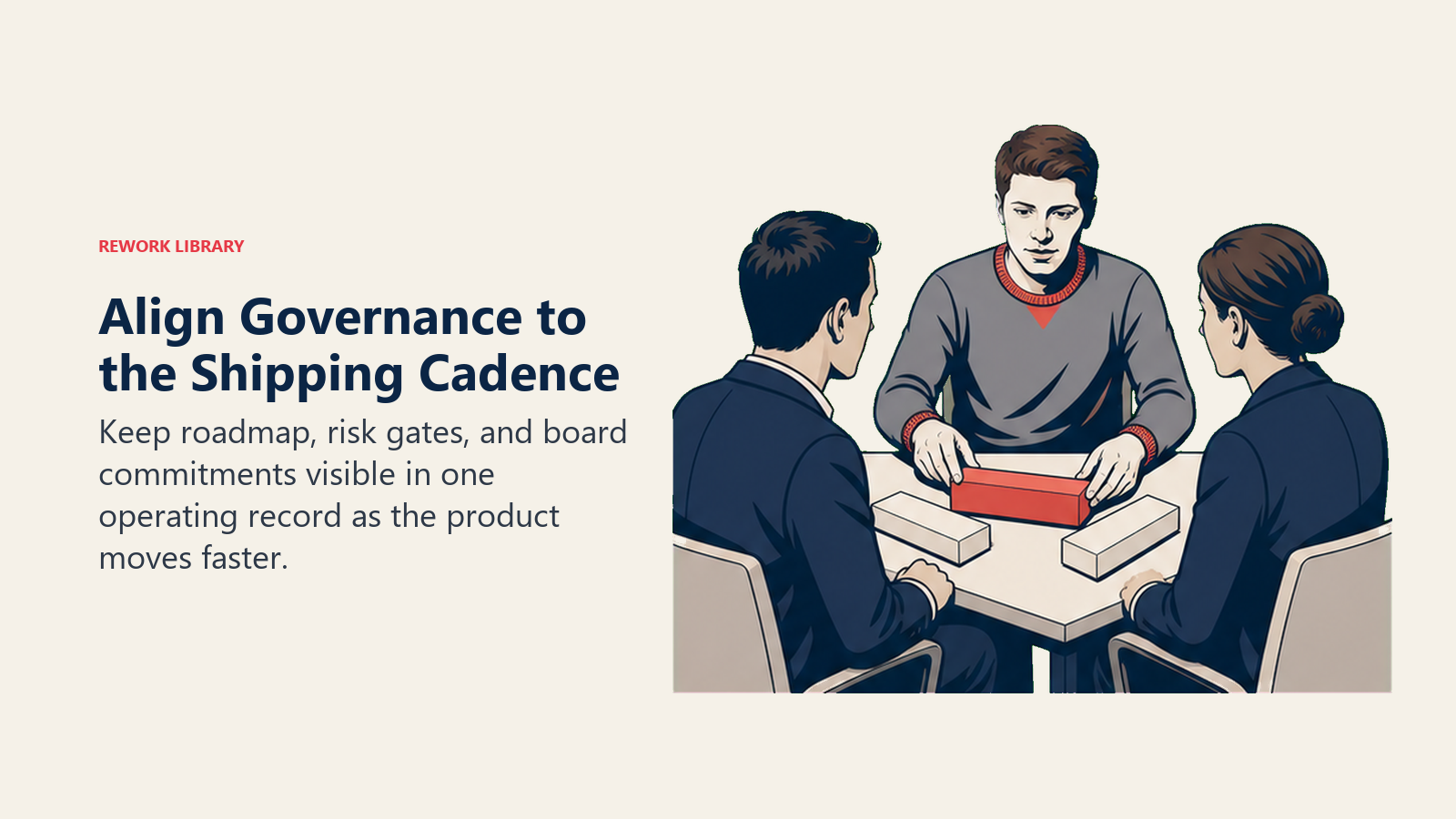
The hardest part of running an Altman-style organization isn't the vision, it's keeping board, executives, and ~700+ employees aligned on a shipping cadence that's faster than governance is comfortable with. The November 2023 crisis wasn't a failure of strategy; it was a failure of shared operating visibility. Rework is built for that gap. A unified work operations layer (Project Engine, from $99/month billed yearly) plus sales and revenue operations (Sales Engine, from $69/month billed yearly) gives a founder one source of truth for what's shipping, what's slipping, and which commitments the board was last briefed on, the kind of transparent audit trail that makes iterative-deployment leadership defensible under pressure. You can't prevent every governance dispute, but you can make sure the disagreement is about strategy, not about whose version of the roadmap is current. See rework.com/pricing.
The Shadow Side: What Altman Got Wrong
The board crisis, whatever your view of the underlying decision, revealed a governance failure. A company responsible for some of the most powerful AI systems ever built had a board that could be overrun by commercial pressure in five days. If the board's safety concerns were legitimate (and they may have been), the outcome of the crisis demonstrates that those concerns had no real institutional backing. That's a problem regardless of whether Altman was right or wrong.
The concentration of AI power is a real critique that doesn't have a clean answer. OpenAI's most powerful models are available to paying customers and API developers, but the underlying capability and the decisions about what to release, when, and to whom sit with a small team in San Francisco. Altman has been unusually transparent about his own concerns about this concentration. But acknowledgment isn't the same as resolution.
The speed-versus-safety tension is ongoing. OpenAI has released systems that produced harmful outputs, enabled misinformation, and created economic disruption for categories of creative workers. Altman's iterative deployment theory is coherent, but it requires accepting real near-term harms in exchange for long-run learning. Reasonable people disagree about whether that trade-off is justified.
And the board communication failure, whatever "not consistently candid" meant, reflects a real leadership risk. Altman is an unusually good external communicator. Whether he was as clear internally with his board about key decisions as he was in public interviews is a legitimate question that the crisis raised and that hasn't been fully answered.
Leadership Lessons You Can Use This Week
1. Write your thesis down. This week, write one paragraph on what your company believes about the future that most people don't yet see. If you can't write it in a paragraph, it isn't clear enough to lead by. Share it with your leadership team and ask them to push back on it.
2. Build loyalty before you need it. Altman's return was possible because he had invested in relationships across his organization for years. Think about who on your team would advocate for you if your position was challenged, and whether that list is as long as it should be.
3. Map your governance risk. If your board, investors, or partners needed to override your strategy tomorrow, what could they do and what couldn't they? Understanding your actual governance constraints is not the same as reading your operating agreement. Map the real dependencies.
4. Ship something to learn something. Find one thing your team has been refining internally for longer than the external learning you'd get from releasing it would justify. Make a decision about whether the additional internal iteration is worth the delayed real-world signal.
Frequently Asked Questions about Sam Altman's Leadership
Who is Sam Altman?
Sam Altman (born 1985) is the CEO of OpenAI, the company behind ChatGPT. He co-founded the location-sharing startup Loopt in 2005 (acquired for roughly $43M in 2012), served as president of Y Combinator from 2014 to 2019, co-founded OpenAI in 2015, and has led it as CEO since 2019. He's a Stanford dropout and one of the most consequential technology executives of the 2020s.
What is 'deployment as the safety process'?
It's Altman's stated thesis that releasing AI systems iteratively to real users, rather than waiting for a perfect lab-certified model, is itself how alignment and safety get solved. The claim is that you cannot fully anticipate how 100+ million people will use a system, so progressive public deployment generates signal (and societal adaptation) that no amount of internal red-teaming can replicate. Critics argue it front-loads real harms; Altman accepts that trade-off explicitly.
What happened in the 2023 OpenAI board crisis?
On November 17, 2023, OpenAI's nonprofit board removed Altman as CEO, citing that he had not been "consistently candid" with them. Within days, more than 700 of OpenAI's approximately 770 employees signed a letter threatening to resign, Microsoft offered to hire the entire team, and five days later Altman was reinstated. The board members who fired him were replaced. It remains one of the most public corporate governance crises in modern tech history.
How did YC shape Altman's philosophy?
Running Y Combinator from 2014 to 2019 gave Altman direct exposure to thousands of founders, investors, and operators, the network that later funded OpenAI, recruited its researchers, and defended him during the board crisis. YC also reinforced his preference for speed, direct founder-to-founder advice, and the belief that unusual outcomes come from backing unusual people with strong conviction.
What is Altman's vision for AGI?
Altman has publicly held that artificial general intelligence, AI broadly smarter than humans across most economically valuable tasks, is coming within years, not decades, and that OpenAI should be the organization to build it. He argues the potential upside (accelerated scientific discovery, economic abundance) justifies continuing development even under genuine uncertainty, while pairing deployment with advocacy for regulation.
What can founders learn from Sam Altman?
Three transferable lessons stand out: (1) write your thesis down cold, if you can't defend why your company exists in one paragraph under hostile questioning, you can't lead through unpopular periods; (2) build loyalty before you need it, because the 700+ employees who defended Altman in 2023 were a function of years of investment, not a last-minute rally; (3) structure capital around your operational tempo, the Microsoft deal funded OpenAI's compute needs without a traditional equity round because Altman designed the terms around OpenAI's actual constraint, not the default venture path.
Learn More
These articles go deeper on the themes in Altman's profile:

On this page
- The Altman Iterative Scaling Model
- Leadership Style Breakdown
- Key Leadership Traits
- The 3 Decisions That Defined Altman as a Leader
- 1. The GPT-4 Launch and Iterative Deployment Strategy
- 2. The Microsoft Partnership
- 3. The Board Crisis and Return
- What Altman Would Do in Your Role
- How Rework Fits an Altman-Style Operating Model
- The Shadow Side: What Altman Got Wrong
- Leadership Lessons You Can Use This Week
- Learn More