Eli Goldratt Leadership Style: Find the Bottleneck, Fix the System
Turn this article into takeaways for your work.


Each assistant summarizes the article only for you and suggests best practices for your work.
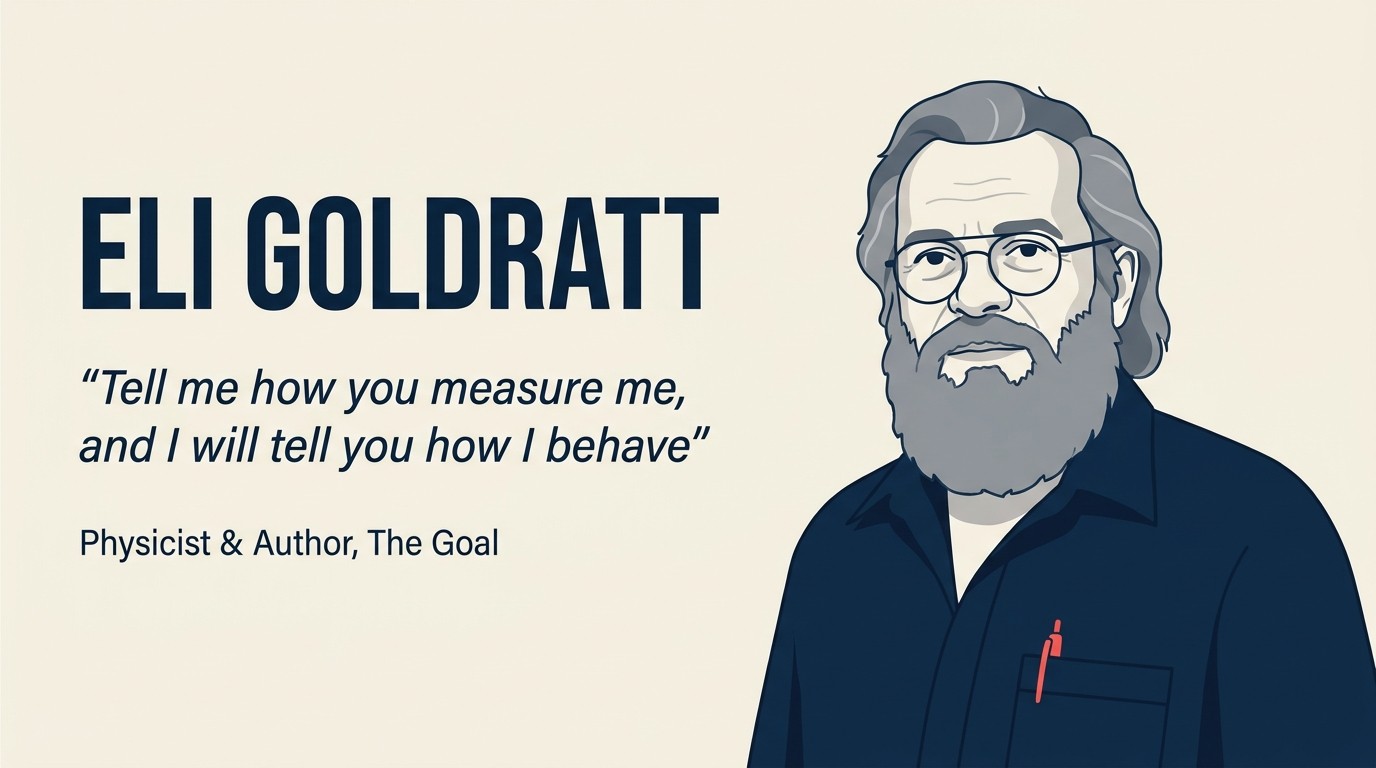
Key Facts: Eliyahu "Eli" Goldratt (1947–2011) was an Israeli physicist-turned-management-consultant whose 1984 business novel The Goal has sold over 10 million copies and been translated into 30+ languages. He founded the Avraham Y. Goldratt Institute to teach his methods, followed The Goal with It's Not Luck (1994) and Critical Chain (1997), and created the Theory of Constraints (TOC) along with its Drum-Buffer-Rope production scheduling system, a management philosophy organized around identifying and elevating the single bottleneck that limits system throughput. His most quoted line, "Tell me how you measure me, and I will tell you how I behave", became a standard warning about metric-driven dysfunction in operations.
The Theory of Constraints (TOC) / The Goldratt Bottleneck Model
The Theory of Constraints is a management framework holding that every system has exactly one constraint limiting its total throughput at any moment, and that improving anything other than that constraint produces no system-level gain. Goldratt's model uses five focusing steps, identify, exploit, subordinate, elevate, repeat, to systematically find and expand the bottleneck. It reframes operational improvement from "optimize everything" to "optimize the one thing that matters, then find the next one."
An Israeli physicist who had never run a factory wrote a novel in 1984 about a plant manager trying to save his facility from shutdown. The Goal has since sold over 7 million copies and is still assigned in MBA and engineering programs 40 years later, because it taught more operations managers how to think about production than most formal education ever did.
Eli Goldratt didn't come from manufacturing. He came from physics, and he brought a physicist's question to an industry drowning in local optimization and misaligned metrics: what is actually constraining this system? Not which machine is slowest, not which team is laziest, not which process is most expensive. What single thing limits the throughput of the entire system?
That question, asked honestly and followed rigorously, became the Theory of Constraints, a management philosophy built on 5 focusing steps that Goldratt spent the rest of his career teaching, refining, and applying across manufacturing, project management, and supply chain. It sits alongside Taiichi Ohno's Toyota Production System and W. Edwards Deming's quality movement as one of the three frameworks that reshaped how the 20th century thought about operational performance. He died in 2011, but his Goldratt Institute is still active, and the frameworks hold up because they're based on logic, not fashion.
This profile isn't about celebrating a methodology. It's about what Goldratt actually built, how it works in practice, and where it breaks.
Leadership Style Breakdown
| Style | Weight | How it showed up |
|---|---|---|
| Systems Thinker | 65% | Goldratt's entire body of work rests on a single conviction: local optimization is the enemy of system performance. A factory where every workstation runs at full efficiency isn't necessarily a factory with high throughput, it's a factory where inventory piles up in front of bottlenecks and starves downstream of them. Goldratt trained managers to stop asking "how do I improve this step?" and start asking "how does this step affect the system?" That shift in framing is harder than it sounds, because most performance management systems reward local efficiency: hit your department targets, get your bonus, regardless of whether your throughput connects to the constraint. |
| Socratic Challenger | 35% | Goldratt didn't write textbooks. He wrote novels and posed questions. The Goal follows plant manager Alex Rogo as a consultant named Jonah never gives him direct answers, only better questions. That was deliberate pedagogy. Goldratt believed that people who arrive at answers through guided discovery retain and apply them better than people who are told answers directly. His workshops were structured the same way: challenge the assumption, expose the conflict, ask what you'd need to believe for this to be true. |
That combination made him unusual in the management consulting world. Most consultants arrive with a framework and sell the implementation. Goldratt arrived with questions that forced clients to see their own system differently, then handed them the tools to fix it themselves.
Key Leadership Traits
| Trait | Rating | What it means in practice |
|---|---|---|
| Bottleneck obsession | Exceptional | Goldratt's core insight is that every system has exactly one constraint at any given moment, the factor that limits total throughput. Improving anything that isn't the constraint doesn't improve the system's output; it just creates more inventory or idle capacity. That's counterintuitive for leaders who are used to optimizing everything simultaneously. The bottleneck obsession says: find the one thing that actually limits you, and focus every unit of management attention there until it's no longer the constraint. Then find the new one. |
| Rejection of local efficiency metrics | Very High | Traditional cost accounting rewards departments for running their machines and people at maximum utilization. Goldratt argued those metrics actively harm system performance by incentivizing overproduction upstream of constraints, creating inventory that looks like productivity but is actually waste accumulating in a queue. He proposed throughput accounting instead, measuring what the system produces for customers, not what each station produces internally. That argument is still controversial with finance teams who need local cost data for external reporting. |
| Willingness to challenge sacred cows | High | Goldratt attacked batch sizes, cost accounting, and inventory management practices that the industry had treated as settled for decades. He was willing to say publicly that accepted management practices were producing suboptimal results and to name the specific mechanisms causing the damage. That kind of public challenge to industry orthodoxy is rare because it's socially costly, but it's also what gets people to actually rethink assumptions rather than refine them at the margins. |
| Socratic teaching style | High | Questions before answers. Goldratt's most lasting pedagogical choice was to embed his frameworks in stories where readers discovered the logic themselves rather than receiving it as a lecture. The 5 focusing steps of TOC are simple enough to fit on an index card, but the reason they actually work is that most managers arrive at them through a guided diagnostic process rather than a PowerPoint. The understanding is earned rather than downloaded. |
The 3 Frameworks That Defined Eli Goldratt
1. Theory of Constraints: The 5 Focusing Steps
The Theory of Constraints is built on 5 steps applied in sequence and then repeated indefinitely.
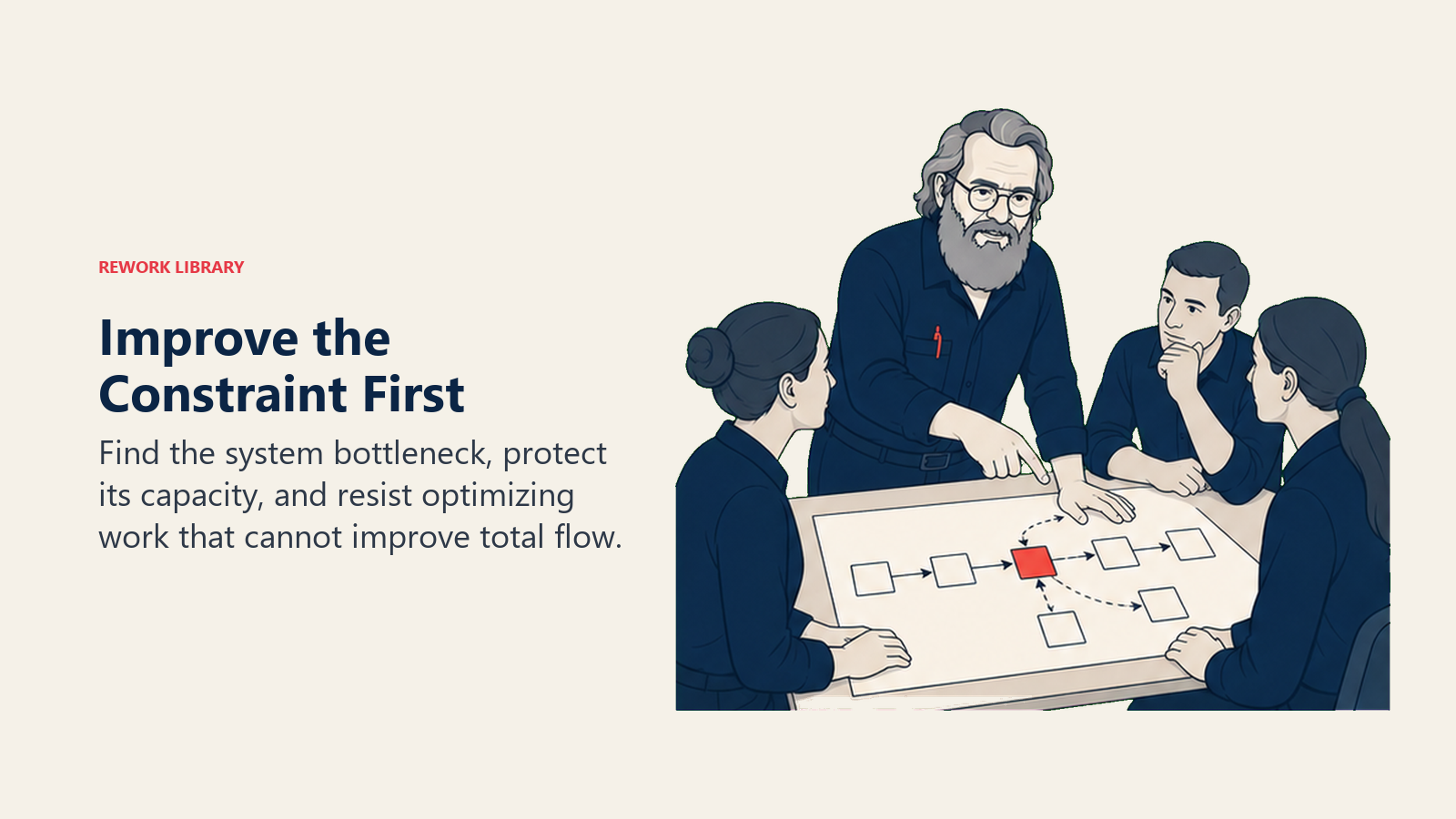
Step 1: Identify the constraint. Find the one element of the system that is currently limiting total throughput. In a factory, it's often a specific machine or workstation. In a service operation, it might be a specific approval process, a specific team, or a specific handoff. The constraint doesn't have to be running at 100% utilization to be the constraint. It just has to be limiting the output of everything downstream. Goldratt's test: what would produce more throughput if it had more capacity? That thing is the constraint.
Step 2: Exploit the constraint. Before adding capacity to the constraint, get the maximum output possible from what you already have. That means ensuring the constraint is never idle: no waiting for upstream supply, no time lost to setup changes that could be batched, no time lost to quality problems catching up with it. In knowledge work, exploiting the constraint means protecting the time of the most limiting person or team from anything that doesn't directly feed throughput.
Step 3: Subordinate everything else to the constraint. This is the most disruptive step operationally, because it means explicitly allowing non-constraint resources to be idle. If the constraint can process 100 units per hour, there's no value in upstream stations producing 130. The extra 30 just pile up as inventory that adds cost without adding throughput. The entire organization's pace should be set by the constraint, not by each team's individual capacity. That requires management commitment to metrics that don't reward individual utilization.
Step 4: Elevate the constraint. Once you've gotten maximum throughput from the current constraint and organized everything else around it, now you can invest in expanding constraint capacity: add a machine, hire a specialist, redesign the process. The key distinction from Step 2 is that elevation involves actual investment in capacity, not just better use of what exists.
Step 5: Find the new constraint and repeat. Once you've elevated the constraint sufficiently, something else in the system becomes the new limiting factor. Go back to Step 1. The system is never static. The constraint moves as you improve things, and the 5 steps repeat indefinitely. Goldratt called this the continuous improvement engine of TOC.
What makes this framework powerful is the sequencing discipline. Most improvement programs try to improve everything simultaneously, which diffuses attention and produces marginal gains across the board rather than significant gains where they matter. TOC forces prioritization by requiring identification of the constraint before any action is taken.
2. Drum-Buffer-Rope: Scheduling Around the Constraint
Drum-Buffer-Rope is the TOC scheduling method that translates the 5 focusing steps into a production control system.
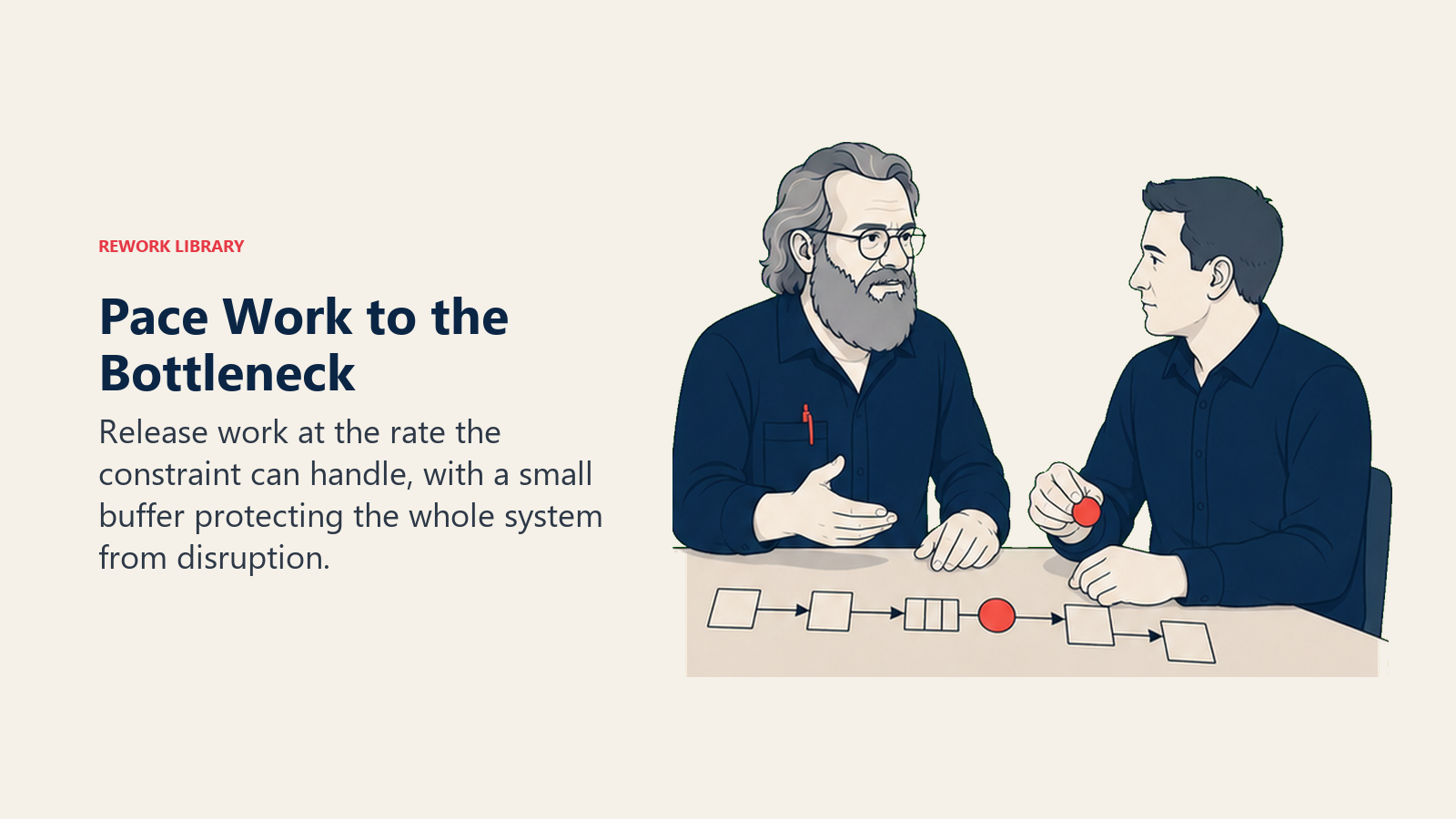
The drum is the constraint. It sets the production pace for the entire system. Everything upstream and downstream operates at the drum's rate, not at its own maximum rate. The drum beat defines the throughput of the plant.
The buffer protects the drum from being starved. Because upstream processes will occasionally have interruptions (machine downtime, quality problems, late supplier deliveries), you need a time buffer in front of the constraint so it never runs out of work. The buffer isn't an inventory buffer in the traditional sense; it's a time buffer, enough work queued ahead of the constraint that normal upstream variation doesn't cause the constraint to go idle. Goldratt typically sized buffers at half the total production lead time, though the exact sizing depends on the variability of upstream processes.
The rope limits the release of raw materials into the production system. Instead of releasing materials as fast as each upstream station can process them, you release them only at the rate the drum can absorb them. The rope prevents the accumulation of WIP (work in progress) upstream of the constraint, which is the source of most factory floor congestion.
In knowledge-work terms, Drum-Buffer-Rope looks like this: identify the team or process that is the current constraint (drum). Ensure that team always has prioritized work queued ahead of it (buffer). And limit the number of projects or items entering the system upstream to what the constraint can realistically complete in a given period (rope). The result is fewer in-flight items, faster throughput, and a clearer picture of where the real bottleneck is.
3. Critical Chain Project Management
Critical Chain Project Management (CCPM), introduced in Goldratt's 1997 book Critical Chain, applies TOC logic to project scheduling.
Traditional project management places safety buffers at each individual task: a task estimated to take 3 days with good probability gets scheduled as 5 days, giving each team member local protection against unexpected delays. The problem is that those individual buffers aggregate into enormous project timelines, and they still don't prevent projects from being late, because of two behavioral effects Goldratt identified.
Student syndrome is the tendency to delay serious work on a task until the deadline is close. If a task has 5 days scheduled, meaningful work often doesn't start until day 3 or 4. The safety buffer evaporates before it's ever used.
Parkinson's Law is the tendency for work to expand to fill the time available. Even if a task could be completed in 3 days, it tends to take 5 because the extra time is spent on refinement, rework, or simply because finishing early doesn't feel urgent.
Goldratt's solution was to strip the individual task buffers, estimate tasks at 50% confidence rather than 90%, and place the accumulated buffer time at the end of the critical chain, called the project buffer. The project buffer protects the overall project completion date without encouraging student syndrome or Parkinson's Law at the task level. Teams also use feeding buffers at the points where non-critical chains feed into the critical chain, protecting the critical path from delays in supporting work streams.
CCPM has been adopted in defense contracting, construction, pharmaceutical development, and software projects, anywhere that complex multi-dependency projects tend to run late despite having individual tasks with safety margins built in.
What Eli Goldratt Would Do in Your Role
If you're a CEO, Goldratt's first question for you is: what is currently limiting your company's throughput? Not your revenue. Not your team size. Not your market opportunity. What single thing, if it had more capacity, would produce more output for customers? Most CEOs haven't answered that question rigorously. They have opinions, but not analysis. Goldratt would want you to trace the flow of value from order to cash, identify where work queues up and waits, and name the constraint explicitly. Once you've named it, the 5 focusing steps give you a sequenced plan. But the naming has to come first, and it has to be honest.
If you're a COO, the subordination step is probably the hardest thing you'll try to implement. Andy Grove faced a version of this at Intel when his strategic-inflection-point framework forced the company to subordinate its profitable memory business to the constraint of a shifting market. Peter Drucker made a parallel argument about management priorities: define what the organization must stop doing before you decide what to start. Subordinating everything else to the constraint means explicitly telling high-capacity teams that running at full utilization is wrong, that they should slow down or go idle rather than create inventory that piles up in front of the bottleneck. That's a direct challenge to how most departments are measured and how most managers think about productivity. Changing the metrics so that local idle time is acceptable, even valued, requires board-level and CEO-level alignment on why that's the right trade. You can't do it unilaterally.
If you're a product leader, Critical Chain thinking applies directly to your release planning. If your team is chronically late on project milestones despite confident estimates, student syndrome and Parkinson's Law are likely culprits. Try stripping the individual task safety margins: estimate tasks at roughly 50% confidence, run the critical chain analysis, and place a project buffer at the end. You'll need to track buffer consumption (how much of the project buffer has been consumed relative to project progress) as your primary schedule health metric. If you're burning buffer faster than you're completing work, you've found a problem that needs intervention.
If you're in sales or marketing, the TOC constraint analysis applies to your pipeline. Pick any 3 active deals that are stalled. Trace where they've been sitting and why. The pattern across multiple stalled deals usually points to the same bottleneck: pricing approval, legal review, a specific person's calendar, a missing integration requirement. That's your sales constraint. Exploit it first (clear the queue), then subordinate (don't let sales reps overload the constraint), then elevate (add capacity if exploitation isn't enough). You don't need a full TOC implementation to use the logic. Just stop treating every stall as a unique problem and start looking for the systemic pattern.
How Rework Applies Goldratt's Thinking
Goldratt's discipline starts with a single question: where does work actually queue up? Rework is built to make that visible. Instead of treating each team's dashboard as a local optimization target, Rework surfaces the full path a deal or task travels, from lead capture to close, from ticket creation to resolution, so the constraint stops hiding in handoffs between CRM, project management, and chat. Stage-level dwell times in the sales pipeline show which step is starving throughput, whether it's pricing approval, legal review, or a specific rep's calendar. Cross-team workflow views expose where tasks sit idle between departments, which is usually where the real bottleneck lives. Throughput-aligned reporting rolls up what the system actually delivers for customers, deals closed, tickets resolved, projects shipped, rather than how busy each team looks. That shift from utilization metrics to throughput metrics is exactly the measurement change Goldratt argued for, and it's what lets operations leaders subordinate non-constraint activity without losing visibility into what's working.
Notable Quotes & Lessons Beyond the Boardroom
"Tell me how you measure me, and I will tell you how I behave." Goldratt wrote this in The Goal-era work, and it's the most practical diagnostic in his library. Before any operational improvement effort, ask what the current measurement system is actually incentivizing. Most operational dysfunction isn't caused by bad people or bad intentions. It's caused by people doing exactly what they're measured and rewarded to do, which doesn't align with what the system needs. Goldratt's first move in any consulting engagement was to map the metrics before recommending any process changes.
"The goal of a manufacturing organization is to make money now as well as in the future." This sounds obvious. What Goldratt meant by it is that most companies pursue proximate goals (efficiency ratios, cost reduction, machine utilization) that don't map directly to the actual goal. An organization can hit every local efficiency target while losing money because its throughput (what it actually produces for customers) is lower than its operating expense. Goldratt was relentless about insisting that managers distinguish between the real goal and the proximate metrics they use to chase it.
The honest assessment of Goldratt's career is that he was significantly better at teaching the theory than at building the institution to carry it forward. The Goldratt Institute, Avraham Goldratt Institute, and related entities fragmented after his death in 2011. TOC is still widely taught and practiced, but Lean and Six Sigma, better supported by consulting infrastructure and certification bodies, have more organizational presence in most industries. Tim Cook's Apple supply chain is the most cited modern example of constraint-aware operations at consumer scale: Cook systematically identified and elevated each bottleneck in the iPhone supply chain across two decades, producing the kind of throughput discipline Goldratt advocated without ever using TOC branding. That's partly because Goldratt's hostility to existing measurement systems (especially cost accounting) made TOC adoption politically difficult in organizations with large finance functions invested in traditional metrics. His frameworks are sound. His deployment strategy required more cultural change than most organizations were willing to make.
Where This Style Breaks
TOC works best when there is a single dominant constraint and a clear throughput metric: units per hour, deals closed per week, features shipped per sprint. In knowledge-work environments with many simultaneous projects and ambiguous bottlenecks, identifying "the constraint" becomes more political than analytical: everyone argues their team isn't the problem. Goldratt's hostility to traditional cost accounting alienated the finance teams whose buy-in is required to change measurement systems. Drum-Buffer-Rope assumes a relatively linear production flow and gets messy in matrix organizations where dependencies run in multiple directions simultaneously. And the novel format of The Goal, while pedagogically effective, limited technical depth. Implementations without proper training frequently misapply the 5 steps and produce disappointing results that discredit the method rather than the implementation.
Frequently Asked Questions about Eli Goldratt's Theory of Constraints
Who was Eli Goldratt?
Eliyahu "Eli" Goldratt (1947–2011) was an Israeli physicist and management consultant who created the Theory of Constraints. He authored The Goal (1984), It's Not Luck (1994), and Critical Chain (1997), and founded the Goldratt Institute to teach TOC across manufacturing, project management, and supply chain.
What is the Theory of Constraints?
TOC is a management philosophy holding that every system has exactly one constraint limiting its total throughput at any given moment. Improving anything other than that constraint does not improve overall system output, it only creates excess inventory or idle capacity. TOC uses a sequenced 5-step method to identify and elevate the constraint, then moves on to the next one.
What is The Goal about?
The Goal is a 1984 business novel following plant manager Alex Rogo as he tries to save his factory from closure with guidance from a Socratic mentor named Jonah. It has sold over 6 million copies, been translated into 35+ languages, and remains a standard text in MBA and operations programs. The book teaches TOC through story rather than lecture.
What are the Five Focusing Steps?
The 5 Focusing Steps are: (1) Identify the constraint, (2) Exploit the constraint by maximizing output from existing capacity, (3) Subordinate everything else to the constraint, (4) Elevate the constraint by adding capacity, and (5) Return to Step 1 once a new constraint emerges. Goldratt called this the continuous-improvement engine of TOC.
What is Drum-Buffer-Rope?
Drum-Buffer-Rope is the TOC scheduling method for production systems. The drum is the constraint, which sets the pace for the whole system. The buffer is a time buffer placed in front of the constraint so upstream variation never starves it. The rope limits the release of raw materials to match the constraint's absorption rate, preventing WIP pile-up upstream. It translates the 5 focusing steps into a concrete production control system.
What did Goldratt say about measurement and behavior?
His most quoted line is "Tell me how you measure me, and I will tell you how I behave." Goldratt argued that most operational dysfunction isn't caused by bad people, it's caused by people doing exactly what they're measured and rewarded to do, which often doesn't align with system throughput. He proposed throughput accounting as an alternative to traditional cost accounting.
What can modern managers learn from Goldratt?
Stop optimizing everything simultaneously. Find the one constraint that limits throughput, exploit it, subordinate non-constraint activity to it, and only then invest in elevating its capacity. Expect subordination to be the hardest step politically, because it requires telling high-capacity teams that running at full utilization is wrong when it produces inventory the constraint can't absorb.
For related reading, see Taiichi Ohno Leadership Style, W. Edwards Deming Leadership Style, Peter Drucker Leadership Style, Andy Grove Leadership Style, Tim Cook Leadership Style, and Jeff Wilke Leadership Style.

On this page
- The Theory of Constraints (TOC) / The Goldratt Bottleneck Model
- Leadership Style Breakdown
- Key Leadership Traits
- The 3 Frameworks That Defined Eli Goldratt
- 1. Theory of Constraints: The 5 Focusing Steps
- 2. Drum-Buffer-Rope: Scheduling Around the Constraint
- 3. Critical Chain Project Management
- What Eli Goldratt Would Do in Your Role
- How Rework Applies Goldratt's Thinking
- Notable Quotes & Lessons Beyond the Boardroom
- Where This Style Breaks