Andy Grove Leadership Style: Strategic Inflection Points and the Paranoid Operator
Turn this article into takeaways for your work.


Each assistant summarizes the article only for you and suggests best practices for your work.
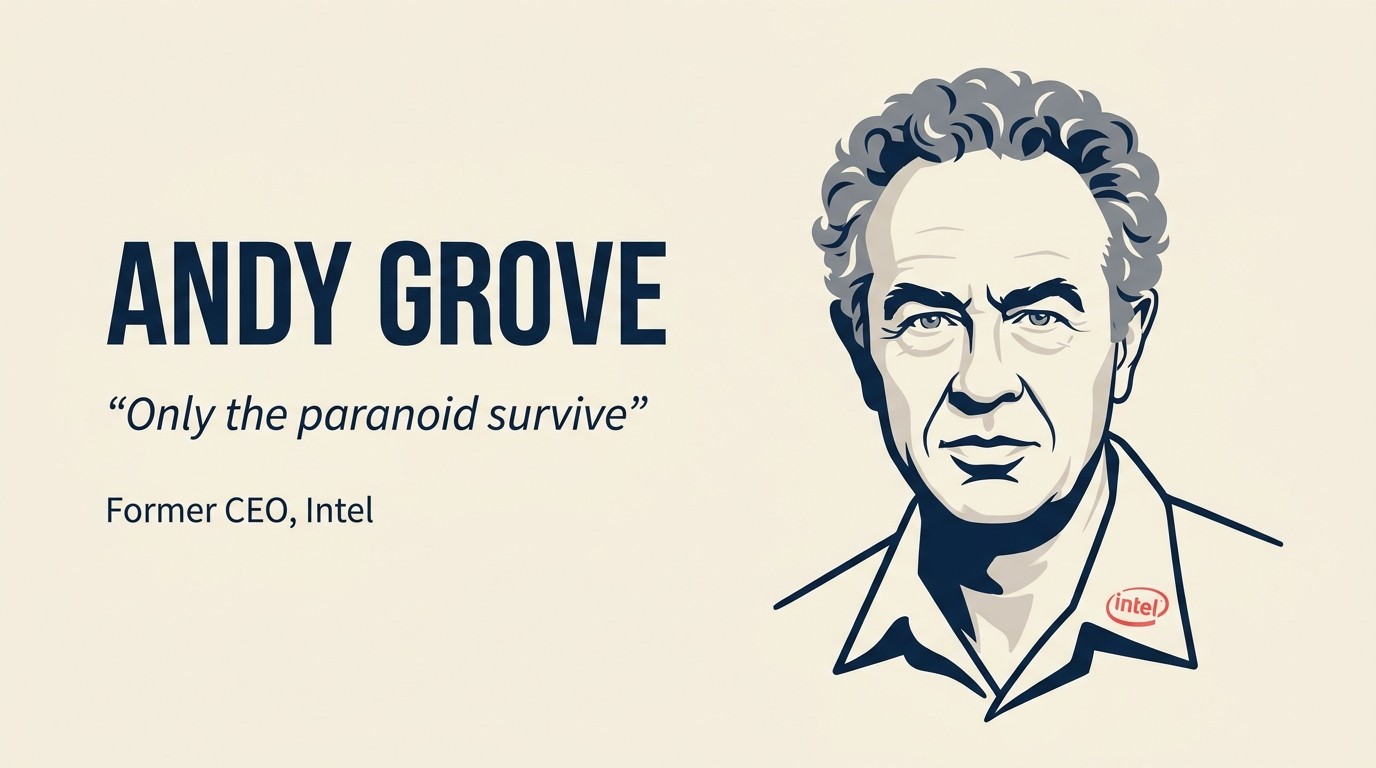
Key Facts: Andy Grove (1936-2016) was Intel's employee #3, CEO from 1987 to 1998, and the operator who grew Intel revenue from $1.9B to $25B during his tenure. He introduced the OKR system (later adopted and popularized by Google via John Doerr), authored High Output Management (1983) and Only the Paranoid Survive (1996), and was named Time Magazine's Man of the Year in 1997.
The Grove OKR Model (Strategic Paranoia)
Strategic Paranoia is the disciplined habit of assuming your current strategy has an expiration date and systematically scanning weak signals, competitors, customers, frontline employees, for the inflection point that will invalidate it. The Grove OKR Model pairs that paranoia with quarterly, numerically-graded Objectives and Key Results where a perfect score means your goals were too easy and a 0.6-0.7 average is the target. Together, they produce organizations that execute with rigor today and stay honest about whether today's game is still the right one.

Andy Grove arrived in the United States in 1956 with almost nothing. He'd escaped Hungary as a 20-year-old after Soviet tanks rolled through Budapest, learned English from scratch, and earned a PhD from UC Berkeley by 1963. He joined Fairchild Semiconductor, then co-founded Intel with Gordon Moore and Robert Noyce in 1968. By the time he stepped down as CEO in 1998, Intel's market cap had grown from roughly $4 billion to over $200 billion under his leadership.
Two things Grove built at Intel matter more than anything else for you as an operator today. The first is the OKR system, Objectives and Key Results, which Grove called "iMBO" (Intel Management by Objectives) and which John Doerr carried from Intel to Google in 1999, where it became the management framework now used by hundreds of companies worldwide. The second is the concept of the "strategic inflection point": a moment when the fundamental forces shaping your business change so dramatically that your existing strategy is no longer viable.
Grove made Intel one of the most valuable companies on earth by building systems for both: a way to execute at scale and a way to recognize when the game had changed entirely.
Leadership Style Breakdown
| Style | Weight | How it showed up |
|---|---|---|
| Constructive Confrontation | 65% | Grove required disagreement to be surface-level and direct. He didn't want consensus-seeking in meetings, he wanted the best argument to win on its merits. He modeled this himself, pushing back hard on anyone who he felt was being vague or politically careful rather than honest. At Intel, this was called "constructive confrontation" and it was an explicit cultural norm, not just Grove's personal style. |
| Systems Builder | 35% | Grove was obsessed with measurability and structure. He created OKRs to ensure that ambition and output were tracked against each other. He wrote High Output Management (1983) as an operator's manual for running complex organizations. He believed that if you couldn't measure an outcome, you couldn't manage it, and he built Intel's management layer around that principle. |
The 65/35 split reflects that confrontation without structure is just chaos. Grove's confrontational style worked because it operated within a highly disciplined measurement and accountability system. When he pushed back on you, there were shared facts to argue about.
Key Leadership Traits
| Trait | Rating | What it means in practice |
|---|---|---|
| Strategic Paranoia | Exceptional | Grove didn't use the phrase "Only the Paranoid Survive" as hyperbole. He described specific behaviors: attending industry conferences to track what competitors were doing, reading trade press carefully, listening to what frontline employees were hearing from customers before it filtered up through management. His paranoia was systematic, not anxious, it was a structured habit of gathering weak signals before they became strong ones. |
| Intellectual Honesty | Very High | Grove was willing to be wrong publicly and visibly. The DRAM exit in 1985 required him to tell Intel's board and employees that the business he'd helped build was no longer viable. He didn't spin it. He described the logic directly and made the call. That combination, willingness to be wrong, willingness to say it plainly, is rarer than most leaders want to admit. |
| Execution Discipline | Very High | Intel under Grove was not a loosely structured creative environment. It was a manufacturing and engineering operation that shipped billions of chips with tight quality controls. Grove believed in process, measurement, and accountability. "High Output Management" is essentially a systems manual for running a complex organization, and it remains in print and in use more than 40 years after its first publication. |
| Successor Grooming | High | Grove spent significant time preparing Craig Barrett and later Paul Otellini for leadership. He didn't hoard decision-making authority or keep succession ambiguous. He identified successors early and gave them real operational responsibility before he stepped back. That deliberate transfer is one reason Intel maintained its position after Grove left, at least for another decade. |
The 3 Decisions That Defined Andy Grove as a Leader
1. Exiting DRAM Memory Chips (1985)
Intel started as a memory chip company. By the early 1980s, Japanese manufacturers, Hitachi, NEC, Fujitsu, had commoditized the DRAM market through volume production and aggressive pricing. Intel's memory chip margins were collapsing. The business that had built the company was no longer a viable business.
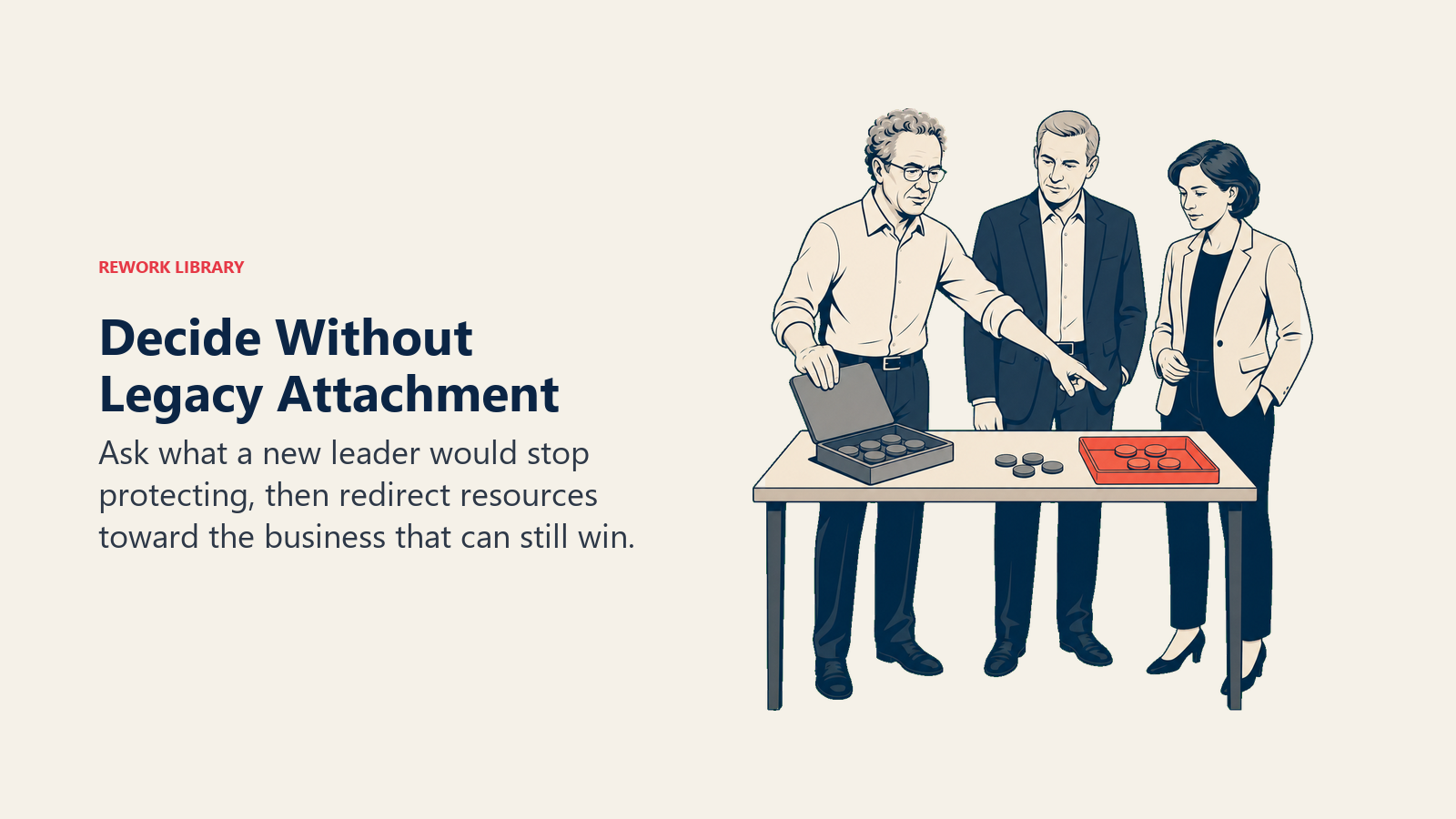
Grove describes the decision in Only the Paranoid Survive using a thought experiment he had with Gordon Moore in 1985. He asked Moore: if we got fired and the board brought in a new CEO, what would that person do? Moore's answer was that they'd get out of memories. So Grove asked: why don't we just do that ourselves?
Intel exited DRAM in 1985, concentrated entirely on microprocessors, and eventually captured the PC CPU market so completely that "Intel Inside" became one of the most recognizable product endorsements in consumer electronics history. The processor business that replaced the memory business generated 10x the margins.
The leadership lesson isn't just "pivot when your core business is failing." It's the thought experiment itself. Grove's mental model, imagine a replacement CEO with no attachment to the past, then ask what they'd do, is a tool you can use in any planning cycle. What's the business you're protecting because you built it, not because it's still the right bet?
2. Creating OKRs as a Management Operating System (1970s-1980s)
Grove didn't invent management by objectives, Peter Drucker described the concept in the 1950s. But Grove systematized and operationalized it in a way that made it replicable across Intel's complex, multi-division manufacturing operation.
His version, which he called iMBO and which Doerr later simplified into OKRs, had a few specific properties that distinguished it from Drucker's original idea. First, objectives and key results were tracked quarterly, not annually. Second, they were set collaboratively, managers and employees negotiated the key results rather than having them handed down. Third, they were graded numerically, typically on a 0-1.0 scale, and a perfect score was seen as evidence the goals were set too low. The aim was 0.6-0.7 on average.
That last point is unusual and important. Grove explicitly built failure into the system. If you hit all your OKRs every quarter, you weren't being ambitious enough. This reframed missed targets not as failure but as evidence of appropriate stretch, which changed the organizational conversation about goal-setting entirely.
If your company uses OKRs today and you're finding they either get gamed or ignored, the problem is almost certainly that someone detached them from Grove's original intent. OKRs only work when missing a key result is treated as useful information rather than a performance incident.
3. Managing Intel Through the Pentium Flaw Crisis (1994)
In 1994, a math professor named Thomas Nicely discovered a flaw in Intel's Pentium processor that could cause errors in floating-point division. The flaw was real but affected an extremely narrow range of calculations. Intel's initial response was defensive: they argued the error was so rare that most users would never encounter it, and they offered replacements only to customers who could prove they needed floating-point precision for professional work.
The response was wrong and Grove knew it eventually. IBM announced it would stop shipping Pentium-based computers. The story exploded in the press. Intel's stock dropped. Grove ultimately reversed course, offered unconditional replacements to any customer who wanted one, and took a $475 million charge to earnings.
In retrospect, Grove described this as a case where Intel failed to recognize that the PC had become a consumer product, not just an engineering tool. Consumer expectations, "I bought it, it should work perfectly", were different from professional engineering tolerances. Intel was still thinking like a component supplier when it had become, effectively, the brand name inside millions of consumer devices.
The lesson: the rules of your market change when your customer base changes. Intel's customer had been OEMs and engineers. By 1994 it was effectively every PC buyer. Grove was slow to recognize that shift, paid for it in brand damage, and wrote about the failure honestly in his subsequent book.
What Andy Grove Would Do in Your Role
If you're a CEO running a 50-500 person company, Grove's most direct gift to you is the inflection-point diagnostic. Once a quarter, ask yourself one question: is there any signal, from customers, from competitors, from adjacent markets, that suggests the rules of competition in your space are about to change? Not whether you're executing well. Whether the game itself is changing. Grove's paranoia wasn't about current threats. It was about threats that weren't yet obvious enough to register on a standard risk log.
If you're a COO or operations leader, read "High Output Management." Not as a historical curiosity but as a working manual. Grove's treatment of meetings, one-on-ones, leverage points, and managerial output remains more practically useful than most management books published since. His framework for thinking about a manager's output, the output of the team, not the individual, is still the clearest articulation of what management actually is.
If you're a product leader, the Pentium crisis is your case study. Grove's mistake wasn't the technical response, it was failing to update his mental model of who the customer was. Product leaders make this mistake constantly: they design for the customer they know well and are caught off guard when the user base shifts. Ask your team quarterly: has the customer we're designing for changed in any meaningful way in the last 12 months? Not just demographics, mental models, expectations, alternatives they're now aware of.
If you're a sales or marketing leader, Grove's OKR structure has direct application. When sales teams set their own targets and those targets are negotiated rather than handed down, something changes in how people relate to the goals. They're not defending against a number someone else chose. They own it. Try one quarter where your team sets the key results for a shared objective and see what happens to accountability and self-reporting of problems. You'll either find the system works, or you'll find out why your current system is preventing that honesty.
How Rework Applies Grove's Operating Model
Strategic paranoia and OKRs aren't historical artifacts, they're operating disciplines that still separate good companies from great ones. But both break down without the infrastructure to actually run them. Paranoia needs a steady flow of weak signals from the frontline; OKRs need quarterly visibility into whether the team is at 0.3 or 0.7 on each key result, not a status slide at the end of the cycle. Most companies fail at both because the data lives in five tools and three spreadsheets, so nothing is actually reviewed in real time. Rework consolidates the operating layer, CRM pipeline, work operations, cross-team projects, and team chat, into a single surface where objectives, key results, and frontline signals sit next to the work producing them. That's the same operating rigor Grove built into Intel: measurable goals, honest progress, and the organizational antibodies to see inflection points before they become crises. Not the Intel of 1995 rebuilt, the discipline of it, running on software built for the way companies operate today.
Notable Quotes & Lessons Beyond the Boardroom
"Only the paranoid survive." Grove used this line for years before he wrote the book. The phrase has aged into a cliché, but the underlying idea hasn't: every successful business builds the organizational antibodies that make it slow to respond to the threats that will eventually kill it. The comfort of dominance is the thing that makes dominance fragile.
"Success breeds complacency. Complacency breeds failure." He said this in various forms throughout his career, but the mechanism matters: it's not that success makes people lazy. It's that success creates organizational structures, incentive systems, and cultural norms that optimize for preserving what worked, not for adapting to what's next.
Grove also said something that gets quoted less often: "Bad companies are destroyed by crisis. Good companies survive them. Great companies are improved by them." The Intel Pentium crisis is a decent example. It was expensive and embarrassing. But Intel's decision to replace chips unconditionally, combined with the internal reckoning about what kind of company Intel had become, made the brand stronger. Companies that treat crises as aberrations to be managed tend to repeat them. Companies that treat crises as diagnostic information tend to actually change something.
Where This Style Breaks
Grove's confrontation culture was extremely difficult to export. Dozens of operators who studied Intel's model went back to their companies, declared "constructive confrontation" a cultural value, and created environments where conflict was sharp but not constructive, where people learned to win arguments rather than surface the best answer. Without Grove's intellectual honesty as a counter-weight, confrontation without rigor just becomes aggression.
Intel itself provides the cautionary tale. The confrontation culture and organizational paranoia that made Intel dominant in the 1990s calcified into something else after Grove left. The company missed the mobile chip market entirely, ARM-based chips, not Intel, ended up inside every smartphone. It was slow to respond to AMD's Zen architecture. And it failed to build a position in AI acceleration GPUs before NVIDIA made that space its own.
Grove's style also demanded a leader willing to be visibly wrong in front of their organization. Most executives are too ego-protective to do this consistently. If you're not genuinely comfortable saying "I was wrong about that," the confrontation model doesn't work, because your teams will learn that confrontation only flows in one direction.
Explore related profiles: Lisa Su at AMD, the leader who finally built a CPU architecture that beat Intel's. Jensen Huang at NVIDIA, Grove's paranoia mantra runs directly through Huang's "30 days from bankruptcy" framing; the semiconductor conviction Grove built at Intel is the cultural ancestor of NVIDIA. Peter Drucker's management philosophy, Grove credited Drucker as the source of iMBO; the OKR system that now runs inside hundreds of companies is Grove's operationalization of Drucker's original idea. Jack Welch's GE, a contemporary operator-CEO who ran a different version of the same confrontation-and-accountability culture at a different kind of industrial institution.

On this page
- The Grove OKR Model (Strategic Paranoia)
- Leadership Style Breakdown
- Key Leadership Traits
- The 3 Decisions That Defined Andy Grove as a Leader
- 1. Exiting DRAM Memory Chips (1985)
- 2. Creating OKRs as a Management Operating System (1970s-1980s)
- 3. Managing Intel Through the Pentium Flaw Crisis (1994)
- What Andy Grove Would Do in Your Role
- How Rework Applies Grove's Operating Model
- Notable Quotes & Lessons Beyond the Boardroom
- Where This Style Breaks