Rand Fishkin Leadership Style: Transparency as Strategy
Turn this article into takeaways for your work.


Each assistant summarizes the article only for you and suggests best practices for your work.
Key Facts
- Co-founded Moz (originally SEOmoz) in 2004 with his mother Gillian Muessig
- Launched Whiteboard Friday video series in 2007, ran for 15+ years as weekly SEO education ritual
- Raised $29.1 million in venture capital at Moz before stepping down as CEO in 2014 and leaving the company in 2018
- Founded SparkToro in 2018 (public launch 2020) as an audience-intelligence tool, raised only $1.3M on a non-traditional SAFE
- Published Lost and Founder (2018), a brutally honest founder memoir about VC pressure, salary gaps, and the cost of scaling
- Publicly transparent about mental health, founder depression, and startup failures, rare in B2B SaaS leadership writing
The Fishkin Authentic Marketing Model
The Fishkin Authentic Marketing Model treats transparency as a competitive moat rather than a PR risk: default to openness on revenue, decisions, salaries, and failures unless there's a legitimate legal or competitive reason for secrecy. The model compounds over years, free educational content plus public honesty builds community trust that makes paid acquisition cheaper and brand loyalty portable across ventures.
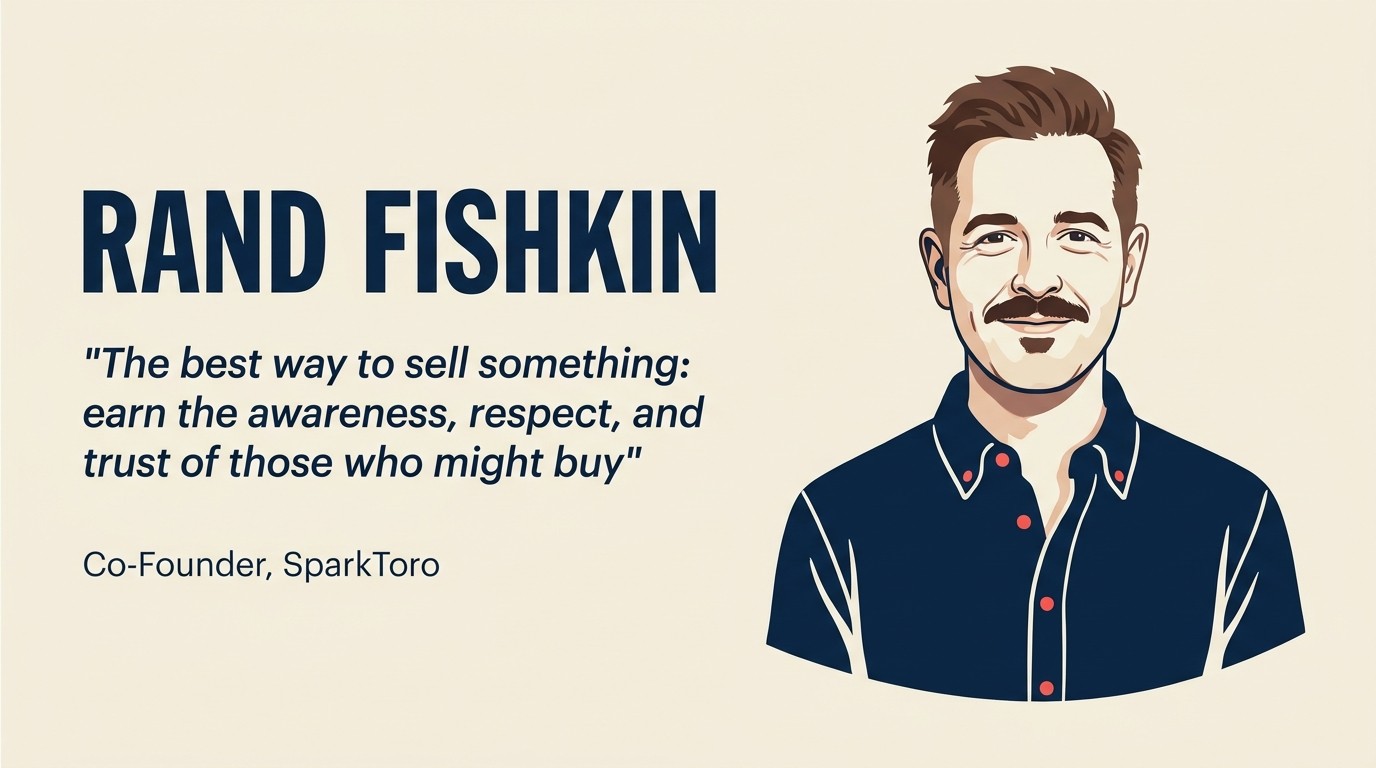
Rand Fishkin co-founded SEOmoz (later renamed Moz) in 2004 with his mother Gillian as a web design consultancy, turned it into the most-read SEO software blog in the world, raised $29.1 million in venture capital, and then wrote a 2018 memoir, Lost and Founder, about how that funding decision nearly destroyed everything he'd built.
Most founders don't do that. They take the exit, write the LinkedIn post about gratitude, and move on. Fishkin published the internal spreadsheets, the board fights, the salary gap that made his employees feel cheated. He named the tension between VC growth expectations and the culture he'd promised his team. And then he left Moz in 2018, started SparkToro in 2020 with just $1.3 million raised on a non-traditional SAFE, and proved the point a second time.
By 2023 SparkToro had crossed $3 million in ARR with a team of two. It's a different kind of company, built on a different kind of logic. But the operating principle behind both ventures is the same: share what you know, even when it's uncomfortable.
Leadership Style Breakdown
| Style | Weight | How it showed up |
|---|---|---|
| Radical Transparency Advocate | 55% | Fishkin's transparency wasn't a brand positioning tactic, it was a practice. He published Moz's revenue numbers when the company was still small. He shared the internal reasoning behind pricing changes and product decisions. He wrote publicly about the gap between his own compensation and the salaries of Moz employees, and why that gap created resentment. When he stepped down as CEO, he explained the circumstances rather than letting the announcement be a press release. Lost and Founder is the sustained form of that instinct: 280 pages of what founders don't normally say out loud. |
| Community-First Builder | 45% | Before the product, before the blog, before the $29M raise, Fishkin spent years answering SEO questions on forums, writing detailed educational posts, and treating his audience as peers rather than prospects. The Moz Blog became the most authoritative SEO content hub in the world not through paid distribution but through genuine usefulness. Whiteboard Friday, the weekly video series he started in 2007, ran for more than a decade. The audience that accumulated around those free resources created enough trust that when Moz launched paid tools, there was already a community willing to try them. |
That combination, radical transparency plus community-first building, created something unusual in B2B SaaS: a founder whose personal brand was more trusted than most companies' institutional brands. Ann Handley built the same kind of trust through MarketingProfs, and Brian Halligan did it at HubSpot, but both worked within institutional structures. Fishkin's trust was personal, which made it more portable and more fragile at the same time.
Key Leadership Traits
| Trait | Rating | What it means in practice |
|---|---|---|
| Willingness to share failure publicly | Exceptional | Fishkin's public output about his own missteps, the VC decision, the depression he describes in Lost and Founder, the strategic errors at Moz, isn't performative vulnerability. It's detailed, specific, and includes the decisions that hurt him financially and reputationally. That specificity is what makes it useful to other founders. Generic "failure taught me lessons" content is everywhere. Content that explains precisely what went wrong, when, and why is rare, and that's why Fishkin's version built more trust. |
| Contrarian skepticism of VC orthodoxy | Very High | Fishkin's critique of venture capital isn't that it's evil, it's that it's a tool misapplied to companies with the wrong growth profile. Moz was building a content-and-community business that compounded slowly and sustainably. VC pressure pushed it to grow faster than the model supported, which required hiring ahead of revenue, which required raising more capital to cover the shortfall. SparkToro was designed explicitly to avoid that trap: small raise, no board, profit-first from year two. He's been public about this analysis, and it's given him credibility with founders who feel the same pressure but haven't had a way to name it. |
| Deep technical credibility (3,000+ blog posts at Moz) | High | Fishkin didn't lead Moz as a generalist CEO who happened to be in SEO. He wrote thousands of posts, ran experiments, published data, and stayed close to the technical realities of how search worked. That depth gave him credibility with an audience of practitioners who could tell the difference between someone who understood SEO and someone who was summarizing it. When he published the data showing that 65%+ of Google searches end without a click, it carried weight because practitioners knew he'd done the methodology carefully. |
| Audience-intelligence focus (SparkToro mission) | High | SparkToro's core product is an audience-intelligence tool that answers a question most marketing teams can't answer precisely: where does your target audience actually spend time online? Which publications do they read, which podcasts do they listen to, which social accounts do they follow? Fishkin built the company around that specific insight because he believed most marketing teams were targeting channels based on assumption, not evidence. The product is narrow, the TAM is real, and the go-to-market relies entirely on the trust he'd built over 15 years of free content. |
The 3 Frameworks That Defined Rand Fishkin
1. Transparent Operating Culture
Fishkin's transparency doctrine has a specific operational shape. It's not about sharing everything all the time, it's about defaulting to openness when there's no compelling reason for secrecy. At Moz, that meant sharing revenue milestones publicly, publishing blog posts about major product decisions before they shipped, and explaining the reasoning behind internal changes that affected employees.

The TAGFEE values he codified at Moz, Transparent, Authentic, Generous, Fun, Empathetic, Exceptional, were an attempt to formalize this instinct into something teachable. The most important of those was transparency, and the hardest to maintain as the company scaled. When Moz was 20 people, sharing revenue numbers and decision-making reasoning was easy. At 150 people with a board and VC oversight, the organizational pressure to be less open intensified.
Lost and Founder is partly a book about what happens when a transparency-first founder collides with institutions designed to control information. Boards don't want founders publishing salary data. VCs don't want cap table details in blog posts. Fishkin did both anyway, and the book is the honest accounting of what that cost him.
For operators, the lesson isn't "publish everything." It's to identify the specific things your organization withholds out of habit or discomfort rather than legitimate competitive or legal constraint, and ask whether keeping them private is actually serving anyone. Most internal opacity serves organizational anxiety, not strategic interest.
2. The Moz Community Flywheel
The Moz growth engine worked in a sequence that most content marketers talk about but few execute over the full timeline it requires. From 2004 to roughly 2012, Fishkin and the Moz team published free educational content at a depth and frequency that established them as the most credible SEO resource available. Whiteboard Friday launched in 2007 and became a weekly ritual for SEO practitioners. Open Site Explorer and other free tools gave the community tangible value without a purchase.

That 8-year investment in free content created a brand moat that paid dividends when paid products launched. Moz Pro's early growth was largely driven by an audience that already trusted the brand. Customer acquisition cost was low because the community was pre-sold on the company's credibility. The product didn't need to explain what Moz was, it just needed to demonstrate that the paid tools were worth the upgrade from the free ones.
The mechanism Fishkin described, free content builds trust, trust reduces acquisition cost, low acquisition cost enables sustainable growth, is now called "content-led growth" or "product-led growth" depending on who's presenting the slide deck. Fishkin was running it before the frameworks had names.
But the flywheel has a limiting condition he's also candid about: it requires years of compounding before the payoff, and VC timelines don't accommodate that patience. By the time Moz raised its second round, the community flywheel was working. The pressure to accelerate growth past what the flywheel could support was what broke things.
3. Bootstrapped Founder Economics
SparkToro represents Fishkin's most deliberate counter-argument to the Moz funding story. The company raised $1.3 million on a non-traditional SAFE instrument that didn't give investors board control, launched a product into a narrow market, and reached $3 million ARR by 2023 with two full-time employees.
The math is intentional. A bootstrapped company with $3M ARR and two employees is a healthy business by most measures. The same ARR at a company that raised $15M is a failure story. Fishkin chose the model that would let him define success on his own terms, which meant choosing a business size that doesn't require hyper-growth to justify the capital structure.
He's been explicit about the trade-offs. SparkToro can't compete with Semrush or Ahrefs on product breadth because those companies have raised hundreds of millions of dollars and built large engineering teams. SparkToro doesn't try to. It solves a specific problem, audience intelligence, for the segment of marketers who care about that problem specifically. That's enough to build a sustainable business and not enough to build a venture-scale one.
The framework for operators is about capital structure as a strategy decision, not just a financing decision. The amount you raise and the terms you accept shape what success means, what pressure you're under, and what decisions you can make. Fishkin learned that lesson the hard way at Moz and designed SparkToro specifically to avoid it.
What Rand Fishkin Would Do in Your Role
If you're a CEO, Fishkin's most direct question is about what you're withholding and why. Not trade secrets, not legal exposure, but the operational reality of your company, your unit economics, your churn rate, your decision-making process on hard calls. Most leaders default to secrecy because sharing feels risky. Fishkin's experience suggests the risk runs the other direction: opacity creates speculation, speculation creates distrust, and distrust is expensive to repair. His prescription isn't radical openness on everything, it's default openness with specific exceptions rather than default secrecy with specific exceptions.
If you're a COO, the Fishkin framework that applies is the community flywheel as an operational investment. Most COOs think about content budgets as marketing spend. Fishkin would reframe it as community infrastructure investment with a multi-year payback. The question isn't "what's the ROI on this blog post?" It's "what does a 5-year commitment to being the most useful free resource in our category do to our customer acquisition cost in year 6?" That's a different calculation, and it changes how you staff, budget, and measure the content function.
If you're a product leader, Fishkin's SparkToro story has a specific lesson about scope discipline. He built a product that does one thing, audience intelligence, and declined to build all the adjacent features that would have made it look more like a platform. That restraint keeps the team small, the product comprehensible, and the use case clear. Most product teams expand scope because each individual addition seems reasonable. Fishkin's model argues for a more aggressive filter: not "is this feature useful?" but "is this feature the only problem we're here to solve?"
If you're in sales or marketing, Fishkin's zero-click search data is the most practically relevant thing he's published in recent years. His analysis showing that 65%+ of Google searches end without a click isn't just commentary on Google's business model. It's an argument that content strategy based entirely on organic search rankings is optimizing for a distribution channel that's increasingly capturing value for itself rather than passing it to publishers. His prescription is to diversify toward channels where you own the relationship: email lists, direct communities, platforms where your audience is subscribed to you specifically rather than discovering you through an intermediary.
Running the Fishkin Playbook on Rework
Applying the Fishkin model inside an operating company requires infrastructure that makes transparency the default rather than a heroic exception. That means growth metrics, ARR, churn, pipeline velocity, CAC payback, visible to the whole team in a shared view, not guarded in a CFO's spreadsheet. It means decision logs where product, hiring, and pricing calls are written up with the reasoning attached, so employees and customers can see how choices were actually made. Founder-authenticity communication depends on that underlying operational openness; without it, transparency becomes a marketing pose.
Rework's Project Engine (from $99/month billed yearly) gives teams a public-by-default surface for goals, weekly updates, and decision records, the kind of running log a Fishkin-style leader can reference when writing a candid blog post or an all-hands update. The Sales Engine (from $69/month billed yearly) makes revenue and pipeline data legible to go-to-market, customer success, and leadership simultaneously, so the numbers you publish externally match the numbers your team sees internally. That alignment is what turns transparency from a brand claim into an operating practice.
Notable Quotes and Lessons Beyond the Boardroom
From Lost and Founder: "If you have a product that people love, venture capital can pour fuel on the fire. But if you don't yet have that, VC will just help you fail faster and more expensively." That's not a generic caution about startup risk, it's a specific retrospective about what happened at Moz when growth targets required scaling the business before product-market fit was solid enough to support it.
Fishkin also wrote about the psychological cost of founder identity at scale: "I was so identified with Moz that I couldn't tell where Rand ended and Moz began. When Moz struggled, I struggled. When the board criticized the company's direction, I experienced it as a critique of me." That conflation of personal identity with company performance is common among founders and rarely discussed honestly. His willingness to describe the mental health impact of that dynamic, including his depression and the effect on his marriage, made Lost and Founder a different kind of business book.
The career-level lesson from Fishkin's two ventures is about the difference between building a company that expresses your convictions and building a company that maximizes a financial return. It's a tension Patrick Collison resolved by building Stripe's culture around long-term thinking from day one, never accepting the sprint-to-exit framing that VC pressure often imposes. Fishkin learned the same lesson the harder way, and documented it in a way Collison hasn't needed to. Both are legitimate goals. But they require different capital structures, different growth strategies, and different definitions of success. The founders who get into trouble are often the ones who start with the first goal and accept the second goal's constraints without recognizing the conflict.
Where This Style Breaks
Fishkin's transparency model works when your brand is the founder. When he left Moz, a significant portion of the community trust he'd built went with him. Moz continued operating but never regained the cultural authority it had when he was writing and publishing. His anti-VC stance limits capital access and rules out acquisitions that require balance sheet strength, which is fine for SparkToro's model but isn't portable to categories with infrastructure costs or longer sales cycles. And Moz's market share loss to Ahrefs and Semrush demonstrates that community love doesn't fund product velocity: both competitors raised or generated the capital to build faster, and the trust deficit they suffered from being less transparent than Moz mattered less than the feature gap.
Frequently Asked Questions about Rand Fishkin's Marketing Philosophy
Who is Rand Fishkin?
Rand Fishkin is an SEO and marketing entrepreneur who co-founded Moz (originally SEOmoz) in 2004 with his mother Gillian Muessig, grew it into one of the most influential SEO software and content brands in the world, and later founded SparkToro in 2018, an audience-intelligence tool he built as a deliberate counter to venture-scale startup orthodoxy.
What is Whiteboard Friday?
Whiteboard Friday is a weekly video series Fishkin launched at Moz in 2007, where he or another expert would teach a specific SEO concept in front of a whiteboard. It ran for over 15 years and became a ritual for SEO practitioners, cementing Moz's authority in the category through free, high-depth educational content.
Why did Fishkin leave Moz?
Fishkin stepped down as CEO of Moz in 2014 and left the company entirely in 2018, citing a combination of board tensions, growth-at-all-costs VC pressure that clashed with his transparency-first culture, strategic decisions he disagreed with, and the personal toll, including depression, of being over-identified with the company. He documented the full story in Lost and Founder.
What is 'Lost and Founder' about?
Lost and Founder (2018) is Fishkin's founder memoir. It walks through Moz's $29M venture capital journey, the pricing and pivot mistakes, the salary-gap tensions with employees, the mental health cost of scaling under VC expectations, and what he'd do differently. It's unusually specific compared to most startup books, which is why it became a reference text for bootstrapped and contrarian founders.
What is SparkToro?
SparkToro is an audience-intelligence software company Fishkin co-founded in 2018 (public launch 2020). It helps marketers discover where their target audience actually spends time online, which publications, podcasts, social accounts, and websites they trust. Fishkin raised only $1.3M on a non-traditional SAFE and grew the company to $3M+ ARR with a small team, intentionally avoiding the VC-scale trap.
What can marketers learn from Rand Fishkin?
Marketers can take three durable lessons from Fishkin: (1) long-term free educational content compounds into a brand moat that reduces paid acquisition cost, (2) radical transparency on revenue, decisions, and failures builds trust that most competitors won't match, and (3) the rise of zero-click search means you should diversify toward owned channels, email lists, communities, direct audiences, rather than relying purely on organic Google rankings.
For related reading, see David Ogilvy Leadership Style, Ann Handley Leadership Style, Brian Halligan Leadership Style, Neil Patel Leadership Style, and Seth Godin Leadership Style.

On this page
- Key Facts
- The Fishkin Authentic Marketing Model
- Leadership Style Breakdown
- Key Leadership Traits
- The 3 Frameworks That Defined Rand Fishkin
- 1. Transparent Operating Culture
- 2. The Moz Community Flywheel
- 3. Bootstrapped Founder Economics
- What Rand Fishkin Would Do in Your Role
- Running the Fishkin Playbook on Rework
- Notable Quotes and Lessons Beyond the Boardroom
- Where This Style Breaks