Jill Konrath Leadership Style: Selling to the Overloaded Buyer
Turn this article into takeaways for your work.


Each assistant summarizes the article only for you and suggests best practices for your work.
Key Facts: Jill Konrath
- Role: Sales strategist, speaker, and author focused on B2B prospecting and buyer engagement
- Bestselling books (4): Selling to Big Companies (2005), SNAP Selling (2010), Agile Selling (2014), More Sales Less Time (2016)
- Background: Former IBM seller turned independent consultant and author
- Recognition: Named a LinkedIn Top Sales Expert; widely cited in sales enablement programs
- Speaking: Keynote speaker for enterprise audiences including IBM, 3M, and Oracle
- Core thesis: Modern B2B buyers are "crazy-busy", sellers must adapt messaging, cadence, and learning velocity to match
The buyer you're trying to reach today is managing 60 unread emails before lunch, sitting in back-to-back meetings, and evaluating three other vendor conversations simultaneously. They're not waiting for your cold call. They're not thinking about your product. And when your email lands in their inbox at 10:47 AM on a Tuesday, they're making a split-second decision about whether it deserves three more seconds of their attention.
Most sales training ignores this reality. It assumes a buyer who has time and patience to be moved through a structured discovery conversation. Jill Konrath built her entire body of work on the opposite assumption.
Konrath sold for IBM before becoming a consultant and author. She understood, from direct experience, what it felt like to try to break through to buyers who had no time for anything that wasn't immediately, obviously relevant to a problem they were already trying to solve. Her 2010 book SNAP Selling named this the "frazzled buyer" dynamic and built a framework around selling to it rather than against it.
She's published four books in 15 years: Selling to Big Companies (2005), SNAP Selling (2010), Agile Selling (2014), and More Sales Less Time (2016). The throughline across all four is the same: the sales profession hasn't caught up to how buyers actually behave, and most reps are using techniques calibrated for a buyer who no longer exists.
That's a diagnosis worth taking seriously.
Leadership Style Breakdown
| Style | Weight | How it showed up |
|---|---|---|
| Buyer-Centric Practitioner | 65% | Konrath's starting point is always the buyer's mental state, not the seller's process. Where most sales methodology starts with the rep, here's how to prospect, here's how to demo, here's how to close, Konrath starts with what the buyer is experiencing and works backward to what rep behavior can break through that experience. SNAP Selling's four principles (Simple, iNvaluable, Aligned, Priority) are each a direct response to a specific cognitive state of the frazzled buyer, not a checklist for the rep to follow. This is a genuinely different design philosophy than most frameworks, and it produces different behaviors at each stage of the sales process. |
| Agile Adapter | 35% | Her 2014 book Agile Selling made the case that selling skill is as much about learning velocity as about technique. Markets change, products evolve, buyer priorities shift, new competitors emerge. The rep who can acquire new knowledge quickly, about industry context, about the buyer's world, about a new product capability, outperforms the rep with more experience but slower adaptation. She borrowed the "agile" framing from software development: short iterations, rapid feedback, continuous improvement rather than annual training refreshes. |
The 65/35 split reflects where Konrath's influence is actually concentrated. Her buyer empathy framing has influenced how a generation of sales practitioners thinks about outreach and messaging. Her agile learning argument is directionally right but less operationally specific than her prospect engagement work.
Key Leadership Traits
| Trait | Rating | What it means in practice |
|---|---|---|
| Empathy for Buyers | Very High | Konrath asks reps to genuinely inhabit the buyer's perspective before crafting any message. How busy is this person? What are they most concerned about this quarter? What does their inbox look like? What would have to be true for them to open a cold email from someone they don't know? This isn't customer research at the persona level, it's situational empathy at the individual interaction level. And it produces measurably different prospecting messages than the "here's what we do and why you should care" format most reps default to. |
| Speed and Concision | Very High | Every Konrath framework includes a bias toward brevity. The frazzled buyer doesn't read past the first sentence of a cold email if the first sentence doesn't earn the second. Cold calls need a hook in the first ten seconds or the buyer has already decided to disengage. Subject lines need to be specific enough to seem relevant and short enough to be read on a phone preview. Konrath's training on prospecting messaging is essentially a clinic in the economics of buyer attention: you have less of it than you think, and every extra word you use is a withdrawal from a very limited account. |
| Continuous Adaptation | High | Her Agile Selling framework positions learning itself as a sales skill. A rep who can rapidly understand a new buyer's industry context in two hours of preparation outperforms a rep who relies on generic talk tracks. A rep who can absorb a product update and translate it to buyer value within a day of the announcement outperforms one who waits for the next training session. Konrath argues that the pace of change in most B2B markets has made this adaptation capacity more important than mastery of any single technique. |
| Practical Over Theoretical | High | Konrath's work is consistently executable. Her books include sample email templates, voicemail scripts, subject line formulas, and call opening frameworks. She doesn't just describe what good looks like, she gives you a starting version you can use tomorrow. This practical bias comes from her practitioner background. She knows what it feels like to need something you can use in the next call, not something to contemplate at a retreat. The trade-off is that her frameworks are less analytically rigorous than Rackham's research-based approach, but they're much more immediately deployable. |
The Konrath Crazy-Busy Doctrine
The Konrath Crazy-Busy Doctrine states that every modern B2B buyer operates in a state of chronic cognitive overload, so the job of the seller is not to demand attention but to earn it in the smallest possible increments. Messaging must pass a three-second relevance test before any discovery happens, and cadence must respect the buyer's scarcity of mental bandwidth rather than the rep's activity quota. In practice, the doctrine converts the SNAP principles (Simple, iNvaluable, Aligned, Priority) into a single governing question: does this interaction reduce the buyer's load or add to it?
The 3 Frameworks That Defined Konrath
1. SNAP Selling: Simple, iNvaluable, Aligned, Priority
SNAP isn't a discovery model like SPIN. It's a lens for evaluating whether your sales interactions are calibrated for how frazzled buyers actually make decisions.
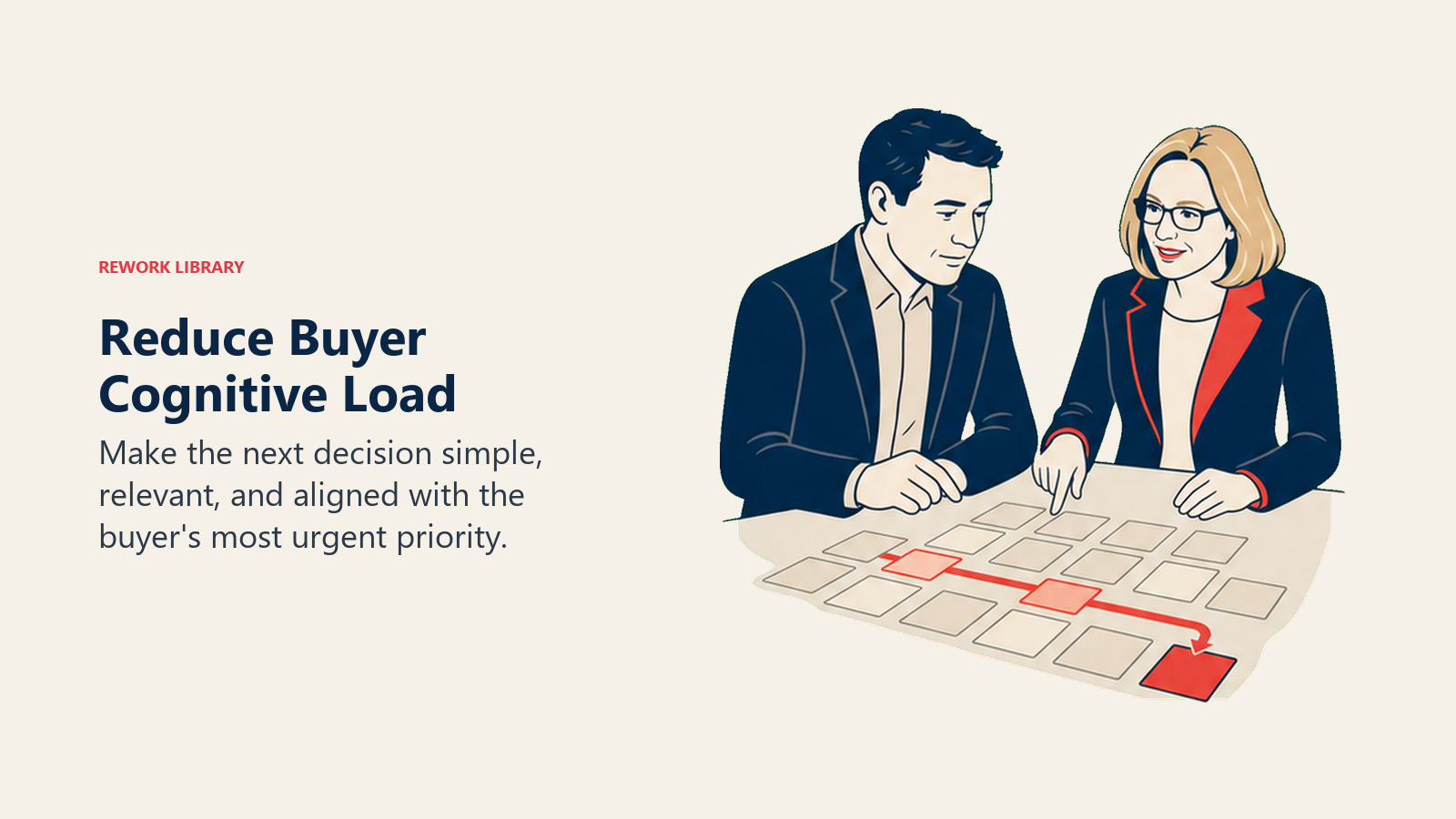
Simple means reducing complexity at every interaction point. A message that requires the buyer to figure out what you do before understanding why it matters fails the simple test. A demo that showcases 15 features when the buyer cares about 2 creates cognitive load rather than reducing it. An email that asks three questions when one would do loses the reply. Konrath's simple principle is an ongoing audit question: is there any way to say this with less effort required from the buyer?
iNvaluable means being more than a vendor. If you're selling what your competitors also sell, using messaging your competitors also use, the buyer has no reason to talk to you versus them. Being invaluable means bringing a perspective, a piece of market intelligence, a benchmark, or a specific industry insight that the buyer couldn't easily get elsewhere. Konrath frames this as the "trigger event" principle: understand what's happening in your buyer's business right now, a leadership change, a new initiative, a competitive pressure, and lead with how that context shapes what you can offer.
Aligned means matching your offer to the buyer's current priorities rather than to your product roadmap. The buyer who is focused on cutting operational costs does not want to hear about your product's new integrations. They want to hear about time savings and headcount reduction. The rep who can translate product capabilities into the language of the buyer's current strategic priority is aligned. The rep who leads with features is not.
Priority means helping the buyer see why acting now is more valuable than acting later. Not through artificial urgency, Konrath is explicit that manufactured urgency damages trust, but by helping the buyer understand the cost of inaction in terms of their own goals. What does staying with the current solution cost them per quarter? What do competitors who've already made this change gain that they don't have? Priority is about making the case for timeliness without pressure.
2. Agile Selling: Rapid Skill Acquisition
The central argument of Agile Selling is that the half-life of sales knowledge has shrunk. Products change faster, markets move faster, buyer priorities shift faster, and competitors emerge faster than the annual sales training cycle can accommodate.
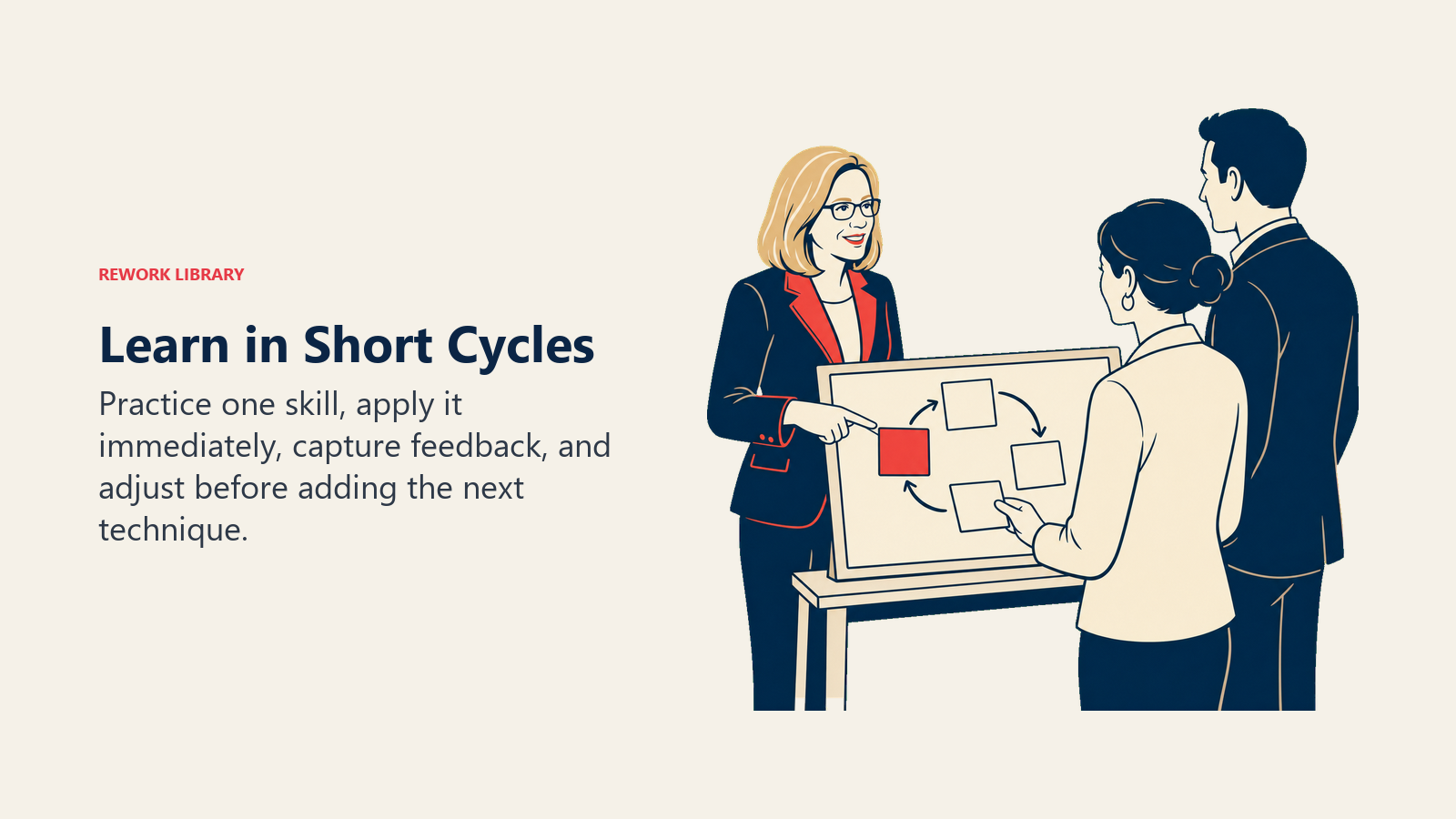
Konrath's response is to treat learning as an ongoing skill in itself. The best reps she observed weren't the ones with the deepest product knowledge or the longest tenure. They were the ones who could get up to speed quickly on new context, a buyer's industry, a new competitive threat, a changed product feature, and translate that context into relevant buyer conversations faster than their colleagues.
She structures this as a set of rapid-learning practices: pre-call research routines that cover a buyer's recent company announcements, industry news, and LinkedIn activity in under 30 minutes; frameworks for distilling new product capabilities into two or three buyer-relevant sentences within hours of a product update; and habits for absorbing competitive intelligence continuously rather than waiting for a quarterly battlecard.
The agile framing also applies to the sales process itself. Konrath argues that reps who can adjust their approach mid-call based on new information, the buyer mentions a constraint, the decision timeline shifts, a new stakeholder enters the conversation, outperform reps who execute a predetermined script. The skill of reading real-time signals and adapting in the moment is as important as knowing the right script to start with.
3. Fresh Perspectives: Standing Out in a Crowded Inbox
In Selling to Big Companies, Konrath's earliest and most operationally detailed book, she focused specifically on the problem of breaking through to large company buyers, people with gate-keeping assistants, overflowing inboxes, and zero patience for generic outreach.
Her core principle for standing out is what she calls the "fresh perspective" approach: lead with an insight or observation about the buyer's business that demonstrates you've done real work to understand their situation. Not a generic industry trend, but a specific observation about their company, their market position, their recent announcements, or their competitive context that shows you're not using a template.
The practical mechanics: research the buyer's company before any outreach, annual reports, earnings calls, press releases, leadership LinkedIn posts. Identify one specific thing happening in their business right now that your offering connects to. Lead with that observation before you say anything about your product. "I noticed you expanded into the European market last quarter, companies in that situation typically run into X problem. Here's what we've seen work." That's a different first sentence than "I'd love to schedule 15 minutes to show you our platform."
Konrath extended this into the digital prospecting context with early work on LinkedIn-based social selling before it was a standard part of most sales training programs. She understood that the buyer's digital footprint was research material, not just a channel for outbound.
What Konrath Would Do in Your Role
If you're a CEO, Konrath's framing has a direct implication for your go-to-market positioning. If your marketing and sales messaging leads with product features rather than buyer priorities, you've built a communications strategy calibrated for buyers who have time and patience to decode what you do and why it matters. The frazzled buyer test is this: if your buyer reads your homepage or your cold email for three seconds, would they understand what problem you solve for someone in their specific situation? If not, the message needs to change before the sales motion does.
If you're a COO or enablement leader, the agile learning framework translates into a specific training infrastructure design. Instead of annual sales training events, build a rapid-learning cadence: 30-minute weekly digests of competitive intelligence, structured pre-call preparation templates, and a library of "translate this feature to this persona" messaging guides that update with each product release. The goal is to reduce the time between a market change and the rep's ability to have a relevant conversation about it.
If you're a product leader, the aligned principle from SNAP should inform your sales enablement materials. Most product teams write release notes for engineers and then hand them to sales. Konrath would have you start from the buyer's current strategic priority, identify which product capabilities connect to it, and write the rep's talking point first, not the feature description. That reordering changes what goes into the materials and what reps actually use.
If you're a sales or marketing leader, Konrath's most immediately actionable contribution is to your prospecting messaging audit. Pull your last ten cold emails. Score them on the SNAP criteria: is the message simple enough to read in 15 seconds, does it offer something iNvaluable rather than a generic pitch, is it aligned to what this specific buyer cares about right now, does it create a reason for priority without manufactured urgency? Most teams score poorly on all four. The rewrite guided by those criteria produces measurably higher reply rates.
How Konrath's Philosophy Maps to Rework
Konrath's doctrine forces a hard question about CRM design: does your system encourage respectful cadence, or does it reward activity for activity's sake? Most legacy CRMs celebrate dial counts, email volume, and touch totals, metrics that punish the crazy-busy buyer by flooding their inbox with low-relevance outreach. Rework's CRM is built around the opposite premise. Sequences are sequenced around trigger events and buyer context, not fixed cadence templates. Reply-rate and meeting-conversion dashboards sit next to activity totals, so managers can see when a rep is simply spraying rather than landing. Agile learning surfaces through shared playbooks and one-click snippet libraries that let reps absorb a new product update or competitive angle in minutes, not quarters. The result is a sales motion that matches Konrath's argument: fewer, sharper, more aligned touches beat high-volume noise, and the CRM should be the instrument that enforces that discipline, not the one undermining it.
Notable Quotes and Lessons Beyond the Boardroom
In SNAP Selling, Konrath writes: "Your prospects are in a state of Crazy Busy. They're overwhelmed and overloaded. As sellers, we need to adjust to this new reality, or our prospects will never give us the time of day." That "new reality" framing was accurate in 2010 and is more accurate today. The cognitive load on decision-makers has not decreased, a point reinforced by McKinsey's research on the future of B2B sales, which found that buyers now prefer controlling their own research journey over engaging with sellers early.
She's also direct about the competitive stakes of mediocre outreach: "If your prospects don't think you can help them, they'll never talk to you. If your messages are like every other salesperson's, you'll be ignored." The double standard she describes, you have to be simultaneously simple enough to process quickly and distinctive enough to be worth processing, is genuinely hard to achieve. But it's the accurate description of the problem.
What's notable about Konrath's longer career arc is her consistent focus on the rep as a learner, not just a performer. Her most recent work addresses time management and attention for salespeople themselves, the cognitive burden of selling in a high-distraction environment affects rep performance as much as it affects buyer receptiveness. She applies the same empathy to salespeople that she applies to buyers, which is a less common perspective in sales methodology that tends to treat reps instrumentally.
Where This Style Breaks
SNAP's strengths are in the prospecting and early-stage engagement phases of the sale. But the framework's simplicity bias can leave reps underprepared for complex enterprise pursuits where the buyer actually needs to see depth, technical credibility, and rigorous proof before committing budget. "Be simple and aligned" is good advice for a cold outreach message but incomplete guidance for a 6-month enterprise evaluation with multiple stakeholders. Konrath's agile learning model also risks becoming an excuse for avoiding deep mastery, the rep who is always adapting and rarely drilling fundamentals may be broadly competent and never excellent. Her body of work is most valuable when combined with a more operationally rigorous framework like Rackham's or Roberge's, rather than treated as a complete system.
Frequently Asked Questions about Jill Konrath's Sales Philosophy
Who is Jill Konrath?
Jill Konrath is a B2B sales strategist, keynote speaker, and author of four bestselling books on prospecting and sales effectiveness. She started her career as an IBM seller before becoming an independent consultant, and she's recognized as a LinkedIn Top Sales Expert with keynote engagements at companies like IBM, 3M, and Oracle.
What is SNAP Selling?
SNAP Selling is the framework Konrath introduced in her 2010 book of the same name. The acronym stands for Simple, iNvaluable, Aligned, and Priority, four criteria that every seller interaction must satisfy to break through to overloaded buyers. It's a filter for messaging and cadence, not a step-by-step discovery model like SPIN.
What is selling to crazy-busy buyers?
"Crazy-busy" is Konrath's term for the cognitive state of modern B2B decision-makers: overwhelmed inboxes, back-to-back meetings, and no patience for generic outreach. Selling to crazy-busy buyers means earning attention in small increments, leading with specific relevance to their current situation, and avoiding any message that adds cognitive load instead of reducing it.
What is Agile Selling per Konrath?
Agile Selling, from Konrath's 2014 book, argues that rapid learning velocity is now a core sales skill. The best reps can absorb a buyer's industry context, a new product capability, or a competitive shift in hours rather than quarters, and translate that new knowledge into relevant buyer conversations faster than their peers.
What are Konrath's most important books?
Her four bestsellers are Selling to Big Companies (2005), which focuses on breaking through to enterprise buyers; SNAP Selling (2010), which introduces the SNAP framework for frazzled buyers; Agile Selling (2014), on rapid skill acquisition; and More Sales Less Time (2016), which applies her crazy-busy analysis to sellers' own productivity.
What can modern salespeople learn from Jill Konrath?
Three things carry over cleanly. First, audit every cold email against the SNAP criteria, most fail, and the rewrite lifts reply rates. Second, treat pre-call research as a 30-minute discipline, not an optional extra. Third, build learning velocity into the team's cadence so reps stay relevant as products, markets, and buyer priorities shift.
Learn More
- Prospecting Strategy: How to Break Through to Buyers Who Won't Respond
- Sales Enablement That Actually Works: Building Materials Reps Use
- Cold Email That Gets Replies: The Messaging Audit Framework
- Building Your Lead Management Process from the Ground Up
- Neil Rackham Leadership Style: Research-First, Question Everything
- Mark Roberge Leadership Style: Engineering a Repeatable Sales Machine
- Chris Voss Leadership Style: Tactical Empathy Over Pressure
- Marc Benioff Leadership Style: How Salesforce's CEO Built the Cloud CRM Era

On this page
- Key Facts: Jill Konrath
- Leadership Style Breakdown
- Key Leadership Traits
- The Konrath Crazy-Busy Doctrine
- The 3 Frameworks That Defined Konrath
- 1. SNAP Selling: Simple, iNvaluable, Aligned, Priority
- 2. Agile Selling: Rapid Skill Acquisition
- 3. Fresh Perspectives: Standing Out in a Crowded Inbox
- What Konrath Would Do in Your Role
- How Konrath's Philosophy Maps to Rework
- Notable Quotes and Lessons Beyond the Boardroom
- Where This Style Breaks
- Learn More