Neil Patel Leadership Style: Content at Scale as a Growth Machine
Turn this article into takeaways for your work.


Each assistant summarizes the article only for you and suggests best practices for your work.
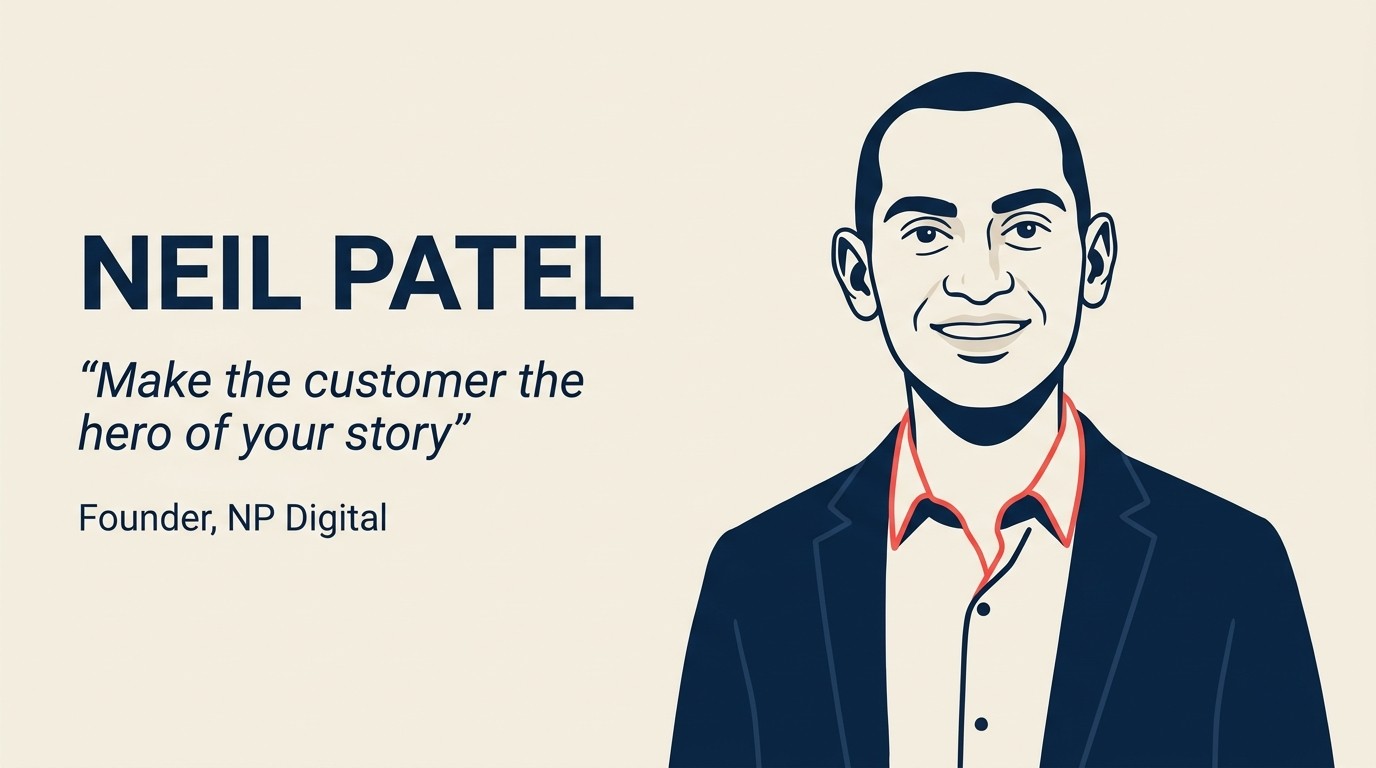
Neil Patel built one of the most trafficked marketing blogs on the internet. NeilPatel.com draws millions of visitors per month, ranks for thousands of competitive marketing keywords, and generates a consistent pipeline of consulting leads, without a single dollar of paid advertising to acquire that traffic.
Then he turned that organic reach into a consulting and software business. NP Digital, the agency he founded in 2017, has been named a top global digital agency by Clutch three years running. Ubersuggest, the SEO tool he acquired in 2017 for $1 and rebuilt, has over 3 million registered users.
None of it was funded by venture capital in any meaningful sense. Patel's growth model is simpler and harder than most VC-backed growth playbooks: publish more useful content than your competitors, build backlinks more systematically than your competitors, and let compounding organic traffic fund every subsequent business you want to build.
He was born in London in 1985, moved to Orange County at age two, built his first website at 16 (a job board that failed), discovered SEO around 2002, and has been systematizing it ever since. Crazy Egg, the heatmap tool he co-founded in 2005, is still running. Hello Bar, the email capture tool from 2012, is still running. His Marketing School podcast with Eric Siu has passed 2,000 episodes. The through-line in all of it is the same thesis: create content worth ranking, distribute it systematically, and let the organic compounding do the work.
This profile examines what that leadership model actually requires, where it works, and where it doesn't.
Key Facts
- Companies founded or co-founded: KISSmetrics (2008, shut down 2017), Crazy Egg (2005, still operating), Hello Bar (2012), NP Digital (2017, serving Fortune 50 clients)
- Personal brand and tools: NeilPatel.com draws millions of visitors monthly; Ubersuggest (acquired 2017 for ~$120 and rebuilt as a freemium SEO tool)
- Reach: 40M+ monthly users across his tools and properties
- Recognition: Named a Forbes Top 10 Marketer; Wall Street Journal called him a top influencer on the web
- Background: Born in London in 1985 to Indian parents, moved to the US (Orange County) at age two, immigrant entrepreneur story baked into his personal brand
- Content output: Marketing School podcast with Eric Siu has surpassed 2,000 daily episodes
Leadership Style Breakdown
| Style | Weight | How it showed up |
|---|---|---|
| SEO-First Growth Operator | 60% | Patel's default approach to any new market or topic is to research the search demand first, what are people already looking for, and how competitive is the keyword landscape, and then produce content against that demand. This is the opposite of most content strategies, which start with what the company wants to say. His agency pitches and wins clients partly because he can demonstrate this approach at scale: NeilPatel.com itself is the case study. He doesn't just advise clients on content strategy; he shows them a 10-year traffic graph from his own domain. |
| Data-Obsessed Content Systematizer | 40% | Patel's content operation is a production system. He publishes on a fixed cadence, tests headlines and formats systematically, tracks keyword rankings on a weekly basis, and runs A/B tests on landing page conversion continuously. The creativity is constrained by data at every step, topic selection, headline writing, content length, internal linking structure. This produces content that ranks well and converts well but rarely surprises or provokes. It's optimized for search intent, not for intellectual novelty. |
That combination, SEO-first topic selection plus systematic production, is what makes his model replicable. Most content operations are either driven by editorial instinct (what we think is interesting) or by SEO data (what people search for), but not both simultaneously. Patel runs both in parallel and uses the data to discipline the editorial judgment.
Key Leadership Traits
| Trait | Rating | What it means in practice |
|---|---|---|
| Content-as-moat thinking | Exceptional | Patel's core competitive insight is that organic search traffic is a compounding asset rather than a perishable inventory. An article that ranks on page one for a high-volume keyword generates leads every month indefinitely, with no incremental cost per visit after the initial production investment. Most marketing budgets are spent on perishable inventory, ads that stop generating leads the moment the budget stops. Patel's model inverts this: heavy upfront investment in content, near-zero marginal cost after ranking. That's a defensible competitive position if you can hold the rankings long enough for the compounding to matter. |
| Radical transparency about failures | Very High | Patel has published accounts of his own startup failures publicly and in some detail, including a venture that lost over $1 million. That's unusual in an industry where personal brand depends heavily on appearing successful. His argument is that the transparency builds trust more than it damages credibility, readers identify with the failure stories and trust the success advice more because he's not pretending the path was linear. KISSmetrics, the analytics company he co-founded, shut down in 2017. He's written about why. That kind of documented failure creates credibility that manufactured success stories can't match. |
| Compounding patience | High | Patel's standard framing for SEO is 12 to 24 months before meaningful returns. He's consistent about this timeline across his blog, podcast, and consulting work. That's hard to sell to leadership teams that want to see marketing ROI in one quarter, but it's accurate for organic search, and it's the reason most companies underinvest in content. The ones willing to wait 18 months for results build a channel that their competitors, unwilling to wait, never build. Patel's personal patience with compounding is what allowed him to build NeilPatel.com before it had any obvious business model attached to it. |
| Tool-building alongside content | High | Patel's pattern is to build or acquire tools that complement his content reach. Crazy Egg (heatmaps), Hello Bar (email capture), and Ubersuggest (SEO research) are all tools that serve the same audience as his blog content. The tools generate user data that informs content topics. The content generates leads for the tools. Each reinforces the other. This content-plus-tool flywheel is harder to execute than a pure content strategy, but it creates a competitive moat that pure content operations can't easily replicate. |
The 3 Frameworks That Defined Neil Patel
The Patel SEO Growth Engine
The Patel SEO Growth Engine is a self-funding acquisition model that combines keyword-driven topic selection, high-volume "10x" content production, and systematic backlink outreach to turn organic search into a compounding distribution asset. The engine runs on an 18-to-36-month time horizon, where upfront content and link investment produce near-zero marginal customer acquisition cost once rankings compound. Its defining characteristic is pairing the content machine with complementary free tools (Ubersuggest, Hello Bar, Crazy Egg) so that traffic, user data, and product pipeline all reinforce each other inside a single flywheel.
1. Content at Scale: Volume Plus Consistency Plus Depth
Patel's content strategy has three components that work together, and removing any one of them significantly reduces the effectiveness of the other two.
Volume means publishing frequently enough that you're building domain authority faster than competitors and covering enough keyword surface area to capture long-tail search traffic. For NeilPatel.com, this has meant posting multiple times per week for over a decade. That's not a realistic cadence for every organization, but the principle applies at smaller scales: consistent publishing at whatever cadence your team can sustain builds authority faster than irregular publishing at higher quality.
Consistency means not stopping when the traffic doesn't materialize immediately. Most content programs get abandoned at month six when the organic traffic curve is still flat. Patel's observation is that the curve is flat for the first 12 to 18 months because domain authority takes time to accumulate, then it inflects sharply as rankings compound. The companies that build content moats are the ones that fund the flat part of the curve patiently.
Depth means producing the most complete, most useful version of each topic rather than a summary. His "10x content" principle is simple: before writing about any topic, look at what's currently ranking and ask whether you can produce something significantly more useful. Not slightly better, substantially better in length, specificity, data, and practical applicability. That threshold filters out content that would rank initially but get replaced in 12 months by something better.
The combination of those three produces what Patel calls an "unfair advantage" in organic search: you're producing more content, more consistently, at higher quality than competitors who are either inconsistent or shallow. The barrier isn't insight, it's the discipline to do all three simultaneously over a multi-year period.
2. Keyword-First Content Strategy: Start with Demand, Not with What You Want to Say
Most editorial content strategies start with ideas the team finds interesting and then hope those ideas correspond to what the target audience is searching for. Patel's approach inverts this: start with search demand data, identify topics where search volume is high and current ranking content is weak, and produce content explicitly designed to serve that demand.

The practical workflow is: use Ubersuggest, Ahrefs, or Semrush to identify keywords with meaningful search volume and manageable competition, cluster related keywords into content topics, and produce one comprehensive piece per cluster rather than multiple thin pieces per keyword. That structure maximizes the topical authority signal to search engines while minimizing content production overhead.
What this means for topic selection is that you're not writing about what you think is strategically important or intellectually interesting. You're writing about what your audience is already searching for. That's a discipline that produces more useful content, on average, than editorial instinct, because it's grounded in actual demand signals rather than assumptions about what the audience cares about.
The limitation of the keyword-first approach is that it produces content that follows demand rather than creating it. Ogilvy-style Big Ideas and thought leadership that shapes opinion rather than satisfying existing search queries require the editorial instinct approach. Patel's model is excellent for capturing existing demand; it's not designed for creating new categories.
3. Skyscraper Plus Distribution: Write the Best Version, Then Build the Links
The Skyscraper technique, originally named by Brian Dean of Backlinko, is one of the core link-building strategies in Patel's toolkit. The logic is: find content that has already accumulated backlinks in your target category, produce a substantially better version of the same content, and then reach out to everyone who linked to the original asking them to link to yours instead.

Patel's version of this extends beyond the original technique: he pairs the skyscraper content with an active outreach and content promotion campaign. Publishing a great piece of content and waiting for links to accumulate organically is too slow. He sends the content directly to journalists, bloggers, and newsletter operators in the category, with a specific angle about why their audience would find it useful. That proactive distribution compresses the time it takes for a new piece of content to accumulate enough backlinks to rank competitively.
For operators applying this to their own categories, the skyscraper plus distribution model requires two capabilities most content teams don't have simultaneously: the ability to produce genuinely superior content and the ability to systematically promote it through outreach. Most teams have one or the other. Building both is what allows the model to work at scale.
What Neil Patel Would Do in Your Role
If you're a CEO, Patel's most useful reframe for you is on the time horizon for content investment. Most CEOs evaluate marketing channels on a quarterly ROI basis. Organic content doesn't produce quarterly ROI, it produces compounding returns that are near-zero for the first 12 months and significant by year three. That mismatch in time horizon is why most companies underinvest in content relative to paid channels and then wonder why their customer acquisition costs are rising every year while competitors with content moats are seeing theirs fall. If you're evaluating content as a channel, use a 24-month horizon, not a 90-day one.
If you're a COO, Patel's content-at-scale model has direct implications for how you staff and structure a content operation. Volume, consistency, and depth at scale require a systematic production process, topic research, content brief, writing, SEO optimization, editing, publishing, performance tracking, with clear ownership at each step. Most content teams are organized around editorial judgment rather than production throughput. Patel's model requires treating content as a manufacturing operation: defined inputs, defined steps, defined quality standards, and a production capacity you can predict. That's a different org design than most editorial teams run.
If you're a product leader, the keyword-first research method applies directly to product discovery. Before building a feature, check whether your target users are actively searching for solutions to the problem that feature addresses. High search volume for a problem means buyers have already recognized they have it and are looking for solutions, which is a much better early signal than internal conviction that the problem is important. Patel's SEO research toolkit is actually a market research toolkit for identifying which buyer problems are large enough and recognized enough to fund a feature investment.
If you're in sales or marketing, the content-plus-tool flywheel is the most replicable part of Patel's model for a B2B operation. The pattern is: produce content that attracts your target buyer for free (blog posts, guides, calculators), offer a tool that makes the next step easier (an SEO analyzer, a pricing calculator, a template generator), and use the tool's user base as a qualified pipeline for your paid product or service. The tool creates intent data you can't get from content alone. Buyers who use a free tool have demonstrated a specific problem, which makes the conversion conversation much easier than cold outreach.
How Rework Supports a Patel-Style Growth Engine
Running the Patel SEO Growth Engine is a multi-team operation: content producers write the assets, SEO leads manage keyword strategy and outreach, product builds the free tools, and sales converts the inbound demand. That creates an attribution problem most growth teams never solve, which article, which keyword, and which free-tool signup actually moved a deal forward 90 days later. Rework's Revenue Engine ($159/month billed yearly, with 5 marketing and 5 sales seats) gives marketing and RevOps a shared pipeline where every deal carries its original content entry point, multi-touch attribution path, and tool-signup history as first-class fields. Content leaders can see which 10x articles generate qualified opportunities, not just traffic. SEO teams can tie specific rankings to closed revenue on an 18-month window, which is the only defensible way to justify the compounding investment Patel's model requires. When the content engine, free tools, and sales conversations live in the same system, content-led growth stops being a faith-based channel and becomes a measurable one.
Notable Quotes & Lessons Beyond the Boardroom
"Content marketing is a commitment, not a campaign." Patel has made this point in various forms across his blog and podcast. The distinction between a campaign and a commitment is the operational difference between companies that build content moats and those that don't. A campaign has a start date, an end date, and a budget attached to a specific goal. A commitment is an ongoing operational investment with compounding returns. Most CMOs run campaigns. The companies with the largest organic traffic advantages made commitments.
"It doesn't matter how great your marketing is if the product isn't any good." He's made this point when discussing the KISSmetrics failure and other ventures that didn't reach their potential. It's a reminder that content marketing is a distribution strategy, not a product strategy. You can drive enormous organic traffic to a product with a broken value proposition and the traffic won't convert. Patel's content framework works when the underlying product or service is genuinely good, it amplifies existing quality, it doesn't substitute for it.
The KISSmetrics shutdown in 2017 is the most instructive episode in his career for operators. The analytics platform was well-funded, well-marketed, and built by someone with significant SEO and content expertise. It failed anyway, largely for reasons related to product-market fit and competitive positioning rather than marketing. Patel published about it honestly. The lesson is that his content distribution skills are real and repeatable, but they solve a distribution problem, not a product problem.
Where This Style Breaks
Patel's content-moat model requires 18 to 36 months of investment before meaningful returns, which most growth-stage companies operating on 12-month runways can't afford. His SEO playbook is increasingly challenged by AI-generated answers in search: Google's AI Overviews reduce click-through rates on informational queries, which is exactly the content type his model has optimized for over 15 years. Ubersuggest competes against well-funded tools like Ahrefs and Semrush that have larger crawl indexes and longer track records with professional SEO teams. And his personal-brand-led business model is structurally hard to separate from the person, NP Digital's growth is tied to Patel's visibility in a way that creates succession risk that most investors in agency businesses wouldn't accept.
Frequently Asked Questions about Neil Patel's Marketing Philosophy
Who is Neil Patel?
Neil Patel is a digital marketer and entrepreneur born in London in 1985 who moved to Orange County, California at age two. He co-founded KISSmetrics, Crazy Egg, and Hello Bar, founded the agency NP Digital in 2017, and runs NeilPatel.com, one of the most trafficked marketing blogs on the internet. Forbes has named him a Top 10 Marketer, and his tools reach over 40 million monthly users.
How did Patel build multiple marketing companies?
Patel reinvested organic traffic from his personal blog into each successive venture rather than raising significant venture capital. NeilPatel.com generated a consistent lead pipeline that funded Crazy Egg (2005), Hello Bar (2012), Ubersuggest (acquired 2017), and NP Digital (2017). His thesis is that compounding organic search traffic is a cheaper and more durable growth channel than paid acquisition if you can wait 18 to 36 months for rankings to compound.
What is Patel's content-at-scale strategy?
The strategy combines three disciplines: high publishing volume to build topical authority faster than competitors, multi-year consistency to survive the flat early part of the traffic curve, and "10x content" depth that produces substantially more useful pieces than whatever is currently ranking. Removing any one of the three, volume, consistency, or depth, significantly reduces the effectiveness of the other two.
What is Ubersuggest?
Ubersuggest is a freemium SEO research tool that Patel acquired in 2017 and rebuilt into a free alternative to Ahrefs and Semrush. It provides keyword research, competitor analysis, site audits, and backlink data, with over 3 million registered users. Ubersuggest functions as both a product and a distribution asset, free users become a qualified audience for Patel's consulting and agency services.
What is NP Digital?
NP Digital is the global digital marketing agency Patel co-founded in 2017 with Mike Kamo. The agency serves Fortune 50 clients across SEO, paid media, content marketing, and analytics, and has been named a top global digital agency by Clutch multiple years running. NP Digital operationalizes Patel's content-plus-SEO methodology for enterprise clients who can't or won't build the capability in-house.
What can marketers learn from Neil Patel?
The core lesson is that content marketing is a commitment rather than a campaign, meaningful organic search results require 18 to 36 months of consistent investment before compounding kicks in. Marketers should start with keyword demand data rather than editorial instinct, pair content production with complementary free tools to create a flywheel, and publish transparently about failures to build more credibility than manufactured success stories provide.
For related reading, see Gary Vaynerchuk Leadership Style, David Ogilvy Leadership Style, Philip Kotler Leadership Style, Seth Godin Leadership Style, Neil Rackham Leadership Style, and Aaron Ross Leadership Style.

On this page
- Key Facts
- Leadership Style Breakdown
- Key Leadership Traits
- The 3 Frameworks That Defined Neil Patel
- The Patel SEO Growth Engine
- 1. Content at Scale: Volume Plus Consistency Plus Depth
- 2. Keyword-First Content Strategy: Start with Demand, Not with What You Want to Say
- 3. Skyscraper Plus Distribution: Write the Best Version, Then Build the Links
- What Neil Patel Would Do in Your Role
- How Rework Supports a Patel-Style Growth Engine
- Notable Quotes & Lessons Beyond the Boardroom
- Where This Style Breaks