Daniel Goleman Leadership Style: Emotional Intelligence, the 4 EQ Dimensions, and the HBR Article That Never Stopped Being Reprinted
Turn this article into takeaways for your work.


Each assistant summarizes the article only for you and suggests best practices for your work.
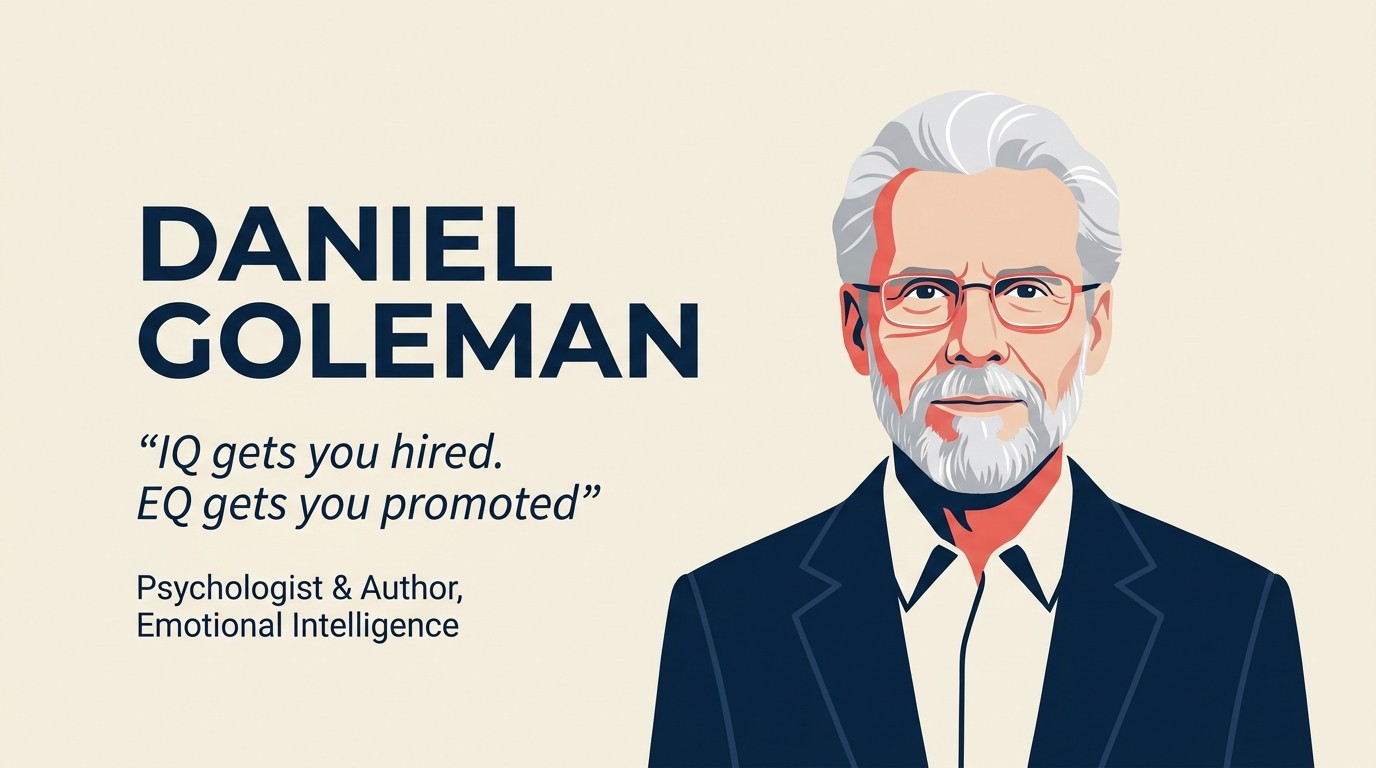
Key Facts: Daniel Goleman (b. 1946) is a Harvard-trained psychologist and former New York Times science writer whose 1995 book "Emotional Intelligence" sold more than 5 million copies and has been translated into 40+ languages. His 2002 book "Primal Leadership" (co-authored with Richard Boyatzis and Annie McKee) extended the framework into executive practice. His 1998 Harvard Business Review article "What Makes a Leader?" remains the most-requested reprint in HBR's history, and he popularized the EQ framework that is now standard vocabulary across HR, coaching, and leadership development.
In 1998, Harvard Business Review published Daniel Goleman's "What Makes a Leader?" It became the most-requested reprint in the magazine's history. The argument wasn't complicated: IQ and technical skills matter for entry-level performance, but above a threshold, emotional intelligence (how you read yourself and others) predicts who rises, who leads well, and who gets the promotion over the equally smart but less aware colleague.
His 1995 book "Emotional Intelligence" had already sold 5 million copies and spent 80 weeks on the New York Times bestseller list. Goleman didn't invent the concept. Researchers Peter Salovey and John Mayer coined it in 1990. But he translated it into a framework that executives could actually use.
If you've ever watched a high-IQ leader derail their career because they couldn't manage their reactions in a difficult conversation, you've watched Goleman's thesis play out in real time.
The Goleman EQ Doctrine
The Goleman EQ Doctrine holds that above a cognitive threshold, leadership effectiveness is determined not by IQ or technical skill but by five emotional competencies: self-awareness (knowing your emotions, strengths, and limits), self-regulation (managing impulses and reactions), motivation (internal drive beyond money or status), empathy (reading others accurately), and social skills (managing relationships and building networks). Goleman's argument is that these competencies are observable, trainable, and predictive of performance in ways that cognitive ability alone is not, making EQ a developmental target rather than a fixed trait.
Leadership Style Breakdown
| Style | Weight | How it showed up |
|---|---|---|
| Science Translator | 65% | Goleman spent 20 years as a science journalist at the New York Times before writing "Emotional Intelligence." That background gave him a specific skill set: he knew how to read academic research, understand what it said and didn't say, and render it in language that non-academics could use. "Emotional Intelligence" draws on Salovey and Mayer's construct, neuroscience research on the prefrontal cortex and limbic system, and Goleman's own synthesis across disciplines. The translation job is harder than it looks, most researchers who try to write popular books either oversimplify or fail to reach a general audience. Goleman did neither. |
| Practitioner Advocate | 35% | Goleman's influence on organizations came through his advocacy role, speaking, consulting, co-founding the Consortium for Research on Emotional Intelligence in Organizations (CREIO), and producing the applied frameworks in "What Makes a Leader?" and "Leadership That Gets Results." The 35% weight reflects that his primary contribution is intellectual translation, but his organizational reach comes through direct practitioner work and platform building. |
The 65/35 split explains both Goleman's strength and his vulnerability. As a translator, he's exceptional. But translation involves choices about what to include and what to leave out, and some of those choices in his early work overstated the evidence, a problem he's acknowledged since. The best version of his work is "What Makes a Leader?" (1998) and "Leadership That Gets Results" (2000), where the translation is tight and the application is precise. The books that came after are more variable.
Key Leadership Traits
| Trait | Rating | What it means in practice |
|---|---|---|
| Ability to translate research into actionable models | Exceptional | The 4 EQ dimensions, self-awareness, self-regulation, social awareness, relationship management, are Goleman's construct, not Salovey and Mayer's original model. He reorganized the academic research into a framework with cleaner boundaries and clearer practical applications. Each dimension maps directly to behaviors that leaders can assess, practice, and develop. That's translation work, and it's the reason EQ became a mainstream management concept rather than staying a niche research topic. |
| Self-awareness as a publicly modeled behavior | High | Goleman has been willing to acknowledge that some of his early claims, particularly the "EQ matters more than IQ" framing, were overstated relative to the evidence base at the time. That's an intellectually honest position, and it models the self-awareness he advocates. He hasn't revised the core framework, but he's been candid that the popularization outran the research in some respects. |
| Long-term influence through simplification | Very High | Goleman published "Emotional Intelligence" in 1995. Thirty years later, HR departments, executive coaches, and leadership development programs still use his 4-dimension framework as standard vocabulary. That's rare. Most management frameworks fade within a decade. The reason his hasn't is that the dimensions are real, the behaviors they describe are observable, and the framework is simple enough to apply without a PhD in psychology. |
| Intellectual honesty about the limits of EQ science | Medium | This is the weakest of Goleman's leadership traits, and it matters for how you use his work. His early popularization made strong causal claims, EQ predicts leadership effectiveness better than IQ, EQ accounts for two-thirds of leadership success, that the research didn't fully support. He's softened those claims over time, but the strong versions of them are still widely quoted by coaches and consultants who haven't read the caveats. If you're using Goleman's framework for hiring decisions, understand that its predictive validity depends heavily on the assessment instrument, and most EQ assessments have weaker validity than cognitive assessments in hiring research. |
The 3 Decisions That Defined Daniel Goleman as a Leader
1. Publishing "Emotional Intelligence" for a General Audience in 1995
Before "Emotional Intelligence," the concept existed strictly in academic psychology. Salovey and Mayer had published their construct in 1990. It was a research idea in a research journal, with the distribution and influence of a research idea in a research journal. Goleman made a specific decision: to write a book for a general audience that would take the construct seriously rather than simplify it into self-help.
That's a harder balance than it sounds. Most popular psychology books at the time fell into one of two failure modes: they cited research without understanding it, or they understood the research and couldn't make it readable. Goleman's background as a science journalist for 20 years gave him the specific skill to thread that needle. He understood the neuroscience. He understood what the Salovey-Mayer model claimed and what it didn't. And he could explain it without losing the reader by page 40.
The result was a book that spent 80 weeks on the New York Times bestseller list and sold 5 million copies. More importantly, it created a category, emotional intelligence as a leadership variable, that universities, HR departments, and coaches have been building on for 30 years. You can argue about whether Goleman's specific claims were correct. You can't argue that the category wasn't worth creating.
The organizational consequence was significant. Before "Emotional Intelligence," most leadership development programs focused on skills: strategy, finance, communication, negotiation. After Goleman, they began incorporating self-awareness, empathy, and emotional regulation as developmental targets. That shift created the conceptual ground on which Brené Brown's work on vulnerability and shame resilience later took hold, and it gave Kim Scott the vocabulary to frame Radical Candor as an emotional-intelligence problem rather than just a communication one. That shift has real effects on how leaders are hired, evaluated, and trained, all tracing back to Goleman's decision to write for a general audience in 1995.
2. Writing "What Makes a Leader?" for HBR in 1998
If "Emotional Intelligence" created the category, "What Makes a Leader?" made it operational for executives. The 1998 HBR article defined the 4 EQ dimensions in the context of leadership effectiveness specifically, not in the context of life success generally.
The 4 dimensions are worth understanding as a system. Self-awareness is foundational: knowing your emotions, strengths, limits, and values, and understanding how they affect your judgment and behavior. Self-regulation builds on that foundation: the ability to manage impulses, adapt to changing circumstances, and not let emotional reactions drive decisions in high-stakes moments. Social awareness adds the external dimension: reading other people's emotions accurately, understanding organizational dynamics, and recognizing what others need. Relationship management is where the other three come together: inspiring, influencing, developing, and collaborating with people effectively.
The sequence matters. Leaders who try to develop relationship management skills without self-awareness tend to be charismatic but unpredictable. They can rally people in favorable conditions and damage them in unfavorable ones. Leaders who have self-awareness without social awareness understand themselves but misread others. The framework isn't a pick-your-favorite menu. It's a developmental sequence.
Why did the article become the most-reprinted in HBR history? Partly because the timing was right: the dot-com era was producing a specific kind of leadership failure that IQ-and-strategy frameworks couldn't explain. High-cognitive leaders with no emotional regulation were destroying teams and companies. "What Makes a Leader?" gave HR executives and board members a vocabulary for the failure mode they were seeing and a framework for the developmental work they needed to do.
3. Developing the 6 Leadership Styles Framework
"Leadership That Gets Results" (HBR, 2000) is less famous than "What Makes a Leader?" but more immediately actionable. Drawing on Hay Group research with 3,871 executives, Goleman identified 6 leadership styles (coercive, authoritative, affiliative, democratic, pacesetting, coaching) and found that leaders who could deploy 4 or more styles had measurably better team climate and financial results than those who defaulted to one or two.
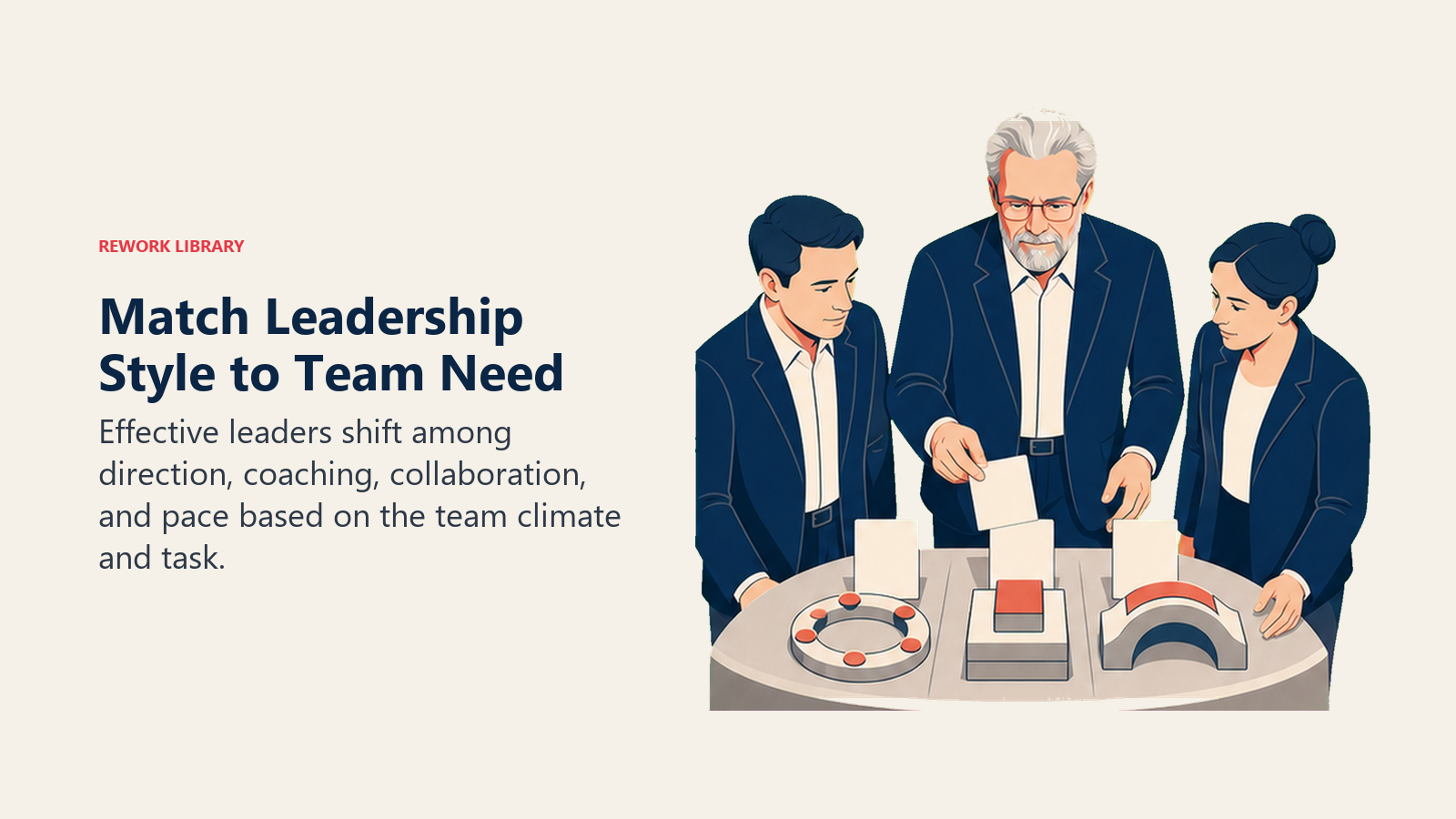
The 6 styles are each appropriate in specific contexts. Coercive (demand compliance) works in genuine crises, fires, compliance failures, turnarounds, and backfires in almost every other context because it destroys psychological safety and initiative. Authoritative (mobilize toward a shared vision) is the most broadly effective style across most circumstances. Affiliative (build harmony) works for repairing trust after disruption and sustaining morale but fails in situations requiring difficult feedback. Democratic (build consensus through participation) works when the team has more information than the leader but breaks down under time pressure. Pacesetting (set high standards and expect others to meet them) works with highly motivated, highly competent teams and exhausts everyone else. Coaching (develop people for the long term) works when individuals are willing to be developed but not when they're resistant to changing their behavior.
The finding that style-switching predicts team climate is more operationally useful than the EQ book's general argument because it's prescriptive: if you're over-relying on pacesetting (which many high-performing leaders do), you can see specifically what that does to your team climate and what adding more coaching and affiliative interactions would change. That's a behavioral intervention, not a personality development project.
What Daniel Goleman Would Do in Your Role
If you're a CEO, Goleman's most direct test for your EQ is about how you behave when you're wrong in public. Not whether you acknowledge mistakes in the abstract, every CEO says they value feedback. The test is the specific moment when someone on your leadership team contradicts you in a meeting with evidence that you're wrong. Your immediate reaction in that moment (not the words you say, but the body language, the tone, the follow-up behavior) tells your team everything they need to know about whether it's safe to challenge you. If your self-regulation in that moment is poor, everything downstream suffers: the quality of information you receive, the decisions your team makes without you, the culture of honesty.

If you're a COO or operations leader, the 6 leadership styles framework has a specific application to operational cadence. Ops leaders who default to pacesetting, setting high standards and expecting people to figure out how to meet them, tend to produce short-term compliance and long-term burnout. The coaching style, applied to one or two direct reports systematically, produces compounding returns: people who've been developed intentionally develop others, and the organization's capability grows faster than any hiring plan could produce. Goleman's data suggests the ROI is real. The challenge is that coaching feels slower than pacesetting in the short term, which is why most ops leaders never make the switch.
If you're a product leader, the social awareness dimension of Goleman's framework is the most applicable. Product leaders sit at the intersection of engineering, design, business, and customer, and each of those groups has different emotional dynamics, different concerns, and different definitions of what "good" looks like. Social awareness, in Goleman's framework, is about accurately reading those dynamics: who's actually aligned versus who's performing alignment, where the tension is between functions, what the customer is feeling that they're not saying in the research interview. That's not soft intuition. It's pattern recognition that you can deliberately develop.
If you're in sales or marketing, the relationship management dimension is where Goleman's framework is most immediately useful. Relationship management includes inspiring, influencing, developing others, catalyzing change, managing conflict, and collaborating. That's a description of what sales and marketing leadership requires: mobilizing people who don't report to you, managing the tension between volume and brand, influencing product without authority. Goleman's argument is that each of those skills has an emotional component, and that the emotional component is trainable, unlike IQ.
Rework Analysis: Applying Goleman's EQ at Operational Scale
Goleman's framework is developmental, but most leadership teams try to apply it in a vacuum, workshops, 360s, coaching conversations, without the operational visibility that lets empathetic decisions actually get made. Empathy without data turns into sentiment. Self-regulation without a clear view of pipeline, workload, and team capacity turns into guesswork about whether to push or protect. This is where Rework changes the calculus. When a manager can see in one view which reps are carrying unsustainable pipeline weight, which support tickets are stalling in a specific teammate's queue, and where cross-functional work is bottlenecking, the emotional intelligence conversation stops being abstract. Empathetic leadership decisions, rebalancing load, pausing a launch, coaching one person instead of pressuring five, become evidence-based rather than intuition-based. Goleman's four dimensions describe the leader's internal capability. Ops visibility gives that capability somewhere real to land. At scale, EQ without operational data is a virtue. EQ with it is a decision-making system.
Notable Quotes and Lessons Beyond the Boardroom
Goleman's 4 EQ dimensions are worth understanding in sequence, because he's clear that they're not independent. "Self-awareness is the foundation. Without it, you can't regulate yourself, you can't read others accurately, and your relationships are built on incomplete data about who you actually are." He's explicit that leaders who believe they have high EQ because they're empathetic, but who have poor self-awareness, tend to project their emotional states onto others rather than accurately reading what others are actually experiencing.
On the distinction between EQ and IQ, he's been more careful in recent years: "I never meant to claim that EQ matters more than IQ in all contexts. I meant that above a cognitive threshold, EQ is the differentiator. For a surgeon, cognitive ability and technical skill are primary. For a CEO who already has those, the question is whether their emotional intelligence enables or undermines the talent around them." That's a more precise version of the claim, and it's the version worth applying.
His acknowledgment that early popularizations overstated the evidence is worth noting specifically for how you use his work in hiring. Most EQ assessments have weaker predictive validity than cognitive assessments and structured interview techniques in hiring research. Adam Grant's organizational psychology research at Wharton has been a useful corrective here: Grant has pushed back on simplistic EQ-over-IQ claims while defending the practical value of emotional skills in team contexts, a more calibrated position than either Goleman's early popularization or his critics. And Peter Drucker's foundational argument that management is about results, not personality, is worth holding alongside Goleman's framework: self-awareness matters insofar as it improves decisions and outputs, not as a virtue in itself. Using EQ as a hiring screen without understanding the specific validity of the instrument you're using is an application that the evidence doesn't fully support. Using Goleman's framework as a developmental lens, by contrast, is well-supported and consistently useful.
Where This Style Breaks
The EQ framework's biggest weakness is measurement. Most EQ assessments have poor predictive validity compared to personality inventories or cognitive assessments in hiring research. The Mayer-Salovey-Caruso Emotional Intelligence Test (MSCEIT) measures EQ as ability and has decent validity. The Goleman-derived 360-feedback instruments measure behavioral competencies and have different validity properties. Bar-On's EQ-i measures a different construct entirely. Organizations that use "EQ assessment" without specifying which model and which instrument are often measuring different things and calling them the same thing.
Goleman's popularization also created a coaching and consulting industry that sometimes treats emotional intelligence as a cure-all rather than one variable in a complex system. Leaders who adopt "EQ" as an identity without doing the actual developmental work (therapy, structured feedback, behavioral practice) tend to use the vocabulary without changing the behavior. And leaders who are high in some EQ dimensions (social awareness, relationship management) but low in others (self-regulation, accountability) can use the framework to rationalize poor performance management as "coaching."
Frequently Asked Questions about Daniel Goleman's Leadership Research
Who is Daniel Goleman?
Daniel Goleman (b. 1946) is a Harvard-trained psychologist and former New York Times science journalist who popularized emotional intelligence as a leadership variable. His 1995 book "Emotional Intelligence" sold more than 5 million copies in 40+ languages, and his 1998 HBR article "What Makes a Leader?" is the most-requested reprint in that magazine's history.
What is emotional intelligence?
Emotional intelligence (EQ) is the ability to recognize, understand, and manage your own emotions, and to recognize, understand, and influence the emotions of others. The construct was introduced academically by Peter Salovey and John Mayer in 1990; Goleman translated it into a practical framework for leadership and organizational performance starting in 1995.
What are Goleman's five components of EQ?
Goleman's original five components are self-awareness (knowing your emotions, strengths, and limits), self-regulation (managing impulses and reactions), motivation (internal drive beyond external rewards), empathy (accurately reading others' emotions), and social skills (managing relationships and influence). He later consolidated these into four dimensions, self-awareness, self-regulation, social awareness, relationship management, in "Primal Leadership."
Why does Goleman say EQ matters more than IQ for leadership?
Goleman's more precise claim is that above a cognitive threshold, EQ becomes the differentiator. IQ and technical skill qualify you for senior roles, but once everyone at that level is cognitively capable, emotional intelligence predicts who leads effectively and who derails. He has acknowledged that early popularizations of the "EQ over IQ" framing overstated the evidence, and the more calibrated version of the claim is that EQ is the differentiator at the top of the distribution, not a replacement for cognitive ability.
What is Primal Leadership about?
"Primal Leadership" (2002), co-authored with Richard Boyatzis and Annie McKee, argues that the leader's emotional state is contagious and shapes organizational climate. The book introduces the idea of "resonant leadership" and operationalizes the 6 leadership styles, visionary, coaching, affiliative, democratic, pacesetting, and commanding, showing that leaders who can deploy four or more styles fluently produce better team climate and financial results than those who default to one or two.
What can managers learn from Daniel Goleman?
Three practical takeaways. First, self-awareness is foundational, managers who can't accurately read their own emotional state tend to misread others and make reactive decisions under pressure. Second, leadership style should be contextual, not fixed, pacesetting works with elite teams in crisis and exhausts everyone else. Third, EQ is developmental, not innate, unlike IQ, emotional competencies can be deliberately practiced and improved through feedback, coaching, and structured behavioral change.
For related reading on leadership psychology and team performance, see Amy Edmondson Leadership Style, Brené Brown Leadership Style, Kim Scott Leadership Style, Adam Grant Leadership Style, Peter Drucker Leadership Style, and Patrick Lencioni Leadership Style.

On this page
- The Goleman EQ Doctrine
- Leadership Style Breakdown
- Key Leadership Traits
- The 3 Decisions That Defined Daniel Goleman as a Leader
- 1. Publishing "Emotional Intelligence" for a General Audience in 1995
- 2. Writing "What Makes a Leader?" for HBR in 1998
- 3. Developing the 6 Leadership Styles Framework
- What Daniel Goleman Would Do in Your Role
- Rework Analysis: Applying Goleman's EQ at Operational Scale
- Notable Quotes and Lessons Beyond the Boardroom
- Where This Style Breaks