Larry Fink Leadership Style: Capital as Influence
Turn this article into takeaways for your work.


Each assistant summarizes the article only for you and suggests best practices for your work.
Key Facts
- Born: 1952, Van Nuys, California
- Education: UCLA (BA Political Science, 1974; MBA 1976); early career at First Boston
- Role: Co-founder, Chairman, and CEO of BlackRock, CEO continuously since founding in 1988
- Founded BlackRock: 1988, with 7 other partners inside Blackstone Group; spun out in 1994
- AUM: $10+ trillion, the world's largest asset manager
- Aladdin Platform: BlackRock's risk management software; analyzes risk for ~$21 trillion in assets across BlackRock and competitor firms
- Annual CEO Letters: Published since 2012, agenda-setting writings on long-termism, purpose, governance, and climate risk
- Defining Acquisitions: Merrill Lynch Investment Managers (2006); Barclays Global Investors / iShares (2009, $13.5B)
- ESG Arc: Aggressive stakeholder-capitalism push 2018–2022, then public modulation (dropping "ESG" terminology) in 2023–2024 under political pressure and state pension divestments
- Teaching Affiliation: NYU Stern School of Business (trustee and frequent speaker)
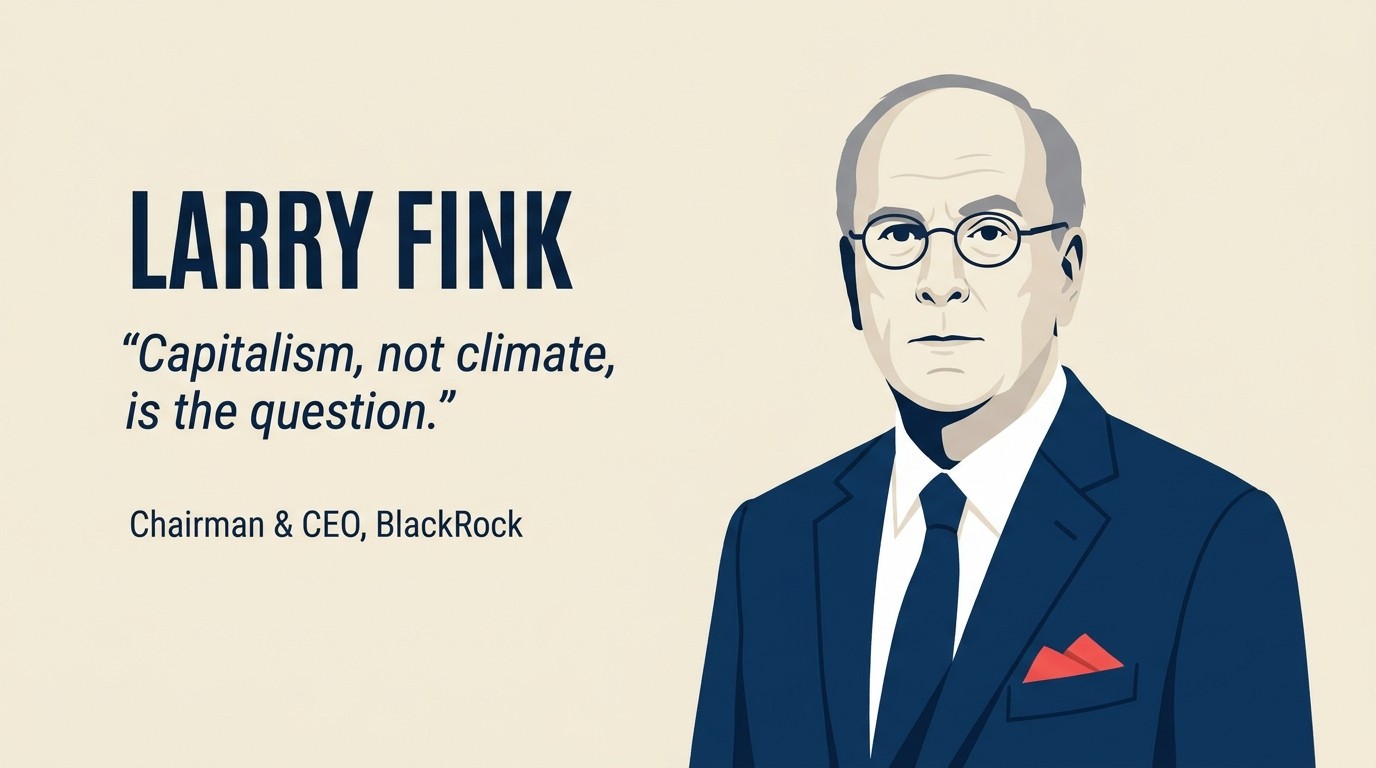
For about a decade, Larry Fink's annual letter to S&P 500 CEOs was the closest thing the corporate world had to a shared curriculum. Boards read it before earnings calls. Institutional investors quoted it in proxy filings. Consultants used it to anchor ESG advisory engagements. Starting in 2012, Fink used it to push public companies toward long-term thinking, stakeholder accountability, and eventually climate disclosure, and most of them listened, at least publicly, because BlackRock controlled $10 trillion in assets and voted at their annual meetings.
Then, in 2023-2024, Fink stopped using the word "ESG" in the letters. Republican state attorney generals had organized boycotts. Texas and Florida pulled state pension funds from BlackRock. The political cost had shifted. The letters got quieter.
That arc, using institutional scale to shift corporate behavior, then retreating under political pressure, is the most instructive thing about Fink's leadership. It's not a story of hypocrisy. It's a story about what happens when institutional influence meets electoral politics, and it has direct lessons for any leader trying to operate with stated values inside a politically divided environment.
The Stakeholder Capitalism Doctrine (The Fink Annual Letter Model)
The Stakeholder Capitalism Doctrine is Larry Fink's leadership thesis that the largest holders of passive capital have both the authority and the obligation to push portfolio companies toward long-horizon, multi-stakeholder decision-making, not out of charity, but because durable financial returns depend on customers, employees, communities, and the climate staying intact. The Fink Annual Letter Model operationalizes that doctrine: a single public document, published yearly to every CEO of a portfolio company, that sets explicit governance expectations and is backed by BlackRock's actual proxy voting behavior. The power isn't the letter, it's the combination of publicly committed positions and visible follow-through at 15,000+ annual meetings.
Leadership Style Breakdown
| Style | Weight | How it showed up |
|---|---|---|
| Institutional Builder | 65% | Fink built BlackRock from 8 people in 1988 to the world's largest asset manager. The core mechanism wasn't product genius alone, it was platform strategy. Aladdin, BlackRock's risk management software, powers risk analysis for roughly $21 trillion in assets globally, including at competitor firms. Building infrastructure that everyone depends on is a different kind of moat than building a better product. |
| Public Influence Operator | 35% | Starting around 2012, Fink realized that the annual CEO letter was a lever most asset managers weren't using. He published positions on purpose, long-termism, gender diversity on boards, and climate risk. Each letter generated board-level discussions at thousands of companies. That's a form of leadership that doesn't require a product or a vote, it requires scale, credibility, and willingness to say something controversial. |
Key Leadership Traits
| Trait | Rating | What it means in practice |
|---|---|---|
| Platform Thinking | Exceptional | Aladdin isn't just software, it's the reason BlackRock can't easily be replaced even by firms that disagree with its governance positions. When you build the infrastructure layer, you create switching costs that protect your position across political cycles. Fink understood this earlier than most asset managers, and invested in Aladdin's capabilities while competitors were focused on fund performance alone. |
| Narrative Control | Very High | Few financial CEOs have been as deliberate about using written communication as a strategic asset. The annual letters weren't investor relations, they were agenda-setting. They worked because they were specific, publicly committed, and tied to BlackRock's actual voting behavior at portfolio companies. When the letters got vague, that leverage weakened. |
| Risk Management Instinct | Very High | Fink came out of First Boston's mortgage desk in the 1980s, where he built what was essentially a risk management function before that language existed in mainstream finance. When a $100M trading error ended his First Boston career in 1986, it was partly a risk management failure that he had warned about internally. That experience shaped how he built BlackRock's analytical foundation from day one. |
| Institutional Patience | High | Fink spent decades building BlackRock through acquisitions (Merrill Lynch Investment Managers in 2006, Barclays Global Investors in 2009) while maintaining organizational coherence. The BGI deal for $13.5 billion brought iShares, transforming BlackRock into the dominant force in passive ETF investing. Patience on the acquisition thesis, buying distribution and infrastructure, not just AUM, is underappreciated. |
The 3 Decisions That Defined Fink as a Leader
1. Leaving First Boston After a $100M Loss and Starting BlackRock with 8 People
In 1986, Larry Fink was a rising star at First Boston. He'd helped build the mortgage-backed securities market from scratch. He was being positioned for senior leadership. Then his mortgage desk lost roughly $100 million, a staggering amount at the time, partly because the risk management systems he'd been asking for weren't in place. He was pushed out.
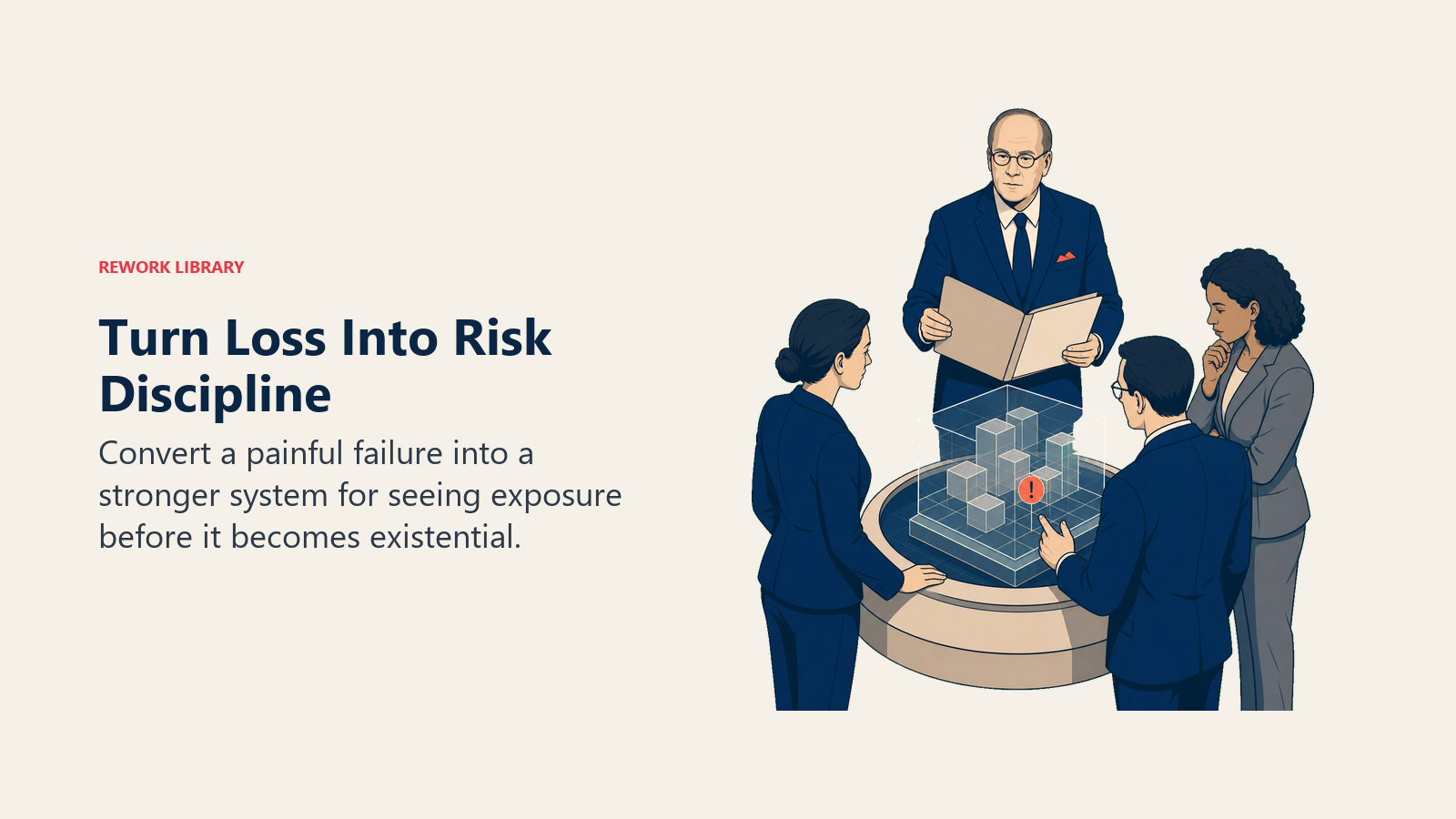
Most people in that position would have looked for a similar role at a competitor bank. Fink co-founded BlackRock in 1988 with 7 other partners, operated out of a single room at Blackstone Group's offices (under a sub-lease), and built the firm around the one insight the First Boston debacle had burned into him: risk management has to be quantitative, transparent, and institutional, not intuitive.
That origin story matters because it explains Aladdin. Fink didn't build a risk platform because it seemed like a good product opportunity. He built it because he'd experienced firsthand what happens when major institutions fly blind on risk exposure. The product was the lesson.
For today's leaders: your most important strategic insight is probably sitting inside a failure you don't talk about publicly. The question is whether you've actually built something from it or just moved on.
2. Acquiring Barclays Global Investors and iShares in 2009 for $13.5 Billion
In 2009, the financial crisis had just cratered markets. Barclays needed capital and was selling its investment management arm. Fink paid $13.5 billion for BGI at a time when most firms were in capital preservation mode, not acquisition mode.
The prize was iShares, the world's largest ETF platform. At the time, passive investing was still seen as a niche product for retail investors. Fink bet that it would become the dominant vehicle for institutional asset allocation. He was right. iShares now manages over $3.5 trillion and is the single most profitable business unit inside BlackRock. The ETF industry it helped mainstream now holds more than $10 trillion globally.
The leadership lesson is about timing conviction against consensus. In 2009, the consensus view was to wait. Fink had a thesis about the structural shift toward passive investing that made the wait seem more dangerous than the acquisition. He moved when others couldn't, using a moment of competitor weakness to lock in a position that would be nearly impossible to replicate later.
3. Publishing the 2018 "Purpose" Letter and Shifting the Governance Conversation
Fink's 2018 annual letter was the one that changed the terms of corporate governance debate. He wrote directly to CEOs that every company needed to demonstrate "a purpose beyond profit" and that BlackRock would scrutinize governance, diversity, and environmental strategy in its voting decisions. Fink's annual CEO letters from 2012 onward are publicly archived and worth reading as a sequence to see how the position evolved.
The letter was specific enough to be credible: BlackRock backed it with actual proxy votes against companies it felt weren't engaging on these dimensions. That combination, public commitment plus visible follow-through, made the 2018 letter different from typical corporate social responsibility positioning.
But the 2023-2024 retreat from ESG language under political pressure revealed a structural tension Fink hadn't fully resolved: you can't use your AUM as a policy lever without becoming a political target. The Texas pension fund divestment ($8.5 billion pulled from BlackRock strategies in 2022) was the first major test of whether political pressure could override institutional conviction. Fink's response suggested it could. That damaged credibility on both sides of the debate and is probably the most studied aspect of his leadership in business schools right now.
What Fink Would Do in Your Role
If you're a CEO, the platform strategy lesson is directly transferable even if you're not managing $10 trillion. Fink built BlackRock's moat not just through fund performance but through infrastructure dependency, Aladdin sits inside competitors' risk systems. Ask whether your company has a platform component that creates switching costs independent of your core product. If you're a SaaS business, that might be your API layer or data integrations. If you're a services firm, it might be the proprietary methodology your clients have built internal processes around. That's the layer worth investing in.
If you're a COO, the BGI acquisition is a case study in operational integration at scale. Merging two asset managers with different cultures, different technology platforms, and different product philosophies is brutal. Fink maintained operational coherence through that integration partly by being explicit about which elements of BlackRock's culture were non-negotiable and which were flexible. Clarity on non-negotiables during M&A integration is the difference between strategic acquisitions and expensive distractions.
If you're a product leader, the Aladdin model is worth studying for how to build something clients can't leave. It's not just features, it's workflow integration so deep that removing the product would require rebuilding internal processes from scratch. That's the goal of every enterprise product, but few achieve it. The mechanism is usually data, the product becomes indispensable because it holds institutional memory or analytical history that's expensive to reproduce.
If you're a sales or marketing leader, the annual letter model shows how consistent public positioning builds institutional authority over time. Fink didn't build BlackRock's influence through advertising. He built it through 12+ years of publishing well-reasoned positions that turned out to be directionally right more often than not. For sales leaders, the analog is thought leadership that actually takes positions, not white papers full of "it depends," but genuine arguments about where a market or industry is going. That's how you build credibility with buyers before they're actively buying.
How Rework Supports a Fink-Style Operating Model
Fink's leadership rests on two mechanics most companies struggle to execute: long-horizon capital discipline and operations that visibly serve more than one stakeholder group at a time. That second piece is where most executive teams quietly fall apart, the CRM serves sales, the project tool serves ops, the chat tool serves internal collaboration, and nobody can produce a single view of how a decision affects customers, employees, and partners together. Rework unifies CRM and sales operations with work operations on one record layer, so a board-level question like "how are we tracking against our stated commitments to employees, customers, and shareholders this quarter?" is answerable without a consultant. Long-horizon leadership needs infrastructure that makes stakeholder-balanced decisions observable, not framed in an annual letter after the fact, but visible in the day-to-day operating cadence. Rework is built for that operating posture.
Notable Quotes & Lessons Beyond the Boardroom
"We need to be more demanding of our portfolio companies, but we also need to be better at explaining what we're asking for and why." Fink said this in internal contexts as BlackRock's ESG push accelerated. It reflects a leadership tension he navigated poorly in the end: you can push for accountability as a large shareholder, but if the ask is ambiguous or seems ideological rather than financial, the political response is harder to manage.
"I don't like the word ESG." Fink said this in 2023 when the political cost of the terminology became clear. The statement was meant to reframe BlackRock's position as purely financial, not ideological. Whether you read that as pragmatism or retreat depends on your priors. What's unambiguously true is that leading with values-based positioning creates a different kind of risk than leading with financial positioning, and Fink discovered that risk later than he should have.
That dynamic has a direct parallel in banking. Jamie Dimon's stakeholder navigation at JPMorgan shows what it looks like when a systemically important institution manages political exposure more carefully, Dimon rarely commits to positions that can be used against him by either side. On the capital allocation side, Warren Buffett's long-horizon discipline offers a useful contrast: Buffett builds his moat through concentrated patience rather than institutional scale, which makes his position less politically exposed. And Ruth Porat's discipline-imposing finance leadership at Alphabet illustrates what happens when financial architecture becomes a credibility asset rather than a political liability.
The management lesson from BlackRock's ESG episode: when your public position becomes a political target, the question isn't whether to retreat but whether the retreat itself damages your credibility more than the position did. For Fink, the retreat from ESG language appears to have cost trust on both sides. That's the classic outcome of a values position held inconsistently under pressure.
Where This Style Breaks
Fink's influence model depends entirely on AUM scale. When you vote at 15,000 companies' annual meetings, your letter gets read. Most leaders don't have that lever. Borrowing the "lead through public positioning" approach without the institutional weight behind it produces thought leadership nobody acts on.
The ESG retreat also exposed a structural problem with using capital as a policy tool when you have fiduciary obligations to clients with diverse political views. BlackRock's clients include state pension funds managed by both progressive and conservative administrations. Fink tried to thread a needle, push corporate behavior on climate while maintaining fiduciary neutrality, and discovered the needle was smaller than he thought.
The deeper lesson: institutional authority and political authority are different things, and they erode differently. AUM protects institutional authority. Nothing fully protects political authority once it becomes a target.
Frequently Asked Questions about Larry Fink's Leadership
Who is Larry Fink?
Larry Fink (born 1952) is the co-founder, Chairman, and CEO of BlackRock, the world's largest asset manager. He founded the firm in 1988 with seven partners inside Blackstone Group and has led it continuously since, making him one of the longest-serving CEOs in global finance.
How big is BlackRock under Fink?
BlackRock manages more than $10 trillion in assets under management, making it the largest asset manager in the world. Its Aladdin risk platform analyzes risk for roughly $21 trillion in assets across BlackRock and external clients, including competitor firms, giving the company deep infrastructure influence beyond its own AUM.
What are Fink's annual letters to CEOs about?
Since 2012, Fink has published an annual letter addressed to the CEOs of BlackRock's portfolio companies. The letters set expectations on long-termism, corporate purpose, board diversity, governance, and climate risk, and BlackRock backed them with actual proxy votes at thousands of annual meetings. The 2018 "Purpose" letter is widely viewed as the one that shifted mainstream corporate governance debate.
What is stakeholder capitalism per Fink?
Fink's version of stakeholder capitalism argues that long-term financial returns depend on companies serving customers, employees, communities, and the environment, not only shareholders. He positioned this as a financial thesis, not a social one: ignoring stakeholders is itself a source of risk that prudent fiduciaries should price in.
Why did Fink modulate on ESG?
Starting in 2022, Republican state attorneys general organized campaigns against ESG investing, and states including Texas and Florida pulled billions from BlackRock (Texas divested $8.5B in 2022). By 2023, Fink publicly said he no longer used the word "ESG," reframing BlackRock's work as purely financial rather than ideological. The modulation was a pragmatic response to political and client-concentration risk, and it cost credibility with both progressive and conservative audiences.
What can executives learn from Larry Fink?
Three lessons stand out: build platform infrastructure (like Aladdin) that creates switching costs independent of product performance; use consistent written public positioning to compound institutional authority over time; and understand that values-based leadership without political durability is fragile, once a stated position becomes a target, retreat under pressure damages credibility more than the original position did.
Learn More

On this page
- The Stakeholder Capitalism Doctrine (The Fink Annual Letter Model)
- Leadership Style Breakdown
- Key Leadership Traits
- The 3 Decisions That Defined Fink as a Leader
- 1. Leaving First Boston After a $100M Loss and Starting BlackRock with 8 People
- 2. Acquiring Barclays Global Investors and iShares in 2009 for $13.5 Billion
- 3. Publishing the 2018 "Purpose" Letter and Shifting the Governance Conversation
- What Fink Would Do in Your Role
- How Rework Supports a Fink-Style Operating Model
- Notable Quotes & Lessons Beyond the Boardroom
- Where This Style Breaks
- Learn More