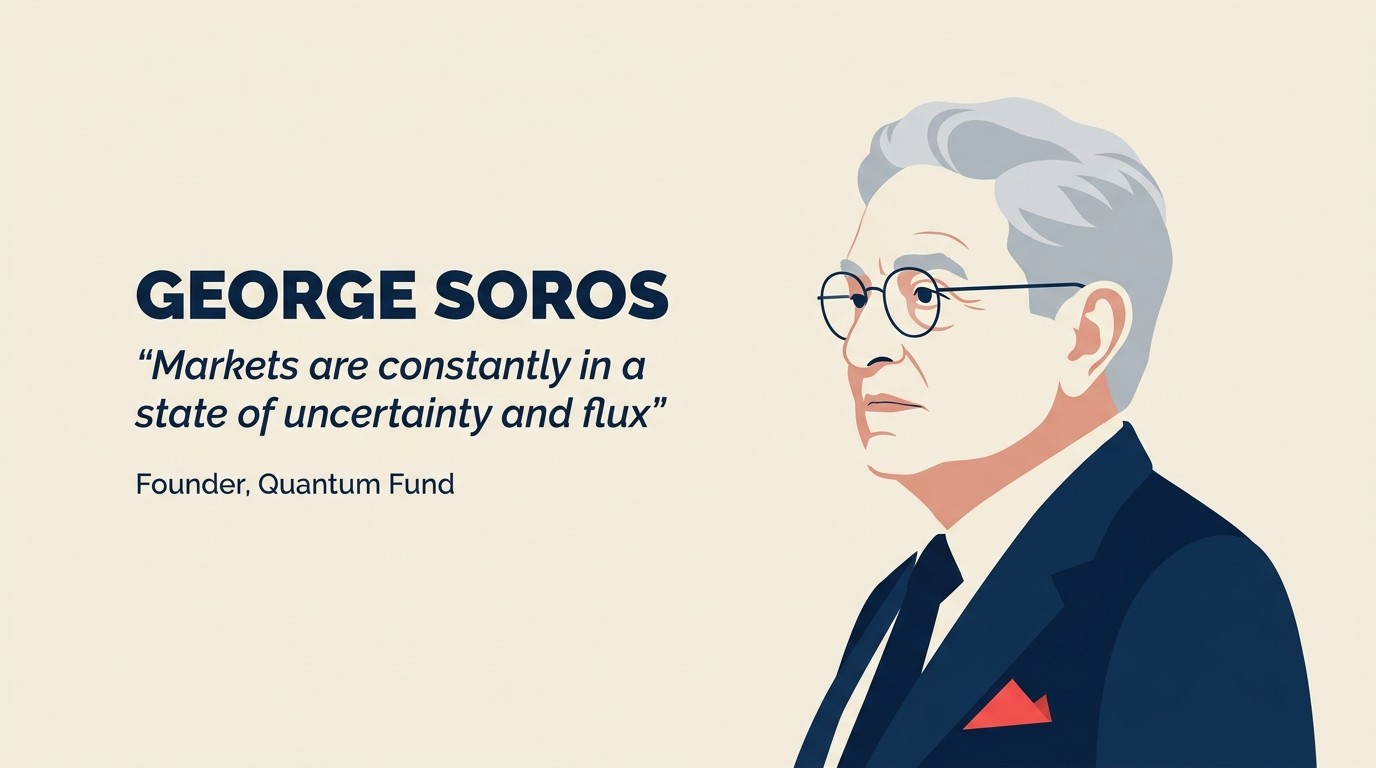
George Soros Leadership Style: Reflexivity Theory, Breaking the Bank of England, and What Hedge Fund Thinking Teaches Operators About Risk
Turn this article into takeaways for your work.


Each assistant summarizes the article only for you and suggests best practices for your work.
Key Facts: George Soros (b. 1930, Budapest) is a Hungarian-born Holocaust survivor who emigrated to London in 1947 and studied under philosopher Karl Popper at the London School of Economics. He co-founded the Quantum Fund in 1969 (launched under the Soros name in 1973), which delivered ~30% average annual returns for three decades. On September 16, 1992, "Black Wednesday", he shorted $10B in British pounds for $1B+ profit, forcing the UK out of the European Exchange Rate Mechanism. He founded the Open Society Foundations in 1979, has donated more than $32B to democracy and civil society causes across 120+ countries, and authored "The Alchemy of Finance" (1987), which introduced his reflexivity theory.
The Reflexivity Doctrine (The Soros Conviction Principle)
The Reflexivity Doctrine is the principle that market prices don't passively reflect fundamentals, they actively shape them through a self-reinforcing feedback loop between biased participant perception and underlying reality. The Soros Conviction Principle is the operational corollary: when rigorous analysis identifies a structural gap between consensus and reality, size the position in proportion to conviction rather than comfort, and hold through mark-to-market volatility until the gap forces a resolution.

On September 16, 1992, George Soros's Quantum Fund shorted $10 billion worth of British pounds. The British government spent the day defending sterling, raising interest rates twice in a single afternoon, burning through foreign currency reserves, and ultimately forcing a decision that no government wants to make. By midnight, the UK withdrew from the European Exchange Rate Mechanism. Soros made roughly $1 billion in profit. The day became known as Black Wednesday, and it's the most famous single trade in financial history.
Not because of the size. There have been larger trades. Because of the structure. Soros correctly identified that the UK government's commitment to a fixed exchange rate was structurally unsustainable, that the political will to sustain it at the required interest rate cost didn't exist, and that the market consensus was still pricing sterling as if that commitment were credible. He acted before the consensus caught up. He sized the position at a scale that made the bet worth making. And he held it through significant mark-to-market volatility until the thesis played out.
The framework he used to reach that conclusion is called reflexivity: the idea that market prices don't just reflect fundamentals, they actively shape them. The feedback loop between perception and reality is visible in every market bubble, every competitive industry cycle, and every moment when the gap between what people believe and what's actually true becomes wide enough to exploit. If you make decisions under uncertainty (which is the job description of everyone this profile is written for), Soros's model of how markets work is worth understanding.
Leadership Style Breakdown
| Style | Weight | How it showed up |
|---|---|---|
| Macro Theorist-Operator | 65% | Soros built his investment career on a specific intellectual framework, reflexivity, and applied it consistently to global macroeconomic positions for 30+ years. His value wasn't in better data or faster execution. It was in a theory of how markets behave that was more accurate than the efficient market hypothesis dominating academic finance during the same period. The Quantum Fund's ~30% average annual return from 1970 to 2000 is the performance record of a systematic framework applied with conviction, not a streak of fortunate guesses. |
| Contrarian Risk-Taker Under Conviction | 35% | The Black Wednesday trade is the clearest expression of this dimension. Soros was betting against a sovereign government's stated commitment. That requires a specific kind of institutional courage, the willingness to hold a position that looks wrong until the moment it's obviously right, while absorbing the mark-to-market losses and institutional skepticism in between. His contrarian instinct was always theory-driven, not contrarian for its own sake. He wasn't short sterling because he wanted to be different. He was short because his reflexivity analysis showed a structural misalignment between the UK's ERM commitment and its domestic economic constraints. |
The 65/35 split reflects the actual operating structure. Soros is primarily a framework operator. The theory comes first, then the position. The contrarian dimension is what's required to act on a framework when the market consensus is on the other side. Those two things are inseparable in his track record.
Key Leadership Traits
| Trait | Rating | What it means in practice |
|---|---|---|
| Identifying Structural Mispricings Before Consensus | Exceptional | Soros's edge in financial markets was the ability to recognize when market prices had diverged from underlying fundamentals due to participants' biased perceptions, and to identify this divergence before the consensus did. The Black Wednesday trade is the clearest example: sterling was mispriced because market participants were treating the UK government's ERM commitment as credible when the economic math made it unsustainable. Finding those gaps between perception and reality, and acting before consensus recognition, is the core of his performance record. |
| Intellectual Framework Discipline | Very High | Soros applied reflexivity as a consistent analytical lens for 30+ years. He didn't rotate between frameworks based on market conditions. He used reflexivity to analyze boom-bust cycles, currency crises, and political transitions with the same underlying logic. That consistency is what made his framework a durable edge rather than a lucky streak. For operators, the lesson is in the discipline of maintaining a coherent analytical framework through periods when the market (or the competitive environment) appears to contradict it. |
| Position Sizing Under High-Conviction | Exceptional | The $10 billion sterling short is also a position-sizing story. Soros's willingness to size positions at levels that would force the thesis to resolve, rather than small enough to survive being wrong indefinitely, is a specific risk management philosophy. His framework: when conviction is genuinely high and the analysis is rigorous, under-sizing is as costly as over-sizing. Most decision-makers under-bet their best ideas because institutional and psychological factors push toward consensus positioning. |
| Acting Against Institutional and Political Pressure | Very High | Soros shorted the currency of one of the world's largest economies while that government was publicly committed to defending it. In 1997, he maintained positions in Asian currencies through explicit political attacks from Malaysian Prime Minister Mahathir Mohammed, who publicly blamed Soros for the regional financial crisis. Ray Dalio faced the same kind of institutional pressure in different form, his radical transparency principles and his willingness to publish macroeconomic frameworks that contradicted central bank consensus required a similar ability to separate analytical conviction from social environment. The ability to hold positions under that kind of pressure requires separating the analytical case from the social environment in which it's being made. That's a cognitive skill with direct applications for executives making unpopular strategic bets. |
The 3 Decisions That Defined George Soros
1. Founding the Quantum Fund in 1969: Building Reflexivity Into a Track Record
Soros grew up in Budapest, survived the Nazi occupation as a teenager through a combination of forged papers and his father's resourcefulness, emigrated to London in 1947, and studied at the London School of Economics under Karl Popper, the philosopher who wrote "The Open Society and Its Enemies" and developed the epistemological framework that Soros would later adapt into reflexivity theory.
Popper's argument was that knowledge is always provisional, that our theories about the world are hypotheses that can be falsified but never finally confirmed, and that progress comes through the willingness to test beliefs against reality and update them when the evidence demands it. Soros took that epistemology into financial markets. His conclusion: if all market participants are operating on imperfect and biased perceptions of reality, then the prices they produce don't accurately reflect fundamentals. They reflect the consensus of those imperfect perceptions. And consensus perceptions can diverge dramatically from underlying reality for extended periods.
He co-founded the Quantum Fund in 1969 with Jim Rogers. The fund used a global macro strategy (trading currencies, commodities, equities, and bonds across multiple countries based on macroeconomic analysis) that was unusual for the period. From 1970 to 2000, it reportedly returned approximately 30% average annual return, one of the best 30-year track records in investment history.
But the Quantum Fund's performance record isn't the most useful thing about it for non-finance operators. The useful thing is the operating model: build an explicit analytical framework, apply it consistently to identify gaps between market consensus and structural reality, size positions in proportion to conviction, and maintain the positions through the noise until the thesis resolves. That model applies anywhere decisions are made under uncertainty with incomplete information and competing interpretations.
The reflexivity framework itself: market participants' perceptions are biased by their interests, cognitive limitations, and social environment. It's worth contrasting this with Warren Buffett's buy-and-hold philosophy: where Buffett trusts that underlying business quality surfaces over time, Soros treats the gap between perception and reality as the tradeable event, both approaches acknowledge market inefficiency, but they exploit it on completely different time horizons. Those perceptions influence their behavior. That behavior influences prices. Those prices feed back into the information environment that shapes the next round of perceptions. The cycle is self-reinforcing in both directions: biased optimism drives prices up, which validates the optimism, which drives prices further up, until the divergence from fundamentals becomes unsustainable. The same cycle runs in reverse on the way down.
This isn't just a market theory. It describes how competitive advantages get overbuilt, how technology adoption curves accelerate past rational adoption rates, and how management consensus about a strategy can persist long after the strategy has stopped working.
2. Black Wednesday: The Anatomy of a High-Conviction Bet Against a Sovereign
In 1992, the UK was a member of the European Exchange Rate Mechanism, which required it to maintain sterling within a specific band relative to the German Deutsche Mark. The problem: German interest rates were high following reunification, and UK interest rates needed to be low to support a domestic economy in recession. Maintaining the ERM peg required UK rates to stay high enough to attract capital, but the domestic economy couldn't absorb that rate level without significant damage.
Soros's analysis: the UK government's commitment to the ERM peg was structurally unsustainable. The political cost of the interest rates required to defend it exceeded the political cost of withdrawal. The question was timing, not direction. He built a short position in sterling worth approximately $10 billion, funded partly through borrowed pounds he immediately converted to Deutsche Marks and other currencies.
On September 16, 1992, the UK government raised interest rates from 10% to 12% in the morning to defend sterling. It worked for hours. By afternoon, with the reserves depleting and no visible effect on the pound's decline, the government announced another rate hike to 15%. It never took effect. By evening, the UK withdrew from the ERM. Sterling fell sharply. Soros's position converted back to pounds at the lower rate, producing approximately $1 billion in profit in a single day.
The decision anatomy is worth studying independently of the specific trade. Soros's process: identify a structural constraint that limits the opponent's options. Identify the commitment they've publicly made that the structural constraint makes unsustainable. Build conviction about the direction, not just the timing. Size the position based on conviction. Hold through the resistance.
For operators, the analog isn't currency trading. It's the moment when you can see that a competitor's current strategy is structurally unsustainable: their cost structure, their customer economics, their technology choices, or their market positioning has created a constraint they can't sustain indefinitely. Soros's framework says: if you can correctly identify that constraint and size your strategic bet accordingly, you don't need to predict the exact timing of the resolution. The structural reality will eventually force the issue.
3. Open Society Foundations: Applying Investment Discipline to Philanthropy
Soros began his philanthropic work in 1984, before he was globally famous, by supporting student exchanges and photocopiers in Soviet-bloc countries. The photocopiers mattered: in a system where information was controlled by the state, access to copying technology was a genuine civil liberties issue. He was thinking about information access and open discourse before those were recognized as strategic levers.
By 2026, the Open Society Foundations (named explicitly for Popper's framework) has committed more than $32 billion cumulatively to democracy, civil liberties, anti-authoritarian governance, and civil society organizations in more than 120 countries. It's one of the largest private philanthropic operations in history.
The connection between his investment philosophy and his philanthropy isn't incidental. Reflexivity theory describes how self-reinforcing feedback loops create boom-bust cycles. In financial markets, those cycles produce economic crises. In political systems, they produce authoritarianism: biased perceptions of threat justify restrictions on information and dissent, those restrictions produce more biased information, which justifies more restrictions, until the system collapses under the weight of its own unreality.
Soros's philanthropic theory is that open societies (with free press, independent courts, competitive elections, and civil society) are more stable over time because they have error-correction mechanisms. Closed societies are more fragile because they don't. His investment in democratic institutions is reflexivity theory applied to political systems.
The controversy around Open Society is real and worth addressing directly. Soros has been the target of intense political opposition: from Viktor Orbán's government in Hungary (his birth country), from nationalist movements across Eastern Europe, and from segments of the American right. The opposition frequently includes anti-Semitic conspiracy theories about his philanthropic influence. That political targeting has made it harder for the substantive arguments about democratic institutions to be evaluated on their merits. For operators analyzing his investment philosophy, the lesson is to separate the analytical framework from the controversy surrounding the person who developed it.
What George Soros Would Do in Your Role
If you're a CEO, reflexivity theory has a direct application to how you read your own competitive position. Ask: what beliefs does my market currently hold about our industry that might be driving behavior disconnected from underlying fundamentals? Where is the consensus wrong? The companies that have created the most durable competitive advantages in the last decade (in cloud, in direct-to-consumer brands, in platform businesses) were often built by founders who correctly identified a gap between market consensus and structural reality and acted before that gap closed.

If you're a COO, the position-sizing principle has an operations analog. When you have high conviction about a strategic change (a process redesign, a technology transition, a supplier shift), under-resourcing it is as costly as over-resourcing it. The most common operational failure mode isn't betting on the wrong thing. It's correctly identifying the right thing and then resourcing it at a level that makes success unlikely. Soros's framework says: when conviction is high and analysis is rigorous, size the bet accordingly.
If you're leading product, reflexivity describes the technology adoption cycle better than most S-curve frameworks. Early adopters' use of a technology changes the technology, through feedback, feature requests, and use cases the designers didn't anticipate. That change attracts more users. Those users change it further. The gap between what the technology can do and what the mainstream market believes it can do is the space where the next generation of products gets built. Find that gap.
If you're in sales or marketing, the Black Wednesday lesson translates to competitive positioning. Identify the structural constraint in your largest competitor's current strategy: their cost structure, their go-to-market model, their technology architecture. Build your sales narrative around that constraint. The best competitive positioning isn't "we're better than them on features X and Y." It's "their current model requires them to make tradeoffs that our model doesn't, and here's how that plays out when you're three years into the relationship."
How Rework Supports Reflexivity-Driven Decision Making
Soros's framework demands that leaders hold multiple scenarios in mind simultaneously, the consensus view, the structural reality, and the timing of the gap's resolution. During macro uncertainty, that cognitive load gets distributed across cross-functional teams: finance models the cost structure, sales tracks competitor customer economics, product watches adoption curves, ops monitors supplier exposure. Rework gives those teams a shared operating surface for scenario planning: custom pipelines per thesis, cross-team dashboards that surface when sales data contradicts the finance model, and work ops workflows that let you run three versions of a strategic plan in parallel without duplicating the org. When a CEO commits to a high-conviction bet the way Soros committed to shorting sterling, the limiting factor is usually not conviction. It's the organization's ability to execute the bet while staying open to the signals that would falsify it. Rework's cross-functional visibility is the infrastructure for reflexivity at the company level, positioning during uncertainty without losing the ability to update when the market tells you you're wrong.
Notable Quotes and Lessons Beyond the Boardroom
Soros has been unusually transparent about his analytical framework, including its limitations. "I'm only rich because I know when I'm wrong." This is the most honest statement in his body of public work. His edge isn't being right more often than others. It's recognizing when his thesis has been falsified and updating quickly rather than defending the position.
On reflexivity, in plain language: "Financial markets, far from accurately reflecting all the available knowledge, always provide a distorted view of reality. The extent of the distortion may vary from time to time. Sometimes it's quite insignificant, at other times it is quite pronounced." The practical implication for operators: the prices your market assigns to things (company valuations, product category growth rates, talent costs) are always some mixture of reality and consensus bias. The question is how large the bias is at any given moment.
Soros's personal history also contains a leadership lesson that has nothing to do with finance. He survived Nazi-occupied Budapest as a teenager through his father's combination of forged documents, paid protections, and the willingness to improvise under conditions of genuine life-or-death uncertainty. His later comfort with uncertainty, his ability to hold a position through intense volatility and institutional pressure, has roots in a formative experience that would condition anyone to distinguish between discomfort and actual danger.
Where This Style Breaks
Reflexivity is a diagnostic framework, not a predictive one. Soros has been wrong repeatedly: on trades, on political outcomes he positioned around, on the timing of market corrections he correctly identified in structure but misjudged in timing. Carl Icahn's activist approach shares the same structural-bet logic, identify a company whose current management is underperforming the underlying asset value, force a correction, but where Soros trades macro cycles with liquid instruments, Icahn takes concentrated equity positions and forces the resolution through shareholder pressure rather than market momentum. And Cathie Wood's thesis-driven conviction investing offers a more recent expression of the same high-conviction framework: build a narrative about structural change, size accordingly, and hold through the volatility that comes before the thesis resolves. He's acknowledged significant losses across his career and has written about the difference between having the right thesis and having the right thesis at the right moment.
His framework requires an unusually high tolerance for mark-to-market losses while waiting for a thesis to resolve. Most institutional investors and most corporate decision-makers don't have that tolerance, either because their governance structure doesn't allow it or because the psychological pressure of being wrong on paper is more than they can sustain. Soros's approach works when the framework is right and the position can survive the wait. It fails when liquidity forces a position close before the thesis resolves.
The political dimension of his philanthropic work has also made his investment philosophy harder to evaluate on its merits than it should be. Some operators dismiss reflexivity because of the politics, which means they're making an analytical error for social reasons. Others overcredit the framework because they share his political views, which is the same error in the opposite direction. The framework stands on its own. Evaluate it that way.
Frequently Asked Questions about George Soros's Leadership
Who is George Soros?
George Soros (b. 1930) is a Hungarian-born American investor and philanthropist. He survived Nazi-occupied Budapest as a teenager, emigrated to London in 1947, studied under Karl Popper at the LSE, and co-founded the Quantum Fund in 1969. The fund became one of the most successful hedge funds in history, and Soros has since donated more than $32 billion to democratic and civil society causes through the Open Society Foundations.
What is reflexivity theory?
Reflexivity is Soros's framework (adapted from Karl Popper's epistemology) that market prices don't just reflect fundamentals, they actively shape them through a feedback loop between biased perceptions and underlying reality. Rising prices validate optimism, which drives more buying, which drives prices further from fundamentals until the divergence becomes unsustainable. Soros introduced the theory in his 1987 book "The Alchemy of Finance."
How did Soros break the Bank of England?
On September 16, 1992, known as Black Wednesday, Soros's Quantum Fund shorted approximately $10 billion in British pounds. His reflexivity analysis had concluded that the UK's commitment to the European Exchange Rate Mechanism was structurally unsustainable given German interest rates and the UK's domestic recession. The UK burned through reserves and raised rates from 10% to 12% to 15% in a single day before withdrawing from the ERM. Soros made roughly $1 billion in profit.
What is the Open Society Foundations?
Open Society Foundations is the philanthropic network Soros founded in 1979, named after Karl Popper's "The Open Society and Its Enemies." It funds democratic institutions, independent media, civil liberties, and anti-authoritarian governance in more than 120 countries. By 2026, it has committed more than $32 billion cumulatively, making it one of the largest private philanthropic operations in history.
What is Soros's approach to risk?
Soros treats risk through position-sizing tied to conviction: when rigorous analysis identifies a genuine structural gap, under-sizing is as costly as over-sizing. He sized the Black Wednesday short at $10 billion, large enough to force the thesis to resolve rather than small enough to merely survive being wrong. The discipline that makes the risk survivable is rapid updating, "I'm only rich because I know when I'm wrong", so he closes losing positions quickly rather than defending them.
What can investors and executives learn from George Soros?
Three lessons: first, maintain a consistent analytical framework (Soros applied reflexivity for 30+ years across currencies, equities, and political systems). Second, identify gaps between market consensus and structural reality, then act before the consensus catches up. Third, recognize quickly when you're wrong, Soros's own quote is "I'm only rich because I know when I'm wrong." The framework is diagnostic, not predictive, so update aggressively when evidence contradicts the thesis.
Learn More

On this page
- The Reflexivity Doctrine (The Soros Conviction Principle)
- Leadership Style Breakdown
- Key Leadership Traits
- The 3 Decisions That Defined George Soros
- 1. Founding the Quantum Fund in 1969: Building Reflexivity Into a Track Record
- 2. Black Wednesday: The Anatomy of a High-Conviction Bet Against a Sovereign
- 3. Open Society Foundations: Applying Investment Discipline to Philanthropy
- What George Soros Would Do in Your Role
- How Rework Supports Reflexivity-Driven Decision Making
- Notable Quotes and Lessons Beyond the Boardroom
- Where This Style Breaks
- Learn More