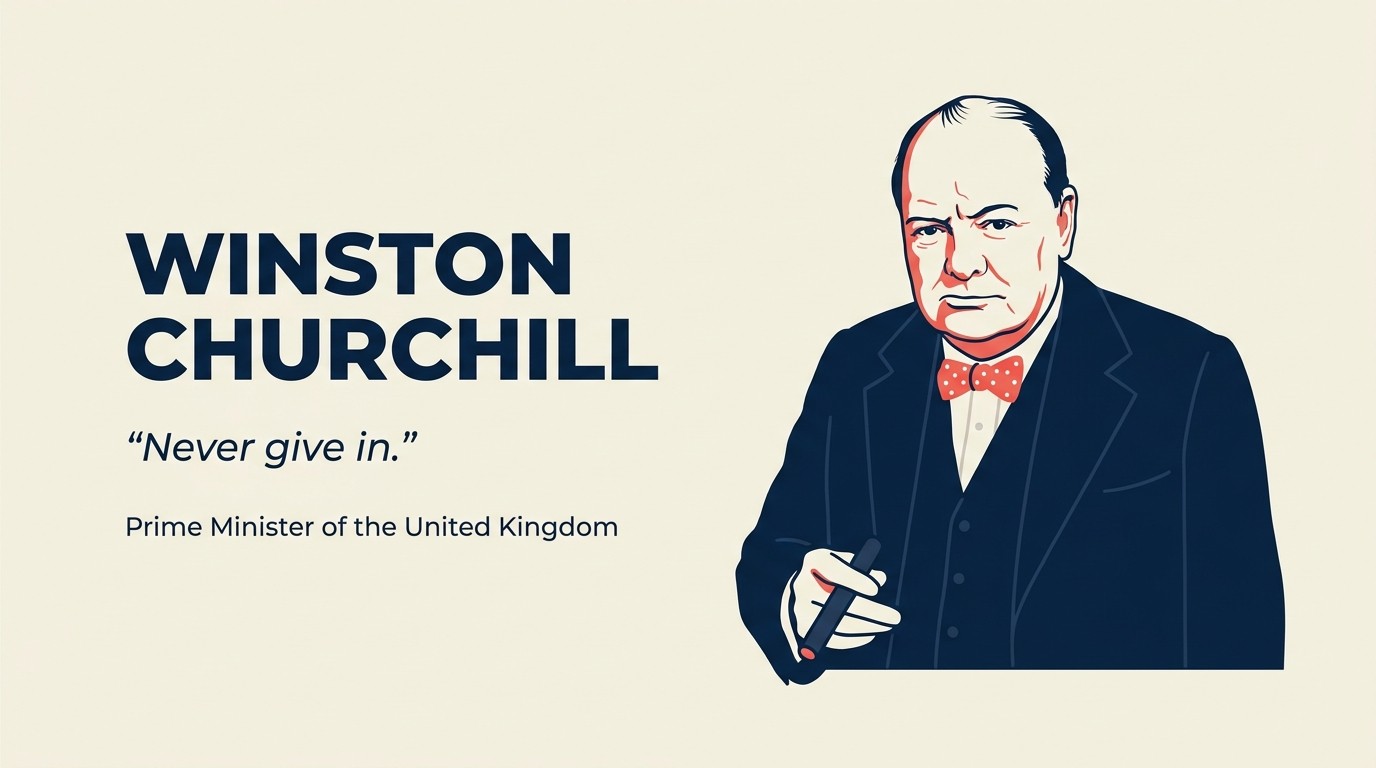
Winston Churchill Leadership Style: Wartime Conviction and the Rhetoric of Resolve
Turn this article into takeaways for your work.


Each assistant summarizes the article only for you and suggests best practices for your work.
Key Facts: Winston Churchill (1874-1965) served as UK Prime Minister twice, 1940-45 (wartime) and 1951-55, and led Britain through World War II. He was awarded the Nobel Prize in Literature in 1953 for his historical writing and oratory, and wrote 43+ books including the four-volume "A History of the English-Speaking Peoples" (1956-58) and the six-volume "The Second World War." His most famous speeches include "We shall fight on the beaches" (June 4, 1940) and "Blood, toil, tears and sweat" (May 13, 1940). His "Iron Curtain" speech, delivered March 5, 1946 at Westminster College in Fulton, Missouri, named the emerging Cold War divide and reshaped Western strategic thinking for the next 40 years.
The Conviction Under Pressure Doctrine
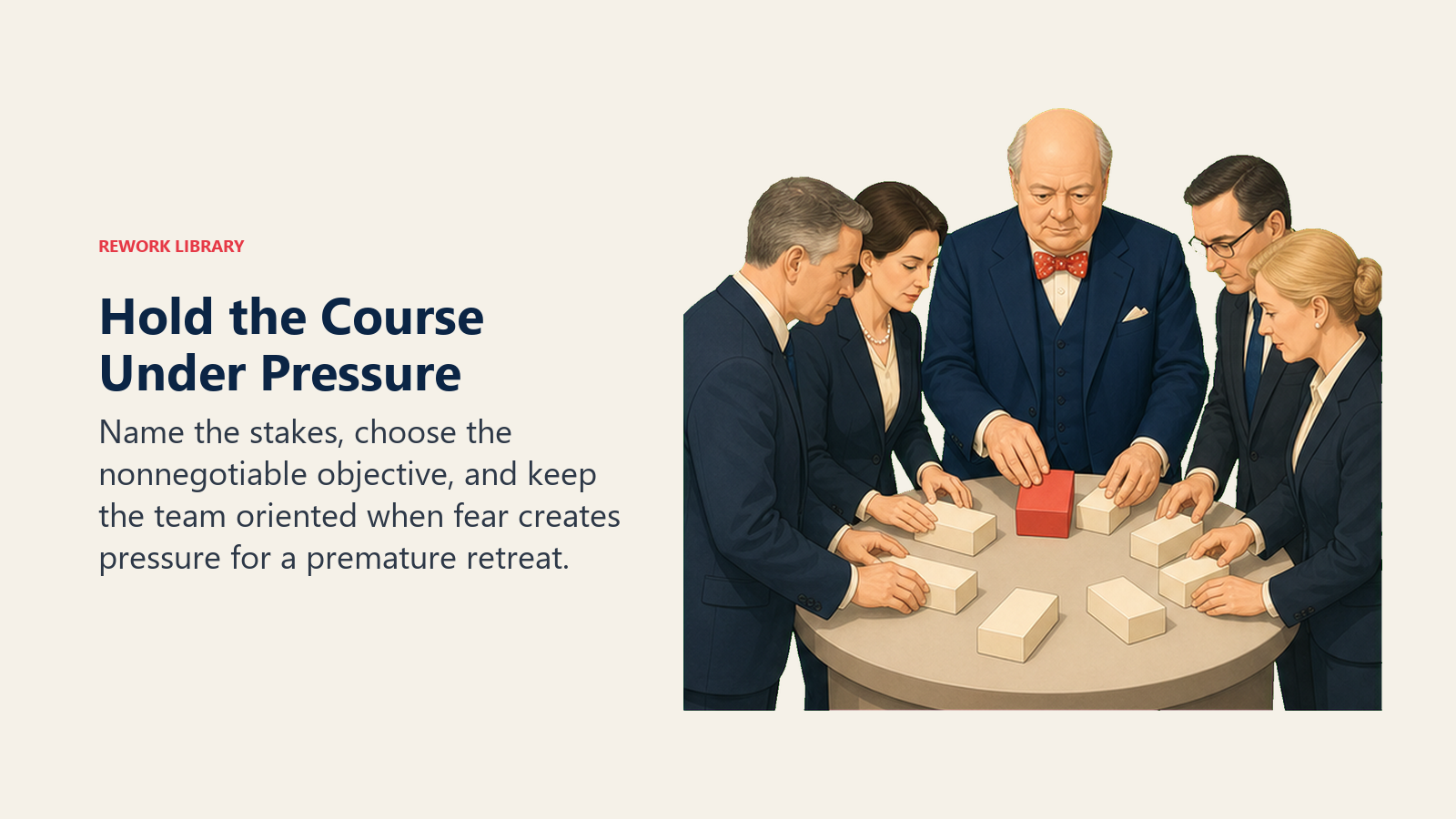
The Churchill Rhetorical Leadership Model holds that in acute crisis, a leader's most valuable act is to make capitulation politically unavailable before exploration of capitulation begins. Conviction is expressed through rhetoric that names the full cost of the chosen path before asserting the claim, acknowledging the negative completely, then staking the position unconditionally. This structure preempts the listener's counterargument and converts strategic judgment into durable public commitment.
Winston Churchill spent most of the 1930s as a political embarrassment. He'd been a cabinet minister at 33, First Lord of the Admiralty, Chancellor of the Exchequer. He'd held nearly every senior position in British politics. And then, through a combination of misjudgments, Gallipoli foremost among them, and unpopular positions on India, abdication, and the Gold Standard, he had become a liability. His own party didn't want him in the room.
For ten years, while Hitler rearmed Germany in explicit violation of the Versailles Treaty, Churchill gave speeches that nobody wanted to hear. He was right about nearly everything. He was comprehensively ignored.
On May 10, 1940, Germany invaded France. On the same day, Neville Chamberlain resigned and Churchill became Prime Minister at 65. France fell in six weeks. Britain's army was rescued from the beaches of Dunkirk, 338,000 men evacuated across the Channel, most of their equipment abandoned. Churchill's War Cabinet, inside his first week in office, had a serious debate about whether to seek peace terms through Mussolini.
He refused. He was right to refuse. He won the war. Then, in July 1945, four months after V-E Day, the British electorate threw him out of office in a landslide.
That arc, ten years of being right and ignored, five years of being right under maximum pressure, then a democratic rejection at the moment of greatest success, is the most complete leadership case study available to any operator.
Leadership Style Breakdown
| Style | Weight | How it showed up |
|---|---|---|
| Wartime Conviction Leader | 65% | Churchill's defining leadership quality was his ability to hold a position under pressure from every direction simultaneously. In May 1940, with France collapsing, his own cabinet divided, and the British Expeditionary Force trapped, the rational calculation favored negotiation. Lord Halifax, the Foreign Secretary and the man who could have been PM instead of Churchill, argued for exploring terms. Churchill argued that negotiating from weakness would produce worse terms than fighting, and that the act of negotiating would destroy public resolve before a shot was fired. He was right on both counts. The conviction wasn't stubbornness, it was a precise strategic judgment delivered with the force of moral certainty. |
| Grand-Strategy Coalition Builder | 35% | The 35% is what made the conviction sustainable beyond Britain. Churchill understood, from the moment he became PM, that Britain could not win the war alone. The entire 1940-1941 period was an exercise in managing the United States toward involvement without allowing Roosevelt to appear to be manipulated. The Atlantic Charter in August 1941, signed four months before Pearl Harbor, was Churchill's most important diplomatic achievement: a statement of shared war aims that committed both countries to a post-war order before America was technically at war. The coalition weight is also visible in how Churchill managed Stalin, a relationship built entirely on strategic necessity, with no illusions about shared values. |
Those two weights held in tension produce a leader who can be simultaneously immovable on core strategic direction and extremely flexible on tactics and alliances. Churchill didn't compromise on whether to fight. He compromised on almost everything else: who to work with, what promises to make, what to concede at Yalta, how to divide Europe with Stalin in the "percentages agreement." The distinction between strategic conviction and tactical flexibility is the thing most people miss when they try to apply his model.
Key Leadership Traits
| Trait | Rating | What it means in practice |
|---|---|---|
| Rhetoric as a force multiplier | Exceptional | Churchill's speeches changed the material situation of the war. Not as metaphor, literally. His May 13, 1940 speech to Parliament ("blood, toil, tears and sweat") set the moral frame for the entire conflict before a single major battle had been won or lost. The June 1940 "We shall fight on the beaches" speech was delivered to an empty Commons and broadcast via radio, and it shifted public resolve at a moment when the military situation was objectively catastrophic. His oratory didn't just describe the situation. It created a version of the situation that became politically actionable. That's a specific kind of leadership communication that goes beyond messaging or narrative. |
| Tolerance for personal political failure | Very High | Most leaders in Churchill's position after Gallipoli, a campaign he conceived and advocated, which cost 130,000 lives and achieved nothing, would have retired or redirected. He stayed, rebuilt, and came back. The wilderness years (1929-1939) required sustaining a political identity through a decade of irrelevance. He did it by writing, 40+ books and thousands of articles, and by being consistently on record about Germany's rearmament. When history vindicated him, he had a paper trail. For operators, this is a model of playing a long game in public: staying visible, staying on record, staying in the argument even when you don't have institutional support. |
| Coalition management across ego-heavy allies | High | Roosevelt and Stalin were not easy partners. Roosevelt was managing American domestic politics that made formal alliance commitment difficult; Stalin was a mass murderer with specific territorial ambitions in Eastern Europe; de Gaulle was a difficult ally who resented being rescued. Churchill managed all three simultaneously for five years. His approach was deeply personal, he knew that great-power coalitions are held together by personal relationships at the top, not by legal agreements. He traveled constantly, held face-to-face meetings at personal physical cost, and invested in the interpersonal trust that kept the alliance functional when the institutional framework wasn't sufficient. |
| Historical consciousness shaping present decisions | High | Churchill read history obsessively and wrote it himself. His six-volume "The Second World War" won the Nobel Prize in Literature in 1953. That historical frame wasn't just intellectual decoration, it directly shaped his strategic decisions. He chose to fight in 1940 partly because he'd studied enough history to know that declining to fight from a position of weakness rarely produced the negotiated peace its advocates promised. He understood Appeasement as a historical pattern, not just as a political failure. When you see the present moment as part of a longer arc, you make different decisions than when you optimize for the next quarter. |
The 3 Decisions That Defined Churchill
1. Refusing to Negotiate with Hitler in May 1940
The five days between May 24 and May 28, 1940 are the most important five days in Churchill's leadership story and possibly in 20th-century history.
France was being overrun. The British Expeditionary Force was surrounded at Dunkirk. Lord Halifax proposed approaching Mussolini as an intermediary to explore what peace terms Hitler might offer. Churchill's War Cabinet, a small group of five men, debated this seriously over multiple sessions.
Halifax's argument was rational on its face. Britain was in a weak military position. Negotiating now, before the situation got worse, might produce better terms than negotiating later. Churchill's counterargument was strategic and psychological simultaneously: any negotiation from weakness would produce terms that stripped Britain of independence, and the act of entering negotiations would signal to the British public and to America that the fight was effectively over. Once you've shown you're willing to negotiate, you can't credibly threaten to fight instead.
He was also making a prediction about Hitler: that any terms offered would not be honored once Britain was pacified, and that the precedent of capitulation would accelerate the collapse of European resistance. Modern parallels exist: Jamie Dimon at JPMorgan during the 2008 financial crisis made the same structural choice, refuse to appear weak, hold the public line on solvency, and let the institutional confidence that creates become self-fulfilling. The mechanism is identical even if the stakes were different.
Churchill won the War Cabinet argument not through formal authority but through a speech to the full Cabinet of 25 ministers on May 28, in which he made the case directly, ending with "I have thought carefully in these last days whether it was part of my duty to consider entering into negotiations with That Man... and I am convinced that every man of you would rise up and tear me down from my place if I were for one moment to contemplate parley or surrender." The room responded with spontaneous physical expression of support. Halifax's position became untenable.
The leadership lesson: in a crisis, the single most valuable thing a leader can do is prevent the organization from entering a state of negotiated paralysis. The act of exploring options, when the situation is acute enough, can be the mechanism by which the best option (fighting on) becomes politically unavailable. Churchill understood this and acted on it at exactly the right moment.
2. Building the US-UK Alliance Before Pearl Harbor
Churchill became PM knowing that Britain couldn't win the war without American involvement. He also knew that the American public, in 1940, had no interest in a European war. The challenge was to bring America into the conflict without appearing to drag it in, because the moment Americans felt they were being manipulated, the political backlash would push Roosevelt's administration further from intervention.
His strategy had three components. First, build a personal relationship with Roosevelt so strong that Roosevelt would take political risks to help Britain. They exchanged 2,000 letters and telegrams before they ever met in person. Second, demonstrate that Britain could survive independently, that helping Britain was backing a winner, not throwing good money after bad. Third, make the case that British survival was in American strategic interest, not just British interest.
Lend-Lease, passed by Congress in March 1941, was the result: $50B in materiel to Britain and eventually the Soviet Union, charged to a credit account that everyone understood Britain couldn't repay. Roosevelt called it "lending a garden hose to your neighbor whose house is on fire." Churchill called it "the most unsordid act in the history of any nation."
The Atlantic Charter, signed at a secret meeting on a ship off Newfoundland in August 1941, went further: a joint statement of war aims that included self-determination, freedom of seas, and collective security. This was four months before Pearl Harbor. America wasn't at war. Roosevelt was taking a significant domestic political risk to sign it.
Churchill's coalition-building instinct was to give Roosevelt the framework for American involvement before the precipitating event that would make involvement politically easy. When Pearl Harbor came in December 1941, the alliance structure was already built. Churchill's response on hearing the news was reported as: "So we had won after all."
3. Accepting the 1945 Election Defeat
On July 26, 1945, the results of the British general election were announced. Labour won 393 seats. Churchill's Conservative party won 213. The man who had led Britain through its most dangerous five years was voted out of office.
He conceded immediately. He transferred power to Clement Attlee the same day. He made no effort to undermine the result or delay the transition. He gave a brief, dignified statement and left Downing Street.
This is more remarkable than it looks. Churchill had just led the country through a war that cost 450,000 British lives. He was, at that moment, one of the most celebrated figures in the world. He was also 70, in declining health, and had defined his entire political identity around this moment of national survival. To be rejected by the electorate immediately afterward required absorbing a personal humiliation of a kind that very few public figures have been tested by.
His acceptance of the result was a genuine act of democratic faith. He believed in the system that had just ejected him. He served as Leader of the Opposition, wrote his war memoirs, and became Prime Minister again in 1951. He never questioned the 1945 result's legitimacy.
For operators, the democratic acceptance lesson is about the relationship between personal conviction and institutional legitimacy. Churchill was as certain he was right in 1945 as he'd been in 1940. The difference was that in 1940, being right justified overriding the doubters in his cabinet. In 1945, being right didn't justify overriding the democratic process. He knew the difference. That distinction, between the contexts where conviction justifies unilateral action and the contexts where it doesn't, is what separates Churchill from leaders who correctly identify themselves as the smartest person in the room and then act as if that settles every question.
What Churchill Would Do in Your Role
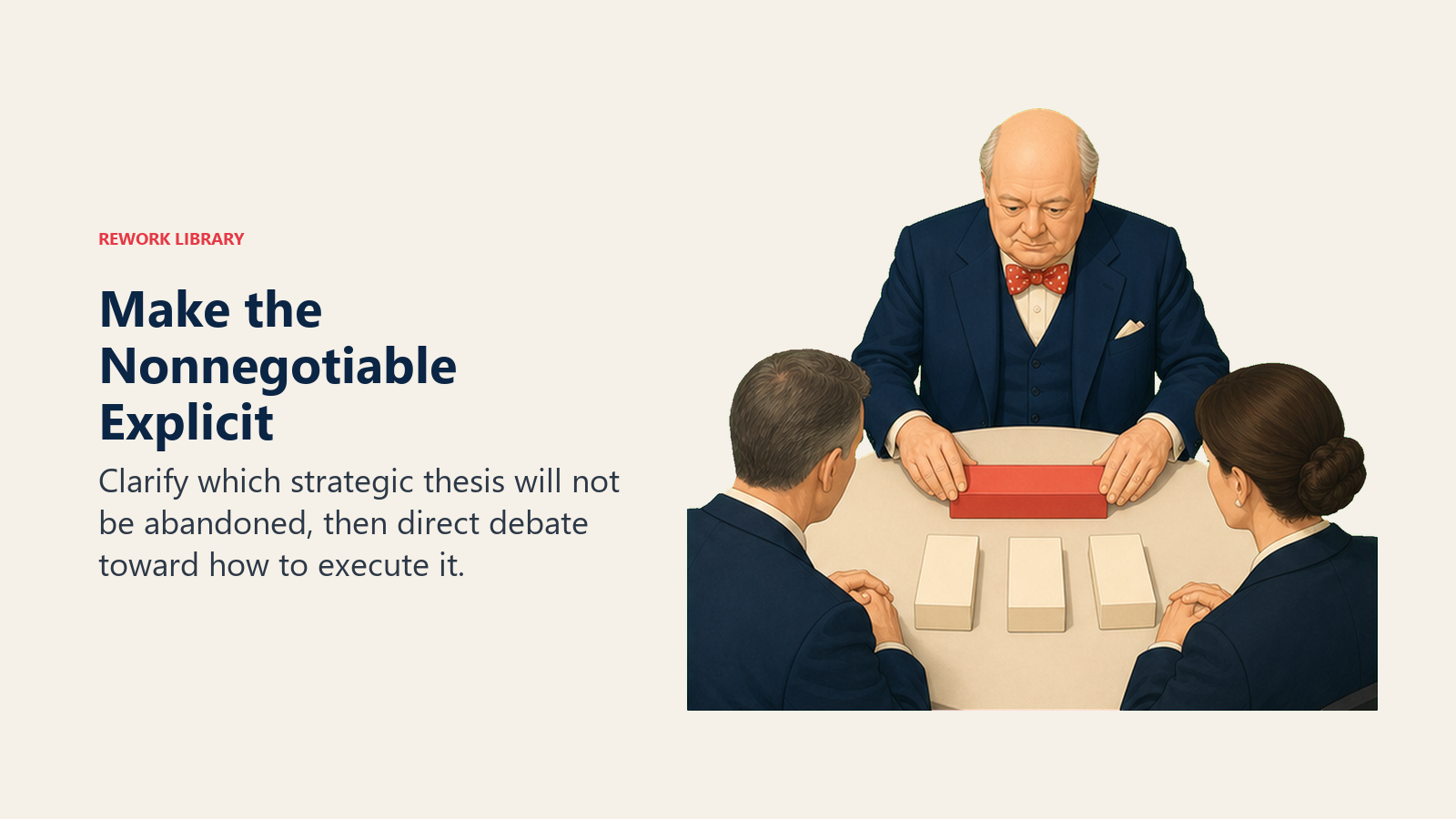
If you're a CEO, the May 1940 War Cabinet is a model for what to do when your organization is under acute pressure and the "rational" options all involve some version of capitulation. The temptation in a crisis is to explore every option, show the board that you're being flexible, keep all doors open. Churchill's insight is that keeping all doors open can be the mechanism by which the best door closes. If you're running a company in a competitive crisis where your core strategic thesis is sound, the most important leadership action may be to make the option of abandoning that thesis politically unavailable, by being unambiguous about what you're not going to do before the negotiation starts.
If you're a COO, the alliance-building strategy between 1940 and 1941 is a model for managing up and across when you need resources or decisions from people who have their own political constraints. Churchill couldn't order Roosevelt to help Britain. He could only make British survival in America's interest and give Roosevelt the political framework to act on that interest. The equivalent for operators: when you need something from an internal stakeholder who has constraints you can't remove, your job is to understand their constraints deeply enough to give them a path to yes that works within those constraints, not to argue that their constraints shouldn't exist.
If you're in product, Churchill's wilderness years (1929-1939) are a model for sustained external communication when you don't have institutional support. He stayed on record, consistently, about a threat that most of the establishment didn't want to hear. When the threat materialized, his prior statements became his credibility. If you're building a product in a market where your thesis is early, where the customer adoption curve is still flat, where the mainstream dismisses the category, your job is to stay on record about why you believe what you believe, in enough specific detail that when the market turns, you've established the intellectual foundation that makes your product the obvious choice for people looking for the early thinking.
If you're in sales or marketing, Churchill's rhetoric is the most studied example in English of language that changes the material situation of a conflict. The specific technique is worth examining: he almost always gave the full weight of the negative before asserting the positive. "We shall fight on the beaches, we shall fight on the landing grounds, we shall fight in the fields and in the streets, we shall fight in the hills; we shall never surrender" doesn't minimize the difficulty. It names the full scope of what's required and then stakes the claim. That structure, acknowledge the real cost completely, then stake the position, is more persuasive than leading with the benefit because it preempts the listener's counterargument before they raise it.
The Rework Angle
Churchill's wartime leadership rested on two mechanisms most modern teams never operationalize: rallying communication that reaches every person simultaneously with the same unambiguous message, and unwavering conviction that holds strategic direction even when tactical noise is overwhelming. Both depend on the organization being aligned enough to hear the message and act on it. Rework is built for the periods when that alignment matters most, when a company is under competitive pressure, a product launch is slipping, or a sales quarter is threatened. The platform unifies CRM, project execution, and team chat in one workspace so leaders can see the full picture, broadcast strategic direction without it getting filtered through five tools, and hold the line on what matters while being flexible on everything else. Starting at $69/month billed yearly for the Sales Engine and $99/month billed yearly for the Project Engine, it's the infrastructure layer that lets conviction-driven leaders actually reach the people executing the work.
Notable Quotes & Lessons Beyond the Boardroom
"We shall fight on the beaches, we shall fight on the landing grounds, we shall fight in the fields and in the streets, we shall fight in the hills; we shall never surrender." June 4, 1940. The speech was given to a House of Commons from which most members had just returned from Dunkirk or received news of its conclusion. Britain had just executed the largest naval evacuation in history because its army had been chased into the sea. Churchill reframed that retreat as a demonstration of survival rather than a military defeat, "Wars are not won by evacuations," he said in the same speech, without letting the audience pretend that Dunkirk was a victory. The combination of unflinching assessment and unconditional commitment is the thing that makes the speech work. Remove either element and it becomes propaganda. Together they produce something that the audience could believe precisely because it didn't ask them to pretend the situation was other than it was.
He also wrote, in the preface to his war memoirs: "I have nothing to offer but blood, toil, tears and sweat." This is from his first speech as PM, May 13, 1940. The sentence is often quoted for its grit. But the management insight is different: he was setting expectations. He was telling the people who had just hired him exactly what the next several years were going to cost. Leaders who give honest assessments of difficulty before they're required to are trusted more and able to ask more when the difficulty arrives than leaders who maintain optimistic framing until circumstances make it untenable. Churchill set that expectation on day one.
Where This Style Breaks
Gallipoli (1915) is the essential counter-case. Churchill conceived and advocated the Dardanelles campaign, an attempt to open a route to Russia through the Ottoman Empire and knock Turkey out of the war. The campaign was poorly planned, poorly executed, and ultimately catastrophic. Over 130,000 Allied soldiers died. The strategic objective was not achieved. Churchill bore significant personal responsibility for the decision and for the execution failures. He resigned from the Admiralty. The same conviction that made him right in 1940 made him wrong in 1915.
The pattern is that wartime conviction style works when the underlying strategic judgment is correct, and fails catastrophically when it isn't. There's no internal mechanism for self-correction when you're running on certainty. Churchill's 1930s isolation allowed him to recalibrate the certainty by being out of office long enough to be wrong about smaller things before being given a decision that mattered enormously. And the 1943 Bengal famine, where an estimated 2 million people died partly due to wartime food policy decisions Churchill made or endorsed, sits permanently against the record of his wartime leadership. Conviction is not a substitute for judgment on the full range of problems a leader is responsible for.
Frequently Asked Questions about Winston Churchill's Leadership
Who was Winston Churchill?
Winston Churchill (1874-1965) was a British statesman, soldier, and writer who served as Prime Minister of the United Kingdom twice, 1940-45 during World War II and again 1951-55. He led Britain through its most dangerous wartime period, won the Nobel Prize in Literature in 1953, and wrote 43+ books on history and politics.
How did Churchill lead Britain through WWII?
Churchill became PM on May 10, 1940, the same day Germany invaded France, and immediately refused to negotiate with Hitler, even when his own War Cabinet debated seeking peace terms through Mussolini in late May 1940. He built the US-UK alliance through personal correspondence with Roosevelt (2,000 letters before they met), secured Lend-Lease aid in March 1941, signed the Atlantic Charter in August 1941, and managed the Grand Alliance with Stalin and Roosevelt through five years of war.
What are Churchill's most famous speeches?
His three most quoted wartime speeches are "Blood, toil, tears and sweat" (May 13, 1940, his first as PM), "We shall fight on the beaches" (June 4, 1940, after Dunkirk), and "Their finest hour" (June 18, 1940, before the Battle of Britain). Post-war, the Iron Curtain speech (March 5, 1946) is his most historically consequential.
What is the 'Iron Curtain' speech?
On March 5, 1946, Churchill delivered a speech titled "The Sinews of Peace" at Westminster College in Fulton, Missouri, where he declared that "an iron curtain has descended across the Continent" of Europe. The phrase named the emerging Soviet-Western divide and is widely considered the rhetorical starting point of the Cold War. Churchill was out of office at the time, but the speech shaped Anglo-American strategic thinking for decades.
Why did Churchill win the Nobel in Literature?
The Swedish Academy awarded Churchill the 1953 Nobel Prize in Literature "for his mastery of historical and biographical description as well as for brilliant oratory in defending exalted human values." The citation explicitly recognized both his written work, particularly his six-volume "The Second World War", and his wartime speeches as literary achievements.
What can modern leaders learn from Winston Churchill?
Three lessons translate directly. First, in acute crisis, making capitulation politically unavailable can be more strategically valuable than keeping all options open. Second, coalition management with difficult partners requires investing in personal relationships before institutional frameworks can carry the load. Third, staying on record during wilderness years, when your thesis is unpopular, builds the credibility that cashes in when events vindicate you.
Learn More

On this page
- The Conviction Under Pressure Doctrine
- Leadership Style Breakdown
- Key Leadership Traits
- The 3 Decisions That Defined Churchill
- 1. Refusing to Negotiate with Hitler in May 1940
- 2. Building the US-UK Alliance Before Pearl Harbor
- 3. Accepting the 1945 Election Defeat
- What Churchill Would Do in Your Role
- The Rework Angle
- Notable Quotes & Lessons Beyond the Boardroom
- Where This Style Breaks
- Learn More