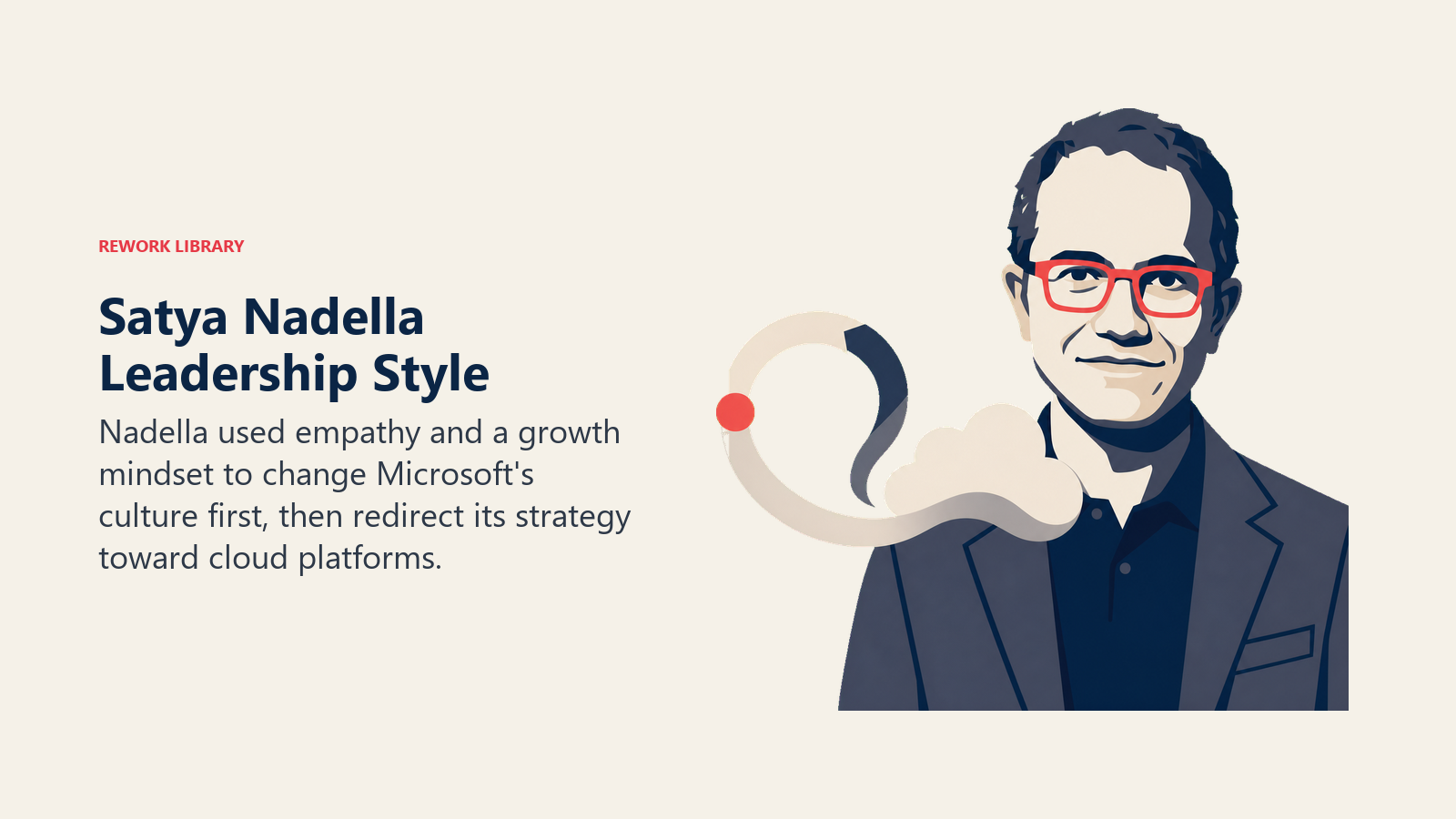
Satya Nadella Leadership Style: How Growth Mindset and Empathy Transformed Microsoft
Turn this article into takeaways for your work.


Each assistant summarizes the article only for you and suggests best practices for your work.
In February 2014, Microsoft was widely considered a cautionary tale. The company that once owned the personal computing era had missed mobile entirely, shipped the Windows 8 disaster, and watched its stock stagnate for over a decade while Apple and Google redrew the map around it.
Then Satya Nadella walked into the CEO chair, and nothing about Microsoft has been the same since.
By 2024, Microsoft's market cap crossed $3 trillion. Azure became the backbone of enterprise cloud. GitHub and LinkedIn turned into strategic platforms rather than acquisitions. The company that everyone was writing obituaries for is now, by most measures, the most valuable technology company on Earth.
But the deeper story isn't about the stock price. It's about what Nadella actually changed first: the culture. Before any product strategy or cloud pivot landed, he had to convince 130,000 engineers and leaders to stop knowing everything and start learning again.
For any executive running a mid-size business, a product org, or a transformation program right now, that is the lesson worth stealing.
The Nadella Empathy-Driven Transformation Model
The Nadella Empathy-Driven Transformation Model is a leadership doctrine that fuses a "learn-it-all" growth mindset with empathy as a strategic design input, treating culture change as the prerequisite to any product or strategic pivot. It holds that organizations cannot out-execute their own internal assumptions, so leaders must first rewire what gets measured, rewarded, and learned from before attempting platform shifts. Empathy, in this model, is not a soft value. It is a mechanism for detecting weak signals from customers, employees, and markets that status-quo cultures routinely suppress.
Leadership Style Breakdown
Nadella doesn't fit neatly into one archetype. He operates as a blend of two complementary styles:
| Style | Weight | What It Looks Like in Practice |
|---|---|---|
| Transformational | 70% | Articulates a compelling vision, challenges the status quo, raises the performance bar across the organization |
| Servant | 30% | Removes blockers for his teams, invests deeply in employee development, leads from behind on cultural change |
The 70/30 split matters. Pure servant leaders can struggle to drive large-scale change fast enough. Pure transformational leaders can be so vision-focused they burn through teams. Nadella's combination lets him set aggressive direction while genuinely investing in the people expected to execute it.
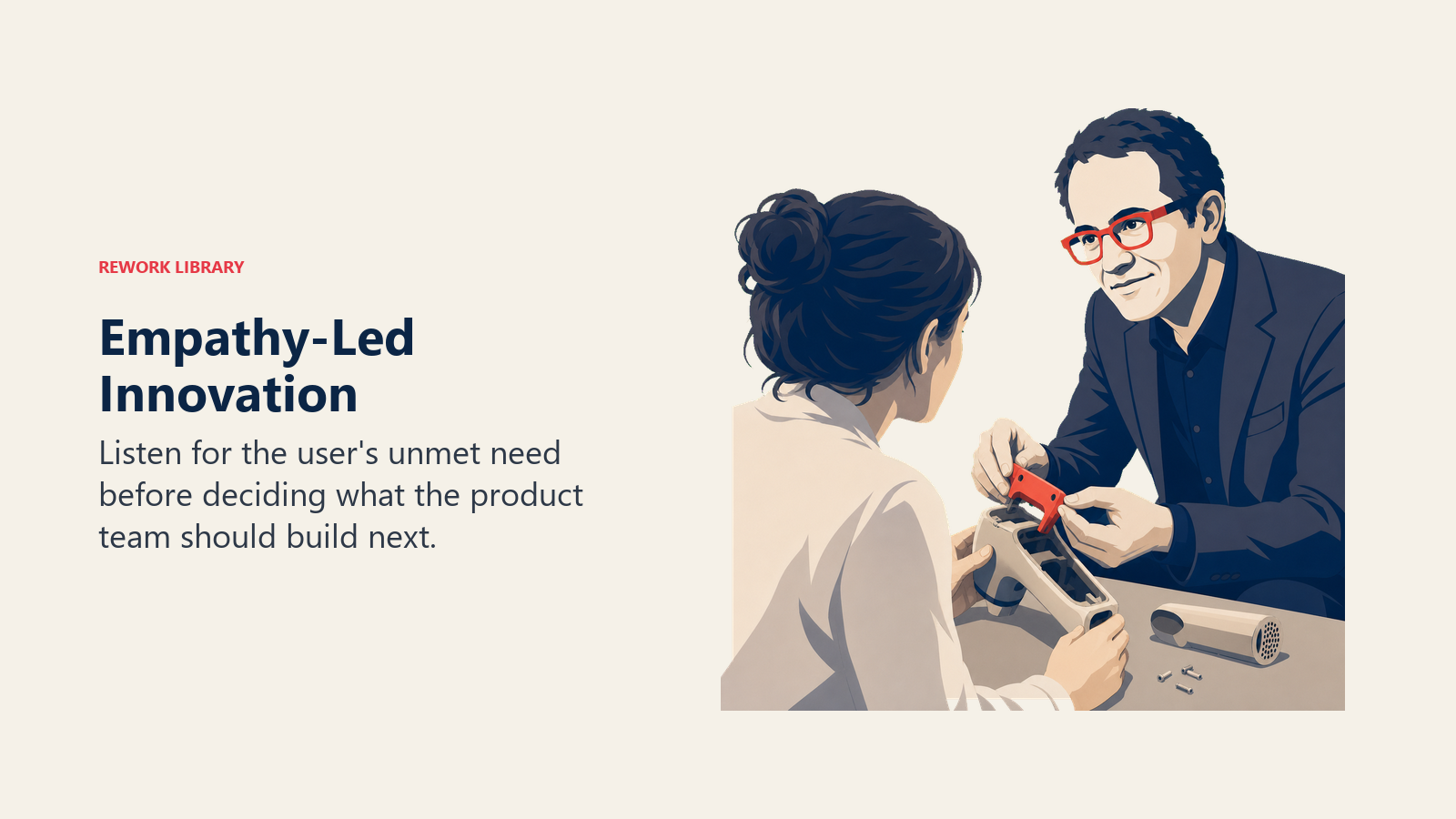
His oft-quoted phrase says it clearly: "Empathy makes you a better innovator." That's not a soft leadership platitude. It's a design principle, one that applies to products, org structures, and strategy alike.
Key Leadership Traits
| Trait | Rating | What It Means for Your Team |
|---|---|---|
| Growth Mindset | Very High | He replaced Microsoft's rank-and-yank culture with a "learn-it-all" model. Failure is data, not a career liability. |
| Empathy | High | Drives product decisions (accessibility features, inclusive design) and internal culture equally. Not performative, it's baked into how he hires and what he rewards. |
| Collaboration | High | Dismantled internal fiefdoms. Teams that competed against each other now share platforms, revenue, and customers. |
| Strategic Vision | Strong | Identified cloud and AI as Microsoft's next platform decades before the market confirmed it, then committed fully before the outcome was obvious. |
The pattern across all four: each trait reinforces the others. A growth mindset makes empathy easier, because you're curious about other people's experiences rather than defensive about your own position. Strategic vision gets sharper when you collaborate, because you're combining signal from more parts of the organization.
The 3 Decisions That Defined Nadella as a Leader
1. The Cloud-First Pivot
When Nadella took over, Windows was still the center of Microsoft's universe. It touched every budget decision, every product roadmap, every partnership negotiation. But Nadella had spent years running the Azure division and could see clearly that enterprise computing was moving to the cloud, and that Microsoft needed to move faster than its own legacy business would allow.
His first major signal wasn't a press release. It was releasing Office for iPad in his first week as CEO. Microsoft had blocked Office from running on non-Windows devices for years to protect Windows. Nadella killed that policy immediately.
That single decision told every employee, partner, and customer where Microsoft was actually going. The era of defending Windows was over. The era of meeting customers on their platform of choice had begun.
The Azure-first strategy didn't just change the revenue mix. It changed who Microsoft competed with, who it partnered with, and how it thought about product development. AWS had a four-year head start. Nadella's team closed the gap by moving faster and partnering more openly than Amazon's culture ever allowed.
2. Acquiring LinkedIn and GitHub
The LinkedIn acquisition in 2016 ($26.2 billion) was criticized heavily at the time. Microsoft had a poor track record with acquisitions, Nokia being the freshest wound. But Nadella saw something most analysts missed: LinkedIn was the world's professional data graph, and Microsoft's productivity tools lived and died on professional context.
He let LinkedIn run independently. Reid Hoffman stayed engaged. The culture wasn't absorbed; it was preserved. Within three years, LinkedIn's annual revenue crossed $8 billion. It's now one of Microsoft's highest-margin businesses.
The GitHub acquisition in 2018 ($7.5 billion) carried even more reputational risk. GitHub was built on a culture of open-source, developer independence, and deep skepticism of Microsoft specifically. Developers on forums threatened to leave the moment the deal closed.
Nadella did the same thing: he left it alone. He kept Nat Friedman as CEO, didn't force Azure integrations, and let GitHub developers continue contributing to competitor platforms. Within a few years, GitHub Copilot became the most-used AI coding assistant in the world: running on Azure, monetizing through Microsoft, but never feeling like a Microsoft product.
The pattern across both: Nadella buys culture, not just revenue. And he's disciplined enough not to destroy what he paid for.
3. Killing the Windows-First Culture
This is the hardest decision and the one that most leaders get wrong. Nadella didn't just pivot Microsoft's strategy. He explicitly named and dismantled the cultural assumption that had stopped the company from adapting.
The old Microsoft ran on stack ranking: employees competed against each other for limited top ratings. It rewarded knowing things, not learning them. It incentivized political maneuvering over collaboration. And it produced a decade of missed opportunities in mobile, search, and social.
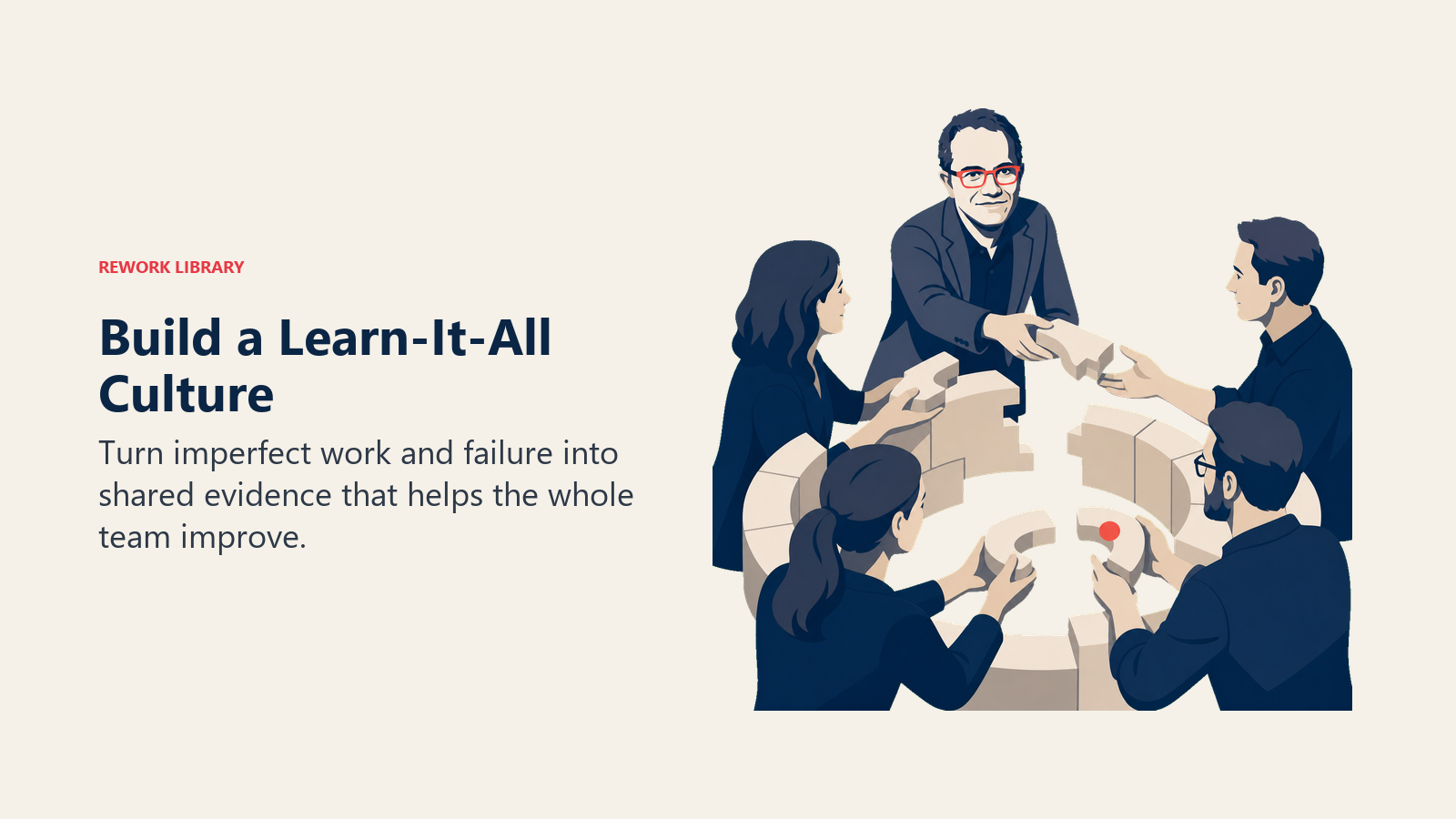
Nadella replaced it with what Carol Dweck calls a growth mindset framework, the idea that intelligence and capability aren't fixed, they're developed through effort. He made it the explicit cultural operating system at Microsoft, a model HBR documented in detail. Not a values poster in the lobby: he changed how managers were evaluated, how performance reviews were run, and what behaviors actually got people promoted.
The shift from "know-it-all" to "learn-it-all" is now embedded in how Microsoft hires, how it runs product reviews, and how it handles failure. That cultural change is harder to replicate than any product decision, and it's the reason the rest of the strategy actually worked.
What Nadella Would Do in Your Role
You're probably not running a 130,000-person company. But the principles Nadella used are directly applicable to a 50-person SaaS company, a 200-person operations division, or a 12-person product team.
For mid-size companies facing a platform shift: Nadella's cloud pivot was about identifying the next platform before it was obvious, then moving decisively. Ask yourself: what's the equivalent of Windows in your business? What legacy product, pricing model, or go-to-market assumption is slowing your ability to adapt? And are you willing to release the Office-for-iPad-equivalent this quarter?
The culture change playbook: Nadella didn't announce a new culture and expect it to happen. He changed the measurement system. You can't tell people to collaborate while evaluating them on individual contribution. You can't say you value learning while punishing honest failure. Look at what you actually measure and reward, not what you say you value. Those two things are often different, and employees know it.
"Learn-it-all" for ops teams: Growth mindset isn't just for engineers. It matters enormously in operations, finance, and customer success roles where expertise accumulates and can calcify into defensiveness. Try running post-mortems where the goal is identifying what the team learned, not assigning blame. Reward people who flag problems early, even when the problem reflects badly on their own work. Over time, that changes who speaks up in meetings and what decisions get made.
On empathy as a strategic tool: Nadella reads customer support tickets. He's known for referencing customer experiences in executive conversations, not as anecdote, but as signal. If you're a director or VP, when did you last talk directly to a customer who churned? Not a case study of a happy customer. Someone who left. That conversation is worth more than most strategy decks.
How Rework Supports Culture-Forward Leaders
Nadella's transformation worked because culture change and operational change reinforced each other. You can't run a learn-it-all org on tooling that hides failures, rewards political maneuvering, or silos customer signal inside one department. That is where Rework fits in for mid-size teams trying to apply the same playbook at a smaller scale. Rework's Sales Engine (from $69/month billed yearly) gives revenue leaders shared visibility into churn conversations, deal post-mortems, and customer feedback, the raw material empathy-driven decisions actually need. The Project Engine (from $99/month billed yearly) lets cross-functional teams run honest retrospectives and track learning loops without adding overhead. Growth mindset isn't a poster; it's what your tooling measures and surfaces every week. Rework is built to make that part easier, so leadership can focus on the cultural work only humans can do.
The Shadow Side: What Nadella Got Wrong
No honest profile skips this section. Nadella has made real mistakes, and acknowledging them is part of applying the lessons accurately.
The layoffs. Microsoft laid off 10,000 employees in January 2023, then continued rounds through 2024, including cuts to its gaming division after the Activision acquisition. Nadella frames these as structural realignments, and there's some truth to that. But the scale and pace contrast uncomfortably with the servant-leader framing. Growth mindset cultures don't always survive large-scale workforce reductions with trust intact.
Bing AI and the chatbot race. After integrating GPT-4 into Bing, Microsoft rushed a public launch in early 2023. The product had real problems. The "Sydney" persona behaved erratically in early sessions, and the rollout exposed how much pressure Nadella was under to beat Google rather than ship a product that was actually ready. It worked out eventually, but the early days were a reminder that competitive anxiety can override product discipline even in growth-mindset organizations.
The mobile miss on his watch too. Nadella inherited Nokia, yes. But the decision to write down $7.6 billion and exit mobile almost entirely also happened under his tenure. In hindsight it was probably the right call, but it represented a complete abandonment of a market that turned out to be the most important computing platform of the last decade. Microsoft has no meaningful mobile OS story today.
Activision scrutiny. The $69 billion Activision Blizzard acquisition faced regulatory battles in multiple jurisdictions and closed under significant antitrust pressure. It also brought Microsoft into closer association with Activision's well-documented workplace culture problems. Nadella's handling of that aspect of the acquisition drew criticism from employees who expected more explicit accountability from leadership.
These aren't disqualifying failures. But they're worth naming, because the temptation with leader profiles is to flatten complexity into a hero narrative. Nadella is genuinely exceptional. He's also a real executive making trade-offs under real pressure, and not all of them go perfectly.
Leadership Lessons You Can Use This Week
Pull one of these into your next team meeting, 1:1, or planning session:
1. Audit your measurement system for cultural alignment. List the three behaviors your performance reviews most reward right now. Then list the three behaviors you say you want from your culture. If those lists don't match, you have a gap. Pick one behavior that matters most and change how you measure it. Don't announce a culture change. Change the scorecard.
2. Run one "learn-it-all" retrospective. Take the last project that didn't go as planned. Run a 30-minute post-mortem where the only output is a list of what the team learned, not what went wrong. No blame, no lessons-learned bullet points that nobody reads. Just: "We now know something we didn't know before. Here's how we'll use it."
3. Talk to someone who left. Nadella's empathy is concrete, not conceptual. This week, schedule a call with a customer who churned, an employee who quit, or a partner who stopped renewing. Ask what they needed that you didn't provide. Listen without defending. Report back to your team what you heard.
4. Identify your legacy Windows. Every organization has a product, process, or cultural assumption that once made sense but is now slowing you down. Name it explicitly in your next leadership meeting. You don't have to kill it today, but naming it out loud is the first step to making the trade-off consciously rather than by default.
Learn More
Leadership profiles in this series:
- Steve Jobs Leadership Style, Visionary intensity, product obsession, and the cost of perfectionism
- Reed Hastings Leadership Style, Freedom and responsibility, radical transparency, and what Netflix got right about talent density
- Jensen Huang Leadership Style, Deep technical leadership, flat org structures, and building for the platform shift
Related frameworks and strategy articles:
- Growth Mindset in Business Teams, How to apply Carol Dweck's framework to operational and sales teams
- Culture Change Playbook for Directors, Step-by-step approach to shifting team behavior without a reorg
- Strategic Acquisition Frameworks, What separates successful acqui-hires from expensive disasters

On this page
- The Nadella Empathy-Driven Transformation Model
- Leadership Style Breakdown
- Key Leadership Traits
- The 3 Decisions That Defined Nadella as a Leader
- 1. The Cloud-First Pivot
- 2. Acquiring LinkedIn and GitHub
- 3. Killing the Windows-First Culture
- What Nadella Would Do in Your Role
- How Rework Supports Culture-Forward Leaders
- The Shadow Side: What Nadella Got Wrong
- Leadership Lessons You Can Use This Week
- Learn More