Marc Benioff Leadership Style: How Salesforce's CEO Built the Cloud CRM Era and Redefined Corporate Purpose
Turn this article into takeaways for your work.


Each assistant summarizes the article only for you and suggests best practices for your work.
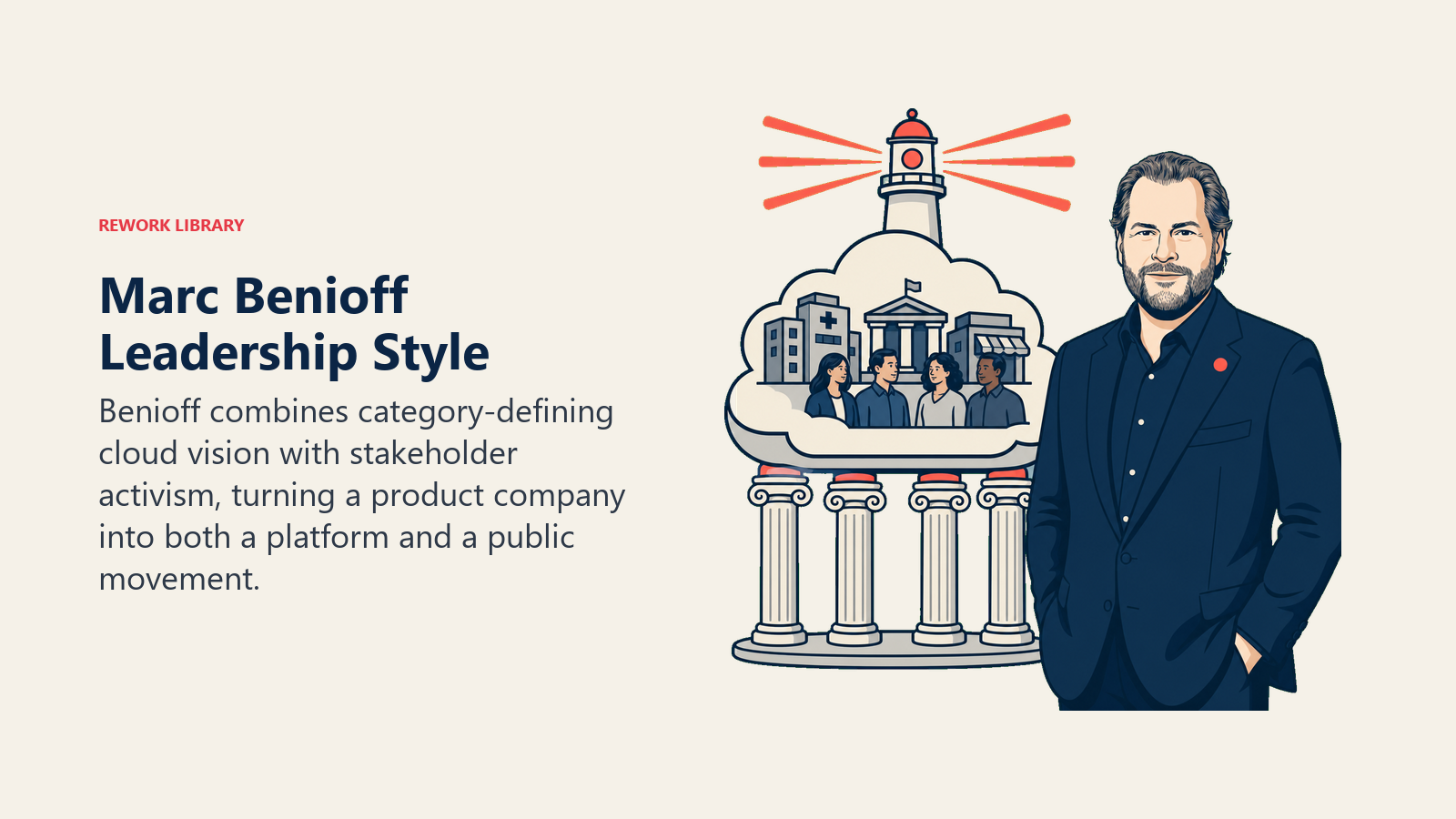
Marc Benioff started Salesforce in 1999 with a fax campaign. He sent faxes to Oracle's customers (he had worked there) urging them to protest the end of software as they knew it. He rented actors to pretend to be protesters outside a Siebel Systems conference with signs saying "No Software." It was theater, but it was theater in service of a real thesis: that enterprise software delivered over the internet would replace installed, on-premise systems.
That thesis was correct. Twenty-five years later, Salesforce has revenues above $35 billion, nearly 80,000 employees, and a market cap that has exceeded $200 billion. The CRM category it helped create and then dominate is the largest segment of enterprise software.
But Benioff's story isn't just a technology bet that paid off. It's also a case study in building a company culture, a philanthropic model, and a public persona that have become as important to Salesforce's identity as its product. Understanding how he built all three, and where the seams show, gives you a more useful profile than the press-ready version.
Leadership Style Breakdown
| Style | Weight | How it showed up |
|---|---|---|
| Visionary | 70% | Benioff saw cloud delivery before the term "cloud" existed. He built an entire product category, convinced enterprise buyers to trust software they didn't run on their own servers, and articulated a future that his competitors dismissed until they were copying it. His brand-building, Dreamforce, the Ohana culture, the No Software positioning, was in service of making that vision legible to buyers, employees, and investors. |
| Servant | 30% | The 1-1-1 model, committing 1% of equity, 1% of product, and 1% of employee time to philanthropy from the company's founding, is the clearest expression of the servant dimension. Benioff didn't add this as corporate social responsibility after the company was successful. He embedded it structurally at the beginning, when equity and product time were scarce. That's a different kind of commitment. |
The 70/30 split reflects a real tension in Benioff's tenure. The vision drives the company forward at a pace that sometimes outstrips its organizational capacity. The servant dimension is what's prevented the culture from becoming purely transactional. Whether those two things are in genuine balance, or whether the servant dimension is partly brand strategy, is a fair question.
Key Leadership Traits
| Trait | Rating | What it means in practice |
|---|---|---|
| Stakeholder Capitalism | Very High | "The business of business is improving the state of the world." Benioff made this argument publicly before it was mainstream and has sustained it under pressure. When the state of Indiana passed legislation that critics argued enabled discrimination, Benioff threatened to move Salesforce employees out of the state. When San Francisco had a homelessness crisis, he funded a ballot measure and helped pass a tax on large companies. These aren't PR gestures, they have real costs and real opposition. |
| Cloud Vision | Very High | Benioff's specific insight in 1999 was that enterprise software's on-premise delivery model was a distribution constraint masquerading as a technical requirement. He understood that if you could make software available over the internet and bill monthly, you'd remove the installation burden, reduce the switching cost for buyers, and dramatically expand the addressable market. That insight became the cloud software industry. His ability to hold that thesis for 25 years while building the infrastructure to execute it is the core of Salesforce's competitive position. |
| Acquisitions | High | Salesforce's acquisition strategy, ExactTarget, MuleSoft, Tableau, Slack, reflects a specific theory of platform building. Benioff wasn't buying revenue. He was buying integration points that made Salesforce harder to displace. Each major acquisition expanded the number of workflows that ran through Salesforce's infrastructure, increasing switching costs for enterprise customers. The Slack acquisition, at $27.7 billion, was the clearest expression of this thesis: Benioff saw Slack as the interface layer that would bring Salesforce data into daily work. |
| Culture Building | Strong | The Ohana concept, a Hawaiian word for family that Benioff adopted as Salesforce's cultural anchor, is either authentic or performative depending on who you ask. The 1-1-1 model is objectively structural. The annual Dreamforce conference, which draws more than 150,000 attendees, is a culture event as much as a product event. Whether you find it inspiring or excessive, it's an unusually deliberate investment in making employees and customers feel part of something larger than a software transaction. |
The 3 Decisions That Defined Benioff as a Leader
1. The Cloud CRM Bet in 1999
When Benioff left Oracle to start Salesforce, enterprise CRM was dominated by Siebel Systems, which sold expensive on-premise software that took months to install and cost millions in implementation fees. The product worked well enough, for the companies that could afford it and the IT organizations that could support it.
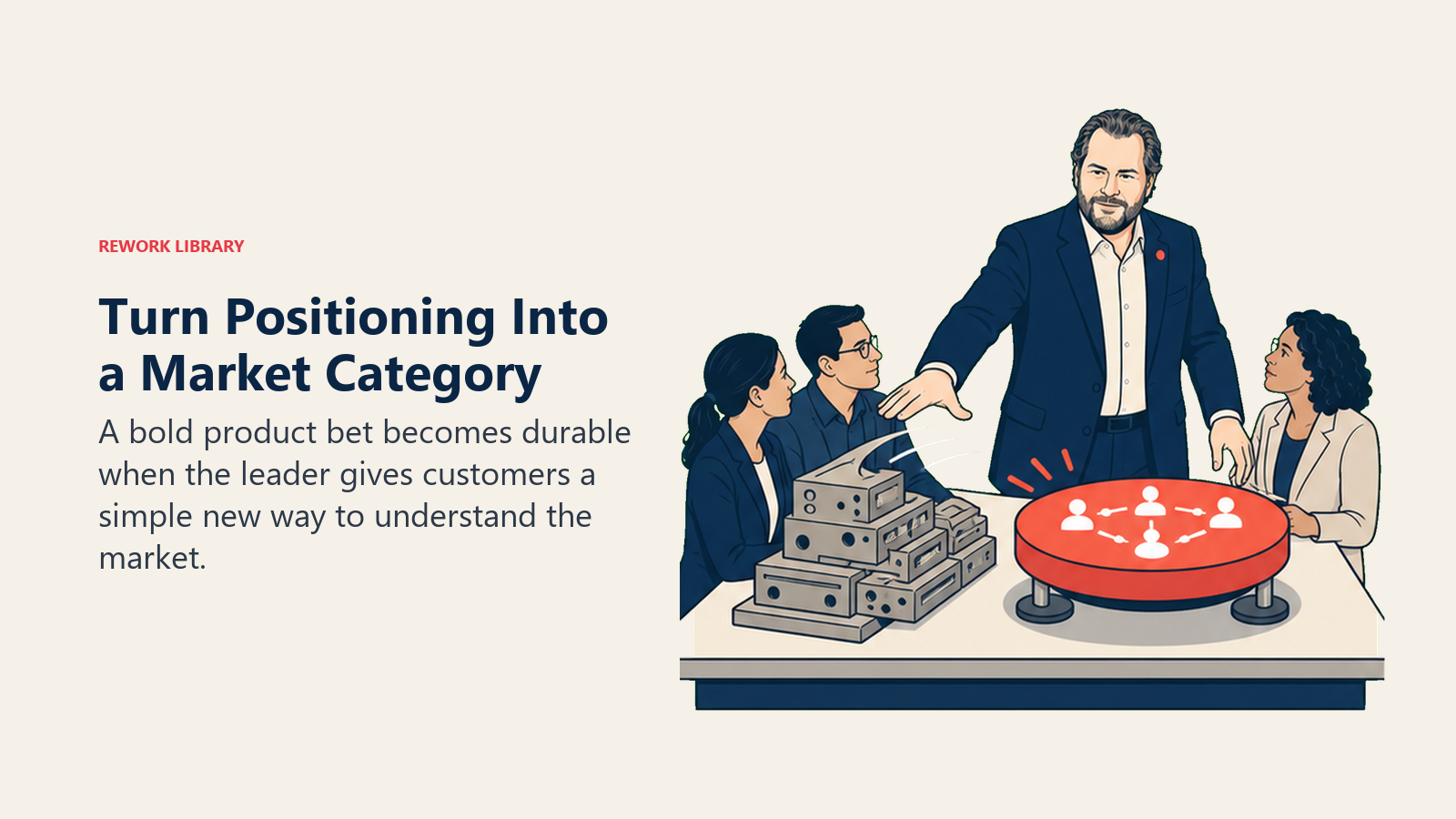
Benioff's bet was that the delivery model was the product's biggest weakness, not its biggest strength. He built Salesforce to be sold as a subscription, delivered over the internet, with no installation required. He priced it per user per month, a model that made it accessible to smaller companies and made the value proposition obvious: you paid for what you used.
The incumbent reaction was initially dismissal. Siebel's CEO called internet-delivered software a fad. Larry Ellison's Oracle, Benioff's former employer, largely ignored him. That dismissal gave Salesforce years to build market position in the mid-market before enterprise buyers took the cloud model seriously.
What this shows about his leadership: Benioff identified a structural weakness in the dominant business model and built his entire company strategy around exploiting it. He didn't try to build a better version of Siebel. He bet that the whole category would change. And he marketed that thesis aggressively while his competitors were busy defending their installed base.
For today's leaders: the clearest analog is to look at your own industry's dominant delivery model and ask whether the delivery is actually the product. Where does the current model force friction on buyers that a different approach could eliminate? That gap is where the next Salesforce in your category is being built right now.
2. The Slack Acquisition at $27.7 Billion
In December 2020, Salesforce announced it would acquire Slack, the company Stewart Butterfield had built out of a failed video game, for $27.7 billion. It was the largest acquisition in Salesforce's history and one of the largest enterprise software acquisitions ever. Analysts immediately questioned whether the price was justified. Slack had been growing but hadn't yet proven it could win against Microsoft Teams, which had dramatically accelerated its own growth during the COVID-19 remote work surge.
Benioff's rationale was strategic rather than financial. He wasn't buying Slack's current revenue. He was buying the interface. His thesis: enterprise software is increasingly consumed through collaboration tools, and whoever owns the daily communication layer owns the context for all other enterprise software decisions. If Slack became where work happened, then Salesforce data flowing into Slack would make Salesforce indispensable in a way that no CRM feature could.
The execution has been uneven. Teams continues to dominate collaboration market share. Slack has been integrated into Salesforce's product suite but hasn't fully delivered on the vision Benioff articulated at acquisition. The $27.7 billion remains a large price for an outcome that is still being determined.
The leadership lesson isn't about whether the acquisition was right. It's about how to evaluate large strategic bets. Benioff was buying a platform position, not a revenue multiple. When you're making a decision like this, the question isn't "what's the DCF on this asset." It's "what does the world look like in five years if this thesis is right, and is that world one we want to be in?" The Slack thesis was coherent. Whether the execution matches the thesis is still open.
The 1-1-1 Philanthropic Model
The 1-1-1 model is Benioff's founding commitment to donate 1% of Salesforce's equity, 1% of its product, and 1% of employee time to philanthropic causes, structured into the company from day one rather than added after profitability. More than 18,000 companies have since adopted versions of it through the Pledge 1% initiative Benioff co-founded. It turns corporate generosity from a post-success afterthought into an embedded obligation that scales automatically with the company.
3. Founding Salesforce With the 1-1-1 Commitment
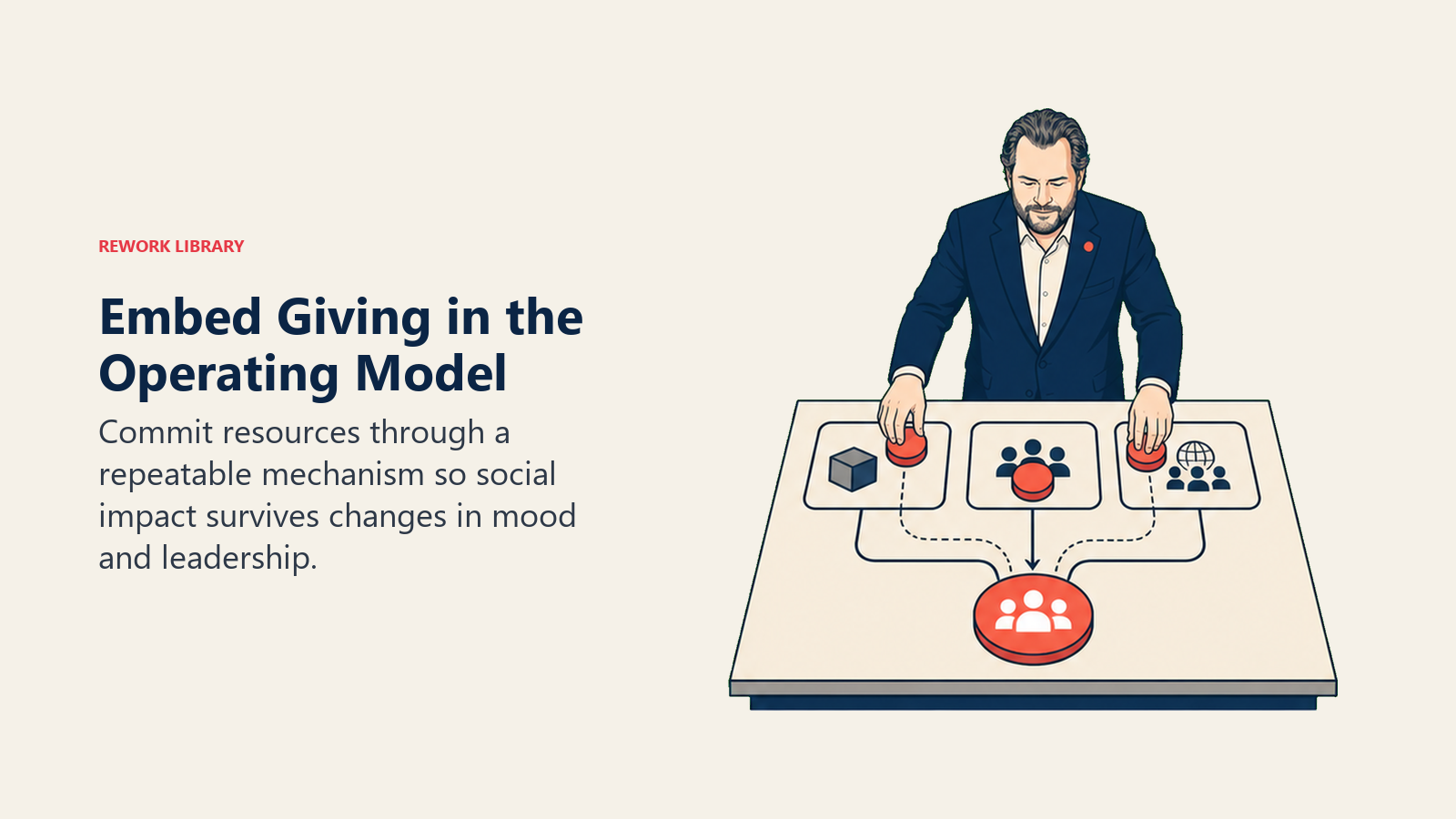
When Benioff founded Salesforce, he committed to the 1-1-1 model before the company had meaningful revenue. He gave 1% of Salesforce's founding equity to a foundation. He committed 1% of the product (free licenses) to nonprofits. He committed 1% of employee time to volunteering.
This decision is worth examining because of its timing. Most corporate philanthropy is reactive, companies build something valuable and then decide what to do with the surplus. Benioff made the commitment upfront, when the equity was speculative, when the product was unbuilt, and when employee time was scarce. That's a different kind of decision than a successful company deciding to be generous.
The model has since been adopted by more than 10,000 companies through the Pledge 1% initiative Benioff co-founded. It's become a template for how technology startups think about embedded philanthropy. And it has been genuinely significant, Salesforce's foundation has given more than $500 million in grants and the product donation program has served tens of thousands of nonprofits.
But the model also functions as a talent and brand asset. The best engineers and operators increasingly choose employers based on values alignment. The 1-1-1 model gives Salesforce a recruitment story that its competitors can't easily copy because they didn't start with it. That doesn't make it cynical. Benioff has continued it long past the point where it was strategically necessary, but it's worth understanding that doing good and doing well aren't always in tension.
What Benioff Would Do in Your Role
If you're a CEO building a SaaS product, the cloud CRM story's most transferable insight is about delivery model disruption. Look at the most painful part of how your customers currently buy, implement, and use products in your category. Is there a delivery model change that would eliminate that friction? That's worth more than any feature set.
If you're building a company culture, the 1-1-1 model has a specific lesson: embed your values structurally rather than aspirationally. A value statement is a policy. A 1% equity commitment made at founding is a structure. Structures produce behavior; policies produce compliance. What structures in your company make your values unavoidable rather than optional?
If you're an M&A or strategy leader, the Salesforce acquisition strategy is worth studying as a platform-building model. Benioff didn't acquire competitors. He acquired integration points. Before your next acquisition conversation, ask whether you're buying revenue or buying a structural position. The valuation logic is completely different.
If you're a CEO navigating stakeholder activism, Benioff's public interventions on LGBTQ rights, homelessness, and gun control have a logic worth understanding. He chose issues where his employee base had strong views and where Salesforce's presence in a city or state gave him actual leverage. He didn't comment on every political issue. He was selective. That selectivity is what made his interventions credible rather than performative.
How Rework Applies the Benioff Playbook
Benioff's cloud-native, stakeholder-driven leadership redefined what enterprise software could look like, delivered over the internet, priced per seat, wrapped in a culture and a mission. But twenty-five years in, Salesforce has also become the friction it once disrupted: multi-year implementations, six-figure consulting engagements, and a product sprawl that small and mid-market teams struggle to absorb. Rework is built as the lean alternative. Our CRM, the Sales Engine, starts at $69/month billed yearly with 5 sales seats included, the Process and Project Engines at $99/month, and most teams are live in days rather than quarters. You get the cloud-delivered subscription model Benioff invented, without the Salesforce-suite overhead or the partner-ecosystem tax. Same delivery-model insight, applied to the teams Salesforce outgrew.
The Shadow Side: What Benioff Got Wrong
The layoffs of early 2023, when Salesforce cut approximately 10% of its workforce (about 8,000 people), arrived just months after Benioff had hired aggressively during the pandemic. The whiplash between expansion and contraction contradicted the Ohana "family" narrative in ways that were hard to explain away. Families don't lay off 10% of their members with a few weeks' notice.
The criticism isn't that Salesforce shouldn't have made those cuts. Most analysts agreed the workforce had grown beyond what the business required. The criticism is about the gap between the stated culture and the actual behavior under pressure. Benioff addressed this in his announcement letter, taking personal responsibility for the over-hiring. But acknowledgment after the fact doesn't undo the lived experience of the 8,000 people who lost their jobs.
Salesforce's product complexity has also grown to a point that creates real customer friction. The platform is powerful but difficult to implement without significant consulting engagement. Salesforce's partnership ecosystem (the army of implementation partners who help customers deploy the platform) is profitable but also signals that the product itself has become harder to use than the cloud-simplicity thesis originally promised. That's a form of strategic drift worth noting.
The Slack integration's slower-than-expected progress reflects a pattern in Salesforce's acquisition history: the strategic thesis is usually coherent, but the integration execution often takes longer and costs more than the acquisition announcement implies. That's a leadership and operations gap that Benioff has acknowledged but hasn't fully resolved.
Leadership Lessons You Can Use This Week
1. Find the delivery model disruption. This week, talk to three customers about the most painful part of how they use your product category, not your product specifically, but the category. The systemic friction they describe is your next strategic thesis.
2. Embed one value structurally. Pick one organizational value that currently exists as a policy or a talking point. Find a structural version of it: something that changes how decisions get made, not just how they're described. The 1-1-1 model is the template: commitment at founding, not aspiration after success.
3. Evaluate your acquisition strategy. If you're thinking about an acquisition, write out what you're actually buying. If the answer is primarily revenue or market share, that's a financial decision. If the answer is a structural position (an integration point, a distribution channel, a capability you can't build), that's a platform decision. The analysis looks different.
4. Close the gap between your culture narrative and your actual behavior. Think of a decision your company made in the last year that contradicted something you say about your culture. The gap between narrative and behavior is always visible to your employees even when it isn't visible to you. What would closing that gap require?
Frequently Asked Questions about Marc Benioff's Leadership
Who is Marc Benioff?
Marc Benioff (born September 25, 1964) is the co-founder, chair, and CEO of Salesforce, the cloud-based CRM company he launched in 1999 after thirteen years at Oracle. He also owns Time Magazine, which he purchased for $190 million in 2018, and is widely credited as one of the inventors of enterprise Software as a Service.
How did Benioff invent SaaS with Salesforce?
Benioff bet in 1999 that enterprise software should be delivered over the internet and billed per user per month, rather than installed on customer servers and sold in multi-year licenses. He branded the model "No Software" and built Salesforce around it, creating the subscription-delivered CRM category that became the template for the entire SaaS industry. Salesforce now generates more than $35 billion in annual revenue as proof of the thesis.
What is the 1-1-1 philanthropic model?
The 1-1-1 model is Benioff's founding commitment to give 1% of Salesforce's equity, 1% of its product, and 1% of employee paid time to philanthropic causes, structured into the company from day one. The Salesforce Foundation has since distributed more than $500 million in grants, and more than 18,000 other companies have adopted versions of the model through the Pledge 1% initiative Benioff co-founded.
What is Ohana at Salesforce?
Ohana is the Hawaiian word for "family" that Benioff adopted as Salesforce's cultural anchor, meant to signal a mutual obligation between employees, customers, partners, and the communities Salesforce operates in. It is codified in company events like Dreamforce (which draws over 150,000 attendees annually), executive rituals, and hiring language. Critics argue the 2023 layoffs of roughly 8,000 employees tested how literal the family framing actually is.
How did Benioff lead the Slack, Tableau, and MuleSoft acquisitions?
Benioff led three platform acquisitions in four years: MuleSoft for $6.5 billion in 2018 (integration layer), Tableau for $15.7 billion in 2019 (analytics layer), and Slack for $27.7 billion in 2020 (collaboration layer). His thesis was not buying revenue but buying structural integration points, surfaces where Salesforce data could flow into the daily tools that enterprise workers already used, making Salesforce harder to displace.
What is stakeholder capitalism in Benioff's view?
Benioff's stakeholder capitalism doctrine argues that CEOs are accountable not only to shareholders but to employees, customers, communities, and the planet, and that ignoring any of those stakeholders is a business risk rather than a moral failing. He has translated this into concrete action, including threatening to relocate Salesforce jobs out of states passing discriminatory legislation and publicly funding a homelessness tax in San Francisco against opposition from other tech CEOs.
What can modern CEOs learn from Marc Benioff?
Three lessons stand out. Find delivery-model disruption in your category, the way customers buy is often a bigger lever than the product itself. Embed values structurally at founding, because commitments made when resources are scarce are more durable than policies layered on after success. And treat acquisitions as platform bets, not revenue trades, so you can tell whether a price is justified by the five-year thesis rather than this quarter's multiple.
Learn More
These articles connect to the core themes in Benioff's profile:
- Stakeholder Capitalism in Practice: What It Actually Requires
- Platform Strategy: How to Build a Product That Becomes Infrastructure
- Sam Altman Leadership Style: How OpenAI's CEO Navigated the Most Consequential Technology Bet of the Decade
- Indra Nooyi Leadership Style: How PepsiCo's CEO Built a Purpose-Driven Strategy at Fortune 50 Scale
- Steve Jobs Leadership Style: How Perfectionism and Vision Built the World's Most Valuable Company

On this page
- Leadership Style Breakdown
- Key Leadership Traits
- The 3 Decisions That Defined Benioff as a Leader
- 1. The Cloud CRM Bet in 1999
- 2. The Slack Acquisition at $27.7 Billion
- The 1-1-1 Philanthropic Model
- 3. Founding Salesforce With the 1-1-1 Commitment
- What Benioff Would Do in Your Role
- How Rework Applies the Benioff Playbook
- The Shadow Side: What Benioff Got Wrong
- Leadership Lessons You Can Use This Week
- Learn More