Konosuke Matsushita's Leadership Philosophy
Turn this article into takeaways for your work.


Each assistant summarizes the article only for you and suggests best practices for your work.
Key Facts: Konosuke Matsushita (born November 27, 1894, in Wasa village, Wakayama Prefecture; died April 27, 1989, in Osaka, at age 94) founded Matsushita Electric Company on March 7, 1918, at age 23, working out of a rented two-story house, initially making electrical light-bulb sockets and an attachment plug of his own design. When the Great Depression reached Japan and warehouses filled with unsold stock, he rejected his executives' recommendation to halve the workforce and implemented a lifetime employment policy in December 1929 instead, telling them: "Cut production by half starting now, but do not dismiss even a single employee." Workers went to half days at full pay with no holidays, sold off the backlog, and full production resumed within two months. On May 5, 1932, at age 37, he gathered 168 employees at the Central Electric Club in Osaka and, for the first time, declared the company's true mission along with a 250-year plan to carry it out: to create material abundance "as plentiful and inexpensive as tap water," a date he fixed afterward as the company's real founding anniversary. In May 1933, he reorganized the business into three self-accounting divisions, each running its own product line's development, manufacturing, sales, and profit and loss. He kept running the company as president until January 1961, founding the PHP Institute in 1946 while still very much in charge, then, two years after stepping down as board chairman in 1977, committed 7 billion yen of his own fortune in 1979 to open the Matsushita Institute of Government and Management the following spring, a school built to train leaders for public life. The company he founded became Matsushita Electric Industrial Co., Ltd. in 1935, adopted Panasonic, originally an export-only brand name from 1955, as its full corporate identity on October 1, 2008, and reorganized again in April 2022 into Panasonic Holdings Corporation, the parent of an operating subsidiary that itself now carries the Panasonic Corporation name.
The Philosophy-as-Infrastructure Doctrine
The Philosophy-as-Infrastructure Doctrine is Matsushita's operating premise that a stated corporate mission is worth nothing unless it is backed by structures built to enforce it: a dated plan you can be held to, a management system that distributes the philosophy down to every worker, and eventually an institution built to carry the idea past the founder's own working life. He did not stop at writing down what the company was for. He kept building the machinery that made the writing hold.
Most founders who write a mission statement never revisit it. Matsushita's May 1932 declaration came bundled with a 250-year plan, an actual number of years, not an inspirational phrase, because he wanted the mission treated as something you schedule against rather than something you frame on a wall. A year later he backed it with the divisional system, handing each product line its own factory, sales office, and independent profit and loss so that the abstract goal of "abundance" had somewhere concrete to live: in whether the radio division or the lighting division was actually solvent that quarter. And across the final third of his life, he converted a personal fortune into institutions built to outlast him, first the PHP Institute researching paths to peace and prosperity, then a school for training the country's next generation of political and business leaders. Soichiro Honda built a comparable-era Japanese manufacturer on the opposite foundation: a single irreplaceable partnership with Takeo Fujisawa, engineering genius paired with a finance-and-sales counterpart, which worked brilliantly until both men retired together in 1973 and the company had to prove the culture could survive without either of them. Matsushita's answer to the same succession problem was to build the culture into structure and doctrine early, so it did not depend on any one relationship surviving.
Taiichi Ohno is the closer parallel, and the more useful contrast. Ohno built an operating system, the Toyota Production System, inside a company someone else ran; his genius was shop-floor mechanics, just-in-time flow and andon cords that stopped the line the instant something went wrong. Matsushita built one level up: not a production system but a governance system, the divisional structure that decided who was accountable for what, layered under a stated purpose that told every division why the numbers mattered in the first place. Kazuo Inamori is the closest thing to a direct descendant of that specific idea. His Amoeba Management, built decades later at Kyocera, broke the company into units small enough that every employee could see their own unit's profit and loss, an idea that traces straight back to Matsushita's 1933 divisions, just carried to a far smaller and more granular unit of account. Matsushita split a manufacturer into three businesses. Inamori split his into dozens of amoebas the size of a small team. Same structural instinct, a much finer grain.
Leadership Style Breakdown
| Style | Weight | How it showed up |
|---|---|---|
| Institutional Philosopher | 50% | Wrote the Basic Management Objective, the Company Creed, and the Seven Principles and treated them as binding, not decorative: the 1932 mission declaration came with a dated 250-year plan attached, not just an inspirational phrase. |
| Decentralizing Structurer | 30% | Split the company into three self-accounting divisions in 1933, each with its own factory, sales office, and profit-and-loss responsibility, years before that kind of decentralization was common at a Japanese manufacturer. |
| Long-Horizon Institution Builder | 20% | Funded the PHP Institute in 1946 and, decades later, committed 7 billion yen of his personal fortune to found the Matsushita Institute of Government and Management in 1979, converting private wealth into an apparatus for training leaders who would never work for his company. |
The 50/30/20 split matters because the second and third traits are what kept the first one from being empty rhetoric. A founder can write a beautiful mission statement and have it mean nothing five years later. Matsushita's held because he built an organizational structure that operationalized it inside the company, and then, later, an institution that carried the underlying idea outside the company entirely. The philosophy survived because it was never asked to survive on its own.
Key Leadership Traits
| Trait | Rating | What it means in practice |
|---|---|---|
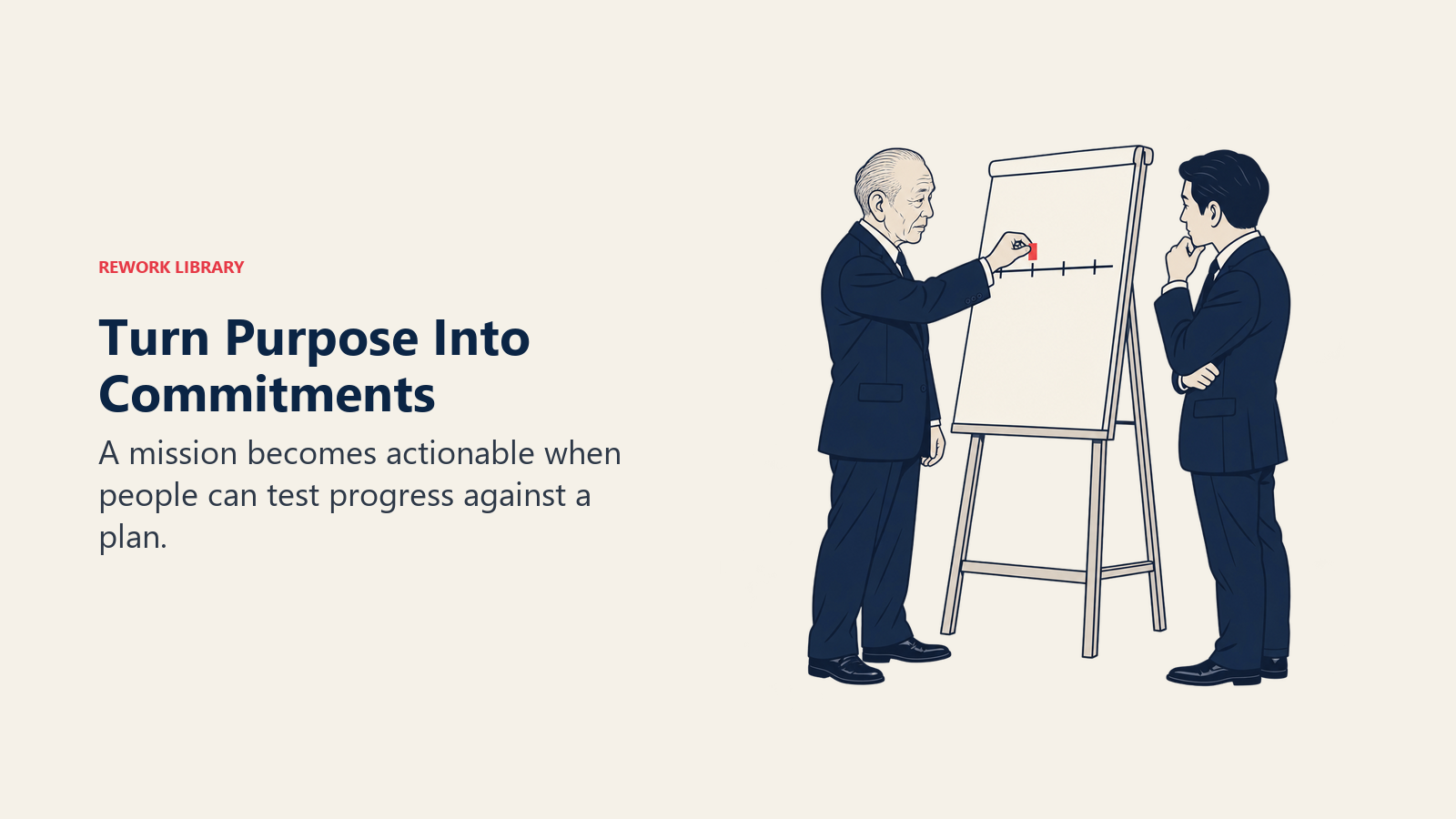
| Codifying abstract purpose into dated, binding commitments | Very High | The May 1932 mission declaration was announced alongside a 250-year plan, not a slogan. Matsushita treated purpose as something you schedule and revisit, not something you proclaim once and move on from. |
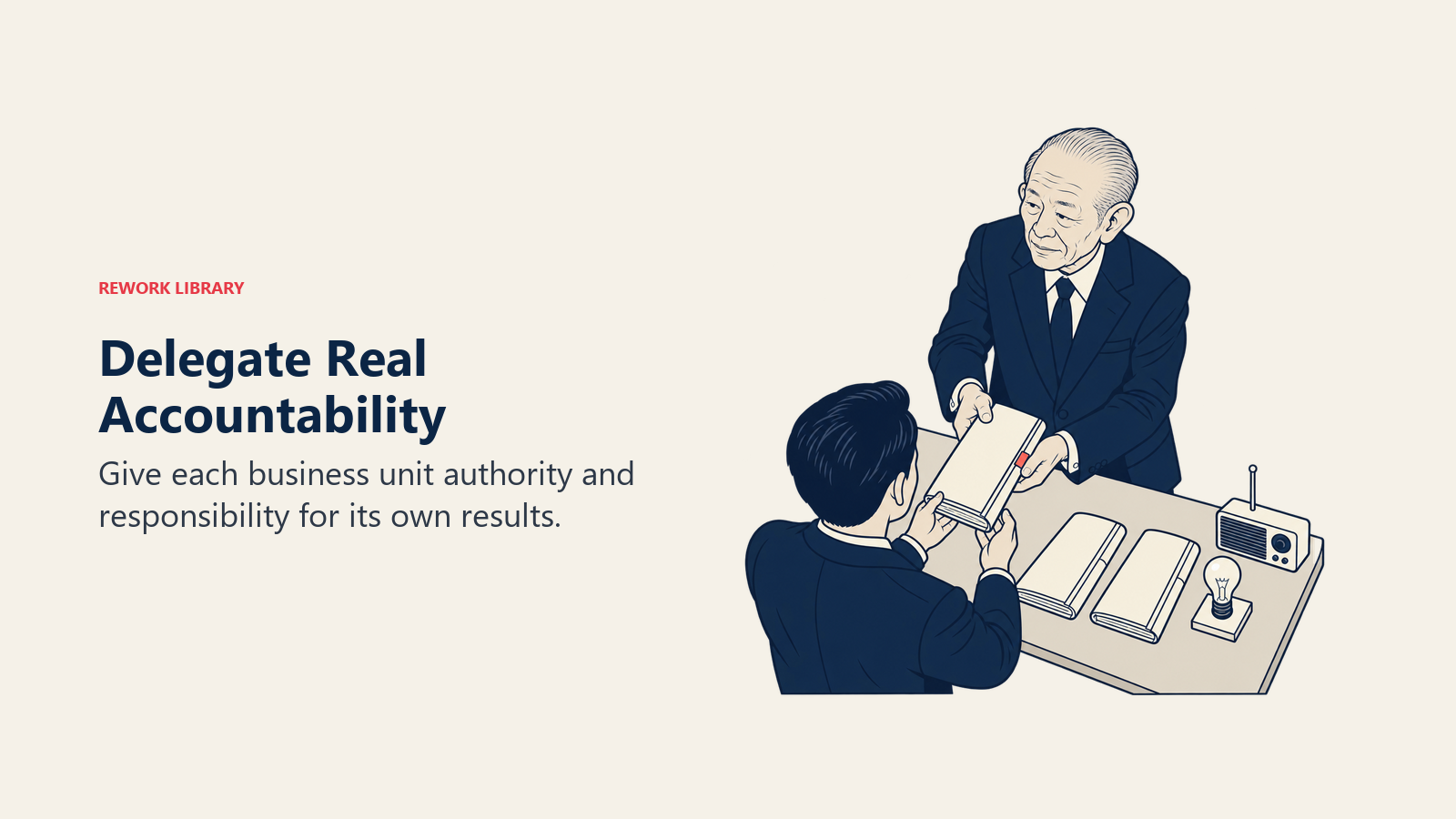
| Radical delegation to unit-level managers | Very High | The 1933 divisional reorganization gave each product line its own accounting, and Matsushita described the underlying instinct plainly when he handed a business unit to a senior executive: he simply delegated everything to him. |
| Employee-first discipline under financial pressure | High | Rather than lay off staff when the Depression hit Japan, he cut production in half, kept full pay on shorter hours, and had the whole company sell down the backlog instead. Demand recovered within two months. |
| Treating institution-building as a decades-long duty, not a retirement gesture | Very High | He founded the PHP Institute in 1946 while still president, then, at 85 and long since stepped down as chairman, put 7 billion yen of his own money behind a school to train the country's next generation of leaders. |
| Insisting ordinary employees think like proprietors | High | The divisional reorganization came with an explicit instruction that workers approach their job as though they were the president or proprietor of their own enterprise, not simply a task list handed down from above. |
The 3 Decisions That Defined Konosuke Matsushita as a Leader
1. Declaring a 250-Year Mission Instead of a Slogan (May 1932)
Three years into a punishing economic slump, and fourteen years into running his own company, Matsushita called 168 employees to the Central Electric Club in Osaka and told them, for the first time, what the company was actually for. The mission he read that day was not a vague call to excellence. It was a specific argument: that the job of a manufacturer is to overcome poverty by making goods as plentiful and cheap as tap water, so abundant that nobody thinks twice about using them, and that Matsushita Electric existed to do that at scale. He paired the mission with a 250-year plan broken into ten-generation phases, an oddly specific number for a company that was, at the time, fourteen years old and had survived the Depression only by cutting hours, not headcount.
The specificity is the point. A vaguer founder says the company exists to "make the world better." Matsushita said it exists to do one measurable thing (drive the cost and scarcity of goods toward zero) on a stated multi-generational timeline, and then marked that day as the company's true founding anniversary going forward, discarding the actual 1918 incorporation date as the less important one. Peter Drucker spent his career arguing that management should be treated as a discipline with real standards, not an art performed by instinct; Matsushita arrived at a version of that same insight from the factory floor rather than from the seminar room, years before Drucker's own writing reached Japan.
For you: writing a mission statement is the easy part. The harder discipline is attaching a number to it, a date, a plan, a milestone you can be judged against later, so the mission is falsifiable rather than merely aspirational. Most executives skip that step because it is uncomfortable to be measured against your own stated purpose decades out. Matsushita didn't skip it.
2. Splitting the Company Into Self-Accounting Divisions (May 1933)
A year after the mission declaration, Matsushita reorganized the company into three divisions, one for radios, one for lighting and dry batteries, one for wiring devices and heating equipment, and gave each one its own factory, its own sales operation, and its own profit and loss. This wasn't a cosmetic reshuffle of the org chart. Each division head was now responsible for everything from product development through to whether the unit made money, an unusually early example of a fully self-accounting divisional structure at a Japanese manufacturer.
The reasoning tied directly back to the mission declared a year earlier. A single monolithic company chasing an abstract goal like "abundance" has no way to know if it's actually succeeding, division by division, product by product. Splitting the business into accountable units gave the philosophy somewhere concrete to be tested. It also solved a second, more practical problem: training capable managers. Matsushita's own explanation for the system named two goals, autonomous management and developing capable managers, and both required giving people real profit-and-loss responsibility rather than task lists. Ninety years later, when Panasonic reorganized again into a holding company structure in 2022, incoming CEO Yuki Kusumi described the goal in almost identical language: promoting "fully autonomous management" across the group's operating companies. The vocabulary Matsushita used in 1933 was still the vocabulary his successors reached for a century later.
For you: decentralizing authority only works if you decentralize accountability with it. Handing a manager a title without handing them a profit-and-loss statement they own creates the appearance of delegation without the substance of it. Matsushita's divisions worked because a division head who failed had nowhere to hide the failure, and one who succeeded could point to the number that proved it.
3. Stepping Back to Fund a School Instead of Running the Company Forever (1946 to 1980)
Matsushita didn't retire in the ordinary sense. He founded the PHP Institute in 1946, researching what he called Peace and Happiness through Prosperity, while he was still very much running the company as president, a role he held until January 1961. He then remained chairman of the board until 1977. Only two years after that, at 85 years old and fully out of daily operations, did he make his largest single institutional bet: 7 billion yen of his personal fortune to establish the Matsushita Institute of Government and Management, a school with no connection to the company's product lines, built to train the country's next generation of political and civic leaders. It opened its doors in April 1980.
The sequencing matters. This wasn't a founder handing off operational control and immediately funding a legacy project to fill the void; there was a full three decades between founding PHP and founding the Institute, and the biggest financial commitment came last, after he had already proven he could let go of the company itself. Ratan Tata built a comparable structure at the Tata Group, where the Tata Trusts, not any single family member, hold the controlling stake in Tata Sons and route dividends into public institutions rather than private wealth. Both men treated the fortune a company generates as raw material for something built to outlast the company's own product cycles, not a personal reward for having run it well.
For you: recognize the difference between stepping back from operations and building something that survives you. The first is a personnel decision. The second requires spending real money, often late, often after the credibility of "I already proved I could let go" has been earned rather than assumed. Matsushita waited until both were true before making his largest bet.
What Konosuke Matsushita Would Do in Your Role
If you're a founder writing your company's first values statement, Matsushita's approach says the document is worthless without a number attached to it. Don't just describe what you believe. Attach a date, a target, or a plan you can be held to later, even an uncomfortably long one, so the belief is falsifiable rather than just aspirational language nobody revisits.
If you're an executive running multiple product lines or business units under one roof, the 1933 reorganization is the model worth studying. Give each unit real profit-and-loss ownership, not just a title and a headcount. A manager who cannot point to a number that proves their unit is working is not actually accountable, whatever their org chart position says. Akio Toyoda inherited a version of this same tension at Toyota decades later: a founding family's stated precepts only mean something if the business units built underneath them are still individually accountable for results, not coasting on inherited reputation.
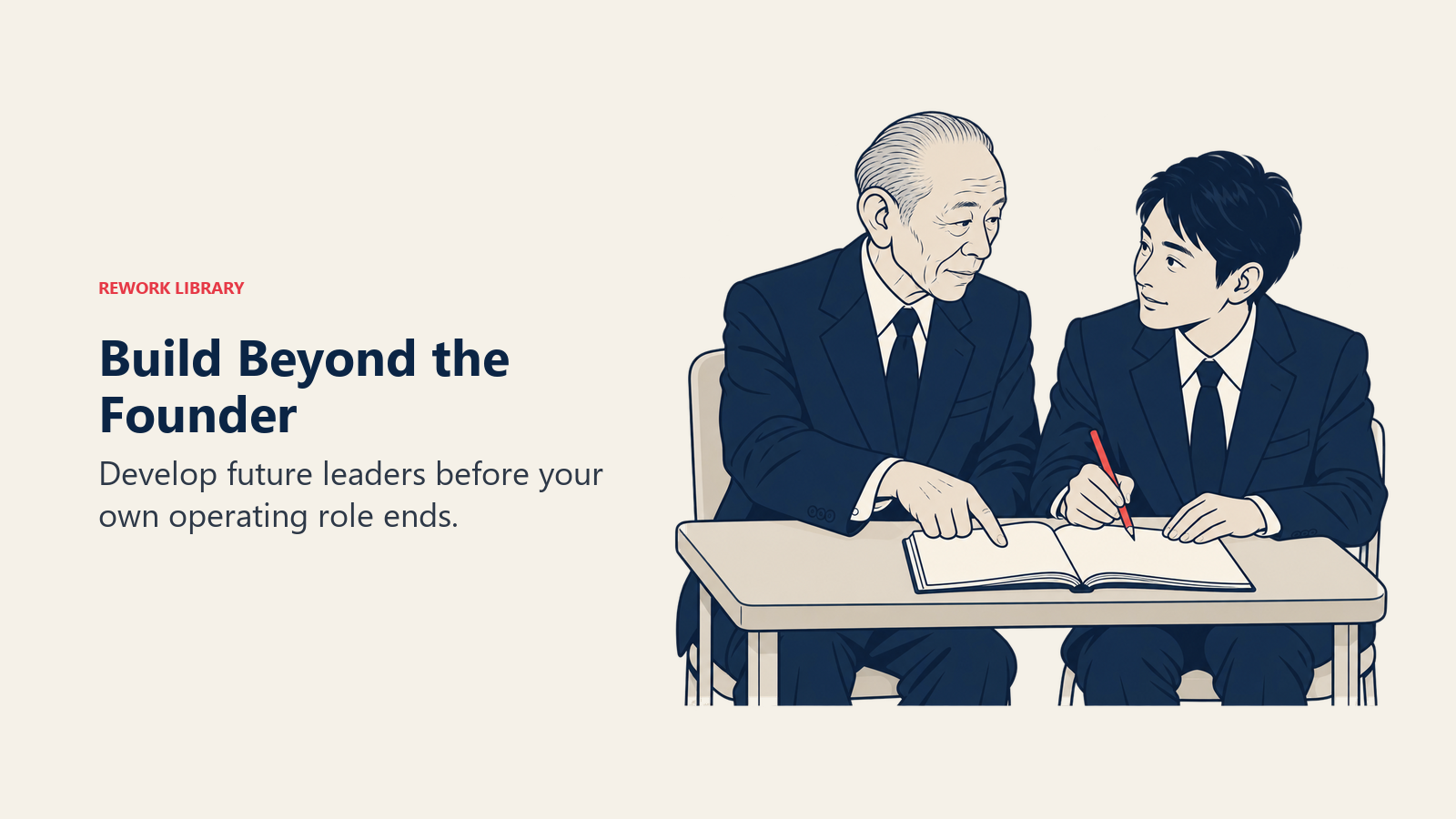
If you're a leader wondering what comes after you stop running the business, Matsushita's sequence is the useful detail, not just the destination. He spent thirty years between founding his first outside institution and making his largest bet on a second one, and he made that second, larger bet only after he had already proven, over years, that he could genuinely let go of daily control. Don't treat institution-building as a retirement hobby you start the week you step down. Start it while you still have something to lose.
| Situation you're facing | Matsushita's likely move |
|---|---|
| You've written a mission statement but nobody inside the company treats it as binding | Attach a specific, dated plan to it, even a multi-decade one, so it can be checked against reality later |
| Multiple product lines report up through one central structure and accountability is blurry | Give each line its own profit-and-loss ownership, not just a manager's title |
| A defining partnership or relationship is the glue holding your culture together | Build the culture into structure and stated principles early, so it does not depend on any one relationship outliving its usefulness |
| You're stepping back from day-to-day control and wondering what comes next | Fund something outside the company's product lines, but do it in stages, and only commit the largest amount after you've proven you can genuinely let go |
| A crisis is pushing your team toward layoffs as the default response | Look for a version of shared sacrifice, reduced hours, deferred pay increases, before headcount, and be explicit about why |
Notable Quotes & Lessons Beyond the Boardroom
At the 1932 mission declaration, Matsushita explained the manufacturer's obligation in terms anyone in the room could picture: "The mission of a manufacturer is to overcome poverty by producing an abundant supply of goods... so as to banish poverty, bring happiness to people's lives, and make the world a better place." He tied that mission to something larger than commerce, telling employees that "only after there is spiritual peace of mind and a limitless supply of material goods will humanity achieve true happiness."
On the Depression-era decision not to cut staff, his instruction to executives was blunt and specific rather than motivational: "Cut production by half starting now, but do not dismiss even a single employee." On the divisional system a few years later, he framed the goal as a change in mindset as much as structure, telling employees to approach their work "as though you were a president or proprietor of your own enterprise."
In Japan, Matsushita is still widely referred to as keiei no kamisama, the God of Management, an honorific serious enough that Harvard Business School professor John Kotter devoted a full biography, Matsushita Leadership: Lessons from the 20th Century's Most Remarkable Entrepreneur (1997), to how a man with a fourth-grade education built one of the world's largest electronics companies and then gave much of his fortune away to institutions meant to outlast it. It's worth being precise about which parts of that story are documented rather than embellished. The Depression story and the tap water mission are two of the most retold anecdotes in business writing, and both have accumulated exaggerated detail across decades of paraphrase in a way the original Panasonic-hosted accounts do not support. The core facts, that he cut hours rather than headcount in 1929, and that he declared a mission built around affordable abundance in 1932, are documented directly by Panasonic's own histories. Specific dialogue beyond the lines above, and any claim about exact profit figures from the sell-off, should be treated as tradition rather than record.
Where This Style Breaks
The Philosophy-as-Infrastructure Doctrine assumes a level of founder authority, and eventually founder wealth, that almost nobody replicates. Matsushita could declare a 250-year plan because he owned the company outright and answered to no board that could veto a mission statement. He could commit 7 billion yen of personal fortune to a leadership school because he had accumulated that fortune first. A manager two or three levels down an org chart, or a founder still years from that kind of capital, cannot borrow this doctrine wholesale. The structural half of it, self-accounting divisions, real profit-and-loss delegation, travels. The institution-building half requires resources most leaders will never have.
There is also a harder tension the doctrine doesn't resolve: the specific practice that made Matsushita famous did not survive him as literal policy. His 1929 refusal to lay off a single employee became one of the most cited episodes in Japanese management history, but Panasonic Holdings announced plans in May 2025 to cut roughly 10,000 jobs globally, split evenly between Japan and the rest of the world, as part of a restructuring driven by weak demand and a shrinking automotive-battery business. The Basic Management Objective and Seven Principles he wrote are still published on the company's own site today, and the vocabulary of "autonomous management" he used in 1933 is still the vocabulary its executives reach for. But the specific human commitment behind the 1929 decision, that headcount is the last lever you pull, was not something the philosophy alone could guarantee ninety years later. A mission statement outlasted its founder. A specific promise about how employees would be treated in hard times did not.
That gap is the honest lesson, not a reason to dismiss the doctrine. Structure and stated purpose can survive a founder's death by decades. The specific practices that made the purpose credible in the founder's own lifetime require every subsequent leadership generation to choose to honor them again, under new pressures the founder never had to face. W. Edwards Deming ran into a version of the same problem with quality: a system of principles is only as durable as the willingness of each new management team to keep implementing it rather than quietly reverting to whatever is easiest under short-term pressure.
Learn More
- Kazuo Inamori Leadership Style: Amoeba Management and a Second Career as a Monk
- Taiichi Ohno Leadership Style: The Toyota System's Architect
- Soichiro Honda Leadership Style: Failure, Speed, and the Fujisawa Partnership
- Akio Toyoda Leadership Style: Heritage, Crisis, and the Hybrid Stand
- Ratan Tata's Leadership Style and Principles
- Peter Drucker Leadership Style: Management as a Humane Discipline
- W. Edwards Deming Leadership Style: Quality as a System
- Sam Walton's Leadership Style at Walmart

Co-Founder, Rework.com
On this page
- The Philosophy-as-Infrastructure Doctrine
- Leadership Style Breakdown
- Key Leadership Traits
- The 3 Decisions That Defined Konosuke Matsushita as a Leader
- 1. Declaring a 250-Year Mission Instead of a Slogan (May 1932)
- 2. Splitting the Company Into Self-Accounting Divisions (May 1933)
- 3. Stepping Back to Fund a School Instead of Running the Company Forever (1946 to 1980)
- What Konosuke Matsushita Would Do in Your Role
- Notable Quotes & Lessons Beyond the Boardroom
- Where This Style Breaks
- Learn More