Dwight Eisenhower Leadership Style: Strategic Patience and the Architecture of Execution
Turn this article into takeaways for your work.


Each assistant summarizes the article only for you and suggests best practices for your work.
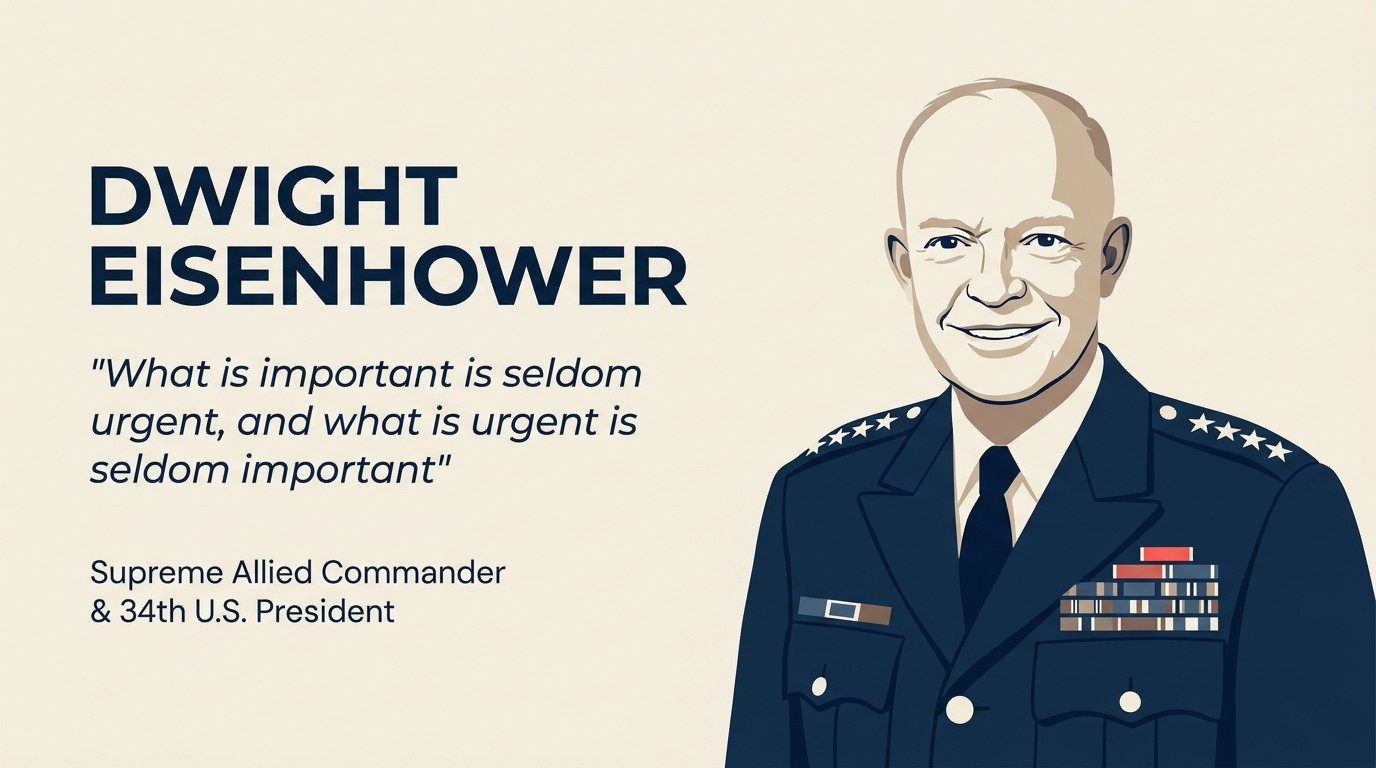
Key Facts: Dwight D. Eisenhower (1890-1969) served as Supreme Allied Commander in Europe during World War II, planning and executing the D-Day invasion on June 6, 1944. He became the 34th President of the United States (1953-1961) and was NATO's first Supreme Allied Commander Europe. A five-star General of the Army, he championed the Interstate Highway System, created NASA, and warned the nation about the "military-industrial complex" in his 1961 farewell address.
The Strategic Patience Doctrine
The Strategic Patience Doctrine is Eisenhower's leadership principle of building complete operational systems before committing to decisive action, then acting with full conviction once conditions align. It treats planning as the foundation that makes rapid execution possible, and it treats decision moments as products of long-range system design rather than acts of individual improvisation.
Dwight Eisenhower spent 25 years as a staff officer and never commanded troops in actual combat. While his West Point classmates led battalions and divisions through the early decades of the 20th century, he planned, coordinated, and advised. He served under MacArthur in the Philippines from 1935 to 1939, learning how to manage a difficult superior with an enormous ego and an appetite for public theater. He wrote planning documents that nobody read. He understood the logistical architecture of large military organizations at a depth that field commanders rarely developed.
At 53, he was appointed Supreme Allied Commander Europe and given operational authority over the most complex military endeavor in history. On June 6, 1944, 156,000 Allied troops crossed the English Channel, supported by 5,000 ships and 11,000 aircraft, and landed at five beaches in Normandy. The night before, Eisenhower wrote two letters: one announcing success, one accepting full personal responsibility for failure. That split-decision discipline, planning for both outcomes while committing fully to the action, is the leadership lesson that transfers most directly to anyone running a complex organization.
He served two terms as the 34th US President from 1953 to 1961. He ended the Korean War, built 41,000 miles of interstate highway, and created NASA. His farewell address coined the term "military-industrial complex", a warning from the five-star general who had built the apparatus he was cautioning his successors about. The man who coordinated the largest war in history was also self-aware enough to see what the machinery he'd built might become.
Leadership Style Breakdown
| Style | Weight | How it showed up |
|---|---|---|
| Systems Architect | 55% | Eisenhower thought in systems before he thought in decisions. D-Day wasn't a single decision, it was 18 months of planning that created the conditions under which a decision window could be taken. The Interstate Highway System, justified to Congress as national defense infrastructure, was a 10-year system-building project disguised as a public works bill. The Eisenhower Matrix, his framework for separating urgent tasks from important ones, reflects how a systems thinker organizes their own time: not by what demands attention, but by what determines outcomes. |
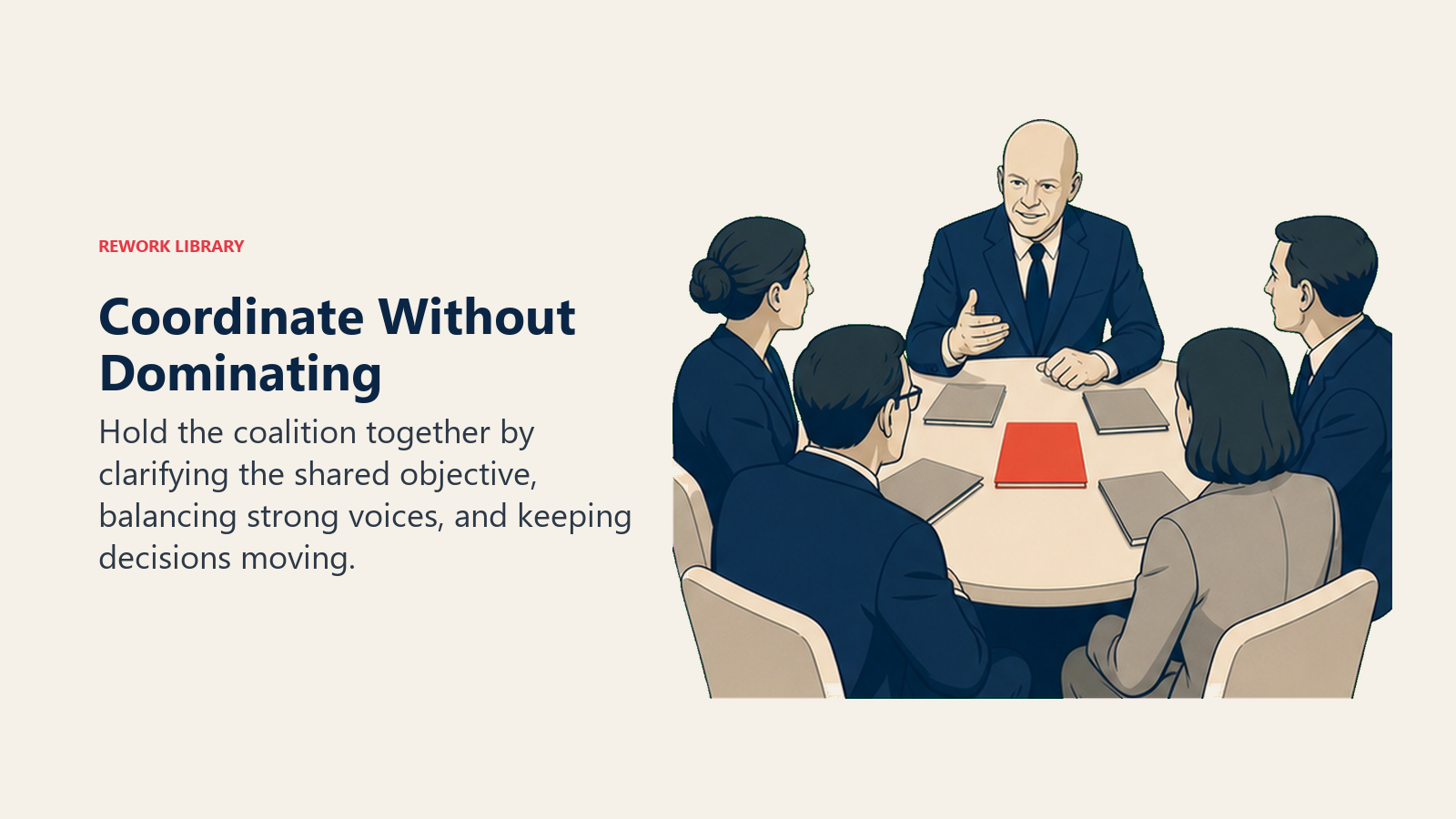
| Coalition Coordinator | 45% | He managed British General Montgomery, American General Patton, and French General de Gaulle simultaneously, three men with conflicting strategic views, large personal ambitions, and national audiences to perform for. Winston Churchill operated in the same Allied command structure during this period, and the two men's relationship captures the essential tension between the coalition's moral voice and its operational authority. His approach was to give each enough authority to commit their forces while maintaining the operational framework that kept the coalition coherent. He didn't defeat them. He gave them enough wins to stay in the tent. |
The 55/45 split reflects the sequence in which the two styles operated. Eisenhower built the system first, then used coalition management to keep the people required to run the system from destroying each other. Without the system, the coalition management would have had nothing to coordinate toward. Without the coalition management, the system would have collapsed under the weight of competing national interests. Both halves were required. Most leaders are better at one than the other. Eisenhower was unusually effective at both.
Key Leadership Traits
| Trait | Rating | What it means in practice |
|---|---|---|
| Prioritization under complexity (the Eisenhower Matrix) | Exceptional | His 1954 speech to the World Council of Churches contained the line: "What is important is seldom urgent and what is urgent is seldom important." That observation became the intellectual foundation of the four-quadrant prioritization framework still taught in every management course. It's a direct product of how Eisenhower organized his own work, distinguishing tasks that require immediate action from tasks that determine long-term outcomes, and protecting time for the latter against the constant pull of the former. |
| Accountability without blame culture | Very High | The "In case of failure" letter he drafted on June 5, 1944 is remarkable for what it doesn't do: it doesn't distribute responsibility to the weather, to the planners, to the British, to Montgomery. It begins: "Our landings in the Cherbourg-Havre area have failed to gain a satisfactory foothold and I have withdrawn the troops." First person, singular, no hedge. That's not a communication strategy. It's a leadership posture that said: if this fails, the responsibility is mine. That posture, genuine personal accountability in advance of the outcome, is rarer than it sounds. |
| Coalition management across ego-heavy personalities | High | Patton and Montgomery actively disliked each other and competed publicly for theater resources and press coverage. De Gaulle resented the entire premise of needing Allied support. Eisenhower managed all three by maintaining private relationships with each, allowing each commander enough operational latitude to have genuine victories to point to, and enforcing the coalition framework only when the friction became operationally damaging. He removed Patton from command twice, once for the slapping incident, once for a political statement, but kept him available because his battlefield performance was irreplaceable. That's coalition management that's clear-eyed about the difference between personality and value. |
| Long-range systems thinking over short-term wins | High | The Interstate Highway System (1956) was sold as defense infrastructure, a way to move troops across the country in a nuclear conflict scenario, but it reshaped American commerce, suburban development, and manufacturing logistics for decades. NASA (1958) was created in response to Sputnik but was designed as a permanent civilian space agency, not a one-time response. Eisenhower consistently used immediate political opportunities to build long-duration institutions. The short-term justification and the long-term intent were often different things. |
The 3 Decisions That Defined Eisenhower as a Leader
1. Setting D-Day for June 6 Despite Marginal Weather
By June 1944, the Allied invasion of Normandy had been planned for months. The window required specific conditions: a full moon for airborne operations, low tide at dawn for beach obstacles, and enough daylight for air support. The viable windows in June were narrow. The first window, June 5, was approaching, and the weather was deteriorating.
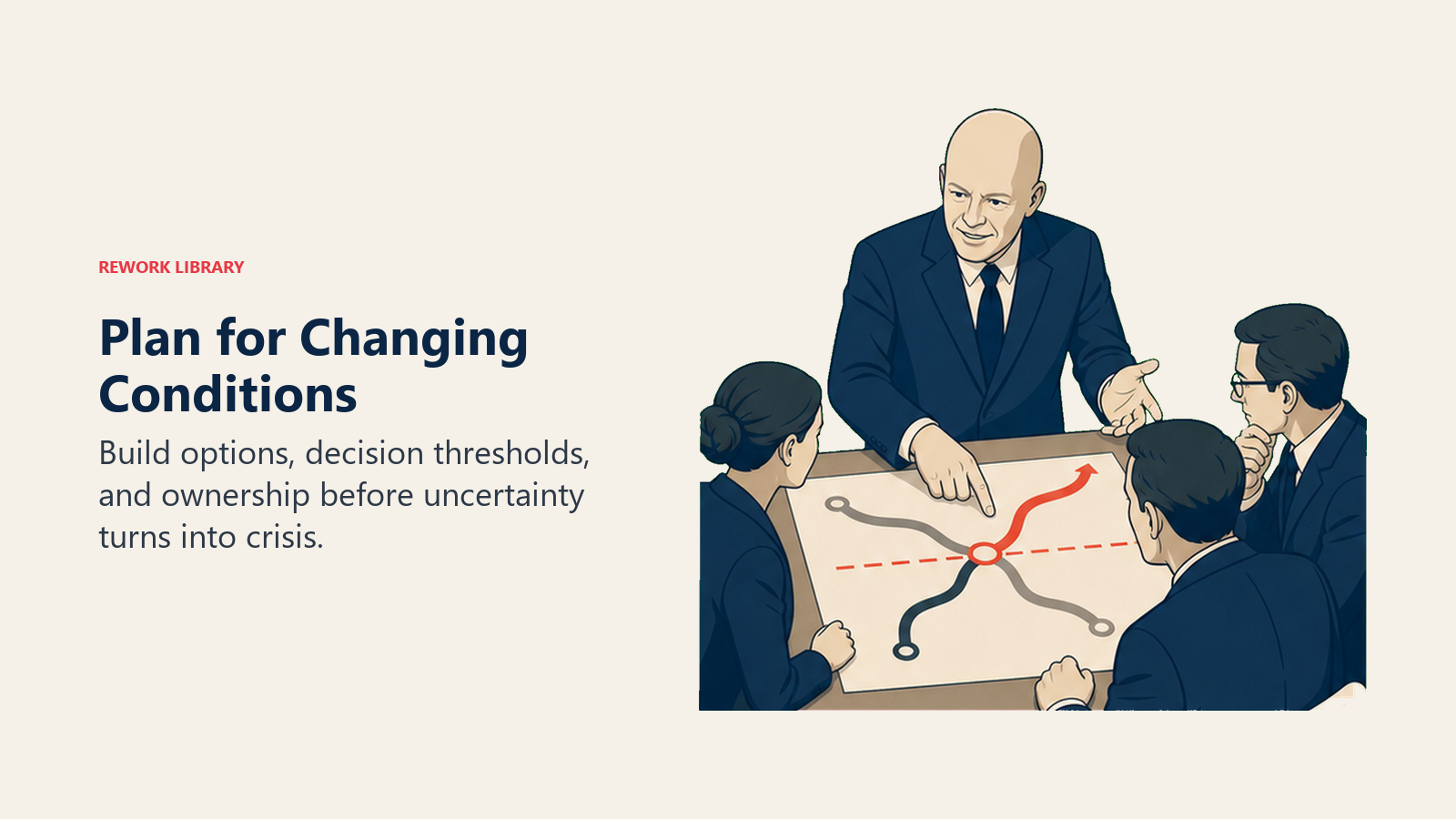
On June 4, Eisenhower's chief meteorologist, Group Captain James Stagg, gave his assessment: June 5 was impossible. But there was a 36-hour window opening around June 6, with conditions marginal but potentially acceptable. The forecast had a confidence interval that Stagg acknowledged was genuinely uncertain.
Eisenhower convened his commanders. Montgomery and Ramsay were cautiously in favor of proceeding. Leigh-Mallory was opposed. Tedder was doubtful. It was not a consensus. It was a situation where the Supreme Allied Commander had to make a call with incomplete information, knowing that delay pushed the operation into the next viable window, two weeks away, with all the security, logistics, and morale costs that entailed.
At 9:45 pm on June 4, Eisenhower said: "OK, let's go." He confirmed the decision the following morning at 4:00 am.
156,000 men crossed to Normandy on June 6. The weather held marginally. The operation succeeded.
The decision illustrates the limits of planning as a decision substitute. Eisenhower had spent 18 months building the planning architecture for D-Day. At the moment of decision, the plan couldn't tell him what to do. The weather window was real but uncertain. The cost of delay was real but calculable. Only the person with operational authority could take the call. He took it, and he took it alone.
2. Drafting the "In Case of Failure" Letter on June 5, 1944
The night before D-Day, while the largest invasion force in history was loading onto ships, Eisenhower wrote a short message that began: "Our landings in the Cherbourg-Havre area have failed to gain a satisfactory foothold and I have withdrawn the troops." Abraham Lincoln had a parallel instinct for pre-committed accountability, his willingness to publicly own outcomes before they happened is one of the through-lines connecting the two wartime presidents.
He drafted the letter in pencil on a notepad. He misstated the date (writing "July 5" instead of June 5, crossed out). He read it once and put it in his wallet. The troops who survived could tell the story of what went right. The letter was his version of what to say if they didn't.
The letter was found in his papers after the war. He never spoke about it publicly.
What makes it significant is the orientation it reveals. Eisenhower didn't write the letter because he thought D-Day was going to fail. He wrote it because a leader who sends 156,000 people into mortal risk should be able to account for that decision if the outcome is catastrophic. The accountability didn't depend on outcome. It was baked in at the moment of commitment.
For operators, the lesson is about pre-commitment to accountability. Most executives are willing to take credit for decisions that work and explain the context for decisions that don't. Eisenhower's model is different: you decide, you own the outcome completely, and you prepare the accountability before you know the result. That standard changes how you make decisions, because you can't write that letter for decisions you're not genuinely prepared to own.
3. Warning About the Military-Industrial Complex in His Farewell Address
On January 17, 1961, three days before handing power to John Kennedy, Eisenhower gave his farewell address to the nation. The speech is remembered for a single warning: "In the councils of government, we must guard against the acquisition of unwarranted influence, whether sought or unsought, by the military-industrial complex."
The phrase was new. The concern was not hypothetical. Eisenhower had watched the defense industry and the military establishment develop a self-reinforcing relationship during his presidency, contractors who needed contracts, generals who needed programs, senators who needed defense jobs in their districts. He had presided over it. He had signed the budgets. And as he left, he named it as a structural risk to democratic governance.
What makes this remarkable is the source. This wasn't a peacenik's warning or a fiscal hawk's complaint. It was a five-star general and former Supreme Allied Commander telling his successors that the machine he had commanded and helped build was now a systemic threat to the country it had defended. He had enough standing to say it credibly. He had enough self-awareness to say it honestly.
For operators, the farewell address is a model for institutional honesty at the moment of departure. Eisenhower didn't spend his last address defending his record. He spent it warning about the most significant risk he could see in the system he was handing over. That orientation, naming what's dangerous rather than protecting what's comfortable, is what distinguishes leaders who are thinking about institutions from leaders who are thinking about legacies.
What Eisenhower Would Do in Your Role
If you're a CEO, his playbook tells you to build the system before you make the decision. D-Day was possible because 18 months of logistics, planning, and coalition-building created the conditions under which a 36-hour weather window could be acted on. If Eisenhower had tried to improvise the invasion, the weather window would have been useless. For your company, the question is whether you're building the operational infrastructure that allows you to act decisively when the opportunity presents itself, or whether each major decision requires rebuilding the foundation from scratch.
If you're a COO, his playbook tells you that the Eisenhower Matrix is a discipline, not a framework. The distinction between urgent and important has to be applied constantly, not just in quarterly planning. Every week that you spend primarily on urgent tasks, fires, escalations, last-minute requests, is a week you didn't spend on the important work that determines the company's next 12 months. Build the mechanism to protect important-non-urgent work from the urgent-non-important category, or it will never happen.
If you're a product leader, his playbook tells you to treat coalition management as a product discipline. Eisenhower kept Montgomery and Patton functional by giving each enough operational wins to stay committed to the coalition's goals. You need the same model with your internal stakeholders: engineering, design, sales, and legal all have their own priorities. Give each one enough genuine wins within your product process to keep them engaged rather than obstinate. Coalition collapse, where one stakeholder becomes a blocker rather than a contributor, is a product execution problem before it's a people problem.
If you're in sales or marketing, his playbook tells you to sell the system, not the decision. The Interstate Highway System passed Congress because Eisenhower framed it as defense infrastructure (urgent, widely supported) while knowing its primary value was commercial (important, harder to sell). When you're trying to get approval for a long-horizon investment, a new market, a platform bet, a category expansion, find the urgent-enough justification that gets it funded, then build the important thing you actually intended.
The Rework Take
Modern executives running hybrid teams rarely fail on intent, they fail on the triage layer. The Eisenhower Matrix is conceptually simple, but applying it across 40 people, 12 projects, and three time zones collapses fast without tooling. Urgent-but-unimportant tasks (Slack pings, status requests, rework of last week's deliverable) crowd out the important-non-urgent work (pipeline architecture, market expansion prep, systems that reduce next quarter's fires). Rework makes the Eisenhower Matrix an operational habit rather than a quarterly exercise: priority tags on every task, automated sweep of stale items, and cross-team views that show where the coalition is spending time versus where the strategy says it should. Like Eisenhower coordinating Patton, Montgomery, and de Gaulle, your job is not to make every decision, it is to build the system that makes the right decisions cheap to make. The Project Engine starts at $99/month billed yearly with 5 seats included; the Sales Engine adds the CRM layer from $69/month billed yearly for teams that need pipeline discipline in the same system.
Notable Quotes and Lessons Beyond the Boardroom
Peter Drucker was writing about management systems at the same time Eisenhower was governing, and Peter Drucker's management philosophy formalized much of what Eisenhower practiced intuitively: the distinction between effectiveness and efficiency, and the discipline of protecting time for important-non-urgent work.
"In preparing for battle I have always found that plans are useless, but planning is indispensable." This is the most practically useful thing Eisenhower ever said about operational leadership, and it holds up. Plans fail on contact with reality. The weather on June 6 wasn't what the plan required. The beach defenses weren't exactly where they were expected. Individual units were dropped miles from their objectives. None of that invalidated the planning process, because the planning had built enough redundancy, enough command clarity, and enough logistical depth that the real operation could adapt. The plan gave way. The planning held.
His presidency is often remembered as passive, two terms of steady management in an era of relative prosperity. That reading misses what he was actually doing. He kept the US out of Vietnam during a period when multiple advisors were pushing for direct military intervention. He ended the Korean War within four months of taking office. He resisted defense budget increases that the Pentagon wanted and Congress was inclined to approve. His "hidden hand" governing style, achieving outcomes through indirect means while appearing to be above the political fray, was a deliberate choice, not a personality limitation. He'd seen enough of what visible, charismatic leadership produced in wartime to be skeptical of it in peacetime.
Where This Style Breaks
Eisenhower's consensus-first approach frustrated commanders who needed faster decisions. Patton famously chafed under the coalition framework that gave Montgomery equal operational standing. In peacetime, his "hidden hand" style was sometimes indistinguishable from inaction, his early response to McCarthyism was widely criticized as too slow and too quiet.
The Eisenhower Matrix oversimplifies what many operators actually face: tasks where the urgent/important distinction isn't clear, where the "important" category requires consensus you don't have, where the system-building work competes with survival-level fires that can't be deprioritized. His framework was built on the assumption that you have enough institutional stability to protect important-non-urgent time. Many operators don't have that stability.
And the military-industrial complex he warned about in 1961 had grown substantially under his own watch. Jack Welch represents the operator-CEO lineage that the postwar industrial expansion produced, the style of execution-driven leadership that Eisenhower's institutional systems helped make possible and that Welch pushed to its logical commercial extreme. The systems thinker who builds a machine well enough that it outlasts his control is the specific irony of Eisenhower's legacy, a reminder that building durable systems means accepting that you won't always control what they become.
Frequently Asked Questions about Dwight Eisenhower's Leadership
Who was Dwight D. Eisenhower?
Dwight D. Eisenhower (1890-1969) was a five-star US Army general who served as Supreme Allied Commander Europe during World War II and planned the D-Day invasion in 1944. He later served as the 34th President of the United States from 1953 to 1961, presided over the end of the Korean War, and created the Interstate Highway System and NASA.
What is the Eisenhower Matrix?
The Eisenhower Matrix is a four-quadrant prioritization framework that sorts tasks by urgency and importance. It derives from Eisenhower's 1954 observation that "what is important is seldom urgent and what is urgent is seldom important," and it directs leaders to protect time for important-but-not-urgent work that determines long-term outcomes.
How did Eisenhower lead the D-Day invasion?
Eisenhower led 18 months of Allied planning for Operation Overlord, coordinating 156,000 troops, 5,000 ships, and 11,000 aircraft across British, American, Canadian, and Free French forces. On June 4, 1944, with marginal weather forecasts, he made the personal call to launch the invasion on June 6 and drafted a letter accepting full personal responsibility in case of failure.
What did Eisenhower warn about the military-industrial complex?
In his January 17, 1961 farewell address, Eisenhower warned the nation to "guard against the acquisition of unwarranted influence, whether sought or unsought, by the military-industrial complex." He named the self-reinforcing relationship between defense contractors, the military establishment, and Congress as a structural risk to democratic governance, despite having presided over its expansion as president.
What did Eisenhower accomplish as president?
As the 34th US President from 1953 to 1961, Eisenhower ended the Korean War within four months of taking office, signed the Federal-Aid Highway Act of 1956 that built 41,000 miles of interstate highway, and created NASA in 1958 in response to Sputnik. He also kept the US out of direct military intervention in Vietnam and resisted defense budget increases that the Pentagon and Congress wanted.
What can modern executives learn from Eisenhower?
Modern executives can learn to build the operational system before the decision, protect important-non-urgent work from the pull of urgent-unimportant tasks, and treat coalition management as a core execution discipline. His model of pre-committed accountability, owning an outcome completely before knowing the result, raises the bar for how high-stakes decisions are made and communicated.

On this page
- The Strategic Patience Doctrine
- Leadership Style Breakdown
- Key Leadership Traits
- The 3 Decisions That Defined Eisenhower as a Leader
- 1. Setting D-Day for June 6 Despite Marginal Weather
- 2. Drafting the "In Case of Failure" Letter on June 5, 1944
- 3. Warning About the Military-Industrial Complex in His Farewell Address
- What Eisenhower Would Do in Your Role
- The Rework Take
- Notable Quotes and Lessons Beyond the Boardroom
- Where This Style Breaks