Jeff Bezos Leadership Style: How Customer Obsession and Long-Term Thinking Built Amazon
Turn this article into takeaways for your work.


Each assistant summarizes the article only for you and suggests best practices for your work.
Key Facts
- Born: 1964
- Founded Amazon: 1994 (originally an online bookstore)
- AWS launched: 2006
- Amazon market cap peak: ~$1.9 trillion
- CEO tenure: 1994–2021 (succeeded by Andy Jassy)
- Founded Blue Origin: 2000 (private aerospace company)
- Acquired The Washington Post: 2013 ($250 million personal acquisition)
- Codified culture: 14 Amazon Leadership Principles
The Customer Obsession Doctrine (The Day 1 Model)
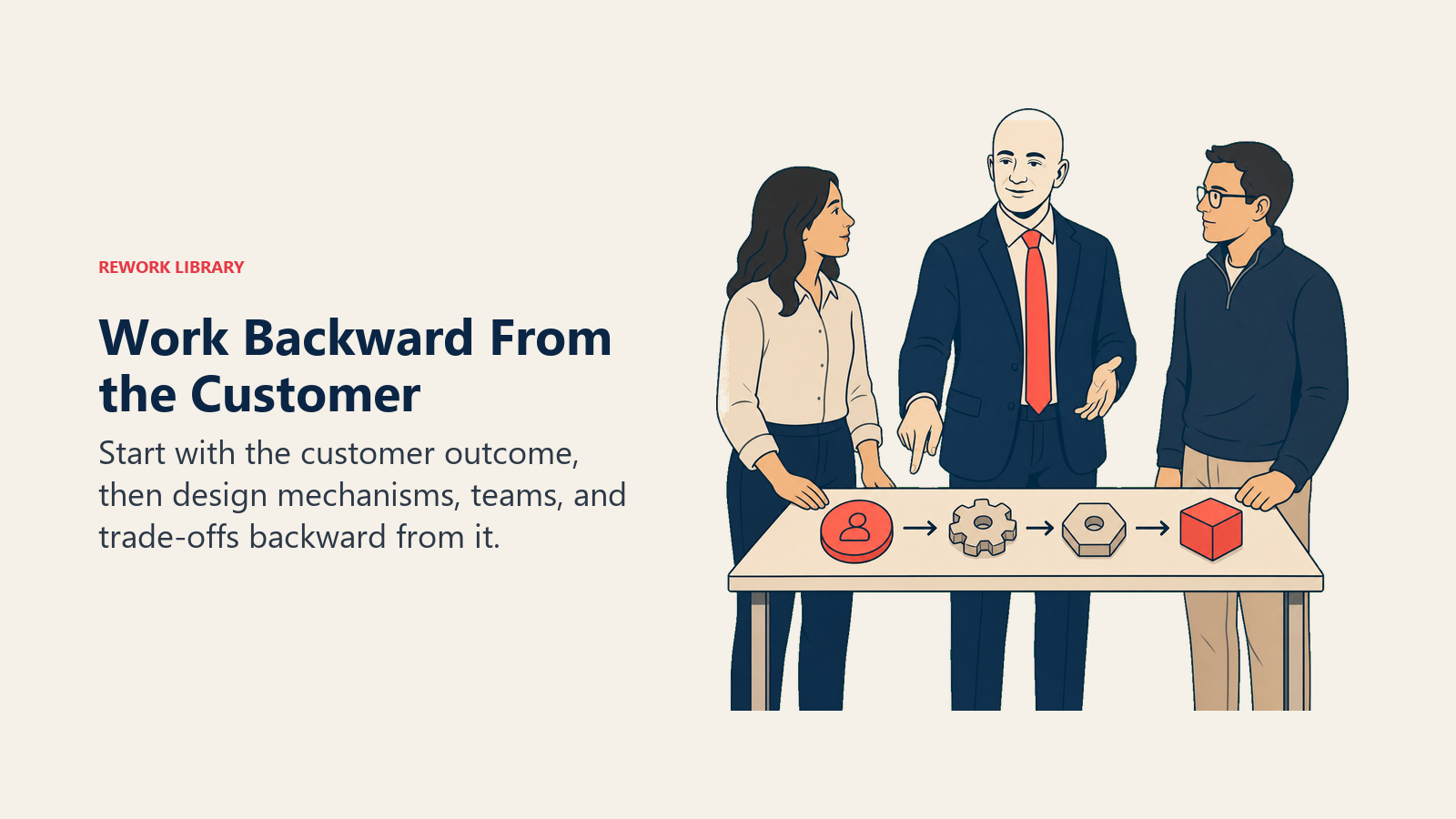
Bezos's operating doctrine treats every working day as the company's first, relentlessly customer-obsessed, intolerant of bureaucratic inertia, and willing to sacrifice short-term margin for long-term customer trust. The "Day 1" framing is a rejection of "Day 2," which Bezos defined as stasis followed by irrelevance. In practice it means working backwards from the customer outcome, codified in mechanisms like the six-page memo, two-pizza teams, and the 14 Leadership Principles.
Most CEOs talk about customer focus. Jeff Bezos actually structured his entire organization around it. The difference isn't philosophy. It's operational. Bezos didn't just say customers mattered. He built mechanisms, rituals, and cultural norms that made ignoring customers structurally difficult.
The result: Amazon went from an online bookstore in 1994 to a $2 trillion enterprise spanning e-commerce, cloud infrastructure, logistics, entertainment, and healthcare. That kind of breadth doesn't happen by accident.
"Your brand is what other people say about you when you're not in the room.", Jeff Bezos
Why does Bezos matter to today's leaders? Because the pressures he navigated (Wall Street short-termism, organizational bloat, the temptation to copy competitors) are the same ones executives face right now. His answers weren't always right. But they were always intentional. And that intentionality is worth studying.
Leadership Style Breakdown
Bezos doesn't fit neatly into a single leadership archetype. He's part visionary, part systems thinker, and occasionally part interrogator. The dominant mix looks like this:
| Style | Weight | What It Looks Like in Practice |
|---|---|---|
| Visionary | 70% | Long-horizon bets (AWS, Prime, Alexa) before the market sees the opportunity |
| Data-Driven | 30% | Decisions anchored in metrics, written memos, and structured analysis rather than gut feel |
The visionary weight shows up most clearly in his willingness to invest in ideas that look terrible in year one but transformative in year ten. AWS made no sense to Wall Street in 2006. It now generates the majority of Amazon's operating income.
The data-driven layer prevents the visionary instinct from becoming delusional. Bezos demanded rigor. Every major initiative required detailed written analysis. Intuition was a starting point, not a conclusion.
Key Leadership Traits
| Trait | Rating | What It Means for Leaders |
|---|---|---|
| Customer Obsession | Exceptional | Every product decision starts with the customer, not the technology or the competitor |
| Long-Term Thinking | Very High | Willing to sacrifice short-term profits for durable competitive advantages |
| Innovation | High | Treats experimentation as a business process, not a creative exercise |
| Risk Taking | High | Makes high-stakes bets where failure is possible but inaction is worse |
These aren't independent traits. They reinforce each other. Customer obsession tells you what to build. Long-term thinking gives you permission to build it before the market demands it. Innovation generates the options worth betting on. And risk tolerance lets you actually place the bet.
Strip out any one of them and the model breaks. A long-term thinker without customer obsession builds things that don't matter. A risk-taker without data discipline burns capital on bad ideas. The combination is what makes the Bezos model distinctive.
The 3 Decisions That Defined Bezos as a Leader
1. Leaving Wall Street for an E-Commerce Startup
In 1994, Bezos was a senior vice president at D.E. Shaw, a successful hedge fund. He walked away to sell books online. At the time, this looked either visionary or reckless depending on who you asked.
His decision framework has become famous: he called it the "regret minimization" test. He asked himself which choice he'd regret more at age 80. Not in the next quarter. At 80. When he framed it that way, the answer was obvious.
That framing reveals something important about how Bezos operates. He doesn't evaluate decisions on the basis of near-term odds. He evaluates them on the basis of long-run regret. For executives conditioned to optimize for quarterly results, this is a genuinely different cognitive mode.
The lesson isn't "quit your job and start a company." It's that your decision horizon shapes which options even appear rational. Bezos extended his horizon and saw opportunities that shorter-horizon thinkers dismissed.
2. The AWS Bet
By the early 2000s, Amazon's internal infrastructure had become sophisticated enough that Bezos recognized something: the underlying capability was itself a product. And that product had nothing to do with selling consumer goods.
AWS launched in 2006. Critics, including some Amazon board members, questioned the strategic logic. Why would a retailer become a technology infrastructure company? His chosen AWS successor Andy Jassy took over as Amazon CEO in 2021 having built AWS from an internal IT project into the cloud market's dominant platform, a cleaner leadership inheritance than most founders manage.
The answer was that Bezos wasn't thinking like a retailer. He was thinking about what Amazon could build that the market genuinely needed but didn't yet have. AWS fulfilled that test perfectly.
What makes this decision instructive isn't the outcome. It's the reasoning process. Bezos asked: "What can we build that will be hard for others to replicate?" Not: "What does our current category demand?" Leaders who define their business by their current category rather than their underlying capabilities tend to be surprised by the companies that eventually displace them.
3. The 6-Page Memo Culture
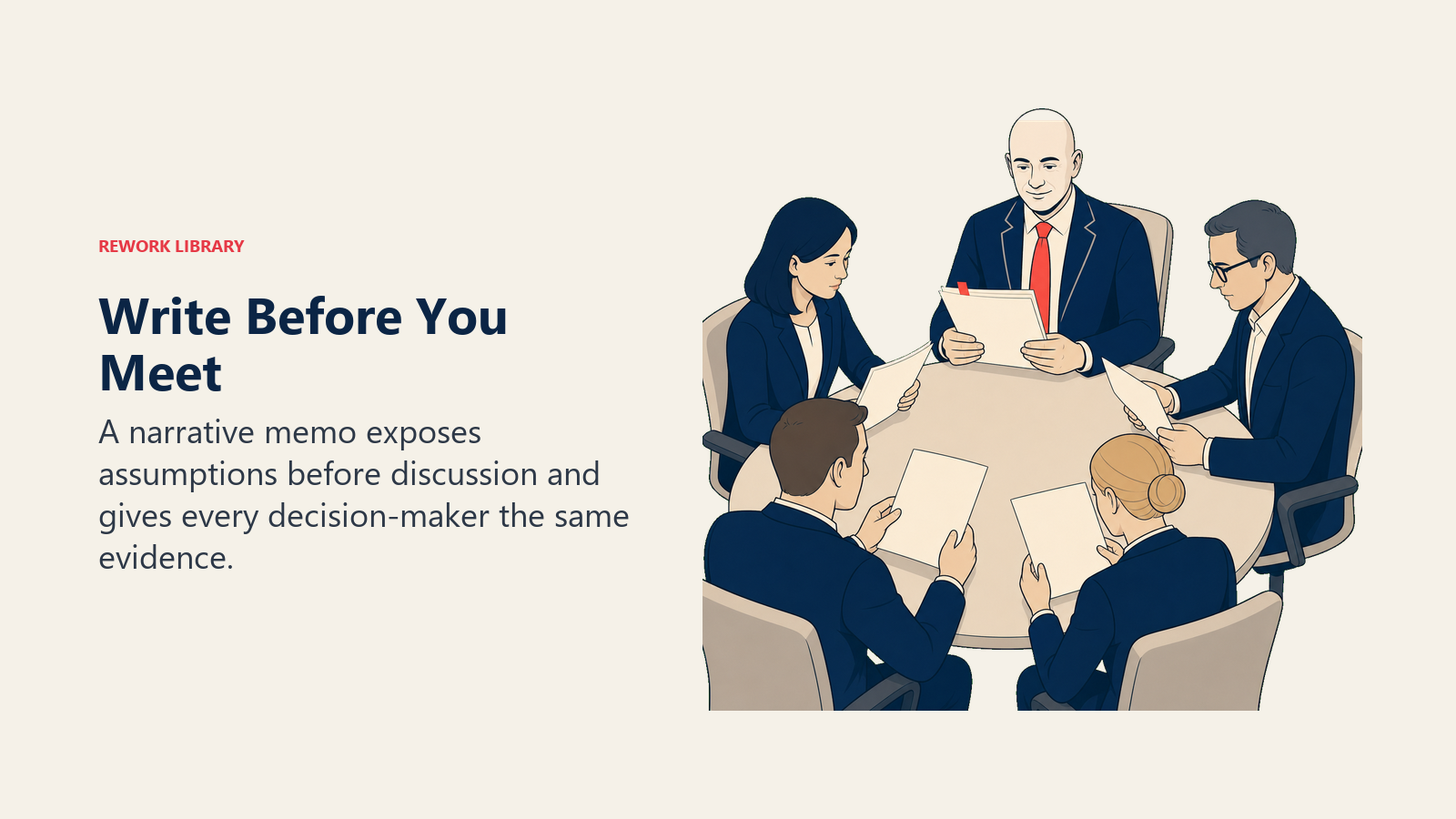
At some point in Amazon's growth, Bezos banned PowerPoint decks from executive meetings. He replaced them with six-page narrative memos, read in silence at the start of every meeting.
This sounds like a process tweak. It's actually a cultural statement.
Bullet points let fuzzy thinking hide behind clean formatting. A narrative memo forces the writer to actually think through the argument. Gaps in logic become visible. Assumptions have to be stated. The discipline of prose is the discipline of thought.
The six-pager also shifted meeting dynamics. Instead of the presenter performing for the room, the document does the work. Discussion starts from a shared understanding rather than from competing interpretations of a slide deck.
Other companies have tried to copy this practice with mixed results, because the form isn't the point. The point is creating conditions where rigorous thinking gets rewarded over confident presentation.
What Bezos Would Do in Your Role
The Bezos playbook isn't locked inside a $2 trillion company. Several principles translate directly to leadership contexts ranging from early-stage startups to mid-market operators.
Day 1 thinking. Bezos's concept of "Day 1" (acting with the urgency and customer focus of a company's founding day) is a direct antidote to institutional complacency. "Day 2 is stasis," he wrote in a shareholder letter. "Followed by irrelevance. Followed by excruciating, painful decline." For CEOs of established companies, Day 1 thinking means asking which of your current behaviors are optimized for the organization's convenience rather than the customer's outcome.
Two-pizza teams. If a team can't be fed by two pizzas, it's too big. This isn't a cute heuristic. It's a principle about accountability and communication overhead. Larger teams develop coordination costs that slow decision-making and diffuse ownership. Two-pizza teams force you to clarify what a unit actually does and give clear ownership over outcomes. COOs implementing this will feel resistance from middle management. That resistance is part of the signal.
Jeff Wilke built Amazon's fulfillment network into a logistics operation that rivals UPS and FedEx, his operational playbook is the under-studied half of how Amazon's consumer promise became physically real. Understanding his work alongside Bezos's strategic framing gives a more complete picture of what it takes to run a company at this scale.
Disagree and commit. Amazon's leadership principles include a phrase most organizations treat as theoretical: "Have backbone; disagree and commit." In practice, it means that once a decision is made, everyone executes it at full effort regardless of whether they agreed with the decision. This isn't blind obedience. It's a recognition that organizational velocity requires alignment in execution even when alignment in perspective wasn't achievable. Leaders who tolerate half-hearted execution from dissenters pay a compounding organizational tax.
Work backwards from the customer. Before starting any significant initiative, Bezos's teams would write a mock press release announcing the finished product, written from the customer's perspective. If you can't write a clear customer-facing story for what you're building, you probably shouldn't be building it. This technique cuts through internal politics and forces honest evaluation of whether a project actually creates customer value.
Type 1 vs. Type 2 decisions. Not all decisions deserve the same deliberation. Type 1 decisions are irreversible and consequential: they deserve careful analysis and senior involvement. Type 2 decisions are reversible and low-stakes, so they should be made quickly, at the lowest appropriate level of the organization. Most companies treat Type 2 decisions like Type 1 decisions, which creates bottlenecks and kills speed. Identifying which category a decision falls into before you process it changes your governance model.
Running the Bezos Playbook on a Modern Operating Stack
Customer obsession only works when leaders can actually see the customer in their data. The Bezos discipline, work backwards from the customer, separate Type 1 from Type 2 decisions, and resist Day 2 drift, depends on cross-functional metrics that most companies still track in disconnected spreadsheets. CSAT lives in support, NPS in marketing, churn in finance, deal slippage in sales. Nobody owns the picture.
This is where Rework earns its keep for executive teams. By unifying CRM, sales ops, project management, and chat in one workspace, Rework gives the CEO a single live view of customer-impact metrics across every team, from the open support ticket to the stalled implementation to the renewal at risk. Two-pizza teams run their own funnels; the leadership layer sees the whole system. That structural visibility is what makes "Day 1" thinking operational rather than aspirational. Without it, customer obsession degrades into a poster on the wall.
The Shadow Side: What Bezos Got Wrong
Any honest assessment of Bezos has to include the parts that didn't work or caused real harm.
Warehouse conditions. Amazon's fulfillment centers became a recurring story about intense productivity demands, high injury rates, and workers who felt surveilled and disposable. These weren't edge cases or media exaggerations. They were documented in injury data, worker testimony, and investigative reporting. A leader who builds a culture of customer obsession while treating frontline workers as interchangeable units has a values gap worth naming. Bezos acknowledged some of this later, but the structural conditions took years to begin changing.
Work-life balance as a cultural blind spot. Amazon's internal culture, particularly in its early years, was known for extreme hours and a high attrition rate that some teams treated as a feature rather than a bug. The implicit logic was that the best people would self-select to stay and weaker performers would leave. But this model has costs: it systematically disadvantages caregivers, burns out high performers over time, and narrows the demographic profile of who can succeed. Leaders who want to build sustainable organizations, not just impressive ones, need to ask whether their culture is filtering for brilliance or filtering for availability.
The HQ2 spectacle. When Amazon conducted its nationwide search for a second headquarters, 238 cities submitted bids totaling billions of dollars in proposed tax incentives. The process looked less like a genuine site evaluation and more like an exercise in extracting maximum concessions. The eventual partial decision (New York City, which was then withdrawn after political backlash) left participating cities with less than they'd hoped for and raised legitimate questions about whether the process was ever a good-faith evaluation. For leaders, the lesson is that how you conduct a process sends its own signal. The HQ2 search sent a signal that the organization viewed its own leverage as something to maximize rather than something to deploy responsibly.
These failures don't cancel the genuine accomplishments. But they matter for leaders who want to apply the Bezos model thoughtfully. Customer obsession without people-centricity creates an imbalanced organization. Long-term thinking applied to shareholder value but not to workforce wellbeing is an incomplete version of the principle. Elon Musk's long-horizon founder approach at SpaceX and Tesla reflects similar tradeoffs, extreme mission focus producing extraordinary output alongside documented human cost. And Mark Zuckerberg's long-horizon bet on the metaverse shows what happens when a Bezos-style "Day 1" commitment meets a market that hasn't arrived yet.
Leadership Lessons You Can Use This Week
Audit one decision for regret minimization. Pick a decision you've been avoiding. Run it through the regret minimization filter. Ask yourself which choice you'd regret more at age 80, not in the next budget cycle. Notice how the answer changes when the time horizon changes.
Replace one meeting's deck with a written brief. Not all meetings, not forever. Just one. Ask whoever owns the agenda to circulate a two-page written analysis before the meeting starts. Require everyone to read it before the discussion. See what changes in the quality of the conversation.
Identify your Type 2 decisions. Make a list of five decisions currently sitting at a level of seniority that doesn't need to own them. Delegate those decisions explicitly, with clear criteria for what a good decision looks like. Watch whether execution speed increases.
Write a customer press release for your next initiative. Before the internal business case, before the financial model, write 200 words from the customer's perspective announcing the finished product. If you struggle to write it, that's information.
Frequently Asked Questions about Jeff Bezos's Leadership
Who is Jeff Bezos?
Jeff Bezos (born 1964) is the founder of Amazon, which he started as an online bookstore in 1994 and grew into a roughly $1.9 trillion company spanning e-commerce, cloud computing, logistics, media, and healthcare. He served as CEO from 1994 until 2021, when Andy Jassy succeeded him. He also founded the aerospace company Blue Origin in 2000 and personally acquired The Washington Post in 2013.
What does 'customer obsession' mean at Amazon?
Customer obsession is Amazon's first leadership principle, and it means starting every decision with the customer rather than with competitors, technology, or internal politics. In practice, teams write mock press releases from the customer's perspective before building anything, prioritize long-term customer trust over short-term margin, and treat customer-impact metrics as the ultimate scoreboard.
What are Amazon's 14 Leadership Principles?
The 14 Leadership Principles are Amazon's codified cultural operating system, used in hiring, promotion, and decision-making. They include Customer Obsession, Ownership, Invent and Simplify, Are Right A Lot, Learn and Be Curious, Hire and Develop the Best, Insist on the Highest Standards, Think Big, Bias for Action, Frugality, Earn Trust, Dive Deep, Have Backbone (Disagree and Commit), and Deliver Results. Two more (Strive to be Earth's Best Employer; Success and Scale Bring Broad Responsibility) were added in 2021.
What is 'Day 1' thinking?
'Day 1' is Bezos's metaphor for operating with the urgency, customer focus, and willingness to experiment of a company's founding day. Day 2, by contrast, is stasis followed by irrelevance and decline. Day 1 leaders resist proxies (where process replaces outcomes), embrace external trends, make high-velocity decisions, and stay obsessively close to the customer rather than the org chart.
How did Bezos launch AWS?
Amazon Web Services launched in 2006 after Bezos recognized that Amazon's internal compute and storage infrastructure was itself a product the broader market needed. The bet looked strange to Wall Street, why would a retailer become an infrastructure provider? but AWS now generates the majority of Amazon's operating income and pioneered the entire public cloud category. Andy Jassy built and led AWS before succeeding Bezos as Amazon CEO.
What can modern CEOs learn from Jeff Bezos?
Modern CEOs can borrow several portable mechanisms from Bezos: the regret-minimization framework for high-stakes decisions, two-pizza teams to limit coordination overhead, the six-page memo to force rigorous thinking, the Type 1 vs. Type 2 decision distinction to unlock organizational speed, and the working-backwards press release to test whether an initiative actually creates customer value. The deeper lesson is that culture is built through mechanisms, not slogans.
Learn More
Looking to go deeper on leadership styles and executive strategy? These resources build on the themes in this profile:
- What Is Leadership Style - A foundational overview of how leadership styles are defined and assessed
- Transformational Leadership Theory - The academic framework most closely aligned with Bezos's visionary approach
- Situational Leadership Styles - How effective leaders adapt their style across different organizational contexts
- Classic Leadership Styles - The historical taxonomy that Bezos's profile cuts across
- Executive Leadership for CEOs - Practical leadership frameworks for chief executives

On this page
- Key Facts
- The Customer Obsession Doctrine (The Day 1 Model)
- Leadership Style Breakdown
- Key Leadership Traits
- The 3 Decisions That Defined Bezos as a Leader
- 1. Leaving Wall Street for an E-Commerce Startup
- 2. The AWS Bet
- 3. The 6-Page Memo Culture
- What Bezos Would Do in Your Role
- Running the Bezos Playbook on a Modern Operating Stack
- The Shadow Side: What Bezos Got Wrong
- Leadership Lessons You Can Use This Week
- Learn More