Daniel Pink Leadership Style: The Attunement Framework That Made Sales Intellectually Respectable
Turn this article into takeaways for your work.


Each assistant summarizes the article only for you and suggests best practices for your work.
Key Facts: Daniel Pink (b. 1964) served three years as chief speechwriter for Vice President Al Gore in the 1990s before becoming one of the most influential business authors of his generation. His bestsellers include "Drive" (2009), "To Sell Is Human" (2012), "When" (2018), and "The Power of Regret" (2022). His TED talk "The Puzzle of Motivation" has surpassed 30 million views, making it one of the most-watched TED talks ever. He holds a JD from Yale Law School.
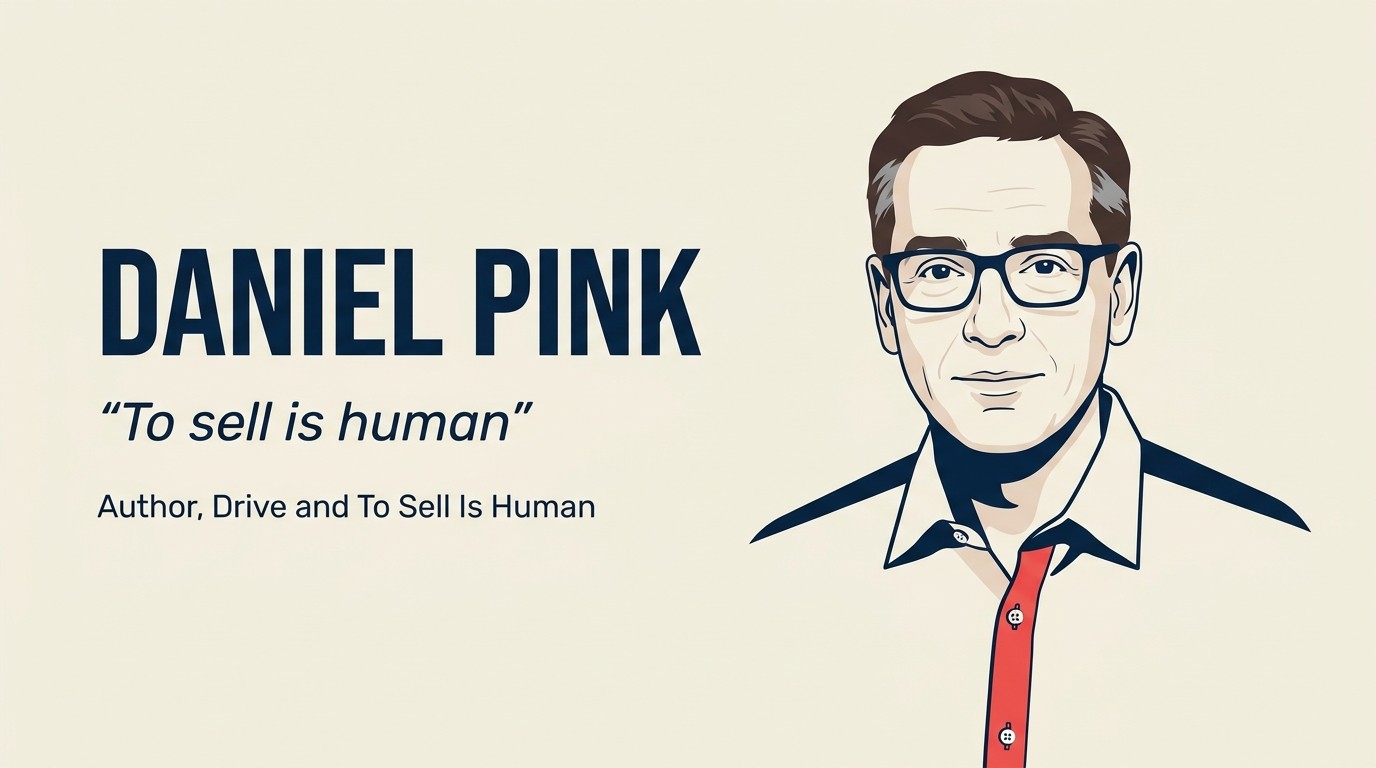
Daniel Pink spent three years as a speechwriter for Al Gore in the 1990s, graduated from Yale Law School, and never worked in sales. That outsider background is exactly why his books have had more influence on how executives think about persuasion than most of the practitioners who built careers in it. He approached selling the way a good journalist approaches any subject: asking the questions the insiders stopped noticing, reading the research the practitioners weren't reading, and synthesizing what he found into frameworks that were immediately legible to someone running a business rather than carrying a quota.
"To Sell Is Human" (2012) made the case that 1 in 9 Americans works in traditional sales, but the other 8 spend roughly 40% of their working time in what Pink called "non-sales selling": persuading, influencing, convincing, cajoling colleagues, boards, customers, and partners to do things they wouldn't do without some form of pitch. The implication: sales skill isn't a professional specialty. It's a fundamental executive competency.
That reframe mattered more than any single technique he described. And the three frameworks he built around it (attunement, buoyancy, clarity) still hold up better than most tactical selling methodologies.
Leadership Style Breakdown
| Style | Weight | How it showed up |
|---|---|---|
| Behavioral Science Translator | 75% | Pink's core contribution is taking research that existed in academic journals and making it operationally usable for people who run businesses. His books don't generate original research. They synthesize it. "Drive" took self-determination theory, decades of academic work on intrinsic motivation by Deci and Ryan, and connected it directly to the comp structures, management practices, and organizational designs that most companies had built on exactly the opposite assumptions. His value is the translation layer, not the discovery. |
| Contrarian Framer | 25% | Pink is consistently willing to argue against the dominant practitioner consensus. When sales culture said "always be closing," he argued the research showed the opposite was more effective. When management culture said bonuses drove performance, he argued the research showed they damaged it for complex work. These aren't hedged academic arguments, they're clear-stated positions that require specific organizational changes to act on. |
The 75/25 split reflects Pink's actual operating mode. He's not a practitioner and he doesn't pretend to be. His influence comes from the clarity and accessibility of his synthesis, not from battlefield credibility. That's both his greatest strength (he can see patterns practitioners can't because they're inside them) and his most consistent limitation.
Key Leadership Traits
| Trait | Rating | What it means in practice |
|---|---|---|
| Attunement | Very High | Attunement, Pink's term for the ability to see a situation from the other person's perspective, is the first of his three core persuasion capacities. It's not empathy exactly. It's more cognitive than emotional: the skill of temporarily setting aside your own frame of reference to genuinely inhabit the buyer's. Pink's research found that people who approached negotiation and persuasion by imagining what the other party was thinking (rather than what they were feeling) achieved better outcomes. The practical application is in how you prepare for sales calls, negotiations, and board presentations: don't just know your pitch; know what the other person is trying to accomplish. |
| Buoyancy | High | Pink defines buoyancy as the quality that sustains people through the persistent rejection that selling requires. His research identified three components: interrogative self-talk before a presentation ("Can I do this?" outperforms "I can do this" because it activates problem-solving rather than simply asserting confidence), a particular ratio of positive to negative emotions during the process, and an explanatory style that treats rejection as specific and temporary rather than global and permanent. Most sales coaching on handling rejection is either motivational noise or avoidance. Pink's framing is more precise. |
| Clarity | Very High | Pink argues that the most important skill in modern selling isn't access to information, buyers have as much information as sellers, often more. The skill that's grown in value is clarity: the ability to identify the problem the buyer actually has rather than the problem they think they have. This is the "finding the problem" skill that distinguishes consultative selling from product pushing. Pink calls it "problem-finding" and argues it's become more valuable than "problem-solving" because the problems that are hard to find are the ones worth solving. |
| Timing Research | Strong | Pink's 2018 book "When" synthesized research on how daily energy patterns affect performance. His framework: most people follow a peak-trough-recovery pattern in cognitive performance across the day, sharp early, depleted mid-afternoon, recovered in late afternoon. The research implications for operators are specific: schedule high-stakes decisions, creative work, and negotiations for peak time; reschedule or automate trough-time work; use recovery time for insight-requiring reflection. Medical research he cites shows that colonoscopy complication rates are 25% higher in afternoon procedures, the stakes of timing aren't trivial. |
The 3 Frameworks That Defined Daniel Pink
The Motivation 3.0 Model (The Autonomy-Mastery-Purpose Doctrine)
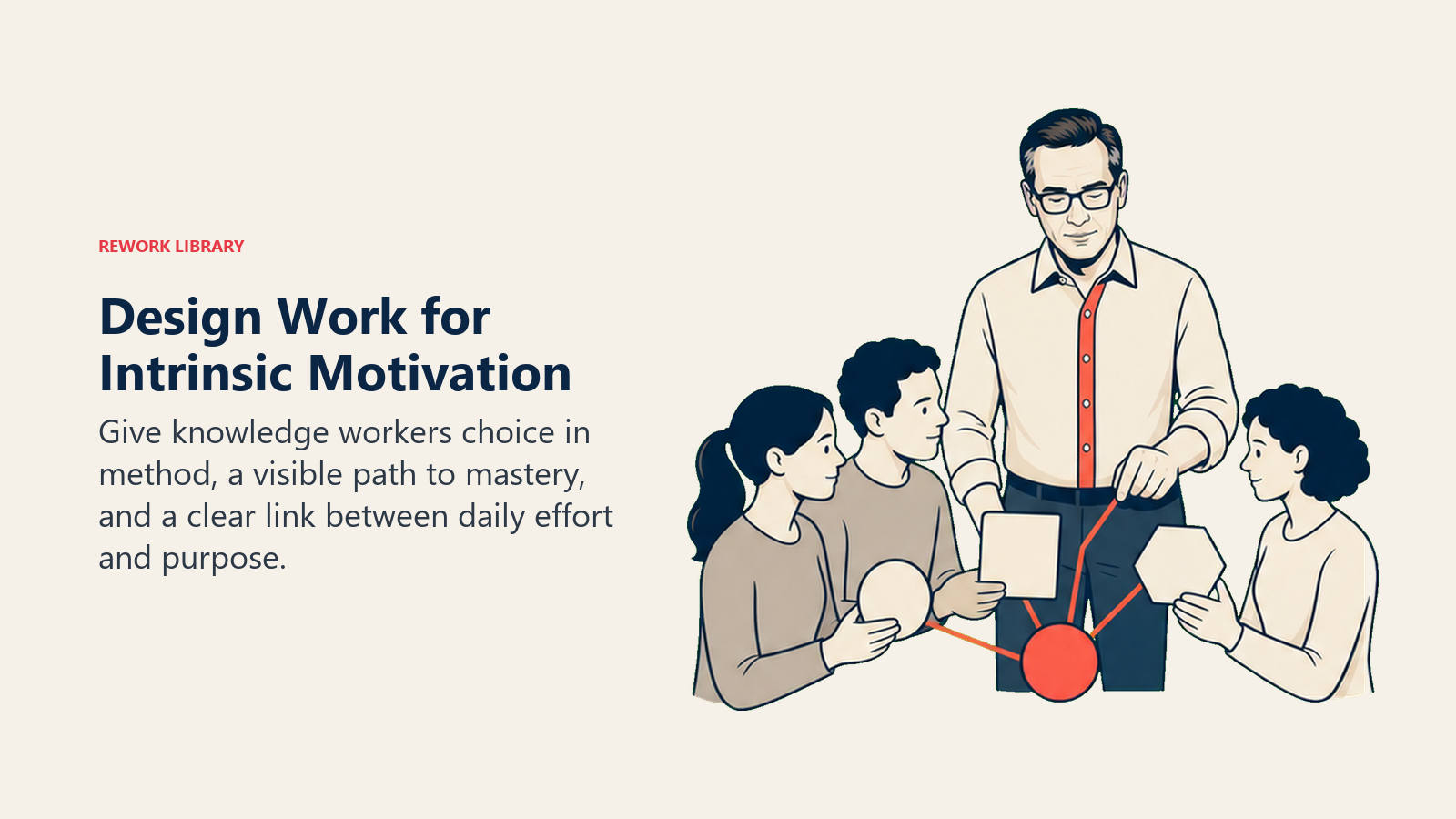
The Motivation 3.0 Model is Daniel Pink's operating system for managing complex, creative work: replace the carrot-and-stick incentives of industrial-era management with three intrinsic drivers, autonomy (control over how work gets done), mastery (the chance to get measurably better at something that matters), and purpose (a legible connection between daily effort and a larger goal). The doctrine holds that extrinsic rewards crowd out these intrinsic motivators for any task requiring judgment, creativity, or problem-finding, so the manager's job is to design environments where Autonomy-Mastery-Purpose can operate, not to tune the bonus structure harder. It is the clearest synthesis of self-determination theory ever translated for business use.
1. The ABC of Modern Selling: Attunement, Buoyancy, Clarity
Pink's replacement for "Always Be Closing" is ABC: Attunement, Buoyancy, Clarity. The framework is built on a specific argument about what changed in selling when information symmetry flipped.
Before the internet, sellers had more information than buyers. That asymmetry made certain manipulative techniques viable: pressure closes, artificial scarcity, false urgency. The seller knew more than the buyer and could exploit that gap. Pink documents this era through the "Used Car Salesman" stereotype, a profession defined by information exploitation.
After the internet, buyers often arrive at a sales conversation knowing as much as the seller about product features, pricing, competitive alternatives, and market positioning. The techniques that worked in an asymmetric information environment don't just fail in a symmetric one. They create active hostility. A buyer who knows they're being pressured and knows they have alternatives doesn't close. They leave.
Attunement is the first requirement in this new environment: you need to understand the buyer's actual situation well enough to offer something genuinely relevant, not just a pitch that fits your product's features. Pink's research shows that starting from the buyer's perspective (their constraints, their politics, their definition of success) is both more ethical and more effective.
Buoyancy is the operational challenge. Pink analyzed what separates sales professionals who sustain performance over years from those who burn out or plateau. The answer wasn't technique. It was psychological architecture. Specifically, it was how they explained rejection to themselves. People who treated each "no" as evidence of global failure (I'm bad at this) quit. People who treated it as specific feedback (this prospect wasn't ready yet) kept going. Coaching teams on their explanatory style is more durable than coaching them on closing techniques.
Clarity is Pink's most original contribution. He argues that the era of information access has made problem-solving a commodity. If the problem is well-defined, anyone can solve it. The scarce skill is problem-finding: identifying the problem the buyer actually needs to solve, which is often different from the problem they describe. This is what the best enterprise sales professionals actually do. They ask questions until the real constraint surfaces, and then they design a solution around that constraint rather than their product's features.
2. Drive: Why Carrot-and-Stick Comp Structures Fail
Pink's 2009 book "Drive" took on one of the most deeply held assumptions in business: that extrinsic rewards (money, status, titles) are the primary drivers of performance.
He synthesized research from self-determination theory, behavioral economics, and organizational psychology to make a more specific argument. Adam Grant's organizational psychology work, on givers versus takers, on creative confidence, on rethinking entrenched assumptions, extends the same tradition Pink draws from, and the two read well together as a pairing. Extrinsic rewards work for simple, rule-based tasks: if you can completely specify what "good" looks like, then a bonus for hitting that specification will increase the behavior you want. But for complex, creative, insight-requiring work (the kind that actually creates competitive advantage), extrinsic rewards consistently produce the opposite of their intended effect. They narrow focus, reduce creativity, and create instrumental relationships between effort and reward that crowd out genuine engagement.
Pink's alternative framework: Autonomy, Mastery, Purpose. He argues these three intrinsic motivators are the actual drivers of sustained high performance.
Autonomy: people perform better when they have control over how they do their work, not just what they're supposed to produce. Atlassian's "FedEx Days" (20% time given to work on anything, as long as you ship something overnight) were an early expression of this. Google's 20% time was another.
Mastery: people are motivated by getting better at things that matter to them. The key insight for managers is that the feedback and challenge structure required for mastery is different from the reward structure required for compliance. Mastery requires stretch goals that are within reach with effort, rapid feedback, and enough autonomy to course-correct.
Purpose: people perform better when they understand how their work connects to something larger than the immediate task. This isn't about mission statements. It's about making the connection between daily work and real impact legible to the people doing it.
The comp structure implication is specific: commission-only sales structures, pure stack-ranking, and tournament-model compensation consistently undermine the performance of your best people while retaining your worst ones. Pink doesn't argue against paying people well. He argues against using money as the primary management lever for complex work.
3. When: Timing as a Strategic Variable
Pink's 2018 book "When" brought the research on chronobiology (how biological time patterns affect human performance) into a business context that most operators had never considered.
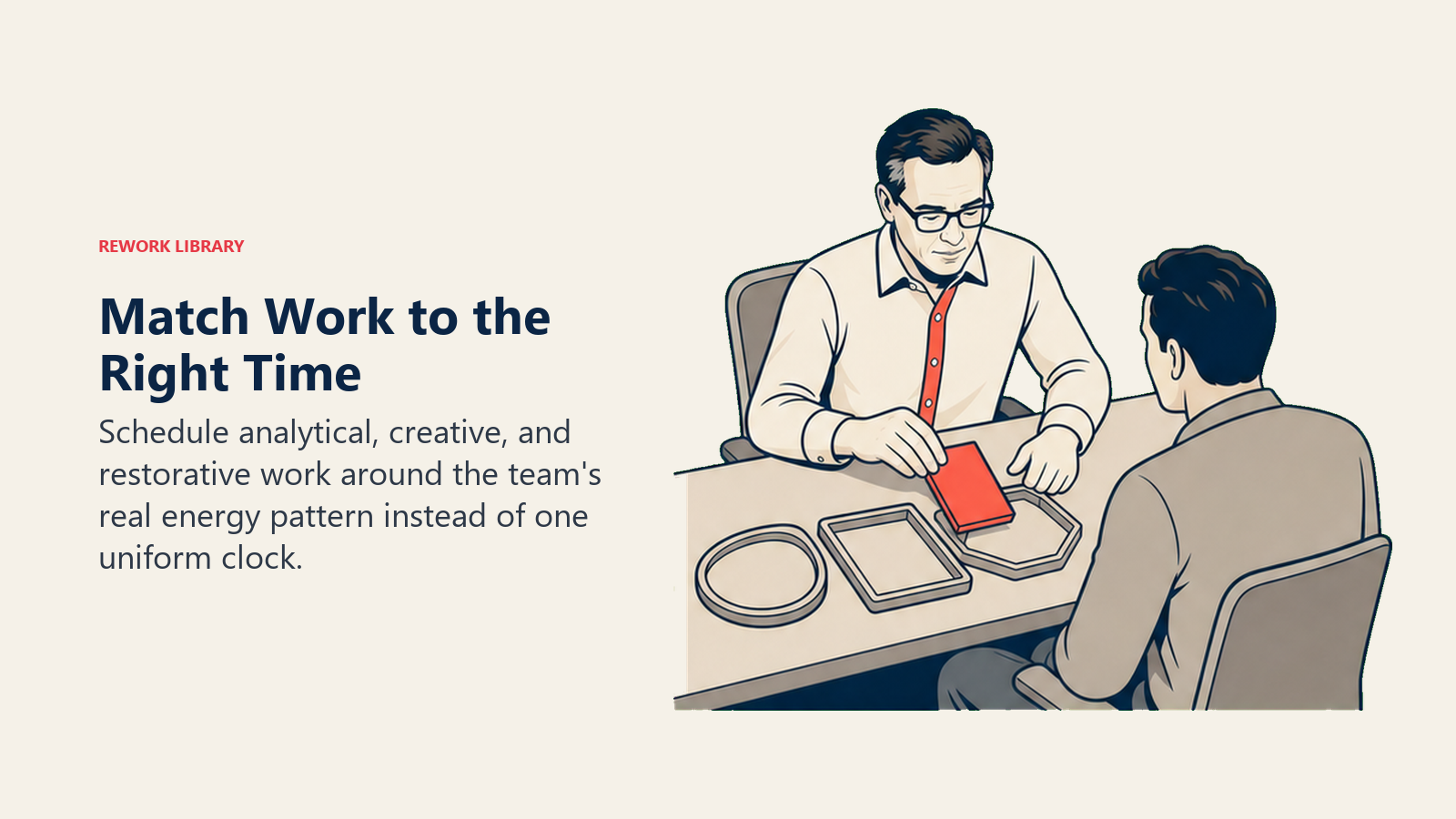
The core finding: performance isn't flat across the day. It follows a predictable pattern for most people (with individual variation): cognitive sharpness peaks in the late morning, drops sharply in the early-to-mid afternoon, and partially recovers in the late afternoon. The trough (roughly 1:00 to 3:00 p.m.) is when analytical accuracy is lowest, error rates are highest, and decision quality is worst.
The research implications are operationally significant. Pink cites studies showing that medical errors are more common in afternoon hospital rounds, that judicial decisions are more punitive in the afternoon, and that financial traders make worse risk-adjusted decisions after 2 p.m. These aren't small effects.
For executives, the scheduling implication is direct. Your highest-stakes decisions (board presentations, pricing negotiations, strategic planning sessions, hiring interviews) should be scheduled for peak time, not scheduled around other people's calendars. Your sales team's most important demo calls should be in the morning, not the post-lunch slot the prospect defaulted to.
Pink also identified the value of breaks, specifically social breaks and nature breaks, which his research shows restore peak-state cognitive function better than phone breaks or passive rest. This has a specific implication for how you structure long meeting days and conference schedules.
The timing framework doesn't require a personality audit or a self-discovery exercise. It requires reading a calendar differently.
What Daniel Pink Would Do in Your Role
If you're a CEO, the most important application of Pink's work is to the comp and incentive structures you've inherited. Map your current incentive architecture against Pink's autonomy-mastery-purpose framework. Where are your incentives driving narrow behavior at the expense of creative engagement? Where are commissions or bonuses creating the kind of instrumental motivation that crowds out genuine problem-solving? Pink's prescription isn't to eliminate extrinsic rewards. It's to make sure they're not the primary operating system for your best people.
If you're a COO, the timing research has a direct scheduling application. Look at your meeting calendar and identify which recurring meetings are scheduled in the trough. Those meetings are getting systematically lower-quality thinking than meetings scheduled in the morning, and nobody's tracking the cost. Audit your Q4 planning calendar, your budget reviews, and your executive team offsites for timing. Moving your strategy sessions to the morning and your status reviews to the afternoon is a zero-cost performance improvement.
If you're leading product, the "problem-finding over problem-solving" insight from Pink's clarity framework has a specific product research application. Most product teams are excellent at solving problems that users can clearly articulate. Pink's framework suggests the highest-value work is identifying the problems users don't know how to describe: the friction they've normalized, the workarounds they've stopped noticing. Build your user research around problem-finding, not feature validation.
If you're in sales, the attunement framework changes how you prepare for calls. Don't prepare by reviewing your product's features and benefits. Prepare by answering two questions: what is this buyer trying to accomplish in the next 90 days, and what would have to be true for this category of solution to be the highest-ROI thing they could invest in right now? Those two answers give you the frame for the conversation. If you can't answer them, you're not ready for the call.
How Rework Enables Pink's Intrinsic-Motivation Management for Knowledge Workers
Pink's Autonomy-Mastery-Purpose doctrine only works if the operational layer supports it, and for knowledge work teams, that layer is where most companies break down. Autonomy requires that people can see what needs doing and choose how to do it without a manager brokering every handoff; Rework's Work Ops gives each teammate a clear view of their owned work, shared context, and the ability to re-prioritize without permission theater. Mastery requires rapid, specific feedback on real work, not quarterly reviews, and Rework's per-task activity history makes the feedback loop short enough for people to actually improve. Purpose requires that daily tasks stay legibly connected to the outcomes they feed; when goals, projects, and tasks live in the same system, the connection is structural rather than motivational poster-ware. The point isn't "tools replace management." It's that the comp-structure conversations Pink wants leaders to have get easier when the operating system already assumes autonomous, purpose-visible team ops.
Notable Quotes and Lessons Beyond the Boardroom
Pink's most useful quote for operators comes from "Drive" (summarized in his TED Talk on motivation, one of the most-watched TED Talks ever recorded): "The secret to high performance and satisfaction, at work, at school, and at home, is the deeply human need to direct our own lives, to learn and create new things, and to do better by ourselves and our world." The implications for management practice are more demanding than most organizations are comfortable with.
From "To Sell Is Human": "Clarity on how to think about your situation can make the difference between a mediocre outcome and a genuinely useful one." The problem-finding argument is in this one sentence. You don't close deals because you're articulate. You close them because you understood the problem well enough to make the solution obvious.
Pink's own career is an argument for the value of the informed outsider. It's a parallel worth drawing to Peter Drucker, who also never ran a large company but whose management frameworks, built from decades of observation and synthesis, shaped how more executives think about their work than almost any practitioner who did. He wrote about sales without having sold. He wrote about motivation without having run a large organization. He wrote about timing without being a neuroscientist. What he had was methodological rigor, genuine curiosity, and the discipline to synthesize across fields rather than defend a single expert position. That's a different kind of credibility, and it's the kind that produces frameworks with genuine shelf life.
Where This Style Breaks
Pink's frameworks are best suited for complex, consultative selling and knowledge work management. They break down in transactional environments where speed and volume are the primary drivers. For the tactical objection-handling and negotiation layer that Pink's work doesn't address, Chris Voss's tactical empathy framework is the natural complement, Pink explains why attunement works psychologically; Voss shows you the specific verbal techniques for executing it in a high-stakes conversation. His buoyancy framework is insightful but operationally thin. Knowing that you need to treat rejection as specific and temporary is different from having a training system that builds that explanatory style in 20 salespeople.
The "Drive" autonomy-mastery-purpose framework is consistently misapplied by companies that take the narrative without changing the incentive structure. Posting "autonomy" on the values wall while maintaining a quarterly stack ranking doesn't create intrinsic motivation. It creates cynicism. Pink describes the destination; he doesn't provide a detailed map for organizations with entrenched comp architecture to get there.
His academic framing also means his recommendations sometimes lack operational specificity. "Find the problem before you solve it" is correct and underutilized. It's also not a process. It's a posture.
Learn More

On this page
- Leadership Style Breakdown
- Key Leadership Traits
- The 3 Frameworks That Defined Daniel Pink
- The Motivation 3.0 Model (The Autonomy-Mastery-Purpose Doctrine)
- 1. The ABC of Modern Selling: Attunement, Buoyancy, Clarity
- 2. Drive: Why Carrot-and-Stick Comp Structures Fail
- 3. When: Timing as a Strategic Variable
- What Daniel Pink Would Do in Your Role
- How Rework Enables Pink's Intrinsic-Motivation Management for Knowledge Workers
- Notable Quotes and Lessons Beyond the Boardroom
- Where This Style Breaks
- Learn More