Julie Zhuo Leadership Style: Growing Managers at Facebook, 'The Making of a Manager,' and What It Actually Takes to Lead a Design Organization
Turn this article into takeaways for your work.


Each assistant summarizes the article only for you and suggests best practices for your work.
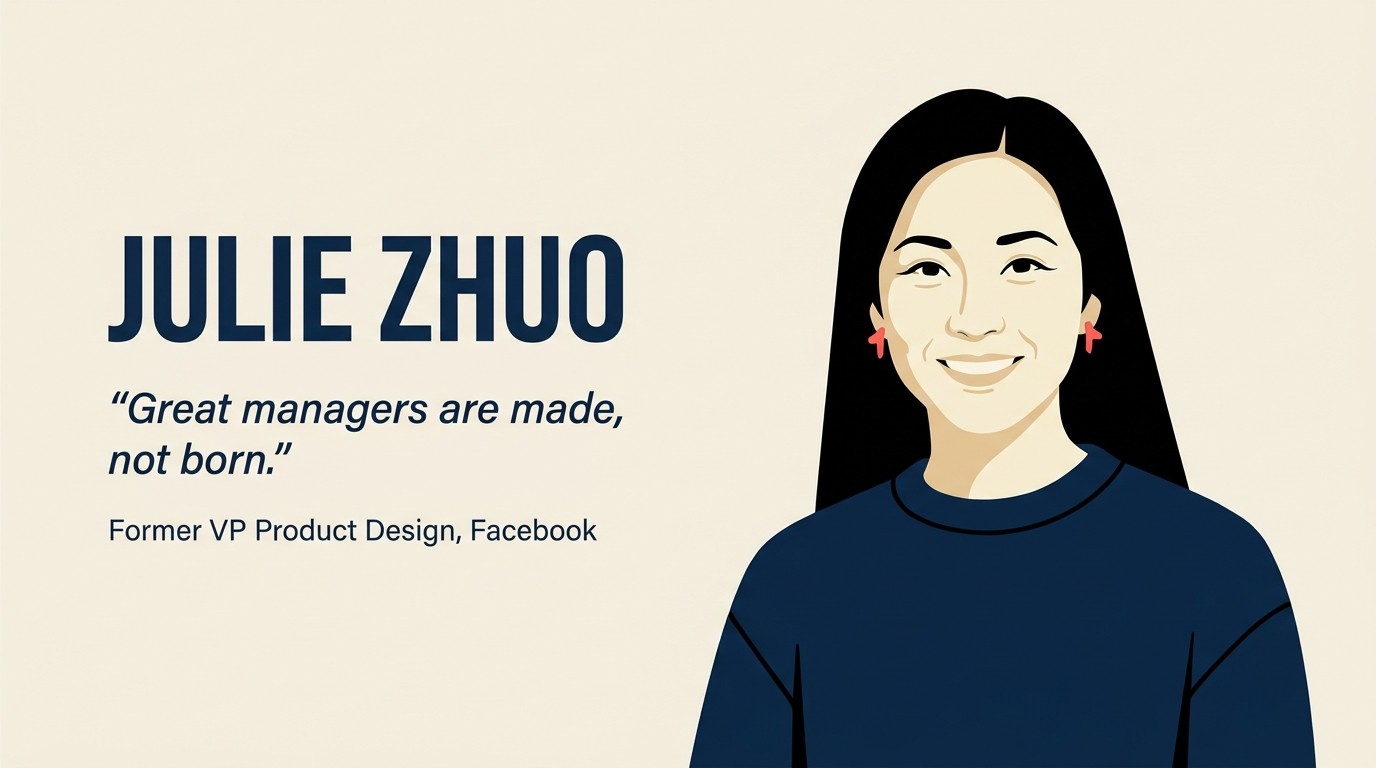
Key Facts: Julie Zhuo was VP of Product Design at Facebook from 2006 to 2019, joining at age 22 as a product design intern fresh out of Stanford. She helped design core surfaces including News Feed and Facebook Groups, eventually leading a design organization of hundreds. Her book "The Making of a Manager" (2019) became a New York Times bestseller and is one of the most-recommended guides for first-time managers. After leaving Facebook, she co-founded Sundial, a data analysis platform, and writes the widely-read blog "The Looking Glass."
The Making of a Manager Doctrine
Zhuo's doctrine holds that the single test of a manager is whether their team produces better outcomes than it would without them, not effort, intent, or care. The first-time manager model diagnoses underperformance through three interdependent levers: purpose (does the team know why they exist?), people (are the right people in place with trust and skills?), and process (do decisions and information flow cleanly?). Purpose and people problems won't resolve through process fixes, which is why new managers who jump to workflow changes first usually fail.
Julie Zhuo joined Facebook as an intern at 23. By the time she left, she was VP of Product Design, had a team of hundreds, and had written what became one of the most-read management books for first-time managers. The interesting part isn't the trajectory. It's what she did with it.
Most executives who rise that fast inside a single company write memoirs or strategy books. Zhuo wrote a practical guide to the part nobody teaches you: the first few years of managing people, when you don't know what you're doing, the feedback conversations feel personal, and you're trying to figure out whether you're the problem or the team is. "The Making of a Manager" (2019) sold because it was honest. She didn't pretend to have figured it out quickly.
If you're scaling a team right now and your managers are struggling to give feedback and run useful 1:1s, this profile is the framework brief you didn't know you needed.
Leadership Style Breakdown
| Style | Weight | How it showed up |
|---|---|---|
| Reflective Practitioner-Teacher | 60% | Zhuo's primary contribution is writing and teaching from real experience, not abstraction. She started as a designer at Facebook in 2006 when the company had a few hundred employees and managed her first team at 25, before she'd had any formal management training. Her blog posts and, later, "The Making of a Manager" document the actual mistakes: avoiding hard feedback, running 1:1s as status updates, mistaking busyness for impact. The 60% weight reflects how much of her leadership influence comes from documenting the learning process in real time rather than retrospectively repackaging it as expertise. |
| Design-Driven Systems Thinker | 40% | Zhuo spent 14 years building Facebook's design organization from a small team into one of the most scrutinized product design cultures in tech. That required her to think systematically, about how design connects to product decisions, how design representation at the executive level changes what gets shipped, and how design quality scales when your design team grows from 5 people to 500. The systems-thinking lens shows up clearly in how she frames purpose, people, and process as interdependent variables rather than sequential steps. |
The 60/40 split reflects a genuine tension in Zhuo's influence. Her practitioner-teacher mode made her famous. But the underlying design systems thinking is what made her effective as an operator. The book is accessible because of the first mode. It's useful because of the second.
Key Leadership Traits
| Trait | Rating | What it means in practice |
|---|---|---|
| Candor about personal management failures | Exceptional | Zhuo is unusually specific about where she got it wrong. She's written about giving feedback so diplomatically it didn't land. About running 1:1s that felt like status meetings. About confusing her team's output with her own contribution. That specificity is rare in management writing, where the default is to describe hard moments in the past tense with the implicit message that the author figured it out. Zhuo writes as though she's still figuring it out, which is what makes new managers trust her. |
| Systems thinking applied to team design | High | Zhuo's purpose-people-process framework isn't a list. It's a diagnostic. If your team isn't delivering, the problem is in one of three places: they don't understand why they exist and what success looks like (purpose), they don't have the skills, motivation, or trust to work together (people), or the way decisions get made and information flows is broken (process). Most managers jump to process fixes because they're the most visible. Zhuo's point is that purpose and people problems will persist through any process change. |
| Translating design intuition into business language | Very High | One of the underappreciated challenges of design leadership at scale is that design quality is often hard to quantify until after the fact. Zhuo built credibility inside Facebook's product-centric culture by translating design decisions into product and business terms, engagement, retention, user trust. That's a different skill than being a great designer, and it's a much rarer one. |
| Intellectual honesty when experiments fail | High | Zhuo's departure from Facebook in 2020 to co-found Sundial, and Sundial's shutdown in 2024 after three years of operation, is where her intellectual honesty is most visible. She's been public about what the startup failure taught her: that operating inside a large, well-resourced system develops specific skills that don't automatically transfer to building from scratch. That's an uncomfortable admission for someone whose management book is partly premised on the lessons of her own leadership development. |
The 3 Decisions That Defined Julie Zhuo as a Leader
1. Joining Facebook as an Intern in 2006 and Staying 14 Years
Zhuo joined Facebook in 2006 at age 23 as a product design intern. She was studying computer science at Stanford and had a summer internship that turned into a full-time role in one of the fastest-growing companies in history. She eventually became VP of Product Design, a role she held until she left in 2020.
Fourteen years at one company is unusual in tech, where executives often move every three to five years. The argument for staying is what she built: a design organization that eventually had hundreds of designers working on products used by more than 3 billion people. Working directly under Mark Zuckerberg during Facebook's explosive growth shaped Zhuo's understanding of how product culture is set at the top, and how design either earns a seat at the table or gets handed specs. That kind of depth (watching the same organization evolve through explosive growth, multiple leadership changes, and significant product crises) produces a pattern library that company-hopping can't replicate.
The tradeoff is that everything she learned about management was learned inside one very specific context: a hyper-resourced, talent-dense, product-first culture where design had genuine executive representation. That context shaped her frameworks in ways that are sometimes visible and sometimes not. Her advice on growing managers, running useful 1:1s, and building team purpose is largely transferable. Her assumptions about what a healthy product-design relationship looks like are more context-dependent.
The other thing 14 years at one company gives you is reputation. By the time Zhuo published "The Making of a Manager" in 2019, she was already one of the most-read voices on product design and management on the internet. The book landed in a community that already trusted her because she'd been writing honestly about her experience for years.
2. Writing "The Making of a Manager" as a Practitioner's Guide to Early Management
Most management books are written by people who have already figured things out. The subtext is: here's what I learned, and here's why it works. Zhuo's book inverts that. It's written from uncertainty, and that framing is the main reason new managers still recommend it to each other five years after publication.

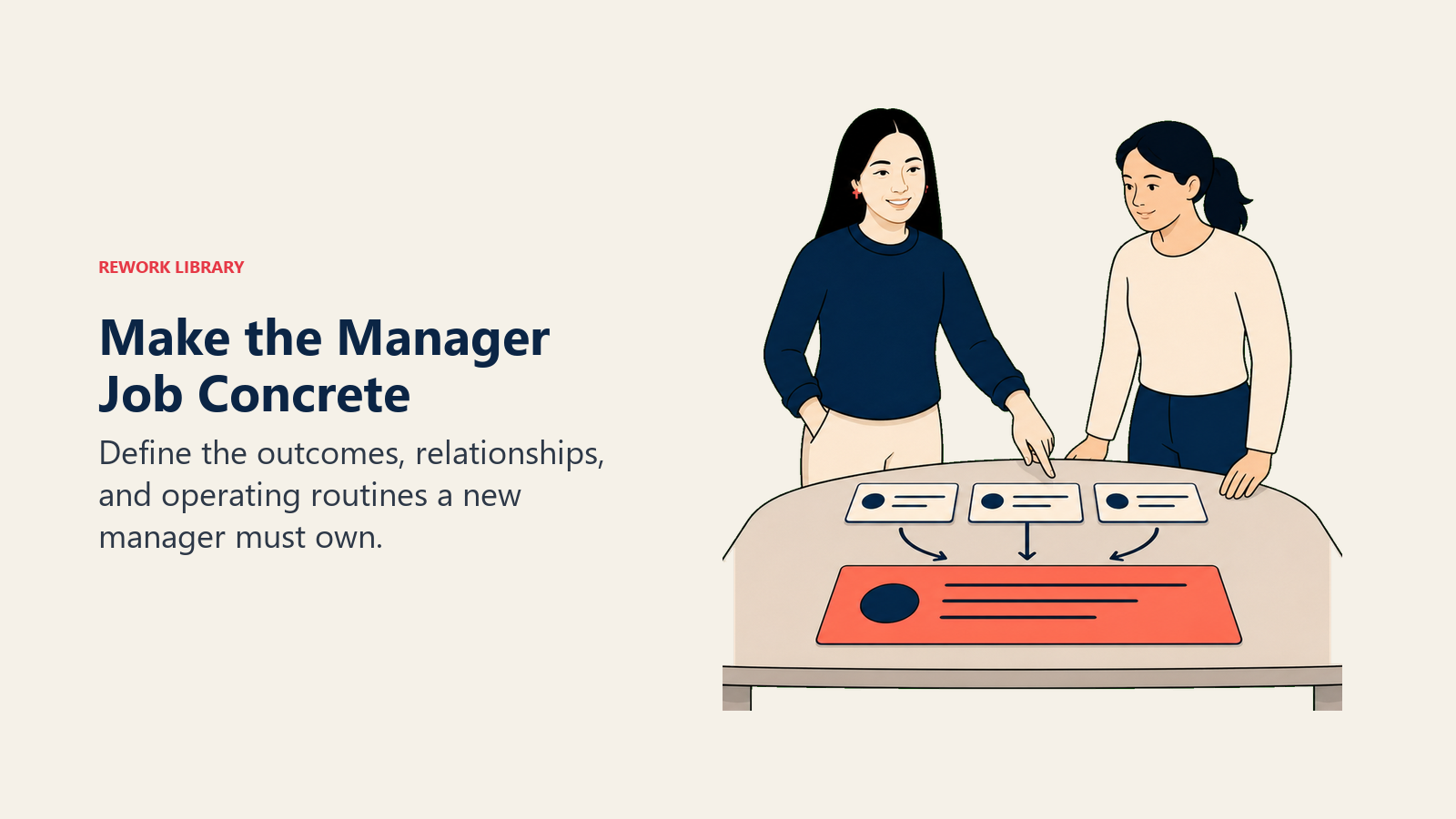
"The Making of a Manager" is organized around a deceptively simple framework: the job of a manager is to get good outcomes from your team. Not to work hard. Not to have good intentions. Not to care about your people. To get good outcomes. Everything else (the 1:1s, the feedback conversations, the hiring decisions, the goal-setting) is in service of that single test.
Her three-part framework of purpose, people, and process is how she operationalizes that test. Purpose: does your team understand why they exist and what success looks like? People: do you have the right people with the right skills, motivation, and trust in place? Process: do you have clear ways for decisions to get made and information to flow? If outcomes are bad, the diagnostic starts there.
The decision to write from failure rather than authority, including the feedback conversations she bungled, the 1:1s that didn't work, the hires she got wrong, is both a stylistic choice and a strategic one. It builds trust. And trust is what gives practical advice traction with readers who are skeptical of management writing because so much of it is sanitized.
3. Leaving Facebook to Found Sundial, and What the Failure Revealed
In 2020, Zhuo left Facebook after 14 years to co-found Sundial, a data startup. The company raised venture funding, spent three years building, and shut down in 2024. Zhuo has since joined Greylock Partners as a venture partner.
The Sundial failure matters as a leadership lesson because it illustrates a gap that's rarely discussed explicitly: the skills required to build and scale a function inside a large company are different from the skills required to build a company from scratch. Zhuo was exceptional at the first. The second requires product-market fit discovery, capital efficiency, founder-led sales, and recruiting from a standing start, without the brand, the talent pipeline, or the operational infrastructure that Facebook provided.
This isn't a criticism. It's a distinction. The operator-to-founder transition is genuinely hard, and most people who attempt it underestimate the degree to which their previous success was context-dependent. Zhuo's public reflection on what Sundial taught her, specifically about product-market fit, about building before you have conviction on the problem, about the difference between product-building inside a system and product-building as the system, is actually consistent with the intellectual honesty that made "The Making of a Manager" useful.
Her move to Greylock as a venture partner is interesting in context. She's now in a position to evaluate founders making the same transition she made, from the other side of the table. For context on what that transition looks like from the VC side, her profile and writing at Greylock are worth reading directly.
What Julie Zhuo Would Do in Your Role
If you're a CEO, Zhuo's most direct question for you is whether your managers are actually managing or whether they're doing a second job. Her point in "The Making of a Manager" is that first-time managers often stay in individual-contributor mode, doing the work themselves rather than enabling their team to do it better than they could alone. If your managers are the best individual contributors on their teams, that's a signal they haven't made the shift. The CEO version of this is: are you the best operator in the room, or are you enabling a room of operators to be better than they'd be without you?
If you're a COO or operations leader, Zhuo's purpose-people-process diagnostic is the most applicable tool from her framework. When an operational team is consistently underperforming, the instinct is to fix the process, change the workflow, add a review step, build a better dashboard. Zhuo would push you to check purpose first. Does the team understand what good looks like and why their work matters? If not, process fixes won't hold because the team doesn't have a shared standard to execute against.
If you're a product leader, Zhuo's experience building design representation inside a product-first culture is directly relevant. One of her consistent arguments is that design quality requires design to be involved in problem framing, not just solution delivery. If your designers are being handed requirements and asked to make them look good, you're running a feature factory with better aesthetics. Zhuo would push you to integrate design into discovery, the stage where you're figuring out what problem you're actually solving, a discipline that Marty Cagan and Teresa Torres have developed into explicit continuous discovery frameworks.
If you're in sales or marketing, the "Making of a Manager" has a less obvious application: her argument about the test of a good manager applies equally to the test of a good leader in any function. The question isn't whether you worked hard this quarter. It's whether your team produced better outcomes because of how you led them. That reframe is useful for any function where managers tend to measure themselves by activity rather than by the results their teams generate.
Applying Zhuo's Doctrine With Rework
Zhuo's framework works only if first-time managers have the operational scaffolding to actually run it. Purpose, people, and process collapse into a single mess when 1:1 notes live in four places, feedback lands inconsistently, and team goals aren't visible. Rework's Project Engine (from $99/month billed yearly, with 5 seats included) gives newly promoted managers a shared surface for 1:1 agendas, feedback logs, goal tracking, and team rituals, the quiet infrastructure that turns Zhuo's doctrine from a reading assignment into a repeatable practice. Managers who've been in the role six months can see which of their 1:1s are drifting into status updates, which feedback conversations never happened, and whether their team understands the quarter's purpose. Rework doesn't replace the judgment, that's still the manager's job, but it removes the excuse that "I didn't have time to do it right." The feedback culture Zhuo describes gets built one documented conversation at a time.
Notable Quotes and Lessons Beyond the Boardroom
Zhuo's purpose-people-process framework is the most operationally useful thing she's published. The order matters: purpose first, because a team that doesn't understand why they exist or what success looks like will fail regardless of talent or workflow. People second, because the right skills and the right trust structure determine what's possible. Process third, because even good processes won't save a team with wrong people or unclear purpose.
Her test for a good manager is memorable and blunt: "The definition of a great manager is someone who gets great outcomes from their team." Not someone who works hard. Not someone who cares. Someone who produces results through other people. That framing shifts accountability from effort to output and forces managers to ask the harder question: are you actually making your team better?
On Sundial, Zhuo has been specific about what she learned. She's described the experience as teaching her the difference between product intuition and product-market fit conviction: the first she had, the second she didn't develop fast enough. That's a lesson worth more than most startup post-mortems, because it names the failure clearly rather than attributing it to market timing or fundraising conditions.
Where This Style Breaks
Zhuo's management frameworks were developed inside a hyper-resourced, high-talent-density environment where the cost of an experimental 1:1 structure or a slow feedback cycle is relatively low. In resource-constrained startups, small teams, or organizations where the manager is also the top individual contributor, her frameworks require significant compression. You don't have the luxury of separating purpose-setting from execution when you're doing both simultaneously.
Her design leadership lens also assumes a product-centric culture where design has executive representation. In sales-led or engineering-led organizations, the dynamic she describes, where design quality shapes product decisions at the strategic level, doesn't exist until someone builds it from scratch. That's a different leadership challenge than managing a design team inside a system that already values design. The framework describes the destination. It's less precise on how you get there from a standing start.
Frequently Asked Questions about Julie Zhuo's Management Philosophy
Who is Julie Zhuo?
Julie Zhuo is a designer, writer, and operator who was VP of Product Design at Facebook from 2006 to 2019, joining as an intern at age 22 and eventually leading a design organization of hundreds. She later co-founded Sundial, a data analysis startup, and joined Greylock Partners as a venture partner. She's also the author of the bestselling management book "The Making of a Manager."
What is The Making of a Manager about?
"The Making of a Manager" (2019) is a practical guide for first-time managers, written from the perspective of someone who learned on the job at Facebook. It's organized around the test that a manager's job is to get good outcomes from their team, and Zhuo's purpose-people-process framework diagnoses why teams underperform. The book became a New York Times bestseller because it documents actual management mistakes rather than polished retrospective wisdom.
What did Zhuo design at Facebook?
Zhuo worked on some of Facebook's most consequential product surfaces, including News Feed and Facebook Groups, during the company's growth from a few hundred employees to one of the largest product organizations in tech. Over 14 years she transitioned from individual designer to engineering manager to VP of Product Design, ultimately overseeing design for products used by billions.
What is Zhuo's approach to new managers?
Zhuo argues that new managers often stay in individual-contributor mode, doing the work themselves instead of enabling their team. Her approach emphasizes honest feedback, 1:1s that actually surface real problems rather than status, and clarity of purpose before process. She's explicit that early management is hard and that faking certainty makes it worse.
What is Sundial?
Sundial was a data analysis platform Zhuo co-founded in 2020 after leaving Facebook. The company raised venture funding, operated for about three years, and shut down in 2024. Zhuo has been publicly reflective about what the experience taught her about the gap between operating inside a large system and building a company from scratch.
What can first-time managers learn from Julie Zhuo?
First-time managers can learn that effort and intent aren't the job, outcomes through other people are. Zhuo teaches that hard feedback given kindly is more caring than diplomatic feedback that doesn't land, that 1:1s should develop people rather than report status, and that confusion about purpose causes more team failure than broken process. She also models intellectual honesty about her own mistakes, which normalizes learning in public.
For related reading on product and design leadership, see Marty Cagan Leadership Style, Teresa Torres Leadership Style, Gibson Biddle Leadership Style, Kim Scott Leadership Style, and Adam Grant Leadership Style.

On this page
- The Making of a Manager Doctrine
- Leadership Style Breakdown
- Key Leadership Traits
- The 3 Decisions That Defined Julie Zhuo as a Leader
- 1. Joining Facebook as an Intern in 2006 and Staying 14 Years
- 2. Writing "The Making of a Manager" as a Practitioner's Guide to Early Management
- 3. Leaving Facebook to Found Sundial, and What the Failure Revealed
- What Julie Zhuo Would Do in Your Role
- Applying Zhuo's Doctrine With Rework
- Notable Quotes and Lessons Beyond the Boardroom
- Where This Style Breaks