Jeff Wilke Leadership Style: Operations at Amazon Scale
Turn this article into takeaways for your work.


Each assistant summarizes the article only for you and suggests best practices for your work.
Key Facts: Jeff Wilke
- Born: 1966
- Role: CEO Worldwide Consumer, Amazon (2016–2021), a retail business of roughly $280B+
- Joined Amazon: 1999, leading fulfillment operations
- Built: Amazon Prime and the global fulfillment network (hundreds of FCs)
- Retired: February 2021
- Education: Princeton (chemical engineering), MIT Sloan/MIT engineering
- Legacy: Turned Amazon's operational backbone into a durable competitive moat
When Jeff Bezos needed someone to rebuild Amazon's fulfillment operations from a single warehouse into a global network of hundreds of facilities, he didn't hire a logistics veteran. He hired Jeff Wilke, a chemical engineer from Andersen Consulting and AlliedSignal who applied manufacturing science to e-commerce fulfillment as if it were an industrial chemistry problem, which at some level it is.
Wilke joined Amazon in 1999, when the company was hemorrhaging cash and shipping packages out of a Seattle warehouse that was overwhelmed by its own growth. Jeff Bezos needed someone who could apply engineering discipline to a problem no one had solved at this scale before. By the time he retired in February 2021 as CEO of Worldwide Consumer, he had overseen a fulfillment and retail machine that processed hundreds of millions of orders annually, with two-day delivery as the baseline customer expectation rather than the premium offering. Forbes covered his retirement as the end of an era for Amazon's consumer business.
That transformation didn't happen through inspiration. It happened through the systematic application of operations research: statistical process control, lean manufacturing principles, rigorous metric discipline, and an organizational model that gave single owners accountability for end-to-end outcomes.
Wilke wasn't Bezos's charismatic counterpart. He was the person who made Bezos's customer obsession operationally possible, at a scale no one had attempted.
Leadership Style Breakdown
| Style | Weight | How it showed up |
|---|---|---|
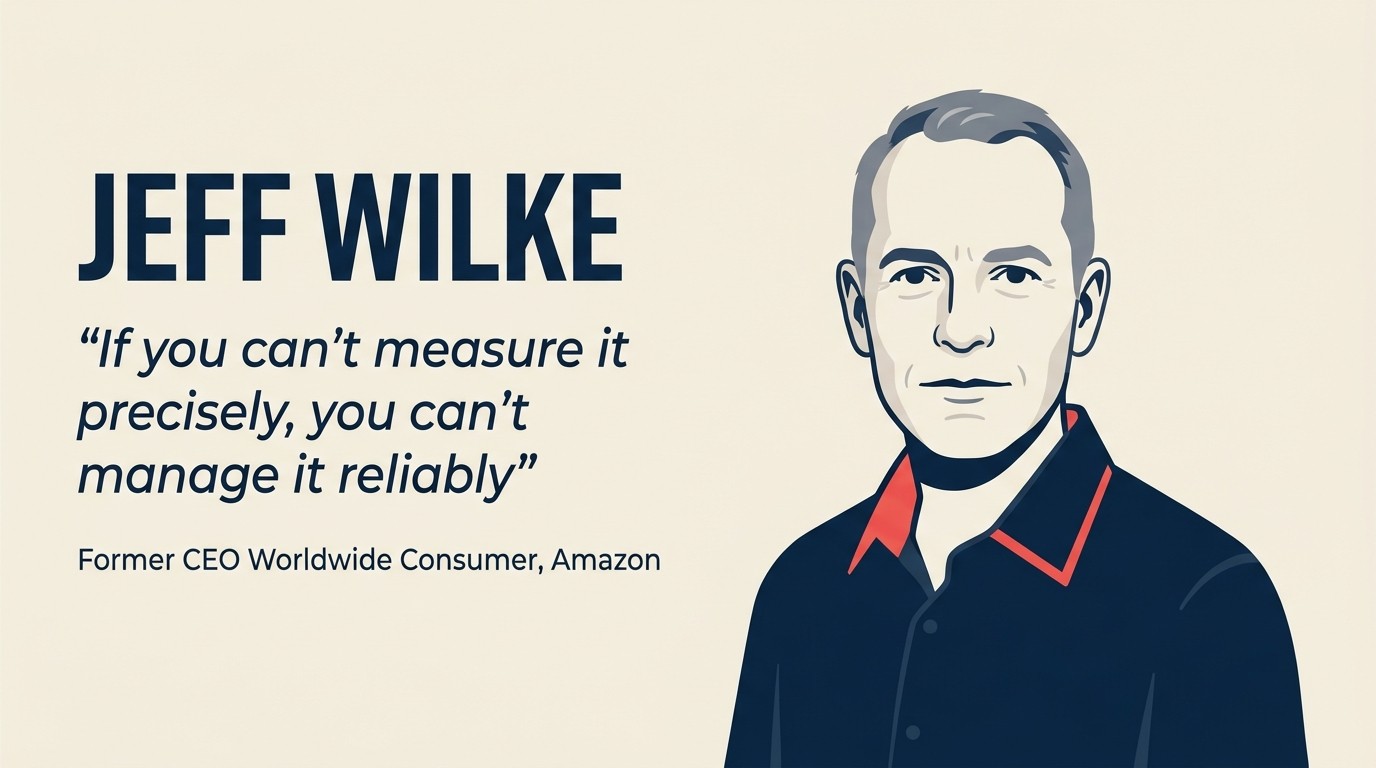
| Metrics-Driven Operator | 65% | Wilke's operating philosophy was that if you couldn't measure it precisely, you couldn't manage it reliably. He imported statistical process control from AlliedSignal, where he'd worked under Larry Bossidy's Six Sigma regime, and applied it to pick rates, pack accuracy, shipment defect rates, and throughput per labor hour across every fulfillment center. He built standard dashboards so a new FC in Memphis operated with the same visibility as one in Seattle, and he held leaders accountable to those numbers with the consistency of a manufacturing plant manager rather than a retail executive. |
| Systematic Problem Solver | 35% | Wilke wasn't reactive to operational problems, he was preventive. His engineering background drove a conviction that most operational failures are process failures, not people failures. When defect rates spiked or throughput dropped, the first question was about the process: what changed, what was the root cause, and what systematic fix would prevent recurrence? That made his operational reviews different from typical retail ops sessions, they were closer to engineering post-mortems than performance management conversations. |
The combination produced an operational culture that was demanding but principled. The standard wasn't "work harder." It was "work against a defined process that we improve systematically." That distinction matters for how people experience high-performance cultures. Wilke's model was rigorous; it was also fair in the sense that accountability was tied to process adherence and process outcomes, not to arbitrary expectations.
Key Leadership Traits
| Trait | Rating | What it means in practice |
|---|---|---|
| Engineering discipline applied to logistics | Exceptional | Wilke brought chemical engineering's process analysis mindset to a domain, e-commerce fulfillment, that didn't have systematic engineering standards. He developed Amazon's SPS (Single-Piece Flow System), applying lean manufacturing's small-batch logic to warehouse pick-and-pack operations. That redesign fundamentally changed how Amazon processed individual orders versus batched shipments, dramatically reducing error rates and improving throughput per labor hour. The discipline was applying tools that worked in manufacturing to a new context rather than assuming retail was categorically different. |
| Comfort with ambiguity in early Amazon | Very High | When Wilke joined in 1999, there was no playbook for e-commerce fulfillment at scale. He didn't have precedents to reference or consultants who'd solved the problem before. He built the methodology by treating the fulfillment center as a laboratory, instrumenting it, running experiments, measuring results, and iterating. That approach to building knowledge in genuinely uncharted territory is a separate skill from executing against a proven playbook. |
| Commitment to Amazon Leadership Principles | High | Wilke was a deep practitioner of two Amazon Leadership Principles in particular: Dive Deep and Deliver Results. Dive Deep means leaders are expected to know the details of their operations at every level, not just the aggregate metrics but the specific process failures, specific FC performance data, and specific root causes. Deliver Results means commitments are kept. He modeled both visibly and consistently, which is how cultural principles actually take hold. |
| Long-term capacity planning over short-term cost cuts | High | Amazon built its fulfillment network at a pace and scale that required investing ahead of demand, opening new FCs before the customer volume was there to justify them, building the network infrastructure that would support future Prime growth rather than optimizing for current year unit economics. Wilke championed that forward investment approach against what must have been significant pressure to optimize for near-term margins. The Prime fulfillment network that exists today was built through that multi-year capacity strategy. |
The Ops-as-Moat Doctrine (The Wilke Fulfillment Model)
The Ops-as-Moat Doctrine holds that operational excellence, instrumented, standardized, and owned by named individuals, is itself a strategic differentiator, not a cost center to be minimized. In Wilke's application at Amazon, this meant investing ahead of demand in fulfillment capacity, applying statistical process control to every FC metric, and assigning single-threaded owners to each critical outcome so accountability never diffused across teams. The result: a logistics network rivals couldn't replicate without matching a decade of compounded process investment.
The 3 Frameworks That Defined Jeff Wilke
1. Statistical Process Control in Fulfillment
Wilke arrived at Amazon from AlliedSignal, where Six Sigma was the management operating system. He brought statistical process control (SPC), a manufacturing quality method that uses data to distinguish normal process variation from signals of real problems, and applied it to e-commerce fulfillment operations.
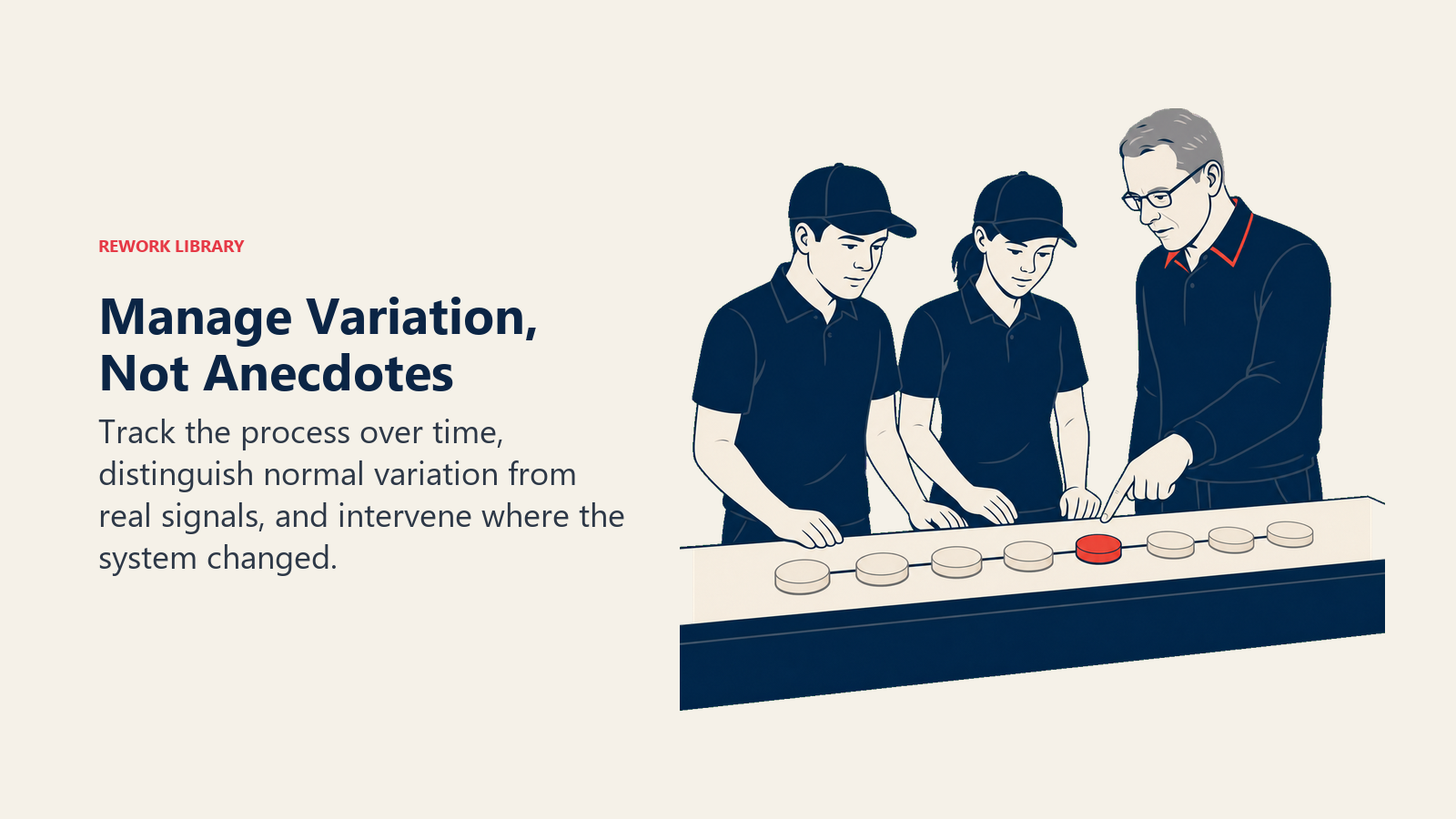
The application wasn't trivial. Fulfillment centers have thousands of variables: pick accuracy, pack cycle time, dock-to-stock time, throughput per labor hour, damage rates, return rates, shipment defects. Taiichi Ohno had done something similar at Toyota decades earlier, applying industrial engineering to a production system that everyone else treated as too complex to standardize, and Wilke's SPC approach drew directly from that manufacturing science lineage. Most retail operations tracked these metrics as point-in-time snapshots. Wilke built control chart thinking into Amazon's FC management, tracking metrics over time, identifying statistically significant deviations, and triggering root cause analysis when the data indicated a real process shift rather than normal variation.
The practical result was that Amazon's operational management became less reactive. Instead of responding to crises (a spike in defects, a miss on shipment SLAs), the control chart approach identified process deterioration early, while it was still manageable, and before it became a customer-facing failure. The system also allowed Amazon to replicate performance across FCs: once you had defined the process and the metrics, you could compare any FC against the standard and identify where performance was deviating and why.
For any COO or VP of Operations considering this approach: the prerequisite is instrumentation. You can't apply SPC to processes that aren't measured consistently. The investment in measurement infrastructure (sensors, tracking systems, consistent data definitions) is what enables the analytical discipline. Most operations organizations underinvest there and then wonder why they can't get systematic improvement.
2. Single-Threaded Ownership
Single-Threaded Ownership (STO) is the organizational principle Wilke is perhaps most credited with institutionalizing at Amazon. The concept is simple: for any critical outcome or operational problem, one person owns it end-to-end. Not a committee. Not a team with shared accountability. One person who is the single point of accountability for whether that thing gets done and done correctly.
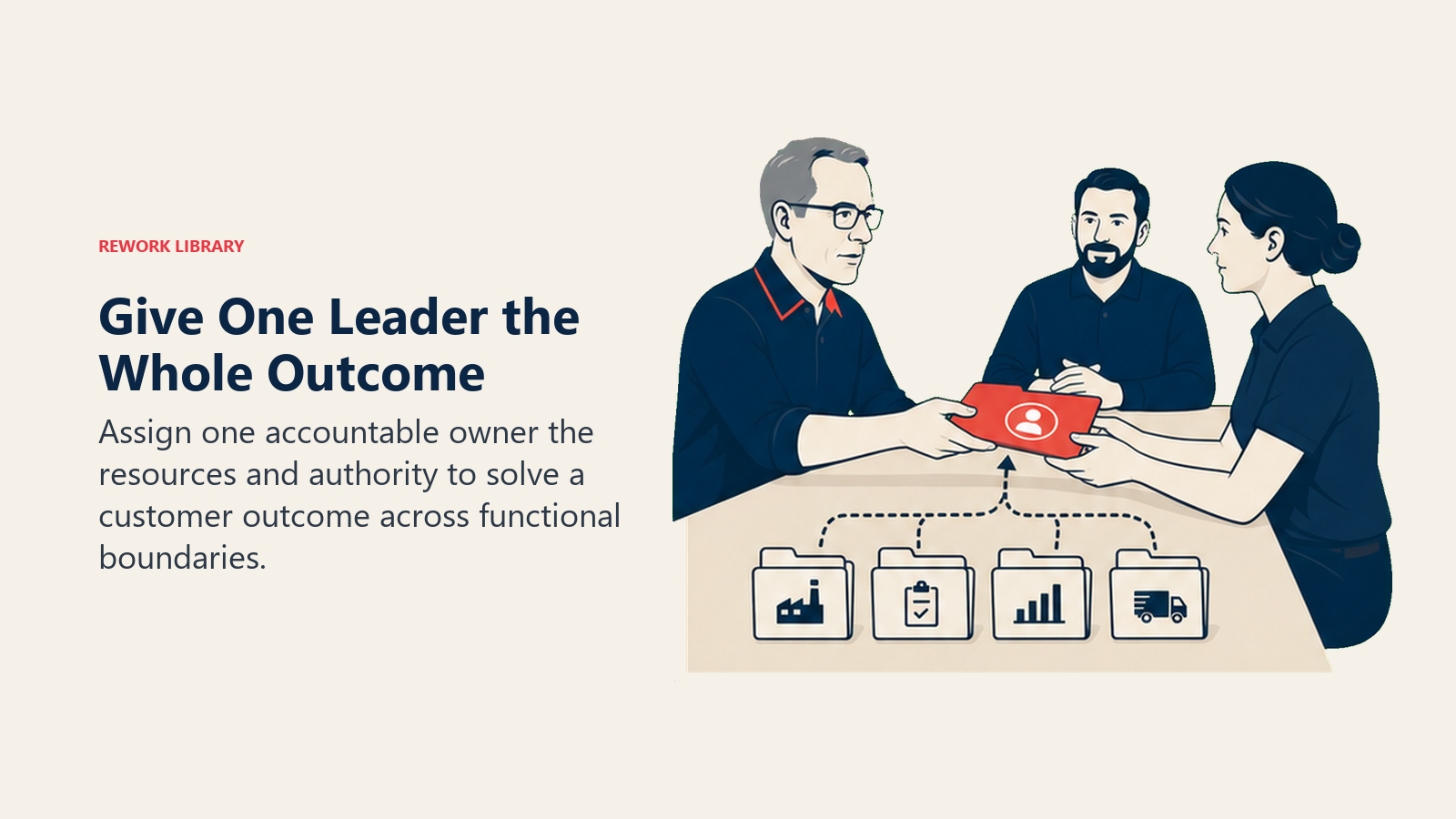
The rationale is about accountability clarity. In matrixed organizations, it's common for a problem to be "owned" by three teams simultaneously (operations, technology, and logistics, say) which in practice means it's owned by nobody, because each team can point to the others when the outcome is poor. STO eliminates that diffusion. If you're the single-threaded owner of fulfillment accuracy in a specific region, you can't blame the technology team for the defects in your FCs. You own the outcome, and you get accountability for coordinating everything required to achieve it.
Amazon applied STO across both operational functions and product/technology development. The "two-pizza team" model (small teams with a single owner working on a discrete problem or product) is an extension of the same principle. What Wilke brought to the operational side was applying STO to large-scale logistics functions that traditional operations management would have distributed across functional silos.
The implementation challenge is organizational design. Single-threaded ownership requires drawing clear lines between domains at a level of specificity that most organizations resist, because drawing clear lines means explicitly deciding who doesn't own things, which creates political friction. Most leadership teams prefer a level of ambiguity about ownership that feels collaborative but produces diffuse accountability in practice.
3. Scaling Through Standardization
Amazon's fulfillment network grew from a handful of FCs in the early 2000s to hundreds of facilities globally by the 2010s. That growth rate was only possible because Wilke built fulfillment operations around replicable standards rather than customized local solutions.
The standardization effort covered physical FC layout, process flows, technology systems, training programs, and management operating rhythms. When Amazon opened a new FC in a new geography, the goal was to have it operating at close to standard performance within weeks rather than months, because the process, the tooling, and the training were all drawn from a common playbook rather than being built from scratch.
This is harder than it sounds. Operations in different geographies have different labor markets, regulatory environments, and supplier ecosystems. The standardization effort required distinguishing between elements that were truly universal (pick process logic, quality control standards, technology platforms) and elements that required local adaptation (labor practices, compliance requirements, supplier relationships). Wilke's team maintained the standardization discipline on the former while explicitly allowing flexibility on the latter.
The lesson for scaling operators: standardization enables speed, but only if you're disciplined about what you standardize. Standardizing everything produces rigidity that breaks in new contexts. Standardizing nothing produces a collection of local operations that can't share knowledge or be compared against each other. The hard work is in identifying which elements of your operation are truly portable and building the standards around those while leaving appropriate local flexibility everywhere else.
What Jeff Wilke Would Do in Your Role
If you're a CEO, Wilke's question for you is about single-threaded ownership at the top of your organization. For each of your critical strategic outcomes (growth, retention, operational efficiency, whatever your priority set is) can you name one person who owns it end-to-end? Not a team. Not a committee. One person who is accountable for the result and who has the authority to coordinate everything required to achieve it. If you can't name that person immediately for each of your top 3 priorities, you have a diffuse accountability problem that no amount of quarterly planning will fix.
If you're a COO, the SPC approach is worth considering for your highest-stakes operational processes. Pick the three processes where a failure has the most customer-facing impact. Are those processes instrumented well enough to detect deterioration before it becomes a customer problem? Do you have control charts or equivalent time-series views of key quality metrics, or do you see problems only in aggregate monthly reviews? The investment in measurement infrastructure isn't glamorous, but it's what separates reactive operations management from preventive operations management.
If you're a product leader, Wilke's standardization framework applies to your development process rather than your product itself. Consistent definitions of done, common sprint structures, shared engineering standards: these are the equivalent of Amazon's FC standardization playbook. The goal isn't uniformity for its own sake; it's enabling teams to share learnings, compare performance, and onboard new members faster because the process is legible rather than bespoke. Teams that resist standardization often cite autonomy as the reason, but what they're frequently protecting is the ability to avoid being measured consistently.
If you're in sales or marketing, the STC principle translates to pipeline management. Most sales organizations have shared ownership of deals across SDRs, AEs, and CSMs, with handoffs that lose context and accountability at every transition. Ask whether you could redesign critical pipeline segments around single-threaded ownership: one person or one small team who owns a customer relationship from first contact through renewal, with a clear handoff protocol rather than an ambiguous shared accountability model. You'll find that accountability clarity improves both customer experience and internal performance visibility.
How Rework Applies the Wilke Playbook
Wilke's core lesson is that operational excellence, made visible, measurable, and owned, becomes the moat competitors can't easily copy. At Amazon-scale that meant hundreds of FCs and statistical process control. At SMB-scale, the same principle shows up as cross-team process visibility: knowing which handoffs break, which owners are accountable, and where throughput lags before customers feel it.
That's where Rework fits. Rework gives growing SMBs a shared operational layer across CRM, lead management, chat, and project work, so a sales handoff to onboarding, or a support ticket escalating to engineering, has single-threaded ownership and a visible SLA rather than diffuse shared accountability. Rework's Process Engine (from $99/month billed yearly) instruments the cross-team processes most SMBs run on tribal knowledge, while the Sales Engine (from $69/month billed yearly) applies the same accountability discipline to pipeline. For operators who want to turn process rigor into differentiation before they hit enterprise scale, that's the Wilke doctrine, made usable at a growing company's size.
Notable Quotes & Lessons Beyond the Boardroom
In his 2021 retirement letter to Amazon employees, Wilke wrote about the importance of "creating an environment where builders can do the best work of their lives." That framing (operations as an environment for builders, not a system for processing labor) is the philosophy that drove how he approached FC management. The standard wasn't "maximize throughput per hour." It was "build processes that let good people do good work reliably." That's a different orientation, and it's part of why Amazon's operational culture, for all its intensity, was also genuinely innovative.
Wilke has spoken in various forums about the importance of metrics clarity at every level of the organization, not just at the top. The principle is that every person in an organization should know what the metrics are that define their performance, how those metrics connect to the broader system outcomes, and what success looks like on a weekly basis. That sounds basic. But most organizations have metrics that are visible at the senior level and progressively fuzzier at each operational layer below it. Wilke's model was to push metric clarity down to the FC floor worker level, which requires significant investment in data systems and management training.
The honest assessment of his career is that Wilke was extraordinarily effective inside Amazon's specific cultural and operational context. His peer on the Amazon leadership team, Andy Jassy, ran AWS with similar metric discipline but in a B2B services context rather than consumer fulfillment, two different expressions of the same Amazon operating system. And Tim Cook at Apple represents the closest external analogue: another engineer-operator who built supply-chain excellence into a competitive moat that the company's product success depended on.: a company with massive scale, metric rigor as a shared language, and a founder whose customer obsession aligned with operational excellence as a competitive advantage. The Amazon operational model has proven difficult to export to other organizations in part because it requires a level of measurement infrastructure and metric accountability that most companies haven't built, and in part because the FC worker conditions that the model produces became a significant reputational issue in the late 2010s and into the 2020s. The operational results are real. So are the human costs of the pace Wilke's systems demanded.
Where This Style Breaks
Wilke's metrics-first model works in high-volume, measurable operations. It's considerably less useful in creative or sales functions where output quality is harder to quantify. The Single-Threaded Ownership model requires organizational clarity about who owns what, which breaks down in large matrixed companies where everything is interconnected. And Wilke operated inside a company where Bezos provided the vision and cultural direction. Operators who try to replicate his methods without that top-level alignment find the metrics rigorous but the direction unclear. Post-Amazon, Wilke stepped back from public operational roles by choice, and his specific playbook hasn't been transplanted wholesale to another organization. The principles (instrumentation, STO, standardization) are portable. The full Amazon system is not.
Frequently Asked Questions about Jeff Wilke's Leadership
Who is Jeff Wilke?
Jeff Wilke (b. 1966) is a former Amazon executive who served as CEO of Worldwide Consumer from 2016 until his retirement in February 2021. A Princeton-trained chemical engineer, he joined Amazon in 1999 and spent two decades building the company's fulfillment operations and retail business into a roughly $280B+ franchise.
What did Wilke lead at Amazon?
Wilke ran Amazon's Worldwide Consumer business, the retail, marketplace, and fulfillment operations that most customers think of as "Amazon." He oversaw Prime, the fulfillment center network, retail categories, and the operational infrastructure that made two-day delivery the category standard rather than a premium perk.
How did Wilke build Amazon's fulfillment network?
He applied manufacturing engineering principles, statistical process control, lean manufacturing, and standardized process design, to e-commerce fulfillment. Coming from AlliedSignal's Six Sigma regime, he instrumented every FC metric, built replicable playbooks so new facilities reached standard performance in weeks, and invested capacity ahead of demand rather than optimizing for near-term margins.
What is Wilke's operational philosophy?
Operational excellence as competitive moat. Wilke believed that if you couldn't measure a process precisely you couldn't manage it reliably, and that accountability had to be single-threaded, one named owner per critical outcome, not diffuse team ownership. The combination of measurement rigor and clear ownership is the core of what insiders call the Wilke Fulfillment Model.
Why did Wilke retire in 2021?
Wilke retired by choice in February 2021 after 22 years at Amazon, stepping back from public operational roles. His retirement coincided with Jeff Bezos's transition out of the CEO role and Andy Jassy taking over Amazon overall; Dave Clark succeeded Wilke as CEO of Worldwide Consumer.
What can COOs learn from Jeff Wilke?
Three practical takeaways: (1) invest in measurement infrastructure before you try to apply analytical discipline, SPC fails without instrumentation; (2) assign single-threaded owners to your top outcomes, even if it creates political friction about who doesn't own things; (3) standardize the portable elements of your operation while leaving explicit local flexibility for genuinely context-specific decisions.
For related reading, see Jeff Bezos Leadership Style, Andy Jassy Leadership Style, Tim Cook Leadership Style, Taiichi Ohno Leadership Style, and Gwynne Shotwell Leadership Style.

On this page
- Leadership Style Breakdown
- Key Leadership Traits
- The Ops-as-Moat Doctrine (The Wilke Fulfillment Model)
- The 3 Frameworks That Defined Jeff Wilke
- 1. Statistical Process Control in Fulfillment
- 2. Single-Threaded Ownership
- 3. Scaling Through Standardization
- What Jeff Wilke Would Do in Your Role
- How Rework Applies the Wilke Playbook
- Notable Quotes & Lessons Beyond the Boardroom
- Where This Style Breaks