Henry Mintzberg on Management and Leadership
Turn this article into takeaways for your work.


Each assistant summarizes the article only for you and suggests best practices for your work.
Key Facts: Henry Mintzberg (born September 2, 1939, in Montreal) earned a B.Eng from McGill in 1961, a bachelor's from Concordia in 1962, then an SM and PhD from MIT Sloan, finishing his 1968 doctoral dissertation, "The Manager at Work: Determining His Activities, Roles, and Programs by Structured Observation," on the question that would define his career: what do managers actually do, as opposed to what the textbooks say they do. He joined McGill's faculty that same year and never left; he still holds the title of John Cleghorn Professor of Management Studies at the Desautels Faculty of Management, teaching continuously since 1968. His dissertation became The Nature of Managerial Work (1973, Harper & Row), built on a week each spent shadowing five chief executives, and the 1975 Harvard Business Review article "The Manager's Job: Folklore and Fact," which won that year's McKinsey Award. Twenty years later he turned the same evidence-first instinct on strategy itself, publishing The Rise and Fall of Strategic Planning (1994, Free Press), then Strategy Safari (1998, with Bruce Ahlstrand and Joseph Lampel), which sorted the entire field into ten schools of strategic thought. In 1996 he co-founded the International Masters Program for Managers with Lancaster, INSEAD, and the Indian Institute of Management Bangalore, then made the underlying argument explicit in Managers Not MBAs (2004, Berrett-Koehler). He is an Officer of the Order of Canada (1997) and a recipient of the Herbert Simon Award (2006), and he remains an active writer on his own site, mintzberg.org, into his eighties.
The Direct Observation Doctrine
The Direct Observation Doctrine is Mintzberg's operating premise, running from his first study to his last book: you learn what a job actually requires by watching someone do it, not by reading the job description, and the same rule applies to strategy itself, which is better understood as a pattern that emerges from real decisions than as a document produced in a planning cycle. He did not arrive at this as an abstract philosophy. He arrived at it by shadowing five chief executives for a week apiece and timing every call, meeting, and piece of mail that crossed their desks, then publishing findings that contradicted decades of textbook description of what managers do. Forty years later he was still applying the identical instinct, this time to an entire industry of corporate planners who had never stopped to check whether their five-year plans matched how strategy actually got made.
Mintzberg is usually filed next to Peter Drucker as one of the twentieth century's defining management thinkers, and the comparison is useful mostly for how it breaks down. Drucker worked by synthesis, reading broadly across business, government, and society and distilling durable principles from what he observed and read. Mintzberg worked by fieldwork: he counted minutes, timed interruptions, and built his conclusions bottom-up from a small number of executives he personally watched. It is closer to Clayton Christensen's method than to Drucker's: both built theory from patterns in real cases rather than from first principles, though Christensen studied why entire industries got disrupted and Mintzberg studied what happened inside a single executive's Tuesday. Jim Collins shares the research instinct too, coding thousands of pages of company data before generalizing, but Collins was hunting for what separated great companies from good ones. Mintzberg was hunting for something more basic: what a manager's job actually consists of, before anyone tried to rank who was doing it well.
That distinction matters because it explains why Mintzberg spent his career picking fights with the field's own prestige objects rather than adding to them. He didn't publish a competing framework for strategic planning. He argued the entire premise, that strategy could be produced by a formal planning process, was a category error: planning is analysis, and strategy is synthesis, and no amount of better analysis substitutes for the second thing. He didn't publish a better MBA curriculum. He argued the credential itself trained the wrong people using the wrong method, then built a rival program to prove the point. Both moves required the same underlying confidence: that direct observation of what actually happens beats the elegance of a model that has never been checked against practice.
Leadership Style Breakdown
| Style | Weight | How it showed up |
|---|---|---|
| Empirical Field Researcher | 45% | Built his entire body of work, from the five-CEO shadowing study behind The Nature of Managerial Work to the case-by-case cataloguing in Strategy Safari, on direct observation rather than survey data or theoretical modeling. Distrusted any conclusion nobody had actually watched happen. |
| Contrarian Critic of Institutional Orthodoxy | 35% | Attacked the field's own prestige objects at the peak of their institutional standing: corporate strategic-planning departments in 1994, when they were standard fixtures of the Fortune 500, and the MBA credential in 2004, when it was the default management education for an entire generation of executives. |
| Institution Builder | 20% | Didn't stop at critique. Co-founded the International Masters Program for Managers in 1996 as a working alternative to the degree program he was criticizing, recruiting four partner business schools to build and run it alongside him rather than leaving the argument on the page. |
The 45/35/20 split matters because the first trait is what earned him standing for the second. A critic without an evidence base gets dismissed as a contrarian for its own sake. Mintzberg's attacks on strategic planning and the MBA landed because he had already spent two decades building a reputation for empirical rigor nobody could easily wave away, the same rigor Andy Grove brought to operations at Intel, translated from a factory floor to a research career.
Key Leadership Traits
| Trait | Rating | What it means in practice |
|---|---|---|
| Insistence on direct observation over theory | Very High | Built a career-defining finding, that managers spend a median of about nine minutes on any one issue, by literally sitting next to five chief executives with a stopwatch rather than sending out a survey. |
| Willingness to attack a field's own prestige objects | Very High | Chose the strategic-planning industry and the MBA credential as targets specifically because they were the two most institutionally respected structures in the field he worked in, not because they were easy targets. |
| Follow-through from critique to built alternative | Strong | Didn't leave the MBA argument as a book. Spent 1996 recruiting Lancaster, INSEAD, and the Indian Institute of Management Bangalore into a working rival credential, admitting only people who were already practicing managers. |
| Consistency of a single research program across five decades | Very High | The same instinct, watch the real thing before theorizing about it, runs from his 1968 dissertation through Strategy Safari in 1998 and into work he was still publishing on his own site decades later. |
| Precision in public disagreement without personal rancor | High | Built an entire chapter of Strategy Safari (1998) around the Positioning School, openly organized around Michael Porter's work, cataloguing it as one of ten legitimate schools of strategic thought rather than dismissing it. |
| Self-branding through memorable, teachable frameworks | High | Packaged complex empirical findings into structures other people could actually use and cite: ten managerial roles, five Ps of strategy, ten schools of strategic thought. |
The 3 Decisions That Defined Henry Mintzberg as a Leader
1. Choosing Structured Observation Over Survey Data for His PhD (1968)
By the late 1960s, the dominant way to study what managers did was to hand out questionnaires or read organization charts and job descriptions, an approach that produced tidy categories like planning, organizing, coordinating, and controlling. Mintzberg's MIT Sloan dissertation, "The Manager at Work: Determining His Activities, Roles, and Programs by Structured Observation" (1968), rejected that method entirely. He instead shadowed five chief executives at private and semi-public organizations for a full week each, timing every phone call, scheduled meeting, unscheduled interruption, and piece of mail, an approach closer to anthropological fieldwork than to the management science of the era.
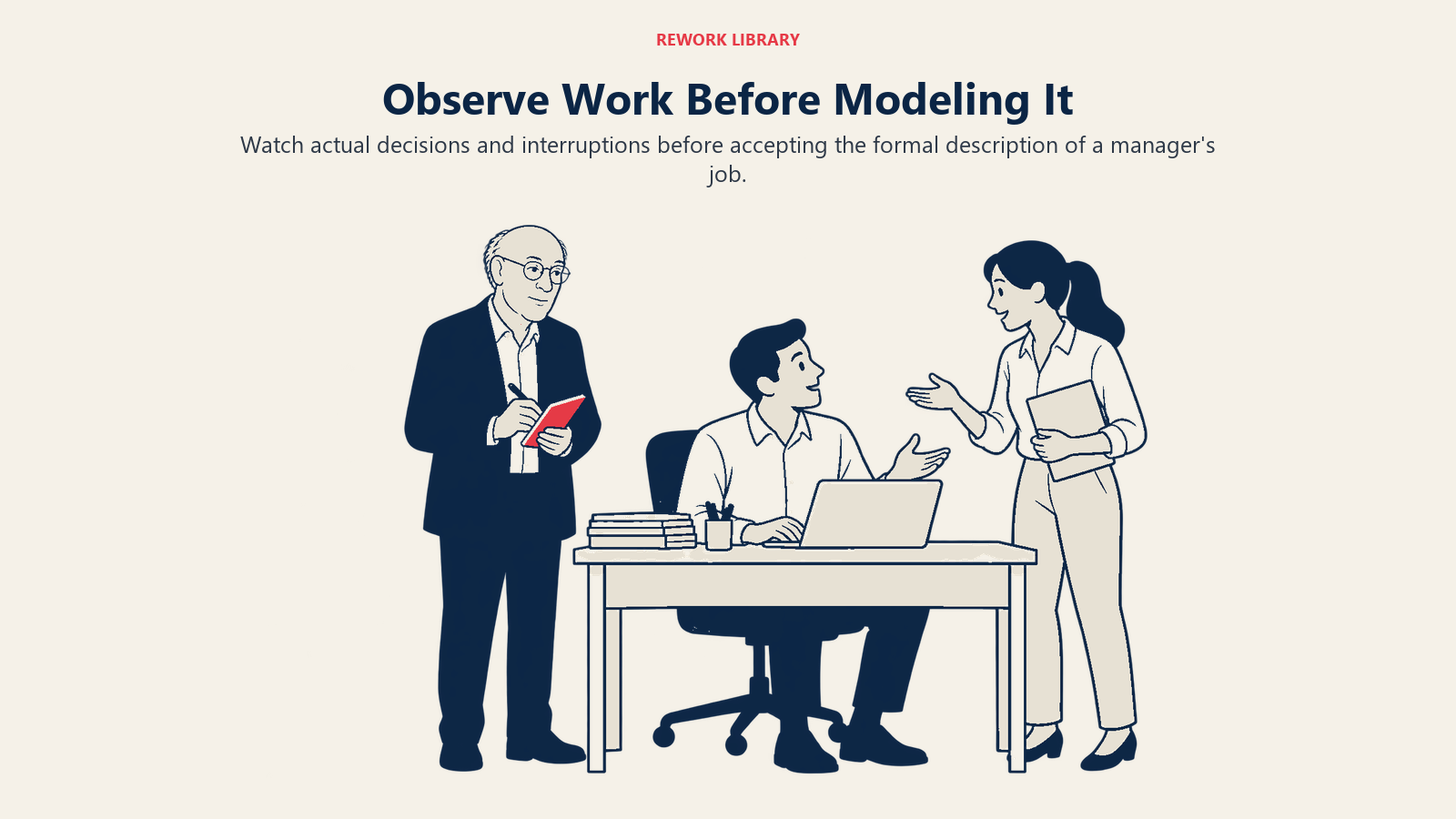
The finding overturned the textbook description of the job. Rather than large blocks of reflective planning time, the median activity these executives handled lasted about nine minutes, and their day was fragmented, verbal, and constantly interrupted. That evidence became The Nature of Managerial Work (1973) and the widely cited 1975 Harvard Business Review article "The Manager's Job: Folklore and Fact," which won that year's McKinsey Award for best HBR article, and it introduced the ten managerial roles, split into interpersonal, informational, and decisional categories, that are still taught in management programs today.
For you: don't accept a job description as an accurate account of the job. If you actually want to understand what a role requires, the more reliable method is watching someone do it for a week, not reading how the org chart says it should work.
2. Publishing The Rise and Fall of Strategic Planning at the Planning Industry's Peak (1994)
By the early 1990s, corporate strategic-planning departments were standard fixtures inside large companies, staffed by professional planners producing multi-year plans built on forecasts and portfolio matrices. The Rise and Fall of Strategic Planning (1994, Free Press) didn't propose to refine that machinery. It argued the entire premise rested on a category error: "strategy cannot be planned. While planning is concerned with analysis, strategy making is concerned with synthesis." He went further, arguing that "planning by its very nature defines and preserves categories," while genuine strategic creativity rearranges the categories a business already assumes, which is exactly what a formal planning process is built to prevent.
That is not a claim that planning departments executed their job badly. It is a claim that the job, as conceived, converting a manager's intuitive sense of where a business should go into a formal five-year document, cannot produce a real strategy in the first place, only operationalize one that already exists. Making that argument in book form in 1994, aimed squarely at an entire profession and the consulting industry built around it, at a moment when corporate planning departments were near the peak of their institutional standing, was a direct attack on the field's own establishment, not a technical refinement of it. The distinction he drew between deliberate, planned strategy and strategy that emerges from a pattern of real decisions still structures how strategic management is taught.
For you: when a process claims to produce something it structurally cannot produce, the fix isn't a better version of the process. It's naming what the process is actually good for (in Mintzberg's case, programming and operationalizing a strategy that already exists) and stopping there.
3. Founding the IMPM Instead of Reforming the MBA From Within (1996)
Mintzberg had spent years criticizing conventional MBA programs in articles and interviews before deciding critique alone wasn't enough. As he later described his own motivation: "I had been writing lots of articles badmouthing MBA programs and what was wrong with them, and then people began asking me, what are you doing about it?" In 1996 he answered that question by co-founding the International Masters Program for Managers with Lancaster University, INSEAD, and the Indian Institute of Management Bangalore, admitting only students who were already practicing managers and replacing case-study lectures with modules built around participants' own jobs.
He made the underlying argument explicit eight years later in Managers Not MBAs (2004, Berrett-Koehler): "conventional MBA programs are mostly for young people with little or no experience. These are the wrong people," taught through methods that "overemphasize the science of management while ignoring its art and denigrating its craft," leaving graduates with "the false impression that they have been trained as managers." Building a rival credential, one that required four partner business schools and an entirely new admissions standard, is a materially bigger bet than publishing another critical paper aimed at colleagues who could simply disagree in a journal response.
For you: if you've spent years pointing out that a system is broken and nothing changes, the more consequential move isn't a sharper critique. It's building the alternative and making people choose between the two, in public, on the record.
What Henry Mintzberg Would Do in Your Role
If you're a CEO staffing up a strategic-planning function, Mintzberg's framework asks you to separate what planners are actually good for from what you're implicitly asking them to produce. He argued planners can be excellent strategy finders, analysts, and catalysts who sharpen a strategy that already exists in a manager's head. What they cannot do is generate that strategy from a spreadsheet. If your planning department's deliverable is the strategy itself rather than a formal write-up of a direction management has already chosen, you've built the exact structure his 1994 book said fails.

If you're a board member deciding whether to fund an executive's MBA, the Managers Not MBAs argument reframes the question. Mintzberg's objection was never to management education itself. It was to teaching abstract technique to people with no managerial experience to test it against. His practical test: is the person you're funding already managing something real, or are you hoping the degree will manufacture managerial judgment out of someone who has never had to exercise it.
If you're a manager trying to understand your own job, the instinct behind his 1968 dissertation is worth borrowing directly. Track your own week the way he tracked his five CEOs: how many minutes did you actually spend on reflective, uninterrupted planning versus fielding interruptions, taking calls, and putting out fires. Most managers discover the honest answer looks a lot more like his nine-minute median than like the job description they were hired against.
| Situation you're facing | Mintzberg's likely move |
|---|---|
| A strategy process keeps producing polished documents that don't change behavior | Ask whether the process is generating strategy or just formalizing a decision someone already made, then stop pretending it's the former |
| You want to understand what a role actually requires | Watch someone do the job for a week and time what actually happens, rather than trusting the written job description |
| An entire industry treats a method as settled best practice | Check the method's own track record before adopting it, and say so publicly if the evidence doesn't hold up |
| You disagree fundamentally with a respected peer's framework | Catalogue their approach fairly as one legitimate school of thought rather than dismissing it, then argue for your own on the evidence |
| Years of criticizing a broken system haven't changed anything | Build the working alternative yourself, with real partners, rather than publishing a sharper version of the same critique |
Notable Quotes & Lessons Beyond the Boardroom
On what strategic planning actually is versus what it claims to be, Mintzberg wrote plainly: "strategy cannot be planned. While planning is concerned with analysis, strategy making is concerned with synthesis." On why formal planning structurally cannot produce the creative leaps a real strategy sometimes requires: "planning by its very nature defines and preserves categories. Creativity, by its very nature, creates categories or rearranges established ones."
On what conventional MBA programs get wrong, from Managers Not MBAs: "conventional MBA programs are mostly for young people with little or no experience. These are the wrong people," taught by methods that "overemphasize the science of management while ignoring its art and denigrating its craft." On his own motivation for building an alternative rather than continuing to write about the problem: "I had been writing lots of articles badmouthing MBA programs and what was wrong with them, and then people began asking me, what are you doing about it?"
And on the gap between how strategy is imagined and how it's actually made, the opening line of his 1987 Harvard Business Review article "Crafting Strategy" still holds: "imagine someone planning strategy. What likely springs to mind is an image of orderly thinking: a senior manager, or a group of them, sitting in an office formulating courses of action that everyone else will implement on schedule." The rest of his career was an argument that this image is close to fiction, and that the honest picture looks more like a craftsman working clay than an executive working a spreadsheet.
Where This Style Breaks
The Direct Observation Doctrine has a real limitation, and it is the same one that made the doctrine possible in the first place: a five-executive sample, however carefully timed, is a thin empirical base for universal claims about all managerial work. Mintzberg built an entire theory of what managers do from watching five chief executives at five organizations for one week each. That is rigorous fieldwork by the standards of 1968 management research, and it is also, by design, too small a sample to represent every industry or level of management, a limitation Mintzberg's own methodology invites rather than hides.

There is a sharper tension in the Porter disagreement. Strategy Safari (1998) catalogues the Positioning School, built around Michael Porter's work on industry structure and generic strategy, as one of ten legitimate schools of strategic thought, an implicit concession that positioning analysis has a real place even inside Mintzberg's own framework. Porter's frameworks, the five forces chief among them, have endured for decades in boardrooms precisely because they give executives a starting analytical structure that Mintzberg's more descriptive account of emergent strategy doesn't provide on its own. Mintzberg is very good at explaining how strategy actually forms after the fact. He is less useful the moment before a decision, when a manager genuinely needs an analytical frame, not a description of how patterns tend to emerge in hindsight. That gap is also why the deliberate, calculated tradition of strategic thought running back through military theory, the same tradition Sun Tzu represents in its oldest form, never fully went away just because Mintzberg proved it wasn't the whole story.
The institution-building record is real but bounded, too. The IMPM has run continuously since 1996 and built a genuine international footprint across five partner schools, but it was never going to displace the mainstream MBA at scale. Most large employers still default to hiring from conventional MBA programs, the exact credential Managers Not MBAs argued against, which means the critique landed intellectually more completely than it did in the hiring market it was aimed at. A framework built on watching what already works, applied to an entrenched hiring habit, runs into the same problem Eric Ries found when large companies adopted the language of validated learning without changing how they actually funded new projects: naming the better practice is not the same as making the market choose it.
Learn More
- Peter Drucker Leadership Style: Management by Principle
- Clayton Christensen Leadership Style: Disruption Theory From the Man Who Named It
- Jim Collins Leadership Style
- Michael Porter Leadership Style
- Mintzberg's 5 Ps of Strategy: Plan, Ploy, Pattern, Position, Perspective
- Levels of Strategy: Corporate, Business, and Functional
- Porter's Five Forces Explained
- Competitive Positioning: The Full Framework
Frequently Asked Questions about Henry Mintzberg
Who is Henry Mintzberg?
Henry Mintzberg (born September 2, 1939) is a Canadian academic and the John Cleghorn Professor of Management Studies at McGill University's Desautels Faculty of Management, where he has taught continuously since 1968. He is best known for his empirical studies of what managers actually do, his critique of formal strategic planning, and his co-founding of the International Masters Program for Managers.
What are Mintzberg's ten managerial roles?
Based on his structured observation of five chief executives, Mintzberg identified ten roles grouped into three categories: interpersonal (figurehead, leader, liaison), informational (monitor, disseminator, spokesperson), and decisional (entrepreneur, disturbance handler, resource allocator, negotiator). The framework first appeared in his 1973 book The Nature of Managerial Work and the 1975 Harvard Business Review article "The Manager's Job: Folklore and Fact."
What is the difference between Mintzberg's view of strategy and Michael Porter's?
Porter's Positioning School treats strategy as choosing a defensible position within an industry structure, analyzed through frameworks like the five forces. Mintzberg treats strategy as something that also emerges from a pattern of decisions over time, not only from deliberate analysis, and catalogued Porter's approach as one of ten legitimate schools of strategic thought in Strategy Safari (1998) rather than dismissing it.
Why did Mintzberg attack strategic planning?
In The Rise and Fall of Strategic Planning (1994), Mintzberg argued that formal planning processes are built for analysis, not synthesis, and that genuine strategic creativity requires rearranging the categories a business already assumes, something a formal planning process is structurally built to prevent. His argument was that planning can operationalize a strategy that already exists but cannot generate one from scratch.
What is the IMPM and why did Mintzberg create it?
The International Masters Program for Managers (IMPM) is an executive program Mintzberg co-founded in 1996 with Lancaster University, INSEAD, and the Indian Institute of Management Bangalore, built specifically for people already practicing management rather than for those without managerial experience. He created it as a working alternative after years of criticizing conventional MBA programs, an argument he later made explicit in Managers Not MBAs (2004).
What can leaders learn from Henry Mintzberg's approach?
Three things. First, watch what actually happens in a job or a process before trusting its formal description. Second, be willing to challenge a field's most respected orthodoxy if the evidence doesn't support it, not just its weaker ideas. Third, if criticism alone doesn't change a broken system, build a working alternative rather than writing a sharper version of the same argument.

Co-Founder, Rework.com
On this page
- The Direct Observation Doctrine
- Leadership Style Breakdown
- Key Leadership Traits
- The 3 Decisions That Defined Henry Mintzberg as a Leader
- 1. Choosing Structured Observation Over Survey Data for His PhD (1968)
- 2. Publishing The Rise and Fall of Strategic Planning at the Planning Industry's Peak (1994)
- 3. Founding the IMPM Instead of Reforming the MBA From Within (1996)
- What Henry Mintzberg Would Do in Your Role
- Notable Quotes & Lessons Beyond the Boardroom
- Where This Style Breaks
- Learn More