Shreyas Doshi Leadership Style: Product Thinking Over Product Management
Turn this article into takeaways for your work.


Each assistant summarizes the article only for you and suggests best practices for your work.
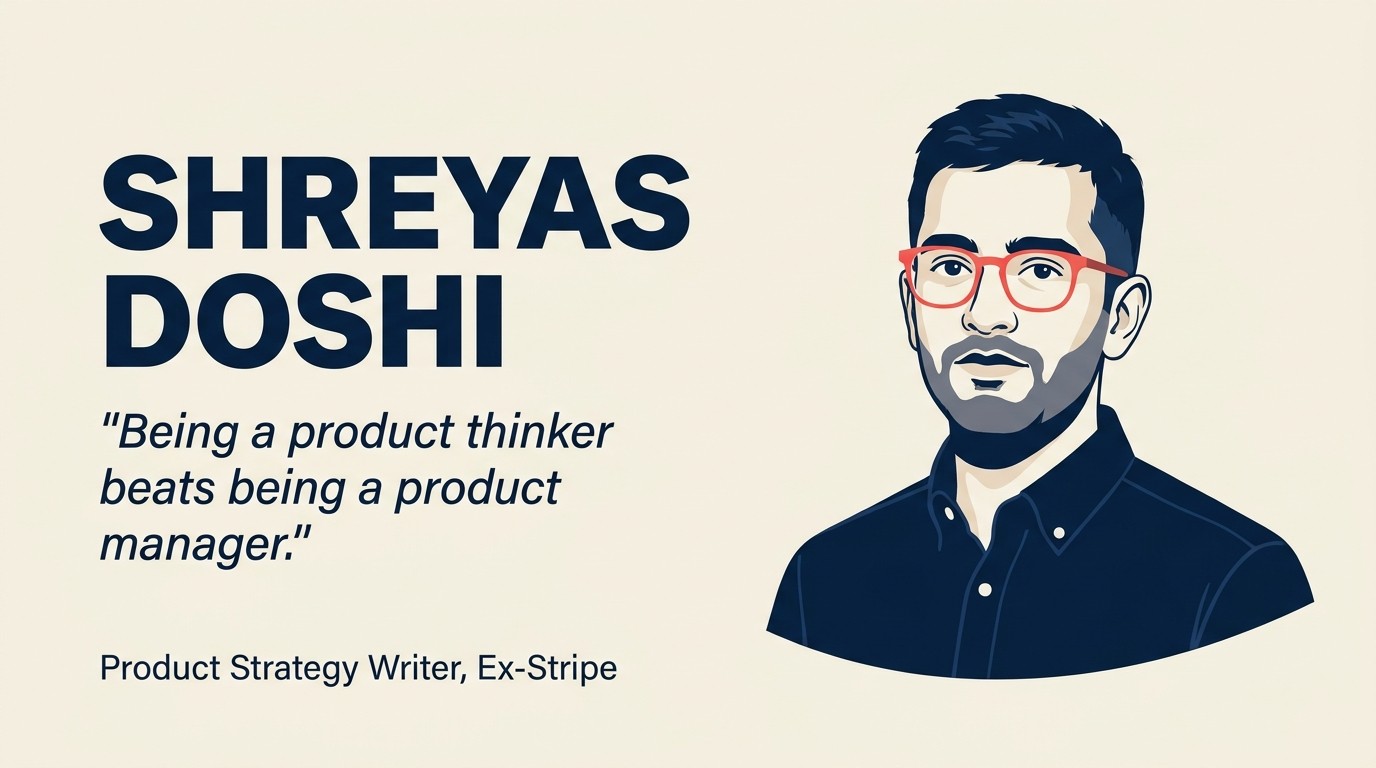
Shreyas Doshi spent 10 years inside three of the most studied product organizations on the internet, Yahoo, Twitter, and Stripe, and then walked away from executive titles to think and write in public.
That decision is either a career risk or a strategy, depending on what you're trying to build.
In Doshi's case, it's a strategy. He left Stripe around 2019 without a next job and became one of the most quoted voices in product strategy within 18 months. He did it through X (Twitter) threads that were specific enough to be useful and honest enough to be uncomfortable. He now has 500,000-plus followers and more influence over how product managers think about their work than most CPOs at public companies. His extended writing is collected at his Substack, where he publishes longer-form frameworks that his Twitter threads compress.
That's not a coincidence. The frameworks Doshi built, LNO task prioritization, the product manager versus product thinker distinction, pre-mortem discipline, are directly applicable to decisions you're making this week. They didn't come from academic research or consulting engagements. They came from years of operating inside hard problems at fast-moving companies.
Key Facts
- Former Director of Product Management at Stripe, led product orgs before departing circa 2019 to teach and write independently
- Previous roles at Google, Twitter, Yahoo, and Nokia, decade-plus inside four of the most-studied product organizations of the 2000s–2010s
- Independent product advisor and consultant to major tech PM organizations and startups
- LinkedIn Top Voice and one of the most-followed product thinkers on X (Twitter), with 500,000+ followers
- Author of widely-shared PM frameworks, LNO (Leverage/Neutral/Overhead), product thinker vs. product manager, pre-mortem discipline, anti-goals, "product sense"
- Contributor to Lenny's Newsletter and publisher of long-form frameworks at shreyasdoshi.substack.com
The LNO Framework (Doshi Product Thinking Model)
The LNO Framework is Shreyas Doshi's three-bucket task classification system that sorts every unit of a product manager's work into Leverage tasks (disproportionate-impact decisions and strategic artifacts that deserve roughly 80% of attention), Neutral tasks (necessary coordination and reporting that should consume the minimum viable time), and Overhead tasks (redundant meetings, approvals, and status rituals that actively displace leverage work and must be aggressively eliminated). The framework's discipline is that overhead is never reduced by trying harder, it is reduced by naming it, categorizing it publicly, and giving teams explicit permission to cut it.
Leadership Style Breakdown
| Style | Weight | How it showed up |
|---|---|---|
| Frameworks Architect | 55% | Doshi's primary contribution is conceptual. He takes problems that practitioners feel intuitively but can't name precisely and gives them frameworks that make the problem actionable. LNO doesn't describe anything new about task prioritization, people have always known that some work matters more than other work. But naming the categories (Leverage, Neutral, Overhead) and insisting on the distinctions creates a decision tool. The product manager versus product thinker distinction works the same way: the difference existed before Doshi named it, but naming it gave product leaders a shared language for a gap they'd been working around without being able to address directly. |
| Radical Clarity Operator | 45% | Doshi operated inside organizations where strategic clarity was genuinely hard to maintain. Twitter's product direction during his time there was contested at the executive level. Stripe's ambitions were expanding faster than organizational alignment. In those environments, his operating style was about removing ambiguity, being willing to say uncomfortable things clearly rather than managing around them. His public writing reflects the same quality. He regularly publishes threads that name failure modes in product management that most practitioners recognize but don't say in meetings. The combination of framework precision and directness is what gives his public persona its credibility. |
The 55/45 split matters because Doshi is operating differently from most product thinkers. He's not primarily a coach (like Torres) or a systems critic (like Cagan). He's building frameworks in public and testing them against a large audience of practitioners who push back, apply them, and report back. That feedback loop is the mechanism that keeps his frameworks honest.
Key Leadership Traits
| Trait | Rating | What it means in practice |
|---|---|---|
| Pre-mortem discipline | Exceptional | Doshi's most operationally useful habit is running pre-mortems before committing to major initiatives. A pre-mortem asks: if this project fails a year from now, what is the most likely failure story? That question surfaces assumptions that optimism hides. Most planning processes are structured to build confidence in a plan. A pre-mortem is structured to find the plan's weakest point before you're invested in it. Doshi applies this to product strategy, to career decisions, and to organizational design. It's transferable to any high-stakes decision with uncertain outcomes. |
| LNO task prioritization | Very High | Doshi's LNO framework, Leverage, Neutral, Overhead, is a daily tool for managing where attention goes. Leverage tasks are the ones that produce disproportionate results: a decision that unblocks five people, a conversation that clarifies the strategy for the quarter, a document that replaces ten meetings. Neutral tasks are necessary but not multiplying: reviews, reporting, routine communication. Overhead tasks are organizational drag: meetings that could be emails, processes that exist because nobody removed them, coordination work that produces no direct output. Most people know they're spending time on overhead. LNO gives you a label and a mandate to eliminate it. |
| Tolerance for saying uncomfortable truths publicly | High | Doshi's public threads regularly name things that practitioners agree with but don't say at work. "Your PM team is mostly project managers" is not something most CPOs will say in an all-hands. Doshi says it on X with specific examples. "Most product roadmaps are vanity documents" is not a safe opinion inside a company with a recently approved roadmap. Doshi's willingness to publish uncomfortable specifics is what distinguishes his writing from generic product management advice, and it's what generates the engagement that makes his audience trust the frameworks. |
| Distinguishing product managers from product thinkers | High | Doshi's product manager versus product thinker distinction is his most intellectually precise contribution. A product manager executes a process: discovery, prioritization, roadmap, delivery. A product thinker asks whether the process is building the right thing, whether the outcome being optimized is the right outcome, whether the customer problem being solved is the real problem, whether the strategy the roadmap serves is correct. Most organizations hire for product management competence and expect product thinking. That mismatch is a persistent source of frustration on both sides. |
The 3 Frameworks That Defined Shreyas Doshi
1. LNO Framework, Leverage, Neutral, Overhead
Doshi developed the LNO framework as a response to a problem he observed across multiple organizations: smart, capable people working very hard and producing mediocre results. The problem wasn't effort. It was where the effort was directed.
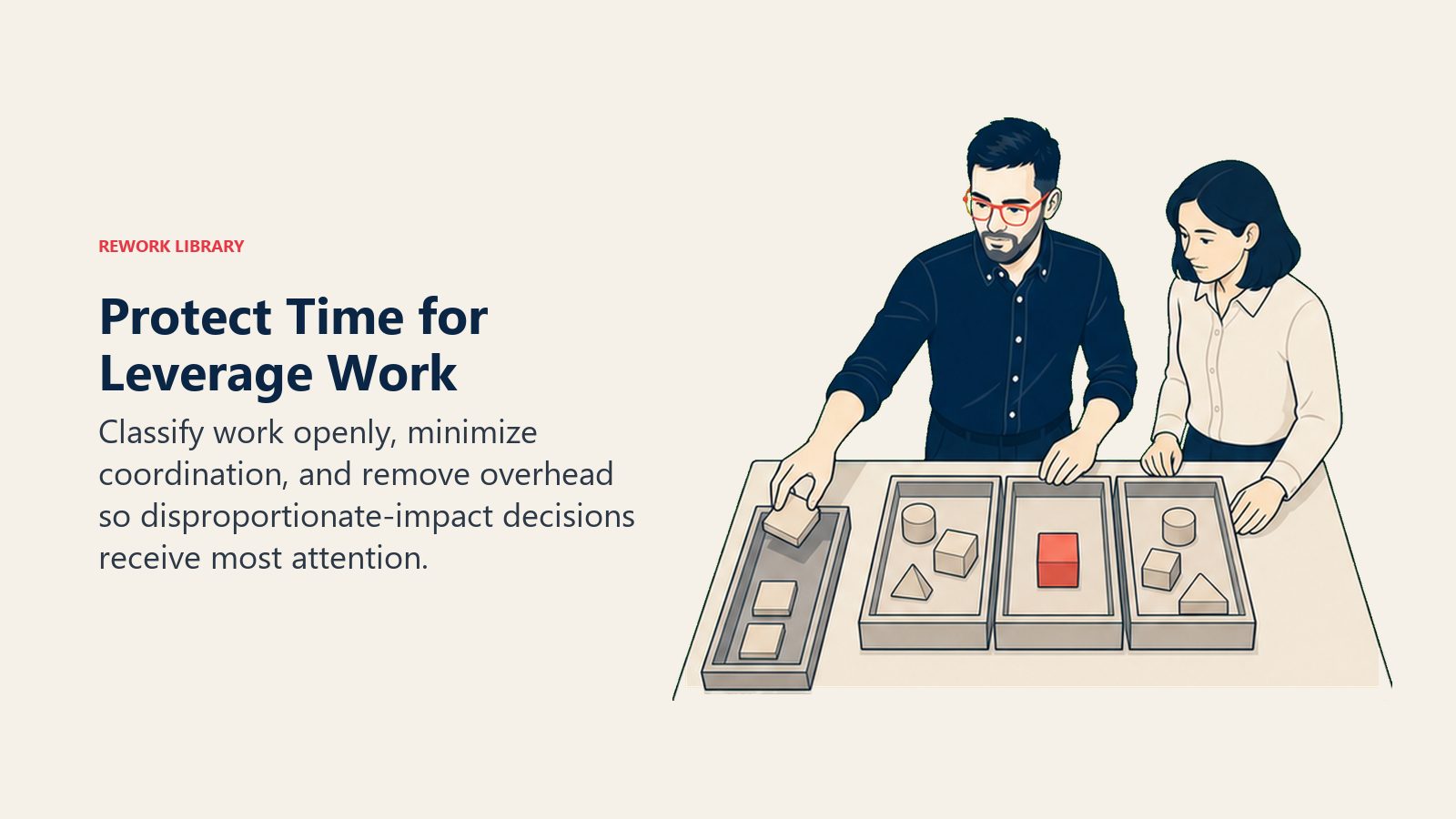
LNO is a classification system for tasks. Every task a PM does falls into one of three categories. Leverage tasks are the ones that produce results disproportionate to the time invested, decisions that unblock teams, strategic documents that create alignment across functions, customer conversations that change the direction of a feature. These are the tasks that deserve 80% of a PM's time.
Neutral tasks are necessary but not multiplying. Sprint ceremonies, status updates, regular review meetings, routine stakeholder communication. These need to happen. They shouldn't consume more time than the minimum required to keep them running.
Overhead tasks are the expensive category. They're the work that takes time without producing output that matters: redundant approval processes, coordination that could be replaced with a decision, meetings that produce no decisions and could have been an email. Overhead is corrosive not just because it consumes time but because it displaces Leverage work. A PM who spends 4 hours in status-update meetings isn't spending 4 fewer hours on neutral work. They're spending 4 fewer hours on the decisions and strategic thinking that actually advance the product.
The LNO framework's practical application requires the willingness to do something most organizations resist: explicitly categorize overhead and eliminate it. That's harder than it sounds because overhead is often presented as accountability, the status meeting exists because leadership wants visibility, the approval process exists because something went wrong once. Doshi's argument is that accountability achieved through overhead is a bad trade. The visibility you get costs more in Leverage work than it's worth.
2. Product Manager Versus Product Thinker
Doshi's most influential conceptual contribution isn't a framework you fill in. It's a distinction that forces a different kind of self-assessment. Seth Godin applies a similar discipline to marketing, asking whether you're building for the smallest viable audience who would miss you, rather than optimizing for reach. The structural move is identical: question the premise before optimizing the execution.
A product manager executes a set of practices. Discovery, definition, prioritization, delivery, measurement. They know how to run a sprint, write a PRD, conduct a user interview, analyze a funnel. These are learnable skills and most PMs who've been doing the job for two or three years have them reasonably well.
A product thinker asks the question upstream of all those practices: are we solving the right problem? Is the outcome we're optimizing the outcome that matters? Is the customer segment we're building for the one whose problem is worth solving? Are we capturing value in proportion to the value we're creating?
The distinction is important because most organizations hire for product management skills and expect product thinking outputs. They want a PM who can run the process efficiently, but they also want a PM who knows when the process is pointed at the wrong thing. Those are different people, or rather, the same people at different stages of development. You can be a technically proficient PM without being a product thinker. But you can't be a high-impact PM without it.
Doshi's argument is that the difference between PMs who have outsized impact and PMs who are competent but interchangeable is almost always this distinction. The high-impact ones are asking whether what we're building is right before asking whether we're building it correctly.
For product leaders, the implication is diagnostic: look at the questions your PMs ask in reviews. If every question is about execution, what's the timeline, what are the dependencies, what's the risk, and none of them are about strategy, why are we doing this, what happens if we don't, what would have to be true for this to succeed, you have a team of capable product managers who aren't doing product thinking. The fix isn't a training program. It's changing what questions you ask in reviews, which changes what questions feel safe to ask.
3. Pre-Mortem and Anti-Goals Thinking
Doshi's pre-mortem practice comes from Gary Klein's work in decision science, published in HBR, but Doshi applied and popularized it specifically in the product management context. Peter Drucker framed the same discipline decades earlier as "the effective executive", the manager who makes decisions by first asking what would have to be true for this to be wrong, not what would have to be true for it to succeed. The exercise is simple: before committing to a major initiative, project yourself one year forward to a failure state. The project launched, it didn't work, and now you're doing a retrospective. What was the most likely reason it failed?
The discipline of the pre-mortem is that it bypasses the optimism bias that pervades planning. When you're planning forward, your brain is pattern-matching on success stories and filtering out the failure modes. When you're projecting backward from failure, the failure modes become visible because you've given yourself permission to take them seriously.
Doshi applies this to product strategy, to organizational design decisions, and to personal career choices. The structure is always the same: name the failure story in advance, identify the assumption that failure story reveals, and decide whether to change the plan or accept the risk explicitly.
Anti-goals are a related practice. Most strategic planning defines what you're trying to achieve. Anti-goals define what you're explicitly not trying to achieve, outcomes you're willing to sacrifice, customer segments you're not optimizing for, metrics you're willing to let decline in service of the goal you've chosen.
Anti-goals matter because they reveal tradeoffs that positive goal-setting hides. If your goal is growth in enterprise accounts, what are you de-prioritizing? If you don't say explicitly, you'll implicitly discover the answer when your SMB retention starts declining and nobody made the decision to let that happen. Anti-goals force the tradeoff to the surface where it can be decided rather than discovered.
What Shreyas Doshi Would Do in Your Role
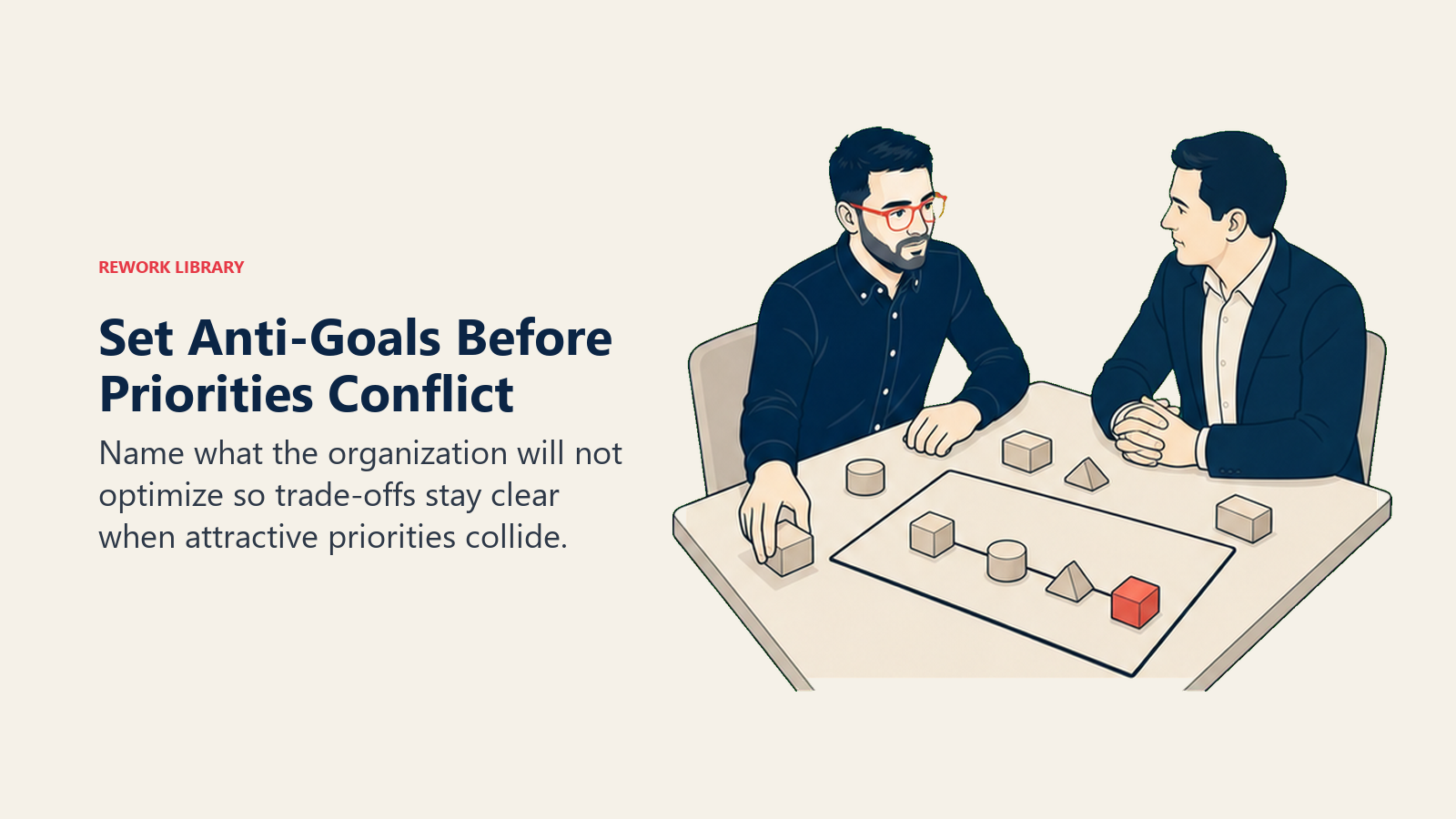
If you're a CEO, Doshi's most useful framework for you is anti-goals. You almost certainly have annual goals. What are the things you're explicitly not optimizing for this year? If you can't answer that question clearly, your organization will discover the implicit answer in the second half of the year when conflicting priorities create decision gridlock. The anti-goal list forces you to decide what's lower priority before the moment of conflict, when the decision is easier to make clearly.
If you're a COO, the LNO framework applies directly to how your team spends time. Run the exercise with your direct reports: have each person classify their last week of work into Leverage, Neutral, and Overhead. Then look at the overhead column as a leadership question, not an individual one. If your direct reports are spending significant time in meetings that don't produce decisions, or in coordination that exists because information doesn't flow automatically, those are structural failures you can fix. Don't ask people to eliminate overhead from their individual calendars without changing the organizational structures that create it.
If you're a product leader, the product manager versus product thinker distinction gives you a diagnostic lens for your team. For each of your PMs, ask: what was the last time they challenged the premise of a project before it was approved? What was the last time they said "I don't think we should build this" based on a strategic argument rather than a capacity argument? PMs who only say no when there's no capacity available are executing a process. PMs who say no when the project is wrong are doing product thinking. You want a team that does both, and you build it by making it safe to raise strategy questions before planning is locked.
If you're in sales or marketing, Doshi's pre-mortem is the most directly applicable practice. Before committing to a campaign, a pricing change, or a go-to-market motion, run the failure story forward: it's a year from now, this didn't work. What was the most likely reason? That question will surface the assumption you're most uncomfortable examining, which is usually the one that matters most. Most GTM failures are predictable in advance. The pre-mortem doesn't prevent failure; it converts unexamined assumptions into known risks that you can either mitigate or accept explicitly.
Applying Doshi's Thinking With Rework
Product sense doesn't develop in isolation, it develops when PMs can see the full arc of a decision, from customer signal to roadmap commitment to delivered outcome. Most product teams lose that arc because the evidence lives in six tools: interview notes in a doc, tickets in a tracker, deals in a CRM, support themes in a help desk, decisions in Slack, metrics in a dashboard. Rework collapses the stack, CRM, project management, customer conversations, and shared operations in one workspace, with the Project Engine starting at $99/month billed yearly, so the signal a product thinker needs to question a premise is actually reachable. That's the precondition for LNO to work: you can only classify a task as Leverage vs. Overhead if you can see which tasks moved the metric that mattered. Rework gives PM, sales, and support teams a shared surface where roadmap bets and their downstream outcomes are visible in the same view, which is exactly the workflow visibility Doshi's frameworks assume but most orgs never build.
Notable Quotes and Lessons Beyond the Boardroom
"The difference between great PMs and mediocre PMs isn't talent. It's how they think about problems." Doshi published this in a thread that received tens of thousands of engagements, and the reason it landed is that it's a reframe most practitioners hadn't encountered. The normal attribution for PM quality is execution skill. Doshi's argument is that execution skill is table stakes. The differential is upstream.
His framing of "looking busy vs. being productive" is worth applying literally as a calendar audit. Pull up the last two weeks. For each event and task, ask honestly: was this Leverage work that produced results, or was it Overhead that produced the appearance of activity? Most leaders who do this exercise honestly find that 30-40% of their time was overhead disguised as work. That's not a personal failing. It's an organizational design problem. But it's a problem you can start fixing once you've named it.
His most consistently applicable advice is about trusting uncomfortable data early. Doshi's pre-mortem discipline comes from the same source as his product thinker framing: most planning failures happen because the information that would have changed the decision was available before the decision was made, but the organizational culture didn't create space for it. MIT Sloan Management Review's research on decision-making bias documents the same pattern, teams systematically discount early warning signals under planning pressure, and structured pre-mortem exercises measurably improve decision quality. His operating principle is to actively look for the uncomfortable signal rather than filtering it out.
Where This Style Breaks
Doshi's frameworks assume you have smart people who can handle intellectual honesty about their own performance. LNO breaks in organizations where the definition of "leverage" is contested, where what the PM thinks is high-leverage differs from what the organization values. That's not a framework problem; it's an alignment problem that the framework surfaces but can't resolve.
His public-writing mode also doesn't translate directly to operators who need privacy. Doshi's 500,000-follower teaching platform works because he's not employed by the companies he's analyzing. Inside a company, writing publicly about product failures creates different risks.
And most of his frameworks are optimized for B2B SaaS product teams, mid-stage companies with technical products and established PMF. Hardware products, regulated industries, and consumer businesses with different discovery dynamics are less well served by his specific framing. The underlying principles transfer; the specific applications don't always.
Frequently Asked Questions about Shreyas Doshi's Product Philosophy
Who is Shreyas Doshi?
Shreyas Doshi is a former Director of Product Management at Stripe with earlier product roles at Google, Twitter, Yahoo, and Nokia. He left executive product roles around 2019 to become an independent advisor, teacher, and writer, and has grown to 500,000-plus followers on X and a LinkedIn Top Voice designation by publishing precise, practitioner-grade frameworks about how product work actually succeeds or fails.
What is the LNO framework?
LNO stands for Leverage, Neutral, Overhead, Doshi's three-bucket classification for every task a PM does. Leverage tasks produce disproportionate results and deserve most of your time. Neutral tasks are necessary but non-multiplying. Overhead tasks consume time without producing meaningful output and must be aggressively cut. The framework's job is to make the category of each task explicit so that overhead stops hiding as "real work."
What is 'product thinking' per Doshi?
Product thinking, for Doshi, is the discipline of questioning the premise of a project before optimizing its execution. A product manager runs the process, discovery, PRDs, sprints, delivery. A product thinker asks whether the outcome being optimized is the right outcome, whether the customer problem is the real problem, and whether the strategy the roadmap serves is correct. It's the upstream judgment that separates interchangeable PMs from high-impact ones.
How does Doshi define product sense?
Product sense, in Doshi's usage, is the cultivated judgment that lets a PM predict which product decisions will resonate with real customers before the evidence is fully in. It comes from absorbing large volumes of customer signal, debating tradeoffs in public with other thinkers, and running pre-mortems rigorously enough that failure modes become intuitive. It's not a gift, it's a trained pattern-recognition skill.
What did Doshi do at Stripe?
At Stripe, Doshi served as a Director of Product Management, leading product teams during a period when Stripe's ambitions were expanding faster than organizational alignment could keep up. He exited in 2019 without a next role lined up, which he has described as a deliberate decision to think and write in public rather than take another executive title.
What can product managers learn from Shreyas Doshi?
Three things. First, categorize your time using LNO and defend your Leverage hours ruthlessly. Second, build the habit of running pre-mortems before major commitments so unexamined assumptions surface before they become failures. Third, cultivate product thinking, not just product management, make a weekly practice of questioning whether what you're building is the right thing before asking whether you're building it correctly.
For related reading on product strategy and prioritization, see Marty Cagan Leadership Style, Teresa Torres Leadership Style, and Strategic Prioritization for Product Leaders.

On this page
- Key Facts
- The LNO Framework (Doshi Product Thinking Model)
- Leadership Style Breakdown
- Key Leadership Traits
- The 3 Frameworks That Defined Shreyas Doshi
- 1. LNO Framework, Leverage, Neutral, Overhead
- 2. Product Manager Versus Product Thinker
- 3. Pre-Mortem and Anti-Goals Thinking
- What Shreyas Doshi Would Do in Your Role
- Applying Doshi's Thinking With Rework
- Notable Quotes and Lessons Beyond the Boardroom
- Where This Style Breaks