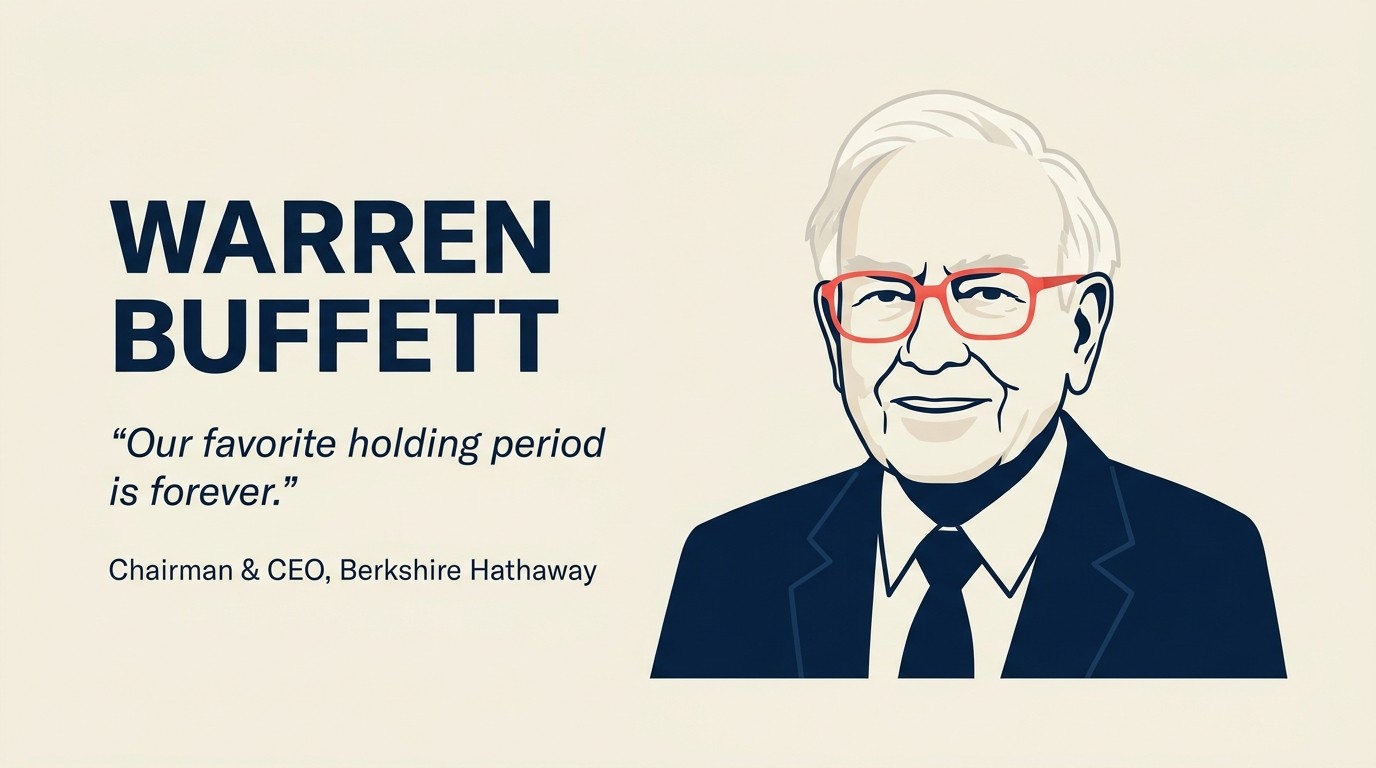
Warren Buffett Leadership Style: The Temperament Edge
Turn this article into takeaways for your work.


Each assistant summarizes the article only for you and suggests best practices for your work.
Every quarter, someone on your team is probably asking whether you should pivot. Kill that product line. Chase the new market. Double down on the thing that's gaining traction fastest. That pressure is real, and it's relentless. Warren Buffett has been ignoring it since 1965.
That's not naivety. It's a deliberate operating system. Buffett bought Berkshire Hathaway as a failing New England textile mill and over the next six decades built it into a holding company with a market cap north of $800 billion. He didn't do it by being smarter than everyone else. He's said repeatedly that his IQ isn't what separates him. What separates him is the ability to sit still when others can't.
Understanding how that temperament works as a leadership framework, not just an investment philosophy, is the part most profiles miss. This one won't.
Key Facts
- Born: August 30, 1930 (Omaha, Nebraska)
- Role: Chairman and CEO, Berkshire Hathaway since 1970
- Education: MBA from Columbia Business School (1951), studied directly under value-investing pioneer Ben Graham
- Berkshire scale: Transformed a failing New England textile mill into a holding company with a market cap crossing $1 trillion in 2024
- Stock milestone: Berkshire Class A shares became the first US equity to cross $500,000 and later $600,000 per share
- Annual letters: His Berkshire shareholder letters, written for 60+ years, are required reading in business schools and on Wall Street
- Philanthropy: Co-founder of the Giving Pledge (2010) with Bill and Melinda Gates; has pledged to give away 99%+ of his wealth
- Net worth: $140B+, consistently one of the world's 10 wealthiest individuals despite massive ongoing donations
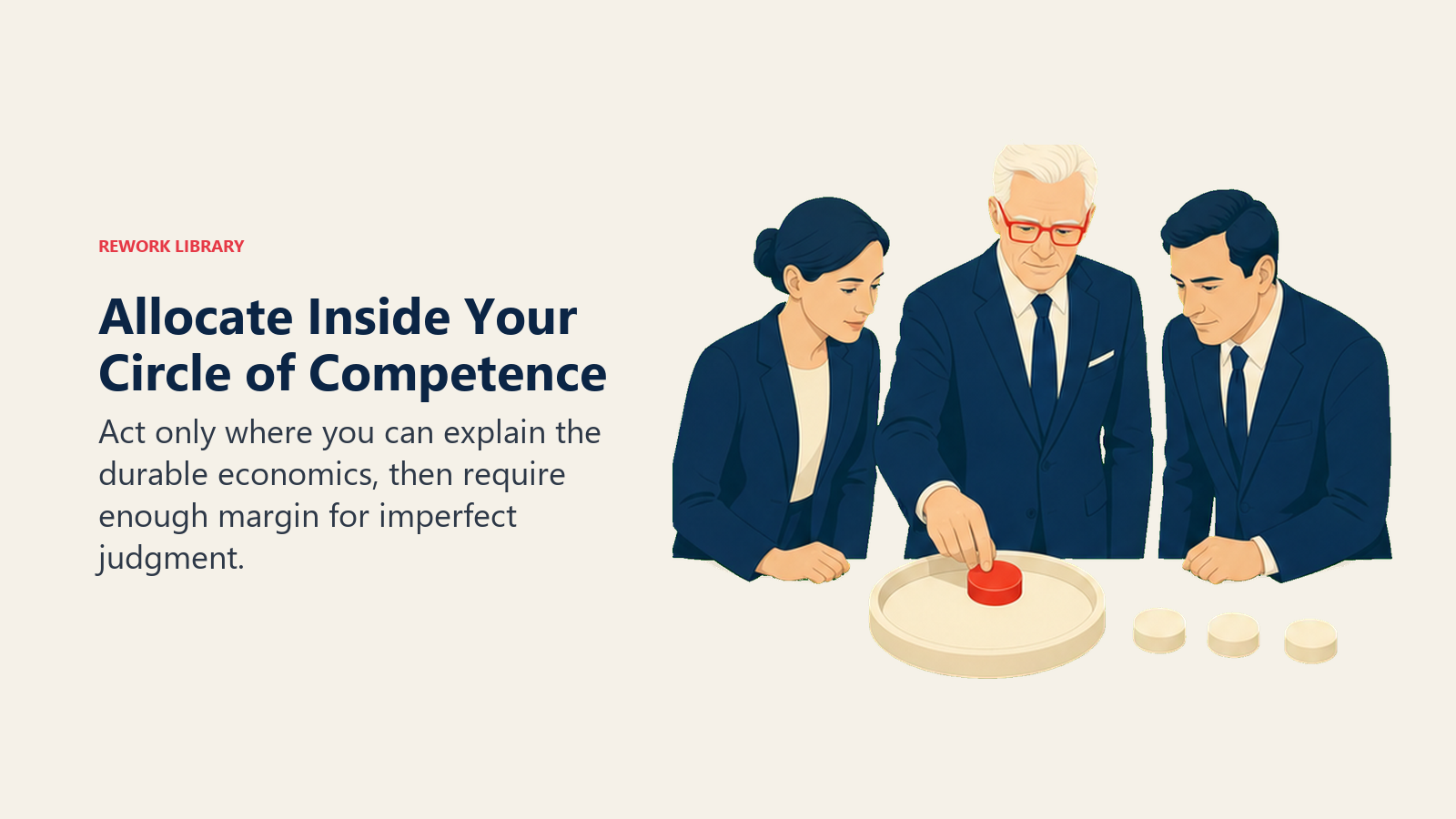
The Circle of Competence Doctrine (The Buffett Margin-of-Safety Model)
The Circle of Competence Doctrine is the discipline of allocating capital and attention only to businesses or decisions whose competitive dynamics you can genuinely predict a decade out, and saying no to everything else, regardless of how attractive it looks. Paired with the Margin-of-Safety Model, it means you only act when the price you pay is so far below your estimate of intrinsic value that even a flawed analysis still produces a positive outcome. Together, they turn patience and self-knowledge into a durable structural edge rather than a personality trait.
Leadership Style Breakdown
| Style | Weight | How it showed up |
|---|---|---|
| Deliberate / Long-Horizon | 70% | Made major capital allocation decisions with 10-20 year holding horizons. Held Coca-Cola through four decades of brand cycle. Avoided tech for 20+ years not out of ignorance but out of honest self-assessment. Wrote annual shareholder letters for 60+ years to communicate thinking, not just results. |
| Decentralized Operator | 30% | Never built a central M&A team or integration function. Acquired businesses and left management in place. Set culture through writing and example rather than process and compliance. Greg Abel and Ajit Jain run major subsidiaries without weekly check-ins from Omaha. |
The 70/30 split matters. Buffett's primary act isn't investing, it's not acting when most leaders would. The patience isn't passive. It's a daily choice against noise.
Key Leadership Traits
| Trait | Rating | What it means in practice |
|---|---|---|
| Intellectual Honesty | Exceptional | Buffett has publicly admitted mistakes in shareholder letters, the original Berkshire textile investment, buying Dexter Shoe, holding too much cash in 2020 during a market rout. He doesn't spin losses. He explains the reasoning, says where it broke down, and moves forward. That transparency built 60 years of investor trust. |
| Circle of Competence | Exceptional | He stayed out of tech for decades not because he didn't understand technology but because he didn't understand how to predict which tech companies would win. When he finally bought Apple in 2016 with an initial $36 billion stake, he framed it as a consumer brand bet, not a tech bet. That distinction is the circle in action. |
| Capital Discipline | Very High | Berkshire has returned capital to shareholders through buybacks, not dividends, preserving optionality. Buffett's standard is clear: only deploy capital when the expected return exceeds what Berkshire could earn doing nothing. That sounds obvious. Almost no public company actually runs that way. |
| Long-Term Thinking | High | Buffett's BNSF acquisition in 2010 for $44 billion was premised on freight infrastructure being essential for 50+ years regardless of what happened in the economy short-term. He didn't need a model with 12 assumptions. He needed one conviction and the balance sheet to back it. |
The 3 Decisions That Defined Buffett as a Leader
1. Walking Away from Textiles and Pivoting Berkshire to Insurance Float
When Buffett first acquired Berkshire in 1965, it was a New England textile business bleeding cash. He kept the textile operations running for 20 more years, which he later called a mistake, sentimental attachment to jobs in the region clouded his judgment. But the more important decision was recognizing that the insurance subsidiaries he'd acquired alongside the business generated something no textile mill could: float.
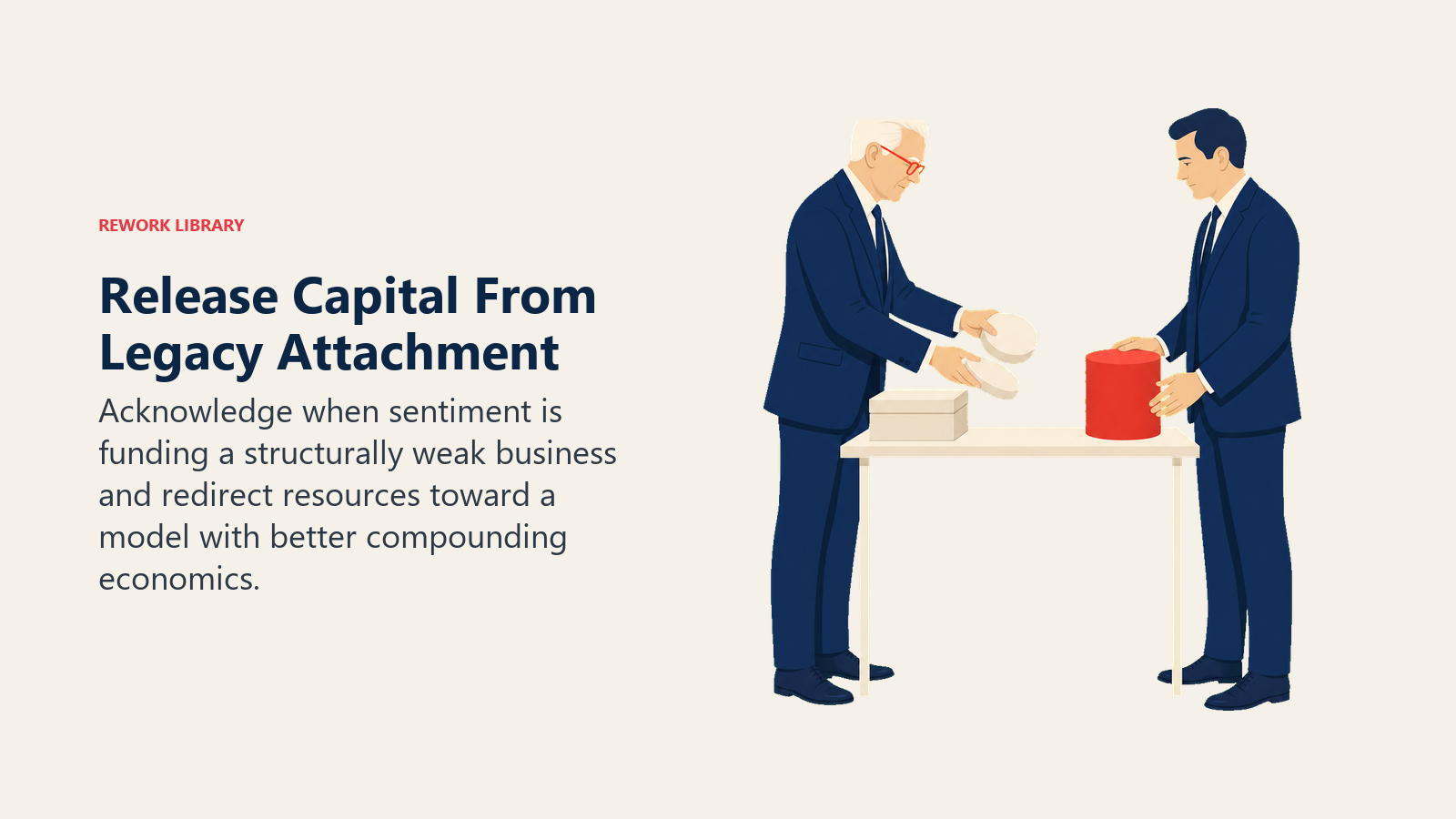
Insurance float is the premium money customers pay before claims are made. If you underwrite well, you're essentially investing money that costs you nothing. Buffett built GEICO, General Re, and dozens of other insurers into Berkshire's foundation. The float now exceeds $160 billion. Buffett has explained the float concept in plain terms across his annual shareholder letters for decades.
The leadership lesson isn't "buy insurance companies." It's that Buffett identified a structural advantage inside a failing business that most people would have written off entirely, and he reorganized everything else around it. When you're running a struggling unit or product line, the question isn't always whether to kill it. It's whether there's a float mechanism buried inside it.
2. The Coca-Cola Bet When Sentiment Was Against It
In 1988, Berkshire began buying Coca-Cola stock. The stock market had just crashed in October 1987. Consumer sentiment was uncertain. Several analysts thought Coke was a mature brand with limited upside. Buffett spent $1.3 billion, eventually accumulating roughly 6.2% of the company.
Today that position is worth more than $25 billion.
What makes this a leadership story rather than just an investment story is the reasoning. Buffett didn't predict the exact outcome. He identified a business with global brand recognition, pricing power, high margins, and a distribution network that would take decades and billions to replicate. He knew what he was buying and why, and he was willing to hold through any short-term turbulence. That's conviction backed by analysis, not stubbornness.
For today's leaders: how much of your strategic planning is genuinely analytical versus reactive to what your competitors announced last quarter? Buffett's Coke thesis took 30 seconds to summarize and 35 years to pay out. Your best strategic bets might look the same.
3. The Apple Position, Overcoming His Own Stated Blind Spot
In 2016, Buffett began buying Apple stock. He was 86 years old. For decades, he'd said publicly that technology companies were outside his circle of competence, he didn't invest in companies where he couldn't predict the competitive position 10 years out, and fast-moving tech sectors made that impossible.
Apple was different in his reading. He wasn't buying a tech company. He was buying a consumer ecosystem with extraordinary switching costs, 1.5 billion active devices, and a customer base that renewed iPhones on a predictable 2-3 year cycle. As Warren Buffett has explained publicly, the bet was on consumer behavior, not engineering. That's not a technology bet. That's a consumer habit bet. Berkshire's position grew to over $150 billion at its peak, making Apple its single largest holding by value.
What this reveals about leadership: Buffett was willing to be wrong about his prior framework when the evidence demanded it. He didn't change his principles. He applied them more precisely. There's a difference between abandoning your standards and recognizing that your categories were too broad.
What Buffett Would Do in Your Role
If you're a CEO running a 50-500 person company, the Buffett move is to get brutally honest about where your competitive moat actually sits. Not where your deck says it sits. Where it actually sits. Buffett spent 30 years investing in companies with durable advantages, pricing power, switching costs, brand loyalty, cost advantages, and refusing businesses that were structurally commoditized no matter how good the management was. Ask whether your business would survive a competent, well-funded competitor who spent three years trying to take your customers. If the honest answer is "probably not," that's your strategic problem, not a quarterly execution problem.
If you're a COO or operations leader, the Berkshire model is worth studying for how little central overhead Buffett runs. Berkshire employs roughly 30 people at its Omaha headquarters while owning companies with 360,000 employees. That's not accidental. Buffett's view is that if you hire capable managers and give them autonomy, you don't need compliance layers, integration teams, or quarterly strategy reviews. Your question: where in your organization are you adding coordination overhead that's actually just covering for the wrong person in the wrong seat?
If you're a product leader, the circle of competence principle translates directly. Buffett says no to investments constantly because they're outside what he can genuinely evaluate. Most product organizations do the opposite: they say yes to features constantly because the engineering capacity exists, not because the product case is clear. Saying no to 80% of the things that come across your desk isn't conservatism, it's how you protect the things you actually know how to do well.
If you're a sales or marketing leader, the annual shareholder letter is the model. Buffett writes in plain English for a hypothetical smart relative who doesn't know finance. No jargon. No hedging. No management-speak. His letters build trust not because they're optimistic but because they're honest, including when Berkshire got something wrong. That approach to communication builds a customer or partner base that's genuinely loyal because they feel informed rather than marketed to.
The Rework Angle: Patient Capital and Temperament as an Operating Edge
Buffett's real edge isn't analytical firepower, it's temperament plus the operational discipline to hold conviction for decades without drifting. That only works if your day-to-day operations are quiet enough to let long-term bets compound. Most leadership teams fail here not because their thesis is wrong, but because execution chaos forces them to react every quarter. Rework is built for the opposite: CRM and Work Ops that keep pipeline, revenue, and cross-team coordination so disciplined that patient capital isn't a slogan, it's what's left when panic has nowhere to enter. When your GTM, customer-success, and finance teams all run on one source of truth, leadership finally gets space to allocate attention the way Buffett allocates capital: toward the small number of bets that actually define the decade. Patience requires plumbing. Rework is the plumbing.
Notable Quotes & Lessons Beyond the Boardroom
"The stock market is a device for transferring money from the impatient to the patient." Buffett has said variations of this for decades. It sounds like an investing aphorism. It's actually a management principle. Most organizational dysfunction, the rushed pivots, the chasing of competitive trends, the quarterly reorgs, comes from impatience. The willingness to hold a thesis long enough to find out if it's right is genuinely rare.
"Rule No. 1: Never lose money. Rule No. 2: Never forget Rule No. 1." This is widely quoted and widely misunderstood. He doesn't mean capital preservation above all else. He means: before you allocate any resource, your primary obligation is to not destroy what you already have. That's a governance standard, not a risk-aversion standard.
Few finance leaders match Buffett's longevity, though Jamie Dimon's 18-year run at JPMorgan offers a comparable case study in durable institutional authority. And while Buffett tends toward equities, Ray Dalio's all-weather capital framework represents an interesting counterpoint, systematic diversification versus concentrated conviction. Michael Bloomberg's self-funded empire-building follows a similar founder-operator logic, where long-term capital patience creates compounding advantages that short-term competitors can't match.
Buffett's relationship with Charlie Munger, who died in November 2023 at 99, is worth noting for non-investors too. Their decades-long partnership is documented across the Berkshire Hathaway shareholder letters archive in ways that management books rarely capture as honestly. The two disagreed regularly and apparently productively for 60 years. Munger pushed Buffett toward better businesses at fair prices rather than fair businesses at great prices, a distinction that shaped Berkshire's direction significantly. The lesson: a long-term intellectual partner who will tell you when you're wrong is worth more than a team of yes-people with impressive credentials.
Where This Style Breaks
Buffett's framework requires a very specific set of conditions to work. You need cash-generating businesses funding your patience. You need a long enough time horizon to ignore short-term noise. And you need to genuinely understand the competitive dynamics of what you're holding. Remove any of those three, and "patient" becomes "frozen."
Most operators are burning cash, not generating it. That constraint changes everything. Buffett can hold through a bad year because Berkshire throws off billions in insurance premium float. If you're a startup or a scaling company with a 24-month runway, patience isn't a strategy, it's a liability.
His decentralized model also only works with excellent subsidiary managers. The handful of times that failed at Berkshire, the damage was real and slow to correct because the oversight infrastructure wasn't there to catch it early. Autonomy without the right people is just delayed accountability.
Frequently Asked Questions about Warren Buffett's Leadership
Who is Warren Buffett?
Warren Buffett (b. 1930) is the chairman and CEO of Berkshire Hathaway, which he has led since 1970. He is widely regarded as the most successful long-term investor in modern history and is consistently one of the 10 wealthiest people alive, with a net worth north of $140 billion despite giving away tens of billions through the Giving Pledge.
What is the Circle of Competence?
The Circle of Competence is Buffett's discipline of investing only in businesses whose long-term competitive dynamics he can genuinely understand and predict, and saying no to everything outside that circle. It's why he avoided tech stocks for decades and, when he finally bought Apple in 2016, framed it as a consumer-behavior bet rather than a technology bet.
How did Buffett grow Berkshire to $1T?
Buffett grew Berkshire from a failing New England textile mill into a $1 trillion+ holding company by pivoting the business onto insurance float, then compounding that low-cost capital into wholly-owned businesses like GEICO, BNSF, and See's Candies and concentrated equity stakes like Coca-Cola and Apple. Berkshire crossed the $1T market cap mark in 2024, and its Class A stock became the first US equity to trade above $500,000, later $600,000, per share.
What is the margin of safety?
The margin of safety, a principle Buffett inherited from his Columbia mentor Ben Graham, is only committing capital when the price paid is meaningfully below your estimate of intrinsic value. The buffer exists so that even if your analysis is partly wrong or the future is worse than expected, you still avoid permanent loss. Buffett has called it the three most important words in investing.
What are Buffett's annual letters about?
Buffett's Berkshire Hathaway shareholder letters, written every year for 60+ years, explain his capital allocation decisions, admit his mistakes, and teach investing and management in plain English. They're widely considered the most valuable free business education ever published and are archived publicly at berkshirehathaway.com.
What can executives learn from Warren Buffett?
Executives can learn to compete on temperament and time horizon rather than speed and noise, protecting a small number of high-conviction bets, staying inside their circle of competence, communicating honestly with stakeholders, and running decentralized operations with minimal headquarters overhead. The deepest lesson is that patience is only a strategy if your cash flow and operational discipline can sustain it.
Learn More

On this page
- Key Facts
- The Circle of Competence Doctrine (The Buffett Margin-of-Safety Model)
- Leadership Style Breakdown
- Key Leadership Traits
- The 3 Decisions That Defined Buffett as a Leader
- 1. Walking Away from Textiles and Pivoting Berkshire to Insurance Float
- 2. The Coca-Cola Bet When Sentiment Was Against It
- 3. The Apple Position, Overcoming His Own Stated Blind Spot
- What Buffett Would Do in Your Role
- The Rework Angle: Patient Capital and Temperament as an Operating Edge
- Notable Quotes & Lessons Beyond the Boardroom
- Where This Style Breaks
- Learn More