Lee Kuan Yew Leadership Style: Nation as Startup, Meritocracy as Strategy
Turn this article into takeaways for your work.


Each assistant summarizes the article only for you and suggests best practices for your work.
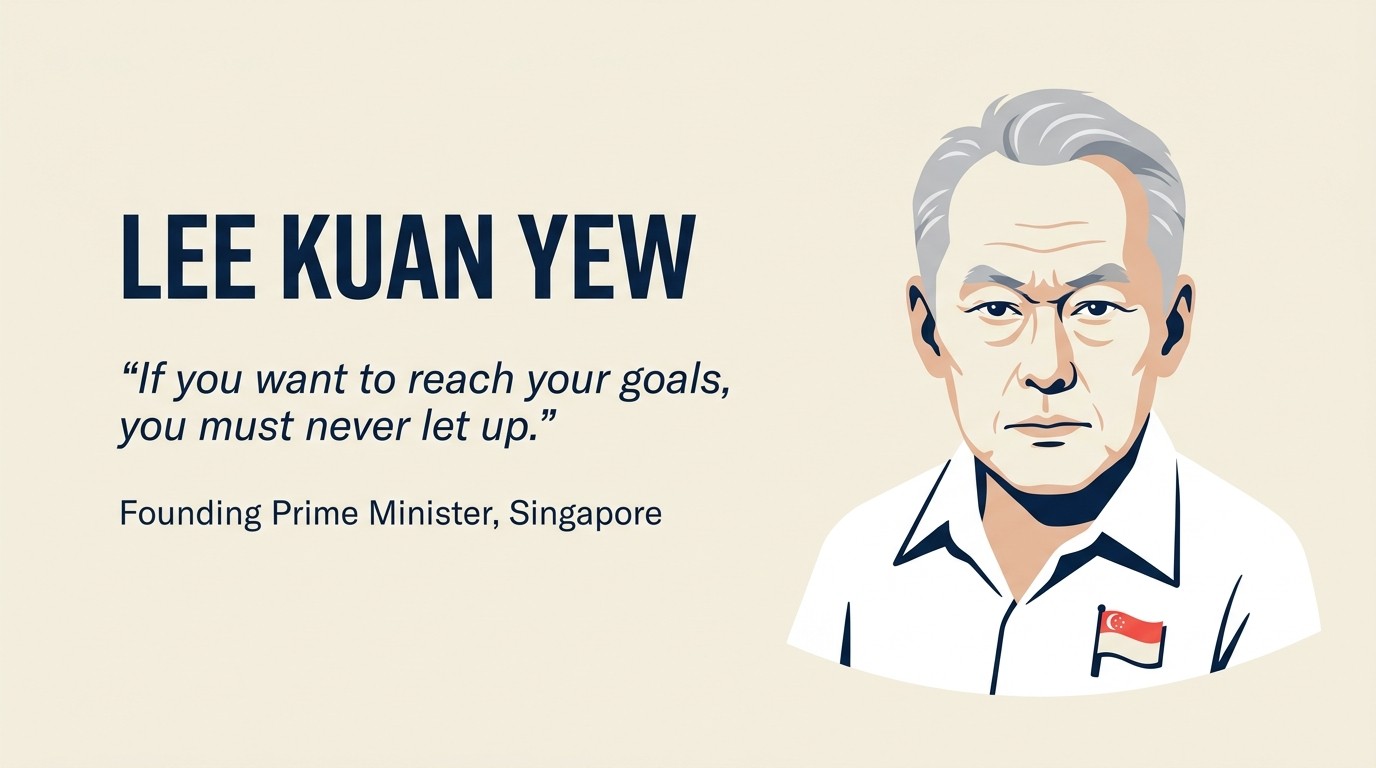
In August 1965, Lee Kuan Yew appeared on Singapore television and wept. Singapore had just been expelled from Malaysia, involuntary independence for a city-state of 1.9 million people with no natural resources, no hinterland, no military, and a GDP per capita of roughly $400. Race riots had torn through the streets the year before. The British military base that provided the primary source of employment was closing.
He collected himself, and got to work.
Key Facts
- Lifespan: 1923-2015 (died at 91)
- Role: Founding Prime Minister of Singapore, 1959-1990 (31 years); Senior Minister and Minister Mentor until 2011
- Economic transformation: Singapore GDP per capita rose from roughly $500 in 1965 to over $40,000 by 2015 (crossing $53,000 by his death)
- Education: Cambridge-trained lawyer (double starred first in law at Fitzwilliam College, 1949)
- Signature institutions: Meritocratic civil service, Housing Development Board (HDB), Central Provident Fund (CPF), Economic Development Board (EDB)
- Major book: From Third World to First: The Singapore Story 1965-2000 (2000)
- Regional legacy: One of the principal architects of ASEAN (founded 1967)
The Nation-as-Startup Doctrine (The LKY Meritocracy Model)
The Nation-as-Startup Doctrine is Lee Kuan Yew's operating philosophy: treat a country (or organization) as a resource-constrained venture where survival depends on recruiting the highest-capability people into the most consequential roles, paying them at market rates, and compounding institutional quality over decade-long horizons. Under the LKY Meritocracy Model, selection runs on demonstrated performance rather than patronage, and governance is engineered as a long-lived system whose outputs, economic growth, ethnic stability, institutional trust, must outlast the founder.
By 2015, the year he died at 91, Singapore's GDP per capita had crossed $53,000, higher than the United Kingdom that had colonized it, higher than France, higher than Japan. Over 80% of Singaporeans owned their homes. The country ranked in the top five globally for economic freedom, corruption control, and quality of governance by every major index. He had been Prime Minister for 31 years, and Senior Minister or Minister Mentor for 20 more.
Most CEOs run companies smaller than what Lee Kuan Yew built from nothing, with no starting assets and no safety net. His model is worth examining precisely because its results are verifiable and its methods were explicit, he wrote about them in detail, justified them publicly, and was honest about what they cost.
Leadership Style Breakdown
| Style | Weight | How it showed up |
|---|---|---|
| Meritocratic Authoritarian | 55% | Lee Kuan Yew governed Singapore on the principle that the best people should make the most important decisions, and that governance quality was the primary determinant of national outcomes. He recruited civil servants by test score and academic credential, paid them at private-sector rates (Singapore's senior civil servants are among the highest-paid in the world), and promoted relentlessly on demonstrated performance. He was also genuinely authoritarian: opposition politicians were sued for defamation, newspapers were controlled, and dissent was managed through legal mechanisms rather than tolerated. The meritocracy and the authoritarianism weren't contradictions in his framework, he believed that a young multiracial city-state couldn't afford the inefficiencies of factional democracy, and he acted accordingly. |
| Institutional Systems Builder | 45% | The 45% is what separates LKY from leaders who get results through personal force and leave nothing when they go. He didn't just run Singapore well. He built the Housing Development Board, the Central Provident Fund, the Economic Development Board, and the Corrupt Practices Investigation Bureau as functioning institutions with their own mandates, staffing, and operating logic. Those institutions continued to work after he stepped down as PM in 1990 and after his death in 2015. The test of an institution builder is whether the institutions outlast the builder. Singapore's institutions have. |
The combination is uncommon. Autocratic leaders who are poor institution builders leave chaos when they leave. Institution builders who lack the conviction to make unpopular calls produce incrementally good organizations that miss transformational opportunities. LKY did both, which is why the Singapore story is studied by development economists and organizational theorists simultaneously.
Key Leadership Traits
| Trait | Rating | What it means in practice |
|---|---|---|
| Long-horizon decision-making | Exceptional | LKY consistently made decisions that would produce results 20-30 years out and were politically costly in the near term. The English-first language policy, the mandatory savings system, the HDB housing program, none of these produced immediate popular approval. He was explicit about the time horizon in public: "I am often accused of interfering in the private lives of citizens. Yes, if I did not, had I not done that, we wouldn't be here today." He ran a 30-year organization with quarterly pain and decadal payoffs. |
| Ruthless prioritization of competence over loyalty | Very High | Lee Kuan Yew's cabinet appointments were based on capability assessments, not political debt. He recruited Goh Keng Swee, his most important economic architect, partly because of their philosophical differences, not despite them. He hired people who disagreed with him when they were demonstrably better at the relevant function. The civil service was structured so that promotion required examination performance, not relationship management. That discipline is almost impossible to maintain in organizations where political survival depends on building coalitions of loyal mediocrity. LKY maintained it for 31 years in part by ensuring that the political system he designed reduced his dependence on internal coalition management. |
| Willingness to make unpopular calls with public justification | High | He didn't just make unpopular decisions, he explained them in public, in detail, with the full force of the argument. The English-first policy produced protests from Singapore's Chinese community, which was the largest ethnic group and the People's Action Party's core constituency. LKY made the case publicly that English was the language of international commerce and that refusing to adopt it would permanently cap Singapore's economic ceiling. He accepted the political cost because he was confident in the reasoning. That pattern, make the hard call and then explain it publicly rather than obscuring it, built a form of institutional trust that outlasted any individual policy. |
| Pragmatism over ideology | Very High | LKY was not a free-market ideologue, a socialist, or a nationalist. He was a pragmatist with a clear objective function: make Singapore competitive enough to survive as an independent city-state. He nationalized what needed to be nationalized (utilities, public housing), opened what needed to be opened (foreign direct investment, financial services), and suppressed what needed to be suppressed (corruption, racial conflict) based on what the evidence said would produce the outcome, not based on a prior political commitment to any framework. He read voraciously and updated his views. His position on most policy questions evolved between 1965 and 2010 as evidence accumulated. |
The 3 Decisions That Defined LKY
1. English-First Language Policy (1966)
Singapore in 1965 had four official languages: English, Mandarin, Malay, and Tamil. The majority ethnic Chinese population used Mandarin and various southern Chinese dialects as primary languages. The Malay community used Bahasa Melayu. The Tamil community used Tamil. English was associated with the British colonial administration that had just left.
Lee Kuan Yew made English the language of government, education, and business. Not as a co-equal official language, as the primary working language, with all other languages secondary. Tim Cook applied a structurally similar logic at Apple's supply chain: choose the operating language of global commerce (in his case, the rules of Foxconn-era Chinese manufacturing), build your institution around fluency in it, and accept the near-term political costs that fluency requires. Students were taught in English and learned their mother tongue as a second language. Government administration was conducted in English. Foreign companies operating in Singapore were expected to use English.
The political cost was immediate. Chinese community leaders protested. Chinese-language schools, which had significant cultural and community importance, were systematically integrated into the English-language system over several years. The Nanyang University, the only Chinese-language university in Southeast Asia, was eventually merged with the English-language University of Singapore in 1980.
The economic return was enormous and began accumulating within years. Singapore's banking and financial services sector, which would become the city's defining economic engine, required English-speaking professionals. Multinational companies choosing Asian headquarters needed English-speaking administrative staff, lawyers, and accountants. Every Japanese, American, or European company that set up a regional office in Singapore rather than Hong Kong or Bangkok was, in part, choosing it because the workforce could communicate in the language of their home office.
By 2000, Singapore had become the fourth-largest foreign exchange trading center in the world. That outcome wasn't possible without the 1966 language decision.
For operators, the language policy is a model for making decisions that optimize for the competitive environment your organization will inhabit 20 years from now rather than the political environment you inhabit today. The hard version of this principle: if you can identify a capability your organization will need at scale, and building it now is costly and unpopular, the cost of building it early is almost always lower than the cost of building it under pressure.
2. CPF, The Mandatory Savings System
The Central Provident Fund was established before Lee Kuan Yew became PM, but he transformed it from a simple pension scheme into the architecture of Singapore's social contract. Under his expansion of the CPF, both employees and employers contributed a combined rate that reached up to 37% of salary. The funds could be used for housing purchase (buying HDB flats), healthcare (MediSave), children's education, and retirement income.
This was compulsory. You didn't choose to participate. The state decided that Singaporeans, given the option, would not save enough for housing, healthcare, or retirement, and that the state would therefore save for them.
The policy was politically feasible in Singapore's context but would be constitutionally difficult in most democracies. It's also worth examining independently of its political feasibility because the underlying problem it solved, the gap between individual time preferences and social optimal savings rates, is real everywhere.
The CPF solved three problems simultaneously: it funded the housing program (CPF savings were used to purchase HDB flats, which gave the government a reliable pool of capital to build more housing), it prevented the welfare dependency dynamics that LKY associated with Western social models, and it gave Singapore a large pool of domestic savings that could be deployed in sovereign wealth funds (which became Temasek and GIC).
The 2024 value of Temasek Holdings, Singapore's state investment company seeded in part with CPF reserves, exceeded $380B. That's the compounded return on a 1965 decision to make savings mandatory.
3. The Housing Development Board, 80% of Singaporeans in Public Housing
When Singapore became independent, most of its population lived in overcrowded urban slums or rural kampongs with inadequate sanitation, water, and infrastructure. The British colonial administration had built minimal public housing. The private market wasn't going to house a poor city-state's population in adequate conditions.
Lee Kuan Yew made the Housing Development Board the instrument of the most comprehensive public housing program in the non-communist world. By 2000, over 80% of Singapore's population lived in HDB flats, government-built, government-managed housing that they owned outright through CPF savings.
The program wasn't just housing. LKY explicitly used it as a tool of racial integration: HDB estates were designed so that each block had a quota of Chinese, Malay, and Indian residents proportional to the national population. You couldn't choose to live in an ethnically homogeneous block. The 1964 race riots had shown what voluntary segregation produced. The housing policy created forced daily integration, shared lifts, shared common areas, shared schools, that was intended to produce familiarity and reduce the ethnic tensions that had made Singapore's independence crisis so acute.
By most measures, it worked. Singapore today has one of the lowest rates of ethnic conflict of any multiracial society in the world. The housing integration policy is one significant reason.
The HDB program also created a middle class. Singaporeans who purchased their flats in the 1970s and 1980s at subsidized prices held assets that appreciated significantly as Singapore's economy grew. Home ownership gave most Singaporeans a stake in the country's economic success, a direct financial interest in the stability and growth of the system they lived under.
What LKY Would Do in Your Role
If you're a CEO, the most direct LKY lesson is about aligning incentives through ownership structure rather than culture programs. He didn't try to make Singaporeans care about the country's success through rhetoric alone. He gave them HDB flats, assets whose value depended on Singapore's economic performance. The equity stake created aligned interests structurally. In your organization, the question is whether your team has a genuine financial stake in the outcomes you're asking them to produce. Culture creates alignment where equity can't reach. But wherever equity can reach, it's cheaper and more durable than any amount of culture investment.
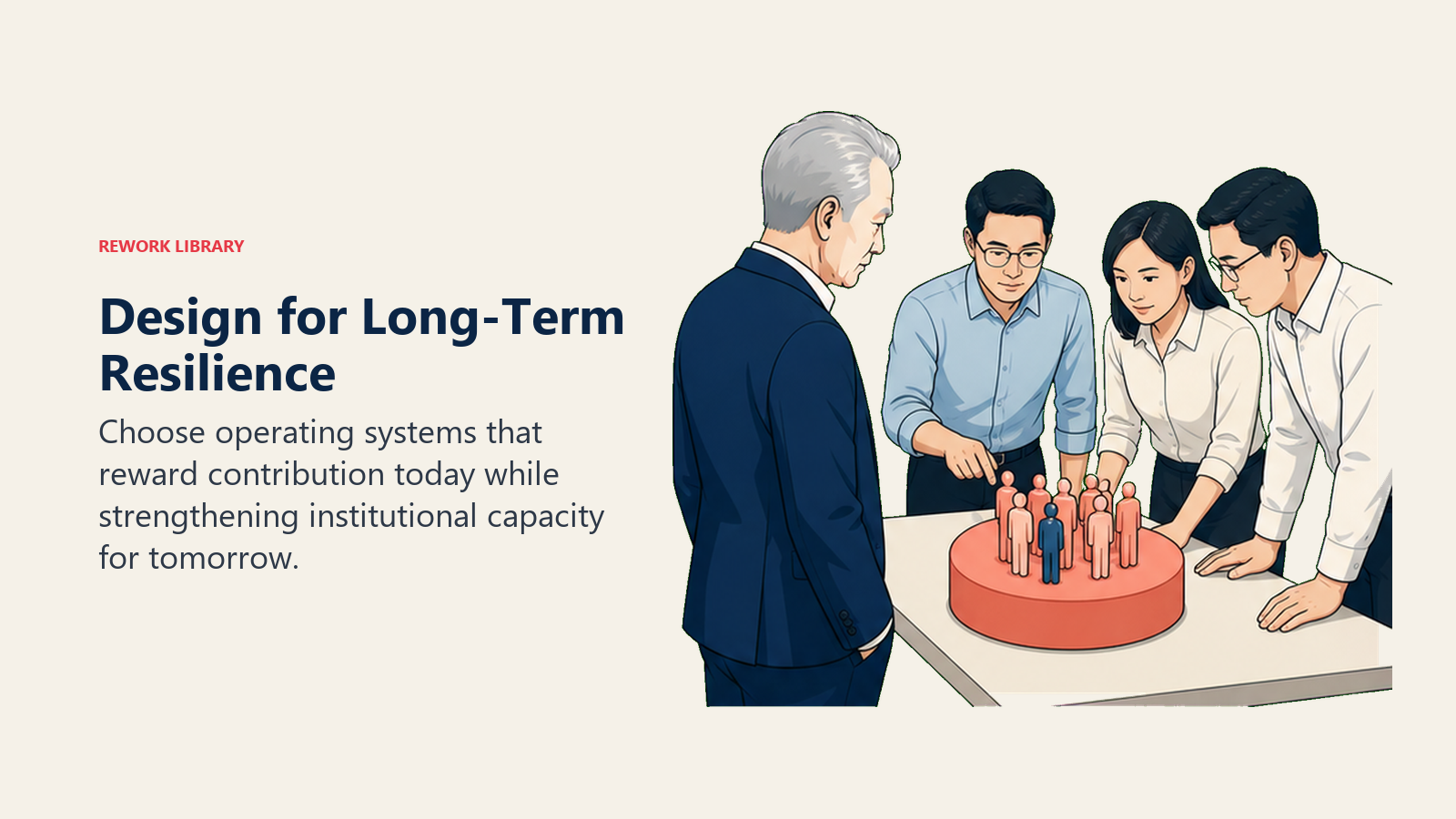
If you're a COO, the CPF mandatory savings mechanism is a model for building institutional capabilities that individuals left to their own devices won't build. LKY understood that voluntary savings programs would produce under-saving at the population level, with expensive downstream consequences for healthcare and retirement systems. The operational principle is: when you identify a behavior that's individually rational to defer but collectively costly when deferred, make it mandatory rather than encouraged. In organizational terms: don't build optional training programs for capabilities your organization depends on. Build them into the job requirements.
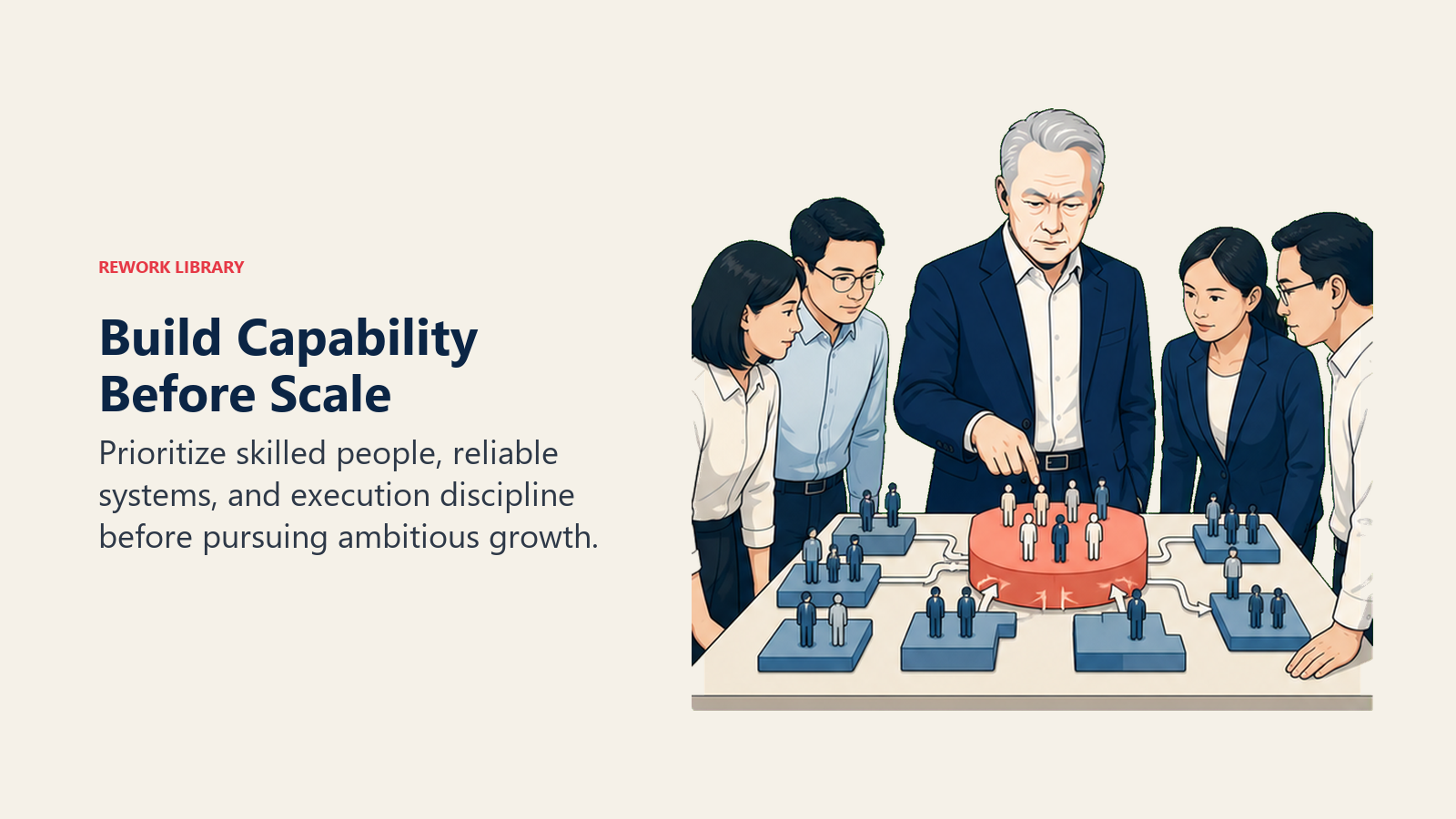
If you're in product, Singapore's economic strategy is a case study in sequencing. LKY didn't try to do everything at once. He sequenced: establish political stability, build physical infrastructure, establish rule of law and corruption control, open to foreign investment, develop financial services, develop technology capability. Each phase created the conditions for the next. Most products that fail do so because they attempt phase three before phases one and two are stable. If you're designing a product rollout, a market expansion, or a platform strategy, ask what order the capabilities need to come online, not what order would be fastest, but what order creates the foundation for each subsequent phase.
If you're in sales or marketing, LKY's public communication model is worth studying for its consistent structure: state the problem precisely, state why the proposed solution is better than alternatives, state the cost of the solution honestly, and then defend the reasoning in public against its strongest critics. He regularly engaged opposition critics in public debate, not to dismiss them but to demonstrate that he'd thought through their objections. That posture, engage the strongest version of the counterargument publicly, is a more credible trust-building mechanism than messaging that only presents the positive case. Buyers and partners who see you engaging seriously with the strongest objections to your product are more confident in your judgment than those who only hear the pitch.
LKY's Model Through a Rework Lens
Scaling an org on LKY's doctrine means two things operationally: promotion decisions have to be legible to the whole team, and the horizon you're optimizing for has to be longer than the next quarter. Both break without tooling. Meritocracy degrades into politics the moment "demonstrated performance" becomes a story one manager tells in a closed-door calibration, if contribution isn't visible across functions, the loudest advocate wins, not the best operator. Rework's work operations platform (Process and Project Engines from $99/month billed yearly, with 5 seats included) is built so every deliverable, every closed deal, every resolved ticket, and every shipped project lives in the same graph, cross-team, time-stamped, queryable. Directors running headcount reviews see who actually moved the numbers, not who was in the room. For nation-building on a 10-year horizon, the LKY version of roadmap planning, the same data layer lets you tie today's hiring and ops decisions to outcomes you won't observe for three years. That's what makes meritocracy durable instead of performative.
Notable Quotes & Lessons Beyond the Boardroom
"I have never been overconcerned with popularity. My job was to do what was necessary for Singapore to survive and progress." From "From Third World to First", published in 2000. The leadership lesson in that sentence is precise: he separated his decision-making from his approval rating structurally, not just rhetorically. Most leaders say they don't care about popularity. LKY designed a political system that reduced his dependence on it, the People's Action Party's dominance meant that short-term public opinion on individual policy decisions had limited ability to reverse those decisions before their long-term consequences materialized. You can't replicate that structure in most organizations. But you can ask honestly whether your decision-making is being shaped by near-term approval metrics when it shouldn't be.
He also said: "If Singapore is a nanny state, I am proud to be its nanny." This was a response to critics who characterized Singapore's paternalistic policies, seatbelt laws, anti-spitting fines, the famous gum ban, as excessive government intrusion. His defense was pragmatic: the policies worked, the behaviors they corrected imposed costs on the collective, and the collective had an interest in enforcing them. Whether or not you agree with the specific policies, the underlying argument is coherent: some constraints that are individually annoying produce collective outcomes that benefit the individuals being constrained. The gum ban is a minor example. The CPF is a major one.
Where This Style Breaks
LKY's model rests on institutional conditions that don't exist in most democracies and most companies. He had 31 years with a dominant political party in a small, dense city-state where the consequences of policy decisions were visible within years and attributable to the decision-maker. That feedback loop, make a call, see the result, iterate, is extraordinarily tight compared to most organizational contexts.
The authoritarianism doesn't port. Singapore's press controls, defamation suits against opposition politicians, and management of civil society worked in a specific political context where the legitimacy trade-off, sacrifice some political freedom for economic development, was accepted, at least retrospectively, by most Singaporeans. That trade-off is not available in democracies or public companies. Trying to apply LKY's governance model without understanding that constraint produces something that looks like LKY's methods without his results.
The dynastic succession question remains unresolved. His son Lee Hsien Loong served as Prime Minister from 2004 to 2024-20 years. The governance quality held, but the nepotism question created a legitimacy problem that even LKY acknowledged privately was real. Institution-building that depends on a single family line has a brittleness built in that differs from institution-building that produces leadership selection independent of lineage.
Frequently Asked Questions about Lee Kuan Yew's Leadership
Who was Lee Kuan Yew?
Lee Kuan Yew (1923-2015) was the founding Prime Minister of Singapore, serving from 1959 to 1990, and remained influential as Senior Minister and Minister Mentor until 2011. A Cambridge-trained lawyer, he co-founded the People's Action Party and led Singapore from involuntary independence in 1965 through five decades of economic transformation.
How did Lee transform Singapore?
He moved Singapore from roughly $500 GDP per capita in 1965 to over $40,000 by 2015 through a sequenced strategy: political stability and corruption control first, then physical infrastructure and public housing, then rule of law, then openness to foreign direct investment, then financial services and technology. Each phase built the conditions for the next.
What is Singapore's meritocratic civil service?
It's a recruitment and promotion system that selects senior officials on the basis of examination performance and demonstrated capability rather than political loyalty, and pays them at private-sector rates. Singapore's senior civil servants are among the highest-paid in the world, which LKY argued was necessary to attract top talent and reduce the economic incentive for corruption.
What is 'From Third World to First' about?
Published in 2000, From Third World to First: The Singapore Story 1965-2000 is Lee Kuan Yew's second volume of memoirs, focused on how Singapore was built after independence. It covers the policy logic behind CPF, HDB housing, the English-first language decision, foreign investment strategy, and Singapore's foreign relations with the US, China, and ASEAN neighbors.
What are the controversies around LKY's leadership?
His governance combined meritocracy with authoritarian instruments: defamation suits against opposition politicians, press controls, limits on public assembly, and strict management of civil society. Critics argue these trade-offs eroded political freedom; defenders argue they were necessary given Singapore's ethnic fragility and economic precariousness. The dynastic succession to his son Lee Hsien Loong (PM 2004-2024) also raised legitimacy questions.
What can modern CEOs learn from Lee Kuan Yew?
Four lessons translate directly: align incentives through ownership structure rather than culture programs (HDB equity model), make organizationally essential behaviors mandatory rather than encouraged (CPF model), sequence capability-building so each phase enables the next (Singapore's economic staging), and optimize for the competitive environment your organization will inhabit in 20 years rather than the political environment it inhabits today (English-first policy).
Learn More

On this page
- Key Facts
- The Nation-as-Startup Doctrine (The LKY Meritocracy Model)
- Leadership Style Breakdown
- Key Leadership Traits
- The 3 Decisions That Defined LKY
- 1. English-First Language Policy (1966)
- 2. CPF, The Mandatory Savings System
- 3. The Housing Development Board, 80% of Singaporeans in Public Housing
- What LKY Would Do in Your Role
- LKY's Model Through a Rework Lens
- Notable Quotes & Lessons Beyond the Boardroom
- Where This Style Breaks
- Learn More