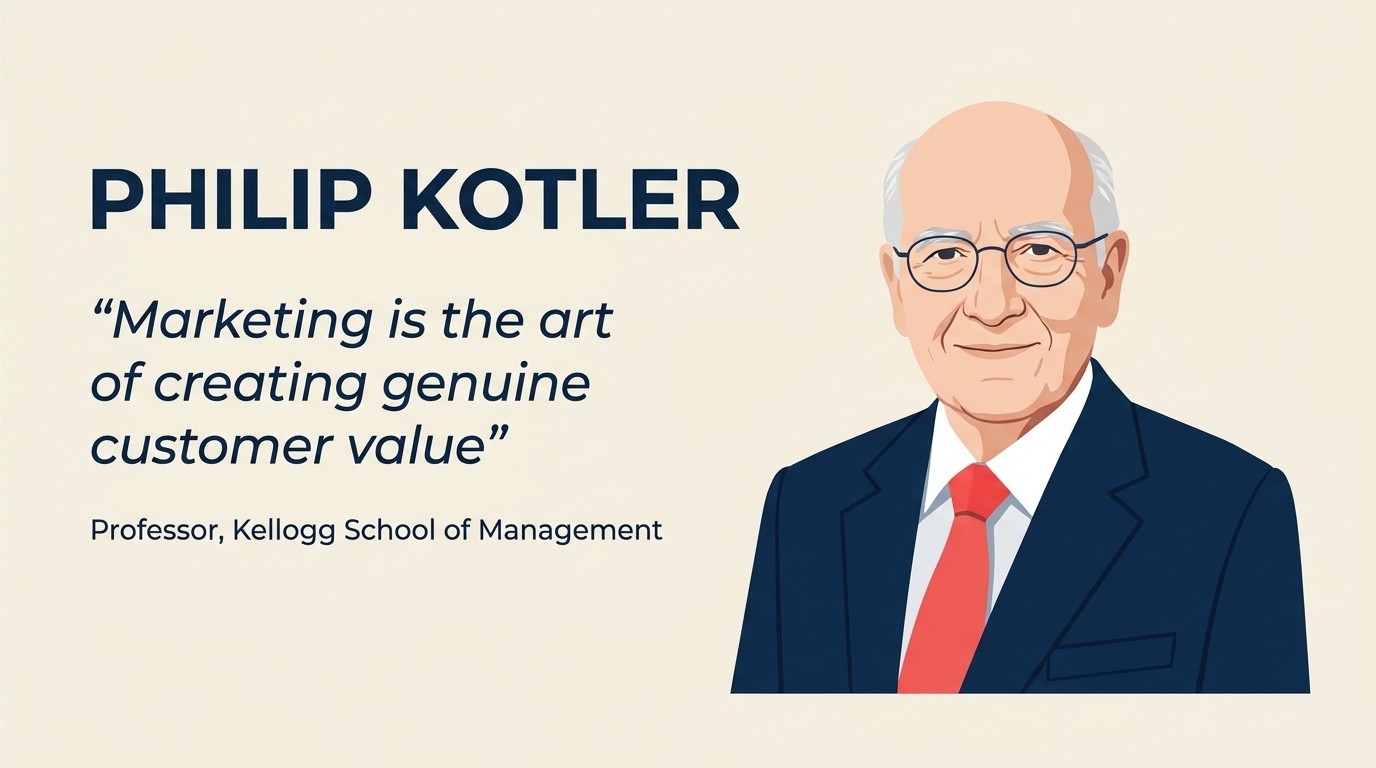
Philip Kotler Leadership Style: The Architect of Modern Marketing
Turn this article into takeaways for your work.


Each assistant summarizes the article only for you and suggests best practices for your work.
Key Facts About Philip Kotler
- Born: May 27, 1931 (Chicago, Illinois)
- Known as: "The father of modern marketing"
- Landmark textbook: Marketing Management (first published 1967, now in 15+ editions)
- Publishing output: 80+ books across marketing, social marketing, political marketing, and place marketing
- Academic home: S.C. Johnson & Son Distinguished Professor of International Marketing (emeritus), Kellogg School of Management, Northwestern University
- Key concept coined: "Societal marketing", the doctrine that marketers must balance company profit, consumer wants, and society's long-term welfare
- Consulting clients: IBM, The Coca-Cola Company, General Electric, AT&T, Honeywell, Bank of America, Merck, Motorola
- Global influence: Introduced and popularized the 4 Ps framework (originally E. Jerome McCarthy's 1960 formulation) to marketing education worldwide across more than 60 countries
Philip Kotler's Principles of Marketing has been revised into more than 80 editions since 1967. It's used in business schools across more than 60 countries. That means Kotler's frameworks, the 4 Ps, STP, the marketing mix, have shaped how at least three generations of executives think about markets, customers, and value creation.
That's a kind of institutional leverage most consultants and academics never approach. Kotler didn't just publish; he got assigned. His books became the default cognitive toolkit for marketing professionals worldwide, which means that when you walk into a strategy meeting and someone says "we need to work through our segmentation and targeting," they're almost certainly running a mental model that Kotler systematized even if they've never read him.
He joined Northwestern's Kellogg School of Management in 1962 after a PhD at MIT in economics and post-doctoral work under Milton Friedman at Chicago and Paul Samuelson at Harvard. He's been there since. That stability matters. Kotler's influence didn't come from consulting celebrity or keynote touring, it came from 60 years of teaching, revising, and expanding the same core framework until it became the standard.
His 80+ books span social marketing, political marketing, demarketing, and lateral marketing. But his leadership contribution is fundamentally about system-building: turning fuzzy practice into teachable structure.
Leadership Style Breakdown
| Style | Weight | How it showed up |
|---|---|---|
| Academic Systematizer | 65% | Kotler's primary contribution is frameworks, not findings. He didn't discover that markets could be segmented, the practice existed. He built a teachable sequence for doing it (STP) that translated what experienced marketers did intuitively into a structured process a junior brand manager could follow. The 4 Ps were E. Jerome McCarthy's original formulation from 1960; Kotler made them the global standard by expositing them rigorously across 16 editions of Marketing Management and 80+ editions of Principles of Marketing. His job was systematization at scale. |
| Market Evolution Watcher | 35% | Kotler has been consistently willing to revise his own frameworks rather than defend them past their useful life. His Marketing 1.0 → 2.0 → 3.0 → 4.0 framework, developed between 2010 and 2017, is a self-critique as much as a new theory. It acknowledges that the product-centric marketing his earlier textbooks described is insufficient for a world where buyers have information parity with sellers. That willingness to update publicly, especially for someone whose reputation was built on the older model, is unusual. |
That combination is what made his work durable. The 4 Ps are a simplification, and Kotler knew it. But a useful simplification, applied consistently, is more valuable in practice than a complex model that requires a PhD to apply. He kept building scaffolding that practitioners could actually use.
Key Leadership Traits
| Trait | Rating | What it means in practice |
|---|---|---|
| Framework obsession | Exceptional | Kotler's instinct, across every topic he touches, is to find the underlying structure and make it explicit. Social marketing, political marketing, demarketing, place marketing, each represents an extension of the same core move: take a domain where practice is intuitive and chaotic, identify the decision variables, and build a model. The result is that his frameworks are sometimes criticized for being descriptive rather than predictive. That's a fair critique. But descriptive clarity has enormous practical value when a team is trying to structure a decision they've never faced before. |
| Long publication horizon | Very High | 80+ books over roughly 60 years means Kotler was publishing consistently through multiple shifts in the marketing discipline, from pre-digital brand management to digital performance marketing to AI-assisted personalization. Most thinkers peak once. Kotler has revised his thinking enough times that different generations of practitioners have encountered different versions of his work. That longevity is a function of discipline, not just productivity. |
| Willingness to evolve his own models | High | The Marketing 1.0 → 4.0 evolution framework directly criticizes the product-centric world his earlier work described. He didn't protect the 4 Ps by pretending they were sufficient. He built a meta-framework explaining when they apply and when they don't. That kind of public self-revision is rare in academic careers built on specific frameworks, because revising the framework can look like admitting the earlier work was wrong. Kotler reframed it as progress, not correction. |
| Extending marketing beyond commerce | High | Kotler and Gerald Zaltman's 1971 paper on social marketing argued that marketing principles applied equally to non-commercial goals, public health, environmental behavior, civic engagement. That was genuinely novel. It opened marketing as a discipline to government agencies, nonprofits, and public health organizations that had previously thought of marketing as purely commercial. His influence in Singapore, China, and India as a government advisor grew directly from this extension of the discipline. |
The Kotler Societal Marketing Doctrine
The Kotler Societal Marketing Doctrine holds that an organization's marketing decisions must simultaneously satisfy three interests: the company's profit requirements, the customer's wants and needs, and society's long-run welfare. Coined by Philip Kotler in the early 1970s, it reframed the classic "marketing concept" by adding an ethical and environmental dimension, arguing that short-term customer satisfaction is not enough when the product or its production harms public health, the environment, or social cohesion. In practice, the doctrine is applied as a three-way check: any marketing program that wins on profit and customer preference but fails the societal test is still considered a strategic failure under Kotler's framework.

The 3 Frameworks That Defined Philip Kotler
1. The 4 Ps: Product, Price, Place, Promotion
- Jerome McCarthy introduced the 4 Ps of marketing in 1960. Kotler made them the dominant framework in global marketing education by expositing them systematically across more than 80 textbook editions and 16 editions of Marketing Management, the definitive graduate text.
The 4 Ps describe the controllable variables a marketer manages: what you sell (Product), what you charge (Price), where and how you distribute it (Place), and how you communicate about it (Promotion). They're a decision checklist, not a theory of how markets work. And that's what makes them practical: they force a marketer to think through all four levers rather than defaulting to promotion and ignoring the others.
The critique most commonly leveled at the 4 Ps is that they're product-centric, they assume you have a product and you're optimizing around it, rather than starting with customer needs and working backward. That critique is correct. Kotler acknowledged it, which is partly why he added the 4 Cs framework (Customer value, Cost, Convenience, Communication) as a consumer-oriented alternative. But the 4 Ps persisted in practice because they're operational in a way the 4 Cs aren't. You can assign an owner to each P. It's harder to assign an owner to "customer value."
For SaaS operators, the 4 Ps translate roughly to: product features and packaging (Product), pricing tiers and models (Price), sales channels and distribution partnerships (Place), and demand generation and messaging (Promotion). Working through all four systematically before a launch reveals gaps. Most teams over-invest in Promotion and under-think Place, the distribution question of how customers actually find and access the product.
2. STP: Segmentation, Targeting, Positioning
STP is Kotler's most operationally useful contribution, and it's less famous than the 4 Ps partly because it requires more judgment to apply. The sequence is: segment the market into groups with meaningfully different needs, target the segment or segments where you have a defensible advantage, and position your offer in a way that's credible to that target and distinct from competitors.
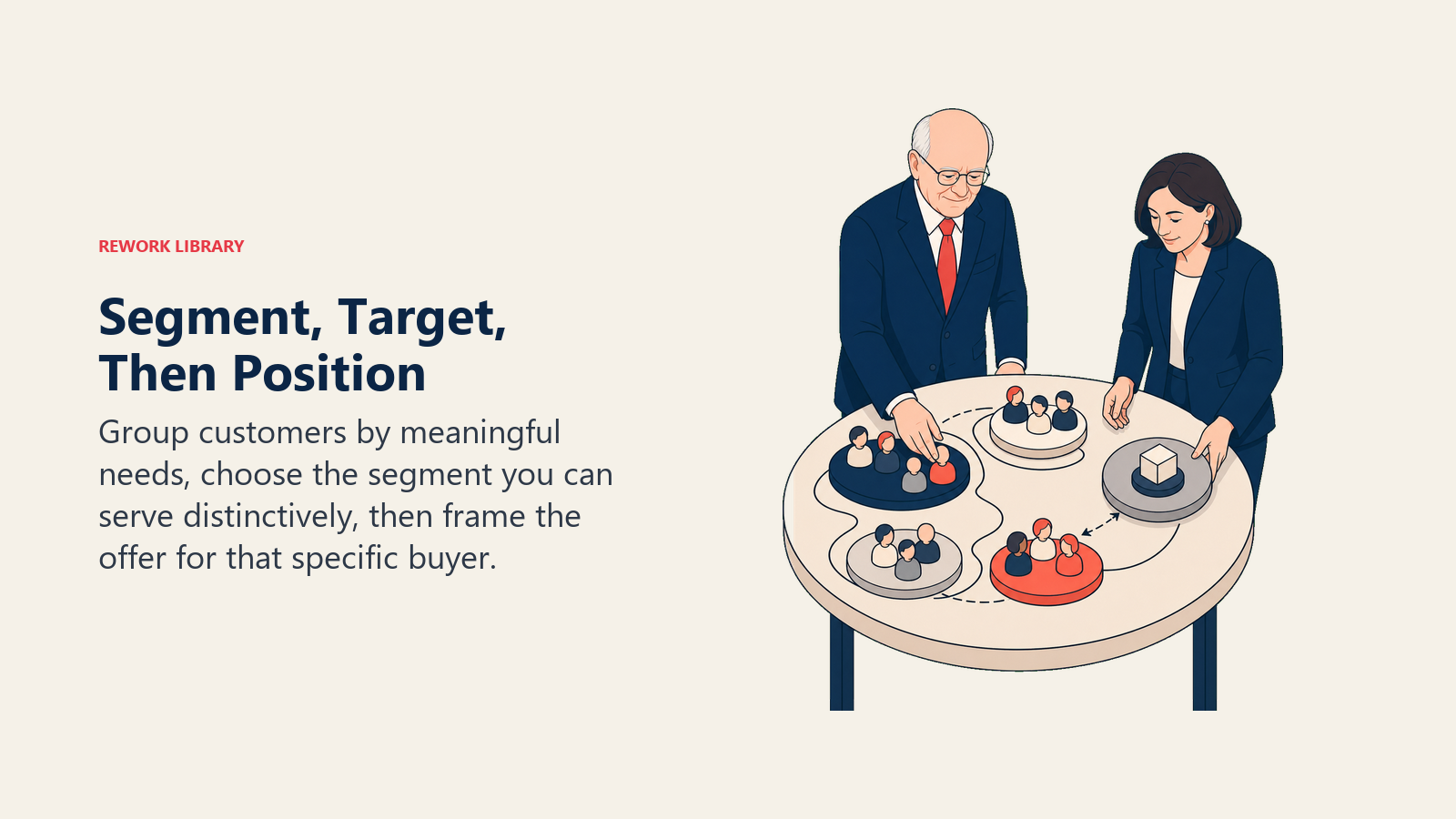
The segmentation step is where most teams shortcut. They define segments by demographics (age, company size, geography) rather than by behavior or need state. Demographic segments are measurable but often don't correspond to meaningfully different purchase motivations. A 45-year-old VP of Sales in a 500-person company and a 32-year-old VP of Sales in a 500-person company probably have nearly identical buying behavior for a CRM tool. Their demographics are different. Their need states are nearly identical.
Kotler's targeting step requires honesty about where you actually win, not where you want to win. Most product teams want to target "enterprise and mid-market." That's usually a resource allocation error, not a strategy. You win by concentrating attention on segments where your specific capabilities create disproportionate value. Trying to win everywhere produces average performance in all directions.
Positioning is the output of the sequence, not the starting point. Most brand teams write a positioning statement first and then try to find the evidence for it. Kotler's STP suggests the positioning should emerge from honest segmentation and targeting work: once you know exactly who you're serving and why your offer fits them better than alternatives, the positioning statement mostly writes itself.
3. Marketing 1.0 Through 4.0: A Framework for Where You Are
In 2010, Kotler published Marketing 3.0 with Hermawan Kartajaya and Iwan Setiawan. In 2017, they added Marketing 4.0. Together, these describe a four-stage evolution of marketing philosophy.
Marketing 1.0 is product-centric: the job is to sell what you've made. Marketing 2.0 is consumer-centric: the job is to satisfy the buyer's needs better than competitors. Marketing 3.0 is values-driven: buyers want to engage with brands that stand for something beyond profit. Marketing 4.0 integrates digital and traditional marketing, recognizing that buyers move fluidly between online research and offline purchase.
The framework is most useful as a diagnostic, not a prescription. When you're reviewing a competitor's marketing and asking why it feels out of step, the 1.0/2.0/3.0/4.0 framing often identifies the problem quickly: a company with exceptional product-centric marketing (1.0) in a market where buyers expect brand values and community (3.0) will feel tone-deaf even if every execution is technically correct.
The practical question for your own team: at which stage is your category, and at which stage is your marketing? If your category has moved to 3.0 and your marketing is still 2.0, optimizing satisfaction metrics without taking positions on things buyers care about, you're likely losing ground to brands that are willing to stand for something.
What Philip Kotler Would Do in Your Role
If you're a CEO, Kotler's most valuable question for you is whether your company's definition of its market is correct. He spent decades arguing that companies often define their markets too narrowly around their current product rather than the customer need being served. The classic example from Theodore Levitt, which Kotler cites often: railroad companies thought they were in the railroad business rather than the transportation business and got disrupted by airlines. Ask yourself what business you're actually in from the customer's perspective, then check whether your strategy is organized around that answer or around your current product category.
If you're a COO, the Kotler insight for operations is about distribution strategy, which most operations leaders under-invest in intellectually. "Place" in the 4 Ps framework is about how your product reaches the customer, every channel, every intermediary, every friction point in the acquisition process. Operations teams that have mapped their full delivery and distribution chain at the level of customer experience, not just internal process efficiency, consistently outperform those that focus only on production and delivery logistics. Kotler would ask: what does the customer's experience of finding, buying, and receiving your product actually look like at each step?
If you're a product leader, STP is your most directly applicable framework. It forces the segmentation question before the feature question. Most product roadmaps are driven by feature requests that aggregate across all customers, which means they optimize for nobody in particular. Running a proper segmentation exercise on your customer base, identifying the two or three need states that represent most of your value creation, and then targeting your roadmap at those segments produces better prioritization than any backlog scoring formula. You're not building features. You're building solutions for specific people with specific problems.
If you're in sales or marketing, the 4 Ps check is worth running on your current GTM strategy at least once a year. Most teams drift toward over-investment in Promotion (content, ads, email) while under-thinking the Product packaging, Pricing model, and distribution (Place) questions. A product with weak packaging can't be saved by better content. A price that doesn't match the buyer's mental model of value creates friction that no amount of sales training overcomes. Work through all four levers before defaulting to "we need more leads."
How Rework Operationalizes Kotler's Marketing Discipline
Kotler's central insistence is that marketing is a discipline, structured segmentation, deliberate targeting, honest positioning, and that the rest of revenue operations should plug into that structure rather than route around it. Rework's CRM and sales pipeline is built on the same premise. Segment definitions live at the account level, not buried in a campaign tool, so the STP work a marketing team does flows directly into how sales reps prioritize outreach and how customer success measures retention. The 4 Ps, Product packaging, Price tiering, Place (distribution channels), Promotion (campaigns), each map to configurable fields and pipelines inside Rework, which means a GTM team can audit whether investment is balanced across Kotler's four levers instead of drifting toward promotion-only thinking. For companies serious about customer-centric strategy, the tool is only as useful as the marketing fundamentals underneath it. Rework assumes you've done the Kotler work.
Notable Quotes & Lessons Beyond the Boardroom
"Marketing is not the art of finding clever ways to dispose of what you make. It is the art of creating genuine customer value." That's from Kotler on Marketing, published in 1999, and it's a direct response to the "marketing as persuasion" view that Ogilvy also pushed back against. Both men believed that the job was to understand what the customer needed and deliver it, not to convince someone to want something they didn't. The difference between marketing and manipulation is whether you've done the customer understanding work first.
"The best advertising is done by satisfied customers." He's made this point in various forms across multiple books. It's a positioning insight dressed as an observation about word-of-mouth. A company that genuinely understands its customer's value definition and delivers against it doesn't need to outspend competitors on advertising because its customers do the distribution work. The implication for product and GTM strategy is that customer success investment and product-led growth are not alternatives to marketing, they're the highest-leverage form of it.
He was also notable for the range of non-commercial applications he pushed marketing into. His work on social marketing in the 1970s helped public health organizations think about behavior change with the same discipline commercial marketers applied to product adoption. The lesson for executives is that Kotler's frameworks aren't marketing tools, they're decision tools for any situation where you need to understand a population of people, identify what they want, and figure out how to serve it better than the alternatives.
Where This Style Breaks
Kotler's frameworks are primarily descriptive rather than predictive, they organize existing practice rather than tell you what to do next. The 4 Ps were E. Jerome McCarthy's formulation, which Kotler popularized but didn't originate, a distinction that matters for credit if not for application. STP assumes you can define market segments clearly, which doesn't hold in fast-moving categories where the segment boundaries shift faster than research can track. And his academic publication pace, measured in years per revision, is mismatched to product cycles that move in weeks. His Marketing 4.0 framework was published in 2017, which means it describes a world without generative AI, real-time personalization at scale, or the privacy constraints that have rewritten digital targeting. The frameworks remain useful starting points. But they need significant translation for any team operating in software or AI markets.
Frequently Asked Questions about Philip Kotler's Marketing Philosophy
Who is Philip Kotler?
Philip Kotler (born May 27, 1931, in Chicago) is an American marketing author, consultant, and emeritus professor at Northwestern University's Kellogg School of Management. He is widely recognized as "the father of modern marketing" for turning marketing from a sales support function into a structured academic and executive discipline. He holds a PhD in economics from MIT and completed post-doctoral work with Milton Friedman at the University of Chicago and Paul Samuelson at Harvard.
What are the 4 Ps of marketing?
The 4 Ps are Product, Price, Place, and Promotion, the four controllable levers a marketer manages when taking an offer to market. They were originally formulated by E. Jerome McCarthy in 1960, but Kotler made them the global standard by expositing them systematically across 15+ editions of Marketing Management and 80+ editions of Principles of Marketing. The framework works as an operational checklist to ensure a launch is balanced across all four decisions rather than defaulting to promotion alone.
Why is Kotler called the father of modern marketing?
Kotler earned the title by codifying marketing as a teachable discipline rather than a collection of practitioner habits. His 1967 textbook Marketing Management established the first rigorous, full-stack marketing curriculum, and subsequent books extended the field into social marketing, political marketing, place marketing, and demarketing. For more than 60 years at Kellogg, he trained the professors who trained the MBAs who populate most Chief Marketing Officer seats today, giving his frameworks institutional reach that no other marketing thinker matches.
What is societal marketing per Kotler?
Societal marketing, coined by Kotler in the early 1970s, is the doctrine that marketing decisions must balance three interests simultaneously: company profit, consumer wants, and society's long-term welfare. It extended the earlier "marketing concept" (satisfy the customer) by adding an ethical and environmental test, arguing that a product which pleases buyers but harms public health or the environment still fails the marketing standard. It's the philosophical foundation for what today is called corporate social responsibility and stakeholder-aligned brand strategy.
What is 'Marketing Management' textbook?
Marketing Management is Kotler's graduate-level textbook, first published in 1967 and now in its 15th-plus edition (co-authored in later editions with Kevin Lane Keller and others). It is the most widely used marketing textbook at the MBA level globally, covering market analysis, consumer behavior, segmentation-targeting-positioning, product strategy, pricing, channels, and integrated marketing communications. Most Fortune 500 marketing executives encountered the Kotler frameworks first through some edition of this book.
What can modern marketers learn from Philip Kotler?
The durable Kotler lessons for modern marketers are: (1) marketing is a discipline with structure, not an art of persuasion, (2) segmentation comes before targeting, and targeting comes before positioning, never the reverse, (3) the 4 Ps force balance across product, price, place, and promotion, so teams don't drift into promotion-only thinking, (4) the marketing concept ("satisfy the customer") must be tested against societal impact, not just customer preference, and (5) frameworks should be revised when the world changes, his Marketing 1.0 through 4.0 evolution is a model for updating your own playbook rather than defending it past its useful life.
For related reading, see David Ogilvy Leadership Style, Gary Vaynerchuk Leadership Style, Peter Drucker Leadership Style, Seth Godin Leadership Style, and Neil Rackham Leadership Style.

On this page
- Leadership Style Breakdown
- Key Leadership Traits
- The Kotler Societal Marketing Doctrine
- The 3 Frameworks That Defined Philip Kotler
- 1. The 4 Ps: Product, Price, Place, Promotion
- 2. STP: Segmentation, Targeting, Positioning
- 3. Marketing 1.0 Through 4.0: A Framework for Where You Are
- What Philip Kotler Would Do in Your Role
- How Rework Operationalizes Kotler's Marketing Discipline
- Notable Quotes & Lessons Beyond the Boardroom
- Where This Style Breaks