Zig Ziglar's Leadership Style: The Sales Philosophy That Outlasted Every Motivational Trend
Turn this article into takeaways for your work.


Each assistant summarizes the article only for you and suggests best practices for your work.
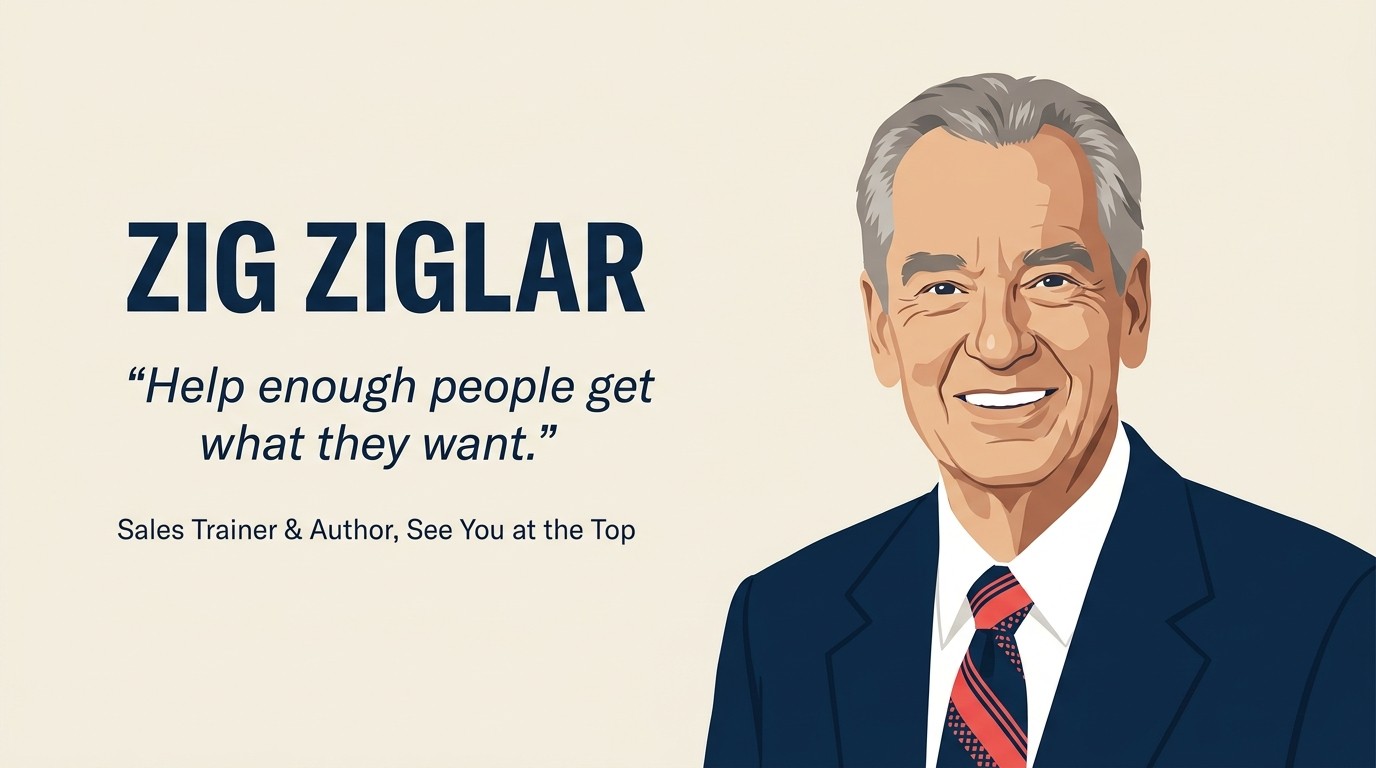
Key Facts: Zig Ziglar (1926-2012) was a legendary American sales trainer and motivational speaker who wrote more than 30 books, including "See You at the Top" (1975), "Secrets of Closing the Sale" (1984), and "Selling 101" (2003). He founded Ziglar Training Systems in 1970, delivered more than 5,000 public talks over his career, and is best known for his signature line: "You can have everything in life you want if you will just help other people get what they want."
The Help-Others-First Selling Doctrine
The Help-Others-First Selling Doctrine, also called the Ziglar Philosophy Principle, states that a salesperson's own financial goals are best achieved by first focusing entirely on solving the buyer's problem. It treats selling as a service transaction where trust, genuine usefulness, and the buyer's outcome come before the seller's quota. Ziglar argued that this sequence is not altruism, it is the most reliable mechanism for producing durable revenue.
Zig Ziglar was one of 12 children in a Mississippi family. His father died when he was five. He dropped out of the University of South Carolina without a degree. He spent years selling cookware door-to-door before anyone took him seriously as a speaker. His manuscript for "See You at the Top" was rejected by 39 publishers before he self-published it in 1975. The book eventually sold 1.7 million copies.
That biography matters because it's the raw material for what Ziglar actually taught. He wasn't selling inspiration as a theory. He was describing what had actually kept him going through a decade of failure and a career that started well below the poverty line. The "positive mental attitude" that critics sometimes dismiss as motivational fluff was, for Ziglar, a survival strategy he had tested under genuine adversity.
"Secrets of Closing the Sale" followed in 1984 and became required reading for sales organizations across North America. By the time he died in 2012, Ziglar Inc. had trained hundreds of thousands of sales professionals, and he had delivered more than 3,000 keynote presentations. His son Tom Ziglar continues the organization today.
Leadership Style Breakdown
| Style | Weight | How it showed up |
|---|---|---|
| Coaching | 60% | Ziglar's core activity was changing how people thought about themselves before changing how they sold. He understood that most sales failure wasn't a skill problem, it was a belief problem. Reps who believed they were bothering prospects acted like they were bothering prospects. His coaching was designed to install a different belief set before he taught a single technique. The framework: if you believe your product genuinely helps people, then selling it is an act of service, not an imposition. |
| Motivational | 40% | The motivational dimension gets the most attention and the most criticism. But Ziglar's version of motivation wasn't "feel good and good things happen." He was explicit that attitude without action is worthless. His definition of positive mental attitude was an operational posture, the decision to approach each call, each rejection, and each setback as information rather than verdict. That's a different thing from the "think and grow rich" school of self-help, and conflating them misses what made his training effective. |
The 60/40 split reflects a tension that Ziglar managed better than most motivational figures. The coaching orientation kept his work grounded in practical skill development. The motivational dimension gave it reach. People who wouldn't sit through a sales techniques seminar would sit through a Ziglar keynote and leave with the belief that they could actually do the work. Whether that sequence is the right one is worth debating, but the combination produced measurable results in the organizations that deployed it well.
Key Leadership Traits
| Trait | Rating | What it means in practice |
|---|---|---|
| Other-Focused Selling | Very High | Ziglar's most quoted line, "You can have everything in life you want if you will just help enough other people get what they want", is not a platitude when you understand what he meant by it. He was arguing that the seller who focuses on their own quota, commission, and close rate will underperform the seller who focuses on the buyer's actual problem. Not because altruism is a business strategy, but because buyer-focused conversations produce more information, more trust, and faster decisions. The operational translation: before every call, write down what the buyer needs to be true for this deal to be good for them, not just for you. |
| Positive Mental Attitude as Discipline | High | Ziglar was critical of the passive interpretation of positive thinking. His version required active management of inputs. He talked about "garbage in, garbage out", that what you read, watch, and listen to shapes how you think, which shapes how you act. He was specific: start the day with content that reinforces your professional identity. Don't read the news first thing. Control your self-talk. This sounds personal-development generic until you apply it operationally: what does your sales team's first 30 minutes of the day look like? What does your own morning look like? |
| Leverage Through Teaching | High | Ziglar's late-career pivot was instructive. He could have continued giving keynotes indefinitely, he was one of the highest-paid speakers in the country. Instead, he built the Ziglar Corporation infrastructure to train trainers, publish materials, and run licensed programs that could operate without him. By the time he was in his 70s, his leverage ratio was enormous: his frameworks were being delivered by hundreds of instructors simultaneously. Most speakers never make this pivot. Ziglar understood that the limiting factor in his model was his own time, and he built a system to get around it. |
| Faith Integration | Moderate | Ziglar's Christian faith was explicit in his speaking and writing, particularly from the 1980s onward. He didn't separate his spiritual beliefs from his professional ones. This gave his work a coherence that purely secular motivational content sometimes lacks, he had an answer to "why does any of this matter?" that went beyond revenue. But it also limited adoption in corporate environments where faith-based framing creates friction. The practical lesson: the universal principles in Ziglar's work (genuine service, personal accountability, long-term thinking) don't require the theological framing to function. You can extract the framework without the denomination. |
The 3 Frameworks That Defined Zig Ziglar
1. The Other-Focused Selling Doctrine
Ziglar's central argument was that the most effective selling wasn't about convincing. It was about serving. And that distinction changed everything about how he trained salespeople.

Traditional sales training of his era was technique-first: here's how to overcome objection X, here's how to handle stall Y, here's the closing sequence. Ziglar's approach was belief-first: before you can sell effectively, you have to genuinely believe that your product improves the buyer's situation. That conviction doctrine became the philosophical foundation that later motivational-sales voices like Grant Cardone would push to its logical extreme, where belief isn't just a prerequisite for selling but a public posture and a brand in itself. If you don't believe that, you'll be inconsistent in your activity and transparent in your hesitation.
The operational implication is significant. Most sales hiring and onboarding is focused on activity metrics and product knowledge. Ziglar's framework says the missing variable is conviction, does the rep actually believe in what they're selling? A rep with conviction and average technique will outperform a rep with great technique and no conviction, because conviction produces consistent activity and genuine engagement that buyers detect.
For leaders deploying this: the conviction diagnostic isn't "does the rep say they believe in the product." It's "what does the rep say when they talk to a buyer who's skeptical?" Conviction shows up in how you respond to doubt, not in how you respond to interest.
2. The Wheel of Life Framework
Ziglar's Wheel of Life is one of his most copied and least-understood frameworks. The wheel has seven spokes: personal, family, career, financial, physical, mental, and spiritual. Ziglar's argument was that weakness in any spoke affects the whole wheel. A professional who's financially stressed, physically unwell, or dealing with a failing marriage won't be able to sustain peak professional performance regardless of their skills.

This sounds obvious now. In the 1970s and 1980s, it was countercultural. Professional development was almost entirely focused on the career and financial spokes. Personal health, family stability, and mental/spiritual wellbeing were considered private matters that had no place in a business training context.
Ziglar's contribution was to make the connection explicit: you can't sustainably outperform in one area of life while systematically underperforming in others. The math doesn't work. A rep who's sleeping four hours a night, skipping exercise, and ignoring their family to hit their number will hit it once, maybe twice, before the system breaks.
For operators, the framework has a direct management application. When a previously strong performer starts declining, the instinct is to look at their activity metrics and skills. Ziglar's framework says look at the whole wheel first. The problem might be in a spoke you haven't asked about.
3. "See You at the Top": The Self-Publishing Decision
The most operationally interesting decision in Ziglar's career wasn't a speech or a framework. It was the decision to self-publish after 39 rejections.
The manuscript had been through every major publisher. Every one passed. The feedback was consistent: too long, too specific, not mainstream enough. Ziglar looked at the evidence and concluded the feedback was wrong. He raised the capital himself, printed the books himself, and sold them out of the trunk of his car at speaking engagements.
This decision is a case study in the distinction between external validation and genuine conviction. Ziglar applied to his own career the same logic he taught about selling: if you genuinely believe the product helps people, the right response to rejection is to find a different distribution channel, not to abandon the product.
The book took years to gain mainstream traction. But it never stopped selling. It's still in print 50 years later and has sold 1.7 million copies. Every publisher who passed on it got that wrong.
The lesson for founders and executives: the mechanism that produces rejection is not always the same mechanism that produces value. Publishers evaluate marketability. Readers evaluate usefulness. Those aren't always the same judgment. If you have genuine conviction in something and an institution rejects it, it's worth distinguishing between "this thing doesn't work" and "this institution doesn't have the right evaluation criteria."
What Zig Ziglar Would Do in Your Role
If you're a CEO, Ziglar would ask you to look at your executive team's belief system before he looked at their skills. Do your direct reports genuinely believe the company is making customers better off? If there's ambiguity there (if the honest answer is "they believe in their compensation but are neutral on the product mission"), that ambiguity will show up in every customer interaction, every hiring decision, and every price negotiation. Conviction is a leadership input, not just a hiring output.
If you're a COO building execution capability, Ziglar's Wheel of Life framework is a management diagnostic you're probably not using. When performance problems emerge, your review process likely looks at skills, activity, and resources. Add a fifth category: whole-person health. Not as a therapy session, but as a practical check on whether the declining performer is dealing with something structural that no amount of coaching will fix until the underlying condition improves.
If you're in product, the other-focused doctrine translates to customer research methodology. The most common product failure pattern is building what engineers think is interesting rather than what customers say is painful. Ziglar's framework says: before you define the product, define what the customer needs to be true for their life or work to be measurably better. Then build toward that, not toward your feature hypothesis.
If you're in sales or marketing, Ziglar's conviction doctrine is the most underused lever in team development. Ramp time for new reps is almost entirely focused on product knowledge and process adherence. Almost no company has a formal conviction-building component, a structured way of helping new reps develop genuine belief in what they're selling. If you built one, you'd see it in the first-call discovery quality, the tone of follow-up emails, and eventually in close rates.
How Rework Supports a Ziglar-Style Sales Motion
Service-first selling only scales if the attitude has infrastructure behind it. Ziglar's doctrine tells a rep to put the buyer first, but if the CRM is messy, the rep loses the context that makes genuine service possible. You can't help a buyer get what they want when you can't remember what they said two calls ago. Rework's Sales Engine, from $69/month billed yearly with 5 sales seats included, gives relationship-driven reps a pipeline view built around buyer context rather than activity vanity metrics: every touchpoint, every pain signal, every commitment logged against the deal. The attitude-as-advantage side, Ziglar's whole point about conviction showing up in how you handle skepticism, is where pipeline discipline matters most. Reps who trust their system to remember the details can spend their energy on the conversation itself. That's the operational bridge between Ziglar's philosophy and a sustainable number: conviction plus a CRM that protects the relationship.
Notable Quotes and Lessons Beyond the Boardroom
"You don't have to be great to start, but you have to start to be great."
This is Ziglar's most action-oriented quote and the one that best represents his view of motivation. He wasn't interested in inspiration that didn't produce movement. The quote is specifically targeted at the paralysis that comes from waiting to feel ready. His position: readiness is produced by action, not the other way around.
"Your attitude, not your aptitude, will determine your altitude."
The alliteration makes this sound like a bumper sticker. But the underlying argument is defensible: above a baseline competence threshold, attitude (specifically, the willingness to keep working through rejection and uncertainty) is a better predictor of long-term success than raw ability. The research on motivation and performance from Harvard Business Review largely backs this up, intrinsic motivation and attitude toward setbacks consistently outperform pure skill metrics in long-horizon sales roles.
"Positive thinking will let you do everything better than negative thinking will."
This is the one critics target most. And they're right that it's incomplete. Positive thinking alone doesn't change the quality of your product, the size of your market, or the competence of your team. Ziglar knew this. His actual argument was about the floor: negative thinking prevents you from doing things well that you're technically capable of doing. Positive thinking removes that floor, which is necessary but not sufficient.
Where Ziglar relied on rapport and warmth to move buyers through hesitation, Chris Voss later demonstrated that many of the same outcomes, surfacing real objections, keeping the conversation open, can be achieved through tactical empathy drawn from hostage negotiation, a framework with very different origins but a surprisingly similar conclusion about what buyers actually need before they'll commit. And Dale Carnegie, whose influence lineage Ziglar explicitly acknowledged, had made the same underlying argument 40 years earlier: the seller who pays genuine attention to the buyer's world will outperform the seller who does not.
Ziglar's own life is the most credible thing he ever taught. He didn't become successful by following a formula. He became successful by refusing to stop when the evidence said he should. His late father, his poverty, the 39 rejections, the years of obscurity as a speaker: all of that preceded the success. The lesson isn't inspirational. It's empirical. Persistence, applied to genuine skill development and real customer value, produces durable results at a rate that talent alone doesn't.
Where This Style Breaks
Ziglar's approach has two real limitations that operators should understand.
The first is the operational specificity gap. Motivation without process is a fire that burns out fast. Ziglar told people to believe and to persist. He didn't give them the pipeline architecture, the call scripts, the qualification frameworks, or the CRM discipline that turn belief into repeatable revenue. Teams that ran pure Ziglar programs often saw short-term activity spikes followed by mean reversion when the motivational energy dissipated.
The second limitation is the faith framing. Ziglar's explicitly Christian worldview made his work deeply compelling to audiences who shared that framework and created friction for those who didn't. The principles beneath the faith framing are universal (genuine service, long-term accountability, whole-person discipline), but the packaging limits adoption in secular enterprise environments. Leaders applying Ziglar's frameworks today typically work with the secular layer and set the theological framing aside.
Learn More
- Dale Carnegie Leadership Style: Why 30 Million People Still Follow a 1936 Playbook
- Brian Tracy Leadership Style: The Goal-Setting Framework That Built a Training Empire
- Jeb Blount Leadership Style: The Fanatical Prospecting Mindset That Built Sales Gravy
- Gary Vaynerchuk Leadership Style: How the Work-Ethic Gospel Built a Media and Investment Empire
- Seth Godin Leadership Style: Permission Marketing and the Art of Building an Audience That Chooses You

On this page
- The Help-Others-First Selling Doctrine
- Leadership Style Breakdown
- Key Leadership Traits
- The 3 Frameworks That Defined Zig Ziglar
- 1. The Other-Focused Selling Doctrine
- 2. The Wheel of Life Framework
- 3. "See You at the Top": The Self-Publishing Decision
- What Zig Ziglar Would Do in Your Role
- How Rework Supports a Ziglar-Style Sales Motion
- Notable Quotes and Lessons Beyond the Boardroom
- Where This Style Breaks
- Learn More