Gwynne Shotwell Leadership Style: Run the Machine While the Visionary Runs Wild
Turn this article into takeaways for your work.


Each assistant summarizes the article only for you and suggests best practices for your work.
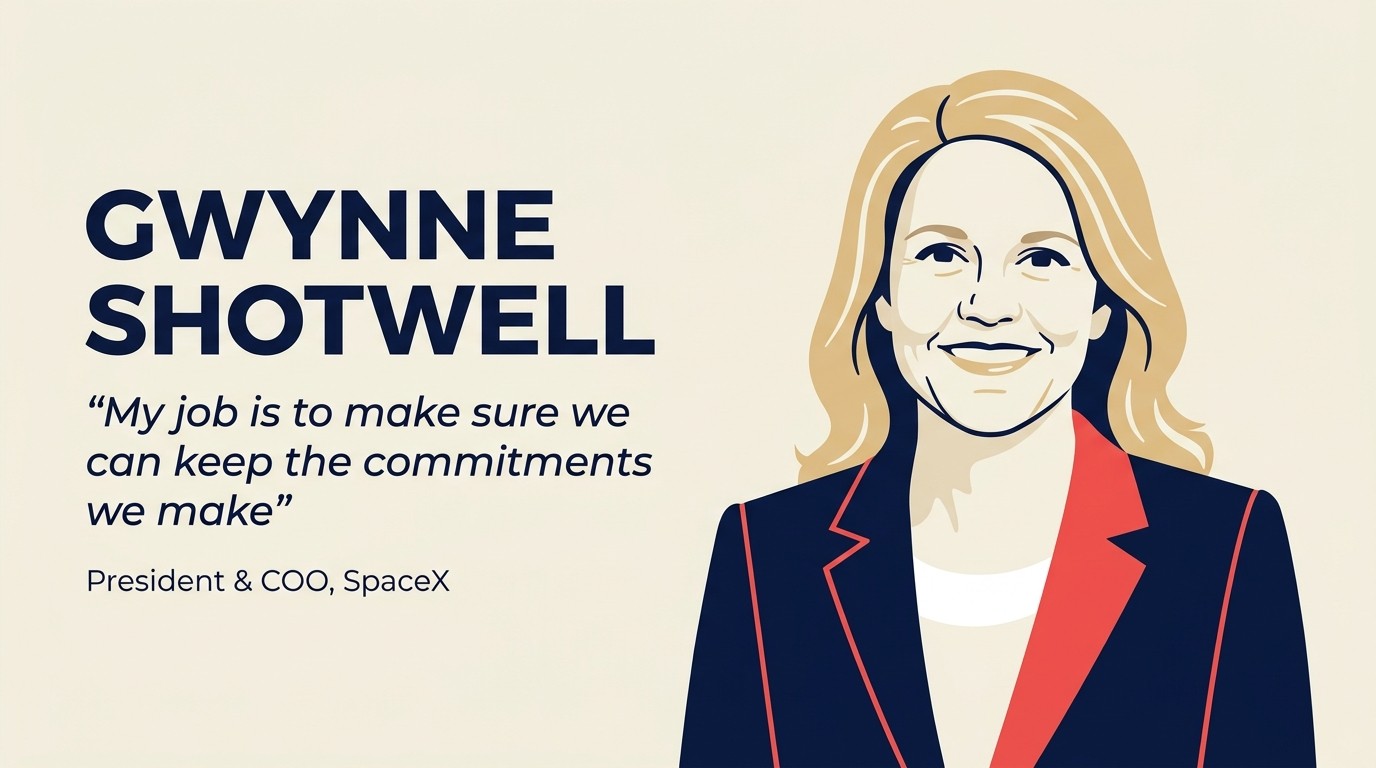
Gwynne Shotwell's leadership style is execution-focused operator leadership: she converts a founder's vision into signed contracts, scheduled launches, and retained customers. As SpaceX President and COO since 2008, she pairs technical credibility with relentless honesty to customers, the model behind the visionary-operator partnership that keeps high-ambition companies functional.
Key Facts, Gwynne Shotwell
- Born: 1963, Evanston, Illinois
- Role: President & COO, SpaceX (since 2008)
- Tenure at SpaceX: Joined 2002 as the 7th employee (VP of Business Development)
- Education: BS Applied Mathematics, MS Mechanical Engineering, Northwestern University
- Signature achievement: Built SpaceX's commercial sales pipeline, NASA COTS ($278M, 2006), Commercial Crew, DoD national security payloads, and the commercial launch market where SpaceX holds ~60% share
- Operating legacy: Operationalized reusable rocket economics (Falcon 9 booster reuse), scaled Starlink to 6,000+ satellites, ran day-to-day through Musk's Tesla, Twitter/X, and xAI distractions
- Reputation: "Musk's operator", the person who actually runs SpaceX while the founder sets the vision
SpaceX is the most operationally demanding aerospace company on the planet. It launches rockets, builds satellites, and sells internet service simultaneously, across government contracts, NASA partnerships, commercial customers, and a Starlink constellation that reached 6,000+ satellites by 2024. For most of that run, the person who actually kept it functional was not Elon Musk.
It was Gwynne Shotwell, President and COO since 2008. She holds a BS in Applied Mathematics and an MS in Mechanical Engineering from Northwestern University.
She joined SpaceX in 2002 as the 7th employee, VP of Business Development, when the company had no launched rockets and no customers. She landed the COTS contract with NASA in 2006 (worth $278M) that kept SpaceX alive through three consecutive Falcon 1 failures. And she has run day-to-day operations through Musk's simultaneous pursuit of Tesla, Twitter/X, and xAI, without losing the plot.
Shotwell's model isn't complicated to describe: she converts vision into operational reality with enough technical credibility to be trusted by engineers, enough relationship discipline to be trusted by government customers, and enough composure to stay functional when the founder is setting fires in three other industries at the same time. Fortune has called her one of the most powerful women in business for her role running the day-to-day at SpaceX.
This is the leadership profile of the person who actually runs SpaceX.
Leadership Style Breakdown
| Style | Weight | How it showed up |
|---|---|---|
| Execution-Focused Operator | 60% | Shotwell's job is to translate mission-level ambition into contracts signed, launches scheduled, hardware delivered, and customers retained. She manages the cadence of SpaceX's actual output, launch manifests, Starlink deployment schedules, NASA mission timelines, and the commercial launch market SpaceX dominates with roughly 60% market share as of 2024. She's publicly said her job is to make sure the company can keep the commitments it makes. That sounds simple. At SpaceX's scale and complexity, it requires constant prioritization, aggressive timeline management, and the willingness to tell customers honest news rather than optimistic news. |
| Relationship Builder | 40% | Shotwell personally manages SpaceX's most critical institutional relationships: NASA, the DoD/USAF, commercial satellite customers. Those aren't transactional relationships, they're multi-year, multi-billion-dollar partnerships with customers who are entrusting their missions, their satellites, and sometimes their astronauts to SpaceX hardware. She's known for direct communication: here's what we can do, here's what we can't, here's when. That honesty built a customer base that stayed with SpaceX through early failures and a testing-pace that would have lost less committed partners. |
The 60/40 split matters because Shotwell's relationship style is in service of execution, not separate from it. She builds trust with customers by being operationally reliable, not by being charming. When Falcon 1 failed three times between 2006 and 2008, she stayed credible with NASA because she was honest about what happened and what SpaceX was going to do about it.
Key Leadership Traits
| Trait | Rating | What it means in practice |
|---|---|---|
| Customer ownership | Exceptional | Shotwell treats major institutional customers, NASA, USAF, commercial operators, as relationships she personally owns, not accounts managed by a business development team. That means she's in the room when bad news happens, not just when the deal is being signed. When the Falcon 1 failed in 2008, threatening to strand a NASA test satellite, she didn't delegate the customer communication. That personal accountability is rare at COO level and it's a significant reason those relationships survived. |
| Technical credibility | Very High | Shotwell has a BS in Applied Mathematics and an MS in Mechanical Engineering from Northwestern. She spent a decade as an aerospace engineer before moving into business development. That background means she can sit across from a NASA mission director or a USAF program manager and have a credible technical conversation about hardware timelines, mission risks, and launch windows. She's not a spokesperson for the engineers, she is, at a meaningful level, one of them. |
| Calm under catastrophic failure | High | Falcon 1 failed on launches 1, 2, and 3 (2006, 2007, and 2008). Each failure was public, expensive, and existential, SpaceX had limited funding and Musk had publicly said the company would not survive a fourth failure. Shotwell managed customer relationships, employee morale, and public communications through all three. The fourth launch succeeded in September 2008. But the three failures before it required someone keeping the organization functional and the customers engaged. She did that. |
| Ability to sell vision while delivering reality | High | SpaceX asks customers to commit to launch manifests years in advance for a company that, in its early years, hadn't yet demonstrated it could do what it said it could do. Shotwell's sales approach was to be honest about risk while making a credible case for why the risk was worth taking. She never oversold. She sold SpaceX's engineering culture, its pace of iteration, and its cost structure, concrete advantages that sophisticated customers could evaluate, rather than making promises about timelines she couldn't guarantee. |
The Shotwell Execution Model (The Operator Doctrine)
The Shotwell Execution Model
The Shotwell Execution Model is a leadership operating pattern where a technically credible operator owns the full delivery system, contracts, cadence, customer trust, hiring, as a structural counterweight to a visionary founder who generates mission and technical direction. It holds that execution quality is not an outcome of good management process; it is the product of a single accountable operator with domain depth, unoverselling honesty with customers, and the authority to make operational calls without founder arbitration. Vision without this operator dissipates into chaos; the operator without vision runs a factory with nothing worth building.
The 3 Frameworks That Defined Gwynne Shotwell
1. The Operator-Visionary Split
The most studied element of SpaceX's leadership model is the division of authority between Musk and Shotwell. Musk sets the technical vision and long-term direction (reusable rockets, Starlink, Mars colonization) and Shotwell converts that vision into organizational execution: contracts, hiring, launch cadence, supplier management, customer relationships.
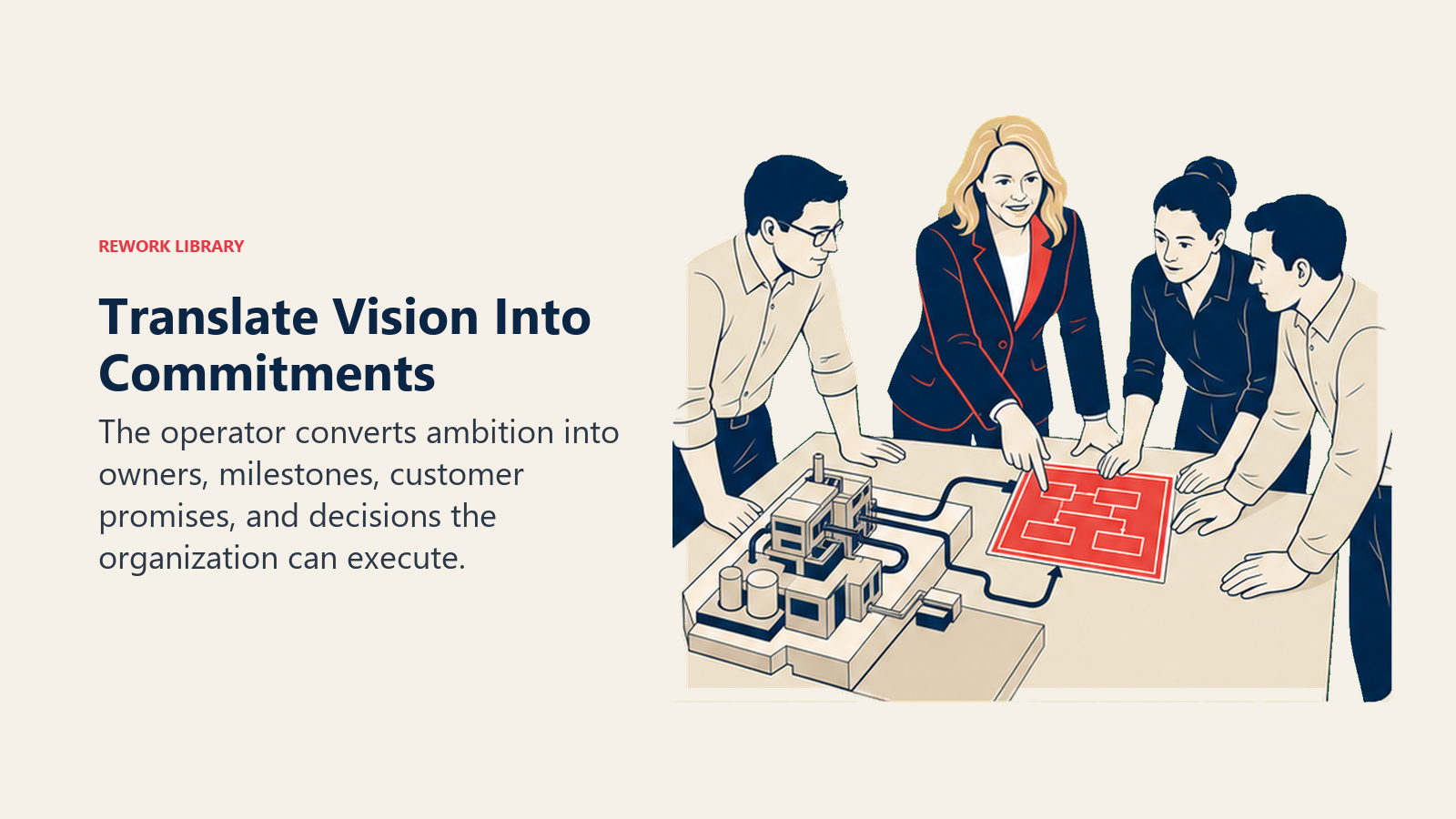
This isn't a standard CEO-COO dynamic. It's a more fundamental separation of roles. Musk operates at the level of "what is technically possible and what should we build?" Shotwell operates at the level of "what have we committed to, when do we deliver it, and what does the organization need to execute?" That separation works because the two functions don't compete. Musk's decisions generate the mission that Shotwell's execution serves.
The arrangement is deliberately asymmetric. Musk retains CEO title and makes final technical calls. Shotwell runs the company. It's structurally similar to what Jeff Wilke built at Amazon alongside Bezos, a founder setting the vision, an operator owning the system, though Wilke's domain was fulfillment logistics rather than aerospace hardware. When Musk was consumed by the Twitter/X acquisition in late 2022 and into 2023, SpaceX continued launching Falcon 9s, deploying Starlink satellites, and delivering on NASA contracts without visible disruption. That's not because Musk was checked out. It's because Shotwell had the operational authority and the institutional knowledge to keep the machine running.
For operators in your organization: the key question is whether the visionary in your leadership team has a genuine counterpart who owns execution, not just someone who "supports" the CEO but someone who's accountable for delivery. Many organizations have a visionary CEO and a team of people who implement individual pieces. That's not the same as an operator who owns the operational system holistically.
2. Customer Success as a Retention Strategy
Shotwell's approach to institutional customers treats retention as more important than acquisition. NASA and the DoD are long-term partners with programs that run 10-20 years. Winning a launch contract with an overpromise and then under-delivering loses the relationship permanently. Building a record of honest communication and reliable execution builds a customer relationship that survives failures, because failures are inevitable in aerospace.

Her stated principle is that SpaceX tells customers exactly what it can and can't do. No overselling timelines. No padding commitments with vague qualifiers. If a launch window is ambitious, she says so. If a technical challenge is unresolved, she says so. That honesty is rare in a procurement environment where most contractors are incentivized to win the contract and manage delivery problems later.
The result is a NASA relationship that survived early Falcon 1 failures, expanded into crew transportation with Commercial Crew Program, and has grown into one of the most consequential government-commercial aerospace partnerships in history. The DoD relationship has deepened similarly, with SpaceX now launching national security payloads that were exclusively handled by ULA for years.
What this means for your customer organization: the question isn't whether to be honest with customers about risk and timeline. Tim Cook built Apple's supplier relationships on the same foundation, a record of delivery credibility that allowed Apple to demand supply exclusivity and pricing terms no competitor could match, because suppliers trusted Apple would execute. Andy Jassy ran AWS the same way: cloud commitments were kept precisely because the credibility of Amazon's infrastructure promises was a competitive moat, not a marketing claim. It's whether your incentive structure rewards that honesty or punishes it. If your salespeople are compensated on bookings and not on renewals, you're optimizing for the wrong moment in the customer relationship.
3. Hiring for Mission Alignment
SpaceX is known for hiring people who need to see the rocket launch, engineers, operators, and managers who are motivated by the mission itself rather than by compensation or career progression. Shotwell has been explicit about this in public interviews: SpaceX doesn't win compensation competitions with Google or Meta. It wins on mission, offering work that's genuinely hard and genuinely matters.
That hiring philosophy is a selection mechanism for resilience. People who joined SpaceX because they believe in the mission don't quit after the third rocket failure. They don't burn out at the pace SpaceX demands because the pace feels meaningful rather than arbitrary. And they don't optimize for personal advancement at the expense of the mission because the mission is why they're there.
This creates real organizational costs: SpaceX is famously demanding, and people do burn out. But the philosophy generates a kind of organizational cohesion that pure compensation-based hiring can't replicate. When everyone in a launch crew is there because they care whether the rocket makes orbit, the culture around that launch is categorically different from a team assembled because the pay was competitive.
The practical application for your organization: clarity of mission is a prerequisite for this kind of hiring to work. If you can't articulate clearly why the work matters and to whom, mission-driven hiring produces inconsistent results. SpaceX can make the mission case credibly. Organizations that try to replicate the approach without the mission clarity get the costs (high demands, lower pay) without the benefits (extreme engagement and retention).
What Gwynne Shotwell Would Do in Your Role
If you're a CEO, Shotwell's model asks you to be honest about whether you have a genuine operational counterpart or a team of executors who implement your direction piecemeal. Those are different things. An operational counterpart owns delivery. They're accountable for whether commitments are met, not just for managing the teams that work toward them. If your organization's execution quality depends on your personal involvement in operational decisions, you don't have an operational counterpart. You have a reports structure. That's a scalability problem that compounds as the company grows.
If you're a COO, Shotwell's first lesson is about the value of technical credibility in an execution role. She can have credible conversations with engineers, customers, and regulators because she's genuinely qualified in the domain. That credibility isn't window dressing. It changes the quality of information she receives and the quality of decisions she can make. COOs who lack domain depth in their organization's core function tend to manage through process and reporting rather than through direct understanding of the work. That's not always wrong, but it limits the quality of judgment in high-stakes operational decisions.
If you're a product leader, the SpaceX launch cadence is a useful model for thinking about release discipline. SpaceX doesn't launch when it's ready. It launches on schedule and fixes problems in the next iteration. That's not recklessness; it's a calculated approach to learning that generates real data faster than extended pre-launch testing. Ask whether your product release process is optimized for launching reliably on a cadence or for achieving perfection before release. Both have contexts where they're right. But most product teams under-index on cadence and over-index on pre-release completeness.
If you're in sales or marketing, the honest-commitment approach Shotwell uses with NASA and the DoD is a model for any long-term institutional relationship. The instinct in enterprise sales is to make the commitment that wins the deal and manage the gap later. Shotwell's approach is the reverse: make only the commitments you're confident you can keep, and earn the right to bigger commitments by delivering on smaller ones. That's slower in the short run and more durable over a decade.
The Rework Angle: Building the Visionary-Operator Partnership
Shotwell's durability at SpaceX comes from a specific pairing: a founder generating mission velocity, and an operator who owns the system that turns mission into delivered launches, signed contracts, and retained customers. Most operators don't fail because they lack ambition, they fail because the operating system fragments across sales pipelines, delivery teams, customer-success conversations, and internal handoffs that nobody can see end-to-end.
Rework is built for operators running high-scale founder visions. The Sales Engine (from $69/month billed yearly, with 5 sales seats included) gives COOs a single pipeline view across government-scale contracts and commercial deals, with commitment tracking that exposes honest delivery dates before a salesperson overpromises them. The Process Engine (from $99/month billed yearly) sits underneath that to coordinate cross-functional execution, the engineering-to-customer handoffs that sink aerospace, SaaS, and manufacturing companies alike. For leaders who need to keep the machine running while the visionary sets fires elsewhere, that integrated stack turns operator credibility into a repeatable system.
Notable Quotes & Lessons Beyond the Boardroom
"I don't work for Elon. I work with Elon." Shotwell has made this distinction publicly, and it matters more than it sounds. A COO who works for the founder is executing the founder's decisions. A COO who works with the founder is co-developing decisions in their respective domains. The distinction is about authority, not hierarchy. Shotwell runs SpaceX's operations. She doesn't implement Musk's operational preferences; she makes operational calls within the mission he sets.
"I am not going to oversell what we can do." She's said this in various forms across years of public appearances. It's a sales philosophy that feels counterintuitive in an industry where most companies are competing for contracts on the strength of their pitches. But in a business where failure is public, spectacular, and sometimes fatal, the alternative to underselling is a customer relationship that breaks the first time reality doesn't match the pitch. Shotwell made the calculation that long-term institutional trust is worth more than any individual contract, and she's had the operational track record to prove it.
The honest observation about Shotwell's leadership is that it's deeply context-specific. She built her style inside a company with an unusually clear mission, an unusually concentrated source of vision, and an unusually strong engineering culture that generates the credibility her customer relationships depend on. She's also the most senior female executive in commercial spaceflight, which matters as a signal about what technical leadership roles look like. But the model she represents, a stable and credible execution-focused operator as counterweight to a volatile visionary founder, has limited portability to organizations where the founder isn't generating genuine breakthroughs or where the mission isn't clear enough to attract mission-driven talent.
Where This Style Breaks
Shotwell's model depends on a founder who trusts the COO completely and whose vision is generating real breakthroughs, not just chaos. That trust isn't replicable on command. It's built over years of aligned decision-making. The operator-visionary split works when the visionary is producing innovations worth executing; it produces confusion when the visionary's direction changes faster than the organization can absorb. SpaceX's mission clarity ("make humans multiplanetary") is an unusually powerful filter for culture and hiring. Organizations without that level of mission specificity can't use the same playbook without getting the costs (extreme demands, below-market compensation, intense pressure) without the corresponding benefits: extreme selection and mission-driven retention that makes those costs feel meaningful.
Frequently Asked Questions about Gwynne Shotwell's Leadership
Who is Gwynne Shotwell?
Gwynne Shotwell (born 1963) is the President and COO of SpaceX, a position she has held since 2008. She joined SpaceX in 2002 as the seventh employee and VP of Business Development, and holds a BS in Applied Mathematics and an MS in Mechanical Engineering from Northwestern University. She is widely regarded as "Musk's operator", the executive who actually runs SpaceX's day-to-day operations.
What is Shotwell's role at SpaceX?
As President and COO, Shotwell owns the full execution system at SpaceX: commercial sales, government contracts, launch cadence, customer relationships with NASA and the DoD, and day-to-day operational decision-making. Musk sets the technical vision (reusable rockets, Starlink, Mars colonization); Shotwell converts that vision into signed contracts, delivered launches, and retained customers.
How did Shotwell build SpaceX's commercial sales pipeline?
She landed the 2006 NASA COTS contract worth $278 million, a deal that kept SpaceX alive through three consecutive Falcon 1 failures. From there she expanded into Commercial Crew (transporting astronauts to the ISS), DoD national security payloads previously reserved for ULA, and the commercial launch market where SpaceX now holds roughly 60% global share. Her approach: never oversell timelines, and let delivery credibility earn larger commitments over time.
What is the visionary-operator partnership model?
It's a leadership structure where the founder owns vision and technical direction while a single accountable operator owns the delivery system end-to-end, contracts, hiring, cadence, customer trust. Unlike a standard CEO-COO split, the operator holds genuine authority to make operational calls without founder arbitration. The model works only when the visionary generates real breakthroughs and the operator has domain depth to be trusted by engineers and customers.
How is Shotwell different from Musk?
Musk operates at "what is technically possible and what should we build?" Shotwell operates at "what have we committed to, when do we deliver it, and what does the organization need to execute?" Musk is publicly volatile and pursues multiple companies simultaneously; Shotwell is operationally steady, stays out of public drama, and keeps SpaceX functional when Musk is consumed by Tesla, X, or xAI. She has publicly framed the relationship as working with Musk, not for him.
What can COOs learn from Gwynne Shotwell?
Three things. First, technical credibility matters, she can have substantive conversations with engineers, customers, and regulators because she's genuinely qualified in the domain, which changes the quality of information she receives. Second, personally own the critical customer relationships; don't delegate bad news to a business development team. Third, optimize for long-term institutional trust over short-term contract wins, make only the commitments you can keep, and let delivery build the right to larger ones.
For related reading, see Jeff Wilke Leadership Style, Andy Jassy Leadership Style, Tim Cook Leadership Style, Andy Grove Leadership Style, and Taiichi Ohno Leadership Style.

On this page
- Leadership Style Breakdown
- Key Leadership Traits
- The Shotwell Execution Model (The Operator Doctrine)
- The Shotwell Execution Model
- The 3 Frameworks That Defined Gwynne Shotwell
- 1. The Operator-Visionary Split
- 2. Customer Success as a Retention Strategy
- 3. Hiring for Mission Alignment
- What Gwynne Shotwell Would Do in Your Role
- The Rework Angle: Building the Visionary-Operator Partnership
- Notable Quotes & Lessons Beyond the Boardroom
- Where This Style Breaks