Evan Spiegel Leadership Style: Ephemeral Content Thesis, Rejecting Facebook, and the Long AR Bet
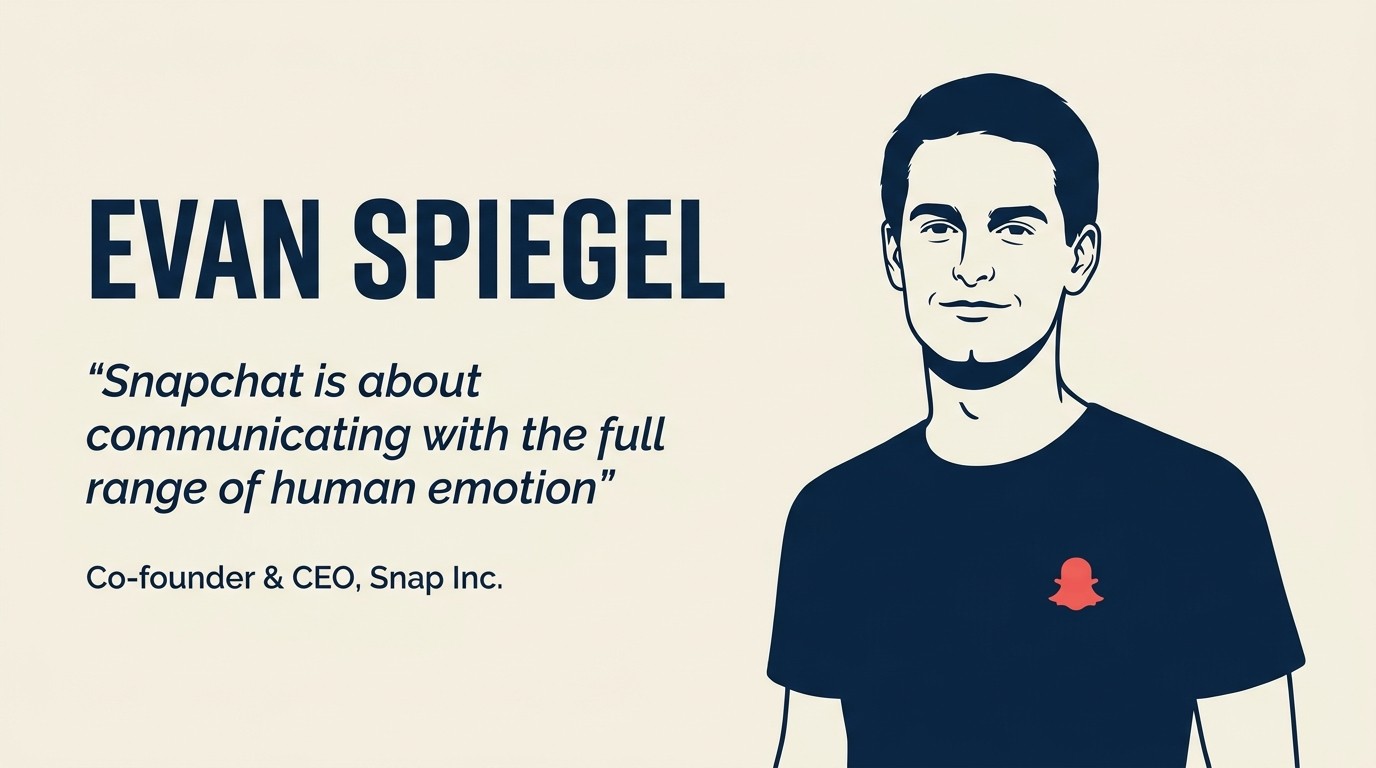
Turn this article into takeaways for your work.


Each assistant summarizes the article only for you and suggests best practices for your work.
Key Facts: Evan Spiegel (b. June 4, 1990) co-founded Snapchat in 2011 at Stanford with Bobby Murphy (and briefly Reggie Brown). He turned down a $3 billion acquisition offer from Facebook in November 2013, took Snap Inc. public in March 2017 at a ~$33 billion valuation, and invented the Stories format that every major social platform later cloned. He launched Spectacles, Snap's AR camera glasses, in 2016 and has shipped four hardware generations. At the time of the IPO he was the youngest self-made billionaire in the world, and Snap today reaches more than 800 million monthly active users.
The Ephemeral Content Doctrine (Contrarian Conviction Model)
The Ephemeral Content Doctrine is the belief that disappearing messages produce more honest communication than permanent-record social media, and that a founder should hold that thesis through imitation, investor pressure, and public backlash rather than negotiate it away. The Contrarian Conviction Model pairs this product-identity refusal with a 10-year operating horizon: you build on an unpopular thesis, accept shareholder punishment while the market catches up, and protect the bet with governance (dual-class shares) rather than persuasion.
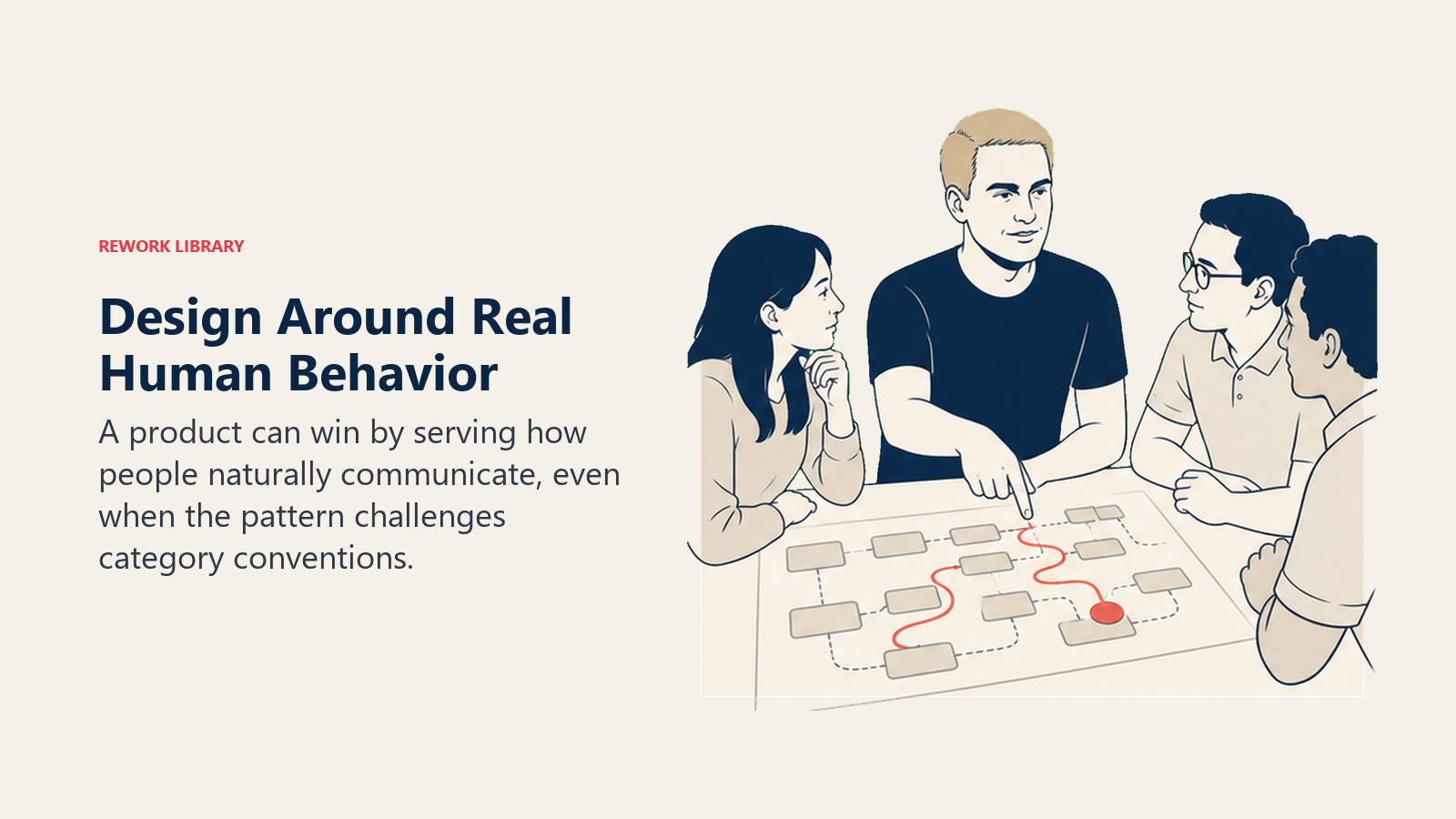
Mark Zuckerberg offered Evan Spiegel $3 billion for Snapchat in 2013. Spiegel was 23. He said no. Most people called it arrogance. A year later Instagram launched Stories, a near-direct copy of Snapchat's core feature, and began systematically dismantling Snapchat's user growth. Mark Zuckerberg ran a playbook Spiegel had seen coming, clone the feature, absorb the audience, and wait for the independent product to stall. Snap went public in March 2017 at a $33 billion valuation. The stock has traded far below that peak for most of its public life.
And yet Spiegel is still CEO, still pursuing the AR camera thesis he's held since 2011, and still running a company with 800 million monthly users and a dedicated hardware program. That's a different kind of founder endurance. Not the triumphant IPO story, the one where you build something real on a contrarian thesis and absorb years of public market skepticism without abandoning the bet.
For operators, the interesting question isn't whether Spiegel made the right call on the Facebook offer. It's what kind of leadership it takes to keep building through 12 years of existential competition, a $1.3 billion market cap wipeout from a single Kylie Jenner tweet, and a stock that sits roughly 80% below its IPO high. That kind of endurance doesn't come from confidence. It comes from conviction about a specific thesis, and an unusually high tolerance for being publicly wrong while you wait for the thesis to prove out.
Leadership Style Breakdown
| Style | Weight | How it showed up |
|---|---|---|
| Contrarian Thesis Builder | 60% | Built the entire Snapchat product around the idea that permanence is a bug in social media, not a feature. Rejected two acquisition offers totaling over $33 billion combined. Kept building AR hardware through 4 generations of Spectacles that didn't reach mass market. Bet the company's long-term identity on a camera-first platform thesis before AR was commercially viable. |
| Long-Horizon Platform Operator | 40% | Sustained the AR investment even as quarterly results disappointed investors. Repositioned Snap+ as a subscription product rather than pivoting purely to ad revenue. Maintained the ephemeral messaging core while gradually adding platform features that the camera-first thesis required. Accepted public market punishment rather than chasing short-term engagement metrics that would've diluted the product vision. |
The 60/40 split matters because these two tendencies operate on different timescales. Spiegel's contrarian conviction kicks in at the product identity level, he decides what Snapchat is and doesn't negotiate that with Wall Street. The long-horizon operating instinct is what keeps the company funded and staffed while the market catches up to the thesis. Without both, the contrarian bet either runs out of money or drifts into whatever investors want it to be. Spiegel has kept both active simultaneously, which is genuinely rare and genuinely expensive for shareholders who wanted the simpler story.
Key Leadership Traits
| Trait | Rating | What it means in practice |
|---|---|---|
| Product thesis conviction under imitation pressure | Exceptional | When Instagram cloned Stories in 2016 and TikTok took the short-video category, Spiegel didn't abandon Snapchat's ephemeral-first identity and rebuild it as a TikTok clone. Jan Koum made a comparable choice at WhatsApp, Jan Koum's leadership shows how refusing advertiser pressure and staying close to the original product thesis can hold a loyal user base even as larger platforms circle. He doubled down on the camera platform thesis. That kind of conviction under direct imitation pressure is rare at any age, exceptional at 26. |
| Public market indifference | High | Spiegel has never run Snapchat to hit quarterly guidance. He runs it to build the AR camera platform. Investors who wanted him to prioritize ad-revenue growth over hardware investment got neither an argument nor a compromise, they got the product roadmap he'd already decided on. That's not investor relations. It's operating with a 10-year horizon while managing a company with 90-day reporting cycles. |
| Ephemeral-first UX philosophy | Very High | The insight that permanent social media creates a performed, curated self, and that disappearing messages create more authentic communication, was genuinely contrarian in 2011 and has proven durable. Spiegel built the entire product philosophy around this belief and has held it through every market pressure to make Snapchat more like Instagram or Facebook. |
| Augmented reality patience as a 10-year bet | High | Spectacles have failed commercially in multiple generations. Snap's AR developer platform has grown steadily but hasn't produced the consumer breakout that would justify the investment timeline. Spiegel has continued building anyway. Whether that patience is vindicated or not, it represents a level of commitment to a specific technology thesis that very few founders maintain through 4 consecutive product generation failures. |
The 3 Decisions That Defined Evan Spiegel as a Leader
1. Turning Down Facebook's $3 Billion Offer in 2013
When Spiegel declined Zuckerberg's $3 billion offer in November 2013, Snap had roughly 26 million daily active users and no revenue. The offer was extraordinary by any rational measure for a 23-year-old running a messaging app with no business model.
His stated reasoning was that Snapchat was building something Facebook couldn't replicate: the ephemeral communication thesis. He believed the value of disappearing content was architecturally incompatible with Facebook's permanent-record model. You couldn't bolt it on. You had to build from that assumption, as Snap had, to get the product right.
He was half right. Facebook couldn't replicate the product identity. But it could replicate the feature, which Instagram did with Stories within 3 years. Snap's daily active user growth slowed materially as Instagram Stories absorbed the addressable audience. The $3 billion offer that looked like arrogance in 2013 looks more complicated in retrospect, not obviously wrong, but not the clean vindication the story is often told as.
What the decision reveals about Spiegel's leadership: he bets on theses, not numbers. At 23, with $3 billion on the table, he was operating from a belief about what communication was becoming rather than from a calculation about the deal. That orientation is what produced both the upside and the downside that followed.
2. The 2018 Redesign That Alienated the Core User Base
In early 2018, Snap released a major redesign that separated creator content from friend content. It was a significant structural change to how users experienced the app. The existing user base reacted badly. A Change.org petition to reverse the redesign gathered over 1.2 million signatures. Kylie Jenner tweeted that she didn't use Snapchat anymore. The stock dropped roughly $1.3 billion in market cap in one trading session. Forbes later cited the incident as one of the most costly celebrity tweets in social media history, noting how a single post can erase billions in market value.

Spiegel didn't reverse the redesign.
His thesis was that Snapchat's existing users were highly engaged but demographically narrow. The redesign was built to make the app more accessible to users who found the original interface confusing: specifically older and international users who hadn't grown up with Snapchat's UX conventions. The short-term engagement cost was the price of long-term demographic breadth.
The execution was imperfect. The Android version of the redesign was notably worse than iOS, which created a secondary problem in international markets where Android dominates. But the underlying product logic was defensible: a product that's beloved by 26-year-olds and confusing to everyone else is a demographic ceiling problem, not a product success. Spiegel saw that and made the call, knowing it would cost him in the short term. That's a specific kind of product courage that's genuinely hard to maintain when the stock is moving against you in real time.
3. Committing to AR Through Four Generations of Failed Spectacles
Snap released its first Spectacles camera glasses in 2016. The launch was deliberately limited: vending machines at beach locations, no broad retail distribution. They sold roughly 150,000 units and disappeared from most conversations within a year.
Spectacles 2, 3, and 4 followed at intervals, each generation improving the hardware, each generation failing to reach meaningful commercial scale. By 2021, Snap wrote down approximately $40 million in unsold Spectacles inventory.
Through all of this, Spiegel continued investing in AR hardware and developer tools. The Snap AR developer platform has grown to over 300,000 developers and 3 million lenses, which is a meaningful ecosystem by any measure. But the hardware question of whether Snap will produce a consumer AR device with mass-market appeal remains genuinely unresolved in 2026.
What this decade-long bet tells you about Spiegel: he picked a platform thesis in 2011, identified the hardware as the eventual delivery mechanism, and has been building toward it through product failures that would have killed most companies' commitment to the category. Whether the bet pays off is still open. But the level of sustained conviction required to keep building AR hardware through 4 failed generations is not a common leadership quality.
What Evan Spiegel Would Do in Your Role
If you're a CEO running a 50-500 person company, the Spiegel model asks you to identify the one thesis your company is built on that you won't negotiate with investors or the market. Not your business model, not your pricing strategy. The core product belief that, if wrong, means the company shouldn't exist. Then ask honestly whether you're actually holding that thesis or gradually drifting away from it every time a competitive or financial pressure arrives. Spiegel has held his for 15 years. How many quarters has yours survived?
If you're a COO or operations leader, Snap's operating history shows what it costs to hold a long thesis: the ad-revenue gap vs. Meta and Google, the Android execution problems, the post-IPO talent churn. Long-thesis companies pay operational inefficiency costs that focused competitors don't. Your job in that environment is building the operational discipline to keep the lights on and the team intact while the founder's 10-year bet plays out. That means tighter unit economics, more deliberate hiring, and more honest conversations with investors about timelines than most COOs want to have.
If you're a product leader, Spiegel's 2018 redesign is the case study. He had a clear product thesis (improve demographic breadth even at short-term engagement cost) and executed it through significant public backlash. But he also had the Android execution failure, which was a separate problem that hit the same news cycle. The lesson isn't that you should ignore user backlash. It's that you need to know which backlash is signal (you made a mistake) and which is noise (users don't like change but the underlying logic is sound). Spiegel read that distinction correctly on the strategy and incorrectly on the Android execution. Know which one you're dealing with.
If you're a sales or marketing leader, Snap's subscription pivot with Snap+ is a different kind of lesson. When ad-revenue growth slowed and the competitive gap with Meta widened, Spiegel added a direct subscriber revenue stream rather than purely chasing ad market share. Jack Dorsey faced a structurally similar moment at Twitter, a social platform stalling on ads while the founder held a product vision the market wasn't yet buying. Snap+ reached 11 million paid subscribers within two years of launch. If your growth channel is capped, the question isn't how to squeeze more out of it. Ask whether there's a different relationship model with your most engaged customers that they'd actually pay for.
How Rework Supports Teams Making Unusual Product Bets
Spiegel's leadership runs on two things most product companies struggle to coordinate: a non-negotiable product thesis and an operating team disciplined enough to survive while the thesis plays out. Rework is built for that split. The CRM and sales ops side keeps revenue predictable and customer signals legible even when the founder is holding a contrarian roadmap, so GTM leaders can report real pipeline without being pressured into diluting the product vision for a quarter. The work ops side gives design-led founders a way to run cross-functional programs, hardware, AR developer platform, subscription launches like Snap+, on shared timelines without forcing engineers into ticket-theater PM tools. For teams making long-horizon product bets, Rework keeps the operational surface tight (unit economics, hiring pace, program status) so the founder's 10-year call isn't quietly eroded by 90-day reporting cycles. See pricing: the Sales Engine from $69/month and the Project Engine from $99/month, billed yearly.
Notable Quotes and Lessons Beyond the Boardroom
Spiegel has said: "The camera is the new keyboard." It's a compact summary of the platform thesis he's been building since 2011. The keyboard was the primary interface for text-based communication. The camera, in his model, is the primary interface for the generation that grew up with smartphones. Everything Snap has built, Stories, lenses, AR layers, Spectacles, is an application of that single belief about where communication is going.
He's also talked about ephemeral communication as more honest than the permanent-record model of Facebook and Instagram. His argument is that when everything you post is archived, you curate. You perform. When it disappears, you communicate. That framing was genuinely contrarian in 2011 and influenced a generation of product thinking, even as Instagram and TikTok took the audience growth that Snap had created conceptually.
Spiegel dropped out of Stanford's product design program three credits short of graduation to work on Snap, returning later to receive his degree after the IPO. Drew Houston went through similar IPO-timing skepticism before Dropbox finally went public in 2018, Drew Houston's leadership is a useful companion study in founder patience through years of "why haven't you gone public yet" pressure. The product design background is visible in how Snap has approached hardware: Spectacles were never ugly, never purely functional. They were objects designed to be worn. Whether the AR bet pays off, the aesthetic discipline in how it's pursued reflects a founder who thinks about the experience of the product as a primary variable, not an afterthought.
Where This Style Breaks
Spiegel's contrarian conviction model works when the core thesis proves durable. Ephemeral content did become a mainstream format, but Instagram cloned it fast enough to blunt Snapchat's growth advantage. The founder who refuses to sell and holds the long AR bet is either vindicated by history or leaves significant shareholder value on the table in the meantime.
For operators, the Spiegel model only works if you have both the capital runway and the governance structure to hold a long thesis without external pressure forcing premature pivots. Snap's dual-class share structure gave Spiegel that insulation. Most companies don't have it. And the model requires that your original thesis was right in the first place, not just directionally correct, but right enough that the long hold produces outcomes that justify the cost. That's still unresolved for Snap's AR bet in 2026, and that unresolved status is part of the honest accounting of this style.
Frequently Asked Questions about Evan Spiegel's Leadership
Who is Evan Spiegel?
Evan Spiegel (b. 1990) is the co-founder and CEO of Snap Inc. the company behind Snapchat. He started the product at Stanford in 2011 with Bobby Murphy, took Snap public in March 2017 at roughly a $33 billion valuation, and was the youngest self-made billionaire in the world at the time of the IPO. Snapchat today reaches more than 800 million monthly active users.
Why did Spiegel turn down Facebook's $3B offer?
In November 2013, at age 23, Spiegel declined Mark Zuckerberg's $3 billion acquisition offer because he believed Snapchat's ephemeral-communication thesis was architecturally incompatible with Facebook's permanent-record model, you couldn't bolt disappearing messages onto a product built around the archive. He was betting on a long product thesis, not the deal on the table.
What is the Stories format that Snapchat invented?
Stories is the 24-hour disappearing photo and video format Snap launched in 2013. Posts stack chronologically, expire automatically, and are designed for casual daily sharing rather than a permanent feed. Instagram cloned the format in August 2016, and it has since been copied by Facebook, WhatsApp, YouTube, LinkedIn, X, and TikTok, making Stories arguably the most imitated UX pattern in social media history.
Why is Snapchat's AR bet (Spectacles) strategically important?
Spiegel's thesis since 2011 is that "the camera is the new keyboard", the primary interface for the next generation of communication. Spectacles are the hardware delivery mechanism for that thesis. Four generations have failed to reach mass-market scale, but Snap's AR developer platform has grown to over 300,000 developers and millions of lenses, positioning Snap to compete with Meta and Apple as consumer AR becomes viable.
How does Spiegel approach competition from Meta?
He refuses to re-platform Snap around whatever Meta has just cloned. When Instagram copied Stories in 2016 and Reels chased TikTok, Spiegel doubled down on the camera-first, ephemeral-first identity rather than rebuilding Snap as an Instagram or TikTok clone. He also diversified revenue with Snap+ (subscription), which reached 11 million paid subscribers within two years, rather than fighting Meta purely on ad market share.
What can founders learn from Evan Spiegel?
Pick one product thesis you won't negotiate with investors or the market, then build the governance and operating discipline that lets you hold it through imitation, bad quarters, and public backlash. Spiegel's dual-class share structure, his refusal to reverse the 2018 redesign, and his decade-plus commitment to AR hardware through four failed Spectacles generations all come from the same playbook: founders hold theses, not numbers.

On this page
- The Ephemeral Content Doctrine (Contrarian Conviction Model)
- Leadership Style Breakdown
- Key Leadership Traits
- The 3 Decisions That Defined Evan Spiegel as a Leader
- 1. Turning Down Facebook's $3 Billion Offer in 2013
- 2. The 2018 Redesign That Alienated the Core User Base
- 3. Committing to AR Through Four Generations of Failed Spectacles
- What Evan Spiegel Would Do in Your Role
- How Rework Supports Teams Making Unusual Product Bets
- Notable Quotes and Lessons Beyond the Boardroom
- Where This Style Breaks