Gibson Biddle Leadership Style: The DHM Model, Netflix Product Strategy, and What Consumer Product Thinking Actually Looks Like
Turn this article into takeaways for your work.


Each assistant summarizes the article only for you and suggests best practices for your work.
Key Facts: Gibson Biddle served as VP Product at Netflix from 2005 to 2010, leading the product organization through the company's transformation from DVD-by-mail to streaming. He later served as CPO at Chegg (2011-2014), extending the consumer subscription model to education. Biddle lectures on Product Management at Stanford Graduate School of Business, coined the "DHM Model" (Delight customers in Hard-to-copy, Margin-enhancing ways), and has advised 50+ tech companies on product strategy since leaving operating roles.
The DHM Model (The Delight-Hard-Margin Strategy)
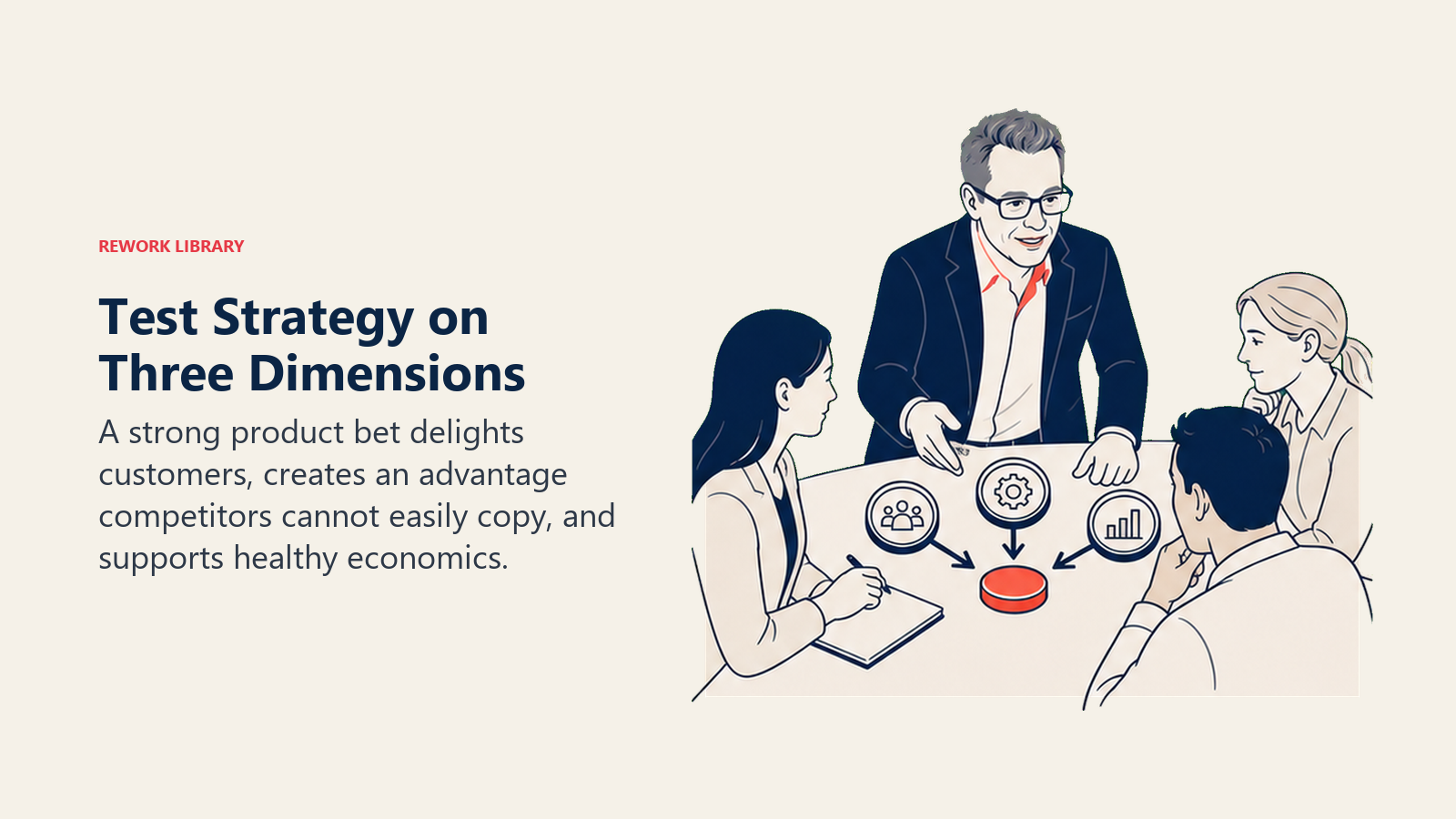
The DHM Model is Gibson Biddle's product strategy framework that tests whether a product bet delights customers, does so in ways that are hard for competitors to copy, and improves the margin profile of the business as it scales. All three conditions must be true simultaneously for a decision to qualify as product strategy rather than merely a product feature. It works as a filter, not a generator, it won't tell you what to build, but it will tell you whether what you're planning to build is strategically defensible.
Gibson Biddle joined Netflix as VP of Product in 2005 when it still mailed DVDs. He left in 2010, by which point Netflix had 20 million subscribers and was already executing the streaming transition. He reported to Reed Hastings, whose leadership profile documents the cultural and strategic decisions that defined the company Biddle was building products inside. What he built during those five years wasn't just a product strategy, it was a framework for thinking about product strategy that he's spent the last decade teaching.
The DHM model, Delight customers in Hard-to-copy, Margin-enhancing ways, sounds like a three-word slogan until you try to apply it. Most companies can identify what delights customers. Very few can explain why their delightful features are genuinely hard for competitors to replicate, and fewer still tie that to margin. If your product team is making roadmap decisions based on NPS scores and engineering capacity rather than strategic defensibility, Biddle's model is a useful forcing function for the conversations you're probably not having.
His career before and after Netflix is worth noting. Marty Cagan developed the empowered product team framework that addresses a similar question, what separates strategic product leadership from feature delivery, and the two thinkers are frequently read together in PM development programs. Teresa Torres extended the discovery side of that work, and her continuous discovery habits model is a natural companion to Biddle's DHM framework for teams that need both a strategy filter and a customer research cadence. Julie Zhuo, who led design at Facebook during a parallel high-growth consumer subscription period, offers a complementary perspective on how product and design leadership interact at scale. He worked at Apple and Mattel earlier in his career. He served as CPO at Chegg from 2011 to 2014, extending the consumer subscription model to education. He's taught Product Management at Stanford Graduate School of Business and has built an active writing presence on Medium and in the PM community. That post-operator teaching path gives his frameworks broader exposure than most practitioners who stay inside companies, but it also means the frameworks are stress-tested against diverse audiences rather than a single organization.
Leadership Style Breakdown
| Style | Weight | How it showed up |
|---|---|---|
| Strategic Framework Builder | 60% | Biddle's primary contribution is translating consumer product experience into teachable models. The DHM framework isn't just a heuristic, it's a structured test for whether a product decision is strategically sound, not just technically feasible or user-requested. His value comes from the ability to take five years at Netflix and convert that experience into a vocabulary that product teams can apply without having lived through the same context. Most senior product operators don't bother to formalize what they know. Biddle did. |
| Consumer Insight Operator | 40% | The framework building is grounded in real operational decisions, not theory. At Netflix, Biddle ran personalization and the recommendation engine during the company's most important growth period. He made specific bets about what the 70% retention metric meant and how it should drive product decisions. His consumer insight isn't academic, it comes from a period when Netflix was figuring out what subscribers actually wanted from a DVD service, and then from a streaming service, with real churn and revenue consequences for every product call. |
That split explains both the strength and the limitation of Biddle's approach. The framework clarity comes from the operational grounding. But the framework was shaped by a specific context, consumer subscription with high frequency, large datasets, and margin economics that look different from enterprise software, hardware, or marketplace businesses.
Key Leadership Traits
| Trait | Rating | What it means in practice |
|---|---|---|
| Framework clarity under ambiguity | Exceptional | DHM works because it asks a question most product teams avoid: not "does this feature delight users?" but "does this feature delight users and is that delight structurally hard to copy and does it improve our economics as we scale?" Most roadmap conversations stop at the first question. The two additional constraints are the ones that separate a product decision from a product strategy. Biddle's value is in forcing the full question rather than accepting an incomplete answer as sufficient. |
| Consumer empathy at executive level | Very High | One of the most common product failures at scale is when senior leaders lose direct contact with how users actually experience the product. Biddle kept consumer insights close throughout his Netflix tenure, and his post-corporate writing consistently returns to specific user behavior observations rather than general principles. The personalization work he led was driven by a specific consumer insight: that the friction of choosing what to watch was a larger retention driver than the content library itself. That observation required proximity to actual user behavior, not just survey data. |
| Willingness to share proprietary thinking openly | High | Biddle has published extensively about his Netflix experience and the DHM model in ways that most former product leaders don't. His reasoning, which he's articulated directly, is that sharing the framework openly creates more influence and more useful feedback than keeping it proprietary. The PM community has pushed back on, extended, and refined DHM in ways that have made it stronger than if he'd tried to monetize it exclusively through consulting. That's a deliberate choice about how to spread ideas, and it's worth examining as a model for how practitioners build influence after leaving corporate roles. |
| Pedagogical discipline in complex product concepts | Very High | Biddle taught Product Management at Stanford, which requires translating practitioner knowledge into curriculum that works for students who haven't shipped products at scale. That translation discipline shows up in how he writes about product strategy, concrete examples, specific numbers, explicit tests for each part of the framework. His Medium writing is consistently the clearest explanation of Netflix-era consumer product thinking available from a practitioner who was inside it. |
The 3 Decisions That Defined Gibson Biddle as a Leader
Joining Netflix in 2005 and Prioritizing the Recommendation Engine
When Biddle joined Netflix, the company's core problem wasn't the content library. It was the friction of choice. Netflix had 80,000+ DVD titles. Subscribers spent 20+ minutes browsing and often gave up without choosing anything. That friction drove cancellations and suppressed the engagement metric Netflix needed to justify subscription pricing.
Biddle's team prioritized the recommendation engine, which Netflix called Cinematch, as the primary lever for reducing that friction. The bet was that personalized recommendations would increase the probability that subscribers found something they wanted to watch quickly, which would drive higher engagement, which would drive lower churn. The 70% retention metric became the proxy for whether product decisions were working.
That bet was right, and it was also strategically brilliant in ways that weren't obvious at the time. Netflix wasn't just building a feature that reduced friction. It was accumulating viewing data at a rate that would compound into one of the most valuable proprietary datasets in the media industry. Every subscriber interaction, what they watched, how far in they got, what they browsed but didn't choose, trained the recommendation model. The model improved with scale, and with scale came better recommendations, and with better recommendations came more engagement, and with more engagement came more data.
That compounding dynamic, what Biddle later called the "Ghost strategy", is the reason Netflix's recommendation quality couldn't be replicated just by copying the feature. By the time a competitor built a comparable recommendation system, Netflix would have accumulated years of viewing data that any new entrant lacked. The algorithm is the visible feature. The data is the moat.
Building the DHM Model as a Teachable Framework
The DHM model, Delight customers in Hard-to-copy, Margin-enhancing ways, emerged from Biddle's attempt to articulate what made Netflix's best product decisions structurally different from average ones. The model has three components, and all three need to be present simultaneously for a decision to qualify as a product strategy rather than just a product feature.
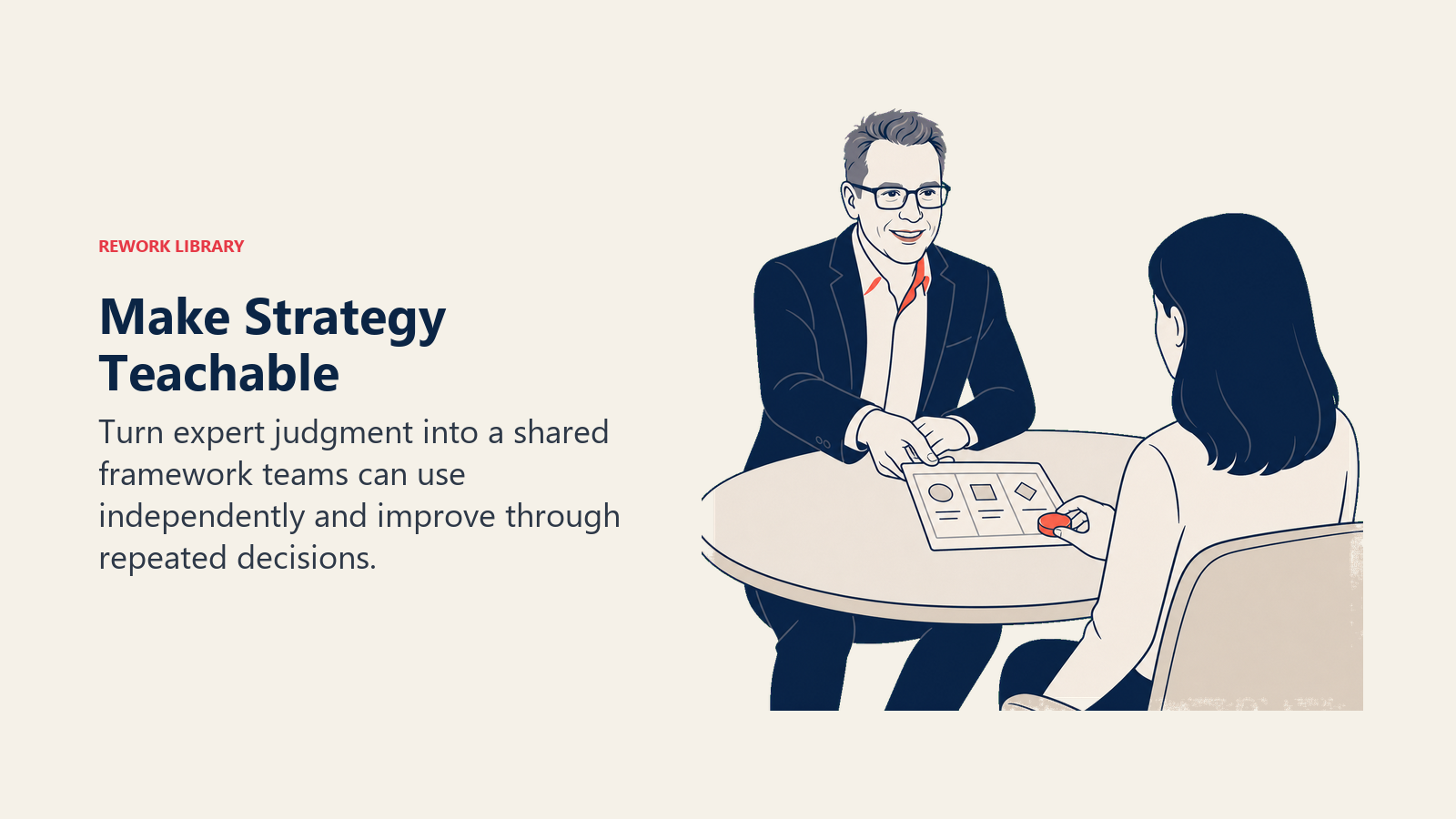
Delight is the customer benefit: the feature produces genuine utility or emotional satisfaction. This is the threshold test. If users don't value it, the other two variables don't matter.
Hard-to-copy is the competitive moat: what makes this specific implementation of the benefit genuinely difficult for competitors to replicate? The answer can be data accumulation, network effects, organizational culture, technical depth, or some combination. But it has to be a real answer, not a general claim that "our team is better."
Margin-enhancing is the economics: does delivering this benefit improve or maintain the margin profile of the business as it scales? Features that delight users but degrade economics are not product strategies. They're subsidies.
The model is useful as a filter rather than a generator. It won't tell you what to build. But it will tell you whether what you're planning to build is strategically defensible or just operationally feasible. Most roadmap decisions that feel justified by user research and engineering capacity don't survive the full DHM test. That's valuable information before you commit the resources.
Teaching at Stanford and Building a Public Framework Library
Biddle's decision to teach at Stanford and publish his frameworks openly rather than convert his Netflix experience into a consulting practice is worth examining as a deliberate choice about how to have influence.
Most senior product leaders who leave large companies take one of two paths: another executive role, or private consulting. Biddle took a third path: open publication and teaching. His reasoning, as he's articulated it, is that the best way to stress-test and improve a framework is to expose it to the widest possible audience and let practitioners push back on it. The PM community has done exactly that, DHM has been critiqued, extended, and refined through thousands of blog posts and discussions in a way that private consulting would never produce.
The Stanford teaching added a different kind of stress-testing. Business school students aren't interested in frameworks that can't be applied. Teaching DHM to students who've never shipped a product forced Biddle to make the framework's application more concrete and its limits more explicit. The quality of his published writing reflects that pedagogical discipline.
The tradeoff is influence over revenue. A private consultant with Biddle's credentials could charge significant rates for applying DHM in individual company contexts. By publishing openly, he gave the framework away. But the framework now has far more reach and more rigorous validation than a private consulting practice would have generated. That's a deliberate bet on influence over income, and it's worth understanding as a model if you're thinking about how to make your own expertise useful beyond your current role.
What Gibson Biddle Would Do in Your Role
If you're a CEO, Biddle's DHM model is most useful as a test for your current product strategy, not your features. Take your top three product bets for this year and run them through all three variables: does each genuinely delight customers (not just satisfy them), is that delight structurally hard to replicate, and does delivering it at scale improve your economics? If you can't answer all three with specificity, you don't have a product strategy yet. You have a roadmap that your best competitor could copy in six months.
If you're a COO, the operational insight from Biddle's Netflix work is about proxy metric discipline. The 70% retention metric didn't come from a survey. It came from a specific theory about what drove subscriber behavior and a willingness to hold the organization accountable to that metric even when it conflicted with other indicators that looked positive. If your operations team is measuring activity (features shipped, velocity, DAU) rather than outcome metrics that actually proxy for long-term value, you're running the wrong performance system.
If you're a product leader, the most directly applicable Biddle tool is the "hard-to-copy" test. Before finalizing any major roadmap bet, answer this question: if a well-funded competitor with good engineers decided to copy this feature, how long would it take them and what would we have that they wouldn't? If the honest answer is "six to twelve months and nothing structural," you've built something that provides temporary value at best. The "hard-to-copy" variable forces you to think about data accumulation, network effects, and technical depth before you've committed to the build.
If you're in sales or marketing, Biddle's Ghost strategy has an important implication for your competitive positioning. The features your competitors can see and copy aren't your real moat. Your real moat is what they can't see: the data you've accumulated, the customer relationships you've built, the institutional knowledge embedded in your team. If your marketing leads with feature comparisons, you're competing on the visible surface rather than the structural advantages. Think about how to communicate the things competitors can't replicate rather than the features they already know about.
Applying DHM in a Modern SaaS Context with Rework
Applying DHM to modern B2B SaaS means translating Biddle's consumer subscription logic into a team-ops environment where moats come from workflow integration rather than viewing data. The "Delight" test becomes: does this feature genuinely reduce friction for the cross-functional team using it, or does it just satisfy a buyer checklist? The "Hard-to-copy" test becomes: what proprietary workflow data, integration depth, or institutional habit would a competitor need years to replicate? The "Margin-enhancing" test becomes: does the feature scale without linear headcount growth in customer success or support?
Rework gives product leaders a concrete environment to run those tests. You can prototype a DHM bet across sales pipeline, lead management, and cross-team project workflows in a single platform, measure which behaviors actually stick, and see whether the compounding data moat shows up in practice. That's the operational equivalent of the Netflix recommendation feedback loop, a live system where product bets either prove hard-to-copy and margin-enhancing, or they don't.
Notable Quotes & Lessons Beyond the Boardroom
Biddle has said, in various teaching contexts: "The product manager's job isn't to build the product the stakeholders want. It's to figure out what delights customers and then build a strategy around that delight that the business can actually sustain." That's a clean articulation of why the first variable in DHM isn't enough, delight without economics is charity, and delight without defensibility is a feature that any competitor can ship next quarter.
His "Ghost strategy" concept deserves more attention than it typically gets. The argument is that competitors can copy your visible features but can't copy the underlying data, customer relationships, and institutional knowledge that make those features work. Netflix's recommendation engine was copyable, the algorithm was discussed publicly, the research was published. What wasn't copyable was the 10+ years of viewing behavior data that made the algorithm genuinely useful. Harvard Business Review has published related thinking on how data moats compound over time, reinforcing why Biddle's Ghost strategy remains relevant in AI-era product thinking. The ghost is what's invisible to the competitor doing the copying.
He's also been honest about the limits of the frameworks he teaches. After leaving Netflix, he's written candidly that DHM is easier to apply in consumer subscription products with high engagement than in categories with different margin structures or competitive dynamics. That intellectual honesty, acknowledging where your framework breaks, is itself a leadership behavior worth noting. Most framework advocates don't do it.
Where This Style Breaks
The DHM model was built for consumer subscription products with high engagement frequency and large user datasets. B2B software, enterprise sales, and hardware products have different margin structures and competitive dynamics where "hard to copy" often means sales process and contracts rather than product features. The framework also presupposes that you have enough usage data to identify what genuinely delights versus what users say they want. Early-stage products and new market categories often lack that signal, making DHM a useful destination but a poor diagnostic tool until you have meaningful scale. And Biddle's operational experience is a generation old relative to the current product environment, pre-mobile, pre-LLM, consumer-subscription-first. The principles are transferable, but the specific applications require significant translation for modern B2B SaaS, marketplace, or AI-native products.
Frequently Asked Questions about Gibson Biddle's Product Strategy
Who is Gibson Biddle?
Gibson Biddle is a product leader best known for serving as VP of Product at Netflix from 2005 to 2010, where he led the product organization through the company's shift from DVD-by-mail to streaming. He later served as CPO at Chegg from 2011 to 2014 and now lectures on Product Management at Stanford Graduate School of Business while advising tech companies on product strategy.
What is the DHM Model?
The DHM Model is Biddle's product strategy framework: Delight customers in Hard-to-copy, Margin-enhancing ways. All three conditions must be true simultaneously for a product decision to qualify as strategy rather than just a feature. Delight is the customer benefit test, Hard-to-copy is the competitive moat test, and Margin-enhancing is the economics test.
How did Biddle contribute to Netflix's streaming pivot?
Biddle led the Netflix product organization during the critical 2005-2010 window when the company grew to 20 million subscribers and executed the transition from DVD to streaming. His team prioritized the Cinematch recommendation engine as the primary lever for reducing choice friction, which drove higher engagement, lower churn, and accumulated the proprietary viewing-behavior dataset that became Netflix's long-term moat.
What does Biddle teach at Stanford?
Biddle lectures on Product Management at Stanford Graduate School of Business, where he translates his Netflix operational experience into a curriculum built around the DHM framework, consumer product strategy, and the use of proxy metrics like Netflix's 70% retention signal. The teaching has forced him to make DHM's application more concrete and its limits more explicit than most practitioner frameworks.
How should product teams apply the DHM framework?
Use DHM as a filter, not a generator. Take each major roadmap bet and test all three variables with specificity: does it genuinely delight users, is that delight structurally hard for a well-funded competitor to replicate in six to twelve months, and does delivering it at scale improve your margin profile? If you can't answer all three concretely, you have a feature, not a strategy.
What can product leaders learn from Gibson Biddle?
Three things: frameworks beat intuition when you need to align a team on what qualifies as strategy, proxy metrics like the 70% retention number beat activity metrics for measuring real product progress, and the "Ghost strategy", the invisible data and institutional knowledge competitors can't copy, matters more than the visible features they can. Biddle also models the value of publishing frameworks openly rather than hoarding them for private consulting.
For related reading, see Marty Cagan Leadership Style, Teresa Torres Leadership Style, Shreyas Doshi Leadership Style, Steve Jobs Leadership Style, and Marc Benioff Leadership Style.

On this page
- The DHM Model (The Delight-Hard-Margin Strategy)
- Leadership Style Breakdown
- Key Leadership Traits
- The 3 Decisions That Defined Gibson Biddle as a Leader
- Joining Netflix in 2005 and Prioritizing the Recommendation Engine
- Building the DHM Model as a Teachable Framework
- Teaching at Stanford and Building a Public Framework Library
- What Gibson Biddle Would Do in Your Role
- Applying DHM in a Modern SaaS Context with Rework
- Notable Quotes & Lessons Beyond the Boardroom
- Where This Style Breaks