Howard Schultz Leadership Style: Building a Third Place and Rescuing It When It Broke
Turn this article into takeaways for your work.


Each assistant summarizes the article only for you and suggests best practices for your work.
Howard Schultz's leadership style fuses visionary brand-building with culture stewardship. He scaled Starbucks from roughly 11 stores to more than 30,000, treating employee investment and customer experience as one inseparable asset. When growth diluted that culture, he returned as CEO to rebuild it, twice. His career teaches both how to build a brand and how to rescue one.
Key Facts: Howard Schultz at a Glance
- Born: 1953, Brooklyn, New York
- Acquired Starbucks: 1987 (from original founders)
- Scale achieved: ~11 stores at acquisition to 30,000+ worldwide
- CEO tenures: 1986–2000, 2008–2017, and a third return in 2022
- Signature policies: Healthcare and stock options ("Bean Stock") for part-time employees; Arizona State University college tuition benefit
- Brand concept: The "third place", a social space between home and work
- Books: Pour Your Heart Into It (1997) and Onward (2011)
The Third Place Doctrine
The Third Place Doctrine is Schultz's operating belief that a retail business can build durable competitive advantage by creating a physical and emotional space between home and work, where the felt customer experience and the wellbeing of frontline employees are treated as a single, inseparable asset. Under this doctrine, investments in people (healthcare, tuition, equity) and investments in atmosphere (store design, barista craft, unhurried pace) are not cost line items but the product itself. When leaders cut either side to defend margin, the brand quietly commoditizes.
You don't need to be a coffee person to learn from Howard Schultz. He took a 6-store Seattle coffee chain, visited Milan in 1983, watched Italians linger over espresso in neighborhood bars, and came back convinced he'd found a business concept America didn't yet know it wanted. His Wikipedia biography details how he acquired the original Starbucks in 1987 after the founders initially rejected his idea to serve espresso drinks. A place between work and home. A third place.
That idea scaled to 32,000+ stores in 80 countries. Then it almost collapsed under its own weight. Schultz stepped back from day-to-day leadership in 2000, watched the company prioritize growth over experience, and returned as CEO in 2008 amid a financial crisis with Starbucks stock down 75% from its peak. He closed every US store for one day, retrained 7,100 baristas, and spent years unwinding the operational shortcuts that growth had normalized. The rescue arc is strikingly similar to Bob Iger's Disney comeback, both leaders came back to a company that had drifted, and both had to make painful cuts before culture could recover. Marc Benioff at Salesforce built a similar founder-CEO model grounded in values rather than pure financials, making employee and customer trust explicit strategic assets rather than soft commitments.
For operators at growing companies, both stories matter. The build and the rescue. Because most founders who scale fast will eventually have to answer for it.
Leadership Style Breakdown
| Style | Weight | How it showed up |
|---|---|---|
| Visionary | 60% | Defined the "third place" concept decades before experiential retail became a category. Made decisions about store design, music, employee benefits, and store expansion based on a felt sense of what Starbucks should be rather than what margin models suggested. |
| Culture Guardian | 40% | Returned twice to protect the brand experience when he judged it had slipped. Introduced healthcare benefits for part-time workers in the 1980s, an era when that was almost unheard of in retail. Treated employee investment as core strategy, not a line item. |
The 60/40 split matters because they reinforce each other. Schultz's vision wasn't a product vision, it was a human experience vision. He wanted customers to feel something specific when they walked in. And that experience depended entirely on how baristas felt about their jobs. Culture and vision weren't separate for him. They were the same bet.
Key Leadership Traits
| Trait | Rating | What it means in practice |
|---|---|---|
| Brand vision | Exceptional | Schultz held a coherent, consistent picture of what Starbucks should feel like across two decades and 30,000+ locations. When the company drifted toward automated espresso machines and drive-throughs in the mid-2000s, he named it clearly: "the commoditization of the Starbucks experience." That level of brand clarity is rare in founders and almost nonexistent in non-founding CEOs. |
| Employee investment | Very High | Healthcare for part-timers working 20+ hours a week, stock options called "Bean Stock," and college tuition reimbursement through Arizona State University. These weren't PR moves. Schultz made these calls when Starbucks was a mid-size private company in a low-margin industry. The business case was retention and engagement. The bet paid off in a company famous for low turnover by retail standards. |
| Turnaround courage | High | Returning to a struggling company you built takes a specific kind of ego strength. It means admitting the decline happened partly on your watch, and then acting decisively enough to reverse it anyway. Schultz did this in 2008 and again in 2022. Both times he was willing to absorb public criticism, take short-term pain, and make calls most incoming CEOs wouldn't make in their first year. |
| Over-attachment to founder role | Medium | Three stints as CEO is two too many for clean succession. Each return sent a clear signal that Starbucks couldn't exist without Schultz's personal judgment. That's flattering to the leader and damaging to the institution. Great founders build companies that outlast them. Schultz hasn't fully done that yet. |
The 3 Decisions That Defined Howard Schultz as a Leader
1. Healthcare Benefits for Part-Time Workers in the 1980s
When Schultz introduced health insurance for Starbucks employees working 20 or more hours a week, the company was still privately held and operating at a scale where that cost actually hurt. Most retail and food service companies in that era didn't offer part-time benefits at all. Many still don't.
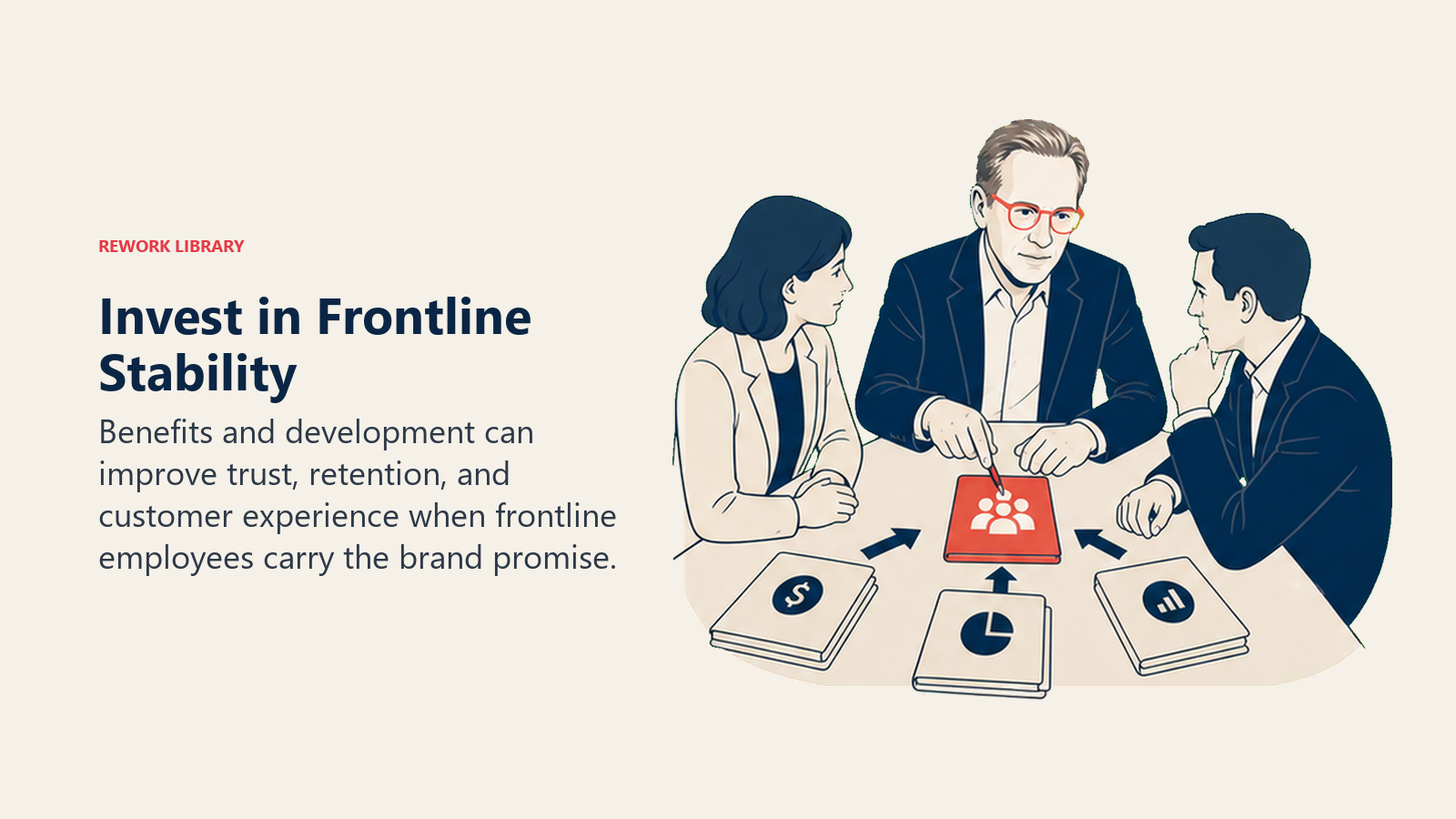
His reasoning was straightforward: Starbucks' service quality depended on frontline engagement. Frontline engagement depended on people feeling some form of security in their jobs. Insurance wasn't charity. It was a structural investment in the thing customers actually experienced, the interaction with the person behind the counter. Peter Drucker made a nearly identical argument decades earlier: the purpose of a business is to create a customer, and everything that touches the customer is therefore a strategic decision, not a cost line. Indra Nooyi's consumer-brand leadership at PepsiCo and Ray Kroc's retail scale at McDonald's both show the same tension between frontline investment and margin pressure, and both resolved it by treating service consistency as the irreducible business variable.
This decision matters for operators today because it reflects a specific kind of cost accounting. Schultz was willing to absorb a visible, near-term expense to protect an intangible, long-term asset: culture. Most companies run the math the other way. They cut the intangibles first when margins tighten. Then they wonder why customer experience declines.
If you're running a service business with frontline staff, the question Schultz's decision poses isn't "can we afford this benefit?" It's "what does it cost us when the people delivering our product stop caring?"
2. The 2008 Return and the Single-Day Store Closure
On February 26, 2008, Starbucks closed all 7,100 US company-operated stores for 3.5 hours in the afternoon. Every barista in the country received espresso retraining. The estimated revenue loss was $6 million. The symbolism was worth more than that.
Schultz had returned as CEO just a few weeks earlier, walking back into a company he'd watched drift. Automated espresso machines had replaced manual pulls. The Starbucks Wikipedia article documents the full scale of the 2008 restructuring: 600 store closures, 18,400 US job cuts, and the single-day retraining event that signaled Schultz meant what he said. Pre-packaged sandwiches had replaced fresh food and filled the stores with smells that competed with coffee. Store count had grown from roughly 2,500 locations when he stepped back in 2000 to nearly 13,000 when he returned in 2008. Efficiency had eaten experience.
The retraining day was a signal, not a solution. The actual turnaround took years and included closing 600 underperforming stores, cutting 19,000 jobs, and rebuilding supply chain disciplines. But the single-day closure communicated something no memo could: this is serious, and we're willing to pay publicly for it.
For operators: signals matter. When a company has drifted from its core standards, fixing the process isn't enough. You need a visible moment that tells the organization you actually mean it. The cost of that signal is almost always worth it.
3. His 2022 Third Stint as CEO and the Union Response
Schultz returned for a third time in April 2022 after Kevin Johnson stepped down, and this stint was his most contentious. By mid-2023, more than 300 Starbucks stores in the US had voted to unionize, a number that grew from near zero to one of the largest private-sector organizing drives in recent American history.
The union push reflected real grievances: understaffing, inconsistent scheduling, and a sense among baristas that the "partner" language Starbucks used had become hollow. Workers Schultz had once called his most important stakeholders were now picketing his stores.
His response was mixed. He increased wages and added benefits during his third tenure, moves he likely would have made regardless. But the labor relations handling, including allegations of anti-union tactics that resulted in National Labor Relations Board complaints, contradicted the employee-first narrative he'd built his reputation on.
The honest read: Schultz's employee investment model worked when Starbucks was a culturally coherent company with a smaller footprint. Scaling to 36,000 locations while maintaining that culture proved harder than the vision demanded. The union organizing wasn't a surprise. It was a symptom.
What Howard Schultz Would Do in Your Role
If you're a CEO running a 50-500 person company, the most Schultz-like move you can make right now is articulating your company's "third place" equivalent. What specific feeling are you building toward? Not your value proposition. Not your feature list. The felt experience you want customers to walk away with. If you can't answer that cleanly, your team definitely can't operationalize it. Start there.
If you're a COO or operations leader, Schultz's 2008 turnaround is your case study. Look at every efficiency-driven decision your company has made in the last 18 months and ask: which ones reduced cost while also reducing what customers experience? Those aren't neutral tradeoffs. They're withdrawals from a trust account. Identify the biggest one and build a plan to reverse it, visibly, this quarter.
If you're a product leader, the lesson isn't about coffee. It's about resisting feature and SKU bloat. Starbucks added breakfast sandwiches, hot food, drive-throughs, and automated machines, all of them individually defensible, collectively diluting. Your product roadmap probably has the same dynamic. What's on it because it makes sense in isolation but weakens the core?
If you're a sales or marketing leader, Schultz's brand-building approach was relational before it was transactional. He was selling membership in a feeling, not a cup of coffee. If your marketing is primarily feature-driven or discount-driven, you're competing on terms that commoditize your product. What's the equivalent of "third place" for your category, the emotional territory only you can credibly own?
How Rework Supports a Schultz-Style Leader
A Schultz-style operator bets that brand experience and employee investment are the same asset, which only works if frontline execution stays consistent across every location, shift, and manager. That's where most values-driven companies quietly fail: the rhetoric lives in the founder's head, but the scheduling, onboarding, and issue-escalation realities live in a sprawl of spreadsheets and chat threads. Rework's Process Engine (from $99/month billed yearly, with 5 seats included) gives culture custodians a single surface to codify the standards they care about, shift checklists, partner feedback loops, training cadences, so the "third place" feeling isn't reinvented by every new store manager. For leaders rebuilding culture after a growth-driven drift, Rework's Sales Engine (from $69/month billed yearly) ties customer feedback directly to the frontline teams who generate it, making the loop Schultz prized, customer experience informing operational decisions, a system rather than a founder's memory.
Notable Quotes and Lessons Beyond the Boardroom
Schultz grew up poor in Brooklyn, the son of a truck driver who broke his ankle on the job and lost his income with no insurance or workers' comp. That origin story runs directly through his decision to give part-time workers healthcare, a point Schultz articulated directly in his 2010 HBR interview, "We Had to Own the Mistakes", where he reflected on what it took to rebuild Starbucks without abandoning the employee-first commitments that defined it. That origin story runs directly through his decision to give part-time Starbucks workers healthcare. "I wanted to build the company that my father never got to work for," he's said in various interviews. That's not just a brand narrative. It's a personal accountability framework.
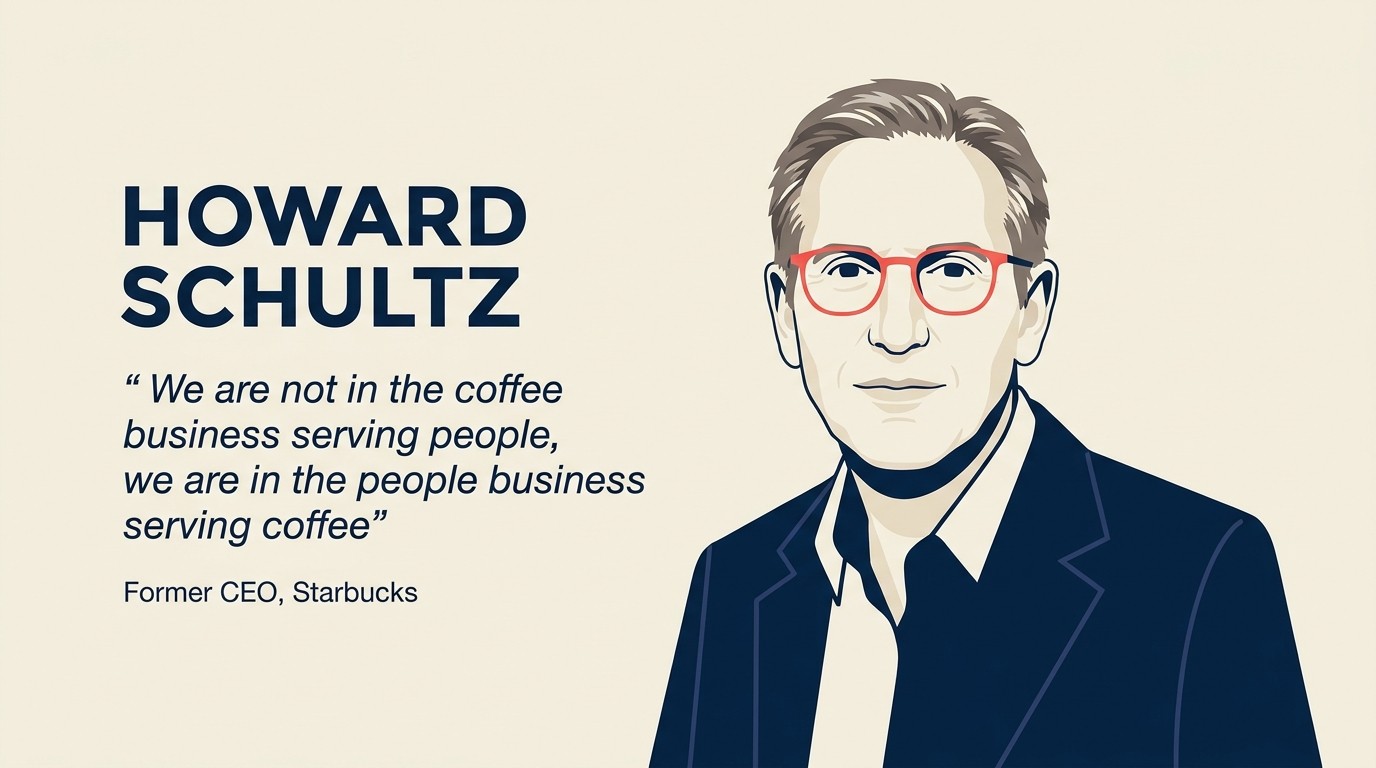
His most quoted line on leadership is probably: "We are not in the coffee business serving people. We're in the people business serving coffee." It reads as a slogan, but it was also an operational directive. Every store decision was supposed to run through that lens. When they stopped running through it in the mid-2000s, the company lost its way. When Schultz returned and insisted on it again, the company found it.
The practical lesson: your leadership principles need to function as decision-making filters, not values statements. If your team can't use them to resolve a real operational tradeoff, staffing level, product quality, cost cut, they're decorative. Schultz's principles, when he lived by them, were load-bearing.
Where This Style Breaks
Schultz's style has a specific failure mode: it doesn't transfer. He's returned to CEO three times because Starbucks hasn't built a succession that works without him. That's partly because his leadership depends on personal conviction and felt sense, neither of which can be written into a management playbook.
The second failure mode is cultural scale. His employee-first model worked when he could personally embody it. At 36,000 stores and 400,000+ partners, culture maintenance requires systems, not just values. The union organizing of 2022-2023 is evidence that the systems lagged the rhetoric.
If you're a founder, the question Schultz's career poses isn't "how do I build a great company?" It's "how do I build a company that doesn't need me to keep coming back?" He hasn't answered that yet.
Frequently Asked Questions about Howard Schultz's Leadership
Who is Howard Schultz?
Howard Schultz (born 1953 in Brooklyn) is an American businessman best known for acquiring Starbucks in 1987 and scaling it from roughly 11 stores to more than 30,000 locations worldwide across three separate CEO tenures (1986–2000, 2008–2017, and a return in 2022).
How did Schultz transform Starbucks?
Schultz reframed Starbucks from a coffee bean retailer into an experiential coffeehouse chain inspired by a 1983 trip to Milan. He rebuilt stores around the "third place" concept, introduced espresso drinks, and invested heavily in employee benefits, treating culture and customer experience as a single strategic asset.
What is the 'third place' concept?
The third place is Schultz's term for a social environment separate from home (first place) and work (second place), a neighborhood gathering spot. He designed Starbucks stores around that idea: comfortable seating, consistent music, familiar baristas, and an unhurried atmosphere meant to encourage lingering rather than pure transactions.
Why did Schultz return to Starbucks multiple times?
Schultz returned in 2008 after watching growth dilute the brand experience, automated espresso machines, pre-packaged food, and aggressive store expansion had, in his words, led to "the commoditization of the Starbucks experience." He returned again in 2022 after Kevin Johnson stepped down, amid unionization pressure and operational strain. Each return reflected his conviction that the founder's judgment was needed to protect culture.
What benefits did Schultz offer Starbucks baristas?
Starting in the late 1980s, Schultz offered health insurance to part-time employees working 20+ hours a week, nearly unheard of in retail at the time. He later added stock options ("Bean Stock"), and in 2014 launched the Starbucks College Achievement Plan offering full tuition reimbursement for an online bachelor's degree at Arizona State University.
What can modern CEOs learn from Howard Schultz?
Three lessons stand out: articulate a felt customer experience rather than a feature list; treat frontline employee investment as a structural driver of service quality, not a cost line; and build succession early, because founder-rescue cycles signal that culture lives in one person rather than the institution.
Learn More
- Visionary Leadership Style: What It Is and When It Works
- How to Build a Culture That Scales Beyond the Founder
- Turnaround Leadership: What It Takes to Fix What You Built
- Employee Experience as Strategy: The Business Case for Investing in People

On this page
- Key Facts: Howard Schultz at a Glance
- The Third Place Doctrine
- Leadership Style Breakdown
- Key Leadership Traits
- The 3 Decisions That Defined Howard Schultz as a Leader
- 1. Healthcare Benefits for Part-Time Workers in the 1980s
- 2. The 2008 Return and the Single-Day Store Closure
- 3. His 2022 Third Stint as CEO and the Union Response
- What Howard Schultz Would Do in Your Role
- How Rework Supports a Schultz-Style Leader
- Notable Quotes and Lessons Beyond the Boardroom
- Where This Style Breaks
- Learn More