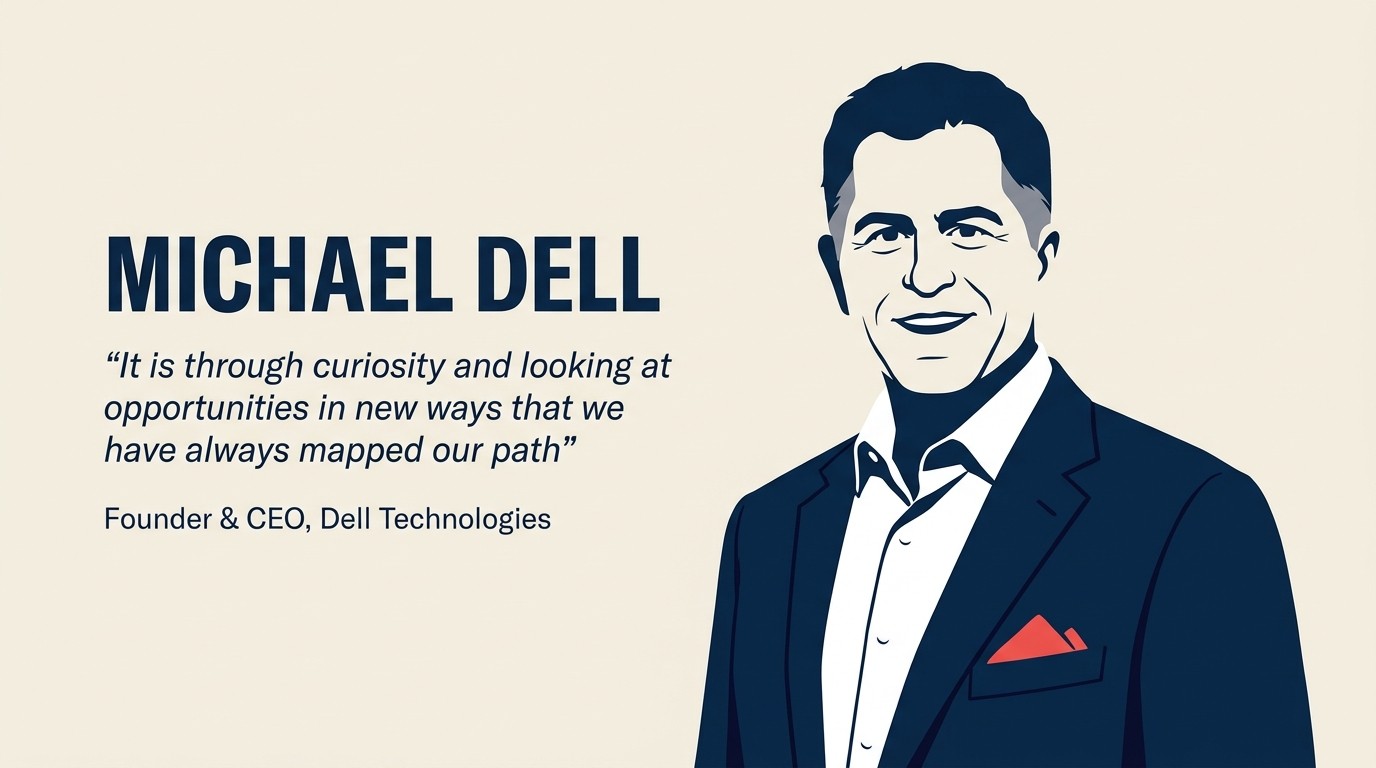
Michael Dell Leadership Style: Direct-to-Consumer Disruption and the Go-Private Bet
Turn this article into takeaways for your work.


Each assistant summarizes the article only for you and suggests best practices for your work.
Here's what most people remember about Michael Dell: started a company in his University of Texas dorm room in 1984 with $1,000 and turned it into a $60 billion PC empire. Here's what most people skip: he stepped down as CEO in 2004 when Dell was still the world's largest PC maker, came back in 2007 when it was falling apart, took the company private in 2013 for $24.9 billion, made what was at the time the largest tech acquisition in history in 2016, then took the company public again in 2018.
That's not a founding story. That's a 40-year operating saga with at least three near-death pivots, each requiring a different kind of leadership.
Key Facts
- Born: 1965, Houston, Texas
- Founded Dell: 1984, in his University of Texas at Austin dorm room, with $1,000 of startup capital
- Core innovation: Pioneered the direct-to-consumer PC sales model with build-to-order manufacturing, eliminating dealer channels and inventory buffers
- Go-private deal: Took Dell private in October 2013 in a $24.9 billion leveraged buyout alongside Silver Lake Partners
- EMC acquisition: Led the $67 billion acquisition of EMC Corporation in 2016, the largest technology deal in history at the time
- Re-IPO: Returned Dell Technologies to public markets in December 2018
- Net worth: Estimated $100B+ (among the wealthiest individuals globally)
- Current role: Chairman and CEO of Dell Technologies
The founding story is interesting. The 2013 go-private decision is what makes Dell worth studying seriously. It's one of the most deliberate strategic resets in tech company history, a founder who saw that public market pressure was destroying his ability to fix a real structural problem, and chose to pay $24.9 billion to buy back the time to fix it properly.
The Dell Take-Private Turnaround
The Dell Take-Private Turnaround is a leadership framework built on a single conviction: when the governance mechanism around a company is forcing short-term behavior that contradicts the long-term strategy, the right move is to change the mechanism, not the strategy. Dell removed public-market quarterly pressure through a $24.9B LBO, then spent a decade, EMC acquisition, debt paydown, VMware spin-off, re-IPO, executing a transformation no public-company CEO could have underwritten cleanly. The doctrine: restructure the constraint before trying to lead differently inside it.
Leadership Style Breakdown
| Style | Weight | How it showed up |
|---|---|---|
| Analytical | 65% | Dell's decision-making has always been numerically grounded. The original Direct model, cutting retailers and distributors to sell build-to-order PCs, was a margin analysis before it was a strategy. The 2013 LBO was underwritten by a detailed model showing that public-market quarterly pressure was structurally incompatible with a multi-year pivot to enterprise infrastructure. The EMC acquisition at $67B was a calculated bet on converged infrastructure at a moment when hybrid cloud was the direction but not yet the market. |
| Execution-Focused | 35% | Dell's operational obsession shows up in his supply chain. The build-to-order model eliminated dealer inventory, which meant Dell didn't own components until a customer had already paid for them. That negative cash conversion cycle, customers paying before suppliers got paid, funded growth without external capital for years. Running a business with negative working capital isn't finance creativity. It's supply chain execution discipline at a level most operators never achieve. |
Key Leadership Traits
| Trait | Rating | What it means in practice |
|---|---|---|
| Supply Chain Mastery | Exceptional | Dell's build-to-order model in the 1990s was genuinely unprecedented at its scale. No dealer channel, no inventory buffer, no finished-goods warehouses. Components arrived from suppliers within hours of a customer order; PCs shipped within days. At peak, Dell's days inventory outstanding was under 4 days while Compaq was running 20+. That gap was the business model. |
| Long-Term Conviction | Very High | The go-private deal required Dell to personally put in $750 million of his own money alongside Silver Lake's investment and $15 billion in debt financing. It closed in October 2013 over significant shareholder opposition. He then spent three years integrating EMC while carrying $50B+ in debt. Most founders would not have had the stomach for a five-year, high-leverage restructuring at that scale. |
| Willingness to Admit Failure | High | Dell publicly acknowledged in 2007 that his company had "lost its way" after returning as CEO. That's not a common admission from a founder coming back to rescue a company. He named specific failures: quality problems, customer service that had deteriorated, a consumer hardware push that didn't fit the operational model. The admission made the restructuring credible. |
| Strategic Patience | High | The full arc of the Dell Technologies transformation, go private 2013, acquire EMC 2016, spin-off VMware 2021, public again 2018, took nearly a decade. Each step was designed to set up the next one. Dell didn't try to transform the company in a single announcement. He built the infrastructure (literally and organizationally) before making the pivot visible. |
The 3 Decisions That Defined Michael Dell as a Leader
1. The Direct Model and Build-to-Order Supply Chain (1984-1999)
Dell didn't invent the personal computer. He invented a distribution model that made PCs cheaper to buy and more configurable than anything a retail channel could offer. Michael Dell started the company from his University of Texas dorm room in 1984 with $1,000 and a simple insight: sell direct and cut the middleman. When you bought a PC from CompUSA or a Best Buy in 1993, you were buying what the manufacturer had guessed customers would want six months earlier, at a price that included retailer margin. When you bought from Dell, you specified exactly what you wanted and Dell built it in three to five days.
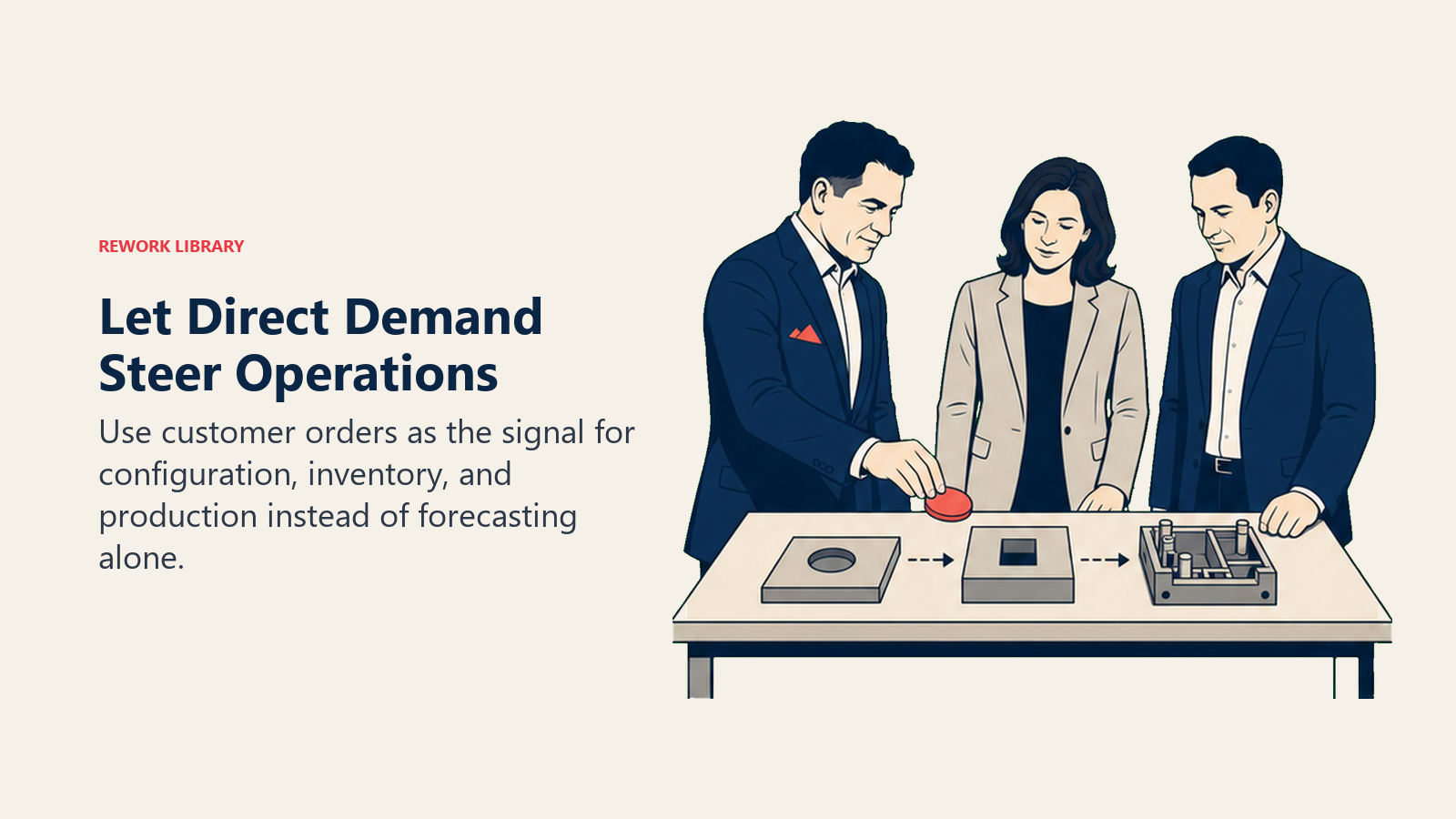
The supply chain behind this was the real innovation. Dell negotiated just-in-time delivery agreements with component suppliers and co-located them near assembly facilities. He signed vendor-managed inventory agreements where suppliers owned the stock in Dell's warehouse until the moment it was used. This meant Dell had virtually no component inventory risk and collected customer payment before it paid suppliers, a negative cash cycle that most manufacturing businesses would consider impossible.
By 1999, Dell's revenue was over $18 billion and it had surpassed Compaq as the world's largest PC maker. The model worked so well that Harvard Business School used it as a case study for a decade.
The leadership lesson isn't "cut out the middleman." It's that distribution model redesign is often more valuable than product redesign. Dell's computers weren't better than Compaq's. His economics were. Where in your business do distribution costs or intermediary margins represent an opportunity that better product development wouldn't touch? Jeff Bezos made the same leap in retail, Bezos's supply-chain disruption playbook is the closest parallel to Dell's model in consumer goods, built on the same logic of eliminating intermediaries and owning the customer relationship directly.
2. Taking Dell Private in 2013
By 2012, Dell was a public company in trouble. PC sales were declining as smartphones and tablets ate consumer demand. HP had passed Dell in enterprise server market share. Quarterly earnings calls were dominated by questions about PC decline that Dell couldn't answer optimistically because the answer was: PCs are a mature market and we need to become something different.
The problem with transforming a public company into something different is that it requires years of investment, margin compression, and strategic uncertainty, exactly the conditions that drive institutional investors to sell. Dell's stock was trading around $10, down from $40 at its peak. Every quarter he spent investing in enterprise services was a quarter that looked like failure to shareholders who wanted PC growth.
He proposed going private in February 2013 with Silver Lake Partners at $13.65 per share, valuing the company at $24.9 billion, at the time the largest technology leveraged buyout in history. It was opposed by activist investor Carl Icahn, who argued shareholders were being shortchanged. The deal closed in October 2013 after a lengthy fight.
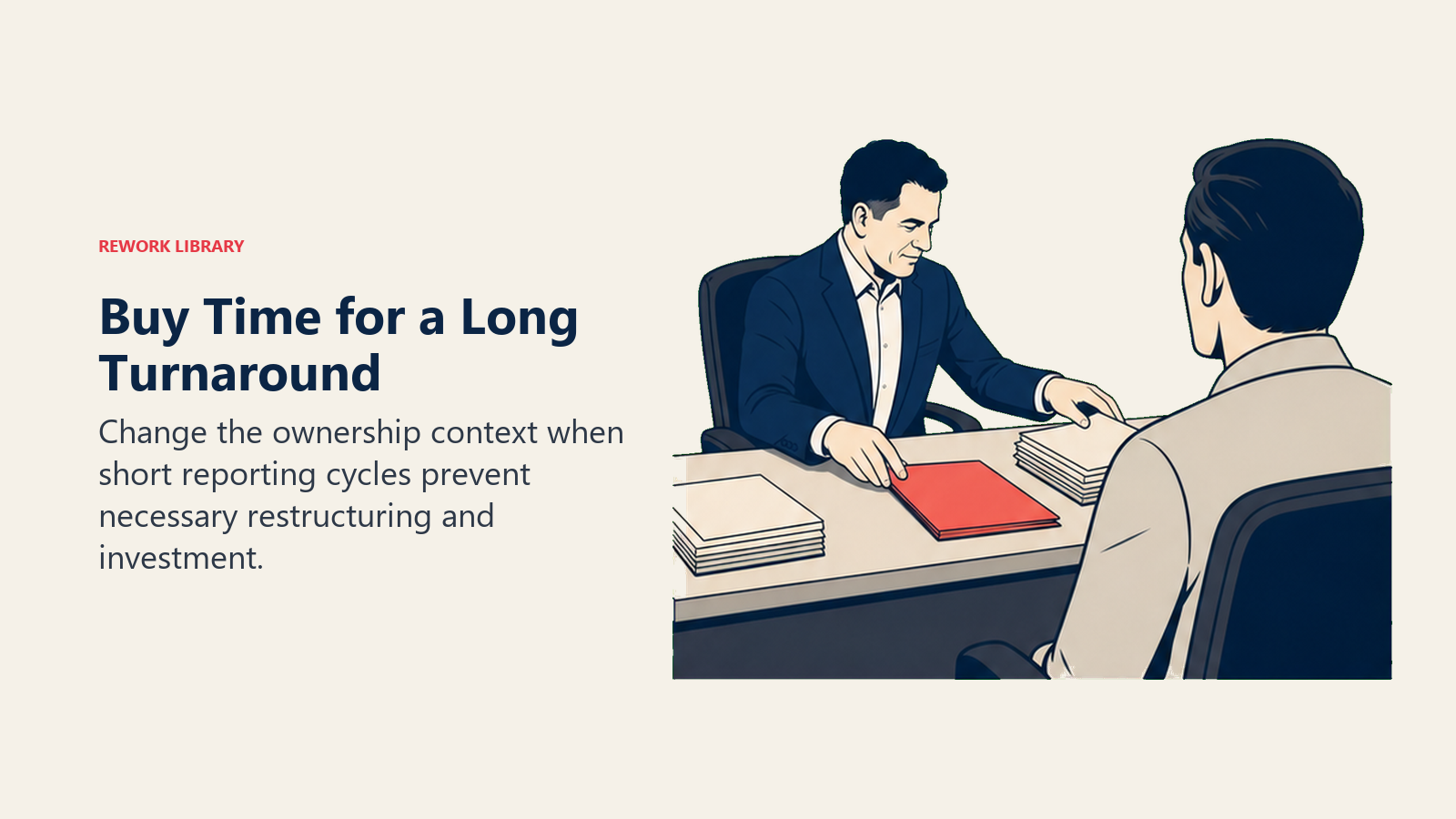
What Dell bought with the deal: time. Without quarterly earnings pressure, he could invest in enterprise infrastructure, services, and software without defending the margin hit on every earnings call. He could fire people without it becoming a news event. He could acquire companies without the stock reacting to the debt. Going private didn't solve Dell's strategic problem; it bought him the operational freedom to solve it himself.
For any operator running a business under short-term performance pressure that makes long-term investment structurally difficult: Dell's answer was structural. He didn't find a way to manage investor expectations better. He removed the mechanism that was creating the constraint.
3. The $67 Billion EMC Acquisition (2016)
Two and a half years after going private, Dell announced the acquisition of EMC Corporation, the enterprise data storage and services giant, for $67 billion. It was the largest technology acquisition in history at the time and remains one of the largest ever.
EMC came with VMware as a subsidiary, the leading virtualization software company, which Dell structured as a separately traded public company (VMware was already public before the deal). The logic: Dell had PC hardware, servers, and networking. EMC had enterprise storage. VMware had the software layer that ran in the data center. Together they could sell converged infrastructure to enterprises that were building hybrid cloud environments and didn't want to integrate five different vendors' products.
The deal loaded Dell Technologies with more than $50 billion in debt. Critics questioned whether Dell could service it, whether enterprise IT was the right bet given cloud providers' growth, and whether integrating a company of EMC's size was achievable.
Dell spent three years integrating and paying down debt. By 2019, the company was generating strong free cash flow from its enterprise segment. VMware spun off as a standalone public company in November 2021. Dell Technologies had become the full-stack enterprise infrastructure vendor it had set out to be.
The EMC acquisition wasn't the kind of deal a public company with analyst pressure could have executed cleanly. The debt load, the integration complexity, and the multi-year payback timeline required exactly the patience that going private had purchased.
What Michael Dell Would Do in Your Role
If you're a CEO, the go-private logic applies beyond literal capital structure. Dell's underlying decision was this: identify the mechanism that's forcing you into short-term behavior you don't believe in, and change the mechanism, not your behavior. For a 50-200 person company, you may not have public shareholders, but you might have a board composition, a funding structure, or a customer concentration that creates the same short-term pressure. Dell would tell you to restructure the governance before trying to lead differently under the same constraints.
If you're a COO, the build-to-order model contains the most transferable insight. Dell achieved competitive advantage by making his inventory position someone else's problem through contract structure, not operational heroics. Look at your own supply chain, vendor relationships, or service delivery model and ask: which inventory risks or fixed costs could you shift to a partner with better information or better economies of scale for holding that exposure? Negative working capital is a design goal, not an accident.
If you're a product leader, the EMC acquisition teaches something specific about platform vs. point solution strategy. Dell didn't acquire EMC because storage was an exciting product category. He acquired it because enterprises don't want to buy storage, compute, networking, and virtualization from four different vendors and integrate them themselves. The full stack was the product. If your company sells one piece of a workflow that customers are currently assembling from multiple vendors, the question Dell would ask is whether you should own more of that stack, or find a partner who already owns the adjacent pieces.
If you're a sales or marketing leader, Dell's original model offers a direct lesson about channel design. The Dell Direct model wasn't just about margin; it was about data. When Dell sold directly, he had complete visibility into what customers were buying, when, and why. Retailers had that data and didn't share it. Your distribution strategy isn't just a revenue question. It's an information question. Which channel gives you closer to real-time signal about what your customers actually need? If it's not the channel you're currently investing in most, that's worth examining.
Applying Dell's Playbook with Rework
Dell's direct-to-customer model works because the operator sees unmediated demand signal, what customers configure, when they buy, what they reject. Retail chains break that loop; full-stack integration inside one vendor restores it. The same logic applies to how a modern operator runs a business through transformation. If your sales pipeline, customer conversations, and account health data sit in three disconnected tools, you're running with the same blind spot Dell's competitors had against him in 1995. Rework consolidates CRM, lead management, customer chat, and cross-team workflows into a single operating surface, so founders see customer-direct signal the way Dell saw order patterns, unfiltered, real-time, and owned by the operator. That's what makes radical ownership of a multi-year pivot possible: you can't restructure a constraint you can't see. Rework gives CEOs the customer-direct visibility the Dell Direct model was built on.
Notable Quotes and Lessons Beyond the Boardroom
"Ideas are a commodity. Execution of them is not." Dell said this early in his career and it remained consistent with how he operated for 40 years. The Direct model wasn't a secret. After it worked, every competitor tried some version of it. But replicating a distribution model requires rebuilding supplier relationships, renegotiating leases, restructuring sales compensation, and retraining customer service, none of which is fast. The insight was public. The execution was the moat.
His other key statement: "You don't have to be a genius or a visionary or even a college graduate to be successful. You just need a framework and a dream." He dropped out of UT Austin in his freshman year. The framework in his case was the Direct model, a clearly articulated logic for why customers would prefer to buy this way, backed by unit economics that proved it before he needed outside capital to scale it.
What the profiles tend to skip: Dell's first CEO tenure ended partly because he'd promoted people loyal to him rather than people who could build the capabilities the company needed next. When he came back in 2007 and needed to pivot to enterprise services, the organizational structure reflected PC-era priorities. The lesson isn't that loyalty is wrong. It's that org design follows strategy, and when strategy changes, the org needs to change with it. Dell had to restructure the leadership team he'd built, which is harder when the people in it are people you trust personally.
Where This Style Breaks
Dell's analytical model is strong when the inputs are clear and the time horizon is long enough to let the thesis play out. It struggles in two situations: fast-moving consumer markets and businesses where brand and taste drive purchasing decisions more than economics.
Dell missed the consumer device moment badly. The original iPhone launched in 2007, the same year Dell came back as CEO. Dell had no meaningful response to the smartphone era. His instinct was to compete on specs and price in a market where Apple was competing on desire. The analytical framing that worked against Compaq in 1995 was the wrong frame for competing against Apple in 2010. Steve Jobs had spent a decade building exactly the category-definition capability that Dell lacked, Jobs's product obsession and category creation is the direct contrast to Dell's cost-engineering genius.
The debt load from the EMC deal also constrained the company for years. Carrying $50B+ in debt at a moment when cloud computing was accelerating meant Dell had less flexibility to invest in cloud-native capabilities. Satya Nadella's Microsoft turnaround is the instructive counter-case, Nadella's legacy-tech transformation at Microsoft shows what a debt-free incumbent can do when it commits fully to cloud, a path Dell's balance sheet made structurally harder. AWS, Azure, and Google Cloud built the next generation of enterprise infrastructure on a different architecture than the one EMC and Dell had bet on. Dell Technologies is still working through how to position itself in a world where the data center is hybrid at best.
And the VMware relationship, arguably the most valuable asset in the portfolio, is now gone as a captive subsidiary. Whether the spinoff was the right call is still being debated.
Frequently Asked Questions about Michael Dell's Leadership
Who is Michael Dell?
Michael Dell (born 1965 in Houston, Texas) is the founder, chairman, and CEO of Dell Technologies. He started the company in 1984 from his University of Texas at Austin dorm room with $1,000 and built it into one of the largest technology companies in the world. His net worth is estimated at over $100 billion.
What is the Dell Direct Model?
The Dell Direct Model is the build-to-order, direct-to-consumer sales approach Dell pioneered in the late 1980s and 1990s. Instead of selling through retailers like CompUSA or Best Buy, Dell sold PCs directly to customers, who specified configurations online or by phone, and built each machine only after payment. This eliminated dealer margins, removed finished-goods inventory, and created a negative cash conversion cycle where customers paid before suppliers did.
Why did Dell take his company private in 2013?
By 2012, Dell's PC business was in decline and the company needed to pivot to enterprise infrastructure, a multi-year transformation that required margin compression and heavy investment. Public-market quarterly pressure made that pivot structurally difficult. In October 2013, Dell closed a $24.9 billion leveraged buyout with Silver Lake Partners, at the time the largest technology LBO in history, to remove quarterly earnings pressure and buy the operational freedom to restructure the business.
What was the Dell-EMC acquisition?
In 2016, Dell Technologies acquired EMC Corporation, the enterprise data storage and services giant, which also owned VMware, for approximately $67 billion. It was the largest technology acquisition in history at the time. The deal combined Dell's servers, networking, and PCs with EMC's storage and VMware's virtualization software to create a full-stack enterprise infrastructure vendor for hybrid-cloud environments.
What is Dell's leadership style?
Dell's leadership style is predominantly analytical (roughly 65%) with strong execution focus (roughly 35%). He is known for numerically grounded decision-making, supply chain mastery, long-term conviction on multi-year transformations, and a willingness to publicly admit failure, as he did in 2007 when he returned as CEO and acknowledged Dell had "lost its way." He combines patience at the strategic level with operational discipline at the execution level.
What can founders learn from Michael Dell?
Three lessons stand out. First, distribution model redesign is often more valuable than product redesign, Dell's PCs weren't better than Compaq's, but his economics were. Second, if short-term governance pressure is forcing behavior that contradicts your long-term strategy, change the mechanism rather than the behavior, the go-private move is the template. Third, admitting failure openly makes restructuring credible; Dell's 2007 acknowledgement that the company had lost its way was the foundation of the decade-long turnaround that followed.
Learn More
- Build-to-Order Supply Chains: How Dell Turned Inventory Into a Competitive Weapon
- When to Take Your Company Private: Capital Structure as Strategic Tool
- Platform vs. Point Solution Strategy: Building Full-Stack Value
- Founder-Led CEO Returns: What Happens When the Founder Comes Back

On this page
- Key Facts
- The Dell Take-Private Turnaround
- Leadership Style Breakdown
- Key Leadership Traits
- The 3 Decisions That Defined Michael Dell as a Leader
- 1. The Direct Model and Build-to-Order Supply Chain (1984-1999)
- 2. Taking Dell Private in 2013
- 3. The $67 Billion EMC Acquisition (2016)
- What Michael Dell Would Do in Your Role
- Applying Dell's Playbook with Rework
- Notable Quotes and Lessons Beyond the Boardroom
- Where This Style Breaks
- Learn More