Stewart Butterfield's Leadership Style at Slack
Turn this article into takeaways for your work.


Each assistant summarizes the article only for you and suggests best practices for your work.
Key Facts: Stewart Butterfield (born 1973) studied philosophy at the University of Victoria (BA, 1996) before a master's degree at Cambridge, then co-founded Ludicorp in Vancouver in 2002 with Caterina Fake to build a multiplayer game called Game Neverending. When the game stalled, they shut it down to chase a photo-sharing side feature instead, and Flickr launched in February 2004. Yahoo announced its acquisition of Ludicorp in March 2005, reportedly for around $35 million. Butterfield left Yahoo in 2008 and founded Tiny Speck in Vancouver the following year to build a game called Glitch, which shut down in December 2012; the company salvaged its internal chat tool and shipped it as Slack instead. Slack's August 2013 preview drew roughly 8,000 signup requests in 24 hours, it publicly launched in February 2014 and hit 500,000 daily active users by its first birthday, and Slack went public via direct listing in June 2019 without raising new capital. Salesforce closed its $27.7 billion acquisition of the company in July 2021, and Butterfield announced his departure in December 2022. Since then he has run no company of his own, describing his focus in a November 2025 interview as "family, philanthropy, and creative projects" and working as an angel investor and advisor.
Stewart Butterfield gets filed under founders who got lucky twice, the guy whose failed video games somehow turned into Flickr and Slack. That undersells the skill involved. Building a game and having it fail is common. Recognizing, twice, which piece of the wreckage is worth keeping is not. In 2004 the keepable piece was a photo-sharing side feature bolted onto a multiplayer game nobody was playing. In 2012 it was an internal chat tool his own engineers had built to talk to each other while making a different, worse game. Both times the product that actually shipped was not the product Butterfield set out to build. Both times he had to convince a team that had just lost a fight that the leftover piece was the real prize.
That's a sharply different model from most of the founders in this collection. Drew Houston built one company, Dropbox, for 17 years and pivoted its product without ever declaring the original bet a failure. Eric Yuan left Cisco with a specific engineering diagnosis and built the fix from scratch, on his own terms, from day one. Butterfield's pattern required something closer to an editor's instinct than a builder's: ship the game, watch what the users actually do with the thing that wasn't the point, then have the discipline to kill the point and keep the byproduct.
The nearest genuine peer isn't in Silicon Valley at all. Tobi Lutke built Shopify in Ottawa after his original venture, an online snowboard shop called Snowdevil, ran into the same wall: the e-commerce software built to sell snowboards worked better than the snowboard business itself. Slack came out of Vancouver, Shopify came out of Ottawa, and both companies exist because their founders noticed the support tool was the real business. Lutke got there once. Butterfield is the rarer case: he got there twice, a decade apart, on two products nobody would group together.
The Salvage Doctrine
The Salvage Doctrine is Butterfield's operating premise that a failing product often contains, buried inside it, a working product nobody set out to build, and that a leader's job is to notice the byproduct before the team's morale, and the payroll, run out. It is not a pivot in the conventional startup sense of adjusting a business model in response to market feedback while the same team keeps building the same thing under a new name. Butterfield's version required an actual death first: a shut-down game, refunded user deposits, laid-off employees, before the salvage could happen honestly. He's been candid that his own read on the odds wasn't encouraging. On Reid Hoffman's Masters of Scale podcast, he described the moment plainly: "At this point, I've learned that this is not going to be a commercially viable creation." What followed both times wasn't a redesign. It was a decision to stop making the thing he'd set out to make and ship the leftover instead.
The doctrine's second half is about persuasion, not products. A salvaged byproduct only becomes a company if a team that just watched its actual project die agrees to bet again on the consolation prize. Butterfield has said the job description for that moment is close to the whole job of running a company: "The job of a CEO is often just to come up with a story that enough people believe that you can make something happen in the world." Twice, he told that story to a demoralized team immediately after a public failure. Twice, enough people believed it to build a real company on top of it.
Leadership Style Breakdown
| Style | Weight | How it showed up |
|---|---|---|
| Salvage Operator | 40% | Recognized, in 2004 and again in 2012, that the side effect of a failing product was more valuable than the product itself, and had the discipline to kill the original goal rather than keep patching it. Both Flickr and Slack exist because Butterfield stopped building the game he actually wanted to build. |
| Category-Defining Writer | 35% | Before Slack's public launch, he wrote "We Don't Sell Saddles Here," a memo arguing Slack wasn't selling chat software but organizational change, and used it to align his own team on what they were actually building before a single customer saw the product. |
| Capital-Markets Contrarian | 25% | Chose a direct listing over a conventional IPO in 2019, explicitly to avoid diluting existing shareholders for capital Slack didn't need, then two years later accepted a $27.7 billion acquisition rather than keep fighting Microsoft alone as an independent public company. |
The 40/35/25 split matters because the writing is what let the salvage instinct survive contact with other people. A founder who quietly notices the byproduct but can't articulate why it matters just looks indecisive to a team that watched the original plan die. Butterfield's memos were the mechanism that turned "we're keeping the leftover chat tool" into a company people wanted to build for years. The capital-markets decisions sit underneath both, since neither one matters if the person in charge can't also handle who owns the company and on what terms.
Key Leadership Traits
| Trait | Rating | What it means in practice |
|---|---|---|
| Recognizing the byproduct as the asset | Exceptional | Twice, Butterfield looked at a failing product built for one purpose and correctly identified that a different, smaller piece of it was the actual business. That's a specific, rare form of pattern recognition, not general founder optimism. |
| Writing as a positioning tool | Very High | "We Don't Sell Saddles Here," sent to his own team two weeks before Slack's preview launch, argued Slack was selling "a reduction in information overload" and organizational change, not chat software, before a single outside customer had seen the product. |
| Handling a shutdown humanely | High | When Glitch closed in December 2012, Butterfield didn't just wind the company down. Tiny Speck built a page listing the roughly 30 laid-off employees' skills and contact details to help them find new jobs, and linked it from the closure announcement itself. |
| Willingness to cede control at the right moment | High | He chose a direct listing over an IPO in 2019 specifically to avoid diluting shareholders for capital Slack didn't need, then accepted Salesforce's $27.7 billion acquisition offer in December 2020 rather than keep running Slack as an independent public company. |
| Sustained execution against a better-resourced rival | Medium | The instinct that made him great at recognizing when to kill a plan is a different skill from the instinct required to out-execute Microsoft on distribution for a decade. Slack's later years under his leadership are the clearest evidence of that gap, examined below. |
The 3 Decisions That Defined Stewart Butterfield as a Leader
Each one required Butterfield to give up something he'd already built in order to keep something smaller and, at the time, unproven.
1. Killing Game Neverending to Ship Flickr Instead (2002 to 2004)
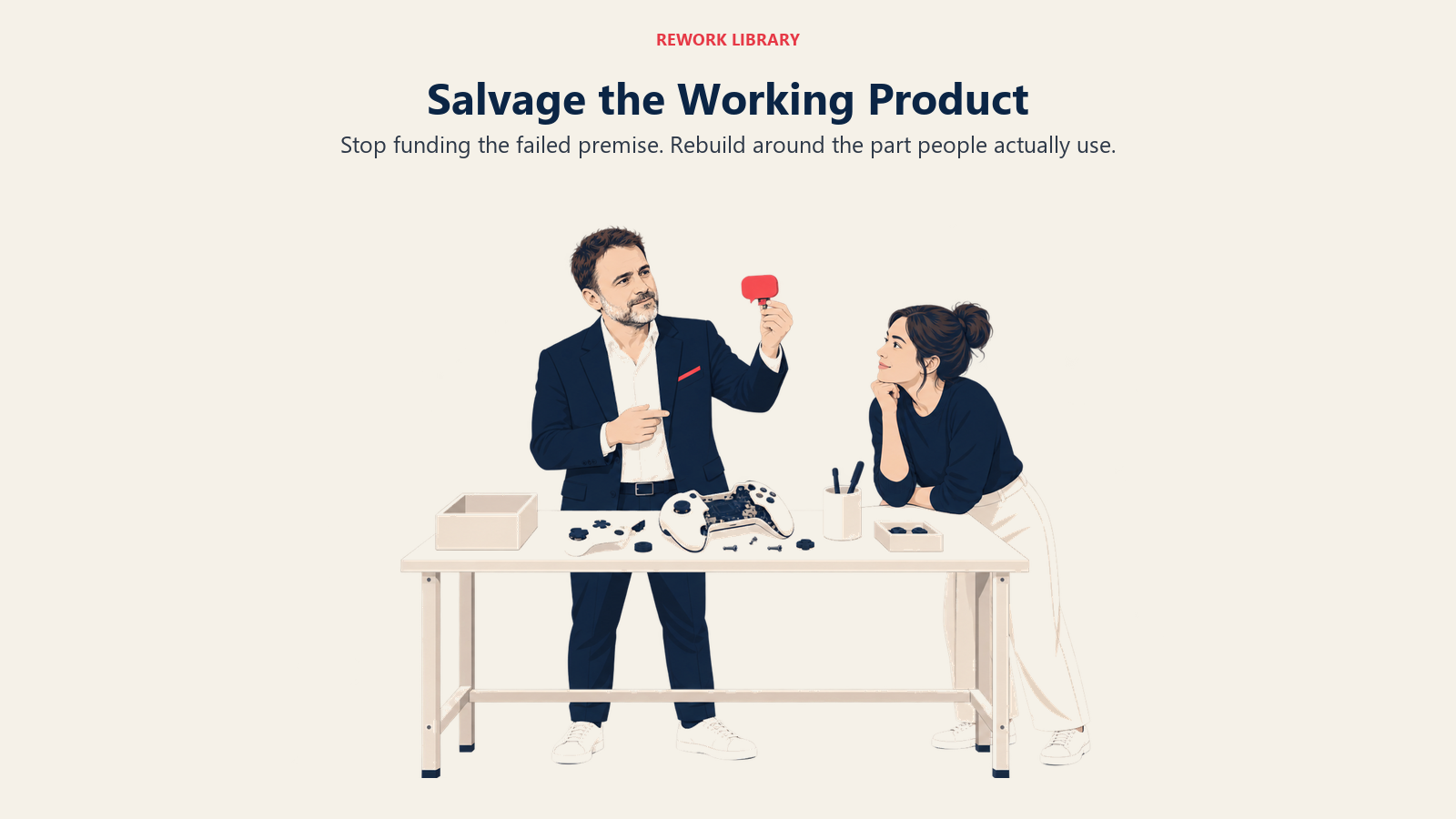
Butterfield co-founded Ludicorp in Vancouver in 2002 with Caterina Fake and Jason Classon to build Game Neverending, a massively multiplayer online game. Money got tight as development dragged on, and a photo-sharing feature the team had bolted on for players to share screenshots started pulling more genuine engagement than the game itself. Fake later described how accidental the whole thing was: "Had we sat down and said, 'Let's start a photo application,' we would have failed." Rather than keep the game alive as the flagship product and treat photo sharing as a feature, Butterfield and Fake shut Game Neverending down entirely and rebuilt the company around what became Flickr, which launched in February 2004.
Yahoo announced its acquisition of Ludicorp in March 2005, reportedly for around $35 million, a deal Butterfield later called a mistake given how the market moved afterward: "We definitely made the wrong decision in retrospect," he said, pointing to the much larger sums that comparable social products commanded within a year or two of Flickr's sale. That's a genuinely useful admission, because it separates two different skills that get conflated in founder mythology. Recognizing which product to build was the harder call, and Butterfield got it right. Pricing what he'd built was a separate call, and by his own account he got that one wrong.
The transferable lesson: the instinct to recognize a byproduct's real value doesn't automatically extend to correctly valuing it once it's built. Butterfield's Game Neverending call was a leadership decision about what to build. Selling Ludicorp for what turned out to be a fraction of comparable deals was a negotiating decision, and he's been unusually candid that the same person can nail one and miss the other.
2. Killing Glitch, Salvaging Slack, and Defining It Before Anyone Used It (2012 to 2013)
By late 2012, Tiny Speck had raised more than $17 million to build Glitch, a browser-based multiplayer game, and it wasn't working. Butterfield made the call to shut it down that November, with Glitch's servers going offline on December 9, 2012, laying off roughly 30 employees in the process. Rather than simply announce the closure and move on, Butterfield linked a page from the shutdown announcement listing the laid-off staff's skills, photos, and contact details, an effort to get them hired elsewhere before the news even settled. It's a small thing next to killing a company, but it's the kind of decision that shows whether a leader treats a shutdown as a paperwork exercise or an obligation to the people who bet their jobs on the plan failing to fail.
What Tiny Speck kept from Glitch was the internal messaging system its distributed team had built to coordinate development, channels, searchable history, file sharing, synced across devices. Butterfield has said the recognition came directly at the point of failure, describing it on Masters of Scale as the moment he'd concluded the game itself "is not going to be a commercially viable creation" and the internal tool was the thing actually worth building around. Two weeks before Slack's August 2013 preview release, he wrote the internal memo that made the case to his own team before it ever reached a customer: "We Don't Sell Saddles Here." The memo argued Slack wasn't in the business of selling chat software any more than a saddle company is really selling saddles, it was selling "a reduction in information overload, relief from stress, and a new ability to extract value" from work that had been happening in email and hallway conversations for decades, and that "centralized internal communication systems will gradually replace email for most organizations over the next 10-20 years."
That memo, and not the product screenshots, is what actually launched Slack. A team that just watched a funded game die needs a reason to believe the leftover chat tool is the real business, not a consolation prize, and Butterfield supplied that reason in writing before a single outside customer weighed in. The preview drew roughly 8,000 signup requests in its first 24 hours and 15,000 within two weeks, by word of mouth alone. The transferable lesson: when you're asking a team to bet on the byproduct of a failure instead of the thing they signed up to build, the case for why it matters has to exist before launch, not as marketing copy after the fact.
3. Choosing a Direct Listing, Then Selling to Salesforce for $27.7 Billion (2019 to 2021)
By 2019, Slack had grown large enough to go public, and Butterfield chose a direct listing on the NYSE rather than a traditional IPO, only the second large company after Spotify to do so. He was explicit about why: Slack didn't need to raise new capital, and a direct listing let the market set the price without the allocation games of a traditional roadshow. Asked about it, he said the appeal wasn't cost savings so much as fairness of access: "In a direct listing, at least they have an opportunity" to buy in on the same terms as institutional investors, rather than getting whatever allocation was left over. The stock opened well above its reference price on debut, a validation of the bet that Slack didn't need underwriters to manufacture demand.
Eighteen months later, Salesforce agreed to buy Slack in a deal announced in December 2020 and closed in July 2021 at $27.7 billion, Salesforce's largest acquisition ever. Marc Benioff framed the deal as building "the digital HQ" for the post-pandemic enterprise, and Butterfield stayed on as CEO of Slack inside Salesforce, saying at the time that the two companies were "uniquely positioned to lead this historic shift to a digital-first world." That's a very different kind of decision than the two salvage calls that built the company. Nobody forced Slack to sell. Microsoft Teams was bundled into Office 365 and growing fast, but Slack was still an independent public company with real revenue and a direct-listing narrative about not needing anyone else's capital. Selling anyway was a bet that Slack's growth curve, standing alone against a competitor with infinite distribution, had a worse expected outcome than joining a bigger platform.
The transferable lesson: the same clear-eyed instinct that tells you when to kill a failing game can also tell you when your independent company is heading toward a fight it's more likely to lose slowly than win outright. Butterfield had already proven, twice, that he could recognize a losing position before it became undeniable. Selling to Salesforce while Slack was still strong, rather than after Teams had visibly won, was that same instinct applied to a decision with far higher stakes and far less romance attached to it.
What Stewart Butterfield Would Do in Your Role
If you're a founder whose flagship product isn't working, Butterfield's advice isn't in a memo, it's in the pattern: look hard at what your team actually uses, builds, or gravitates toward while trying to ship the thing you told investors you'd build. Twice, the real business was the tool built to support the game, not the game. Before you spend another six months fixing the thing that isn't working, ask what your team already built that they didn't mean to build, and whether that's actually the company.
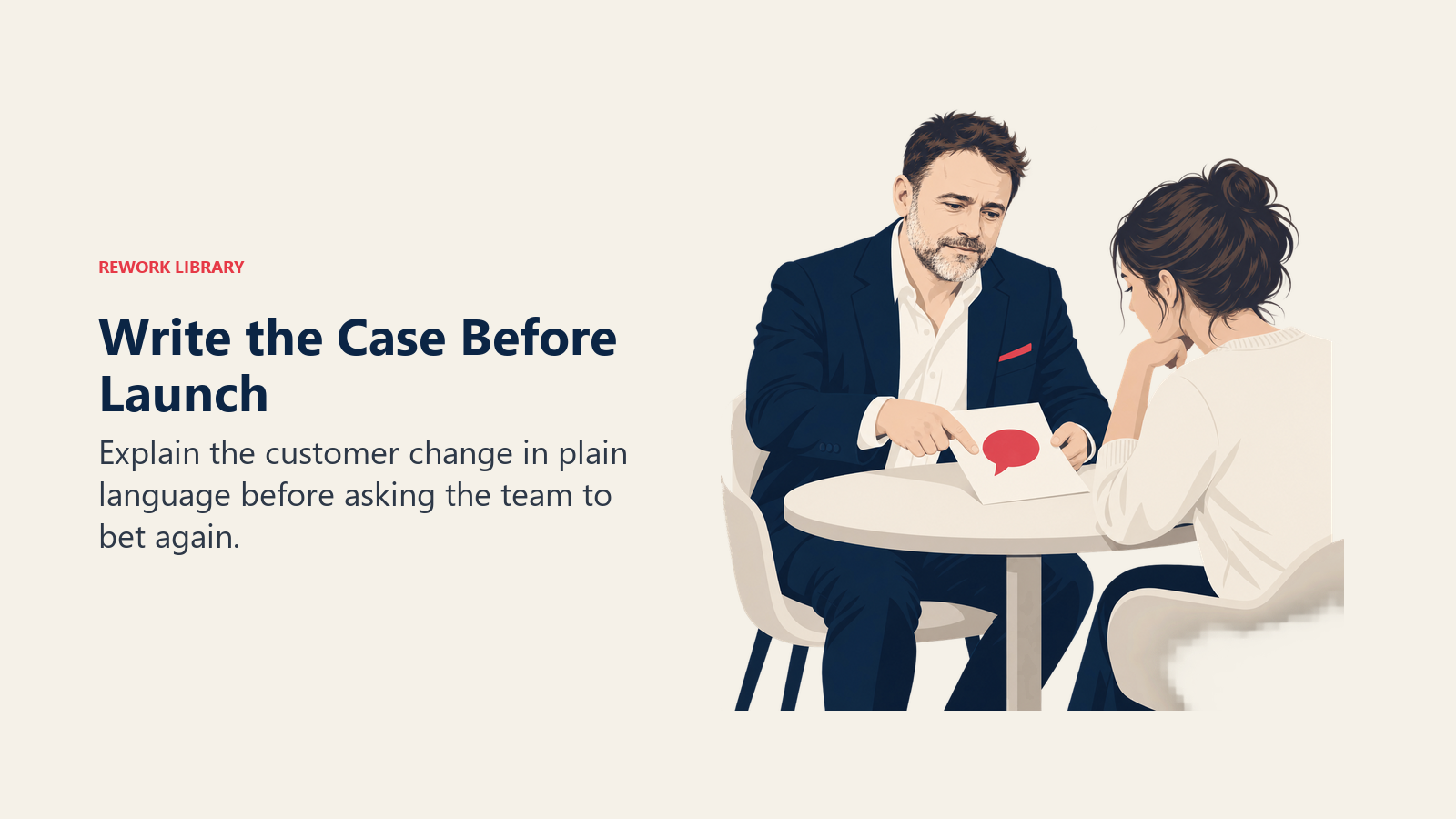
If you're a product or marketing leader launching something genuinely new, "We Don't Sell Saddles Here" is the model worth stealing directly. Butterfield didn't wait for a launch to explain what Slack actually was. He wrote the positioning down for his own team two weeks before a single customer saw it, arguing Slack sold relief from information overload, not chat software. If your team can't articulate what you're actually selling in a memo before launch, a press release afterward won't fix that.
If you're an executive managing a shutdown, a layoff, or a wind-down, the "Hire a Genius" page is worth more attention than it gets. Butterfield didn't just announce Glitch's closure and let 30 people scramble. He linked a page listing their skills and contact information from the announcement itself, treating the obligation to laid-off staff as part of the shutdown, not an afterthought to it.
| Situation you're facing | Butterfield's likely move |
|---|---|
| Your flagship product isn't gaining traction, but a side tool your team built is getting real use | Kill the flagship, rebuild the company around the side tool, and be honest with the team that the pivot is total, not cosmetic |
| You're about to launch something your own team doesn't fully understand yet | Write the positioning down in plain language before launch, for your own people first, not for the press |
| You have to shut down a product and lay off staff | Treat placing those employees elsewhere as part of the shutdown plan, not a courtesy you get to skip |
| You need capital but raising it would dilute shareholders unnecessarily | Look hard at whether you actually need to raise at all before defaulting to the standard process |
| Your independent company is in a slow-motion losing fight against a much larger, better-distributed rival | Sell from a position of remaining strength rather than waiting until the losing trend is undeniable to everyone |
Notable Quotes & Lessons Beyond the Boardroom
On what Slack was actually selling, from the memo written two weeks before launch: "What we are selling is organizational transformation," Butterfield wrote, arguing the product itself was almost beside the point next to the change in how a company communicates. The saddle metaphor did the real work: a saddle company that sells more saddles by selling horseback riding instead grows the whole market, rather than fighting over share of a category customers were never excited about to begin with.
On what actually convinces people to follow a leader through a pivot, he's been unusually direct that it comes down to storytelling, not data: "The job of a CEO is often just to come up with a story that enough people believe that you can make something happen in the world," he said on Masters of Scale, adding that if he could give his younger self one piece of advice, it would be to "concentrate on that storytelling part, on the convincing people." That's a strikingly unromantic description of leadership from someone whose two biggest career decisions both required convincing a demoralized team to bet again immediately after a public failure.
On leaving, after selling the company for $27.7 billion and staying another 18 months to run it inside Salesforce, his exit line is the best in the whole story: "I'm not going to do anything entrepreneurial," he wrote in his December 2022 announcement, adding, "As I said in my announcement to Slack team, these days my fantasies are about gardening." Nearly four years later, that's held. He hasn't founded a third company. He's investing and advising, the closest thing to a stated retirement a two-time unicorn founder has offered publicly.
Where This Style Breaks
A leader whose greatest skill is recognizing when to abandon the plan is, by definition, not the leader you want when the plan actually needs five more years of unglamorous grinding. Slack's core problem after roughly 2016 was never a failure to notice the right byproduct. It was a straight execution fight against Microsoft bundling Teams into Office 365 for free. The skill that built the company twice wasn't the skill it needed most once the real threat stopped being an internal failure to salvage and became an external competitor with more distribution than Slack could out-execute.
The Salesforce years are the second honest tension. Butterfield had spent his whole career as the founder making the calls, first at Ludicorp, then at Tiny Speck. Inside Salesforce he became a business-unit leader answering to Marc Benioff's broader operating culture, a genuinely different job under the same title. He stayed roughly 18 months after the deal closed before announcing his departure in December 2022, a short run for someone who'd built the two companies before it over more than a decade each. That's not necessarily a failure on either side. It's evidence that founder instincts don't automatically transfer to running the same product as one division inside a much larger company with its own established culture.
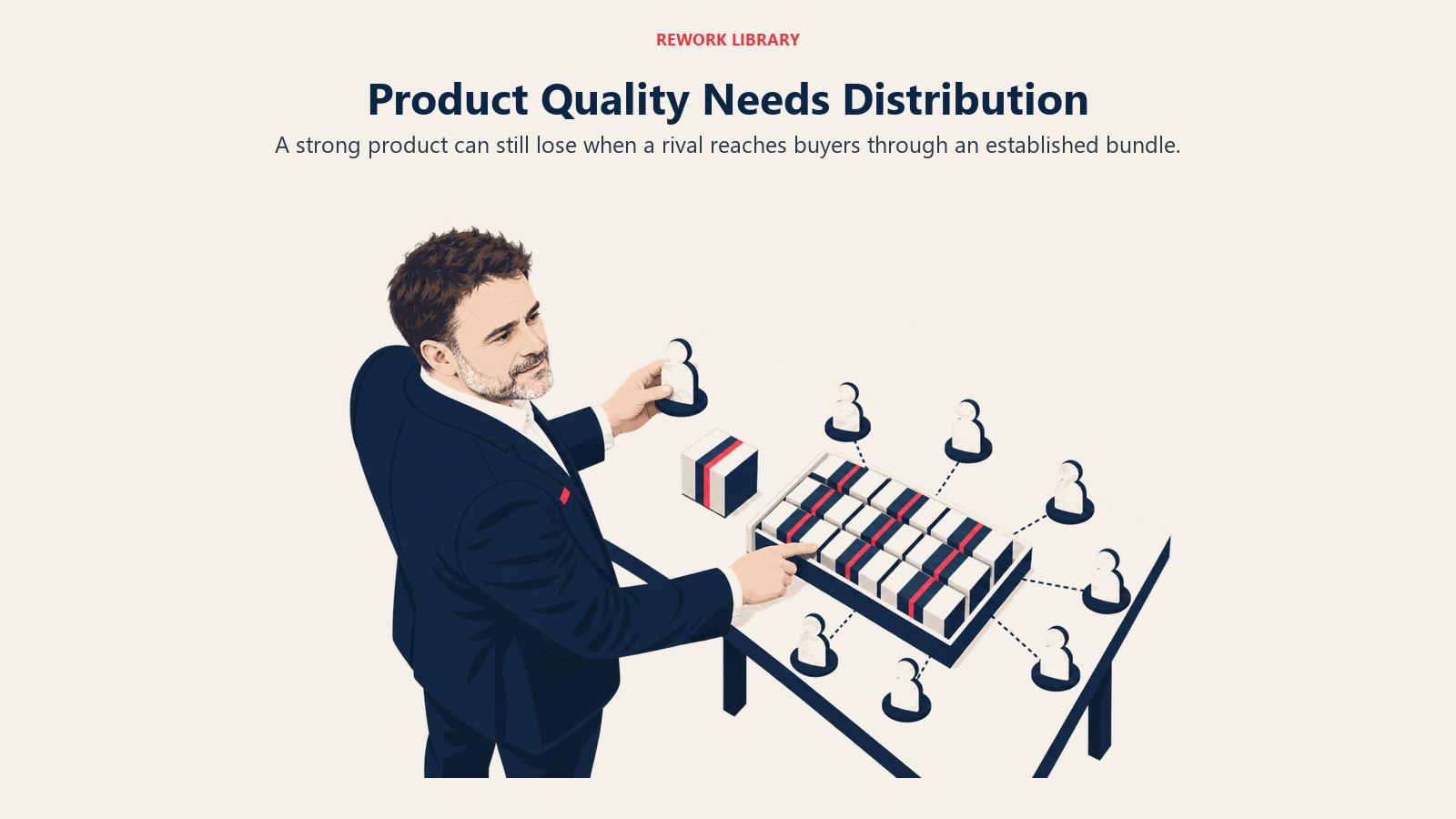
The bluntest evidence against the Salvage Doctrine as a universal leadership model is Slack's own competitive position by the time it sold. Slack had, by most independent accounts, the better product for years running. It lost ground to Teams anyway, because Microsoft could give Teams away inside a bundle enterprises already bought, a distribution advantage no amount of product quality or clever internal memos could fully offset. Drew Houston faced a nearly identical version of this fight against Google Drive and OneDrive at Dropbox, and both founders' answer was the same: stop trying to win the distribution war on the incumbent's terms and move up the stack instead. That it took a $27.7 billion sale to fully resolve the pressure at Slack, rather than a product decision, is the clearest evidence that Butterfield's defining strength was never going to be the thing that won a war of attrition against a platform holder.
Learn More
- Tobi Lutke Leadership Style: Two Founders, Two Failed First Acts, One Shared Canadian Playbook
- Marc Benioff Leadership Style: Building the Digital HQ
- Eric Yuan Leadership Style: Delivering Happiness at Zoom
- Drew Houston Leadership Style: 17 Years as Dropbox CEO
- Brian Chesky Leadership Style: Founder-Mode and Airbnb's Crisis Pivot
- Paul Graham's Leadership Lessons for Startups
- Patty McCord Leadership Style: Netflix's Freedom and Responsibility Culture
- Satya Nadella Leadership Style at Microsoft

Co-Founder, Rework.com
On this page
- The Salvage Doctrine
- Leadership Style Breakdown
- Key Leadership Traits
- The 3 Decisions That Defined Stewart Butterfield as a Leader
- 1. Killing Game Neverending to Ship Flickr Instead (2002 to 2004)
- 2. Killing Glitch, Salvaging Slack, and Defining It Before Anyone Used It (2012 to 2013)
- 3. Choosing a Direct Listing, Then Selling to Salesforce for $27.7 Billion (2019 to 2021)
- What Stewart Butterfield Would Do in Your Role
- Notable Quotes & Lessons Beyond the Boardroom
- Where This Style Breaks
- Learn More