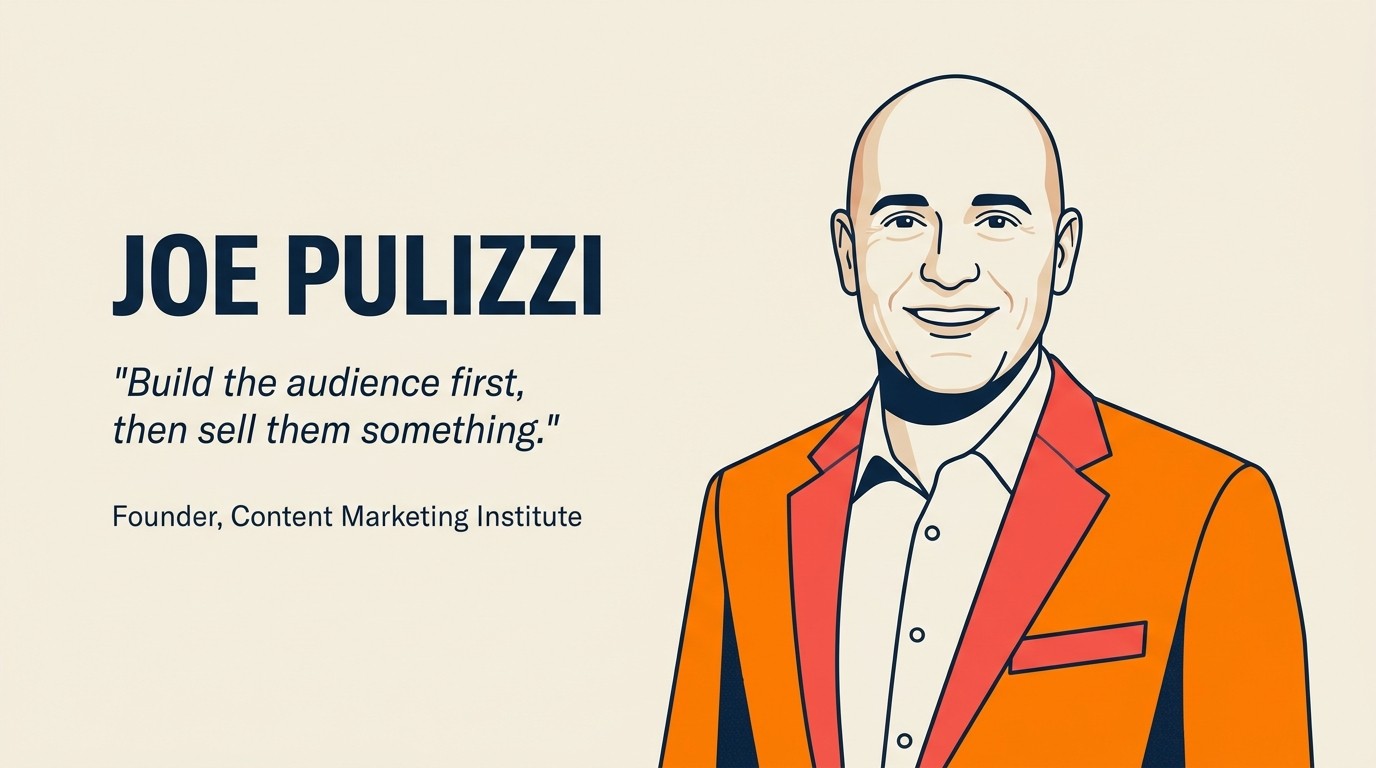
Joe Pulizzi Leadership Style: Build the Audience Before You Build the Product
Turn this article into takeaways for your work.


Each assistant summarizes the article only for you and suggests best practices for your work.
Joe Pulizzi founded the Content Marketing Institute in 2007 with no outside funding. He worked out of Northeastern Ohio, not San Francisco, and he started with a blog and a white paper publishing operation. Eight years later, Content Marketing World was drawing 4,000+ attendees to Cleveland annually, CMI's research reports were the most cited data source in content marketing strategy decks, and UBM paid an estimated $17 million to acquire the whole thing.
He did it by following his own advice: pick a niche no one is serving well, publish consistently for years, build an audience before you ask for anything, and monetize the audience second.
Key Facts
- Founded Content Marketing Institute (CMI) in 2007, bootstrapped from Northeastern Ohio with no outside funding
- Sold CMI to UBM in 2016 for an estimated $17.6 million after building it into the dominant education brand in the category
- Coined the term "content marketing" as the working name for the discipline, then built CMI to define and standardize it
- Authored 6 books, including Epic Content Marketing (2013), Content Inc. (2015), Killing Marketing (2017, with Robert Rose), and Content Inc. Second Edition (2021)
- Founded The Tilt in 2021, a newsletter and education business serving independent content entrepreneurs
- Launched the Content Entrepreneur movement, reframing solo creators and niche publishers as a legitimate business category rather than a hobby tier
The Audience-First Doctrine (Content Inc. Model)
The Audience-First Doctrine is Pulizzi's core thesis that a durable content business is built by attracting and retaining a specific audience for 18 to 24 months before any monetization is attempted. The Content Inc. Model operationalizes this by sequencing six steps, sweet spot, content tilt, base, audience harvest, diversification, monetization, and treating the order as non-negotiable. Most content programs fail because they invert the sequence and try to monetize an audience that hasn't been built yet.
That's the Content Inc. model, a framework he laid out in a 2015 book after watching 99% of content marketers skip straight to the monetization step and wonder why it didn't work. The framework is simple enough to fit on a napkin and hard enough to execute that most businesses quit before the audience shows up.
Pulizzi left CMI in 2018, took time off, then founded The Tilt in 2020, a newsletter and community for independent content entrepreneurs. He followed the Content Inc. model publicly a second time, with full visibility into what he was doing and why. That's either a very confident founder or someone who genuinely believes the playbook works.
Leadership Style Breakdown
| Style | Weight | How it showed up |
|---|---|---|
| Audience-First Builder | 65% | Pulizzi treats audience as the asset class, not the byproduct. Every business decision at CMI was evaluated against whether it served or distracted from the audience relationship. He didn't launch products because they were interesting, he launched them because his audience had signaled demand. Content Marketing World started because the CMI blog readership wanted a place to meet. The annual B2B Content Marketing Report started because practitioners needed benchmarking data. The content strategy produced the community, and the community produced the conference, and the conference produced the acquisition price. |
| Content Business Operator | 35% | Pulizzi understood that audience building without a monetization plan is journalism, not a business. The 35% operator layer meant he was always thinking about the sequence: build the base first, then monetize it in ways that the audience would pay for. At CMI, that sequence was: blog → email list → research reports → conference → training programs → advisory services. Each step monetized the audience at a higher value level without alienating the core readership. |
That split is important because most content marketers either skip the audience-first stage or never get to the operator stage. Pulizzi did both, in order, and was disciplined about not reversing them.
Key Leadership Traits
| Trait | Rating | What it means in practice |
|---|---|---|
| Niche-down discipline | Exceptional | Pulizzi's original thesis was that "content marketing" was an underserved category, there were practitioners doing it, nobody was serving them with dedicated education and community. That niche now seems obvious. In 2007 it was a bet. The discipline is in resisting the impulse to broaden too early. CMI stayed focused on content marketing practitioners, not marketing broadly, not digital marketing, not brand marketing. That narrowness is what made the audience cohesive enough to build from. |
| Patience with audience-building timelines | Very High | Pulizzi's Content Inc. model explicitly builds in 18–24 months before the audience is large enough to monetize meaningfully. That timeline is incompatible with short-term growth expectations, which is precisely why most companies skip it. But Pulizzi practiced it personally, CMI operated at low revenue for its first few years and only scaled after the email list and blog readership were genuinely large. The patience wasn't passive. It was disciplined continued publishing while the audience compounded. |
| Teaching as a business model | High | Epic Content Marketing (2013), Content Inc. (2015), Killing Marketing (2017 with Robert Rose), and Content Marketing World were all teaching vehicles before they were revenue generators. Pulizzi understood that explaining your framework publicly doesn't give competitors an advantage, it establishes you as the authority in the category you're defining. The more clearly he articulated what content marketing was and how to do it, the more CMI became the center of gravity for the discipline. |
| Email list as primary asset | High | Pulizzi was consistently clear that social media followers are rented and email subscribers are owned. His content strategy optimized for email acquisition over social growth, even when social platforms were generating significant traffic. The principle is about channel dependency: if Facebook changes its algorithm (it did), your social reach evaporates. Your email list doesn't. CMI's email list was the single most valuable asset UBM acquired. |
The 3 Frameworks That Defined Joe Pulizzi
The Content Inc. Model: Sequence Matters
The Content Inc. model has six steps, and the sequence is the point. Most companies try to run them simultaneously or skip to the end. Pulizzi's argument is that each step depends on the previous one actually being built.
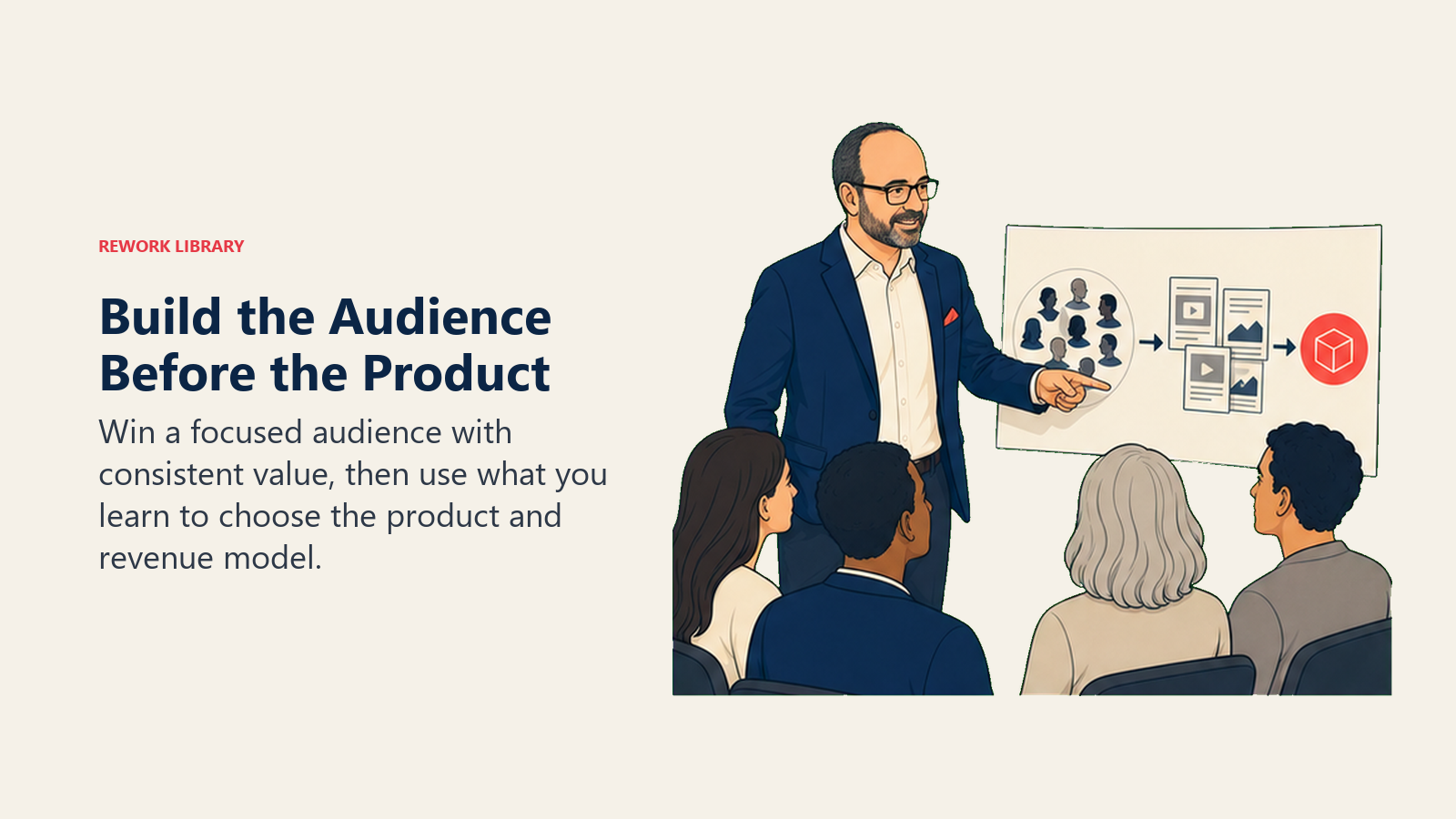
Step one is finding your sweet spot, the intersection between your knowledge and a specific audience need. Not a broad audience. A specific one. Step two is the content tilt, the angle that makes your content different enough from everything else in the category that someone would choose you over an established publication. Step three is building the base, choosing one primary platform (usually email) and publishing consistently over time. Step four is the harvest, building the email list, community, and direct relationships that make monetization possible. Step five is diversification, expanding content platforms after the base is established, not before. Step six is monetization, launching products, events, consulting, or advertising against an audience that trusts you.
The reason most content programs fail is that they start at step six. Companies decide they want revenue from content, build a content calendar, publish for three months, get disappointing results, and conclude content doesn't work. What they actually ran was a monetization strategy without the preceding five steps. Pulizzi's content programs at CMI ran steps one through five for roughly two years before the revenue became meaningful.
For B2B operators, the framework is a useful test for your current content investment. Which step are you actually at? If you're publishing content and expecting pipeline in 90 days, you're trying to run step six against a step-two or step-three foundation. The gap between where you are and where the monetization becomes real tells you how long you need to invest before you evaluate whether it's working.
The 6 Types of Content Tilt
The content tilt is what makes your specific angle worth paying attention to when your audience has already seen generic content from established sources. Pulizzi identified six ways a content program can differentiate:
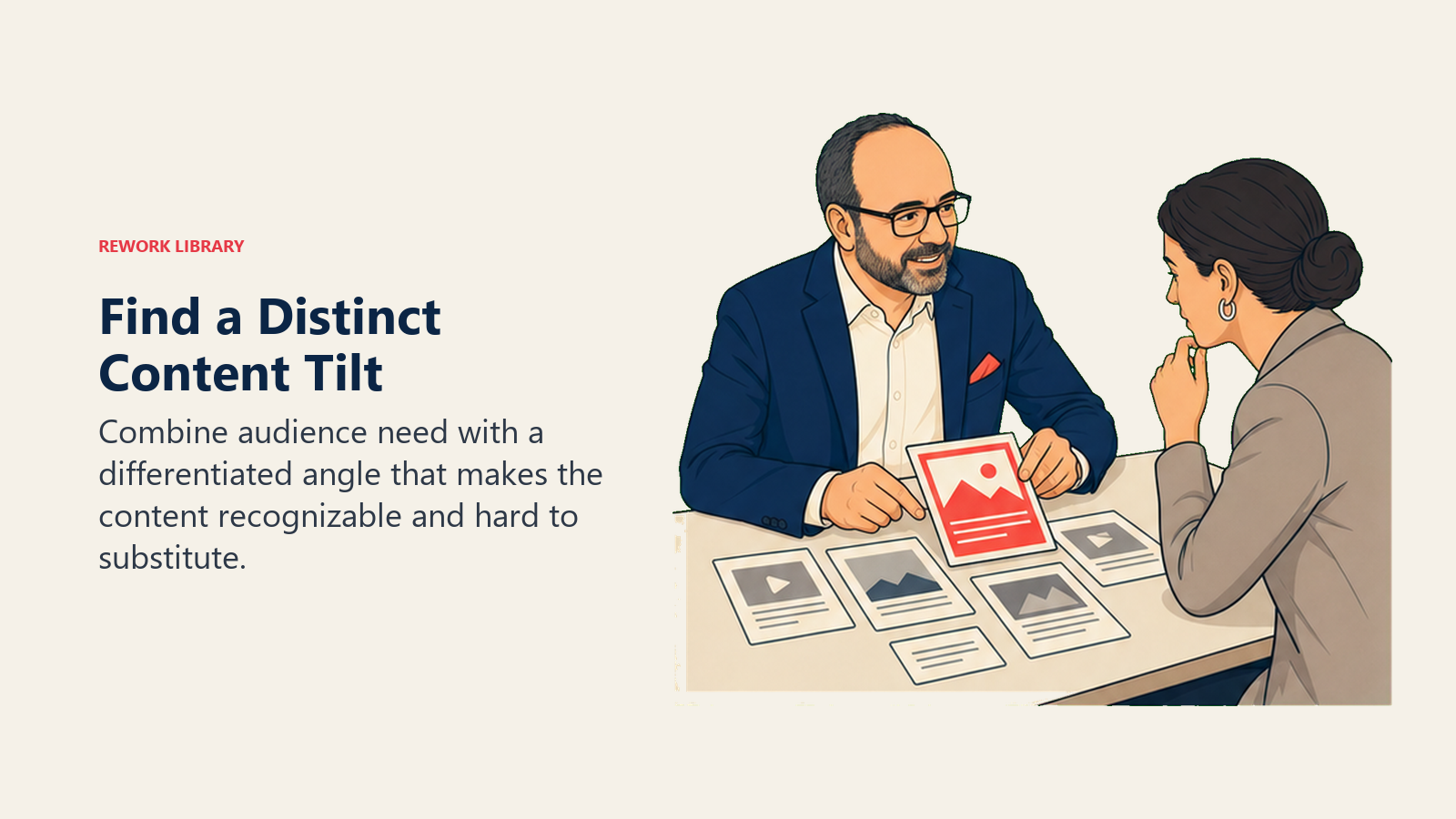
You can go narrower, covering a more specific niche than existing publications serve. You can go deeper, producing more rigorous and complete treatment of topics the category addresses superficially. You can go faster, publishing more frequently or more immediately than competitors. You can go against the grain, taking a position that the mainstream of the category doesn't hold. You can make it personal, building the content around a specific person's experience and voice. Or you can lead with a specific format or platform that the category isn't using well.
CMI's original tilt was definitional: Pulizzi was defining what content marketing was and creating a taxonomy for the category. Nobody else was doing that work. That's a "go narrower" tilt executed at the level of an entire discipline, not just a topic.
The practical use of this framework is pre-publication diagnosis. Before you launch a content program, identify which of the six tilts you're actually using. "We'll produce great content" isn't a tilt. It's a wish. The tilt is the specific reason someone would choose your content over the alternatives they're already consuming.
The Content Marketing Mission Statement
Pulizzi's third framework is the most underused one. Every content program, he argued, should have a mission statement that answers three questions: who are we serving, what will we consistently deliver to them, and what outcome does the reader get from consuming it?
The mission statement is a constraint, not a tagline. It defines what you'll publish and what you won't. It keeps the team aligned when the temptation to cover adjacent topics arises. And it communicates clearly to the target audience what they're subscribing to.
CMI's mission statement was essentially: we serve B2B and B2C content marketing practitioners, we deliver practical and educational content about content marketing strategy and tactics, and readers leave better equipped to build content programs that grow their businesses. That clarity meant CMI could say no to covering general marketing topics even when those topics would have generated more traffic. The narrowness compounded the relevance.
For leadership teams building content programs: write the mission statement before you write anything else. Test it against these three questions. If you can't answer all three specifically, you don't have a content strategy yet, you have a publishing calendar.
What Joe Pulizzi Would Do in Your Role
If you're a CEO, Pulizzi's most direct question is about patience. Your content program will produce almost nothing measurable in its first six months if you're doing it correctly. The companies that get this right treat the first year of content investment as infrastructure spending, not campaign spending. If you're evaluating your content function on 90-day pipeline contribution, you're measuring it wrong. The right metric in the first year is audience growth: email subscribers, repeat readers, direct traffic. Those are the inputs that eventually produce the output your board wants to see.
If you're a COO, the operational lesson is about consistency over volume. Pulizzi's model doesn't require publishing six pieces a day. It requires publishing reliably on a schedule your audience can depend on. CMI built its readership through a consistent publishing cadence maintained over years. The operational decision is choosing a sustainable cadence and holding it rather than bursting with content when there's budget and going dark when there isn't. Inconsistency breaks the compound interest effect that audience building depends on.
If you're a product leader, the audience-first model has a direct product analog. Before you build a feature for a segment, can you demonstrate that the segment is already motivated by the problem you're solving? Pulizzi wouldn't build a product first and then find an audience for it. He'd verify that the audience existed and was active before committing the build. Most product teams learn the market doesn't care after the build. His sequencing puts market validation before product development rather than after.
If you're in sales or marketing, the most useful Pulizzi principle is the email-list primacy doctrine. You don't own your LinkedIn following or your Twitter audience. You own your email list. Every piece of content you publish on rented platforms should have an explicit mechanism for converting that attention into an owned relationship, an email subscriber, a direct sign-up, a community member. If your content strategy doesn't have that conversion path, you're building an audience for someone else's platform, not for your business.
How Rework Applies the Audience-First Doctrine
Rework's content strategy is a working example of the Content Inc. Model applied to the operations software category. The Rework library, covering lead management, deal closing, sales operations, and adjacent disciplines, is built on the Pulizzi sequence: pick a specific operator audience (revenue and ops leaders at growing B2B companies), define a content tilt (frameworks and decision tools rather than vendor-led product marketing), and publish consistently before introducing the product layer. The Rework CRM and the broader Work Ops platform are step six, not step one.
That sequencing matters because the alternative, leading with the product and bolting content on as a lead-gen tactic, is what Pulizzi spent his career arguing against. Operators arriving at Rework through the library are reading material that solves their problem first; the product becomes relevant when their tooling decision is genuinely on the table. That's the audience-before-product model executed inside a SaaS go-to-market, exactly as Pulizzi's framework predicts.
Frequently Asked Questions
Frequently Asked Questions about Joe Pulizzi's Content Philosophy
Who is Joe Pulizzi?
Joe Pulizzi is the founder of the Content Marketing Institute (CMI), widely credited with coining and popularizing the term "content marketing." He sold CMI to UBM in 2016 for an estimated $17.6 million, has authored six books on content strategy, and in 2021 founded The Tilt, a community for independent content entrepreneurs.
What is the Content Inc. Model?
The Content Inc. Model is Pulizzi's six-step framework for building a content business: sweet spot, content tilt, base, audience harvest, diversification, and monetization. The model's central claim is that the order is non-negotiable, most content programs fail because they jump to monetization without first building the audience layer.
What is 'audience first, product second'?
It's Pulizzi's core doctrine that you should attract and earn a specific audience for 18 to 24 months before launching products against them. The audience itself becomes the asset class; products, events, advisory, and ad inventory are monetization layers built on top of an existing trusted relationship rather than substitutes for one.
How did Pulizzi build and sell CMI?
Pulizzi founded CMI in 2007 as a bootstrapped blog and white paper publisher in Northeastern Ohio. He grew it through consistent publishing, an annual research report (the B2B Content Marketing Benchmarks), and Content Marketing World, a Cleveland conference that grew to 4,000+ attendees. UBM acquired the entire business in 2016 for an estimated $17.6 million.
What is Content Entrepreneur?
Content Entrepreneur is Pulizzi's term for solo creators and small teams who build a durable business by attracting an audience around a specific niche, then monetizing through products, subscriptions, events, or advisory. The Tilt, launched in 2021, is the education and community vehicle for this movement, and Pulizzi's Content Inc. Second Edition is its primary playbook.
What can marketers learn from Joe Pulizzi?
The most transferable lessons are sequence discipline (build audience before monetizing), niche-down patience (a narrow focused audience compounds faster than a broad one), email-list primacy (owned channels beat rented ones), and consistency over volume (a sustainable cadence held for years beats sporadic high-output bursts).
Notable Quotes & Lessons Beyond the Boardroom
"The key differentiating factor between a content marketing program that fails and one that succeeds is that most companies give up." That's from Content Inc., and it's characteristically direct. Pulizzi isn't describing a secret formula, he's describing a patience problem. The audience-building timeline is long enough that most organizations quit before the compounding starts.
He also said: "Your customers don't care about you, your products, or your services. They care about themselves, their wants, and their needs." This appeared in Epic Content Marketing and is essentially a Schwartz principle applied to content strategy, the content's job isn't to promote you. It's to serve the desire your audience already has. Ann Handley made a similar argument about brand voice and reader-first writing, and her work on content craft sits directly in the same tradition Pulizzi was building. And Brian Halligan, whose inbound marketing thesis ran parallel to Pulizzi's Content Inc. model, institutionalized much of the same audience-before-product logic inside HubSpot's product and go-to-market strategy. The promotional work follows from the trust you build by consistently delivering value first.
Seth Godin developed a parallel content thesis, permission marketing and the idea that being remarkable beats interruption, that Pulizzi's Content Inc. model builds on directly. And Neil Patel represents the content-at-scale heir: where Pulizzi emphasized patience and depth, Patel operationalized the high-volume, SEO-first side of the same audience-building logic.
Pulizzi's personal example is probably the most instructive thing about his model. He left CMI in 2018 after selling to UBM, took roughly two years off, and started The Tilt in 2020. Forbes recognized him as one of the most influential voices in content marketing, noting that his Content Inc. methodology reframed how companies think about audience ownership versus paid media. He ran the Content Inc. model again, publicly, explaining his own process as he executed it. He grew The Tilt's email list before monetizing it. He didn't take outside capital. He treated the second build as a validation of the framework, not a departure from it. Whether The Tilt reaches CMI's scale remains to be seen, but the willingness to put his own thesis at risk a second time is worth noting.
Where This Style Breaks
Pulizzi's audience-first model requires 18–24 months before revenue follows, that timeline is incompatible with SaaS board expectations of 90-day pipeline contribution from content investment. The Content Inc. framework was designed for founder-led businesses and media startups, not enterprise marketing teams that need to justify headcount in Q2. His niche-down doctrine also conflicts with platform businesses that need to speak to five different buyer personas simultaneously, you can't maintain strict topic focus when your addressable market is diverse. And the email-list-as-primary-asset approach breaks down when your buyers don't read newsletters and your primary discovery channel is dark social or SDR outbound. The model works where it was designed to work. Transplanting it elsewhere requires significant modification.
For related reading, see David Ogilvy Leadership Style, Eugene Schwartz Leadership Style, Seth Godin Leadership Style, Gary Vaynerchuk Leadership Style, and Neil Patel Leadership Style.

On this page
- Key Facts
- The Audience-First Doctrine (Content Inc. Model)
- Leadership Style Breakdown
- Key Leadership Traits
- The 3 Frameworks That Defined Joe Pulizzi
- The Content Inc. Model: Sequence Matters
- The 6 Types of Content Tilt
- The Content Marketing Mission Statement
- What Joe Pulizzi Would Do in Your Role
- How Rework Applies the Audience-First Doctrine
- Frequently Asked Questions
- Notable Quotes & Lessons Beyond the Boardroom
- Where This Style Breaks