Demis Hassabis Leadership Style: Long Bets, Deep Research
Turn this article into takeaways for your work.


Each assistant summarizes the article only for you and suggests best practices for your work.
Key Facts: Demis Hassabis (born 1976, London) is a British AI researcher and chess prodigy who reached master level at age 13. He co-founded DeepMind in 2010, which Google acquired in 2014 for approximately $650 million. His lab built AlphaGo, which defeated world champion Lee Sedol in 2016, and AlphaFold, released in 2020, which solved a 50-year-old protein structure prediction problem and earned Hassabis a share of the 2024 Nobel Prize in Chemistry. He has served as CEO of Google DeepMind since the 2023 consolidation of Google Brain and DeepMind, and was knighted in 2024.
The Hassabis Moonshot Doctrine (Solve Intelligence First Model)
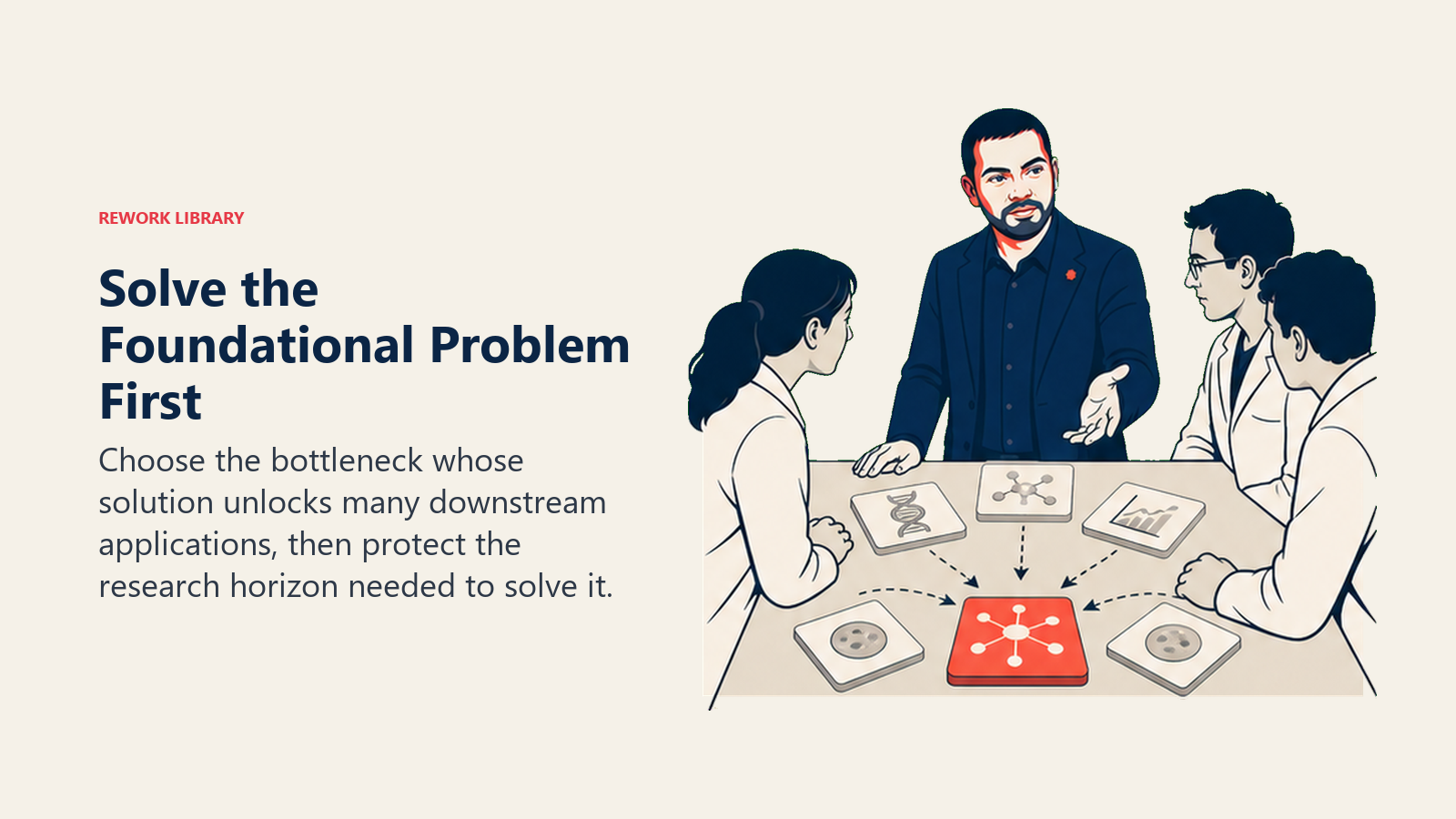
A leadership framework in which an organization commits to solving a foundational meta-problem, general intelligence itself, on a 10-to-20-year horizon, using legible scientific milestones (game matches, Nature papers, Nobel-grade benchmarks) as proof points that sustain institutional funding and talent through decades of non-commercial research. The doctrine inverts the standard startup playbook: instead of iterating toward product-market fit, the organization iterates toward scientific truth, trusting that solving the deeper problem will dominate every narrower application built on top of it.
When Demis Hassabis was 13, he was the second-highest-rated under-14 chess player in the world, with an Elo rating above 2300. At 17, he was a paid game designer at Bullfrog Productions, coding the AI logic for Theme Park while most of his peers were sitting GCSEs. He went to Cambridge for computer science, then spent several years in the games industry, then got a PhD in cognitive neuroscience from UCL at 36. Then he co-founded DeepMind in 2010, sold it to Google for roughly $500M in 2014, retained enough independence to run a long-term research lab inside a $1.7T company, and won a share of the 2024 Nobel Prize in Chemistry for a protein-folding algorithm.
Each chapter funded the next. The chess gave him pattern recognition and competitive temperament. The game design gave him systems thinking and a practical understanding of AI behavior. The neuroscience gave him the theoretical framework that became DeepMind's founding thesis: intelligence is the meta-problem, and neuroscience is the guide to solving it.
That thesis, held consistently across 15 years, is what separates Hassabis from most technology leaders. He hasn't pivoted. He's been executing the same long bet since 2010.
Leadership Style Breakdown
| Style | Weight | How it showed up |
|---|---|---|
| Deep Researcher | 65% | Hassabis built DeepMind as a research organization first and a product organization second. The decisions about what to work on were driven by scientific ambition, what are the hardest problems in AI, and which ones would tell us the most about the nature of intelligence if we solved them? AlphaGo wasn't a product bet. It was a research demonstration. AlphaFold wasn't a commercial play. It was an attempt to solve a 50-year-old scientific problem. The 65% research weight is the reason DeepMind has produced disproportionately important scientific results relative to its headcount. |
| Moonshot Architect | 35% | The 35% is what makes the research weight sustainable inside a commercial organization. Hassabis structured DeepMind's work so that the big research bets had legible, high-profile proof points, AlphaGo's match against Lee Sedol was watched by 280 million people, AlphaFold's protein structures were used by millions of researchers within a year of release. The moonshot architect layer is what kept Google funding the lab through the years when commercial applications weren't obvious. |
The combination is hard to maintain. Pure research labs without the moonshot framing lose internal support. Pure product organizations without the research depth don't generate the breakthroughs. Hassabis has held both for longer than most leaders manage either.
Key Leadership Traits
| Trait | Rating | What it means in practice |
|---|---|---|
| Multi-decade patience | Very High | Hassabis founded DeepMind in 2010 with the explicit goal of solving artificial general intelligence. AGI hasn't been solved. He's still working on it. In the interim, the lab has produced AlphaGo, AlphaFold, AlphaStar, Gemini, and a string of Nature papers that reshaped multiple scientific fields. That output over 15 years was possible because he didn't change the goal when it wasn't achieved on a convenient timeline. |
| Cross-domain synthesis | Very High | The neuroscience-inspired AI thesis is a real intellectual contribution, not a marketing angle. DeepMind's work on memory, attention, and reward systems drew directly on cognitive neuroscience research in ways that produced technically distinct approaches, the Deep Q-Network that learned to play Atari games from pixels used mechanisms inspired by the hippocampus and basal ganglia. Hassabis could make those connections because he had genuine depth in both fields, not just familiarity. |
| Institutional independence | High | Selling to Google in 2014 without losing the research culture was a genuine leadership achievement. Most acquisitions at that scale result in the acquired organization being absorbed and redirected toward the acquirer's commercial priorities. Hassabis negotiated sufficient independence that DeepMind continued to publish fundamental research, pursue non-commercial problems, and operate with its own hiring bar for nearly a decade post-acquisition. That negotiation happened with Sundar Pichai's organization, and the tension between DeepMind's research independence and Google's product urgency became defining after the ChatGPT moment. That independence eroded after the 2023 reorg, but lasting 9 years post-acquisition with research culture intact is unusual. |
| Bias toward hard problems | High | When DeepMind decided to tackle protein folding, the problem had been open for 50 years and had defeated well-funded attempts by pharmaceutical companies and academic labs for decades. The expected value calculation on attempting it was not obvious. Hassabis picked it partly because of its scientific importance and partly because it was the kind of problem that, if solved, would prove something fundamental about what AI could do. That bias toward hard-and-important over easy-and-valuable is a consistent pattern across DeepMind's research agenda. |
The 3 Decisions That Defined Hassabis
1. Founding DeepMind on the AGI-for-Science Thesis (2010)
In 2010, "artificial general intelligence" as a research goal was not taken seriously by mainstream computer science. The field had been through two AI winters and was dominated by narrow applications, computer vision here, natural language processing there, each problem solved with bespoke techniques.
Hassabis co-founded DeepMind with Shane Legg and Mustafa Suleyman on the premise that intelligence itself was the thing to solve, and that solving it would make all other scientific problems tractable. That's a much bigger claim than "we're going to build a better image classifier."
The thesis was grounded in neuroscience in a specific way: Hassabis believed that studying how the human brain achieves general intelligence was the most direct path to building artificial general intelligence. That wasn't a common position in 2010. It was an intellectually defensible minority view held with unusual conviction.
What makes this a leadership decision rather than just a research agenda is that Hassabis built an organization around a thesis that took more than a decade to produce clearly legible commercial results. That requires a specific kind of talent attraction and retention, you need people who are motivated by the thesis, not just by the salary or the near-term product roadmap.
2. AlphaGo (2016): Proof of Concept for Reinforcement Learning at Scale
The 2016 five-game match between AlphaGo and Lee Sedol was the single most visible AI milestone since Deep Blue beat Kasparov in 1997, and it was more significant technically because Go's search space is vastly larger than chess.
AlphaGo's win wasn't just a game result. It was a demonstration that deep reinforcement learning combined with Monte Carlo tree search could achieve superhuman performance on a problem where the strategy space was too large for brute-force computation. The approach generalized. Everything that came after, AlphaZero, AlphaStar, AlphaFold, built on the same underlying framework.
Hassabis chose Go deliberately. Chess had been solved by Deep Blue. Go was considered too complex for near-term AI. Picking Go as the target for AlphaGo was a strategic decision about which proof point would be most convincing and most technically generative.
The timing mattered too. The match was broadcast live. Lee Sedol is one of the greatest Go players in history. Move 37 in Game 2, a play that no human would have considered, which Sedol and the commentators initially called a mistake before recognizing it as genius, became one of the most discussed moments in AI history. The theatrical proof point wasn't accidental. Hassabis understood that legibility to the outside world was part of the research program.
3. AlphaFold (2020-2021): Science's Proof of Value for AI
The protein-folding problem asks: given an amino acid sequence, what three-dimensional structure does the protein fold into? The answer determines the protein's biological function. The problem had been open since the 1970s. Pharmaceutical companies had invested hundreds of millions in computational approaches. Academic labs competed in the biennial CASP competition, where marginal improvements were celebrated.
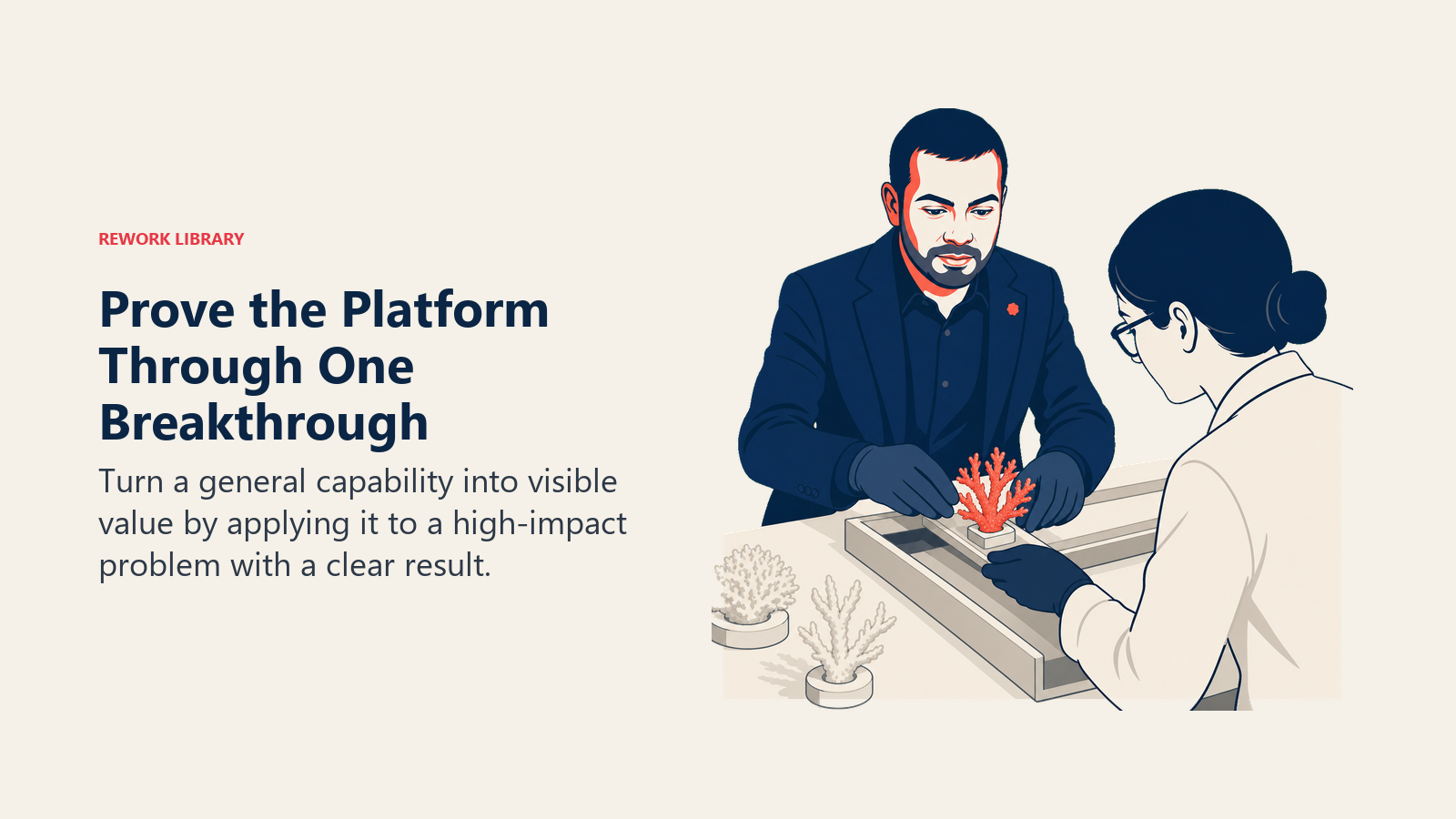
AlphaFold 2, published in Nature in 2021, solved the problem at a level of accuracy that the CASP organizers described as a scientific revolution. DeepMind subsequently released predictions for 200 million protein structures, essentially the entire known protein universe, for free. DeepMind subsequently released predictions for 200 million protein structures, essentially the entire known protein universe, for free.
This was not a commercial product. It was science. Hassabis chose it because it was the kind of problem where AI's contribution could be measured precisely (protein structure prediction accuracy is a well-defined benchmark), announced clearly (the Nature paper), and used broadly (free database release). The 2024 Nobel Prize in Chemistry was a consequence of all three.
For operators, the AlphaFold story is a case study in how to pick a problem that validates your core thesis with maximum clarity. Hassabis wanted to prove that AI could accelerate scientific progress in domains that mattered to humanity. Protein folding was the most precise, publicly verifiable way to make that argument.
What Hassabis Would Do in Your Role
If you're a CEO, the most transferable lesson from Hassabis is thesis durability. He's been running the same organization against the same stated goal for 15 years. The intermediate milestones changed. The thesis didn't. Most leaders update their company's direction every 18 months in response to market feedback, investor pressure, or competitive dynamics. That's often the right call. But there's a category of important work that requires a longer commitment horizon than quarterly planning cycles allow. If you believe you're working on something in that category, you need to build your organization explicitly for multi-year patience, in your hiring, your investor base, and your internal goal-setting.
If you're a COO, the Google acquisition integration is worth studying. Hassabis negotiated independence, but independence is not the same as isolation. DeepMind continued to use Google's compute infrastructure, benefited from its talent network, and eventually became central to Google's AI strategy under Alphabet. The operational lesson is about how to maintain organizational culture and research direction inside a much larger parent organization. The key mechanisms were: separate leadership team, separate research agenda, separate hiring bar, and a clear understanding with the parent company about what "independence" meant in practice.
If you're in product, the AlphaFold free release is an interesting model for products with significant public benefit value. Hassabis released 200 million protein structures for free, which generated enormous scientific goodwill, established DeepMind as the authoritative source on protein structure prediction, and produced a citation base that is extraordinarily valuable for long-term research credibility. There are product contexts, especially in enterprise software with scientific or research applications, where giving away the core output and monetizing the workflow around it is a more durable strategy than paywalling the core.
If you're in sales or marketing, the proof-point strategy embedded in AlphaGo and AlphaFold is a lesson in how to structure demonstrations of complex technical capability. Both were designed to be maximally legible to non-technical audiences, broadcast games, Nobel prizes, Nature papers, while being technically rigorous enough to satisfy expert scrutiny. If you're selling a product that's technically differentiated but hard to demonstrate, ask whether you can design a proof point that's as legible as a chess match and as technically rigorous as a peer-reviewed paper.
How Rework Supports the Hassabis Model
Running a scientist-CEO hybrid means holding two clocks at once: a 10-year research clock where success is a Nature paper or a solved benchmark, and a quarterly operating clock where investors, partners, and hiring committees need visible progress. Rework's work management layer is built for that split. Long-horizon bets get tracked as durable objectives with their own milestone cadence, independent of the sprint-level work that funds them, so a multi-year AlphaFold-style program doesn't get buried under weekly standups or sacrificed in a roadmap reshuffle. The CRM and cross-team views let a research-led founder keep one eye on commercial pipeline without forcing the research org to cosplay as a product team. For founders running R&D-heavy companies, AI labs, biotech, deep tech, the practical value is threading the proof-point strategy Hassabis mastered: capturing the legible milestones (published results, benchmark wins, design-partner case studies) inside the same system that tracks the day-to-day operational work funding them, so thesis durability becomes an operating habit rather than a quarterly argument.
Notable Quotes & Lessons Beyond the Boardroom
In his 2024 Nobel Prize lecture, Hassabis said: "AlphaFold is a first glimpse of what I believe will be a new paradigm for how we use AI in science, as a tool for accelerating discovery and helping scientists tackle the hardest problems." That framing, AI as a tool for science rather than as a replacement for scientists, is a consistent thread in how he talks about the technology.
He's also been direct about the core thesis: "I think AI is the most transformative technology humanity has ever developed, more profound than electricity or the internet." He says this not to hype a product but as a statement of research motivation. It explains why DeepMind has consistently chosen hard, long-horizon problems over near-term commercial applications.
The leadership lesson from both quotes is about alignment between stated beliefs and actual resource allocation. Hassabis says AI is the most important technology ever built and then allocates his organization's resources to the hardest problems in AI, not the most commercially immediate ones. That consistency between belief and resource allocation is rarer than it looks. Most organizations say they believe something significant is possible and then allocate resources as if they don't.
Where This Style Breaks
The research-first model has real limits inside a commercial organization. The 2022-2023 period inside Google was fractious: the ChatGPT launch caught DeepMind flat-footed on the product side, the integration with Google Brain produced organizational friction, and the Gemini 1 launch in late 2023 was poorly received relative to expectations. The pure research culture that produced AlphaFold moves at a different pace than the product culture required to ship competitive consumer AI. For teams navigating similar tensions, building serious AI capability while responding to business demands, the AI team readiness frameworks developed in response to this wave are worth reviewing alongside Hassabis's model.
Multi-decade patience is inaccessible to most operators. The 10-to-15-year thesis horizon that Hassabis can maintain at DeepMind requires a parent company with essentially unlimited patience for the research program. Most organizations don't have that. And the moonshot framing, while effective for research credibility, can mask genuine near-term commercial gaps by treating them as expected costs of the long-horizon approach.
Learn More

On this page
- The Hassabis Moonshot Doctrine (Solve Intelligence First Model)
- Leadership Style Breakdown
- Key Leadership Traits
- The 3 Decisions That Defined Hassabis
- 1. Founding DeepMind on the AGI-for-Science Thesis (2010)
- 2. AlphaGo (2016): Proof of Concept for Reinforcement Learning at Scale
- 3. AlphaFold (2020-2021): Science's Proof of Value for AI
- What Hassabis Would Do in Your Role
- How Rework Supports the Hassabis Model
- Notable Quotes & Lessons Beyond the Boardroom
- Where This Style Breaks
- Learn More