Travis Kalanick Leadership Style: Grow at Any Cost
Turn this article into takeaways for your work.


Each assistant summarizes the article only for you and suggests best practices for your work.
Key Facts: Travis Kalanick (b. 1976) co-founded Uber in 2009 with Garrett Camp and served as CEO from 2010 to 2017, scaling the company to a $70B+ valuation across 70+ countries before being ousted in June 2017 following a series of culture and governance investigations. His earlier ventures were Scour (peer-to-peer search, 1998) and Red Swoosh (acquired by Akamai, 2007). After Uber, he founded CloudKitchens, a ghost-kitchen real-estate platform reportedly valued around $15B.
The Kalanick Expansionist Model
The Kalanick Expansionist Model is a founder operating doctrine that treats regulatory friction as a competitive moat rather than a compliance cost, launch in contested markets before the legal framework is settled, convert consumer demand into political capital, and scale globally in parallel so no single jurisdiction can act as a kill switch. Its core bet is that speed and footprint compound faster than regulators and incumbents can organize against them.
Here's the uncomfortable truth about Travis Kalanick: the same decisions that built Uber into a $70 billion company also made it ungovernable. That's not a contradiction. It's the thesis.
Kalanick launched Uber in 2009 with a simple theory: taxi regulators protected an incumbent industry at the expense of consumers, technology could route around them, and if you moved fast enough, the user demand you created would become too large for any single city government to kill. Elon Musk applied the same logic at Tesla, move before the regulatory framework is settled and make the product so desirable that bans become politically costly. He was right. In 70+ countries. For eight years.
Then it stopped working, not because the strategy failed commercially, but because the organizational culture required to execute it at that speed had become toxic. Sexual harassment. Regulatory deception through the Greyball program. A boardroom at war with itself. The company that had moved too fast for regulators couldn't reform fast enough to survive its own internal crisis.
Kalanick was ousted in June 2017. Uber still went public at a $75B valuation two years later. Both of those things are true, and operators who want to learn from this story have to hold both of them.
Leadership Style Breakdown
| Style | Weight | How it showed up |
|---|---|---|
| Hyper-Growth Aggressor | 65% | Kalanick's primary operating mode was offense. Launch in a city before the legal framework is settled. Build user demand as a political buffer. Make the regulatory problem so large and so public that it becomes easier for cities to negotiate than to shut down. This wasn't recklessness. It was a deliberate strategic frame applied consistently across 70+ markets. |
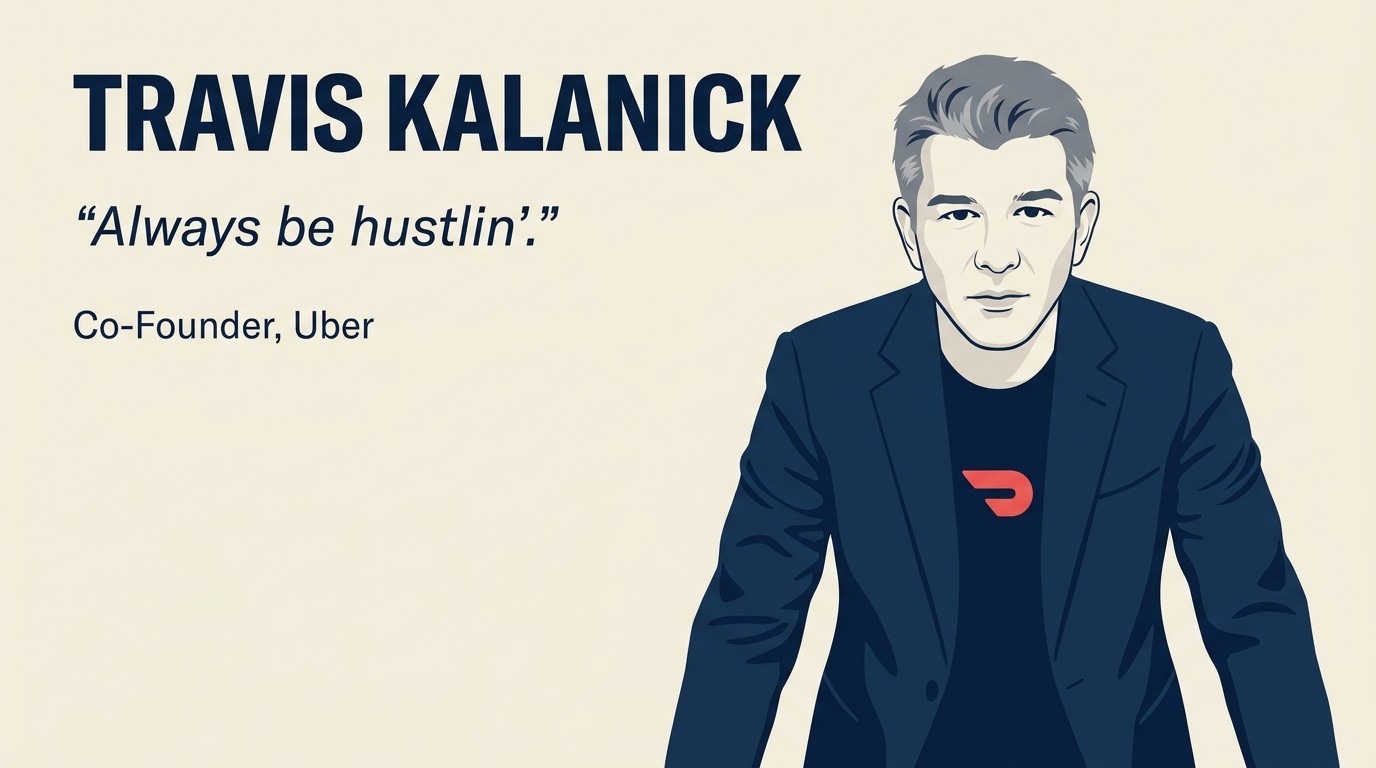
| Founder-Warrior Culture Builder | 35% | Kalanick built Uber's internal culture in his own image. The 14 cultural values he articulated, including "always be hustlin'," "let builders build," and "champion's mind-set," were sincere expressions of his own operating philosophy. The problem was that they created permission structures for behaviors that were incompatible with operating a public-facing business at scale. The culture was a product of his leadership, for better and for worse. |
The 65/35 split reflects that Kalanick was primarily an external strategist, the competitive positioning, the regulatory offense, the international expansion sequencing. The culture he built internally was real and consequential, but it was downstream of the strategic philosophy, not a parallel track. When the external strategy ran into its limits, the internal culture had no corrective mechanisms because it had been designed to reinforce the external strategy.
Key Leadership Traits
| Trait | Rating | What it means in practice |
|---|---|---|
| Blitzscaling intensity | Exceptional | Kalanick's capacity to expand Uber simultaneously into dozens of markets, each with different regulatory environments, different incumbent taxi industries, and different consumer adoption curves, required a kind of operational ambition that few founders sustain. He was in multiple city launch meetings per week, personally involved in regulatory battles in London, New York, and Beijing simultaneously. At peak growth, Uber was entering a new country roughly every two weeks. |
| Regulatory offense | Very High | Most startups treat regulation as a compliance problem. Kalanick treated it as a competitive weapon. Launch first, create consumer demand, use that demand as political capital against taxi commissions and city councils. It worked until it didn't. In some cities Uber was eventually banned, in others it negotiated lasting operating licenses. But the playbook was intentional and it was effective in more markets than it failed in. |
| Culture as leverage | High | The 14 cultural values Uber published became both a recruiting asset and a liability. In the early years, "always be hustlin'" attracted exactly the operators Kalanick wanted: aggressive, fast, growth-obsessed. The problem was that the same framework provided insufficient guardrails when growth pressure created situations requiring judgment calls about ethics, legal compliance, and employee treatment. Culture that optimizes only for growth creates gaps everywhere else. |
| Governance blindspot | Low | Kalanick operated as though the dual-class share structure he'd negotiated gave him permanent control. It gave him a lot of control, but not enough to survive a board coalition that included Benchmark Capital and major institutional investors. Mark Zuckerberg structured his dual-class shares more defensively and retained enough board control to withstand comparable pressure. The difference in execution matters as much as the instrument itself. When the scandals accumulated in 2017, he discovered that contractual control and actual organizational legitimacy are different things. He had the former and had lost the latter. |
The 3 Decisions That Defined Travis Kalanick as a Leader
1. Framing Uber as a "Transportation Network," Not a Taxi Company
This was the semantic move that made everything else possible. Taxis were regulated as common carriers, licensed, rate-controlled, subject to city-by-city operating rules. If Uber was a taxi company, it had to comply with those rules in every market before it could operate. That path led to years of licensing negotiations, regulatory hearings, and controlled slow launches.
Kalanick rejected that frame entirely. Uber was a technology company that connected drivers and riders. The technology was legally distinct from the transportation service. This argument was legally contested everywhere Uber operated and was rejected in many jurisdictions. But the argument bought time. While regulators were deciding whether it was valid, Uber was growing market share and user demand that made the regulatory cost of a ban politically expensive.
The lesson here is about how you define your category. The frame you choose for what your business is determines which regulatory regime you're operating under, which incumbent industries you're competing with, and which customer relationships you have to protect. Kalanick chose the most aggressive possible frame and accepted the legal risk as a cost of speed. That's a founder bet. Not every organization can make it, and most shouldn't. But when it works, it creates years of competitive runway.
2. Expanding Into 70+ Countries Simultaneously Rather Than Sequentially
The conventional market expansion playbook is sequential: prove the model in one market, refine it, then export the operating playbook to the next one. Kalanick ran the opposite strategy. Uber launched in Paris and London and Sydney and Mexico City and Singapore within roughly the same 18-month window, absorbing regulatory battles in all of them simultaneously.
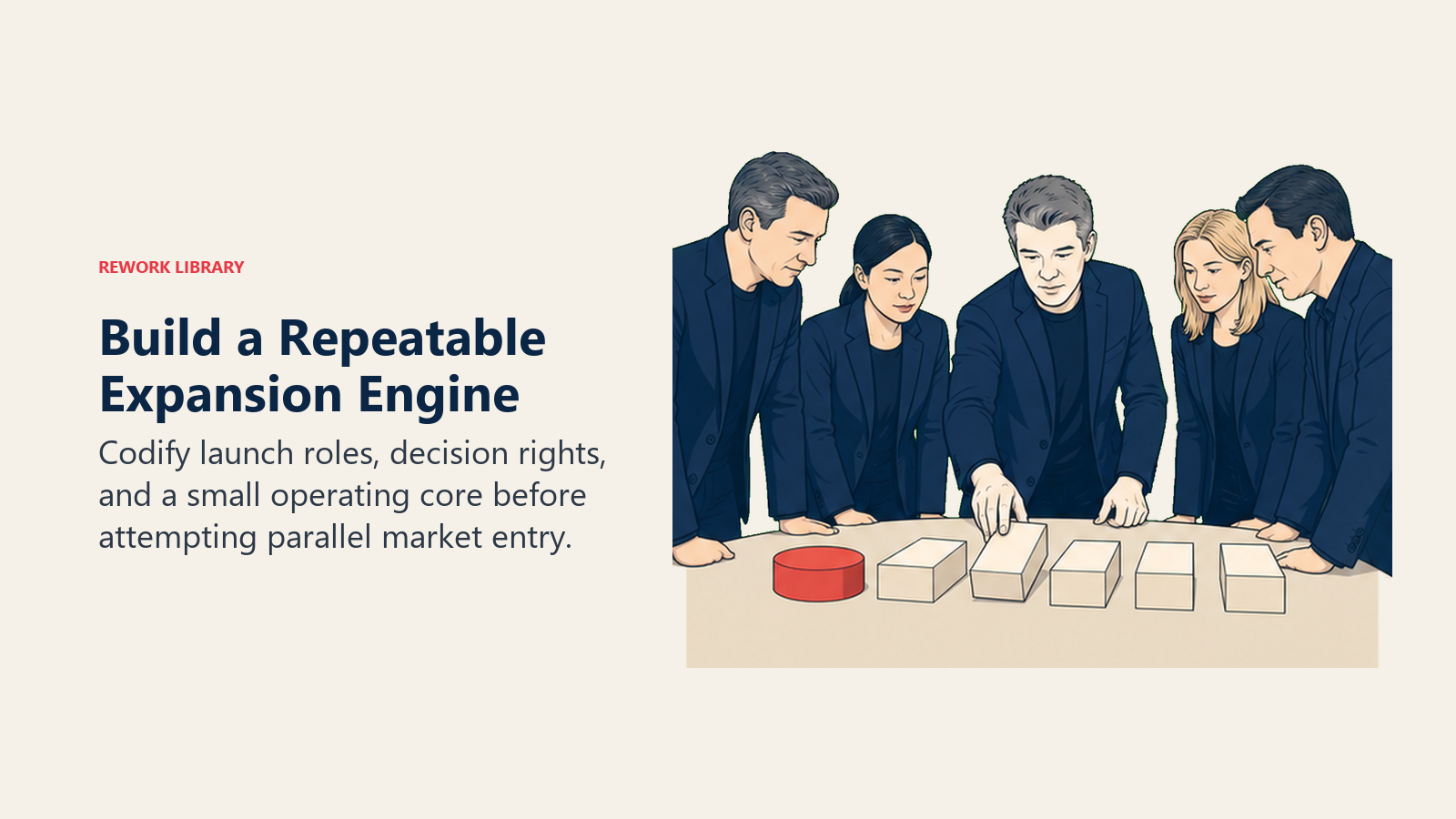
The logic was scale-as-defense: if you're large enough globally, no single regulator can kill you by acting in their jurisdiction. A ban in one city doesn't threaten a company operating in 70 countries. But a company that goes city by city is always vulnerable to the next jurisdiction deciding to move before the demand moat is built.
The execution required raising enormous capital. Uber raised over $20 billion in private funding before its IPO. It required accepting operating losses in most markets for years. And it required absorbing regulatory fights in multiple languages, legal systems, and political environments simultaneously.
What Kalanick got from that expansion is something that's genuinely hard to replicate: Uber's network effects and brand recognition became global before any single competitor could build to comparable scale. Lyft stayed US-focused. Didi was China-only. Grab was Southeast Asia. None of them could match Uber's footprint. That's the lasting competitive output of the blitzscaling choice.
3. Selling Uber China to Didi in 2016 for $7B in Equity
By 2016, Uber China was burning roughly $1B per year competing against Didi, which had deep local relationships, government backing, and an operational understanding of Chinese urban mobility that Uber couldn't easily replicate. The math was brutal. Continuing meant indefinite losses in a market where the odds favored the incumbent.
Kalanick negotiated an exit: Uber sold its Chinese operations to Didi in exchange for a roughly 17.7% equity stake in the merged entity, valued at approximately $7B at the time. Uber exited a war it was probably losing and gained a significant equity position in the company that won.
The decision matters for this profile because it shows something that gets lost in the "growth at any cost" narrative about Kalanick: he was capable of strategic retreat when the math demanded it. The same founder who would launch in a city before the legal framework was settled was also willing to exit a $1B/year burning war when the competitive position wasn't winnable. That's not recklessness. That's a specific kind of market judgment.
For operators, the lesson is about the difference between "never retreat" and "recognize unwinnable wars early." Kalanick's expansion playbook required both, the willingness to fight in most markets and the judgment to exit the specific ones where the fight couldn't be won. Most operators are better at one than the other.
What Travis Kalanick Would Do in Your Role
If you're a CEO entering a regulated market, Kalanick's frame is: launch first, let demand create the political reality. That playbook requires capital, legal tolerance, and a product good enough that consumers will actually defend you to their city councilmember. Not every market or every product meets those conditions. But if yours does, the cost of waiting for regulatory permission is often greater than the cost of regulatory friction you absorb by moving first. The question isn't whether to do this. It's whether you have the product quality and capital cushion to absorb the fight.
If you're a COO or operations leader, the dual-class governance lesson is worth studying. Kalanick structured Uber's equity to give him persistent control through super-voting shares that prevented shareholders from overriding him. That structure was designed to enable long-term founder vision over short-term investor pressure. But it created a governance environment where accountability was structurally compromised. When the 2017 crisis hit, there was no natural mechanism for course correction short of a boardroom siege. Your operational role is to build accountability structures that work even when leadership doesn't want them to. Kalanick didn't build those, and the organization paid for it.
If you're a product leader, Uber's 14 cultural values are a case study in how product and culture become confused. The values were designed to drive growth behaviors, and they did. But they had no equivalent framework for what to do when growth behaviors conflicted with safety, ethics, or legal compliance. As a product leader, your culture needs a second axis: not just "how do we grow" but "what are we not willing to do to grow." The absence of that second axis in Uber's culture created the space for the 2017 scandals.
If you're in sales or marketing, the Uber expansion story has a specific lesson about market selection. Kalanick didn't choose markets because they were friendly. He chose them because they were large. The market selection framework was population density times car ownership rate times regulatory hostility. The more hostile the regulators, the bigger the moat if you survived. For sales leaders, the equivalent question is: are you entering markets based on near-term ease or long-term defensibility? The easiest markets to enter are often the least defensible once competitors arrive.
How Rework Supports a Kalanick-Style Operator
Kalanick's playbook is regulatory-arbitrage scale paired with aggressive multi-front competition across dozens of city launches, each with its own political, legal, and operational tempo. Rework is built for that kind of high-velocity growth: pipeline, lead management, and cross-team chat in one workspace so market-launch teams, policy leads, and ops can coordinate without handoff lag. The Sales Engine starts at $69/month and the Process Engine at $99/month, billed yearly with 5 seats included, which keeps the unit economics honest when you're spinning up a launch pod per country. The cautionary lesson matters too. The Kalanick model broke because culture and accountability didn't scale with growth. Rework helps by making work visible: ownership, SLA timers, and audit trails are first-class, so "always be hustlin'" has a structural ceiling instead of an ethical one. Speed without guardrails is what got Uber in trouble. Speed with guardrails is the version worth copying.
Notable Quotes and Lessons Beyond the Boardroom
After his ouster from Uber in 2017, Kalanick founded CloudKitchens, a company that acquires commercial real estate in urban areas and converts it to ghost kitchen facilities for food delivery brands. The founder-return pattern has worked elsewhere: Brian Chesky rebuilt Airbnb's culture after COVID with a cleaner operating model than the one that preceded the crisis. By 2023, CloudKitchens was estimated to be worth roughly $5B. He runs it with much lower public profile than Uber, which is consistent with someone who learned something from the visibility costs of the Uber years.
He said in a 2016 interview: "Uber is efficiency with elegance on top." That framing, efficiency as the core and elegance as the wrapper, is the actual product philosophy behind Uber's early success. The map, the ETA, the frictionless payment, the driver rating. Every feature optimized for a transaction that took as little friction as possible. That product discipline is worth separating from the cultural problems that followed.
On the regulatory strategy: "We're not a taxi company. We're a technology company that happens to move people." He repeated versions of this in regulatory hearings, press interviews, and internal communications for years. The frame was self-serving, but it was also genuinely believed. Kalanick thought of Uber as software first, and that conviction shaped how he trained his teams to respond to regulators, journalists, and city councils.
Where This Style Breaks
The hyper-growth model requires two things that can't coexist indefinitely: unlimited capital tolerance from investors and unlimited cultural tolerance from the organization. Kalanick had both for eight years. Then he didn't.
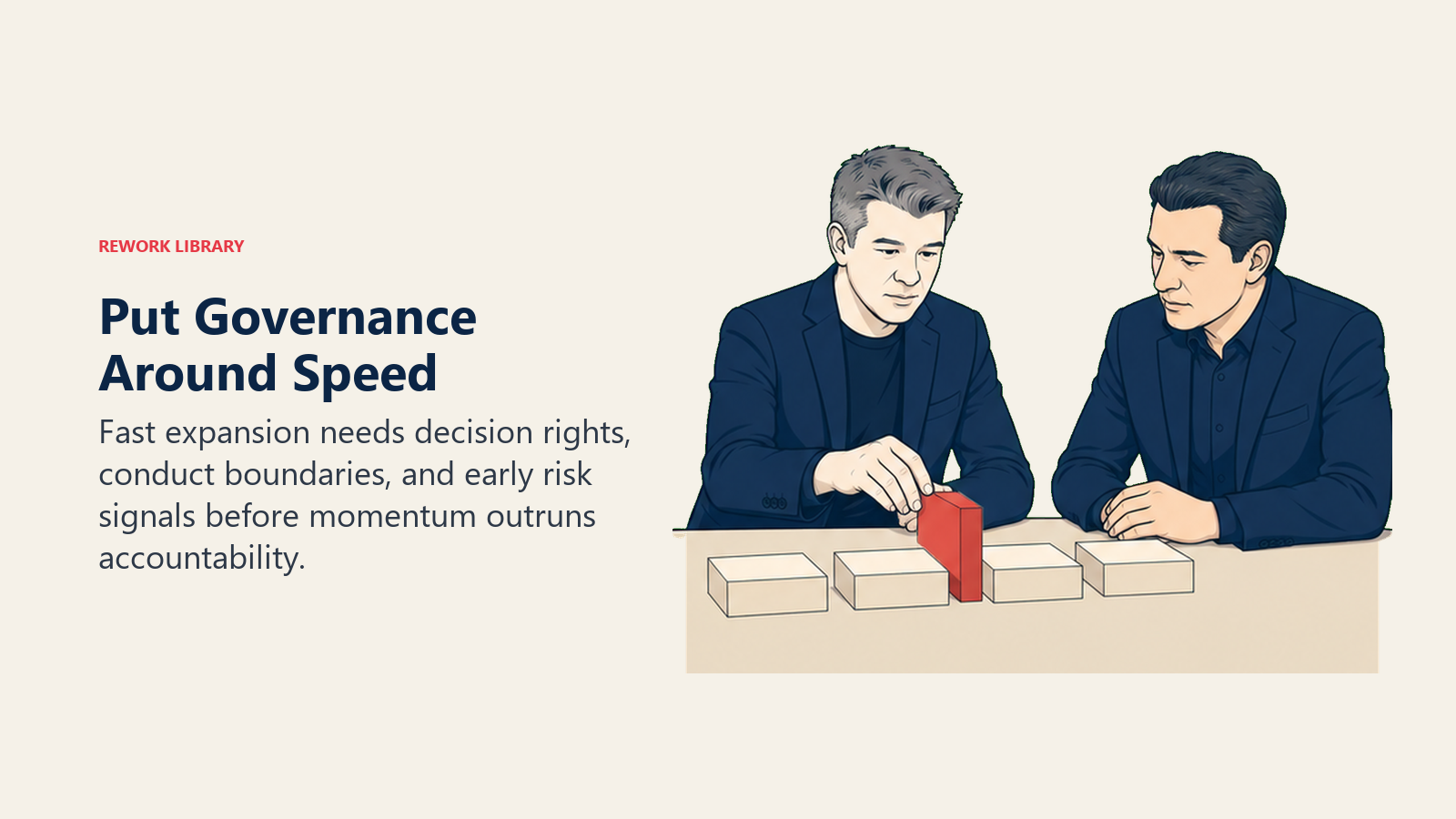
The structural problem with "always be hustlin'" as a company value is that it has no natural ceiling. It doesn't tell you when hustling crosses into harassment, when speed crosses into legal recklessness, or when competitive aggression crosses into the Greyball program, where Uber used fake app experiences to deceive regulators conducting inspections. Each of those failures was a direct downstream consequence of a culture that rewarded moving fast and asked few questions about the cost. The same leadership style that produced 70-country expansion in eight years produced an organization that couldn't govern itself when the growth imperative was briefly removed.
CloudKitchens suggests Kalanick drew some lessons. But no one has successfully replicated his Uber playbook at comparable scale, which tells you something about how context-specific it was. Jack Dorsey made a similarly concentrated post-departure bet, stepping away from Twitter entirely to focus on Block and Bitcoin rather than staging a return.
Frequently Asked Questions about Travis Kalanick's Leadership
Who is Travis Kalanick?
Travis Kalanick (b. 1976) is an American entrepreneur best known as the co-founder and former CEO of Uber. Before Uber, he built two earlier startups, Scour, a peer-to-peer search engine, and Red Swoosh, a content-delivery network later acquired by Akamai in 2007. After being ousted from Uber in 2017, he founded CloudKitchens.
How did Kalanick scale Uber globally?
Kalanick ran a parallel-expansion playbook rather than a sequential one. Uber launched in dozens of cities within overlapping 12-18 month windows, absorbing regulatory fights in multiple jurisdictions at the same time. He framed Uber as a technology platform rather than a taxi company, used consumer demand as political leverage against taxi commissions, and raised more than $20B in private capital to fund market-share wars in 70+ countries.
Why was Kalanick ousted from Uber in 2017?
A cascade of crises in early 2017, including a viral blog post by engineer Susan Fowler detailing sexual harassment, the Greyball regulatory-deception program, boardroom conflict, and multiple internal investigations, eroded investor and board confidence. In June 2017, a group of major investors led by Benchmark Capital formally demanded his resignation, and he stepped down as CEO.
What was Uber's toxic culture controversy?
Uber's 14 cultural values, including "always be hustlin'" and "let builders build," rewarded aggressive growth behavior but provided weak guardrails around ethics, safety, and employee treatment. In 2017, Susan Fowler's public account of sexual harassment triggered an internal investigation led by former U.S. Attorney General Eric Holder, which resulted in more than 20 employees being fired and a broad set of governance reforms.
What is CloudKitchens?
CloudKitchens is the company Kalanick founded after leaving Uber. It acquires commercial real estate in urban areas and converts the properties into ghost-kitchen facilities, shared commercial kitchens used by delivery-only food brands. The business has raised capital from investors including Saudi Arabia's Public Investment Fund and has been reported at valuations in the $15B range.
What can founders learn from Travis Kalanick?
The core lessons cut both ways. On offense: category framing, parallel global expansion, and treating regulatory friction as a moat can produce durable competitive position when executed with capital and product quality. On defense: culture needs a second axis beyond "how do we grow," an explicit frame for what you won't do to grow, and governance structures need real accountability mechanisms rather than just founder control.
Learn More

On this page
- The Kalanick Expansionist Model
- Leadership Style Breakdown
- Key Leadership Traits
- The 3 Decisions That Defined Travis Kalanick as a Leader
- 1. Framing Uber as a "Transportation Network," Not a Taxi Company
- 2. Expanding Into 70+ Countries Simultaneously Rather Than Sequentially
- 3. Selling Uber China to Didi in 2016 for $7B in Equity
- What Travis Kalanick Would Do in Your Role
- How Rework Supports a Kalanick-Style Operator
- Notable Quotes and Lessons Beyond the Boardroom
- Where This Style Breaks
- Learn More