Walt Disney Leadership Style: Creative Vision and the Relentless Bet on Experience
Turn this article into takeaways for your work.


Each assistant summarizes the article only for you and suggests best practices for your work.
Key Facts: Walt Disney (1901-1966) co-founded Walt Disney Productions in 1923 with his brother Roy. He created Mickey Mouse in 1928, released Snow White and the Seven Dwarfs, the first full-length feature animation, in 1937, and opened Disneyland on July 17, 1955. Disney won 22 Academy Awards, the most ever earned by an individual. He narrowly avoided bankruptcy multiple times, coined the "Imagineering" concept to fuse imagination with engineering, and died in 1966 while planning EPCOT, his unfinished dream of a prototype city of the future.
Walt Disney failed his first business before he was 22. Laugh-O-Gram Studios, the animation company he started in Kansas City, went bankrupt in 1921. He arrived in Hollywood with $40, a suitcase, and an unfinished reel of animation. Five years later, he'd built a successful studio. Three years after that, Universal Pictures took his most popular character, Oswald the Lucky Rabbit, away from him in a contract dispute because Disney had failed to read the fine print about IP ownership.
Most people would have recalibrated at that point. Disney created Mickey Mouse instead.
What makes Disney worth studying for a modern operator isn't the fairy tale arc of it, failure to empire. It's the specific mechanism behind his decisions: a willingness to bet everything on an experience he could see clearly, even when no one around him could see it yet. He did this four times in his career, and three of the four succeeded enormously. Understanding how he thought about those bets, and what they cost him personally, is the practical content here.
Leadership Style Breakdown
| Style | Weight | How it showed up |
|---|---|---|
| Visionary Creative | 70% | Disney led from a clear and specific image of what an experience should feel like. He wasn't describing features or deliverables, he was describing emotional states he wanted audiences to have. This applied to films, to Disneyland's layout, to the music synchronization in Fantasia, to the quality of inking in Snow White. Every decision was filtered through "does this create the feeling I'm after?" |
| Conviction-Driven Risk-Taker | 30% | Disney repeatedly committed financial resources he didn't fully have to ideas his advisors thought were reckless. He mortgaged his house for Snow White. He borrowed against his life insurance policy to fund Disneyland after banks refused to lend. He didn't hedge these bets, he went all in because half-measures on a vision tend to produce something that fails to be either commercially viable or creatively excellent. |
The 70/30 split is important to name clearly: Disney was not primarily a risk-taker. He was primarily a creative visionary who was willing to take whatever financial risk was necessary to execute the vision at the level he had set. The risk was in service of the quality, not the other way around.
The Imagineering Model (The Disney Creative Culture Doctrine)
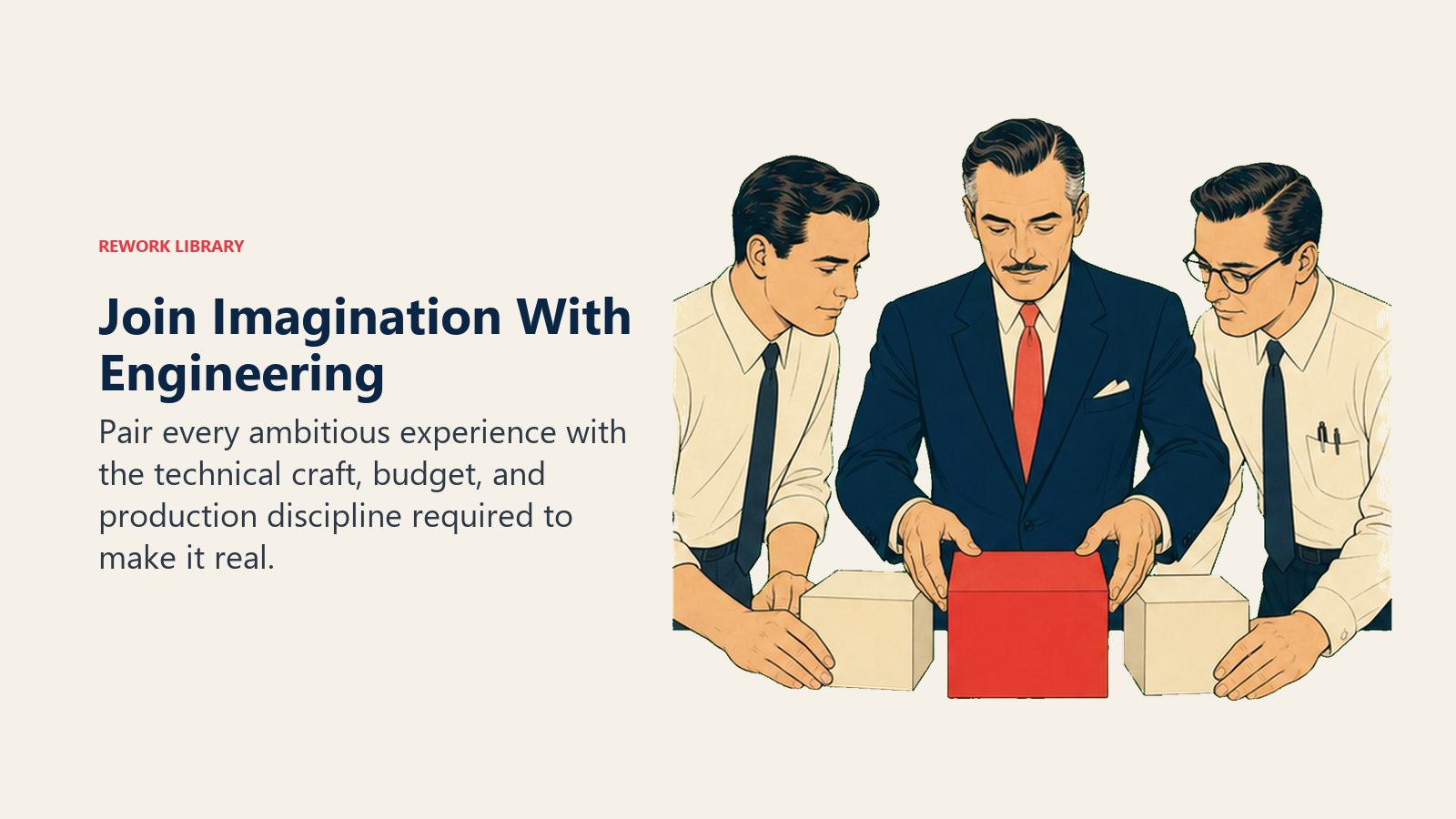
The Imagineering Model is Disney's operating doctrine that treats imagination and engineering as a single integrated discipline, every creative idea must be paired with the technical craft to realize it, and every technical capability must serve a specific emotional experience. Under this doctrine, story, design, sound, space, and engineering report to the same standard: "Is this the best it can be?" Creative ambition and operational execution are never separate tracks; they are the same bet, funded by relentless reinvestment of profit into the next impossible thing.
Key Leadership Traits
| Trait | Rating | What it means in practice |
|---|---|---|
| Creative Conviction | Exceptional | Disney's threshold question for every project was: "Is this the best it can be?" Not "is this good enough" or "will this work commercially." He asked whether it was the best. Snow White cost $1.5 million, roughly three times the original budget, because Disney kept sending scenes back for rework. The press called it "Disney's Folly." It became the highest-grossing film ever released up to that point. |
| Integrated Experience Design | Exceptional | Disney thought in systems, not individual products. He designed Disneyland so that every sight line was intentional, so that the smells of a bakery would drift toward the entrance, so that guests would never see a costumed character from two lands at once. He applied the same logic to film: sound, color, story, and music weren't separate departments. They were a single experience that had to cohere. |
| Learning From Failure | High | Disney lost his first studio. He lost Oswald. He nearly lost the Disney studio itself multiple times to cash-flow crises. What he didn't do was generalize from those failures into risk-aversion. He consistently extracted a specific lesson from each failure, read your contracts, own your IP, control your financing, and applied it precisely, without letting the fear of the last failure prevent the next bet. |
| Operational Delegation (Late Career) | Moderate | Disney was a notoriously poor delegator for most of his career. His brother Roy ran the finances specifically because Walt was incapable of doing so and had no patience for it. On creative decisions, he was deeply controlling and difficult for animators and directors to work with. He improved at operational delegation later in his career, but the dependency on Roy Disney for financial survival was a structural weakness that nearly ended the studio several times. |
The 3 Decisions That Defined Walt Disney as a Leader
1. Snow White as the Original "Bet the Company" Product Decision (1934-1937)
In 1934, Walt Disney told his animation team he wanted to make the first feature-length animated film in history. No one had done it. The production would require a cast of hundreds of animators, a multi-year timeline, and a budget that would eventually reach $1.5 million, at a time when a normal Disney short cost around $50,000 to produce.
Industry insiders called the project "Disney's Folly." The conventional wisdom was that audiences wouldn't sit through 83 minutes of animation, that the technology wasn't good enough to sustain feature-level quality, and that Disney was going to bankrupt himself trying. His wife and most of his advisors shared some version of this view.
Disney pressed forward. He personally storyboarded sequences, reviewed animation frames in detail, and sent scenes back for rework when they didn't match what he had in his head. He borrowed money from his family and later mortgaged his house when production costs exceeded projections.
Snow White and the Seven Dwarfs opened in December 1937. It grossed over $8 million in its initial theatrical run, the equivalent of roughly $170 million today, and was the highest-grossing film ever released at the time of its debut. It funded Disney's first permanent studio and established the company as capable of something no one else in entertainment could do.
The leadership lesson isn't "bet the company." It's the specific reasoning behind the bet. Disney didn't go all-in on Snow White because he was reckless. He went all-in because he understood that a half-realized version of the idea would fail commercially AND creatively, that the only way to validate the concept of feature animation was to execute it at a level that made the question of audience appetite definitively answerable. A cheaper Snow White would have proven nothing.
2. Building Disneyland Against Unanimous Advisor Opposition (1952-1955)
In the early 1950s, Disney began planning a theme park. His animators thought it was a distraction from films. His brother Roy thought it was financially reckless. Bank of America, which had financed multiple Disney productions, passed on the project. Every financial advisor Disney approached told him the same thing: theme parks were dirty, dangerous, poorly run businesses, and the economics didn't justify the capital investment.
Disney spent two years quietly planning it anyway. He hired Stanford Research Institute to help with site selection and used his own TV show, which he'd negotiated as part of the ABC deal for the park's financing, to build public anticipation before opening. He borrowed against his life insurance policy and convinced ABC to take a 35% ownership stake in exchange for a $500,000 investment and guaranteed loans up to $4.5 million.
Disneyland opened in July 1955 in Anaheim, California. The opening day was a disaster by most accounts, fake tickets, heat, a gas leak, a women's heels sinking into freshly poured asphalt. Disney showed up anyway, worked through the problems, and by the end of the first year the park had hosted over 3.6 million visitors.
Disneyland didn't just succeed commercially. It invented an entire industry. Every theme park built since then has been, at some level, a response to what Disney built in Anaheim. The integrated IP experience model, where characters from films became physical experiences, where merchandising reinforced the film, where the park reinforced the brand, was Disney's creation.
The leadership lesson is about what it takes to build something genuinely new. Disney couldn't point to evidence that Disneyland would work because nothing like it existed. He was arguing from first principles: people will pay for a curated, high-quality experience if the standard is high enough and the execution is complete. He was right, but there was no data for it.
3. Synchronized Sound and Steamboat Willie (1928)
The third defining decision came before Snow White, before Disneyland, and in some ways it's the most important one for understanding how Disney thought about competitive positioning.
In 1928, most animated films were silent. Disney had just lost Oswald. He created a new character, Mickey Mouse, and produced two silent shorts with him that were commercially unremarkable. Then Disney heard about talking pictures. The Jazz Singer had come out in 1927, and Warner Bros. was moving fast on synchronizing sound to film.
Disney decided to synchronize sound to animation. Not just add a soundtrack, actually synchronize musical beats, sound effects, and character movements frame by frame. Steamboat Willie premiered in November 1928 and was the first animated film with synchronized sound. It was an immediate sensation.
What this shows about Disney's competitive instincts: he looked at an adjacent technology development, saw that it would redefine audience expectations, and moved into it before the window closed. He didn't wait to see if talking pictures were a fad. He read the trajectory and committed. This is a pattern across his career, color animation (Flowers and Trees, 1932, first Technicolor cartoon), feature length, theme parks, each time seeing that a new capability would redefine what "excellent" meant and moving first.
What Walt Disney Would Do in Your Role
If you're a CEO, Disney's most transferable lesson is the difference between vision and wishful thinking. Disney could describe the experience he was creating in specific, sensory terms. He knew what Snow White's forest was supposed to feel like. He knew how a visitor walking down Main Street USA at Disneyland should feel. That specificity is what separates vision from vague ambition. Can you describe your company's best-case customer experience in concrete, sensory terms? If it stays abstract, it can't be built.
If you're a COO or operations leader, the Walt-and-Roy model is the thing to study. Walt needed Roy. Not as a partner in the usual sense, but as a structural complement, someone who would build the financial architecture that made Walt's spending habits survivable. If you're working with a visionary founder or CEO, your job isn't to slow them down. It's to build the systems that let them move fast without the whole thing collapsing. Roy Disney wasn't famous because he was boring. He was essential because Walt would have gone bankrupt three times over without him.
If you're a product leader, look at how Disney designed integrated experiences rather than individual features. The decision to synchronize sound to animation wasn't about the audio feature, it was about what synchronization made possible emotionally. Every design decision Disney made was downstream of an emotional goal, not a feature specification. Ask your team: what is the emotional state we want the user to have at this point in the journey, and does this feature create it?
If you're a sales or marketing leader, Disney's Disneyland financing story is your case study in how to sell something that doesn't exist yet. He couldn't show investors a comparable theme park because there was none. So he built the TV show first, which made the park tangible to consumers before it was real, and used that consumer interest as the proof point for investor conversations. If you're trying to sell something genuinely new, the question isn't how to pitch it better. It's what proof point you need to create first that makes the thing real in the buyer's imagination.
The Rework Analysis
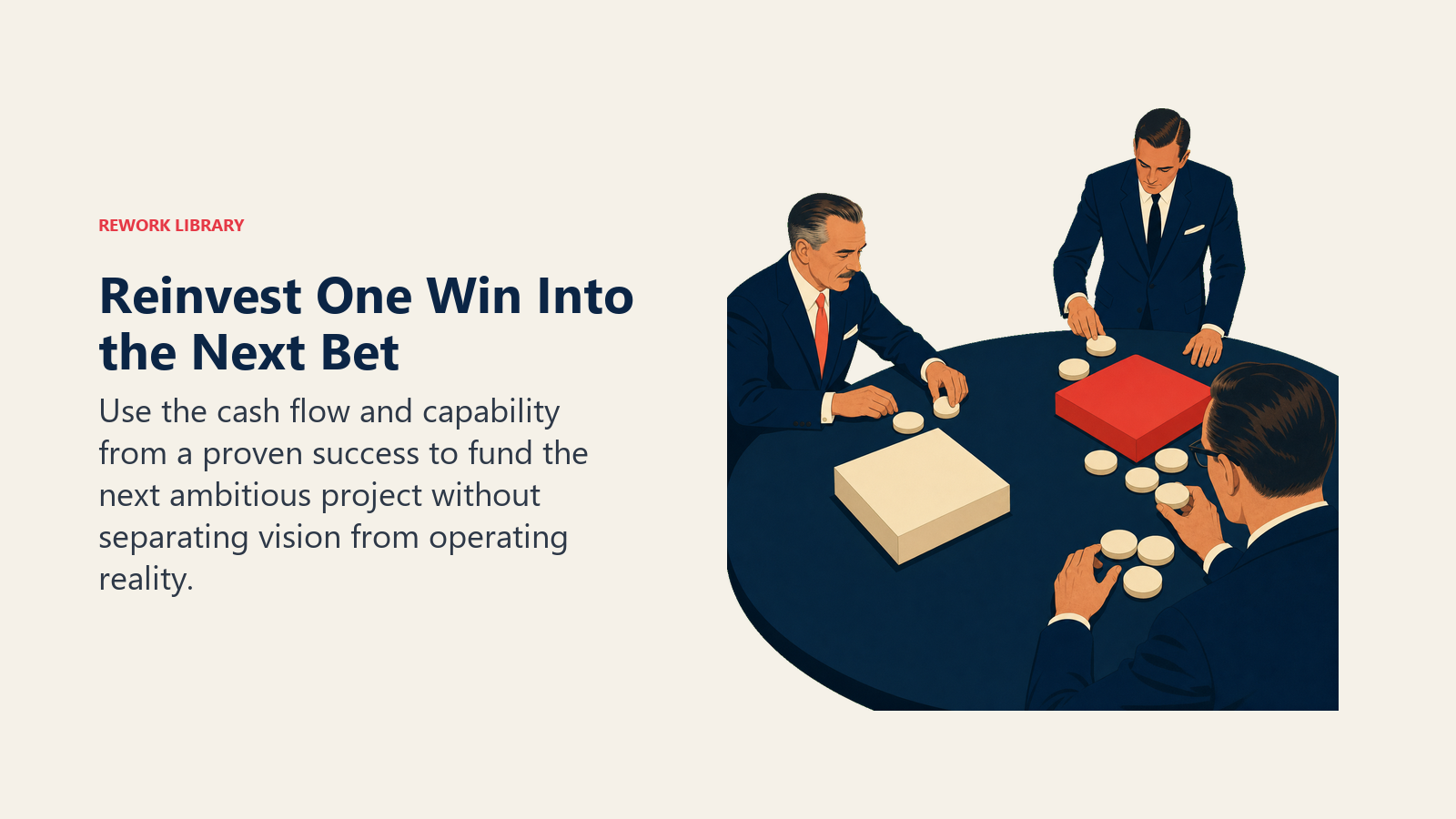
Disney's real edge wasn't creativity alone, it was the tight integration of creative ambition with operational discipline, funded by relentlessly reinvesting profit from one bet into the next impossible one. Mickey Mouse paid for Snow White. Snow White paid for the Burbank studio. The studio and TV deal paid for Disneyland. That loop only works when creative teams and operators share one system of record, not separate silos fighting over budget and timelines. This is where Rework fits modern creative-driven teams. Rework's Sales Engine (CRM, from $69/month billed yearly) and Project Engine (from $99/month billed yearly), each with 5 seats included (rework.com/pricing), connect the creative pipeline, production operations, customer feedback, and revenue in one place, so the equivalent of "Roy" isn't buried in spreadsheets while "Walt" ships. Teams get the visibility to make bold bets without flying blind on the financial and operational cost of each one.
Notable Quotes & Lessons Beyond the Boardroom
"It's kind of fun to do the impossible." Disney said this in various forms and contexts, but the important word is "fun." He didn't treat the impossible as a burden or a cross to bear. He treated it as the interesting part. The problems that excited him were the ones with no existing solution, synchronized animation, feature-length cartoons, an entirely new entertainment format called the theme park.
"All our dreams can come true, if we have the courage to pursue them." This one sounds inspirational until you read it alongside the actual cost of his dreams: multiple near-bankruptcies, brutal creative fights with animators who went on strike against him in 1941, a health decline that his biographers attribute in part to the pressure of Disney World's construction. The courage he was describing wasn't metaphorical. It was the willingness to watch everything he'd built come close to collapse in the service of the next thing.
Disney died in December 1966, before Disney World opened. He spent his last two years deeply involved in the planning of EPCOT, a utopian city of the future he never got to build. That gap between the vision and the execution he was able to see defines him as much as anything else. He was always working toward something he couldn't quite finish.
Where This Style Breaks
Disney's creative control was an asset when the product was a film or a park he could personally oversee. It became a structural liability at scale. He was genuinely difficult to work for on creative projects, animators who went on strike in 1941 had real grievances about wages, credit, and working conditions that Disney handled poorly, partly because he couldn't separate criticism of his management from criticism of his work.
His near-zero delegation on creative decisions meant the company's creative pipeline was always bottlenecked through his judgment. When he was alive and engaged, that produced extraordinary results. But it also meant the company had no real creative succession model. The decades immediately following his death were marked by creative stagnation until new leadership, and eventually Pixar's influence, restored some of what Disney had built.
If your own company's creative output is entirely dependent on one person's taste and attention, Disney's legacy is the warning. The vision has to become a culture, not just a filter sitting at the top.
Frequently Asked Questions about Walt Disney's Leadership
Who was Walt Disney?
Walt Disney (1901-1966) was an American animator, entrepreneur, and co-founder of Walt Disney Productions, which he launched in 1923 with his brother Roy. He created Mickey Mouse in 1928, produced Snow White and the Seven Dwarfs, the first feature-length animated film, in 1937, opened Disneyland in 1955, and won 22 Academy Awards, more than any individual in history.
How did Disney near-bankruptcy multiple times?
Disney's first studio, Laugh-O-Gram, went bankrupt in 1921. Later, Snow White ran roughly three times over its original budget to about $1.5 million, forcing Walt to mortgage his home. Disneyland's financing was rejected by Bank of America, and Walt borrowed against his life insurance and negotiated an ABC deal to fund construction. Throughout his career, Walt's spending habits put the studio in repeated cash-flow crises that only his brother Roy's financial management kept from collapsing the company.
What is Imagineering?
Imagineering is Disney's term for the fusion of imagination and engineering, the discipline of treating creative vision and technical execution as one integrated function rather than separate departments. Disney formalized it with WED Enterprises (later Walt Disney Imagineering) in 1952 to design Disneyland, where storytellers, architects, and engineers worked side by side so every emotional beat had the technical craft to deliver it.
How did Disney build the first feature animation?
Disney committed to Snow White in 1934 against industry consensus that audiences wouldn't watch 83 minutes of animation. He invested in the multiplane camera for depth, storyboarded sequences personally, sent scenes back for rework when they missed his standard, and expanded the studio to hundreds of animators. The production took three years and $1.5 million. Snow White released in December 1937 and became the highest-grossing film ever at that point, grossing over $8 million in its initial run.
What was Disney's creative-leadership style?
Disney led as a visionary creative (roughly 70%) paired with a conviction-driven risk-taker (roughly 30%). He filtered every decision through a specific sensory image of what the final experience should feel like, refused to compromise on execution quality, and was willing to bet personal and company finances on each new format, synchronized sound, color animation, feature length, theme parks. His style was deeply controlling on creative calls and structurally dependent on his brother Roy for financial survival.
What can modern creative leaders learn from Walt Disney?
Describe the target experience in concrete, sensory terms, vague vision can't be built. Integrate creative and operational functions instead of siloing them. Reinvest profits from winning bets into the next impossible one rather than diversifying into safer ground. Pair every visionary leader with a structural complement like Roy who builds the financial and operational architecture. And turn the vision into culture and systems before the founder exits, or the creative pipeline stalls when they're gone.
Explore related profiles: Bob Iger at Disney, the CEO who inherited Walt's institution, kept it alive through acquisition (Pixar, Marvel, Lucasfilm), and then nearly dismantled the trust he'd built by returning a second time. Steve Jobs as creative-tech leader, Jobs studied Disney obsessively; the Pixar relationship was the bridge, and Jobs ran Apple's product reviews with the same "is this the best it can be?" threshold Walt used on Snow White. Ray Kroc at McDonald's, the other great 1950s systematizer: where Disney built experiential systems, Kroc built operational ones, and both scaled something that felt impossible to replicate through rigorous process design.

On this page
- Leadership Style Breakdown
- The Imagineering Model (The Disney Creative Culture Doctrine)
- Key Leadership Traits
- The 3 Decisions That Defined Walt Disney as a Leader
- 1. Snow White as the Original "Bet the Company" Product Decision (1934-1937)
- 2. Building Disneyland Against Unanimous Advisor Opposition (1952-1955)
- 3. Synchronized Sound and Steamboat Willie (1928)
- What Walt Disney Would Do in Your Role
- The Rework Analysis
- Notable Quotes & Lessons Beyond the Boardroom
- Where This Style Breaks