Patrick Lencioni Leadership Style: Team Dysfunction, Organizational Health, and the Fable Format That Sold 3 Million Copies
Turn this article into takeaways for your work.


Each assistant summarizes the article only for you and suggests best practices for your work.
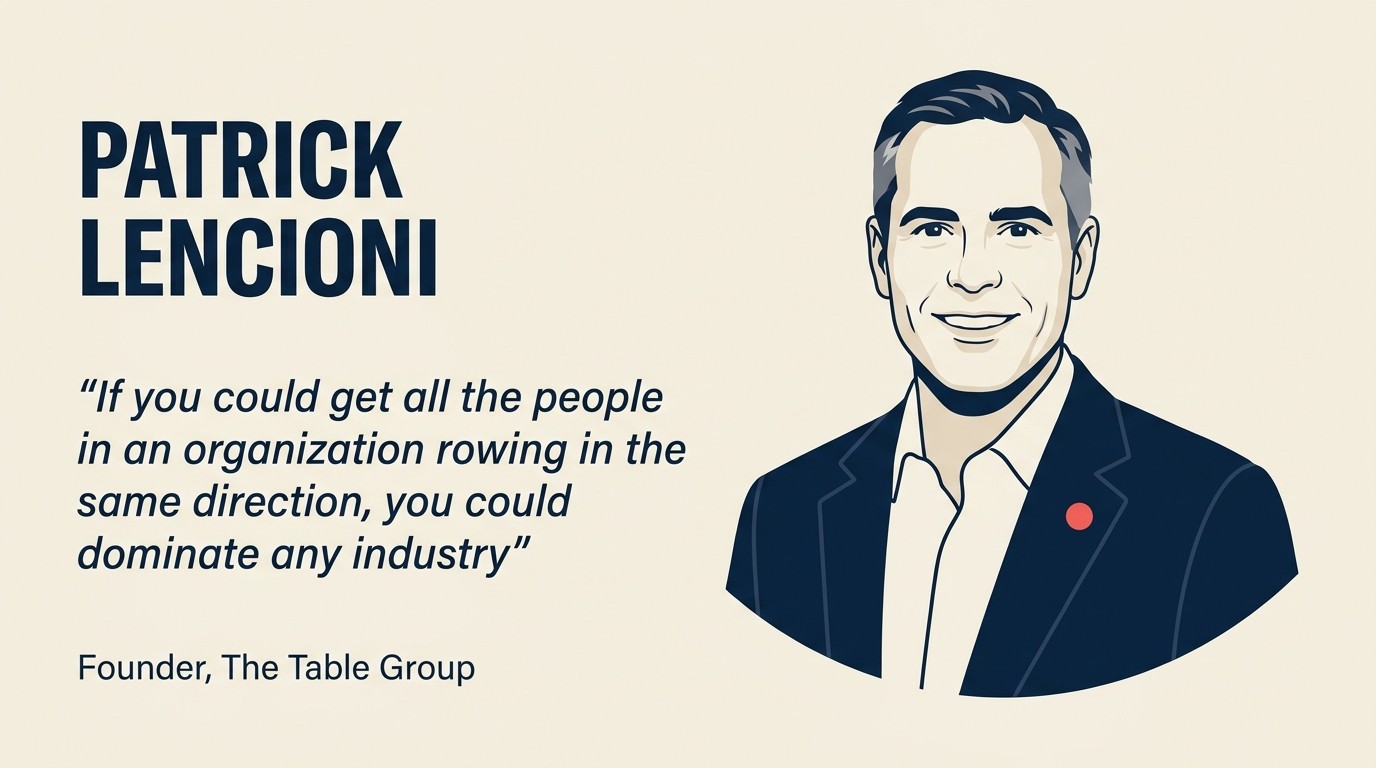
Key Facts: Patrick Lencioni is the founder and president of The Table Group, a management consulting firm he launched in 1997 focused on organizational health and executive team cohesion. He is the author of 12+ bestsellers including "The Five Dysfunctions of a Team" (2002, 3M+ copies sold), "Death by Meeting" (2004), "The Advantage" (2012), and "The Ideal Team Player" (2016). He hosts the "At the Table" podcast and developed the Working Genius assessment in 2020.
The Five Dysfunctions of a Team (The Lencioni Team Health Doctrine)
The Five Dysfunctions of a Team is Patrick Lencioni's named framework describing a causal sequence of five interdependent failure modes that undermine leadership teams: absence of trust, fear of conflict, lack of commitment, avoidance of accountability, and inattention to results. Each dysfunction builds on the one below it, meaning trust is the foundation that makes productive conflict possible, which enables genuine commitment, which permits peer accountability, which ultimately drives collective results. The Lencioni Team Health Doctrine argues that organizational health, clarity, cohesion, and communication at the top, is a greater competitive advantage than strategy, technology, or finance.
Patrick Lencioni published "The Five Dysfunctions of a Team" in 2002 as a business fable, a story about a fictional tech CEO and her struggling executive team. The business book category treated fables with condescension. The market didn't. Over 3 million copies later, it's become standard reading in executive onboarding programs, leadership development curricula, and management training across industries that have nothing to do with Silicon Valley.
The reason isn't that it says anything novel. Absence of trust, fear of conflict, lack of commitment, avoidance of accountability, inattention to results: these patterns were documented in organizational psychology decades earlier. What Lencioni did was package them in a sequence that feels both diagnostic and actionable. And he wrapped the whole thing in a story that executives would actually finish reading.
If you've been in a leadership team meeting where everyone agreed in the room and nothing changed outside it, you've already experienced his model from the inside.
Leadership Style Breakdown
| Style | Weight | How it showed up |
|---|---|---|
| Framework Architect | 60% | Lencioni's primary output is building and maintaining frameworks. The Five Dysfunctions pyramid, the organizational health model in "The Advantage," the Working Genius assessment, each is a structured mental model designed to give practitioners a diagnostic and an action sequence. His books follow a consistent pattern: introduce a story that embeds the framework narratively, then surface the framework explicitly in a summary section at the back. The 60% weight reflects that his intellectual contribution is primarily architectural: he takes complex organizational phenomena and builds models that make them legible and actionable for non-academics. |
| Practitioner-First Consultant | 40% | Before founding Table Group in 1997, Lencioni spent time at Bain, Oracle, and Sybase as VP of Organization Development. He came to consulting with direct experience of how executive teams actually behave, not from academic research but from sitting in the rooms. Table Group works hands-on with executive teams on clarity, cohesion, and communication. The consulting work keeps his frameworks grounded in the specific failure modes that real leadership teams exhibit, rather than the idealized versions that appear in management literature. |
That split matters because Lencioni isn't trying to be an academic or a researcher. He's explicit about that. Table Group doesn't publish peer-reviewed studies. His credibility comes from the practitioner side and the sheer volume of executive teams that have tested his frameworks in real conditions. The frameworks hold not because they're rigorously validated but because they're accurate enough to be useful and simple enough to use.
Key Leadership Traits
| Trait | Rating | What it means in practice |
|---|---|---|
| Ability to simplify without distorting | Exceptional | The Five Dysfunctions pyramid collapses a genuinely complex set of organizational behaviors into five concepts in a causal sequence. The simplification loses nuance, real team dysfunction rarely follows the clean top-to-bottom causality the model implies. But the model is still useful precisely because it's simple enough to hold in your head during a difficult conversation. Lencioni's gift is knowing which details to cut and which to keep, and he cuts more aggressively than most. |
| Narrative clarity over academic rigor | Very High | Lencioni writes fables because he believes executives absorb ideas better through story than through argument. That's a packaging decision with real consequences. Business fables reach readers who would never pick up an organizational behavior textbook. They create emotional engagement with the material. And they create the specific kind of readership that talks about a book in executive team settings, which is the distribution channel that turned 3 million copies into required reading. |
| Sustained single-framework discipline | High | For over 20 years, Lencioni has stayed close to the same core thesis: organizational health is the primary competitive advantage, and it starts with executive team cohesion. He hasn't chased adjacent topics, rebranded his consulting model, or pivoted to technology or AI themes. That discipline gives his work coherence across 12+ books and makes it easy for a new reader to find the primary framework quickly. |
| Practitioner credibility over research credibility | High | Lencioni doesn't claim scientific validation for his frameworks. He claims they work because he's seen them work with real executive teams. That's a honest positioning that makes his work more durable in some ways, it doesn't depend on replication studies that might come back weaker. But it also means his frameworks don't update from evidence the way Edmondson's do. When the research on organizational health evolves, Lencioni's model doesn't automatically incorporate it. |
The 3 Decisions That Defined Patrick Lencioni as a Leader
1. Founding Table Group in 1997 as a Thesis-Driven Consulting Firm
Lencioni founded Table Group in 1997 with a specific argument: that organizational health (clarity, cohesion, and communication at the leadership level) is the primary source of competitive advantage, and that most organizations treat it as secondary to strategy, technology, and financial engineering.
That argument was genuinely contrarian in the late 1990s. The strategy consulting world was dominated by frameworks built around market positioning, competitive dynamics, and operational efficiency. McKinsey, Bain, and BCG were selling strategy. Lencioni was arguing that strategy is largely irrelevant if the team at the top can't make decisions, communicate clearly, and hold each other accountable.
The timing was important. Table Group was founded two years before "The Five Dysfunctions" was published. Lencioni was consulting with executive teams before he had a framework with a brand name. That sequence (work first, book second) meant that when the book came out, it was documenting patterns he'd already seen consistently enough to describe with precision.
Table Group has stayed small and focused by design. Lencioni didn't build a large consulting firm with hundreds of consultants. He built a boutique firm that works directly with executive teams, using the books and speaking as a distribution mechanism rather than a revenue model. That structure has kept the quality of the consulting work high and the intellectual focus narrow, both of which are unusual in management consulting.
2. Writing "The Five Dysfunctions of a Team" in Fable Format
The decision to publish "The Five Dysfunctions of a Team" as a business fable in 2002 was a product decision, not a stylistic one. Lencioni had the framework. The question was how to package it so that the people who most needed it would actually engage with it.
Business fables were not respected in management publishing. They were considered airport books: simplistic, light on evidence, designed for people who didn't read real management literature. Lencioni made the bet anyway, and the market response was unambiguous: 3 million copies across the next two decades, translated into dozens of languages, used as curriculum in business schools and executive development programs.
The fable format works for a specific reason that Lencioni understood: the fictional CEO character, Kathryn Petersen, makes the mistakes in a way that's recognizable without being personally accusatory. A reader can see their own executive team's dysfunction in the story without feeling directly indicted. That distance creates the psychological safety to engage with the material honestly, which is, somewhat ironically, the precondition for the kind of team improvement Lencioni's framework prescribes. It's the same dynamic Brené Brown describes when she argues that vulnerability in a leader gives others permission to be honest, the narrative container lowers the interpersonal cost of acknowledgment.
The back section of the book, where Lencioni surfaces the framework explicitly, is the part that gets used in workshops and offsite diagnostics. But most readers engage with it because they finished the fable first. That's the product insight: the story creates the engagement, and the framework creates the utility.
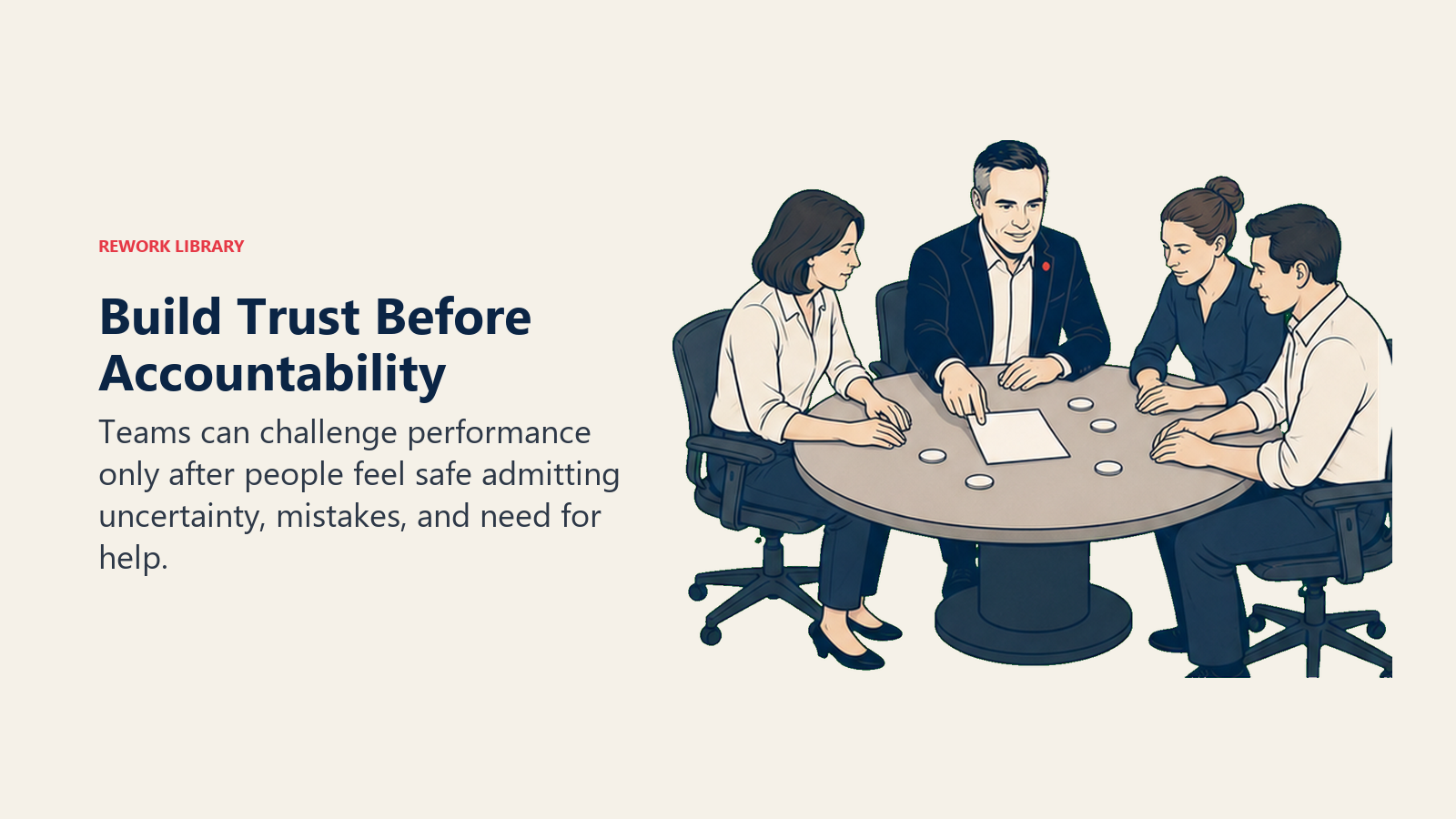
The Five Dysfunctions pyramid is worth understanding as a sequence, not just a list. Absence of trust is the foundation because all other dysfunctions depend on it. Without trust, defined by Lencioni as the willingness to be vulnerable in front of teammates, teams can't have productive conflict. Without productive conflict, they can't reach genuine commitment. Without genuine commitment, they can't hold each other accountable. Without accountability, results suffer. Remove any link and the chain breaks, but the base determines everything above it.
3. Developing the Working Genius Assessment After 2020
In 2020 and 2021, Lencioni developed the Working Genius assessment, a model based on six types of work energy: Wonder (curiosity about what could be improved), Invention (generating new solutions), Discernment (evaluating ideas and spotting problems), Galvanizing (rallying people around a direction), Enablement (supporting others in implementation), and Tenacity (completing projects and sustaining momentum through obstacles).
The assessment distinguishes between each person's two "geniuses" (where they have natural energy and strength), two "competencies" (where they can perform adequately but without natural energy), and two "frustrations" (where they consistently feel drained and underperform).
The Working Genius model extends Lencioni's organizational health thesis in a specific direction: personnel decisions. The Five Dysfunctions tells you what's broken in a team. Working Genius tells you whether you have the right combination of work-energy types to get the whole job done, and why certain people are consistently frustrated in their roles even when they're technically competent.
The product decision to build a psychometric assessment is significant. It takes Lencioni's consulting model beyond books and speaking into a recurring revenue stream with data-backed team diagnostics. The assessment market is crowded: StrengthsFinder, DISC, Myers-Briggs, and dozens of others compete in the same space. But Working Genius is explicitly integrated with Lencioni's team health framework, which gives it a distribution advantage among organizations already using his other tools.
The assessment's most useful application is in team composition decisions. Before adding a new function or project team, you can map which work types are represented and which are missing. A team heavy on Invention and Wonder but short on Tenacity will generate ideas and never ship. A team heavy on Galvanizing and Enablement but short on Discernment will execute without adequately evaluating whether what they're executing is right.
What Patrick Lencioni Would Do in Your Role
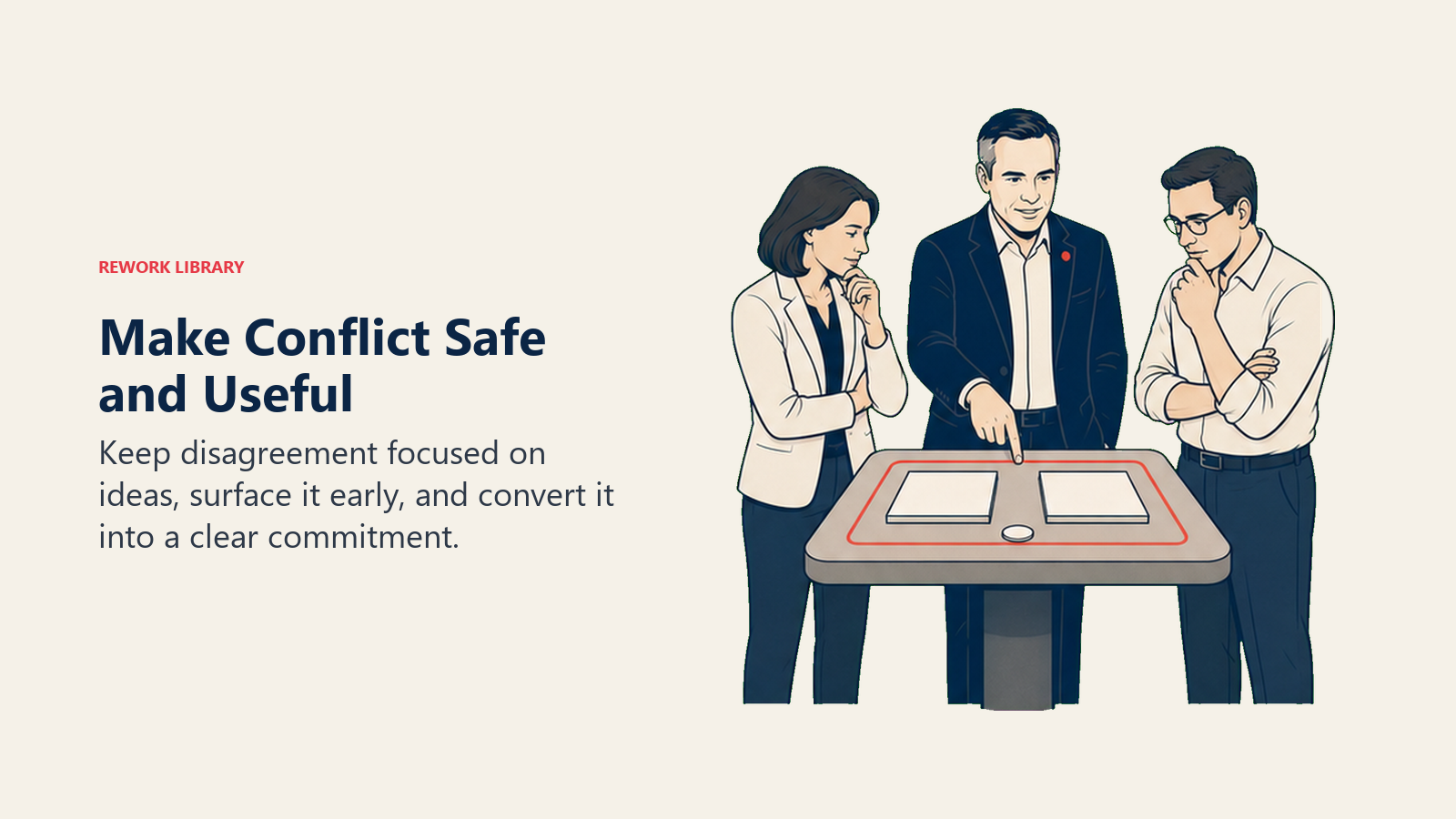
If you're a CEO, Lencioni's most uncomfortable question for you is whether you're the source of your leadership team's dysfunction. The Five Dysfunctions pyramid starts at trust, and trust in an executive team is a function of the CEO's behavior more than anyone else's. If your leadership team doesn't have productive conflict in front of you, if disagreements surface in side conversations after the meeting rather than in the meeting itself, the most likely cause is that you've signaled, consciously or not, that open disagreement is costly. Lencioni would push you to model the vulnerability that creates trust: admit an uncertainty, name a mistake, ask for help in a context where you could have pretended to have the answer.
If you're a COO or operations leader, "The Advantage" has the most direct application for you. Lencioni's argument is that organizational clarity (everyone knowing the answers to six specific questions about the organization's purpose, priorities, and values) is the prerequisite for operational efficiency. Confusion about strategy, goals, or behavioral standards creates coordination overhead that shows up as operational friction. Before you optimize a process, check whether the people running the process have a shared understanding of what they're optimizing for.
If you're a product leader, Working Genius has a specific team-composition application. Product teams that consistently fail to ship probably have a genius gap in Tenacity or Galvanizing. Product teams that ship without confidence in what they're building probably lack Discernment. Mapping your team against the six types before diagnosing performance problems can surface the structural reason for the pattern faster than a retrospective focused on process.
If you're in sales or marketing, the Five Dysfunctions accountability layer is most directly relevant. Sales teams are often strong on commitment (everyone agrees in the forecast meeting) but weak on accountability for the specific behaviors that drive results. Lencioni's point is that accountability on leadership teams doesn't come from performance management systems. It comes from peers holding each other to the standards they've explicitly committed to, in the room, in real time. That's a norm you build through practice, not policy.
How Rework Supports Lencioni-Style Team Health
Lencioni's first dysfunction is absence of trust, and his second is fear of conflict. Both dissolve when leadership teams can't see what each other is working on, where commitments live, or how decisions got made. Rework gives executive teams a shared surface for the structured conversations Lencioni prescribes. Weekly leadership meetings, quarterly offsites, and accountability check-ins all happen in one place where action items, owners, and deadlines are visible to every team member, no side conversations, no ambiguous commitments.
Rework's work operations platform (Process and Project Engines from $99/month billed yearly) turns Lencioni's "accountability in the room, in real time" principle into a persistent system. When a leader commits to a quarterly rock, peers see it, track it, and can raise healthy conflict early if the commitment drifts. The Sales Engine (from $69/month billed yearly) applies the same transparency to revenue teams, forecast commitments, pipeline reviews, and deal-level accountability stay visible across the leadership group rather than buried in individual dashboards.
Notable Quotes and Lessons Beyond the Boardroom
Lencioni's central argument in "The Advantage" (2012) is worth taking seriously as a strategic claim, not just a culture claim: "The single greatest advantage any company can achieve is organizational health. Yet it is ignored by most leaders even though it is simple, free, and available to anyone who wants it." He's arguing that health is a competitive advantage because it's underinvested. Most organizations treat it as secondary to strategy, which means the organizations that treat it as primary have an edge that's genuinely hard to replicate.
His distinction between "smart" organizations and "healthy" ones is operationally useful. Smart organizations have good strategy, strong financials, and sophisticated marketing. Healthy organizations have minimal politics, high clarity, fast information flow, and low turnover. Patty McCord arrived at a compatible conclusion from the HR side: most of the talent systems organizations build to compensate for unhealthy cultures would be unnecessary if the culture were honest and clear in the first place. And Adam Grant's research on give-and-take dynamics in organizations maps cleanly onto Lencioni's accountability layer, teams where members genuinely hold each other to commitments tend to have a higher density of givers at the senior level. Lencioni's point is that most organizations invest heavily in being smart and underinvest in being healthy, and that health produces better long-term results because it makes the smart work more durable.
On Working Genius, Lencioni has made a point about reframing underperformance that's worth applying: most people who are struggling in a role aren't failing because they lack skills. They're failing because their natural work energy doesn't match the demands of the role. That's a different diagnostic and a different intervention. Moving someone from a Discernment-heavy role to one that requires Galvanizing can unlock performance that performance management couldn't touch.
Where This Style Breaks
Lencioni's models are persuasive and easy to deploy in executive offsites but notoriously hard to sustain past the initial workshop. The Five Dysfunctions framework requires ongoing behavioral change from leaders who are often the primary source of the dysfunction. Trust isn't built in a retreat. It's built through hundreds of small interactions over months, and it breaks down faster than it builds up.
"The Advantage" argument also assumes that health and strategy are separable initiatives. In capital-constrained, fast-moving environments, the luxury of working on organizational clarity as a distinct project rarely materializes. The teams that most need Lencioni's frameworks are usually too busy firefighting to run a full organizational health workshop.
His frameworks describe what great teams look like with precision. They're less precise on how you get there when the starting point is a broken team where the dysfunction has been present for years and where the CEO may be the primary source of it.
Frequently Asked Questions about Patrick Lencioni's Leadership
Who is Patrick Lencioni?
Patrick Lencioni is the founder and president of The Table Group, a boutique management consulting firm founded in 1997 focused on organizational health and executive team effectiveness. He is a bestselling author of 12+ books including "The Five Dysfunctions of a Team" (3M+ copies), "The Advantage," and "The Ideal Team Player," and hosts the "At the Table" podcast.
What are the Five Dysfunctions of a Team?
The Five Dysfunctions, introduced in Lencioni's 2002 business fable, are a causal pyramid: absence of trust, fear of conflict, lack of commitment, avoidance of accountability, and inattention to results. Each builds on the one below it. Without vulnerability-based trust at the base, teams can't have productive conflict, reach genuine commitment, hold each other accountable, or focus on collective outcomes.
What is organizational health per Lencioni?
Organizational health, as defined in Lencioni's 2012 book "The Advantage," is the state of minimal politics, minimal confusion, high morale, high productivity, and low turnover that results from clarity, cohesion, and communication at the leadership level. Lencioni argues organizational health is the greatest competitive advantage any company can achieve because it's simple, free, and ignored by most leaders.
What is the Ideal Team Player framework?
The Ideal Team Player, from Lencioni's 2016 book, is a hiring and development framework built on three virtues: humble (lacking ego, sharing credit), hungry (self-motivated, driven), and smart (people-smart, emotionally intelligent). Lencioni argues that great team players have all three, and that missing any one creates predictable team-performance problems.
What does Lencioni say about meetings?
In "Death by Meeting" (2004), Lencioni argues that meetings are boring and ineffective because they lack drama and structure, not because there are too many of them. He prescribes four distinct meeting types with different cadences and purposes: daily check-ins, weekly tacticals, monthly strategic meetings, and quarterly off-site reviews, each designed to surface the right conflict at the right altitude.
What can managers learn from Patrick Lencioni?
Managers can learn that team performance is primarily a function of interpersonal dynamics at the top, not individual skill or strategy. Build vulnerability-based trust by admitting uncertainty, encourage productive conflict by engaging disagreements in the room, create genuine commitment through explicit decisions, and normalize peer accountability so that standards are held by teammates, not just the boss.
For related reading on team performance and organizational culture, see Amy Edmondson Leadership Style, Brené Brown Leadership Style, Adam Grant Leadership Style, Kim Scott Leadership Style, Patty McCord Leadership Style, and Daniel Goleman Leadership Style.

On this page
- The Five Dysfunctions of a Team (The Lencioni Team Health Doctrine)
- Leadership Style Breakdown
- Key Leadership Traits
- The 3 Decisions That Defined Patrick Lencioni as a Leader
- 1. Founding Table Group in 1997 as a Thesis-Driven Consulting Firm
- 2. Writing "The Five Dysfunctions of a Team" in Fable Format
- 3. Developing the Working Genius Assessment After 2020
- What Patrick Lencioni Would Do in Your Role
- How Rework Supports Lencioni-Style Team Health
- Notable Quotes and Lessons Beyond the Boardroom
- Where This Style Breaks