Sheryl Sandberg Leadership Style: Building the Machine Behind the Mission
Turn this article into takeaways for your work.


Each assistant summarizes the article only for you and suggests best practices for your work.
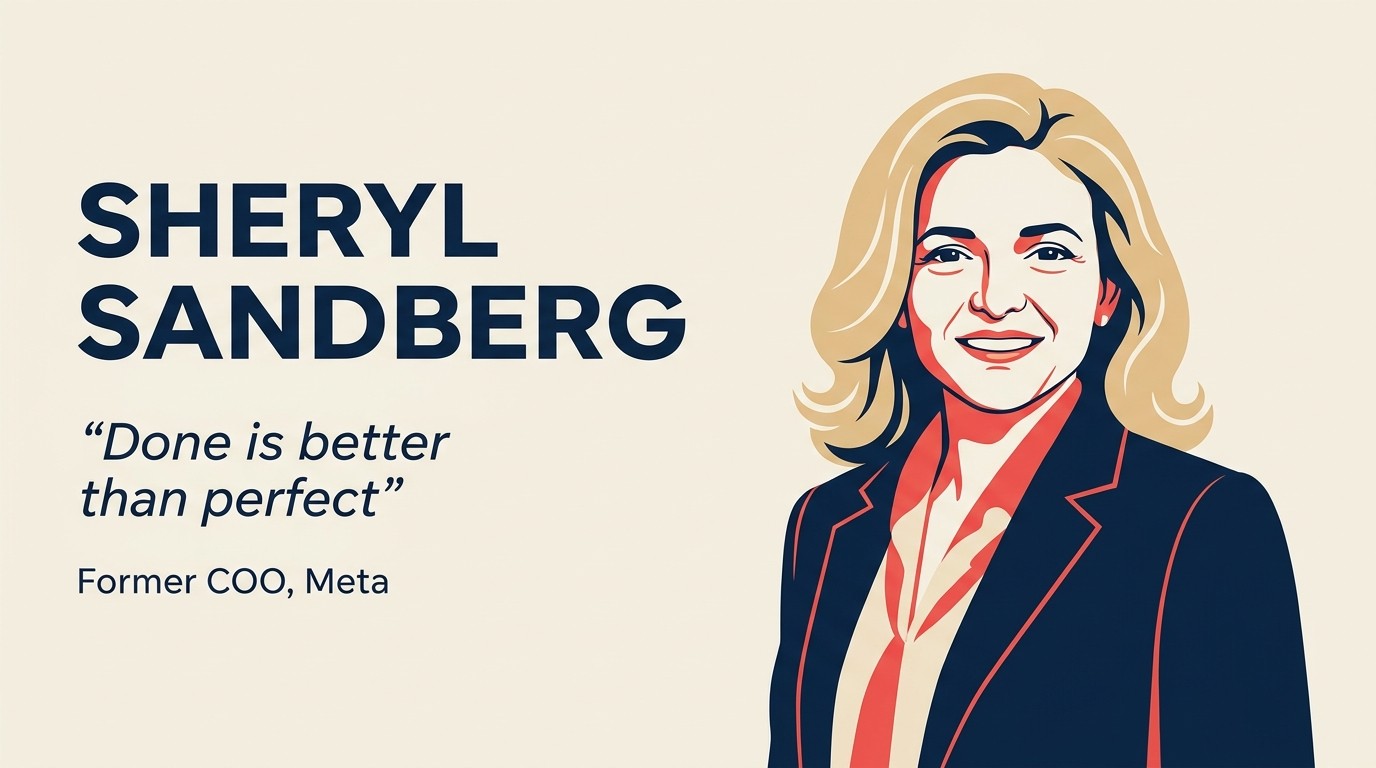
Sheryl Sandberg's leadership style pairs revenue-machine architecture with empathy delivered as direct, structured feedback. As Facebook's COO she built self-serve advertising systems that scaled revenue without scaling sales headcount, then advocated for it through "Lean In." Her transferable lesson: design the operational engine that converts product value into revenue with the same rigor you give the product.
Key Facts: Sheryl Sandberg (born August 28, 1969) served as COO of Facebook/Meta from March 2008 to August 2022, growing the company's annual ad revenue from roughly $272 million to $117.9 billion during her tenure. Before Facebook she was VP of Global Online Sales and Operations at Google (2001-2008), where she built the AdWords and AdSense sales organization. Earlier she served as chief of staff to U.S. Treasury Secretary Larry Summers under President Clinton (1996-2001). She holds a BA in economics (1991) and MBA (1995) from Harvard, authored "Lean In" (2013, 5 million-plus copies sold) and "Option B" with Adam Grant (2017), and founded the Lean In Foundation.
The Sandberg Operator Partnership Model
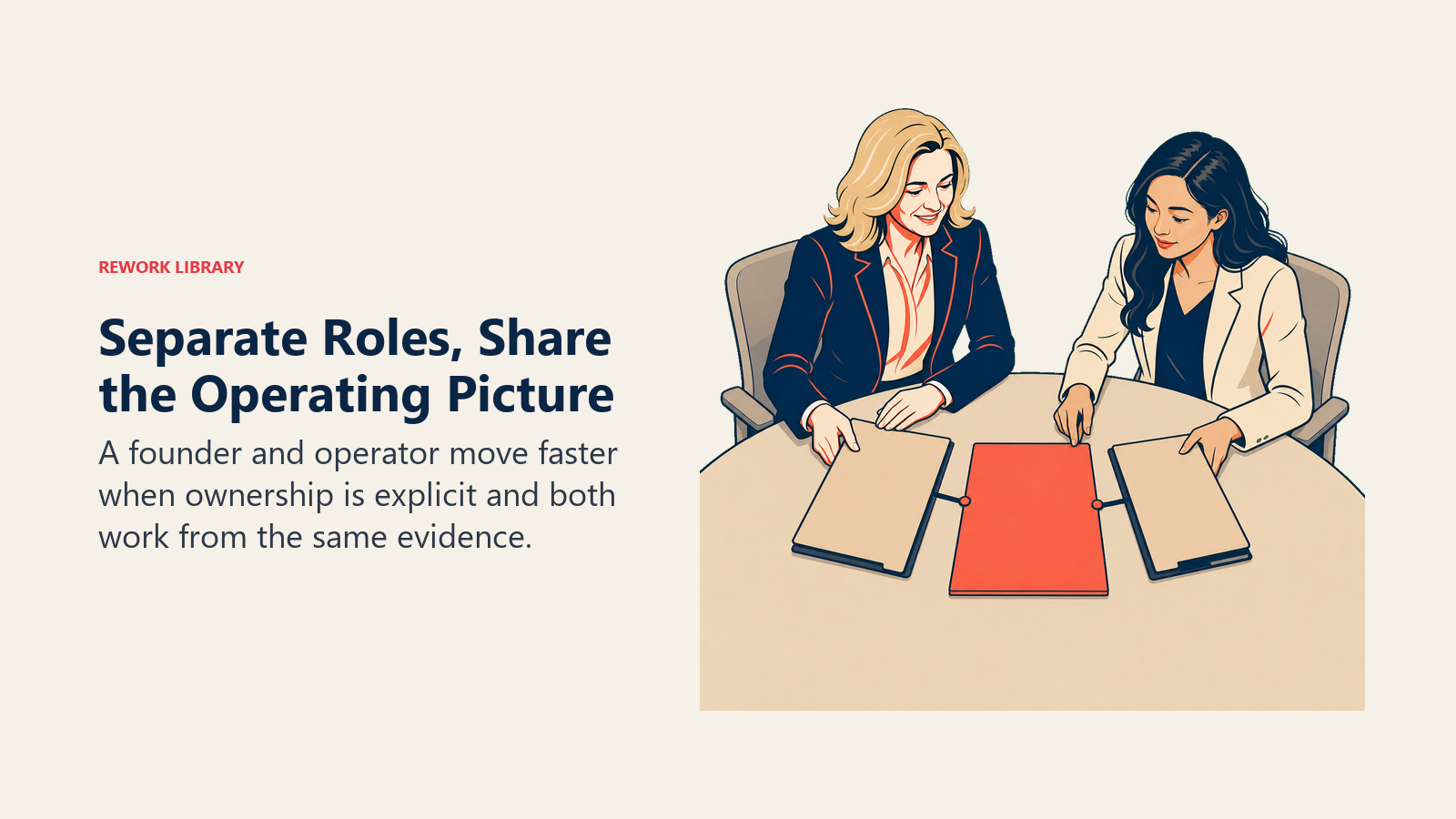
The Sandberg Operator Partnership Model is an executive pairing structure in which a visionary founder-CEO retains product and strategic direction while a senior operator takes ownership of revenue architecture, organizational scaling, policy, and external affairs. The model depends on explicit role separation, a durable personal trust relationship between CEO and COO, and a shared commitment to building self-serve revenue systems rather than sales-gated growth. It was proven at Google (Page-Brin-Sandberg) and scaled at Facebook (Zuckerberg-Sandberg) across 14 years.
When Sheryl Sandberg joined Facebook as COO in March 2008, the company had roughly 70 million users and no real business model. Mark Zuckerberg had a product that people loved and no clear path to making money from it. By the time Sandberg stepped down in June 2022, Facebook, rebranded Meta, had 3.6 billion monthly active users across its platforms and $117.9 billion in annual revenue.
She didn't build the product. She built the machine that turned the product into a business.
That's a skill most organizations are worse at than they realize. Product vision is visible and celebrated. The operational architecture that converts product traction into sustainable revenue, the sales org, the advertiser tools, the self-serve auction systems, the measurement infrastructure, is less glamorous but often the actual constraint. Sandberg spent her career solving exactly that problem, first at Google and then at Facebook at a scale that had no real precedent.
Understanding her approach is useful whether you're running a 20-person sales team or a 2,000-person revenue organization. The specific techniques scale. The underlying model is transferable.
Leadership Style Breakdown
| Style | Weight | How it showed up |
|---|---|---|
| Revenue-Machine Architect | 65% | Sandberg's defining contribution at both Google and Facebook was building self-serve advertising systems that removed the sales bottleneck from revenue growth. At Google she led the AdWords and AdSense sales organization from its early years to a $16 billion-plus annual run rate. At Facebook she applied the same logic at a bigger scale: build the system so that a small business owner in Indiana can set up a $50 Facebook campaign without talking to a sales rep. The machine runs without her. That's the design goal. |
| Empathy-as-Operator | 35% | Sandberg was known for structured one-on-ones, direct feedback delivered with genuine care, and building culture through documented practices rather than hoping values would emerge organically. This wasn't soft, she expected performance and said so directly. But she believed that people do their best work when they feel the organization is invested in their development, and she was willing to invest the time that took. Her writing in "Lean In" and later "Option B" reflects a genuine attempt to integrate personal experience into professional leadership, not just professional positioning. |
The 65/35 split matters because it explains why she's studied as both an operator and a cultural leader. The revenue architecture is the technical accomplishment. The empathy-as-operator approach is what made that architecture work at Facebook's scale, you can't run a 70,000-person organization on process alone.
Key Leadership Traits
| Trait | Rating | What it means in practice |
|---|---|---|
| Ad-revenue systems thinking | Exceptional | Sandberg understood that the bottleneck in advertising revenue at scale isn't the number of sales reps, it's the friction in the self-serve system. Her contribution at Google and Facebook was building infrastructure that let advertisers of any size access precision targeting and conversion measurement without custom deal-making. The result is a revenue model that compounds: more advertisers improve targeting data, which makes the product better for all advertisers, which attracts more advertisers. That flywheel logic was not obvious when she was building it. |
| Direct performance culture | Very High | Sandberg practiced what Kim Scott later called "radical candor" before Scott had named it: direct feedback delivered with genuine care for the person receiving it. She was known for telling people specifically what wasn't working and why, but doing so in a context of investment in their success rather than judgment. She also modeled it, she was willing to receive direct feedback herself and act on it publicly. That combination, giving hard feedback and demonstrating that you can take it, is what makes a performance culture feel safe rather than punitive. |
| Long feedback loops in public advocacy | High | "Lean In" was published in 2013. The Lean In Foundation with 50,000-plus circles in 185 countries was still active a decade later. Sandberg committed to a multi-year advocacy project with the understanding that cultural change in organizations doesn't happen in a quarter. She also adapted her position over time, acknowledging the structural critique that "Lean In" focused too much on individual behavior change and not enough on systemic reform. That willingness to publicly update a major public position is rare among executives who've staked reputational capital on a framework. |
| Resilience as an operational input | High | When her husband Dave Goldberg died suddenly in May 2015, Sandberg was running a major public company in a visible role. She took the experience seriously as a professional question, not just a personal one: how do you build the capacity to function after catastrophic disruption? "Option B," co-authored with Adam Grant, is the output of that inquiry. The operational insight, that resilience is a skill you can develop, not a fixed trait, has direct application for any leader building teams that need to perform through setbacks. |
The 3 Frameworks That Defined Sheryl Sandberg
1. The Ads Monetization Architecture
Sandberg's most durable contribution isn't a book or a quote, it's a structural model for advertising revenue that she built twice, first at Google and then at Facebook.
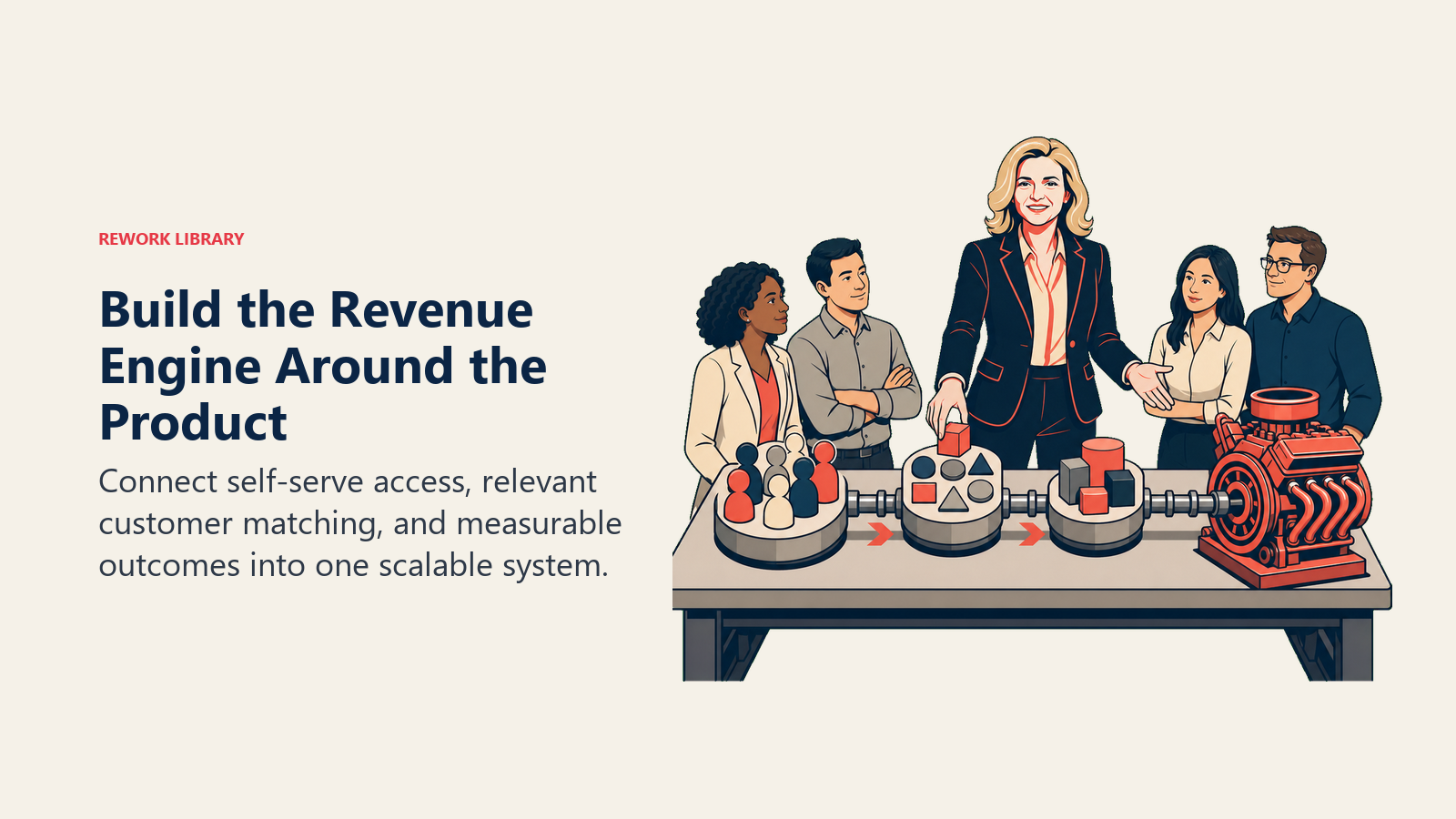
The model has three components. Self-serve auction: any advertiser, regardless of size, can access the platform without going through a sales team. Budget flows toward what performs, and the auction mechanism handles pricing without human negotiation. Precision targeting: advertisers can reach specific demographic and behavioral segments with a level of precision that TV and print couldn't offer. And measurable ROI: conversion tracking lets advertisers see whether campaigns actually drove purchases, signups, or other actions, which justifies shifting budget from channels that can't prove their impact.
At Google, this architecture was already partly built when Sandberg arrived. She scaled the sales organization and extended it globally, a period that overlapped with Sundar Pichai's early product work there, before he eventually inherited the company she helped make profitable. At Facebook, the challenge was more fundamental: a social product that users loved but that had no clear advertising product. Sandberg's team had to build the targeting infrastructure, the measurement tools, and the self-serve system from near zero.
The result shifted Facebook's revenue from roughly $272 million in 2008 to $117.9 billion in 2022. That's a 430-fold increase in 14 years. The ads architecture is why.
For operators today, the transferable principle is the self-serve model. If your revenue requires a human sales touch at every stage, you've built a ceiling into your growth. The question Sandberg asked at each stage was: what's the minimum viable human intervention for a customer to get value from this product? That question is worth asking about your own revenue engine.
2. Lean In: Structural Barriers and Individual Behavior
"Lean In" was published in 2013 and sold 4.5 million copies. The Lean In Foundation that followed extended that work into organizations worldwide. The central argument is that women face both external structural barriers and internal behavioral patterns, the tendency to underestimate their own ability, to sit at the back of the room, to volunteer for lower-visibility work, and that both need to be addressed. Fixing institutions without changing behavior doesn't work. Neither does changing behavior without fixing institutions.
The criticism of the book is well-documented: it focuses more on what individual women can do than on what institutions must change. That critique has validity. Sandberg acknowledged it in subsequent interviews and writing, noting that "Lean In" understated the role of structural barriers relative to individual behavior change.
But the parts of the book that hold up are the specific observations about behavioral patterns in organizational settings. The research on negotiation, on attribution of success and failure, on the confidence gap between men and women in equivalent situations, those findings are consistent with a large body of behavioral research. The operational implication for leaders isn't about women specifically. It's about the systematic ways in which organizational dynamics suppress contributions from anyone who doesn't fit the dominant template of what a leader looks like.
If you're building a team, the Lean In data is an argument for structured processes: structured interviews, blind resume review, explicit discussion of candidate assumptions before making offers. Laszlo Bock, who ran People Operations at Google during a large part of Sandberg's tenure next door, applied the same structured-process logic to hiring at scale and documented why unstructured interviews produce worse outcomes. Not because individuals are malicious, but because unstructured processes reliably favor whoever most resembles the people already there.
3. Option B: Resilience as a Practice
Sandberg's husband Dave Goldberg died unexpectedly in May 2015. "Option B," published in 2017 with organizational psychologist Adam Grant, is partly a personal memoir and partly an examination of the research on resilience and post-traumatic recovery.
The central operational insight is that resilience isn't a fixed personal characteristic, you either have it or you don't. It's a set of behaviors that can be learned and practiced. The research Sandberg and Grant draw on identifies three obstacles to recovery from adversity: personalization (believing the failure was entirely your fault), pervasiveness (believing it will affect every area of your life), and permanence (believing it will last forever). Getting back to a functional state faster requires working through those three specifically, not just time.
For leaders, the organizational implication is direct. Teams and companies go through failures, product launches that miss, markets that don't develop, executives who leave at bad times. The question isn't whether your organization is resilient. It's whether you've built the practices that let teams process failure, extract learning, and return to full functioning without extended dysfunction.
Sandberg's answer, from her own experience and the research: name what happened clearly, separate the controllable from the uncontrollable, and create structured space for the team to process rather than just moving on. Organizations that pretend failures didn't happen, or treat them purely as performance incidents, tend to have the same failures again.
What Sheryl Sandberg Would Do in Your Role
If you're a CEO, the Sandberg question is whether your organization has built the right bottlenecks into the revenue architecture. Every revenue model has human-touch requirements, and some of those are genuinely valuable. But many of them are legacy hangovers from early stages when you needed humans to explain a product that customers didn't understand yet. Ask where your sales team is creating value versus where they're adding process. The places where a well-designed self-serve experience could replace a human touchpoint without reducing conversion, those are the places Sandberg would focus first.
If you're a COO, the most direct Sandberg tool is the structured one-on-one. Sandberg was known for having clear agendas for one-on-ones, for taking notes, and for following up on commitments made in those meetings. That sounds basic. But most one-on-ones are either status updates or relationship maintenance, they don't produce the kind of direct feedback that actually changes behavior. Sandberg's version requires you to say the thing you've been avoiding: the specific problem with how someone is working, stated clearly, with an explicit ask. Most managers never do this. The performance conversations that don't happen are the ones that compound into retention problems later.
If you're a product leader, the measurement infrastructure component of Sandberg's ads architecture applies to product development. She insisted on building conversion measurement from the start at Facebook because advertisers need to know if their spend is working. Product teams need the same discipline about their own feature investments: not just whether a feature shipped, but whether it changed user behavior in the direction you expected. If you can't measure the outcome of the last feature release, you're building on assumption. That's not a data-science problem, it's a product discipline problem.
If you're in sales or marketing, Sandberg's self-serve principle is worth examining in your current motion. Not every deal can or should be self-serve, complex enterprise sales require human judgment. But most sales organizations have too much human involvement in too many parts of the funnel. The question is where the human touch is creating value versus adding latency. Identify the three or four deal types where human involvement most consistently converts at a higher rate and with higher ACV. Then design everything else to run without it.
Rework Analysis
The Sandberg model is unusually relevant to how Rework thinks about scaling revenue operations. The operator-to-founder partnership Sandberg ran with Zuckerberg succeeded because the revenue architecture, self-serve auction, precision targeting, measurable ROI, was treated as a product in itself, with the same rigor applied to the consumer product. Most growing companies treat revenue ops as plumbing: something the sales team complains about until someone patches it. That's the gap Rework closes. Our Sales Engine (from $69/month billed yearly, with 5 sales seats included) gives revenue leaders the same self-serve-style visibility Sandberg built into Facebook's ad platform, pipeline velocity by rep, conversion rates by stage, deal-size distribution, and forecast accuracy, without custom BI builds. Combined with the Process Engine (from $99/month billed yearly), teams get the cross-functional coordination layer Sandberg insisted on between sales, product, and measurement. The Sandberg lesson for operators is that revenue discipline compounds when it's instrumented. Rework is how mid-market teams get that instrumentation on day one.
Notable Quotes & Lessons Beyond the Boardroom
From "Lean In": "What would you do if you weren't afraid?" Sandberg used this question in the context of women's career decisions, but the underlying insight is broadly applicable: most organizations make risk decisions on the basis of avoiding blame rather than maximizing contribution. The fear isn't irrational, it's a rational response to how most performance management systems work. But naming the fear explicitly, as a leader, creates permission to override it.
From "Option B": "We cannot choose our options, but we can choose how to respond to them." That's not a platitude about positive thinking. Sandberg's argument is specific: the research on resilience identifies learnable behaviors that accelerate recovery, and leaders can build those behaviors into their teams rather than waiting for individuals to develop them on their own.
She also created, over 14 years at Facebook, one of the most documented examples of what it looks like to build a monetization architecture from scratch alongside a product that was already growing. Most of that work is invisible because it runs in the background. But the lesson, that the machine that converts product value into revenue is as important as the product itself, and requires as much deliberate design, is one most scaling companies learn too late.
Where This Style Breaks
Sandberg's ads-monetization model was optimized for engagement signals. The business logic was sound: more engagement means more ad inventory, which means more revenue. But engagement-maximizing algorithms amplified misinformation and polarizing content as efficiently as they amplified product reviews. Those externalities weren't priced into the model.
Her COO playbook works best when you're scaling a product with strong network effects. Most companies aren't. The ads-monetization architecture assumes you have billions of potential users and a product that improves with more of them. For a B2B SaaS company with a defined ICP and a 1,000-company TAM, the self-serve model requires significant adaptation.
And her public advocacy became harder to separate from Meta's political exposure after 2016. Whether fairly or not, "Lean In" and Sandberg's brand became associated with an organization that had significant governance criticism through the Cambridge Analytica period and beyond. That's the risk of building personal authority at the same scale as institutional authority.
For related reading on revenue architecture and scaling, see Mark Zuckerberg Leadership Style and Sundar Pichai Leadership Style.

On this page
- The Sandberg Operator Partnership Model
- Leadership Style Breakdown
- Key Leadership Traits
- The 3 Frameworks That Defined Sheryl Sandberg
- 1. The Ads Monetization Architecture
- 2. Lean In: Structural Barriers and Individual Behavior
- 3. Option B: Resilience as a Practice
- What Sheryl Sandberg Would Do in Your Role
- Rework Analysis
- Notable Quotes & Lessons Beyond the Boardroom
- Where This Style Breaks