McKinsey 7S Framework: The 7 Elements Explained (With Examples)
Turn this article into takeaways for your work.


Each assistant summarizes the article only for you and suggests best practices for your work.
The McKinsey 7S framework is what tells you why most change programs quietly fail. Leaders update the strategy and redesign the org chart, then wonder why nothing actually changes. The answer is usually sitting in the five elements they didn't touch: the systems people use every day, the skills teams actually have, and the culture that decides which behaviors get rewarded. Change one element without aligning the others and the strategy stalls before it reaches the front line.
What is the McKinsey 7S framework?
The McKinsey 7S framework is an organizational alignment model developed at McKinsey & Company in the late 1970s by consultants Tom Peters, Robert Waterman, Anthony Athos, and Richard Pascale. It was popularized through two books published in quick succession: In Search of Excellence (Peters & Waterman, Harper & Row, 1982) and The Art of Japanese Management (Pascale & Athos, Simon & Schuster, 1981).
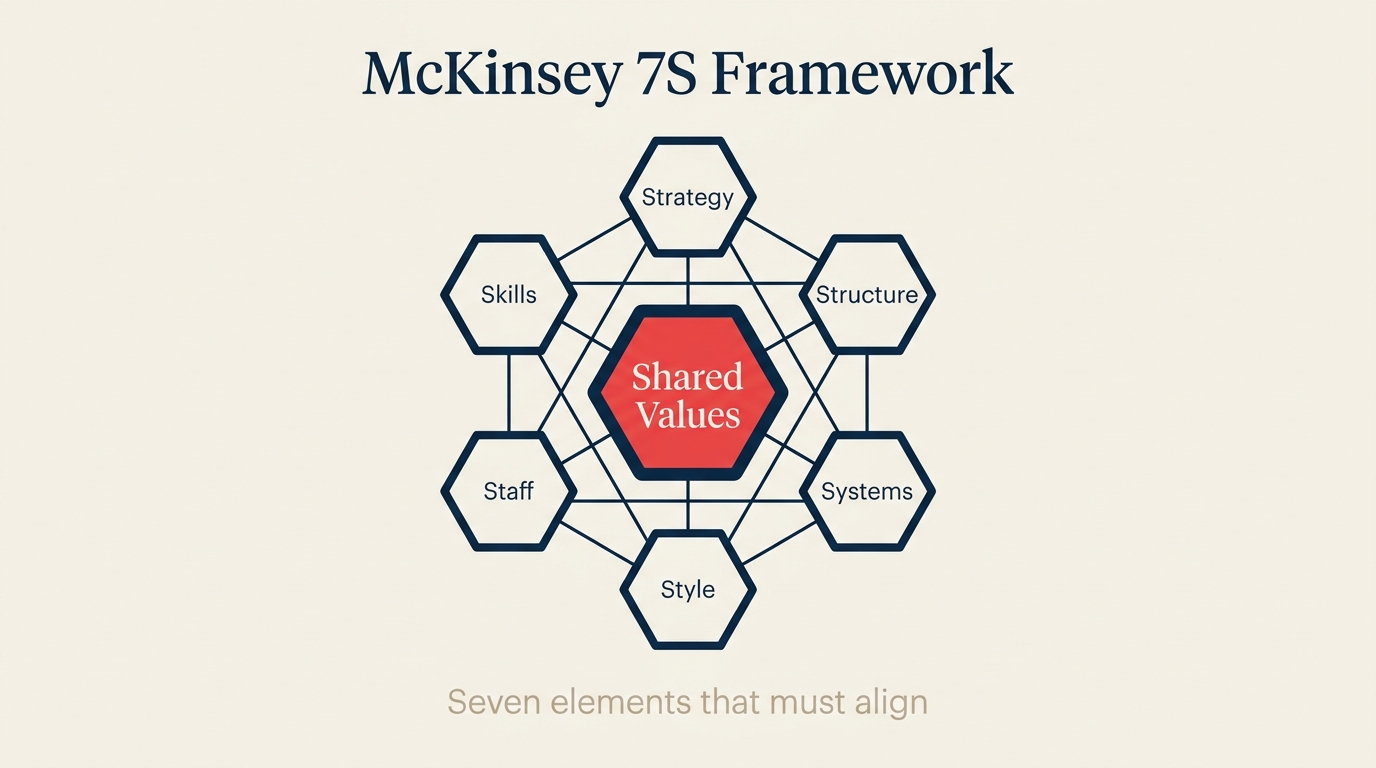
The model identifies seven interconnected elements that must align for an organization's strategy to work in practice. The central insight is that organizations are not machines with interchangeable parts. They are systems. Pull on one element and the others shift. Ignore that web of interdependencies and even a well-crafted strategy gets absorbed and neutralized by the organization it was supposed to change.
The seven elements are: Strategy, Structure, Systems, Shared Values, Style, Staff, and Skills. Three are considered "hard" (easier to define and change); four are "soft" (less tangible, and often where transformations succeed or fail).
Key Facts
Key Facts
- Peters & Waterman's In Search of Excellence (Harper & Row, 1982) sold 3 million copies in its first four years, bringing the 7S model to a mainstream business audience far beyond consulting.
- Pascale & Athos's The Art of Japanese Management (Simon & Schuster, 1981) developed the same framework in parallel, applying it to explain why Japanese firms outperformed American ones on operational consistency.
- McKinsey's own research on large-scale transformations, cited in multiple Global Surveys, consistently finds that roughly 70% of transformation programs fail to meet their stated objectives, most often because leaders underinvest in the soft elements the 7S model highlights. (McKinsey & Company, 2024)
The 7 elements explained
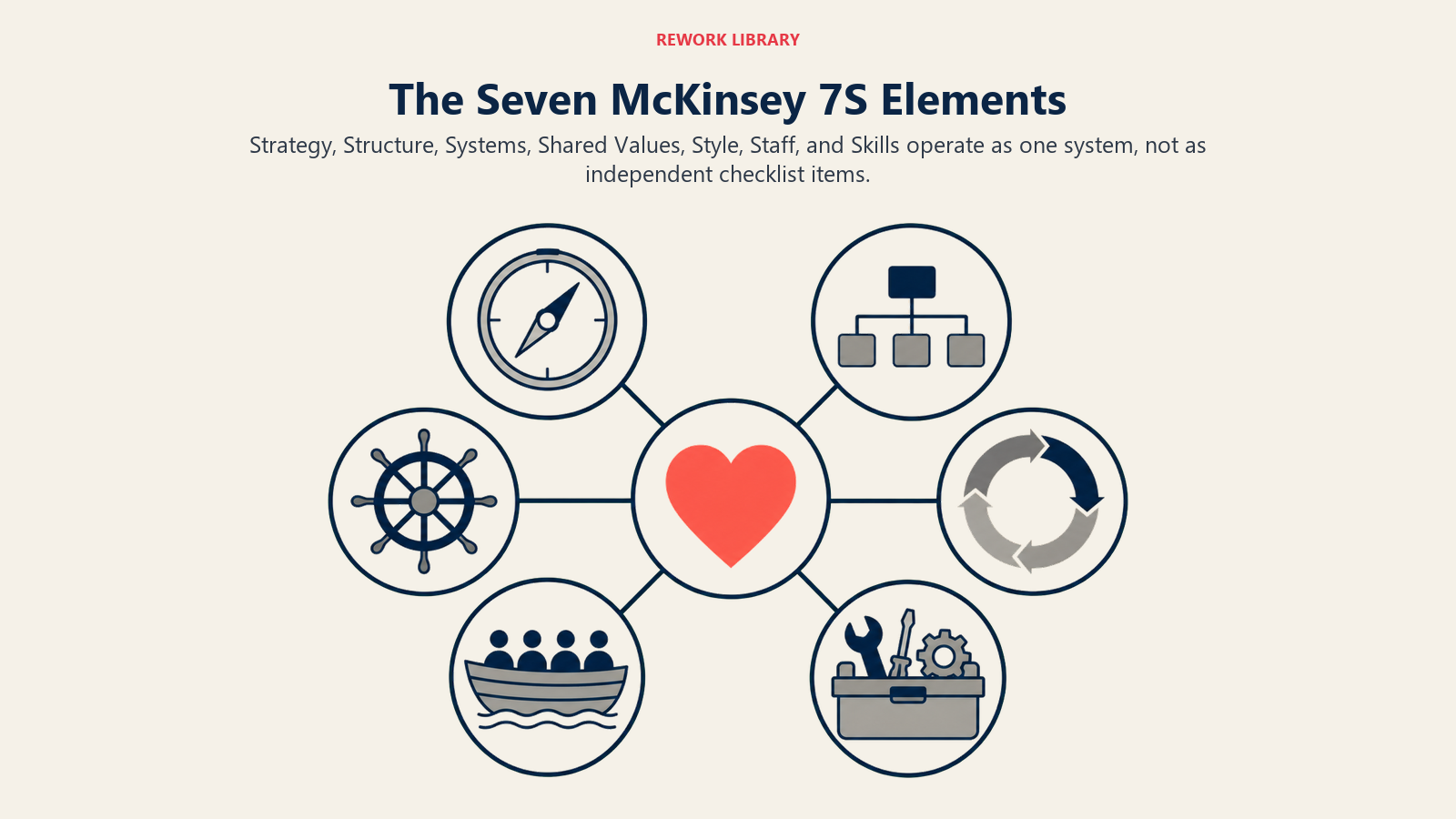
The seven elements are best read as a connected system, with shared values shaping how every other part of the organization behaves.
Strategy
Strategy is the plan for how the organization will achieve and sustain a competitive advantage. It answers the questions: where will we compete, and how will we win there? Good strategy allocates resources toward activities that reinforce a distinctive position and away from activities that don't.
Example: A mid-market SaaS company shifts its strategy from broad horizontal sales to vertical specialization in healthcare. That strategy change only works if Structure, Systems, and Skills all adjust to support it. Selling into healthcare requires different compliance workflows (Systems), sector-specialist salespeople (Staff), and regulatory knowledge (Skills).
Structure
Structure is how the organization divides work, decision-making authority, and reporting relationships. It's the org chart, but also the informal power map that sits beneath it. Common structures include functional, divisional, matrix, and flat or networked designs, each with different tradeoffs for speed, accountability, and coordination.
Example: A company moving from a functional structure (siloed departments) to a cross-functional product team model is changing its Structure. Without updating the Systems (budget allocation, performance reviews) and Style (how managers lead), the new structure tends to revert to the old behavior within a year.
Systems
Systems are the formal and informal processes, procedures, and workflows that govern how daily work gets done. They include financial planning cycles, hiring processes, performance management systems, data reporting, approval chains, and the software tools that encode those processes.
Example: A company can declare a strategy of "customer-centricity," but if its Systems still route all customer escalations through a 3-week ticketing queue with no executive visibility, the strategy is aspirational, not operational.
Shared Values
Shared Values sit at the center of the 7S diagram for good reason. Originally called "Superordinate Goals" in early versions of the model, Shared Values are the core beliefs and culture that define what the organization stands for and how people actually behave when no one is watching. They're the informal constitution that either amplifies or contradicts everything else.
Example: A company trying to adopt OKRs as its goal-setting system won't get traction if the Shared Values reward individual heroics over team transparency. The system is sound; the culture rejects it.
Style
Style refers to the dominant leadership and management approach across the organization: how decisions get made, how conflict is handled, how much autonomy people are given, and how leaders communicate priorities. Style is set at the top but reinforced or undermined by managers at every level.
Example: A CEO announces an empowerment culture while personally approving every hire above a certain salary. The stated Style and the lived Style are different, and employees follow the lived one.
Staff
Staff covers the people dimension: how many people the organization employs, what roles they fill, how they're recruited and developed, and what talent profiles the organization selects for. It's not just headcount; it's the human composition that the strategy depends on.
Example: A company pivoting to an AI-native product roadmap discovers it doesn't have enough machine learning engineers on staff. The Strategy, Structure, and Systems can all be perfect, but the Staff gap will block execution until addressed through hiring, retraining, or acquisition.
Skills
Skills are the distinct capabilities and core competencies that the organization as a whole can do better than its competitors. They're different from Staff (the people) because Skills are collective, embedded in teams and processes, not just individual. They include technical capabilities, domain knowledge, and organizational capabilities like speed of execution or customer insight.
Example: A professional services firm may have talented individuals (Staff) but lack the institutional capability to deliver repeatable digital transformation projects (Skills). Building that collective capability requires deliberate practice, knowledge management, and structured project methodology, not just good hiring.
Hard S vs Soft S
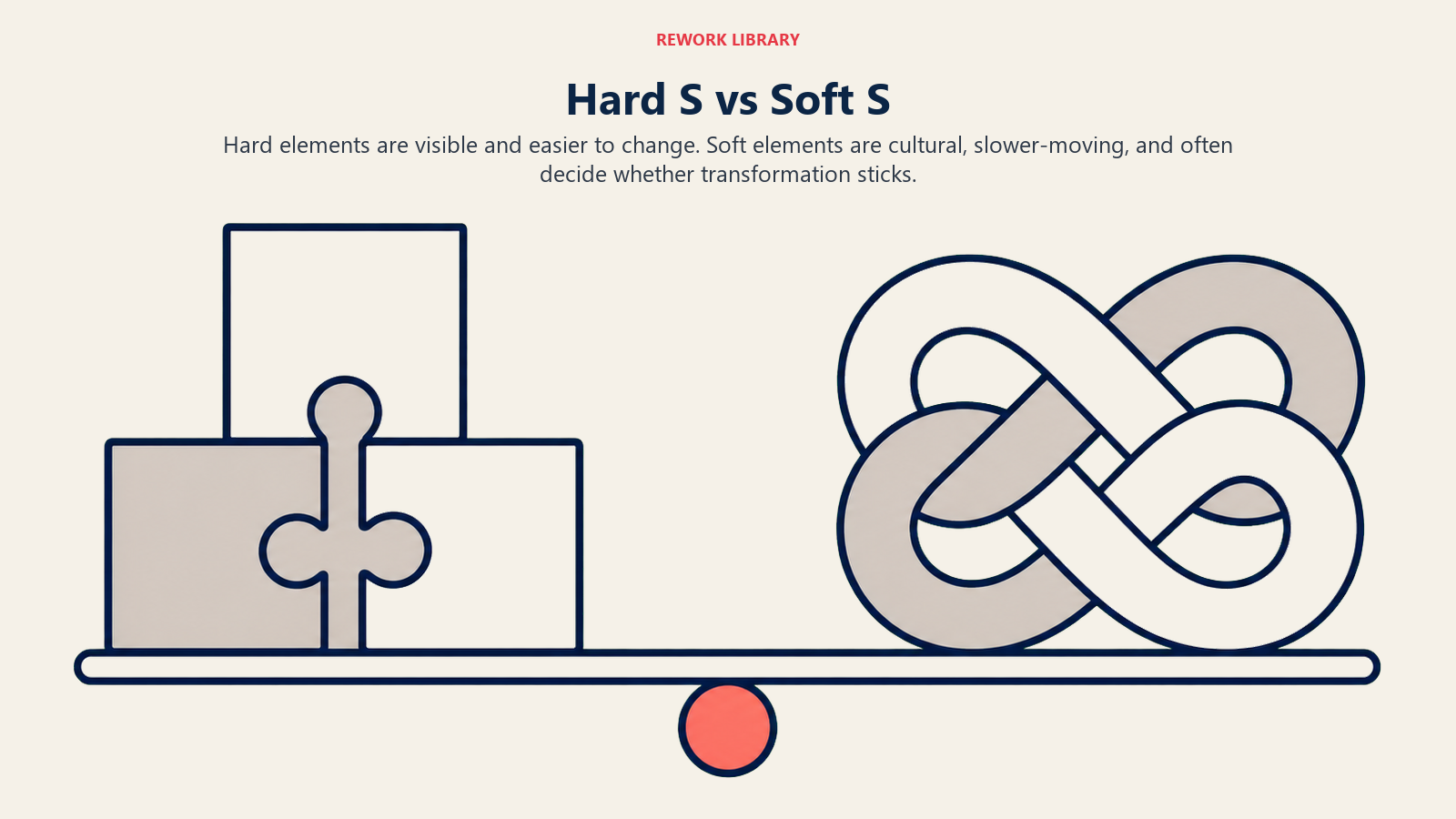
One of the most practical distinctions in the 7S model is the split between Hard S elements and Soft S elements. Hard elements are concrete and relatively easy to document, change, and measure. Soft elements are harder to define, slower to change, and more likely to quietly undermine strategy if neglected.
| Element | Hard or Soft | What it covers |
|---|---|---|
| Strategy | Hard | Competitive plan, resource allocation, market positioning |
| Structure | Hard | Org design, reporting lines, decision rights |
| Systems | Hard | Processes, workflows, tools, operating procedures |
| Shared Values | Soft | Culture, core beliefs, organizational identity |
| Style | Soft | Leadership approach, management behavior, decision style |
| Staff | Soft | People, talent profiles, workforce composition |
| Skills | Soft | Organizational capabilities, competencies, institutional knowledge |
The Hard S elements are the ones that typically appear in a new CEO's first 100-day plan. They're visible, they can be announced in an all-hands, and they produce a paper trail. The Soft S elements rarely make the announcement deck, but they're the ones that determine whether the new plan actually takes hold.
Research on organizational change consistently shows that culture, leadership style, and capability gaps are the top reasons transformations fail. The framework forces you to map all seven, not just the comfortable three.
How to use the 7S framework: a 5-step alignment audit
Step 1: Map the current state for each element
Start with fact-finding, not judgment. For each of the seven elements, document the current reality as precisely as possible. Use employee surveys, process documentation, org charts, financial plans, and leadership interviews. The goal is a shared description of what's actually true today, not what the strategy deck says should be true.
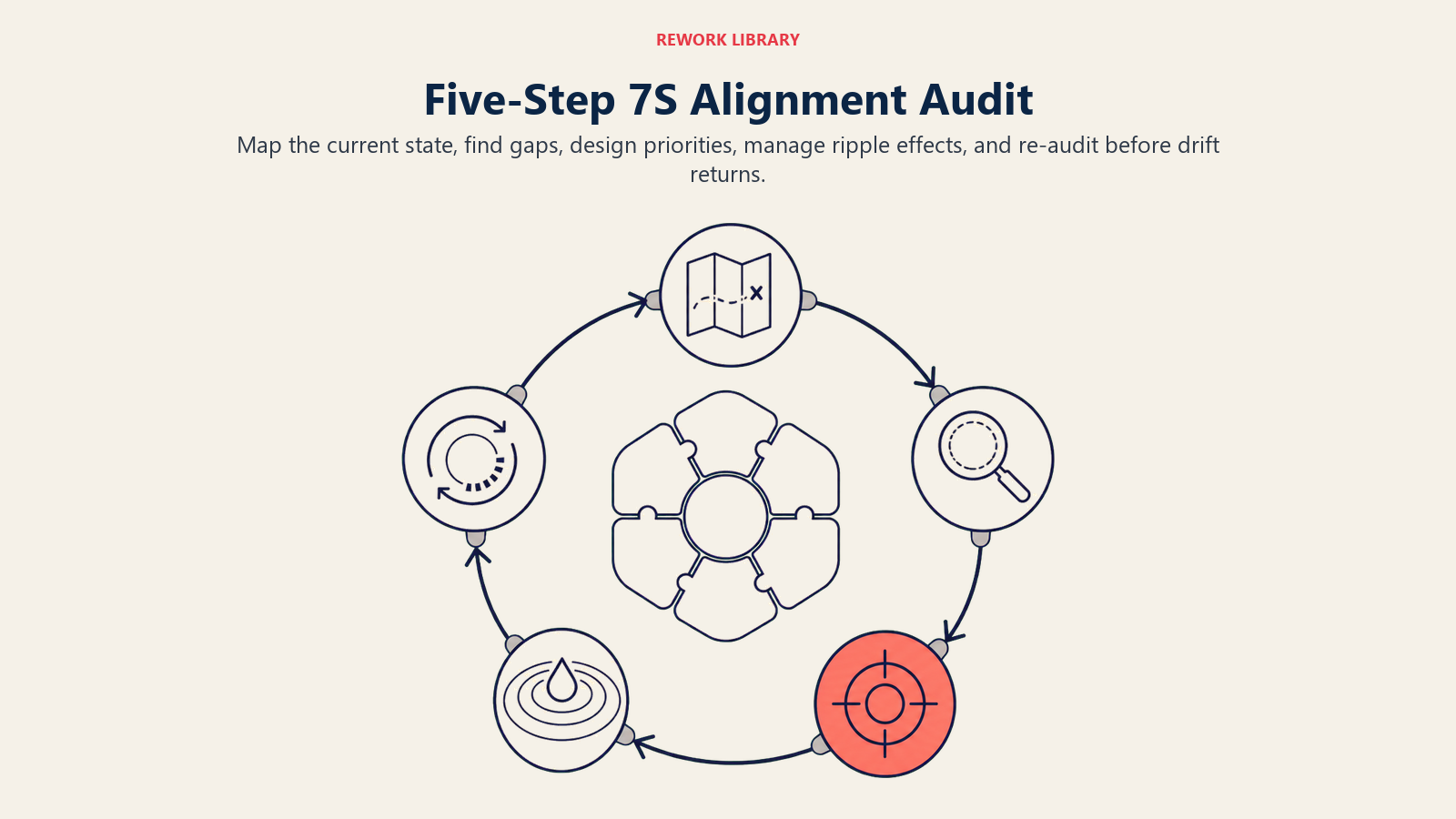
Step 2: Identify misalignments and gaps
Compare your current-state map across all seven elements and look for tension. Where does the Strategy require capabilities the Skills element doesn't yet have? Where do the Systems create friction against the Shared Values? Where does the Structure fragment accountability that the Strategy requires to be unified? Misalignments are typically not obvious in any single element. They show up in the gaps between elements.
Step 3: Design the target state and change priorities
Define what each element needs to look like for the strategy to work. Then sequence the changes. Not all seven can be transformed at once. Prioritize based on which misalignments are blocking the most critical strategic outcomes. A balanced scorecard approach is useful here for tracking intended outcomes across each element alongside financial and operational metrics.
Step 4: Execute with interdependencies in mind
When you start changing one element, actively manage the ripple effects. Changing Structure without updating the performance management Systems means people are evaluated on old behavior in a new structure. Changing Strategy without communicating the new Shared Values means teams keep optimizing for what the culture still rewards. Use a cross-functional change team that spans all seven elements.
Step 5: Re-audit quarterly
The 7S model is not a one-time diagnostic. Organizations drift. New leaders bring new Styles. Market pressures force Strategy adjustments. Run a lightweight re-audit every quarter to catch new misalignments early. A full audit annually should feed directly into the strategic planning cycle.
Worked alignment example: a company shifting from sales-led to product-led growth
A B2B SaaS company with 200 employees wants to shift from a sales-led growth model (outbound sales reps close enterprise deals) to a product-led growth (PLG) model (the product acquires, activates, and expands users without a sales-heavy motion). This table shows what the 7S audit reveals.
| 7S Element | Current state | Future state | Gap |
|---|---|---|---|
| Strategy | Close large enterprise deals through outbound sales | Acquire users via free trial; expand accounts through usage | Requires new pricing, packaging, and funnel metrics |
| Structure | Sales-heavy org; product team serves sales requests | Product team owns growth; sales handles expansion and enterprise | Product org must be elevated; sales team restructured |
| Systems | CRM-centric pipeline, demo-request workflow, sales-driven onboarding | Self-serve onboarding, in-app activation flows, product analytics | New tooling (product analytics, in-app messaging) needed |
| Shared Values | Revenue is closed deals; heroes are top account executives | Revenue is activated users; heroes are product and growth teams | Culture shift needed; recognition systems must change |
| Style | Directive leadership aligned to quota attainment | Experimental, data-driven leadership aligned to activation metrics | Leadership team needs PLG education and role-modeling |
| Staff | Large outbound sales team; lean product growth team | Balanced growth engineering, design, and product management | Hiring plan needed; some redeployment of sales talent |
| Skills | Enterprise sales, relationship management, negotiation | Product analytics, growth experimentation, onboarding design | Skills gap wide; training and hiring both required |
The table makes the scale of change visible. It's not a strategy pivot. It's a full organizational transformation touching all seven elements. Companies that announce a PLG strategy without addressing Staff, Skills, Shared Values, and Systems typically revert to the old model within 18 months because the organization simply cannot sustain the new motion.
Real-world examples of 7S in action
Microsoft under Satya Nadella (2014 onwards)
When Satya Nadella became CEO of Microsoft in 2014, the company was culturally stuck in a competitive, stack-ranking culture (Shared Values, Style) that had produced organizational hoarding and internal rivalry. The strategic pivot to cloud and "growth mindset" culture was a textbook 7S realignment.
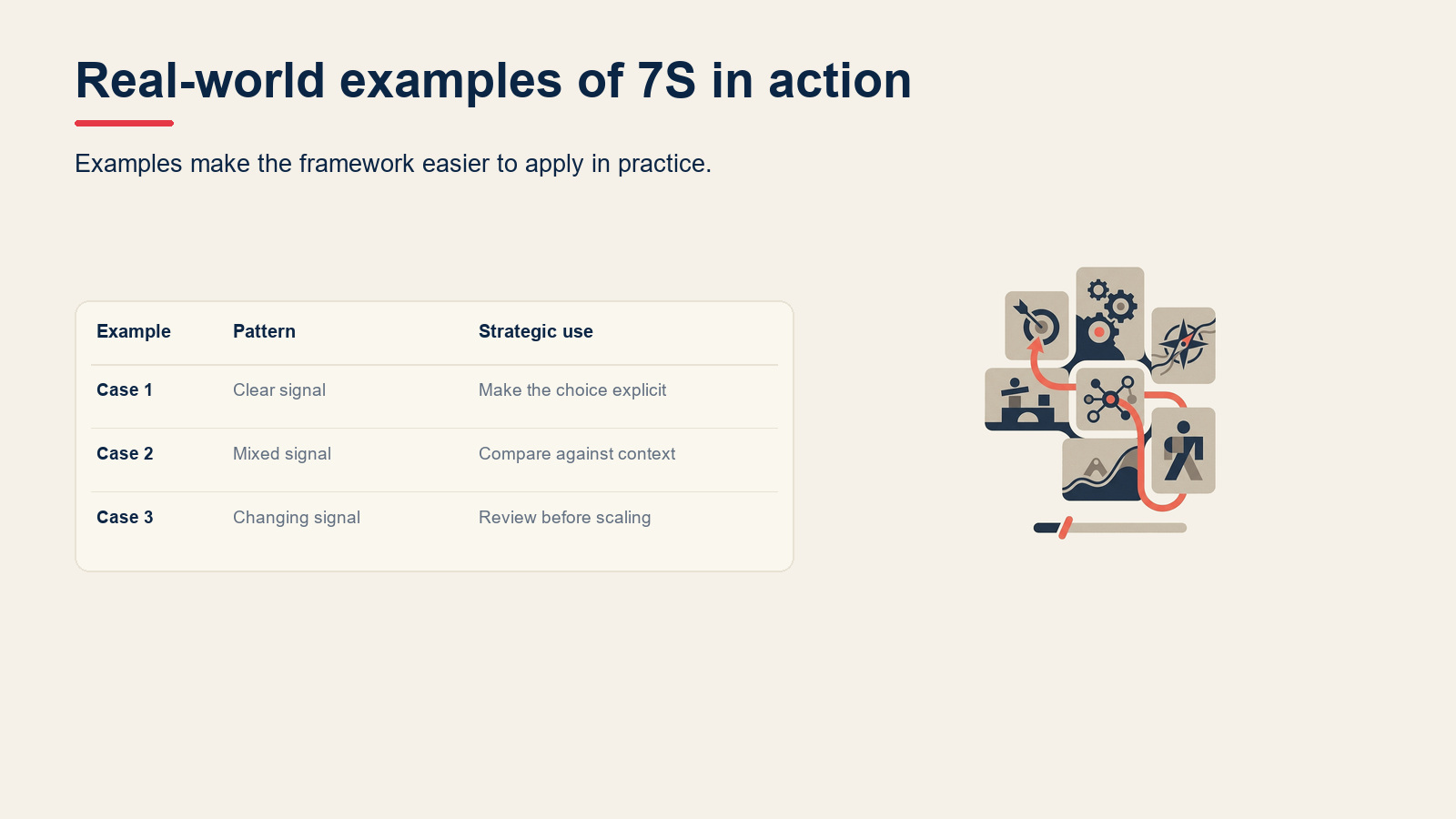
Strategy shifted to cloud-first (Azure) and platform partnerships. Structure was reorganized around products and cloud segments. Systems changed with new performance management that removed forced rankings. Shared Values were explicitly reset around growth mindset, empathy, and collaboration. Style changed at the top with Nadella modeling the new behaviors publicly. Staff was reshaped through acquisitions like LinkedIn and GitHub. Skills were developed in cloud engineering and developer experience.
The result by 2024: Microsoft became one of the most valuable companies in the world, with Azure as the second largest cloud platform globally. The 7S realignment was not incidental to that outcome. It was the mechanism.
GE under Jack Welch (1980s restructuring)
Jack Welch's restructuring of General Electric in the 1980s was a dramatic Hard S transformation: Strategy (be number one or two in every market), Structure (delayered management hierarchy), and Systems (rigorous performance management with forced ranking). The Hard S changes were visible and celebrated.
But the Soft S changes were more contested. Welch's Style was famously intense and confrontational. Shared Values eventually normalized a performance culture that, critics argued, hollowed out long-term institutional capability. When GE's financial engineering model came under pressure after 2008, the Skills and Shared Values gaps became visible in ways the Hard S strength had masked. It's a useful reminder that optimizing Hard S elements without sustained attention to the Soft S layer creates organizations that are efficient in the short term and fragile in the long term.
A startup moving from founder-led to professional management
A high-growth software startup reaches 100 employees and hires its first VP of Sales from a large enterprise. The new hire brings professional Structure (sales stages, forecasting cadence, territory design) and Systems (CRM discipline, quota management). But if the Shared Values of the company still reflect founder-led informality and the existing Staff was hired for hustle over process orientation, the new executive's operating model will collide with the culture daily.
This is an extremely common failure mode. The 7S audit makes the collision predictable before the new hire starts, not after the first missed quarter.
McKinsey 7S vs other change frameworks
| Framework | Created by | Best for | Time horizon |
|---|---|---|---|
| McKinsey 7S | Tom Peters, Robert Waterman, McKinsey & Co. (1977-1981) | Organizational alignment; diagnosing why change isn't sticking | Short to medium term; ongoing audit |
| Kotter's 8-Step Model | John Kotter, 1995 | Managing change sequentially; building urgency and coalition | Medium term; discrete change program |
| ADKAR | Prosci, 1994 | Individual-level behavior change; tracking adoption | Short to medium term; per-person change readiness |
| Lewin's Change Model | Kurt Lewin, 1947 | Simple, three-phase change (unfreeze, change, refreeze) | Short term; focused interventions |
| Balanced Scorecard | Kaplan & Norton, 1992 | Translating strategy into measurable outcomes across four perspectives | Medium to long term; ongoing performance management |
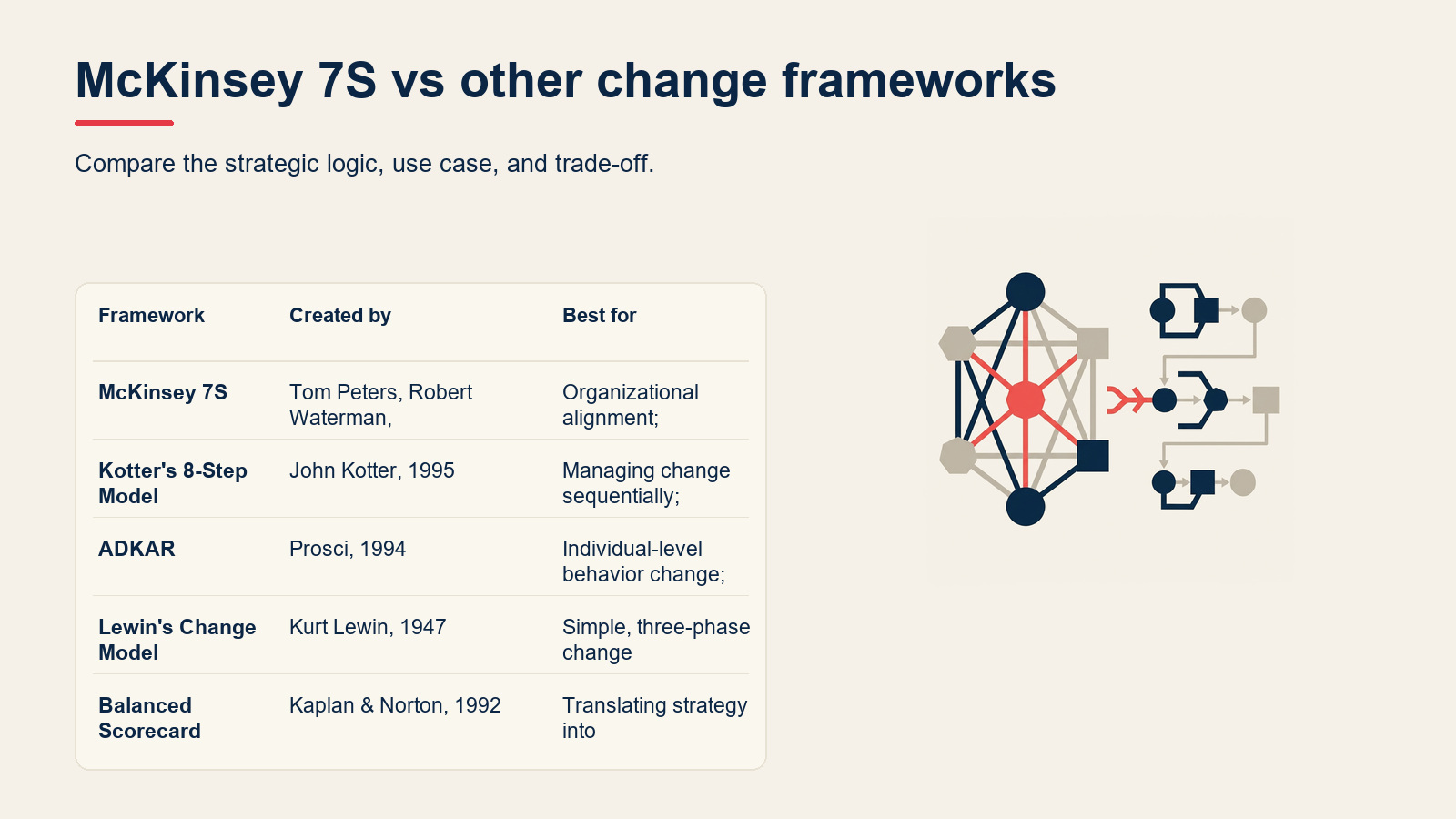
The 7S model is most useful as a diagnostic lens. It doesn't prescribe how to change; it maps what needs to change and where the interdependencies sit. The Nadler-Tushman congruence model and the Burke-Litwin model are close diagnostic cousins. It pairs well with Kotter's model (which sequences how to execute the change) and the Balanced Scorecard (which tracks whether the changes produced the intended outcomes). For building the strategy that feeds into 7S, Porter's Five Forces and the business model canvas are natural complements.
Common mistakes when applying the 7S framework
This view separates the main parts of common mistakes when applying the 7s framework so the details below are easier to compare.
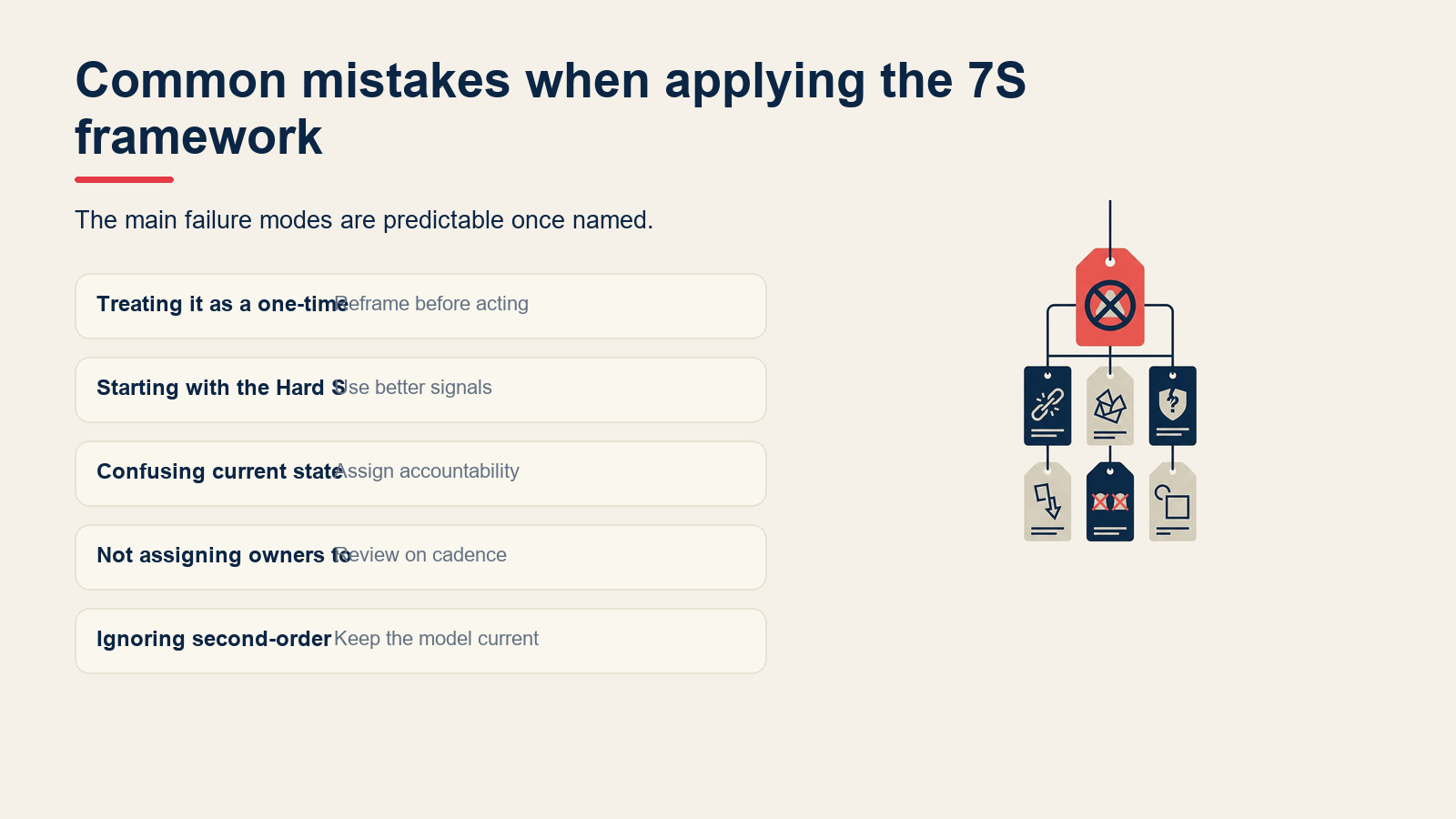
- Treating it as a one-time audit. The 7S model reflects a living system. Organizations drift. Running it once and filing the output is more common than it should be.
- Starting with the Hard S only. Teams comfortable with org charts and process maps often skip the Shared Values, Style, and Skills elements because they're harder to quantify. But that's where most transformations fail.
- Confusing current state with desired state. The diagnostic value of the model comes from being honest about what's actually true, not what the last strategy deck claimed was true. Inflated current-state assessments produce useless gap analyses.
- Not assigning owners to each element. A 7S audit that produces a document but no named accountable owner for each misalignment is an analysis exercise, not a change program.
- Ignoring second-order effects. Changing one element will shift others. A team that plans a Structure change without explicitly planning the Systems and Style changes required to support it will absorb the resistance as unexpected friction rather than managing it proactively.

Co-Founder & COO
On this page
- What is the McKinsey 7S framework?
- Key Facts
- The 7 elements explained
- Strategy
- Structure
- Systems
- Shared Values
- Style
- Staff
- Skills
- Hard S vs Soft S
- How to use the 7S framework: a 5-step alignment audit
- Step 1: Map the current state for each element
- Step 2: Identify misalignments and gaps
- Step 3: Design the target state and change priorities
- Step 4: Execute with interdependencies in mind
- Step 5: Re-audit quarterly
- Worked alignment example: a company shifting from sales-led to product-led growth
- Real-world examples of 7S in action
- Microsoft under Satya Nadella (2014 onwards)
- GE under Jack Welch (1980s restructuring)
- A startup moving from founder-led to professional management
- McKinsey 7S vs other change frameworks
- Common mistakes when applying the 7S framework