Brian Armstrong Leadership Style: Mission-First in a Hostile Market
Turn this article into takeaways for your work.


Each assistant summarizes the article only for you and suggests best practices for your work.
Key Facts:
- Founded Coinbase: 2012 (with Fred Ehrsam); CEO continuously since founding
- IPO: April 14, 2021, direct listing on Nasdaq (ticker: COIN), first major US crypto company to list publicly
- 2020 mission-focused culture memo: declared Coinbase apolitical at work; offered severance to employees who disagreed, roughly 60 took the package
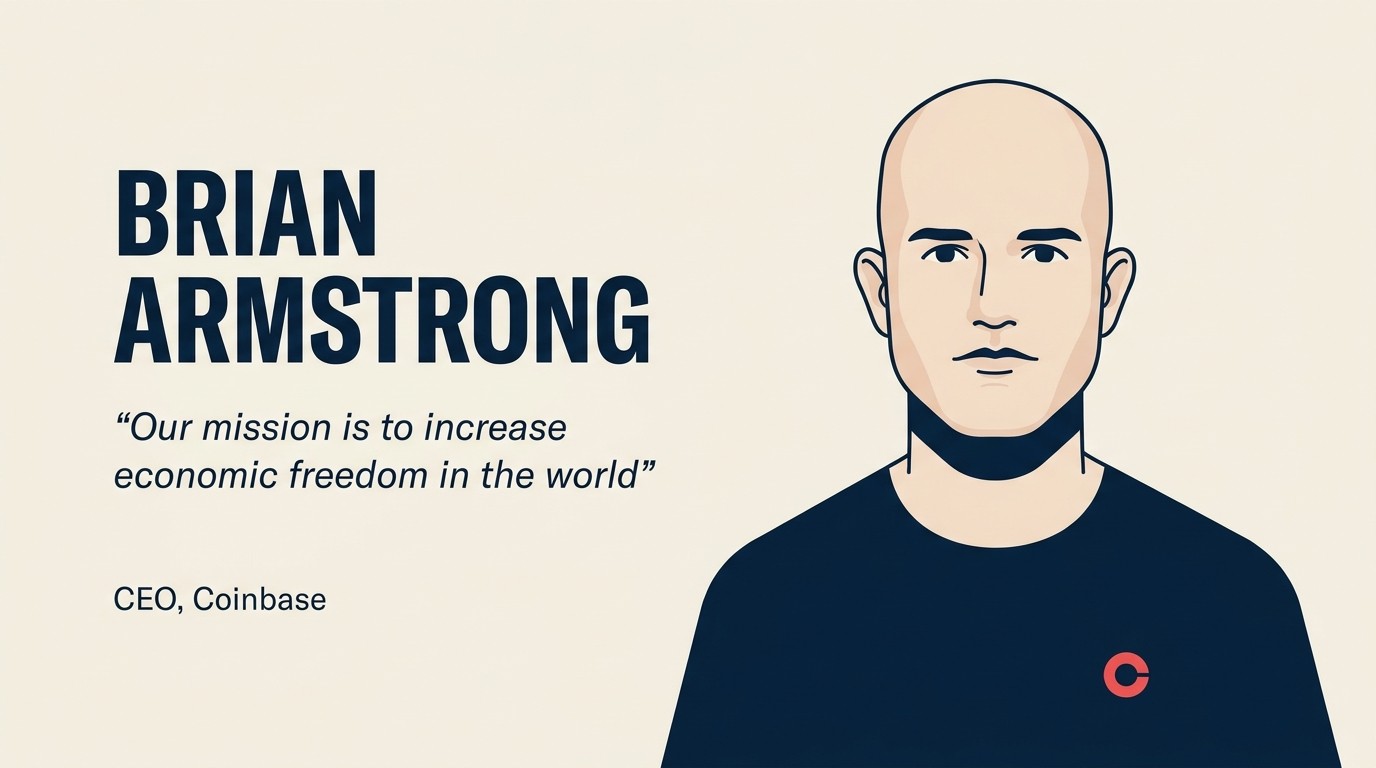
- Stated mission: "increase economic freedom in the world"
- Cycle survivor: led Coinbase through the 2018 and 2022-2023 crypto winters, including two rounds of layoffs (18% cuts) in 18 months
- Scale: 100M+ verified users globally; largest US-compliant crypto exchange
On April 14, 2021, Coinbase went public on the Nasdaq via direct listing. On its first day of trading, the stock reached a valuation of roughly $100 billion. It was the largest crypto company ever to list on a US exchange. Armstrong rang no bell, gave no roadshow, and made no promises about quarterly performance. The market priced Coinbase at a number that made early employees and investors wealthy beyond what most of them had modeled.
Eighteen months later, COIN was down more than 80% from its peak. FTX had collapsed. LUNA/Terra had imploded. Celsius was bankrupt. The SEC had sent Coinbase a Wells Notice signaling it intended to sue the company for operating as an unregistered securities exchange. Armstrong had laid off 18% of his workforce twice in 18 months.
He kept building. He sued the SEC back publicly. He started a crypto-focused political action committee. He went on television and said Coinbase would not settle.
That sequence, peak euphoria to full regulatory assault, tells you more about Brian Armstrong as a leader than the IPO did. The IPO was a market timing story. What came after it was a mission-first story, and the distinction matters.
Leadership Style Breakdown
| Style | Weight | How it showed up |
|---|---|---|
| Mission-First Operator | 60% | Armstrong's consistent public frame is "economic freedom for the world." He uses it in board presentations, recruiting pitches, and SEC depositions. It functions as a decision filter: does this help or hurt the mission? Sam Altman runs a structurally similar playbook at OpenAI, a civilizational mission statement that justifies decisions that would look irrational at a purely commercial company. The 2020 "no politics at work" memo, the decision to fight the SEC rather than settle, the Stand With Crypto PAC, these are all downstream of the mission frame. Whether you agree with the specific mission is separate from evaluating how effectively he uses it to align his organization. |
| Regulatory Offense Strategist | 40% | Armstrong borrowed Travis Kalanick's regulatory playbook and adapted it. Where Kalanick moved before laws were written, Armstrong operated in a regulatory gray zone for a decade and then chose to fight when the regulator moved to clarify the rules against him. Jack Dorsey had already positioned Block as the crypto-adjacent payments infrastructure that would benefit from Coinbase winning this fight, the two founders were running parallel bets on the same long-term thesis. The decision to not settle the SEC case was a bet that the legal outcome would set the framework for the entire US crypto industry, not just Coinbase. That's a different risk profile than most CEOs would accept. |
The 60/40 split reflects that Armstrong's mission clarity is the dominant input, it's what he communicates, what he hires against, and what he uses to make hard calls. The regulatory strategy is downstream of that clarity: if the mission is economic freedom, then regulatory fights that protect that mission are worth having regardless of near-term cost.
The Armstrong Culture Filter
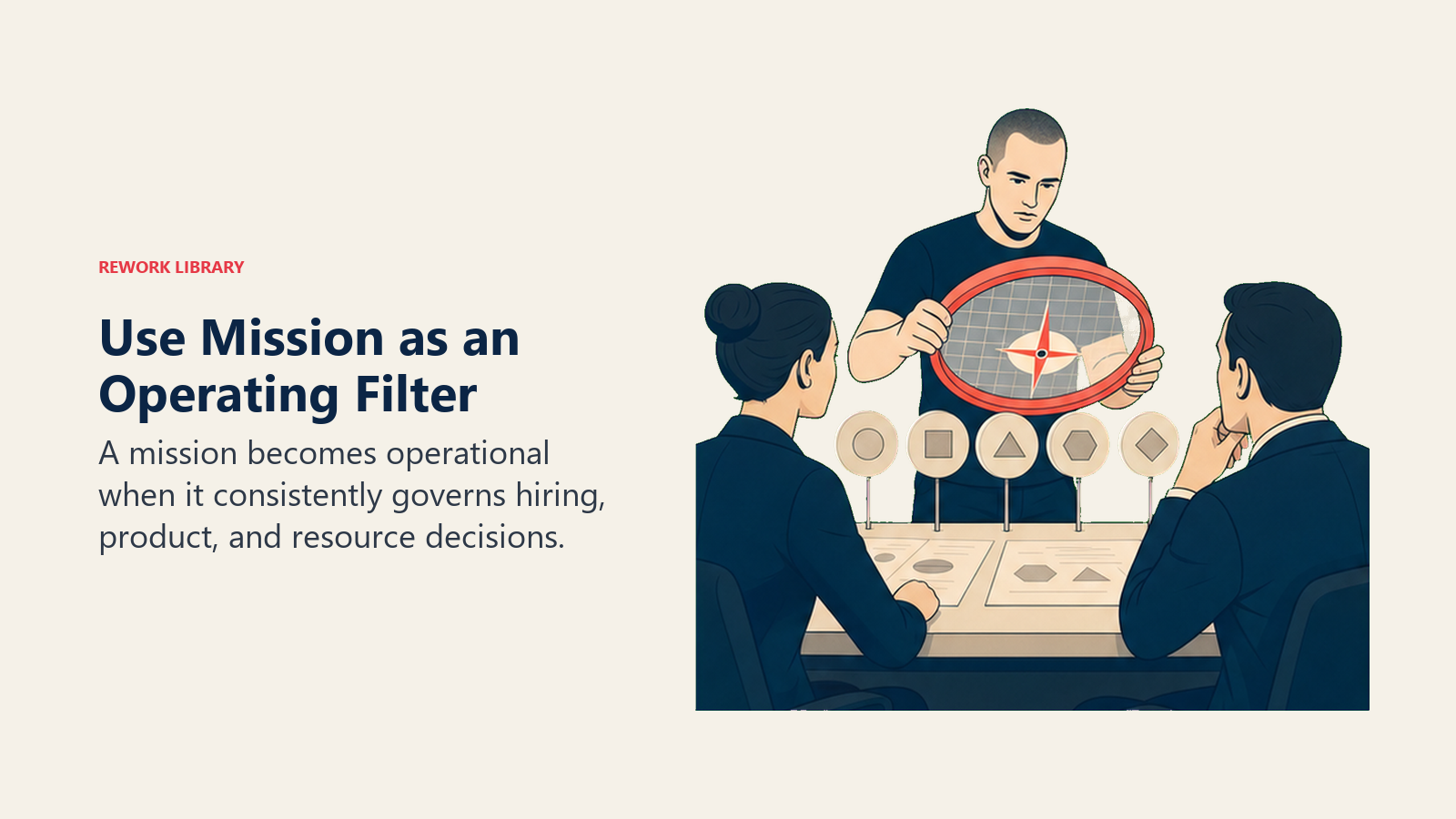
The Armstrong Culture Filter is the practice of using a single, specific mission statement as the decision test for every hiring, firing, product, and regulatory choice, and accepting that employees who can't align with that filter should leave, with severance, rather than stay and dilute focus. It treats mission alignment as an operational asset, not a branding exercise. The filter's power is its willingness to lose people: a mission that nobody ever departs over isn't actually filtering anything.
Key Leadership Traits
| Trait | Rating | What it means in practice |
|---|---|---|
| Mission as management tool | Exceptional | Most CEOs treat mission statements as marketing. Armstrong treats his as an operating manual. When Coinbase published the 2020 "no politics at work" memo, roughly 60 employees left. Armstrong offered severance packages and thanked them on their way out. The mission-filter logic: a company that can't stay focused on its mission will fail its mission, therefore departures over mission alignment are healthy, not damaging. Whether you agree with the politics of the decision, the management logic is coherent and consistent. |
| Regulatory patience | Very High | Building Coinbase on compliance from day one, getting licensed in all 50 US states before competitors had licenses in any, required years of legal and regulatory work before it generated revenue. That patience created a competitive moat. When regulators eventually scrutinized crypto exchanges, Coinbase was positioned as the compliant player. The irony that the compliant player later faced an SEC lawsuit is real, but the decade of compliance investment still differentiates Coinbase from exchanges that ignored US licensing entirely. |
| Crisis communication | High | Armstrong's layoff memos during the 2022-2023 cycle were unusually blunt for a public company CEO. He wrote publicly that Coinbase had grown too fast in 2021, that he'd made a hiring mistake, and that the cuts were necessary to return to operating discipline. Elon Musk cut Twitter's headcount by roughly 80% after the 2022 acquisition, a more extreme version of the same instinct that fast companies hire beyond their sustainable operating model during boom cycles. That candor, admitting the mistake rather than describing the cuts as "restructuring for future growth", is rare and it mattered internally. People trust leaders who tell them the truth about what went wrong. |
| Revenue cycle dependency | Medium | Coinbase's business model is structurally correlated to Bitcoin and Ethereum trading volume. When crypto prices rise, transaction volume rises, and Coinbase earns more. When prices fall, volume falls, and Coinbase's revenue shrinks significantly. Armstrong has worked to diversify into custody, staking, and institutional services, but the core dependency remains. That's a business model risk, not a leadership failure, but it means that Armstrong's leadership is always being evaluated against a macro cycle he doesn't control. |
The 3 Decisions That Defined Brian Armstrong as a Leader
1. Building on Compliance From Day One, Before Anyone Else Was
When Armstrong co-founded Coinbase in 2012 with Fred Ehrsam, he made a foundational strategic choice: get licensed in all 50 US states as a money transmission business before scaling. Patrick Collison took a comparable long-view on compliance infrastructure, Stripe spent years getting the payments licensing right before competing for enterprise contracts. This was slow, expensive, and operationally painful. Bitcoin exchanges in 2012 were largely operating without licenses. The regulatory framework was unclear. Most founders in Armstrong's position decided to move fast and deal with compliance later.

Armstrong decided the opposite. He believed crypto would eventually be large enough to attract serious regulatory scrutiny, and that when that scrutiny arrived, the exchange with the cleanest compliance record would win the institutional market. Getting licensed in every US state took years. It also gave Coinbase a defensible position with institutional investors, banks, and eventually public market investors that competitors who ignored compliance couldn't match.
That decision paid off in a specific way: when major banks, pension funds, and asset managers started looking for crypto exposure in 2020-2021, Coinbase was the exchange they could use without their compliance teams raising flags. The compliance infrastructure that had seemed slow-and-expensive in 2013 became a competitive moat in 2021.
The leadership lesson: early investments in regulatory legitimacy that look like operational overhead can function as strategic assets when your market attracts scrutiny. This is not a universal truth, sometimes regulatory compliance just slows you down. But in markets where institutional trust is eventually the gating factor for growth, it compounds.
2. The 2021 Direct Listing, Choosing the Crypto-Native Path
Armstrong could have done a traditional IPO in 2021. Banks were lined up. Investor appetite was enormous. The fees Coinbase would have paid underwriters were a rounding error on the valuation it would have achieved.
He chose a direct listing instead. Same outcome, Coinbase shares traded publicly, employees and investors got liquidity, the company accessed public capital, but without the investment bank intermediaries, lock-up periods, or roadshow narrative management.
The choice was philosophically consistent with Coinbase's mission. Decentralization, transparency, and reduced reliance on financial intermediaries are core crypto values. Doing an IPO via the traditional Wall Street machinery would have been slightly inconsistent with the story Armstrong had been telling. The direct listing let Coinbase say "we're the crypto company that operates by crypto values even when we go public."
Whether that alignment was worth the trade-off in execution quality and institutional investor relationships is debatable. What's not debatable is that the decision was made on principle rather than convenience, which is exactly what mission-first leadership looks like in practice.
3. Deciding to Fight the SEC Rather Than Settle
In March 2023, the SEC issued a Wells Notice to Coinbase, a formal warning that the regulator intended to file suit against the company for operating as an unregistered securities exchange. In practice, this meant the SEC believed many of the tokens Coinbase listed were securities subject to SEC jurisdiction, and that Coinbase should have registered with the SEC before listing them.
Most companies receiving a Wells Notice settle. The legal cost of fighting the SEC through discovery, depositions, and trial is enormous. The reputational risk of an extended public legal battle with a federal regulator is significant. The rational move for a public company with ongoing business operations is usually to negotiate consent terms, pay a fine, and move on.
Armstrong decided to fight. He gave a public interview saying Coinbase would not settle. He started the Stand With Crypto PAC to build political support for clearer crypto regulation. He argued publicly that the SEC's position was based on enforcement without rulemaking, that the regulator was trying to apply securities laws to an asset class that had never been given clear guidance on whether those laws applied.
The legal outcome is still evolving as of this writing. But the strategic logic of the fight is clear: if Coinbase settles, it implicitly concedes that its token listings were securities violations. That's a precedent that would reshape the entire US crypto industry against Coinbase's business model. By fighting, Armstrong was betting the company's legal budget on an outcome that would benefit the whole industry, a bet that his competitors got the benefit of without bearing the cost.
What Brian Armstrong Would Do in Your Role
If you're a CEO building in a regulatory gray zone, Armstrong's dual strategy is worth studying: comply early where you can, fight selectively where compliance would concede the market. Coinbase's decade of licensing investment gave Armstrong the credibility to say "we tried to comply" when the SEC eventually came for them. If you're operating in an industry where regulation is coming, building compliance infrastructure before it's required gives you both a legal defense and a competitive moat. The fight becomes easier when you can show you made the effort.
If you're a COO or operations leader, the 2022 layoffs are the hardest operational lesson in Armstrong's story. Coinbase hired aggressively in 2021 when revenue was at peak and crypto prices were high. When the cycle turned in 2022, the company cut 18% of headcount, and then cut again in 2023. Two rounds of cuts in 18 months is a sign of a forecasting and hiring discipline failure in 2021, not just bad luck. The operational lesson: build your headcount model around conservative revenue assumptions, especially in cycle-dependent businesses. The upside of hiring aggressively in a boom is growth speed. The downside is two rounds of painful layoffs when the cycle reverses.
If you're a product leader, Coinbase's diversification story has product implications. The core exchange product is cycle-dependent, when trading volume drops, Coinbase's revenue drops. Armstrong has invested in building product lines that generate revenue independently of trading cycles: custody fees, staking rewards, subscription products, institutional services. Each of those required years of product investment before they contributed meaningfully to revenue. If your core product has a revenue cycle problem, the product answer is to build the adjacent revenue lines before you need them, not during the crisis.
If you're in sales or marketing, the "economic freedom" mission framing is a case study in how a specific and bold mission statement can function as a sales and marketing asset. Coinbase doesn't sell "easy crypto trading." It sells participation in economic freedom as a global movement. That framing attracts customers who want to be part of something bigger than a trading app, it attracts employees who want mission-driven work, and it gives Armstrong a narrative frame for regulatory fights that goes beyond Coinbase's commercial interest. The question for your function: what's the mission frame for your company that's bigger than your product features?
How Rework Supports Mission-First Startups
Armstrong-style companies hire on mission alignment and often operate in regulatory gray zones where off-the-shelf tooling assumes a conventional business. That's a hard combination. You need an ops stack that bends to your culture instead of forcing a default one on you, and that can scale with you when adversity turns into growth.
Rework is built for exactly that flexibility. The CRM, lead management, and work ops modules share one workspace, so a mission-driven founding team can wire hiring pipelines, legal trackers, regulatory comms, and customer lifecycle into a single source of truth without paying four vendors. Pricing starts at $69/month billed yearly for the Sales Engine and $99/month billed yearly for the Process or Project Engine, each with 5 seats included, which keeps the tool affordable through the early unprofitable years Armstrong knows well.
For founders running unconventional cultures, apolitical, mission-first, or simply different, Rework's custom fields, pipelines, and automation let you encode your operating principles into the system itself, so the filter is enforced by default.
Notable Quotes and Lessons Beyond the Boardroom
Armstrong has been unusually public about the internal logic of his leadership decisions, which makes him a more readable case study than founders who keep their reasoning private.
On the apolitical memo: "We're going to be a mission-focused company. It's not about being apolitical, it's about making sure that politics doesn't become the reason our team can't execute on the mission." The distinction matters. Armstrong's position isn't that politics is unimportant. It's that Coinbase's specific mission, economic freedom, is better served by an organization that doesn't fracture over political disagreements that aren't related to that mission.
On the SEC fight: "We tried to follow the rules. There weren't any. So we built the most compliant business we could in the absence of clear rules. Now we're being sued for not following rules that didn't exist. We're going to fight that, because the alternative is to let the SEC make law through enforcement." Whether you find that convincing depends partly on how you evaluate the SEC's position. But as a leadership communication, it's clear, specific, and grounded in the mission frame.
He's also been candid about the hiring mistakes of 2021: "I got caught up in the growth moment and we hired faster than we could absorb. That's on me." That kind of direct ownership, naming the mistake without euphemism, is one of the practices that earns organizational trust through the difficult periods.
Where This Style Breaks
Mission-first leadership works when the mission is clear, widely shared, and relevant to the decisions your organization faces. Armstrong's "economic freedom" mission meets the first two criteria, it's clear and his team knows it. The third is more complicated.
When Coinbase's practical decisions involve things like whether to list a specific token, how to price institutional custody, or how to respond to an SEC subpoena, the "economic freedom" frame doesn't always provide clear guidance. The mission is at the right level of abstraction to align the organization's values but too high to resolve specific business decisions. And the apolitical stance, while internally consistent, has cost Armstrong employee trust at moments when people wanted leadership to take a position on events they cared about.
The deeper structural issue is that Coinbase is fundamentally a centralized exchange operating at the heart of an ideology that values decentralization. That tension doesn't resolve. Armstrong has managed it through mission clarity, but it's a permanent friction in the business model that mission framing alone can't fix.
Frequently Asked Questions about Brian Armstrong's Leadership
Who is Brian Armstrong?
Brian Armstrong is the co-founder and CEO of Coinbase, the largest US-compliant cryptocurrency exchange. He founded the company in 2012 with Fred Ehrsam and has led it continuously since, through two crypto winters, an IPO, and an SEC lawsuit.
How did Coinbase go public?
Coinbase went public on April 14, 2021 via a direct listing on the Nasdaq under the ticker COIN, not a traditional IPO. Armstrong chose direct listing to avoid underwriter intermediaries, consistent with the company's crypto-native philosophy of reducing reliance on financial middlemen.
What was the Coinbase mission-focused culture memo?
In September 2020, Armstrong published a memo declaring Coinbase a "mission-focused" company that would not take stances on broader political or social issues unrelated to its mission. He offered severance to employees who disagreed; roughly 60 took the package. The memo became a reference point for other tech CEOs debating workplace political culture.
What is Armstrong's stance on regulation?
Armstrong's dual strategy is "comply early, fight selectively." Coinbase invested years in getting licensed in all 50 US states before competitors had licenses anywhere. But when the SEC issued a Wells Notice in 2023, he refused to settle and publicly sued back, arguing the SEC was making law through enforcement rather than rulemaking.
What is Coinbase's mission?
Coinbase's stated mission is to "increase economic freedom in the world." Armstrong uses this framing as an operational decision filter for hiring, product, and regulatory choices, not just as marketing language.
What can founders learn from Brian Armstrong?
Three lessons stand out: invest in compliance infrastructure early when you expect regulation to follow, use a specific mission as an active management filter rather than a slogan, and be candid with your team about hiring mistakes rather than dressing layoffs up as "restructuring."
Learn More

On this page
- Leadership Style Breakdown
- The Armstrong Culture Filter
- Key Leadership Traits
- The 3 Decisions That Defined Brian Armstrong as a Leader
- 1. Building on Compliance From Day One, Before Anyone Else Was
- 2. The 2021 Direct Listing, Choosing the Crypto-Native Path
- 3. Deciding to Fight the SEC Rather Than Settle
- What Brian Armstrong Would Do in Your Role
- How Rework Supports Mission-First Startups
- Notable Quotes and Lessons Beyond the Boardroom
- Where This Style Breaks
- Learn More