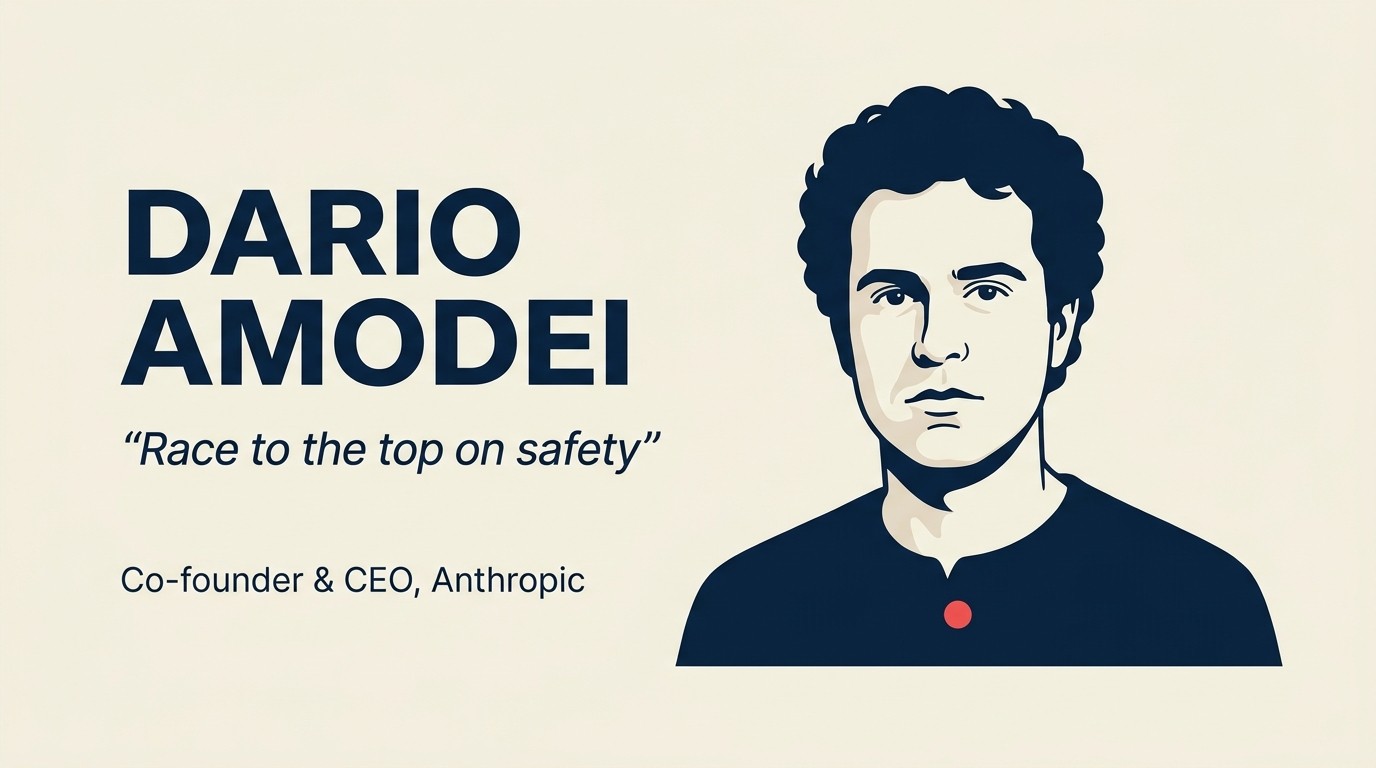
Dario Amodei Leadership Style: Betting Big on Safe AI
Turn this article into takeaways for your work.


Each assistant summarizes the article only for you and suggests best practices for your work.
Key Facts: Dario Amodei
- Co-founded Anthropic in 2021 alongside his sister Daniela Amodei and roughly ten former OpenAI researchers
- Chief Executive Officer of Anthropic
- Former Vice President of Research at OpenAI, leading work on GPT-2 and GPT-3
- PhD in computational neuroscience from Princeton University
- Anthropic valuation surpassed $60B in 2024 (reported $184B by end of 2025)
- Architect of the Claude model family and the Responsible Scaling Policy
- Known for the "race to the top on safety" doctrine in frontier AI development
The Race to the Top Doctrine
The Race to the Top Doctrine is Amodei's thesis that frontier AI labs should compete to set higher safety and alignment standards rather than lower them, using commercial success as fuel for safety research rather than a substitute for it. Paired with the Constitutional AI Method, training models to self-critique outputs against a published set of principles before human feedback is applied, the doctrine treats safety as a competitive differentiator, not a cost center. The combined framework argues that if powerful AI is inevitable, the responsible move is to be at the frontier with binding constraints, not to cede that ground to labs with weaker safety cultures.
In 2021, Dario Amodei walked away from OpenAI, where he was VP of Research and one of the people most responsible for training GPT-2 and GPT-3, because he believed the organization's incentive structure was moving in the wrong direction. He didn't leave quietly. He took his sister Daniela and nine other researchers with him, co-founded Anthropic, and immediately started arguing that the most powerful AI systems ever built needed a different kind of institution behind them.
That bet has since attracted $7.3B in funding, produced the Claude model family, and landed Anthropic at a reported $184B valuation by end of 2025.
But the more interesting question isn't the fundraising. It's whether the "safety-first" thesis is actually a leadership model or a marketing position. The answer, based on what Anthropic has published and how Amodei runs the company, is more complicated than either framing suggests.
Leadership Style Breakdown
| Style | Weight | How it showed up |
|---|---|---|
| Mission-First Technologist | 70% | Amodei organized Anthropic's entire structure, research roadmap, hiring bar, deployment decisions, around the premise that AI systems are "among the most transformative and potentially dangerous technologies in human history." That's not a brand statement. It's an actual constraint. It shaped the decision to invest heavily in interpretability research before it was commercially useful, to publish the Responsible Scaling Policy publicly with specific thresholds, and to slow deployment on capabilities when safety evaluations weren't complete. |
| Measured Scaler | 30% | Amodei isn't anti-growth. He raised massive rounds, built a commercial product (Claude), and competed directly with OpenAI and Google for enterprise contracts. The 30% is the part that makes the 70% sustainable: you can't fund safety research without revenue, and you can't generate revenue without a competitive product. He's held both parts simultaneously, which is harder than holding either one alone. |
Most mission-driven organizations drift toward mission when things go well and toward pragmatism when they need cash. What's unusual about Anthropic under Amodei is that the safety-first framing has held even as the commercial pressure has intensified. Whether that continues is the open question.
Key Leadership Traits
| Trait | Rating | What it means in practice |
|---|---|---|
| Principled patience | Very High | Amodei has consistently refused to ship capabilities before safety benchmarks are met, even when competitors have shipped similar features ahead of him. Constitutional AI, which trains models to self-critique using a set of principles, took years to develop before it was deployed publicly. That's not indifference to speed. It's a specific theory about which cuts are acceptable. |
| Intellectual honesty | Very High | He has said publicly, in published essays and interviews, that he believes he might be building something catastrophic. He builds it anyway, on the argument that if powerful AI is coming regardless, it's better to have safety-focused labs at the frontier than to cede that ground to labs with weaker safety cultures. You can disagree with that argument. But it's a real one, stated clearly, with the trade-offs acknowledged. |
| Risk-calibrated ambition | High | Anthropic's Responsible Scaling Policy is a formal commitment to stop and evaluate if capability benchmarks are breached before safety evaluations clear them. That's a structural constraint, not a press release. Building a binding policy on your own product roadmap, one that could pause your most important revenue-generating work, is a specific kind of leadership decision. |
| Organizational coherence under pressure | High | When you co-found a company with your sibling and nine former colleagues, the interpersonal dynamics are either a strength or a liability. At Anthropic, the founding team has held together through Series A through D, through Claude 1 through 3.7, through intense competitive pressure from OpenAI and Google. That kind of organizational stability under pressure doesn't happen without deliberate work. |
The 3 Decisions That Defined Amodei
1. Leaving OpenAI
The decision to leave OpenAI in 2021 is the clearest expression of Amodei's values-based leadership model.
He wasn't fired. He wasn't marginalized. He was VP of Research at the most prominent AI lab in the world, working on GPT-3, which had already changed the trajectory of the field. By conventional metrics, he had no reason to leave.
His stated reason was that the organization's structure and commercial incentives were creating pressure that he believed would compromise the safety research he thought was necessary. He thought Anthropic needed to operate under different constraints, specifically, constraints where safety research wasn't constantly competing for resources against product and commercial timelines.
That's a high-cost values bet. Walking away from a senior role at a high-trajectory organization because of a structural disagreement, not a personal one, not an ethics violation, but a conviction about the right organizational model for developing powerful AI, is not a common leadership move. Most people rationalize staying. Amodei didn't.
What this shows: he's willing to pay a significant personal and professional cost to act on a structural conviction. That's the same person who built the RSP into Anthropic's charter. The consistency between his stated beliefs and his actual decisions is unusually high.
2. Constitutional AI
In 2022, Anthropic published the Constitutional AI framework. The idea was straightforward but technically difficult: instead of training Claude purely on human feedback (RLHF), they would also train the model to evaluate its own outputs against a set of principles, a "constitution", and revise them accordingly.
This was a real research bet, not a feature announcement. It required significant compute, produced uncertain results early on, and had no guaranteed commercial payoff. The argument for doing it was that RLHF alone creates brittle alignment, models learn to satisfy the humans evaluating them, not to internalize principles. Constitutional AI was an attempt to build something more robust.
The commercial implication was real: Claude became known in the market for being thoughtful, nuanced, and less prone to certain categories of problematic outputs than competing models. That's not marketing. It's a product difference that traces directly to a research decision Amodei made two years earlier.
For operators, the lesson is about the relationship between foundational investments and downstream product differentiation. Constitutional AI looked like a research cost in 2022. By 2024, it was a product advantage in enterprise contracts where customers cared about reliability and safety benchmarks.
3. Scaling with Constraint
Anthropic has raised $7.3B and is building some of the most computationally intensive AI systems in existence. That's not what "safety-first" looks like in a naive reading.
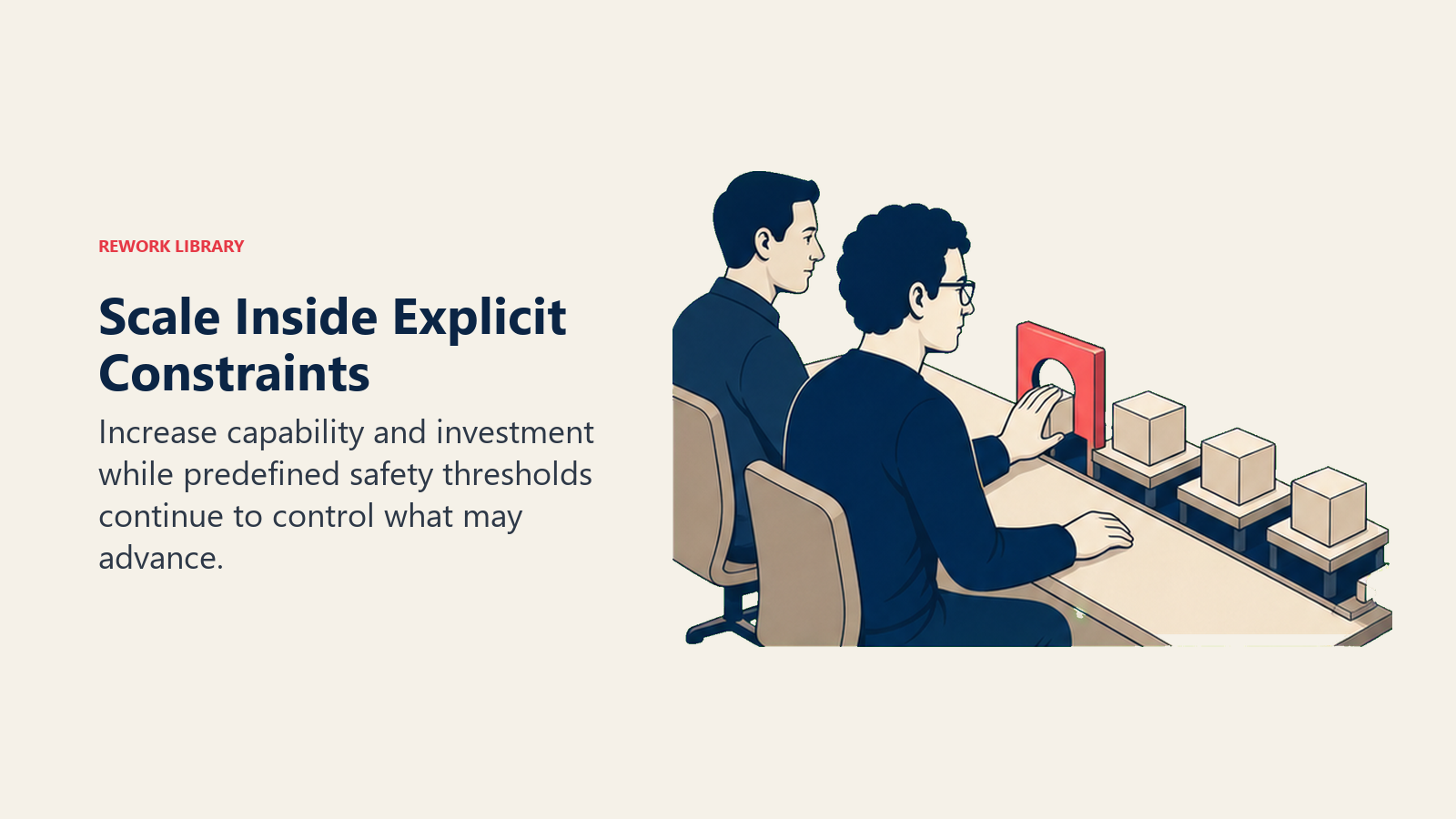
But Amodei's argument is specific: you can't do meaningful frontier safety research without frontier capabilities. If you're trying to study whether AI systems are deceptive or misaligned, you need systems powerful enough to exhibit those properties. Undershooting on compute doesn't make the safety research more rigorous. It makes it less relevant.
The RSP, Responsible Scaling Policy, is the structural mechanism that holds the tension together. It commits Anthropic to specific capability thresholds beyond which they will not deploy unless safety evaluations pass. The thresholds are published. The criteria are public. If a Claude model crosses a defined capability level and safety evals don't clear, deployment pauses.
That's not a guarantee of safety. It's a structural commitment that creates accountability. And it's the mechanism that lets Amodei argue, credibly, that the scale of investment is in service of the safety thesis rather than a contradiction of it.
What Amodei Would Do in Your Role
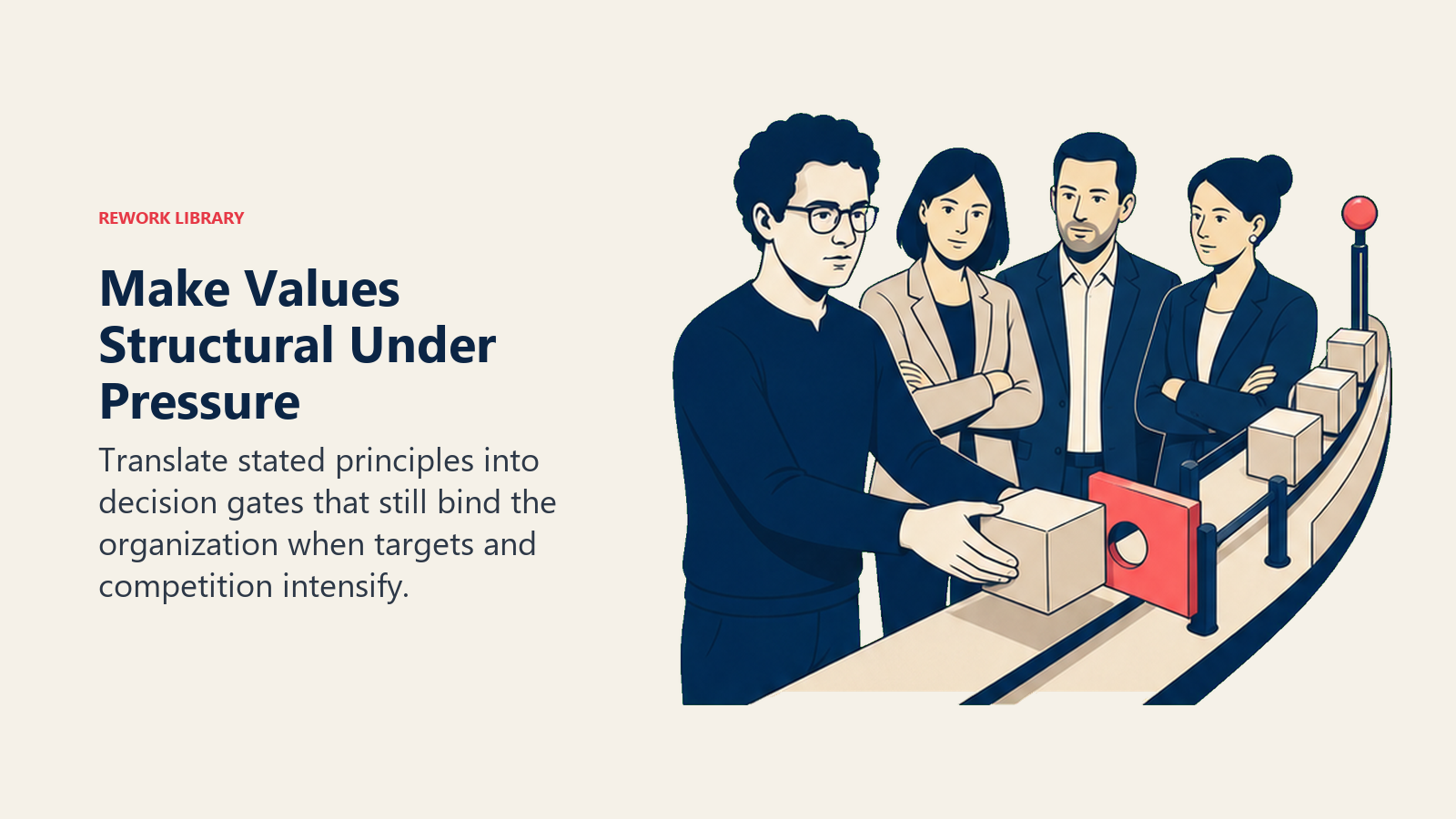
If you're a CEO, the most transferable Amodei lesson is structural: your organization will act consistently with its incentives, not its stated values, under pressure. The only way to make values durable is to build them into the structure. Amodei didn't just say Anthropic was safety-first. He built the RSP, published it externally, and made it a binding constraint. If your company has values that matter to you, ask whether they're structural or aspirational. Aspirational values disappear in Q3 when you're behind on targets. Structural ones hold.
If you're a COO, the Daniela/Dario division of labor is worth studying. Daniela Amodei runs operations, partnerships, and commercial functions. Dario owns research and product direction. That's a clean split that lets each sibling operate in their zone of strength without stepping on each other's decision rights. If you're running ops for a technical founder, your job is to make the technical vision executable without co-opting it. The Anthropic co-founder model is a functional example of that partnership working.
If you're in product, the Constitutional AI story is a lesson in patience with foundational bets. The features that differentiate your product in year four are often the research investments that looked like overhead in year two. If you're cutting foundational work because it doesn't have an obvious near-term payoff, you're optimizing for this quarter at the expense of the product moat that would otherwise be defensible.
If you're in sales or marketing, Anthropic's positioning is an interesting case study in leading with conviction rather than features. The pitch for Claude in enterprise is essentially: "We built this differently and you can verify it." The RSP is public. The Constitutional AI research is published. The safety benchmarks are disclosed. That's a different sales motion than "we have the best benchmarks." It's selling a thesis, which requires sales people who genuinely understand it.
How Rework Applies This Model
Amodei's playbook, safety-first design plus differentiated positioning, maps directly to how Rework approaches trust-first product development. Work management software sits on top of a company's most sensitive operational data: deal pipelines, client communications, team performance, revenue forecasts. Treating that data casually is the default in the category. Rework treats it as a constraint.
That shows up in concrete ways: granular role-based permissions are built into the data model rather than bolted on, audit trails are default-on for sensitive actions, and data residency commitments are published rather than negotiated per-contract. Like Anthropic, Rework leads with verifiable trust signals instead of feature-count marketing, the pricing page and security posture are public, not gated behind a sales call. For operators evaluating CRM and work ops tools, that transparency is the buying signal. Conviction you can verify beats benchmarks you have to take on faith.
Notable Quotes & Lessons Beyond the Boardroom
Amodei has been unusually direct in public writing about the stakes he believes are in play. In his 2024 essay "Machines of Loving Grace," he argued that AI could compress 50-100 years of scientific progress into less than a decade, potentially solving major disease categories and dramatically reducing global poverty. He said this not as a recruiting pitch but as a literal belief about what the technology could do.
That kind of public intellectual honesty, here's what I actually think is possible, here are the risks, here's why I'm building it anyway, is rare in technology executives who usually manage messaging carefully.
He's also said, in various interview contexts: "I think if we're not careful, we could build something that is misaligned with human values in ways we don't fully understand." The unusual thing is that he says this while actively building the systems in question. That's not cognitive dissonance. It's a specific argument: someone is going to build these systems, and it should be people who take the risks seriously.
The lesson for operators is about the relationship between conviction and honesty. Amodei doesn't hide the downside of his thesis to make fundraising easier. He states the downside and makes the affirmative case anyway. That builds credibility with the people who are most skeptical, because they can see he's not pretending the concerns don't exist.
Where This Style Breaks
The core tension in Amodei's model is one he can't fully resolve. Anthropic needs commercial revenue to fund safety research, which means Claude needs to compete with GPT-4o and Gemini for the same enterprise contracts. That commercial pressure creates the same incentive dynamic he left OpenAI to escape. It's just deferred, not eliminated.
The RSP is a real constraint, but it doesn't fully solve the problem. Publishing deployment thresholds creates accountability, but the thresholds are self-defined. The research council that evaluates safety milestones is internal. There's no external verification mechanism.
And the research-to-product pipeline is slower than OpenAI's. Anthropic has shipped excellent models, but the velocity on product features, things like integrations, tooling, and developer ecosystem, has trailed. A safety-first culture that's also thorough is harder to keep moving fast. That's a real competitive liability in a market where speed matters.
Frequently Asked Questions about Dario Amodei's Leadership
Who is Dario Amodei?
Dario Amodei is the co-founder and CEO of Anthropic, an AI safety company he started in 2021 with his sister Daniela Amodei and roughly ten other former OpenAI researchers. He holds a PhD in computational neuroscience from Princeton and previously served as Vice President of Research at OpenAI, where he led work on GPT-2 and GPT-3.
Why did Dario Amodei leave OpenAI?
Amodei left OpenAI in 2021 because he believed the organization's commercial incentives and structural setup were creating pressure that would compromise the safety research he viewed as necessary. He wasn't pushed out, he was VP of Research at the time, but wanted to build an institution where safety work wouldn't constantly compete against product and commercial timelines.
What is Anthropic's mission?
Anthropic's stated mission is to build AI systems that are safe, beneficial, and understandable. The company treats powerful AI as among the most transformative and potentially dangerous technologies in human history and has structured its research roadmap, hiring bar, and deployment decisions around that premise, including the binding Responsible Scaling Policy.
What is 'race to the top on safety'?
"Race to the top on safety" is Amodei's framing for how frontier AI labs should compete. Rather than racing to ship capabilities fastest, labs should compete to set the highest safety and alignment standards. The argument is that commercial success funds safety research, and if safety-focused labs stay at the frontier, they raise the floor for the entire industry.
What is Claude?
Claude is the family of large language models built by Anthropic. First released in 2023, Claude models are trained using Constitutional AI, a method where the model is trained to evaluate and revise its own outputs against a published set of principles, and are known in the enterprise market for being thoughtful, nuanced, and less prone to certain categories of problematic outputs than competing models.
What can founders learn from Dario Amodei?
The core founder lesson is that organizations act according to their incentives, not their stated values, under pressure. If values matter, they have to be structural rather than aspirational. Amodei built the Responsible Scaling Policy as a binding external commitment, not a press release, a model for any founder who wants conviction to survive the next fundraising round or competitive threat.
Learn More
- Constitutional AI: How Anthropic Trains Models on Principles
- AI Governance for Executives: What Boards Need to Understand
- Sam Altman Leadership Style: How OpenAI's CEO Navigated the Most Consequential Technology Bet of the Decade
- Demis Hassabis Leadership Style: Long Bets, Deep Research
- Elon Musk Leadership Style: Extreme Ownership at Civilizational Scale
- Fei-Fei Li Leadership Style: Building AI That Serves Humanity

On this page
- The Race to the Top Doctrine
- Leadership Style Breakdown
- Key Leadership Traits
- The 3 Decisions That Defined Amodei
- 1. Leaving OpenAI
- 2. Constitutional AI
- 3. Scaling with Constraint
- What Amodei Would Do in Your Role
- How Rework Applies This Model
- Notable Quotes & Lessons Beyond the Boardroom
- Where This Style Breaks
- Learn More