Taiichi Ohno Leadership Style: Waste Is the Enemy, Not the Worker
Turn this article into takeaways for your work.


Each assistant summarizes the article only for you and suggests best practices for your work.
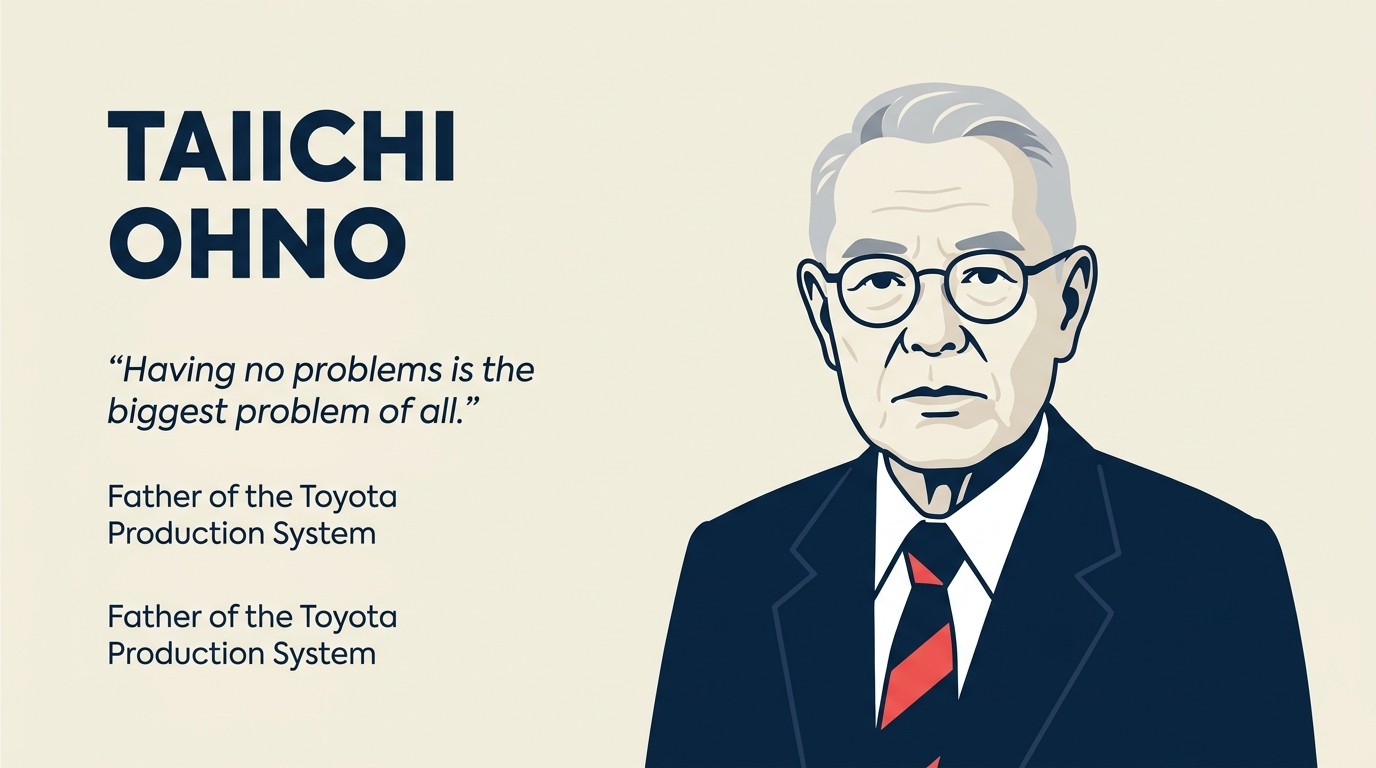
Key Facts: Taiichi Ohno (1912–1990) was the architect of the Toyota Production System (TPS), the foundation of modern Lean manufacturing. He spent more than 40 years at Toyota (1932–1978), inventing the kanban pull system, Just-in-Time (JIT) production, and the Five Whys root-cause technique. His 1978 book Toyota Production System: Beyond Large-Scale Production (English edition 1988) seeded the global Lean movement and shaped Six Sigma and Agile software development.
Taiichi Ohno joined Toyoda Spinning and Weaving in 1932 as a young engineer. He transferred to Toyota Motor when the automotive division was formed, and he spent the next 46 years at the company building a production system that his competitors would spend the following four decades trying to copy, and mostly failing.
The Toyota Production System didn't just improve efficiency. It changed what "management" means inside a factory. And eventually, through the Lean manufacturing movement and its influence on Agile software development, it changed what management means in every knowledge-work organization that read the TPS playbook.
The core of Ohno's insight is simple to state and difficult to execute: every step in a production process either adds value to the customer or it doesn't. The steps that don't add value are waste, and waste should be eliminated relentlessly, systematically, and permanently. Not managed, not optimized, not contained. Eliminated.
He was promoted to machine shop manager at Toyota in 1949 and given authority to redesign the production floor. That's where the Toyota Production System was born. He retired from Toyota in 1978, died in 1990, and never held the CEO title. His influence came from operational authority and technical depth, not from the org chart. He published Toyota Production System: Beyond Large-Scale Production in 1978; the English translation appeared in 1988 and became one of the most influential business books in manufacturing history.
This profile isn't a celebration of lean mythology. It's an examination of what Ohno actually built, what it requires to apply, and where the model breaks.
Leadership Style Breakdown
| Style | Weight | How it showed up |
|---|---|---|
| Waste Eliminator | 60% | Ohno's driving question was never "how do we produce more?" It was "how do we stop doing things that don't produce value?" That distinction matters. Producing more can be achieved by adding people, equipment, and shifts. Eliminating waste requires understanding the production system deeply enough to see where value is being destroyed, through overproduction, waiting, unnecessary transport, excess inventory, defects, and overprocessing. Ohno built his career around the discipline of seeing the second category clearly and acting on it systematically over decades, not in improvement sprints. |
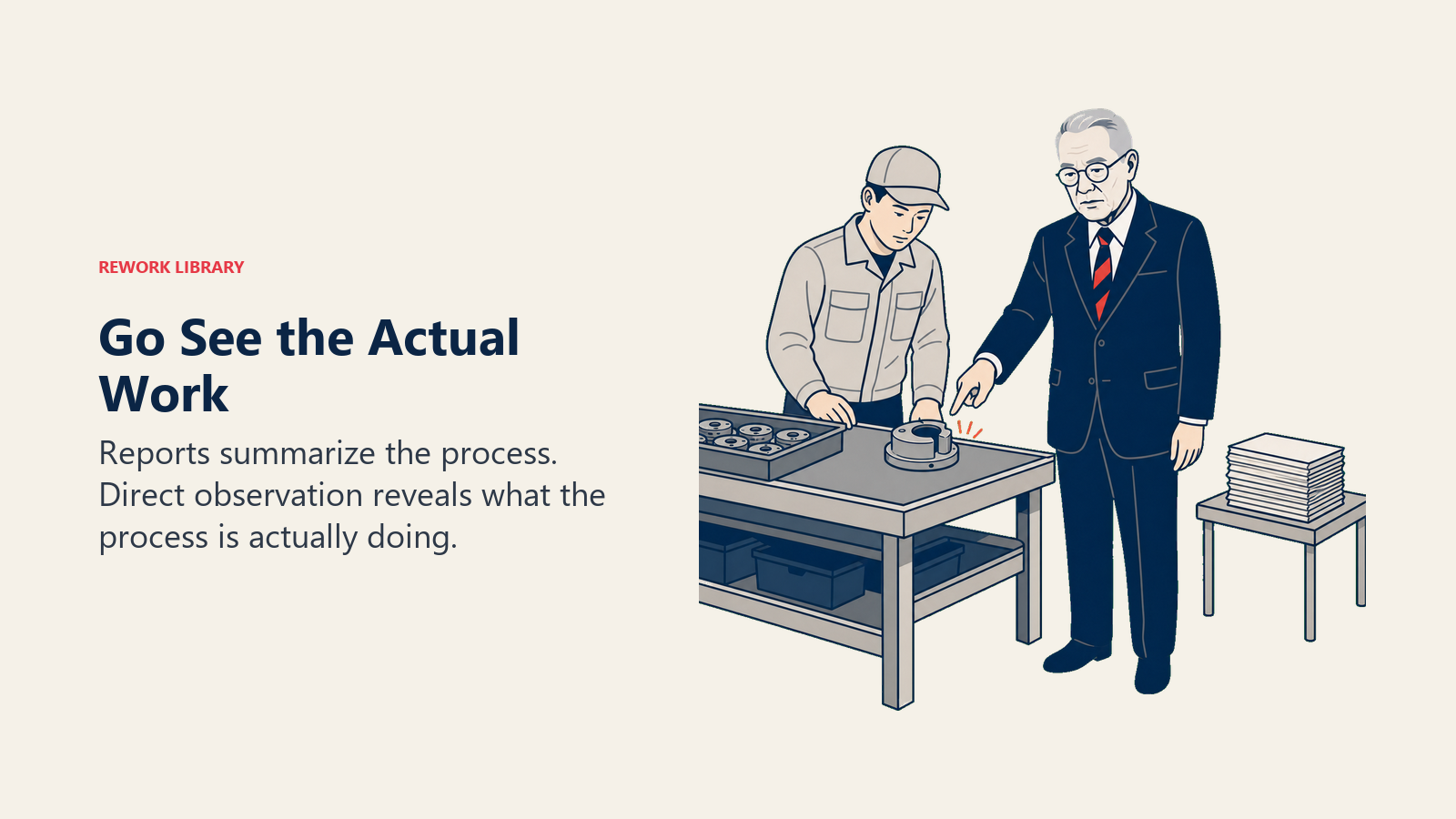
| Floor-Level Observer | 40% | Ohno's management practice was rooted in what he called "genchi genbutsu", go see the actual work. He spent time on the factory floor watching production processes directly, not reading reports about them. He is famous for drawing chalk circles on the floor and asking managers to stand inside them for hours, watching what happened in that area until they saw what he saw. The practice was humbling and intentional: you can't understand a process you've never observed. The floor is where waste hides and where improvement opportunities live. Reports describe what people thought happened; the floor shows what actually happened. |
That combination made Ohno unusual in large organizations. Most senior manufacturing executives in post-war Japan and the United States managed upward, they interpreted reports, attended meetings, and made decisions based on aggregate data. Ohno managed downward and outward, staying connected to the actual production process throughout his career. His authority didn't come from managing people. It came from understanding the work better than anyone else.
Key Leadership Traits
| Trait | Rating | What it means in practice |
|---|---|---|
| Gemba thinking | Exceptional | "Gemba" is the Japanese term for the actual place where work happens, the factory floor, the customer interaction, the code deployment. Ohno's conviction was that managers who managed from offices and meeting rooms were managing abstractions, not reality. He expected managers to spend time where the value was created and where the waste occurred. For knowledge workers, this means the equivalent discipline: understanding your customer's actual workflow, observing your team's actual process, and making decisions based on what you see rather than what you're told. |
| Patience with systematic change | Very High | The Toyota Production System took approximately 30 years to fully develop and stabilize. Ohno wasn't running improvement sprints, he was building a system that would become self-reinforcing over time. Most Western attempts to implement lean failed because they treated it as a set of tools to install rather than a management philosophy to develop. Ohno's patience with the pace of genuine systemic change is part of what made Toyota's advantage so durable. You can't copy a 30-year system in 18 months. |
| Intolerance for inventory | High | Ohno viewed inventory as a form of organizational dishonesty. Inventory hides problems: it masks production imbalances, quality failures, supplier unreliability, and demand forecasting errors. A factory with high inventory can keep running even when its processes are broken because the buffer absorbs the failure signals. Ohno's insight was that reducing inventory forces problems to surface, which is painful in the short term and essential for long-term improvement. This is a principle that applies directly to any buffered system: software release queues, content pipelines, sales funnel stages. The buffer hides the bottleneck. |
| Asking Why five times | High | The 5 Whys method is Ohno's most widely adopted practice. When something goes wrong, ask why it happened. Then ask why that happened. Then ask why that happened. Repeat five times, or as many times as it takes to reach the root cause rather than the symptom. The 5 Whys method's power is in its resistance to premature closure. Most problem-solving stops at the first or second why, the proximate cause that's easy to see and fix, without reaching the underlying process failure that caused it. The 5 Whys discipline forces deeper investigation before action. |
The Ohno Just-In-Time Doctrine
The Ohno Just-In-Time Doctrine states that a production system should make only what the next process needs, in the quantity it needs, at the moment it needs it, with inventory, waiting, and overproduction treated as waste rather than buffers. Pulled small-batch flow replaces pushed large-batch scheduling so that defects and bottlenecks surface immediately. The doctrine reframes operations leadership around eliminating non-value-adding time between customer order and cash collection.
The 3 Frameworks That Defined Taiichi Ohno
1. Just-in-Time: Produce Only What Is Needed, When It Is Needed
Just-in-Time (JIT) is the most famous element of the Toyota Production System and the most frequently misunderstood. It doesn't mean producing as fast as possible or eliminating all inventory. It means producing exactly what is needed, in the quantity needed, at the moment it's needed, no more, no less.
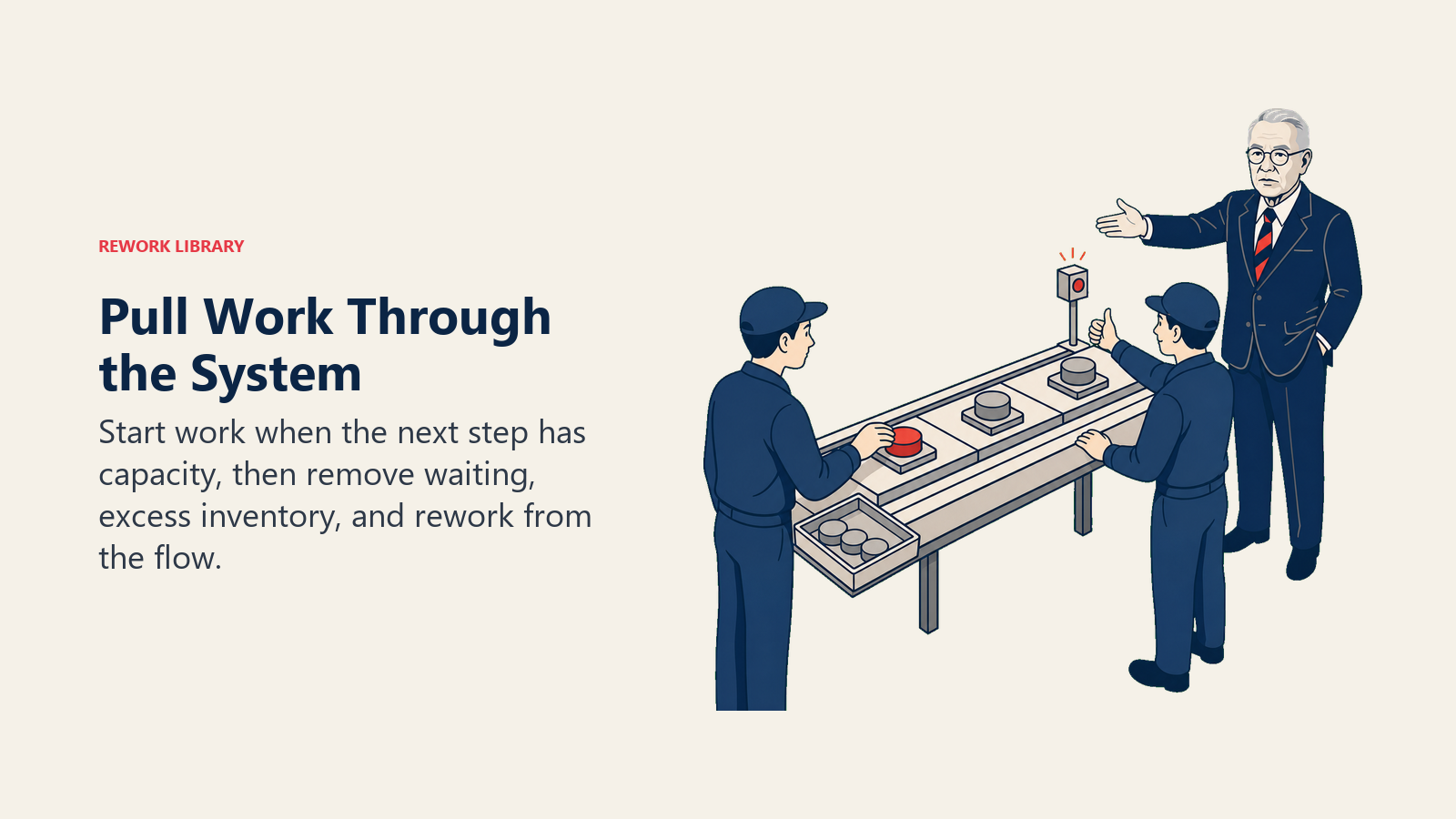
Ohno developed JIT as a direct response to the Ford mass production model, which he studied closely after World War II. Ford's system produced in large batches: press a million of this part, store it, move it to the next station, wait for the previous stage to clear before the next batch could flow. That model maximized machine utilization but created enormous inventory buffers between every production stage. Those buffers hid quality problems, delayed feedback about defects, and required warehouse space that added cost without adding value.
JIT inverted the logic. Instead of producing large batches and pushing them downstream, Toyota pulled production: downstream processes signaled upstream processes to produce only what was needed to replenish what had been consumed. The result was small batches flowing continuously through the production system, with short cycle times and rapid feedback loops that surfaced quality problems immediately rather than after a million defective parts had been produced.
The knowledge-work translation is significant. In software development, the equivalent of JIT is limiting work in progress (WIP) and building features incrementally against actual customer demand rather than a pre-defined roadmap batch. In content operations, it means producing content in response to demonstrated audience need rather than quarterly editorial calendars that buffer production far in advance of distribution. In any system where work is batched and pushed, asking "what would JIT look like here?" is a productive diagnostic question.
2. Jidoka: Build Quality In, Don't Inspect It Out
Jidoka, translated variously as "autonomation" or "automation with a human touch", is the less-famous but arguably more important second pillar of the Toyota Production System. The core principle is that quality should be built into the production process rather than inspected for at the end.
In manufacturing terms, this meant equipping machines with the ability to detect abnormalities and stop automatically rather than continuing to produce defective output. When a machine stopped, the production line stopped, and a worker investigated before the line restarted. This was radical in the 1950s: the accepted approach was to keep machines running at maximum utilization and inspect for defects at the end of the production run.
Ohno's insight was that inspection-after-the-fact is a form of waste. You've already spent the time and materials producing defective output, inspecting it at the end just reveals the damage rather than preventing it. Building detection into the process itself stops defects at the point of creation, where the root cause is closest and the cost of correction is lowest.
The knowledge-work translation is automated testing, continuous integration, and definition-of-done standards in software development. Instead of writing code and inspecting it for quality in a separate QA phase, build quality checks into the production process: unit tests run on every commit, linting catches errors before they reach the codebase, code review standards prevent defects from advancing. The principle is identical to Jidoka: stop the line when something's wrong rather than passing the defect downstream where it costs more to fix.
3. The 7 Wastes: A Framework for Seeing What Doesn't Add Value
Ohno identified 7 categories of waste (muda in Japanese) in manufacturing processes. They are: overproduction (producing more than is needed), waiting (time when nothing is happening), transport (moving materials unnecessarily), overprocessing (doing more than the customer requires), inventory (holding more material than is needed), motion (unnecessary movement of people), and defects (producing output that doesn't meet requirements).
The framework's power is in making waste visible. Most waste in a production system is invisible to people working inside it because it's normalized, it's just how things work here. Ohno's 7 Wastes give managers a vocabulary and a lens for seeing non-value-adding activity that would otherwise remain invisible.
In knowledge work, the 7 Wastes translate with some modification. Overproduction becomes creating features nobody uses or reports nobody reads. Waiting becomes approval queues, meeting delays, and blocked work items. Transport becomes context-switching between meetings and tasks. Inventory becomes work in progress that's been started but not completed. Motion becomes navigating between disconnected tools. Overprocessing becomes perfectionism on deliverables that only need to be good enough. Defects become rework on misunderstood requirements.
The discipline is applying the framework honestly. Most knowledge-work teams, if they mapped their actual process against the 7 Wastes, would find that a significant portion of their working time falls into one of those seven categories. The discomfort isn't in the framework, it's in what the framework reveals.
What Taiichi Ohno Would Do in Your Role
If you're a CEO, Ohno's question for you is about the WIP (work in progress) at the top of your organization. How many strategic initiatives are currently active? How many of those are more than 50% complete? Most leadership teams have 8 to 12 active priorities at any given time, which means none of them is getting enough attention to make rapid progress. Ohno would identify that as overproduction in strategic planning, starting more than you can finish, creating inventory that ages before it's completed. His prescription would be to stop most of them, finish two or three completely, and then start new initiatives only as capacity opens up. That's uncomfortable but it's what JIT looks like applied to strategy.
If you're a COO, the 7 Wastes framework applied to your core operational processes is worth running as a structured audit at least once a year. Pick the three highest-leverage operational processes in your organization and map them end-to-end: every step, every handoff, every approval, every wait time. Then categorize each step as value-adding or waste. Most COOs who do this exercise honestly find that 40 to 60 percent of the steps in their key processes fall into waste categories. That's not a criticism, it's a baseline. Ohno spent 30 years reducing it at Toyota. You don't have to do it in a quarter.
If you're a product leader, Jidoka has a direct application in your quality process. If your release cycle still involves a QA phase that gates deployment, ask whether quality is being built into your development process or inspected out at the end. The gap between those two approaches is the gap between finding defects when they're cheap to fix (during development, when the engineer who wrote the code is still in context) and finding them when they're expensive to fix (during QA or, worse, in production). Investing in automated testing, pair programming, and definition-of-done standards is a Jidoka investment: it shifts the detection point left toward the source.
If you're in sales or marketing, the JIT principle applies to your demand generation and sales pipeline. Most sales pipelines have enormous WIP: hundreds or thousands of opportunities in various stages, many of them stale, none of them getting consistent attention. That's an inventory problem. Ohno would look at your average deal cycle time, identify where deals sit idle without activity, and ask what process failure is causing them to wait. Is it that reps are carrying too many opportunities simultaneously? That qualification criteria are too weak, allowing low-probability deals to consume pipeline capacity? That approval processes delay proposals? The bottleneck is usually visible in the wait time data if you're willing to look at it honestly.
Rework Analysis: Ohno's Doctrine for Modern SMB Operations
Ohno's two non-negotiables, waste elimination and continuous improvement (kaizen), translate cleanly to modern SMB operations, where headcount is thin and buffered inefficiency is fatal. Most small teams run the knowledge-work equivalents of Ohno's seven wastes every week: duplicated spreadsheets, stale pipeline records, approval queues, tool-switching, and rework from misaligned briefs. Rework's role in a lean ops stack is to collapse those wastes into a single system. Rework's Sales Engine (from $69/month billed yearly) removes the inventory buffer of scattered deal data; Rework's Process Engine (from $99/month billed yearly) replaces handoff queues with a shared work surface that surfaces bottlenecks the moment they appear. The kaizen discipline, small, continuous, floor-observed improvements, is what turns a tool rollout into a durable system. Rework gives the surface; Ohno's method gives the habit of using it.
Notable Quotes & Lessons Beyond the Boardroom
"All we are doing is looking at the time line, from the moment the customer gives us an order to the point when we collect the cash. And we are reducing that time line by removing the non-value-added wastes." That's from Toyota Production System: Beyond Large-Scale Production, published in 1978. It's a precise description of what lean operations is actually trying to do, and it's worth holding against any improvement initiative your organization is running. If you can't trace a direct line from the initiative to reduction in customer-to-cash cycle time, it's worth asking what you're actually optimizing.
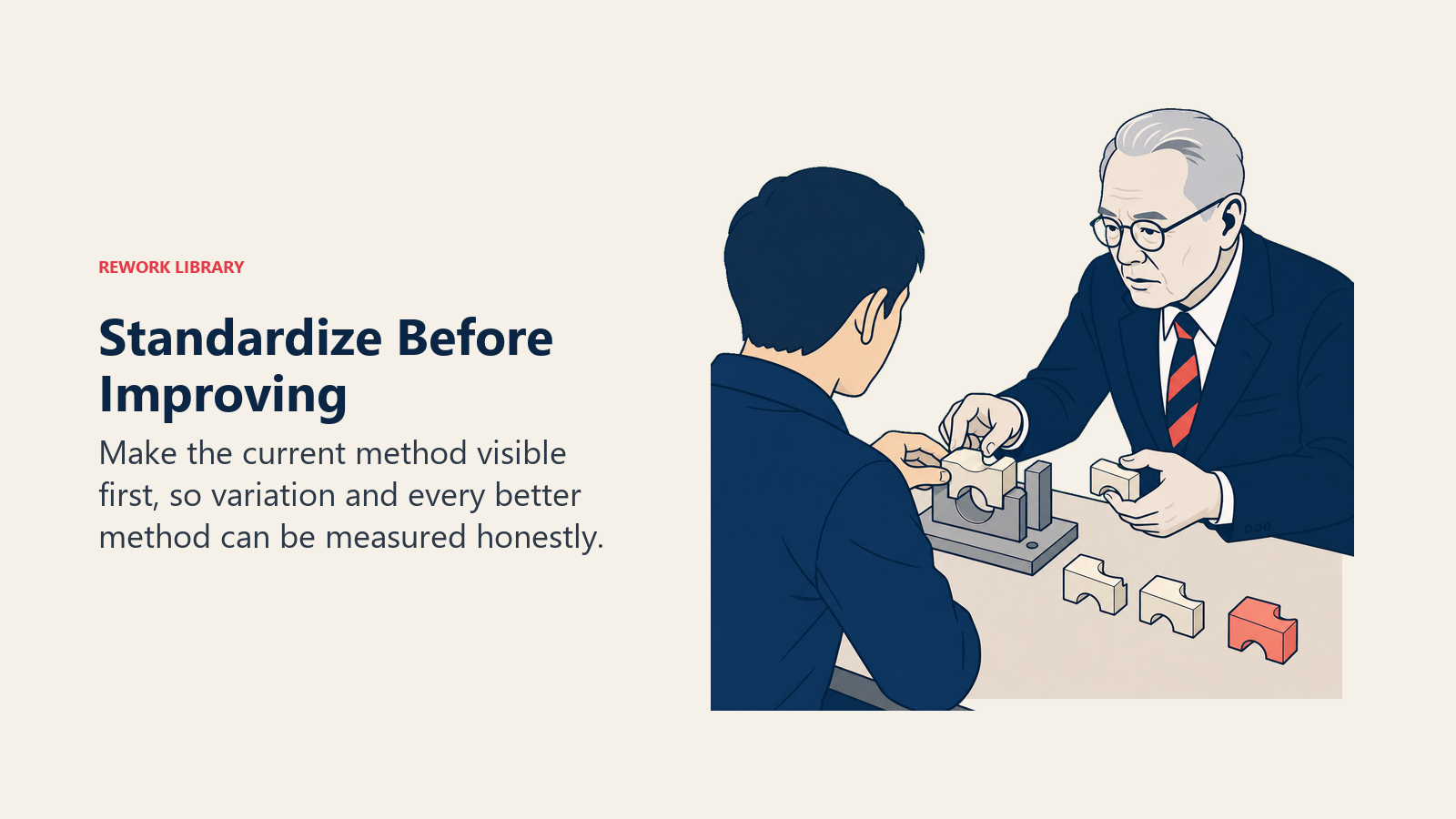
"Without standards, there can be no improvement." This quote captures the less-celebrated part of Ohno's system: before you can improve a process, you have to define what the current process is. Most knowledge-work processes aren't documented well enough to be improved systematically, they're done differently by every person who does them. Standardizing a process isn't about rigidity; it's about creating a baseline that makes improvement visible. You can't know whether you've made something better if you don't know what "current state" looks like.
The other honest lesson from Ohno's career is about the difference between installing tools and building a culture. Most Western manufacturing companies that tried to implement lean in the 1990s installed the tools, Kanban boards, 5S programs, kaizen events, without internalizing the underlying philosophy. The result was lean theater: the surface features of TPS without the management discipline that made it work at Toyota. Ohno's system requires floor-level observation, honest problem visibility, and long-term patience that most quarterly-driven organizations can't sustain. That's not an argument against trying. It's an argument for understanding what you're actually committing to before you start.
Where This Style Breaks
The Toyota Production System was designed for high-volume, low-variability manufacturing, producing hundreds of thousands of the same part to the same specification. It's harder to apply in custom or project-based work where variability is the product, not the defect. The 5 Whys method works well on mechanical failures with single root causes but can misfire in complex sociotechnical systems where multiple simultaneous causes interact, asking why five times produces one causal chain rather than the web of contributing factors the problem actually requires. And Ohno's floor-level authority model depends on managers who genuinely understand the work being managed, which is rare in knowledge-work leadership layers where most managers are two or three abstractions removed from actual execution. The principles translate. The specific methods require significant adaptation.
Frequently Asked Questions about Taiichi Ohno's Toyota Production System
Who was Taiichi Ohno?
Taiichi Ohno (1912–1990) was a Japanese industrial engineer who spent more than four decades at Toyota, rising from machine-shop manager to executive vice president. He is the architect of the Toyota Production System, the operating model behind modern Lean manufacturing, and the author of the 1978 book Toyota Production System: Beyond Large-Scale Production.
What is the Toyota Production System?
The Toyota Production System (TPS) is the production and management framework Ohno developed at Toyota between roughly 1948 and 1975. Its two pillars are Just-in-Time (produce only what is needed, when it is needed) and Jidoka (build quality into the process rather than inspecting it out). TPS became the foundation of the global Lean manufacturing movement.
What is Just-In-Time (JIT)?
Just-in-Time is the principle of producing exactly what is needed, in the quantity needed, at the moment it is needed, no more, no less. Ohno developed JIT as a direct response to Ford's large-batch mass production, replacing push scheduling with pull signals so downstream processes trigger upstream production only to replenish what was consumed.
What is the Five Whys technique?
The Five Whys is Ohno's root-cause analysis method: when a problem occurs, ask "why?" five times in succession to move past symptoms and reach the underlying process failure. It resists premature closure on the first visible cause and forces deeper investigation before corrective action.
What is the kanban system per Ohno?
Kanban (Japanese for "signal card") is the visual signaling system Ohno invented to operationalize Just-in-Time. Physical cards travel with parts through the production line; when a downstream station consumes a bin, its kanban returns upstream as authorization to produce the next batch. It turns production control into a pull system driven by actual demand rather than a central schedule.
What can modern operators learn from Taiichi Ohno?
Modern knowledge-work operators can apply three Ohno disciplines directly: limit work-in-progress to expose bottlenecks, use the 7 Wastes framework to audit non-value-adding activity in operational processes, and practice genchi genbutsu, go and observe the actual work rather than managing from reports. The tools adapt; the management philosophy of relentless waste elimination and floor-level observation translates across industries.
For related reading, see Peter Drucker Leadership Style, Andy Grove Leadership Style, W. Edwards Deming Leadership Style, Akio Toyoda Leadership Style, Mary Barra Leadership Style, and Building High-Performance Teams.

On this page
- Leadership Style Breakdown
- Key Leadership Traits
- The Ohno Just-In-Time Doctrine
- The 3 Frameworks That Defined Taiichi Ohno
- 1. Just-in-Time: Produce Only What Is Needed, When It Is Needed
- 2. Jidoka: Build Quality In, Don't Inspect It Out
- 3. The 7 Wastes: A Framework for Seeing What Doesn't Add Value
- What Taiichi Ohno Would Do in Your Role
- Rework Analysis: Ohno's Doctrine for Modern SMB Operations
- Notable Quotes & Lessons Beyond the Boardroom
- Where This Style Breaks