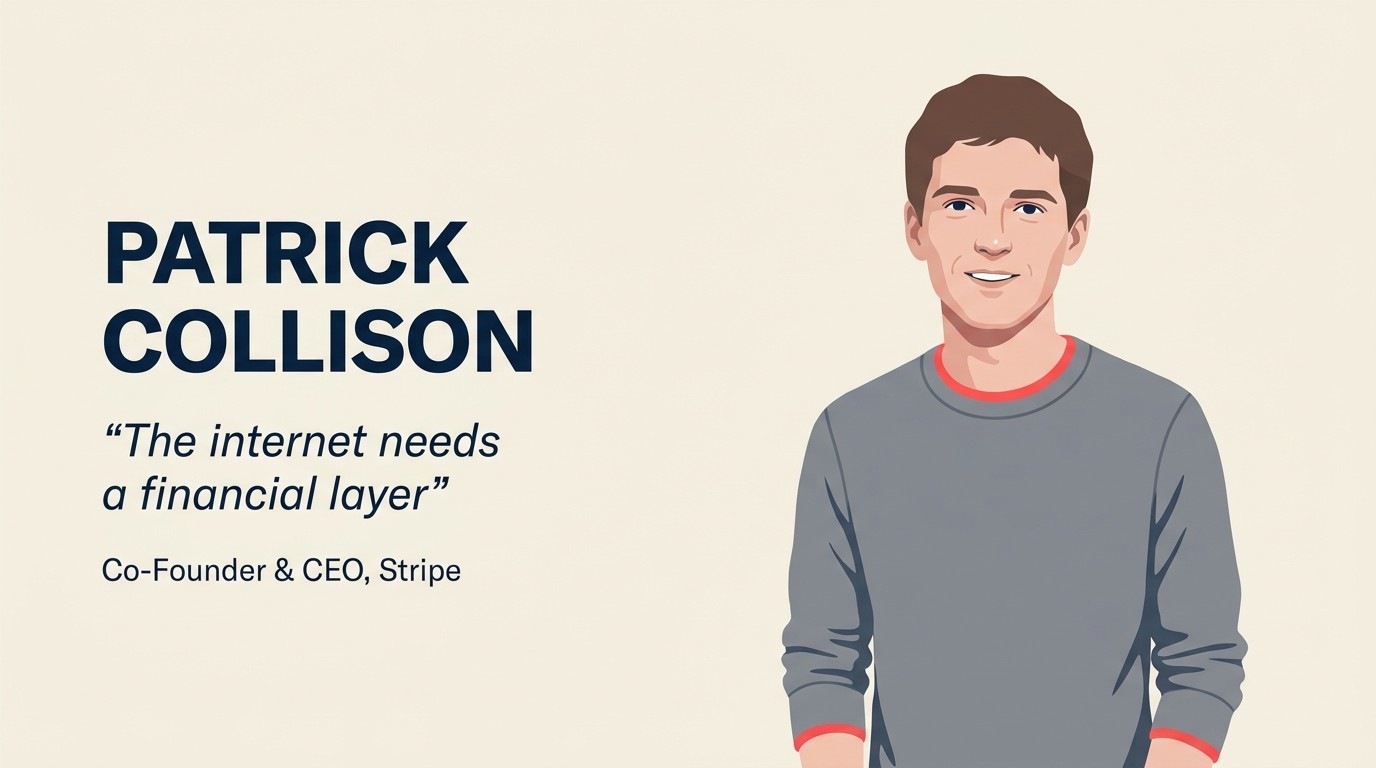
Patrick Collison Leadership Style: Ship Fast, Think Long
Turn this article into takeaways for your work.


Each assistant summarizes the article only for you and suggests best practices for your work.
Key Facts, Patrick Collison
- Born: 1988, Limerick, Ireland
- Co-founded Stripe: 2010, age 22, with younger brother John Collison
- Early signal: Won the BT Young Scientist & Technology Exhibition at age 16 (2005) for an AI-based programming language, Croma
- Education: Admitted to MIT after Harvard; dropped out of both to build Stripe (earlier exit: Auctomatic, sold to Live Current Media in 2008 for ~$5M)
- Stripe peak valuation: $95B (March 2021), at the time the most valuable private US company
- Signature invention: The "seven-line" Stripe integration, accept payments with ~7 lines of code, a radical simplification vs. legacy processors
- Intellectual output: Co-founded the "Progress Studies" movement with Tyler Cowen (The Atlantic, July 2019)
- Civic work: Launched Fast Grants in April 2020, distributed $50M+ to COVID-19 researchers in days, not months
- Publishing arm: Founded Stripe Press (2018), publishing books on science, technology, and economic progress
: accepting payments on the internet should take 7 lines of code, not 7 weeks of enterprise procurement. That insight didn't start with a sales deck or a partner channel. It started with developers. Patrick posted on Hacker News, offered to set up Stripe for anyone who replied, and showed up with a working integration the same day. No contract. No legal review. No quota-carrying rep in a polo shirt. The engineer said yes, and Stripe had a customer.
That was Stripe's go-to-market for the first two years. Developers adopted it because the product made them look fast. Their managers approved it because it was already running. By the time enterprise procurement got involved, Stripe had won the deal on technical merit alone. The company that Patrick Collison co-founded with his brother John at age 22 is now valued at roughly $70-95 billion. The 7-line philosophy still runs through every product decision they make.
The Collison Long-Ship Model
The Collison Long-Ship Model is the operating doctrine of building a company like a Viking longship rather than a cruise liner: keep the crew small, the hull simple, and the voyage measured in decades, not quarters. In practice, it fuses two Collison instincts, radical product simplicity (the seven-line API) and radical time-horizon extension (a 10-year operating mental model with quarterly execution), into a single constraint: maximize compounding per headcount, never the reverse. Companies that run this model reject the "more people equals more output" reflex and treat intellectual compounding, product clarity, and long-horizon bets (Stripe Atlas, Stripe Press, Progress Studies, Fast Grants) as competitive inputs, not PR.
Leadership Style Breakdown
| Style | Weight | How it showed up |
|---|---|---|
| Product-First Operator | 60% | Collison stays unusually close to technical decisions for a CEO at Stripe's scale. He reviews product direction personally, prioritizes ruthless API simplicity, and has kept the engineering culture anchored to developer experience as the primary measure of quality. Headcount has stayed lean relative to revenue, Stripe ran with roughly 3,000 employees at a point when competitors had hired twice as many for similar output. |
| Long-Term Compounder | 40% | Collison has resisted IPO pressure since 2021 despite enormous investor and employee pressure. He funds Stripe Press, an academic publishing arm producing books on economics and progress. He co-founded the Progress Studies movement with Tyler Cowen. These aren't PR moves. They reflect a founder who treats intellectual compounding as a competitive input, the longer your thinking horizon, the fewer dumb short-term decisions you make. |
The 60/40 split reflects that Collison runs Stripe like a product engineer who happens to be CEO, not a CEO who cares about product. He and John structured their roles from the start with Patrick owning product and vision and John owning sales and external relationships. That division created a co-founder dynamic that's stayed relatively stable for 14 years, which is unusual. Most co-founder splits either formalize into clean hierarchy or implode. Theirs built a complementary operating model.
Key Leadership Traits
| Trait | Rating | What it means in practice |
|---|---|---|
| Developer empathy | Exceptional | Collison doesn't just serve developers as customers, he thinks like one. Stripe's API documentation became a benchmark for the industry not because Stripe had a great docs team but because the people making decisions about what the API looked like cared deeply about what it felt like to use it. That's a leadership input, not a product output. |
| Intellectual range | Very High | Collison reads widely across economics, history, urban planning, and philosophy of science. He funds research through the Patrick Collison Research Fund and writes long-form essays on stagnation in scientific progress. In a founder context, intellectual breadth translates to product bets that look counterintuitive until they're obvious, Stripe Atlas, Stripe Treasury, and Stripe Identity all came from thinking about what global economic infrastructure should look like, not what payments competitors were doing. |
| Headcount discipline | High | Stripe consistently ran leaner than comparable fintech companies. Collison treats team size as a proxy for organizational clarity, small teams move faster, have clearer ownership, and produce better software. The 2023 layoffs of roughly 14% of staff were painful, but they reflected a company that had allowed headcount to drift during the 2021 hiring wave and needed to return to its natural operating model. |
| IPO restraint | Medium | Staying private for 14 years while carrying a $95B paper valuation is a choice, not a circumstance. Collison has chosen it deliberately, but the cost is real: employees with stock options have watched liquidity events get delayed repeatedly, secondary market prices have fluctuated wildly, and the 2022-23 valuation markdowns (from $95B to roughly $50B during the markdown cycle) created genuine financial pain for people who'd bet years of their career on Stripe equity. |
The 3 Decisions That Defined Patrick Collison as a Leader
1. Betting on Developer-First Distribution When Enterprise Software Still Owned Payments
In 2010, the conventional wisdom was that payments was an enterprise sale. You called on a procurement team, you negotiated a custom rate, you integrated over a quarter with professional services help. PayPal owned the consumer market. Braintree and Authorize.net owned the developer-adjacent market. The big commercial relationships ran through bank relationships and legacy processors.
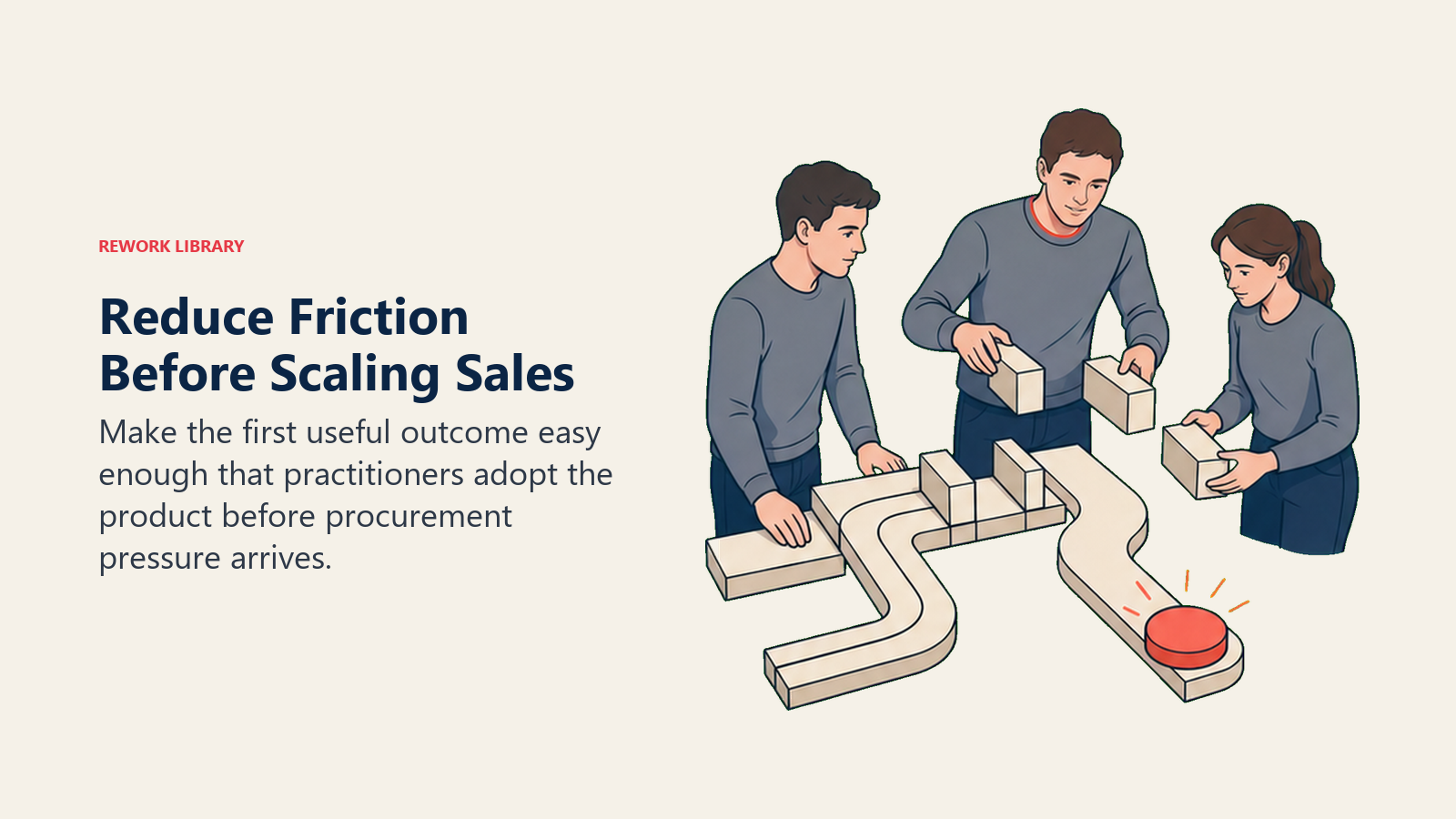
Collison's bet was structural: the software-eating-the-world trend meant that developers would become the actual buyers of infrastructure software, even if their managers signed the checks. If you made your product so simple to adopt that a developer could implement it unilaterally and show it running to their boss the next morning, you'd never need to compete on enterprise sales. You'd win before the enterprise process started.
That bet required the product to be genuinely good, not just well-marketed. Stripe's API documentation, error messages, and webhook design became case studies in developer experience because Collison insisted that the quality of the integration experience was the product, not a supporting feature. The 7-line integration wasn't a tagline. It was a technical constraint he imposed on the design team.
The leadership lesson here isn't "do developer-led growth." It's the underlying move: identify who actually makes the adoption decision in your category, optimize everything for that person's experience, and win before your competitor's traditional sales motion engages. That principle works in B2B SaaS, in professional services, and in any market where the buyer and the user are different people.
2. Staying Private Longer Than Everyone Expected, And What That Bet Actually Cost
In 2021, Stripe's private market valuation hit $95 billion. That's roughly the GDP of a medium-sized country. Investors were pressuring Collison to IPO. Employees with vested options wanted liquidity. Market conditions were as favorable as they'd ever been. Stripe was printing revenue. The IPO window was wide open.
He didn't do it.
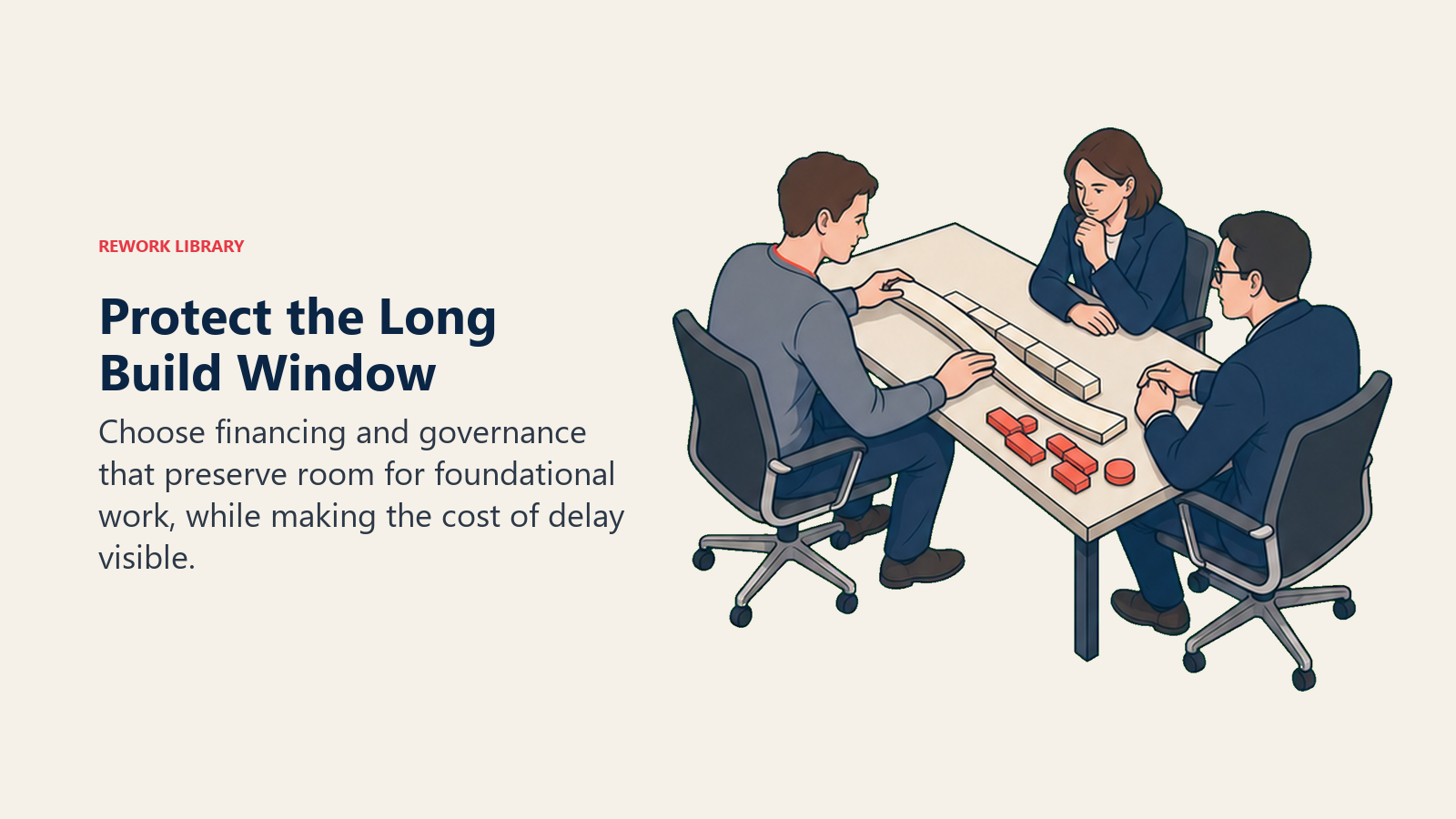
The reasoning Collison has given publicly centers on long-term orientation: IPOs change a company's behavior in ways that are often negative. It's a frame Warren Buffett has defended for decades in public markets, optimize for the decade, not the quarter. The quarterly earnings cycle creates pressure to optimize for metrics that matter to public market analysts, not for the decisions that build a durable business over a decade. Private companies can make investments that don't show up in near-term numbers. Public companies get punished for them.
But the cost of that decision was real. When the 2022-23 valuation cycle hit, Stripe's reported valuation dropped to roughly $50 billion in secondary markets before recovering. Employees who had expected to see their equity convert to liquid wealth at $95B were instead watching it reprice at half that. Morale took hits. Some senior people left.
The lesson isn't that Collison was right or wrong. It's that long-term thinking at the founder level has downstream costs at the employee level that don't show up in the founder's P&L. If you're running a private company and telling employees "we're building for the long term," they need to be able to actually see a path to liquidity. That's a communication and planning obligation that long-term-oriented founders often underfund.
3. Building Stripe Atlas to Expand Stripe's Mission Beyond Payments
In 2016, Stripe launched Stripe Atlas, a service that lets founders anywhere in the world incorporate a Delaware C-Corp, open a US bank account, and get a US Stripe account, entirely online, in 48 hours. For a startup in Lagos or Bogota or Jakarta that wanted to sell to US customers, Atlas removed months of legal complexity.
This wasn't a product that maximized Stripe's near-term revenue. Atlas charges a $500 one-time fee. It's not the payments margin machine that made Stripe's valuation. It's a bet on a thesis Collison has articulated publicly: the global startup ecosystem is underdeveloped because of structural friction, not because of talent or ideas, and removing that friction grows the overall economic pie in ways that eventually flow back to Stripe. Brian Chesky made a similar long-horizon bet when he rebuilt Airbnb around hosting quality during COVID rather than cutting to survive.
This is the Stripe Press / Progress Studies frame applied to product: Collison builds things because he believes they're net positive for economic progress, and he trusts that companies operating at civilizational infrastructure scale will eventually capture value from the growth they enable.
For operators, the decision is interesting because it shows what it looks like to let intellectual conviction drive product expansion rather than market analysis. Collison didn't launch Atlas because user research told him founders in emerging markets wanted it. He launched it because he believed it was the right move and Stripe was positioned to do it. That's a different kind of product intuition.
What Patrick Collison Would Do in Your Role
If you're a CEO running a 50-500 person company, the Collison move is to audit your team's decision-making horizon. Most companies run on 90-day cycles because that's what investors, boards, and sales teams push toward. Collison runs Stripe on a 10-year mental model with quarterly execution. That combination, long-term vision, short-term rigor, is harder to maintain than it sounds. The practical test: what's the one product or infrastructure investment you've been putting off because it doesn't show ROI this year? Make the case for it in your next board meeting.
If you're a COO or operations leader, the headcount discipline angle is the most directly transferable. Stripe's consistent preference for small, high-ownership teams over large, specialized ones means that every team lead has to be a generalist capable of owning outcomes, not just their function. The operational question for you: do your team structures reward ownership or specialization? And when you're deciding whether to hire for a gap, how often are you asking whether the gap is actually a hiring problem or a scope-and-clarity problem?
If you're a product leader, read everything Stripe has published about API design. Not the documentation itself but the principles behind it. Collison's contribution to product thinking is the idea that simplicity is a technical discipline, not a design aesthetic. The goal isn't to look simple. It's to make the hard thing easy at the architectural level so that the user experience of simplicity is a structural output. Take your hardest user flow and ask what it would take to make it work in 7 steps. Not what's feasible, what would it take.
If you're a sales or marketing leader, the developer-led growth model has a lesson even if you're not selling to developers. The principle is: find the person who experiences the value of your product most directly and design your adoption motion around making that person successful, not around getting the contract signed. When the user wins first, the buyer follows. That's a sequencing question that most enterprise sales motions get backwards.
How Rework Fits the Collison Playbook
Collison's advantage stacks two things most tools force you to choose between: developer-first speed (a user can adopt unilaterally and show it running the next morning) and long-horizon compounding (each integration gets cheaper, each team gets leaner). Rework is built for teams trying to run that same pattern without a 30-person RevOps function. Sales, lead management, chat, and cross-team work live in one system, so a five-person team can stand up a full go-to-market stack in hours, not the 4–8 weeks a Salesforce + HubSpot + Slack + project tool assembly typically requires. Rework's pricing starts at $69/month billed yearly for the Sales Engine and $99/month for the Process or Project Engine, with 5 seats included and extra seats in blocks of 5, which keeps headcount discipline real: you don't need a seat-budget justification meeting to add the next operator. That's the Long-Ship Model in execution, small crew, simple hull, shipping weekly, compounding for years.
Notable Quotes and Lessons Beyond the Boardroom
Collison has written and spoken publicly about scientific and economic progress in ways that are unusual for a tech founder. He co-authored a piece with Tyler Cowen arguing that the rate of progress in science and technology had slowed relative to investment, and that understanding why was one of the most important problems anyone could work on. That framing, treating macro civilizational questions as worthy of serious founder attention, shows up in how he thinks about Stripe's role.
He's said: "We want to increase the GDP of the internet." That's a mission statement that makes no sense if you're thinking about payments as a product category. It makes complete sense if you're thinking about Stripe as economic infrastructure for the next 50 years of internet commerce.
On team size: "The single biggest mistake companies make is thinking that more people equals more output. The relationship is almost always inverse at the margin." He hasn't said this in exactly those words, but the operating philosophy is consistent with it. Stripe's headcount-to-revenue ratio has stayed favorable compared to fintech peers specifically because Collison treats additional headcount as a cost to clarity, not just a cost to the P&L.
On staying private: Collison has acknowledged the trade-off publicly but defended the logic on the grounds that Stripe's most important decisions are ones that would be penalized in quarterly public reporting. Whether that remains the right trade-off as the company approaches its 15th year is genuinely open.
Where This Style Breaks
Developer-led growth works brilliantly until your customers aren't developers. Stripe has had to build a serious enterprise sales organization over the last five years as it competes for the payment processing contracts of large retailers, banks, and platforms. Reid Hoffman framed this tension early, blitzscaling into enterprise requires different muscles than the viral loops that got you to scale. That's a different sale from a developer trying a new API. It requires account management, legal negotiation, custom pricing, and relationship infrastructure that product-first cultures are structurally slow to build.
The intellectual-founder model also creates a specific type of organizational slowness. Daniel Ek ran into the same pattern at Spotify, a consensus-driven, long-horizon culture that produced brilliant strategic positioning and frustratingly slow product iteration. When a founder's decisions are anchored in long-horizon thinking and broad intellectual frameworks, the day-to-day cadence can drift toward reflection over action. Stripe has been criticized for slower product iteration than its scale should allow. The long-IPO strategy, for all its intellectual defensibility, has created real employee morale and retention costs that a product-first culture can't fully absorb.
Frequently Asked Questions about Patrick Collison's Leadership
Who is Patrick Collison?
Patrick Collison (born 1988, Limerick, Ireland) is the co-founder and CEO of Stripe, the online payments infrastructure company he started with his brother John in 2010 at age 22. He won Ireland's BT Young Scientist & Technology Exhibition at 16, was admitted to both Harvard and MIT, dropped out to build his first company Auctomatic (sold in 2008 for ~$5M), and then started Stripe. He also co-founded the Progress Studies movement and Fast Grants, and runs Stripe Press.
How did Stripe start?
Patrick and John Collison started Stripe in 2010 after noticing that accepting payments on the internet was absurdly difficult for developers. They built a prototype that let a developer integrate payments with roughly seven lines of code, recruited early users on Hacker News by personally offering to set up the integration, and raised seed funding from Y Combinator, Peter Thiel, Elon Musk, and Sequoia. The company launched publicly in 2011 and grew by word-of-mouth through developer communities before enterprise sales motions existed.
What is the 'seven-line' Stripe API story?
The "seven-line" story refers to Stripe's founding technical promise: a developer could copy roughly seven lines of code into their website and accept credit card payments, versus the multi-week integration, bank applications, and legal review that legacy processors required. The exact line count was less important than the constraint it imposed on the product team: every API decision had to preserve near-instant developer adoption. That technical discipline became Stripe's moat and turned developer experience into a go-to-market strategy.
What is Progress Studies?
Progress Studies is an intellectual movement Patrick Collison co-founded with economist Tyler Cowen in a July 2019 Atlantic essay. The core claim is that humanity's rate of scientific, technological, and economic progress has slowed relative to investment since roughly the 1970s, and that understanding why, and how to accelerate it, deserves a serious research discipline of its own. Collison funds related research through the Patrick Collison Research Fund and publishes adjacent work via Stripe Press.
What is Fast Grants?
Fast Grants is an emergency science-funding program Patrick Collison launched in April 2020 at the start of the COVID-19 pandemic, co-run with Tyler Cowen and Patrick Hsu. It awarded grants to COVID-19 researchers within 48 hours of application, a direct counterpoint to the months-long NIH grant cycle. The program distributed more than $50M and was widely cited as proof that traditional science funding can move far faster without sacrificing rigor.
What can founders learn from Patrick Collison?
Three things. First, identify who actually makes the adoption decision in your category and optimize the entire product for that person, at Stripe, that was developers, not procurement. Second, treat headcount as a cost to clarity, not just a cost to the P&L, small teams compound faster than large ones. Third, extend your time horizon: Collison runs Stripe on a 10-year mental model with quarterly execution, and resists optimizations (IPO timing, quarterly metrics) that would trade long-term compounding for short-term wins.
Learn More

On this page
- The Collison Long-Ship Model
- Leadership Style Breakdown
- Key Leadership Traits
- The 3 Decisions That Defined Patrick Collison as a Leader
- 1. Betting on Developer-First Distribution When Enterprise Software Still Owned Payments
- 2. Staying Private Longer Than Everyone Expected, And What That Bet Actually Cost
- 3. Building Stripe Atlas to Expand Stripe's Mission Beyond Payments
- What Patrick Collison Would Do in Your Role
- How Rework Fits the Collison Playbook
- Notable Quotes and Lessons Beyond the Boardroom
- Where This Style Breaks
- Learn More