Claude Hopkins Leadership Style: Test Everything, Assume Nothing
Turn this article into takeaways for your work.


Each assistant summarizes the article only for you and suggests best practices for your work.
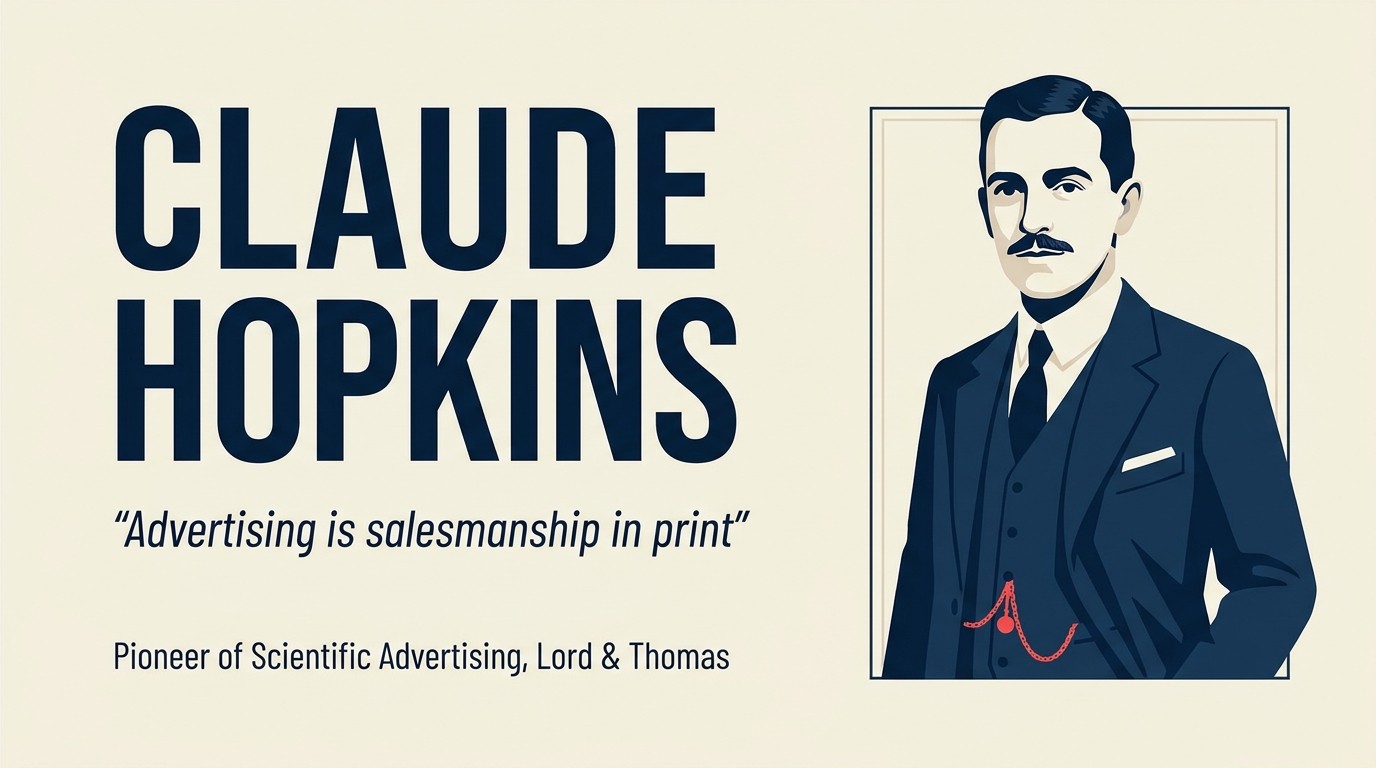
Claude Hopkins's leadership style was test-first: never scale a claim, headline, or budget decision on gut feel, prove it on a small measurable audience first. As Lord & Thomas's star copywriter, he ran split tests with coupon codes, scaled the winners, and killed the losers. That discipline (measure everything, trust data over opinion) became the foundation of modern growth marketing.
Key Facts
- Claude C. Hopkins (1866–1932): legendary American advertising pioneer and the most influential direct-response copywriter of the early 20th century.
- Authored two foundational texts: Scientific Advertising (1923) and My Life in Advertising (1927), both still required reading at modern agencies a century later.
- Lord & Thomas star copywriter: invented the Pepsodent toothpaste campaign and popularized coupon advertising as a measurement mechanism for ad effectiveness.
- Earned $185,000+ annually in the 1920s, equivalent to roughly $3M–$5M today, making him the highest-paid copywriter in the world at his peak.
- Principles still referenced across direct-response marketing, conversion rate optimization, and modern growth teams: test before scale, reason-why copy, preemptive claim, specificity over superlatives.
Claude Hopkins published Scientific Advertising in 1923, a 112-page book that David Ogilvy called "the most important book ever written about advertising" and required reading for every member of his agency. Hopkins made a single argument: every dollar spent in advertising should be measured, and every claim should be tested on a small scale before you roll it out nationally.
That was a radical idea in 1923, when most advertising was about prestige and imagery, not response rates. Hopkins ran his Pepsodent toothpaste campaign by testing two versions of copy in a single city, measured coupon redemption rates, picked the winner, and scaled. He ran the Schlitz beer campaign by visiting the brewery, describing the bottle-cleaning process in his copy, and measuring whether the specific claim moved market share before committing to national rollout.
He invented A/B testing 90 years before the term existed. The conversion optimization discipline he built is now a $1.8 billion software industry, Optimizely, VWO, Google Optimize, and hundreds of others. Hopkins's influence on modern advertising was acknowledged by David Ogilvy, who called Scientific Advertising the most important book ever written about advertising and required every member of his agency to read it. But the fundamental logic hasn't changed. David Ogilvy called Scientific Advertising the most important book ever written about advertising and required his staff to read it, the direct-response discipline Hopkins codified at Lord & Thomas became the foundation Ogilvy built his creative philosophy on top of. And where Hopkins proved claims through coupon redemption, Neil Patel does the same through search traffic and conversion data, the measurement methodology is a century newer, but the test-before-you-scale instinct is identical. Test before you scale. Measure what works. Kill what doesn't. And never trust a claim that hasn't been proven on a small audience first.
Leadership Style Breakdown
| Style | Weight | How it showed up |
|---|---|---|
| Data-Driven Direct Marketer | 65% | Hopkins treated advertising as an investment, not an expense. Every campaign he ran included a measurement mechanism, typically a coupon with a code tied to a specific ad in a specific publication. That tracking let him compare which headlines pulled better, which offers generated more response, and which publications delivered the most qualified buyers at the lowest cost. Before joining Lord & Thomas in 1907, he'd spent years in direct-mail advertising where the measurement discipline was standard. He brought it to mass-market consumer advertising and found the industry had been operating without it. |
| Systematic Tester | 35% | Hopkins's testing discipline wasn't just about measuring campaigns after they ran. It was about designing campaigns to generate useful data from the start. He'd test two versions of the same offer in two cities simultaneously, use different coupon codes to track response, and make the scaling decision based on the data rather than his intuition about which version was better. He was skeptical of his own aesthetic preferences and said so explicitly: the only opinion about copy that matters is the buyer's, and the only way to know the buyer's opinion is to test it. |
That combination, rigorous measurement plus systematic pre-testing, was essentially the scientific method applied to persuasion. Hopkins didn't use that language, but that's what he was doing: hypothesis, experiment, measurement, conclusion, scale.
Key Leadership Traits
| Trait | Rating | What it means in practice |
|---|---|---|
| Measurement-first thinking (no untested claims) | Exceptional | Hopkins refused to scale any campaign without first running a small test that proved the copy worked. This sounds obvious in 2026, when every digital marketing tool comes with A/B testing built in. In 1923, it was unusual enough that he wrote a book about why it was necessary. His measurement discipline meant he had data to defend every major copy decision, not creative opinions, not agency intuitions, but redemption rates and response numbers. That's a specific kind of professional authority: the authority that comes from having tested everything you're recommending. |
| Consumer psychology obsession (understand prospect self-interest) | Very High | Hopkins believed that the only way to write effective copy was to understand what the prospect wanted more than you wanted to sell them something. His process was to identify the single strongest motivation a buyer had for the purchase and write directly to that motivation. He didn't try to create desire, he tried to find desire that already existed and connect it to the product. For Pepsodent, the motivation was vanity about teeth appearance. For Schlitz, it was pride about beer quality. For Palmolive, it was the aspiration to preserve youthful beauty. He found the existing desire and gave it a product to attach to. |
| Offer specificity (concrete reasons beat abstract claims) | High | Hopkins hated vague advertising. He thought abstract claims like "the best," "the purest," or "the finest" meant nothing because every competitor made the same claims and no one believed any of them. His copy favored specific, verifiable, concrete claims: how many times the bottles were cleaned, how many taste tests the product had passed, how long the manufacturing process took. Specificity conveyed honesty. When you give a specific number, buyers believe it more than when you give a superlative. That instinct is still correct, and most B2B marketing still ignores it. |
| Coupon-and-response tracking as accountability system | High | Hopkins made coupon redemption rates the accountability mechanism for every claim he made about copy effectiveness. If he said version A would outperform version B, he'd set up a test that would prove it. If a publication claimed it delivered a high-quality audience, he'd put a coupon in the ad and see whether the response rate validated the claim. This accountability system made him trustworthy to clients in a way that most advertising agents weren't. He could point to data that showed which ads paid for themselves and which didn't. That transparency was rare enough in 1910 that it was itself a competitive advantage. |
The Hopkins Test-First Doctrine (Scientific Advertising)
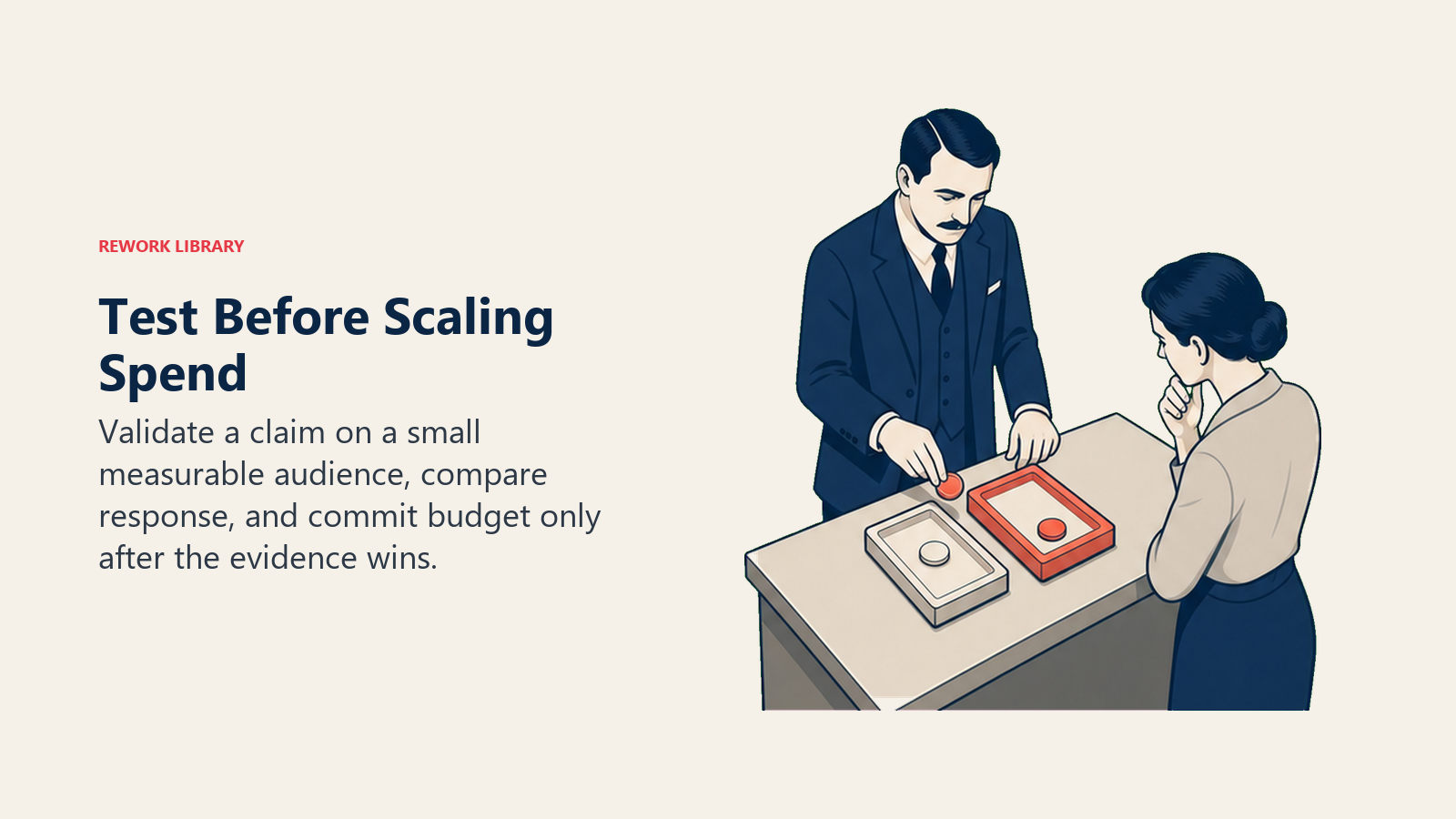
The Hopkins Test-First Doctrine is the principle that no advertising claim, headline, or offer should be rolled out at scale until it has been validated on a small, measurable audience using a trackable response mechanism. Hopkins codified it in Scientific Advertising (1923) as the conviction that advertising is not an art of persuasion but a science of measurement, hypotheses are copy variations, experiments are split-market tests, and conclusions are coupon redemption rates. The doctrine reverses the standard commitment sequence: test first, then commit budget, not the other way around.
The 3 Frameworks That Defined Claude Hopkins
1. Scientific Method Applied to Advertising
Scientific Advertising's central argument is that advertising isn't an art, it's a science with predictable principles that can be tested and measured. Hopkins built his practice on the conviction that copy performance follows patterns consistent enough to generalize from, and that those patterns can be discovered through careful testing rather than through creative inspiration.
His testing methodology was simple by modern standards and radical by 1920s standards. Run two versions of a campaign in two comparable markets simultaneously. Use different coupons in each version so you can track response by source. After a few weeks, compare redemption rates. Scale the winner and kill the loser. If neither version performed well enough, redesign the offer and test again.
The principles he derived from this testing over 30 years still appear in modern conversion optimization literature. Eugene Schwartz later extended Hopkins's reason-why framework into a theory of desire, arguing in Breakthrough Advertising (1966) that mass desire already exists in the market and the copywriter's job is to channel it, not create it. And Al Ries took Hopkins's preemptive claim logic and turned it into a full positioning doctrine: the brand that claims a true attribute first owns it in the customer's mind, regardless of who actually built it best. Headlines that communicate a clear benefit outperform clever headlines. Specific offers outperform vague ones. Copy that addresses the reader's self-interest outperforms copy that talks about the brand. Free samples generate more trial than discounts. These principles weren't derived from theory, they were derived from thousands of coupon redemption measurements across hundreds of campaigns.
For operators, the scientific method framework is a mindset before it's a methodology. It requires accepting that your creative instincts are hypotheses to test, not conclusions to execute. Most marketing teams test, but they test after they've already committed to a campaign direction. Hopkins tested before commitment, he used small-scale tests to decide which direction to commit to. That sequence reversal is what makes the method useful.
2. Preemptive Claim Strategy
One of Hopkins's most replicable frameworks is the preemptive claim, a strategy of identifying an obvious product attribute that no competitor has bothered to publicize and claiming it exclusively before competitors realize it's worth claiming.
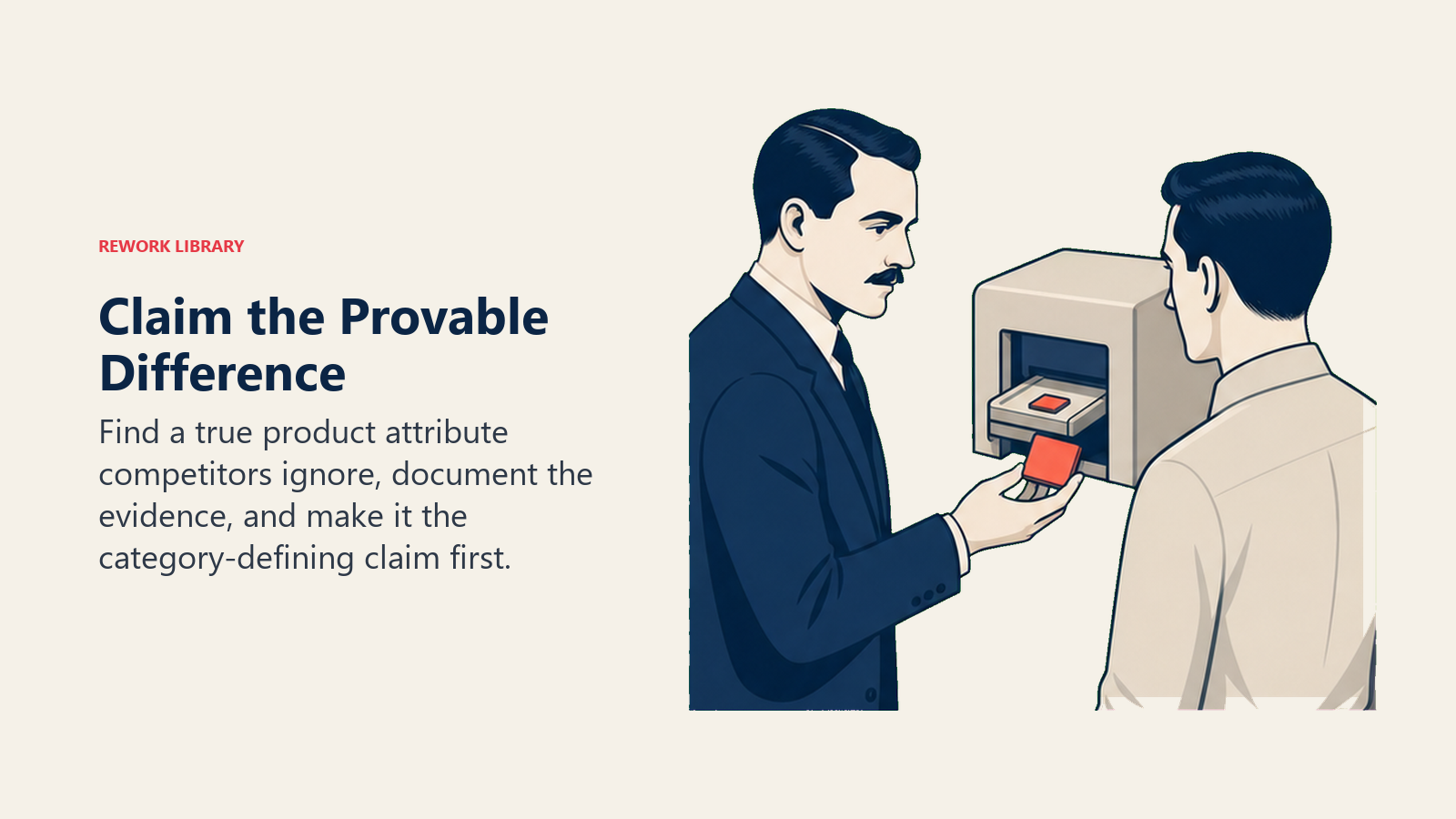
The Schlitz beer campaign is the canonical example. Hopkins visited the Schlitz brewery and learned about their bottle-cleaning process: every bottle was steam-cleaned multiple times before filling. He also learned that every other brewery did exactly the same thing. But no other brewery had told this story in their advertising.
Hopkins wrote copy for Schlitz that described the bottle-cleaning process in detail and implied that Schlitz had a unique commitment to purity that competitors lacked. They didn't. But Schlitz said it first, which made the claim theirs in the minds of buyers. Competitors couldn't then adopt the same claim without appearing to imitate Schlitz. Hopkins tripled Schlitz's market share with a claim that was completely true, completely unoriginal, and completely unclaimed until he made it.
The preemptive claim isn't about lying. It's about being the first to say a true thing that everyone in your industry could say but hasn't. In B2B SaaS, the equivalent is the security certification you were the first company in your category to publicize, the customer support response time you were the first to publish, or the integration depth you were the first to document clearly. Your competitors may have the same attribute. But if you said it first, clearly and specifically, it becomes yours in the buyer's mind.
For product leaders, the preemptive claim framework is a content and positioning audit: what does your product do that's genuinely valuable that you haven't clearly articulated in your marketing? Not features, most feature lists are already published. The underlying attributes that make those features trustworthy: the testing methodology behind your security model, the reason your data accuracy rate is higher than competitors, the specific engineering decision that enables the performance claim you make in demos.
3. Reason-Why Copy
Hopkins called his approach to copy construction "reason-why advertising." The premise is that buyers don't buy because of emotional appeals or brand prestige, they buy because they have a specific reason to. Your job as a copywriter is to give them that reason in a form that's specific enough to be believable and compelling enough to motivate action.
Reason-why copy has a specific structure. It starts with the reader's self-interest: what does this person want, and what are they afraid of? Then it identifies the most specific, credible claim the product can make that addresses that self-interest. Then it provides evidence for the claim: a specific number, a test result, a case study, a testimonial that's detailed enough to be distinguishable from generic praise.
Hopkins contrasted this with what he called "boastful" advertising, copy that makes superlative claims without evidence, that talks about the brand rather than the buyer, and that assumes desire rather than creating it by connecting a product attribute to an existing need.
The reason-why framework is still the best diagnostic for bad copy. When you look at marketing content and ask "why should someone who's never heard of us take the action this piece is asking them to take?", the answer is either a reason or a superlative. Reasons convert. Superlatives don't. Hopkins made this observation in 1923 and every conversion rate optimization test since has confirmed it.
For sales and marketing teams, the reason-why framework is a copy audit. Take your current landing pages, email sequences, and sales decks. For every claim you make, ask: is this a reason or a superlative? "Industry-leading reliability" is a superlative. "99.97% uptime over the past 12 months, verified by third-party monitoring" is a reason. Replace the superlatives with reasons wherever you have data to support them. The conversion lift is typically significant.
What Claude Hopkins Would Do in Your Role
If you're a CEO, Hopkins's most direct question is about your testing infrastructure. Most companies run campaigns and measure results. Hopkins ran tests and measured differences. Before committing your full marketing budget to any campaign direction, you should have data from a small-scale test that shows the approach works. That requires a testing infrastructure, the ability to run controlled experiments, track response rates, and make scaling decisions based on data rather than creative consensus. Hopkins would argue that the most important thing you can build in your marketing operation isn't creative capacity, it's measurement capacity.
If you're a COO, the Hopkins framework has a specific implication for how you evaluate marketing claims. Most marketing reports tell you what happened, impressions, clicks, conversions. Hopkins would want to know what the test showed: what did version A produce compared to version B, and why did the winner win? If your marketing team can't answer that question, you're not running a scientific advertising operation, you're running an opinion operation. The difference matters for budget allocation: money should go to the things the test proved work, not the things the team believes work.
If you're a product leader, Hopkins's preemptive claim framework applies directly to your launch strategy. Before you ship the next major feature, audit what true and specific things you can say about it that no competitor has said. Not "the fastest" or "the most powerful", those are superlatives. The specific performance number from your benchmark tests. The specific use case scenario where your approach outperforms the alternative. The specific engineering decision that makes the claim credible. Being first to say a true thing about your product category is worth more than being the company that built it, because memory is constructed from what was said, not what was built.
If you're in sales or marketing, Hopkins's most immediately applicable contribution is the preemptive claim audit for your current copy. Go through your website, your email sequences, and your sales deck with one question: what is the most specific true thing about this product that no competitor has publicly claimed? It exists in almost every company's product or process, and it's almost never in the marketing because someone assumed customers don't care about operational detail. Hopkins spent 30 years proving they do.
How Rework Applies Hopkins's Test-First Doctrine
Hopkins's doctrine, test-first marketing, salesmanship-in-print, reason-why copy, translates almost directly to modern B2B growth. The friction in 2026 isn't the idea, it's the instrumentation. Most B2B teams still commit budget to a campaign direction before any test data exists, because the tooling needed to compare two variants cleanly is scattered across an email platform, a landing-page builder, a CRM, and a BI dashboard nobody opens.
Rework collapses that stack. Campaign variants, lead capture, sequence outcomes, and pipeline conversion all sit in one analytics layer, so a marketer running a Hopkins-style split test can see which headline produced more qualified demos, not just more clicks, inside a single report. That's the measurement loop Hopkins built manually with coupon codes and ledger books, compressed into hours instead of months. The test-first doctrine becomes operational only when the instrumentation stops punishing you for running small experiments. Rework's goal is to make the smallest possible test the default starting point for every campaign.
Notable Quotes and Lessons Beyond the Boardroom
From Scientific Advertising: "The only purpose of advertising is to make sales. It is profitable or unprofitable according to its actual sales." That was a direct challenge to the advertising industry's tendency to evaluate campaigns on aesthetic quality, awards recognition, or brand metrics that couldn't be connected to revenue. Hopkins thought those evaluation criteria were ways of avoiding accountability, and he structured every engagement to eliminate them: if you can't measure the response rate, you don't know if the advertising is working.
From My Life in Advertising (1927): "I have learned to consider myself as a salesman, not as a writer. I am not trying to entertain people or to be clever or to build what is called a brand. I am trying to make sales to actual buyers." That self-description is the opposite of how most creative professionals think about their work, and it's the source of Hopkins's unusual effectiveness. Copy that prioritizes entertainment is enjoyable. Copy that prioritizes persuasion converts.
Hopkins died in 1932, having built an estate of over $3 million during the Depression era, roughly equivalent to $55 million today. He was the highest-paid copywriter in the world at his peak, earning $185,000 annually at Lord & Thomas, the equivalent of $5 million+ in today's dollars. That financial record was itself a form of proof: if reason-why copy and scientific testing didn't work at the level he claimed, clients wouldn't have paid those rates for 20 years.
Where This Style Breaks
Hopkins's direct-response model optimizes for the immediate conversion, not the brand. Run reason-why copy for 10 years and you've trained your audience to buy only on price and proof, you've created a transactional relationship that's vulnerable to any competitor who can match the specific claims you've built your offer around. His coupon-redemption testing worked in a world with months-long feedback cycles; modern A/B testing can achieve statistical significance in 48 hours, which means the test-and-scale discipline is table stakes, not advantage. And his consumer psychology framework was written for mass-market products with broad appeal, it doesn't map cleanly to enterprise B2B sales where 7 stakeholders each have different reason-why thresholds and the decision cycle runs 6 to 18 months.
For related reading, see David Ogilvy Leadership Style, Al Ries Leadership Style, Ann Handley Leadership Style, Philip Kotler Leadership Style, and Gary Vaynerchuk Leadership Style.

On this page
- Key Facts
- Leadership Style Breakdown
- Key Leadership Traits
- The Hopkins Test-First Doctrine (Scientific Advertising)
- The 3 Frameworks That Defined Claude Hopkins
- 1. Scientific Method Applied to Advertising
- 2. Preemptive Claim Strategy
- 3. Reason-Why Copy
- What Claude Hopkins Would Do in Your Role
- How Rework Applies Hopkins's Test-First Doctrine
- Notable Quotes and Lessons Beyond the Boardroom
- Where This Style Breaks