Andrew Ng Leadership Style: Democratizing AI Through Teaching
Turn this article into takeaways for your work.


Each assistant summarizes the article only for you and suggests best practices for your work.
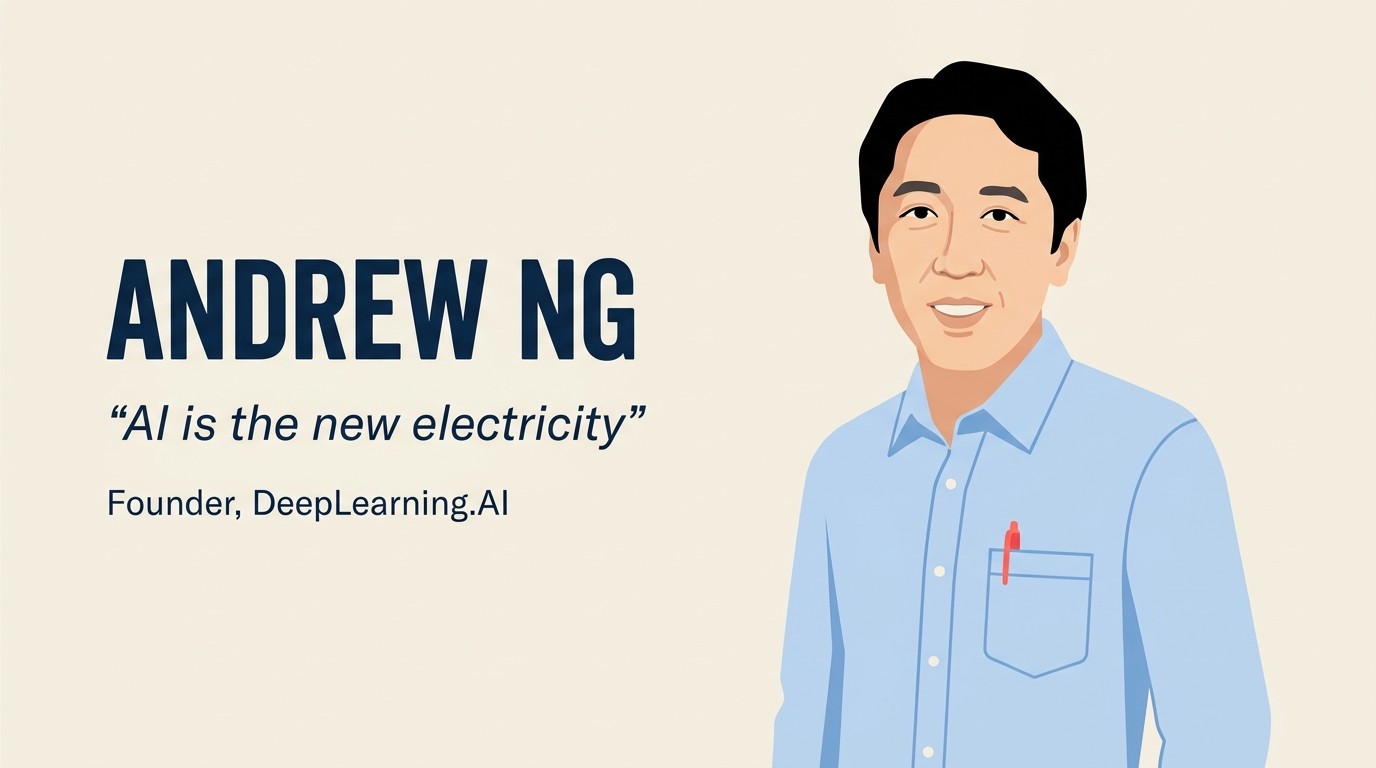
Key Facts: Andrew Ng co-founded Google Brain in 2011 and served as its director during its formative years. He was Chief Scientist at Baidu from 2014 to 2017, leading its AI research group. He co-founded Coursera with Daphne Koller in 2012, and his Stanford machine learning course reached more than 100,000 students in its first offering. He founded DeepLearning.AI in 2017 and launched Landing AI the same year. His 2017 declaration that "AI is the new electricity" became the defining frame for enterprise AI adoption.
The AI-as-Electricity Doctrine (The Democratization of AI)
The AI-as-Electricity Doctrine holds that AI, like electricity a century ago, is general-purpose infrastructure that will transform every industry, but only once enough practitioners know how to wire it in. The binding constraint isn't model capability; it's the skills gap between what AI can do and what operators can deploy. Leadership, under this doctrine, means teaching at scale so the technology reaches its full diffusion curve.
Before ChatGPT made AI mainstream, Andrew Ng had already spent a decade arguing that the biggest obstacle to AI adoption wasn't the technology. It was the skills gap. His "AI is the new electricity" thesis, first articulated in a 2017 Stanford talk, wasn't just a metaphor. It was a leadership program. Electricity didn't transform industries until engineers knew how to wire buildings. AI wouldn't transform companies until operators knew how to build pipelines.
That thesis shaped every major decision Ng made: building Google Brain as a skunkworks inside a search giant, co-founding Coursera to put an ML course in front of millions of people, and launching deeplearning.ai when he concluded the world still didn't have enough AI practitioners.
He was right about the problem. His methods for solving it, teaching at scale, platform building, patient institution-making, are less flashy than the moves that get covered in TechCrunch. But they're worth understanding precisely because they're replicable.
Leadership Style Breakdown
| Style | Weight | How it showed up |
|---|---|---|
| Teacher-Leader | 65% | Ng's default move in any new situation is to teach. At Stanford, he turned his ML lecture notes into the most-enrolled MOOC in history. At Google, he proposed building Brain not as a product group but as a research team that would teach Google's engineers what deep learning could do. At deeplearning.ai, the entire business model is structured education. The teaching instinct isn't a personality quirk, it's a deliberate scaling strategy. |
| Platform Builder | 35% | When Ng wants to amplify impact, he builds infrastructure rather than doing the work himself. Coursera is a platform. The AI Fund (his VC vehicle) is a platform for building AI companies in specific verticals. The Batch newsletter is a platform for distributing his weekly read on what matters in AI. He consistently chooses to build the channel rather than fill it himself. |
The ratio explains his influence and his limits. Teaching-first leadership scales slowly, you're limited by how many people can absorb what you're sharing. But it compounds. The 6.8 million people who took Ng's original Coursera ML course didn't just learn the material. They became practitioners who spread the approach inside their organizations. That compounding effect distinguishes Ng's model from contemporaries like Fei-Fei Li, who built infrastructure (ImageNet, HAI) for the field, and Demis Hassabis, who concentrated resources on a small, elite research team. Three different theories of how to move AI forward, and they've all proven partly right.
Key Leadership Traits
| Trait | Rating | What it means in practice |
|---|---|---|
| Clarity in complexity | Exceptional | Ng's signature skill is making hard technical concepts legible to people who aren't deep specialists. His Stanford ML course was the first to make neural networks accessible to engineers who weren't PhD researchers. That clarity isn't dumbing down, it's compression. He finds the minimal viable explanation and builds from there. |
| Scalable generosity | Very High | Ng publishes openly, teaches for free, and shares his frameworks before they're "finished." His AI transformation playbook, a guide for how enterprises should build internal AI capability, was released publicly rather than sold as consulting. That generosity is strategic: it positions him as the credible teacher for the next person who needs the material. |
| Network orchestration | High | The Coursera founding, the Baidu appointment, and the Google Brain build all required assembling teams of people who weren't natural collaborators. Ng is unusually good at identifying who holds relevant capability and structuring incentives that get them in the same room. He doesn't just have a large network, he activates it. |
| Consistent long-term narrative | High | From 2011 to today, Ng's public message hasn't changed much: AI matters, the skills gap is the real bottleneck, and teaching is the lever. That consistency makes him easy to follow. People who encountered him in 2012 know exactly where to find him and what he'll say. In a field that changes weekly, that coherence is a competitive advantage. |
The 3 Decisions That Defined Ng
1. Founding Google Brain (2011) as a Skunkworks Inside a Giant
In 2011, Ng proposed something that most people inside a large company would have quietly shelved: a dedicated deep learning research group inside Google, run separately from the main engineering organization, with the explicit goal of exploring whether neural networks could transform Google's products.
Google Brain wasn't a sure bet. Deep learning was still considered a niche research area. Ng had to convince Jeff Dean and other Google leaders that the investment was worth making when the commercial payoff wasn't obvious. He succeeded, and the results were significant, Brain's research contributed to improvements in Google's speech recognition, image search, and eventually the attention mechanisms that fed into the Transformer architecture.
The lesson from Brain isn't that skunkworks always work. It's that Ng understood the difference between innovation that requires a new organization and innovation that can happen inside an existing one. Deep learning needed protection from Google's product priorities in order to mature. He created that protection. If you're trying to build a genuinely new capability inside a large organization, the organizational design decision is as important as the technical one.
2. Co-founding Coursera (2012) to Democratize ML Education
Ng's Stanford ML course had 100,000 students before Coursera launched. That number told him something: the demand for rigorous technical education vastly exceeded the supply of institutions that could deliver it. Universities couldn't scale. Corporate training was shallow. The gap was real.
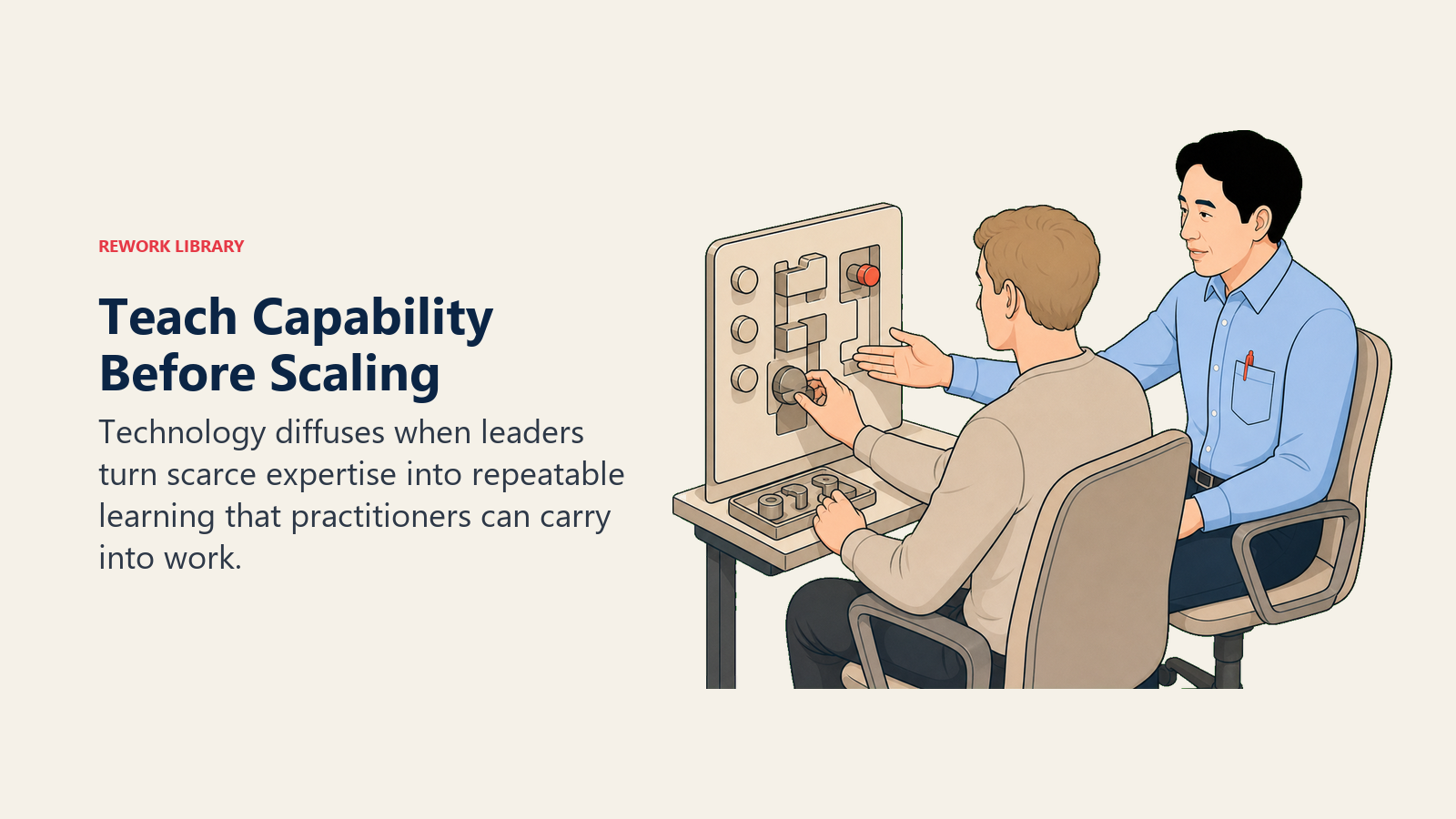
Coursera, co-founded with Daphne Koller in 2012, was an attempt to solve that gap at a platform level rather than a course level. By the end of the first year, Coursera had 1 million enrolled students across 16 university partners. Ng's own ML course eventually reached more than 5 million learners.
But the decision also reveals a tension in Ng's approach. Coursera was built on the thesis that access to education is the binding constraint. But completion rates for MOOCs are consistently low, often under 10% for free courses. The people who most need the skills aren't always the ones finishing. Ng's response has been to iterate on the product, add specializations, and build credentialed learning paths that feel more like degrees. Whether that fully resolves the access problem is still an open question.
3. Launching deeplearning.ai (2017) to Fill the Post-ChatGPT Skills Gap Before It Existed
When Ng left Baidu in 2017, he could have taken a C-suite role at a major AI company. He didn't. He launched deeplearning.ai, a structured set of specializations on Coursera specifically focused on deep learning practice, not theory, not research, but the operational skills needed to build and deploy ML systems at work.
The timing looks prescient in retrospect. deeplearning.ai launched three years before the GPT-3 moment that made AI literacy a mainstream business requirement. Ng was filling a gap that most organizations didn't know they had yet.
The AI Fund, launched alongside deeplearning.ai, was a VC vehicle for building AI companies in specific verticals, manufacturing, healthcare, agriculture. Landing AI, one of its portfolio companies, focused on applying AI to industrial inspection problems. The thesis was that AI would be most impactful not in consumer applications but in domain-specific operational contexts.
That thesis hasn't produced a breakout company. Landing AI remains focused and niche. But the underlying logic, that AI deployment requires deep domain knowledge, not just model capability, is correct, and it's a more defensible position than most AI startups took in 2017.
What Ng Would Do in Your Role
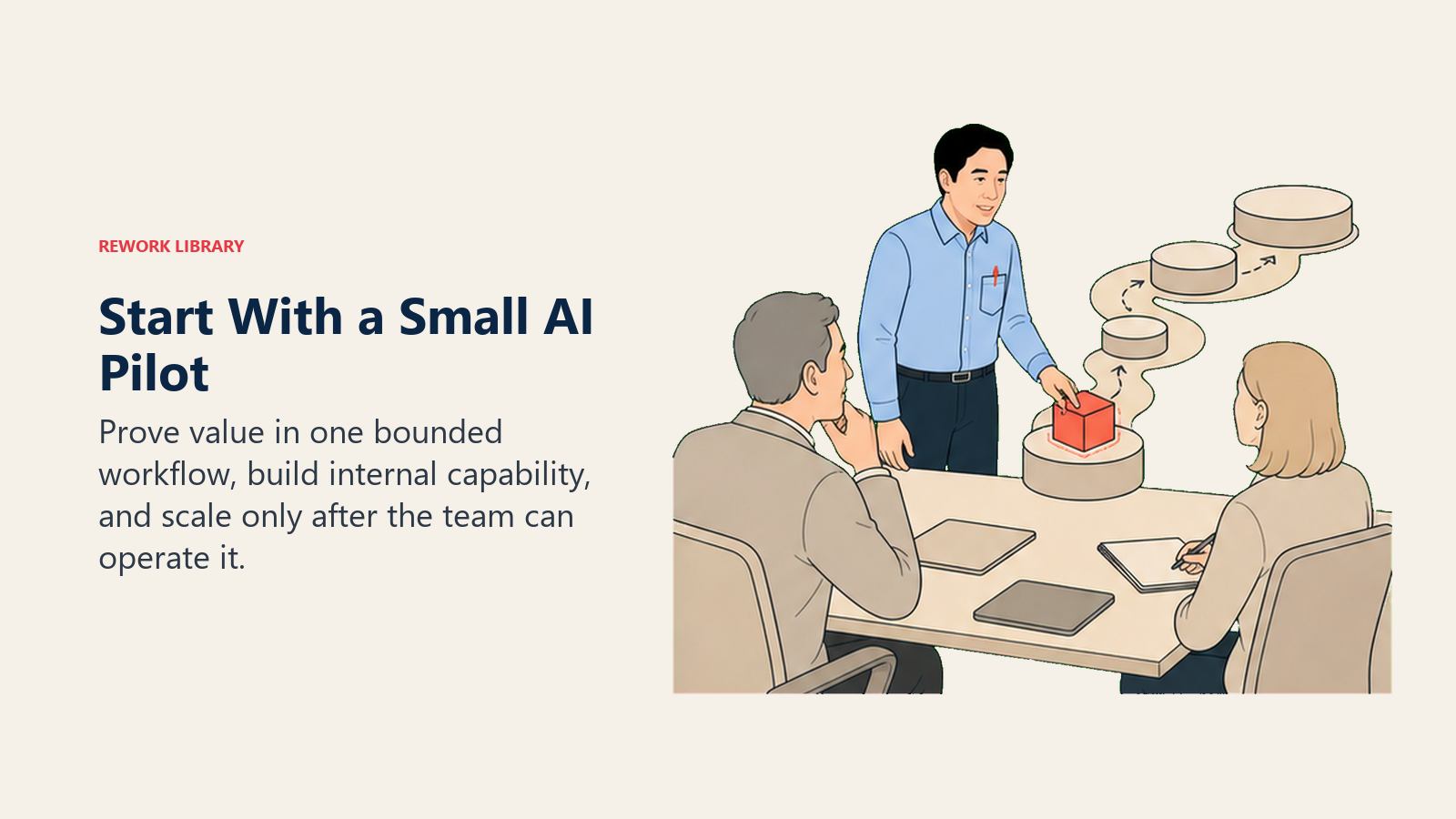
If you're a CEO, Ng's AI transformation playbook is worth reading in full (it's publicly available). The core sequence is: run a small AI pilot to prove value, build internal AI capability (don't just outsource it), scale successful pilots, and then align AI strategy with overall company strategy. The mistake most CEOs make is skipping step two. They run a pilot with an outside vendor, see results, and then wonder why they can't scale it. Without internal capability, every AI initiative stays vendor-dependent.
If you're a COO, the operational lesson from Ng is about skills inventory. He consistently argues that the constraint on AI adoption is talent, not technology. That means before you budget for tools, you should audit your team's current AI literacy. How many people on your operations team can actually evaluate a vendor's ML claims? How many can build a simple data pipeline? That number determines your real AI capacity, not your software spend.
If you're a product leader, Ng's platform-building instinct applies directly. When you solve a problem for one user, ask whether the solution could be packaged as a capability that solves the same problem for 10 users. The teaching habit, documenting what works and making it accessible, is how product teams create leverage. Most product orgs solve the same problem repeatedly because the solution never gets encoded.
If you're in sales or marketing, Ng's Coursera thesis has a direct application to content. He proved that genuine educational content builds larger, more loyal audiences than promotional content. The 5 million people who took his ML course trust his judgment on AI because he taught them something real. If your content strategy is built around product pitches rather than substantive education, you're leaving compounding audience trust on the table.
The Rework Take: Teaching-First Leadership Meets B2B SaaS AI Adoption
Ng's doctrine maps cleanly onto how AI features actually land inside B2B SaaS. The buyers who succeed with AI tools aren't the ones who buy the most sophisticated model, they're the ones whose teams understand what the model is doing. That's a teaching problem, not a procurement problem. Every rollout that skips the literacy step ends up with a shelfware dashboard.
Rework leans into this directly. Our AI features for CRM and work operations ship with in-product walkthroughs, transparent prompt logic, and exportable logs so teams can see what the AI proposed and why. We treat adoption as a curriculum, not a toggle. Managers get playbooks for introducing AI-assisted workflows; admins get visibility into which prompts actually moved deals. The goal isn't to hide the AI, it's to teach the operator to trust it, then extend it. That's Ng's model, applied to the part of the stack where decisions actually happen.
Notable Quotes & Lessons Beyond the Boardroom
"AI is the new electricity. Just as electricity transformed almost everything 100 years ago, today I actually have a hard time thinking of an industry that I don't think AI will transform in the next several years.", Andrew Ng, 2017 Stanford Business School talk.
That framing, AI as infrastructure rather than product, is still underused in how most companies think about adoption. Electricity wasn't a competitive advantage. It was a requirement. Every company that didn't build electrical systems into its operations eventually lost to ones that did. Ng's point is that AI is moving toward the same status, and the companies that treat it as an optional capability are making a strategic error.
In The Batch, his weekly AI newsletter, Ng has spent years pushing back on foundation model hype with a consistent argument: the real work is in deployment, not in building bigger models. In a 2024 issue, he wrote that the focus on billion-dollar foundation model races obscures the fact that most organizations still haven't deployed a single AI application that affects their core operations. That's a practitioner's critique from someone who's been inside both large AI research labs and operational AI businesses.
Where This Style Breaks
Teaching-first leadership creates organizations that move slower than product-first ones. When Ng was at Baidu from 2014 to 2017, the autonomous driving push was aggressive and the results were mixed. Consensus-building through education works well when there's time to build consensus. Competitive environments often don't have that time. Ng's instinct to teach before deploying can read as indecision to stakeholders who want execution speed. Sam Altman represents the opposite end of that spectrum, shipping into the market and iterating fast, which is why their public exchanges about AI timelines and deployment philosophy are worth following as a calibration exercise.
And the "AI for everyone" framing, while compelling, can undersell implementation complexity. Democratizing AI literacy is genuinely valuable. But it creates a population of practitioners who know the basics and underestimate what serious deployment actually requires, data pipelines, governance, change management, and the organizational will to act on model outputs. Ng's own frameworks acknowledge this. But the marketing of accessible AI sometimes papers over the difficulty.
Frequently Asked Questions about Andrew Ng's Leadership
Who is Andrew Ng?
Andrew Ng is a British-American computer scientist and entrepreneur best known for pioneering deep learning at scale. He co-founded Google Brain in 2011, served as Chief Scientist at Baidu from 2014 to 2017, co-founded Coursera in 2012, and founded DeepLearning.AI and Landing AI in 2017.
What did Andrew Ng mean by 'AI is the new electricity'?
In a 2017 Stanford Business School talk, Ng argued that AI, like electricity a century ago, is general-purpose infrastructure that will transform nearly every industry. The point isn't hype, it's that treating AI as optional is a strategic error, because eventually every competitor will have it wired in.
How did Coursera change education?
Coursera, which Ng co-founded with Stanford colleague Daphne Koller in 2012, pioneered the MOOC model by partnering with top universities to offer courses online at scale. Ng's own machine learning course reached over 100,000 learners in its first Stanford run and millions more on Coursera, proving rigorous technical education could scale beyond campus limits.
What is DeepLearning.AI?
DeepLearning.AI is the education company Ng founded in 2017 to train practitioners in applied deep learning. It produces structured specializations on Coursera, the widely-read weekly newsletter The Batch, and short courses on topics like generative AI, targeting working engineers rather than academic researchers.
What is Ng's philosophy on AI development?
Ng consistently argues the binding constraint on AI impact is the skills gap, not model capability. He emphasizes practical deployment over model-size races, domain-specific applications over general-purpose hype, and building internal capability over vendor dependence, a practitioner's view shaped by running both research labs and operational AI businesses.
What can CEOs learn from Andrew Ng?
Ng's AI transformation playbook, publicly available, prescribes a four-step sequence: run a small pilot to prove value, build internal AI capability rather than only outsourcing, scale successful pilots, then align AI strategy with company strategy. The most common mistake CEOs make is skipping step two and staying permanently vendor-dependent.
For more on AI leadership and building technical organizations, see Yann LeCun Leadership Style, Sam Altman Leadership Style, and AI Workforce Transformation.

On this page
- The AI-as-Electricity Doctrine (The Democratization of AI)
- Leadership Style Breakdown
- Key Leadership Traits
- The 3 Decisions That Defined Ng
- 1. Founding Google Brain (2011) as a Skunkworks Inside a Giant
- 2. Co-founding Coursera (2012) to Democratize ML Education
- 3. Launching deeplearning.ai (2017) to Fill the Post-ChatGPT Skills Gap Before It Existed
- What Ng Would Do in Your Role
- The Rework Take: Teaching-First Leadership Meets B2B SaaS AI Adoption
- Notable Quotes & Lessons Beyond the Boardroom
- Where This Style Breaks