What is Shadow AI?
Turn this article into takeaways for your work.


Each assistant summarizes the article only for you and suggests best practices for your work.
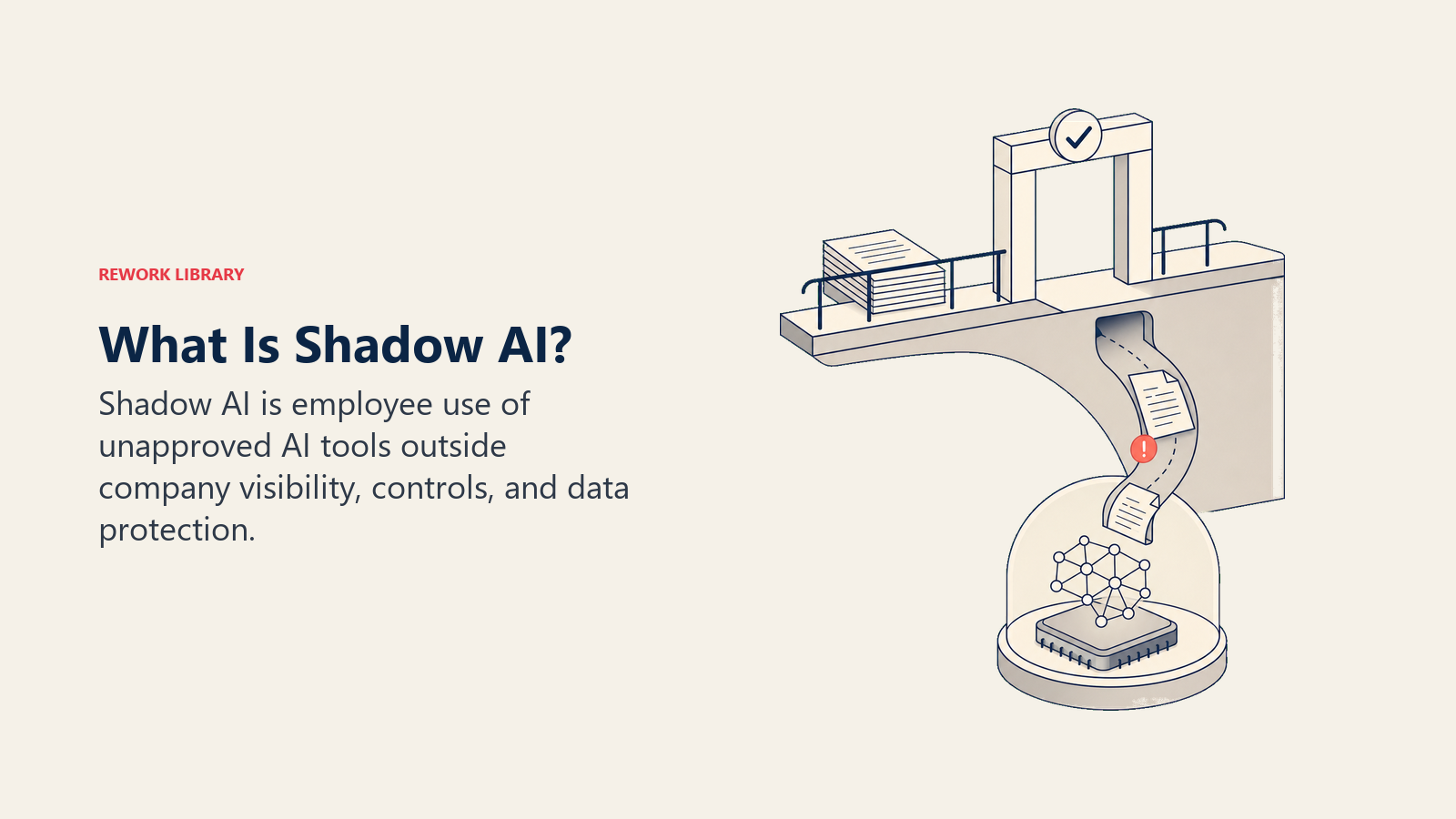
Shadow AI is employee use of AI tools, like ChatGPT, Gemini, or Copilot, that IT and security teams haven't approved, tracked, or secured. It happens on personal accounts, browser extensions, and unauthorized integrations, often just to get work done faster. The tools work fine. The risk is that nobody in the company can see it happening.
A sales rep pastes a contract into a free chatbot to summarize it. A finance analyst uploads a spreadsheet of customer data to get formulas written faster. A marketer drafts a campaign brief using a personal AI account because the company hasn't issued one yet. None of these people think they're doing anything wrong. Most of them are just trying to hit a deadline.
That's shadow AI in a sentence: well-intentioned employees routing company data through tools nobody in security or IT signed off on.
Shadow AI Is Shadow IT's Sequel, and It's Worse
Shadow IT is a familiar problem. Employees sign up for a project management app, a file-sharing tool, or a chat platform without going through procurement, because the approved option is slow or clunky. IT eventually finds out, usually after a data export shows up somewhere it shouldn't.
Shadow AI follows the same pattern, but it moves faster and cuts deeper. Shadow IT tools mostly store data. Shadow AI tools read it, process it, and sometimes retain it to improve their own models. A file sitting in an unauthorized cloud folder is a visibility gap. The same file pasted into a public AI chatbot may have already left the building for good, depending on that tool's data retention terms.
The barrier to entry is also lower. Signing up for unsanctioned SaaS software used to require a credit card and a login. Signing up for generative AI requires an email address and thirty seconds, and most of the popular tools are free. There's no procurement step to catch it.
Why Shadow AI Is Exploding Right Now
Three forces are pushing shadow AI adoption faster than most security teams can track it.
First, consumer AI tools are genuinely useful and genuinely free. An employee doesn't need budget approval to open a browser tab. Second, official company AI rollouts are slow. Legal review, vendor security assessments, and procurement cycles can take months, while a competitor's chatbot is one click away. Third, employees are under real pressure to move faster, and AI is the fastest lever available.
Microsoft's 2024 Work Trend Index put a number on how widespread this already is: 78% of employees who use AI at work are bringing their own AI tools, a practice Microsoft calls BYOAI, and that figure climbs to 80% at small and midsize companies where formal AI programs are rarer. In other words, most AI use inside the average company isn't coming from an approved rollout. It's coming from individual employees making their own call.
That gap between what leadership has sanctioned and what employees are actually doing is exactly where shadow AI lives. Deloitte's 2026 State of AI in the Enterprise survey found sanctioned AI tool access grew from under 40% to about 60% of the workforce in a single year, a real improvement, but one that still leaves roughly 4 in 10 employees without an approved tool of their own, and a reason to keep reaching for whatever's free.
Key Facts: Shadow AI by the Numbers
- 78% of employees who use AI at work bring their own AI tools, unsanctioned by their employer, according to Microsoft's 2024 Work Trend Index. Source
- One in five organizations (20%) reported a data breach linked to shadow AI, adding an average of $670,000 in extra breach costs, according to IBM's 2025 Cost of a Data Breach Report. Source
- More than 40% of enterprises will suffer a security or compliance incident tied to unauthorized shadow AI by 2030, Gartner predicts. Source
The Real Risks of Shadow AI
Shadow AI isn't a compliance technicality. It's an active source of data loss, regulatory exposure, and security incidents, and the risk shows up in a few distinct ways.
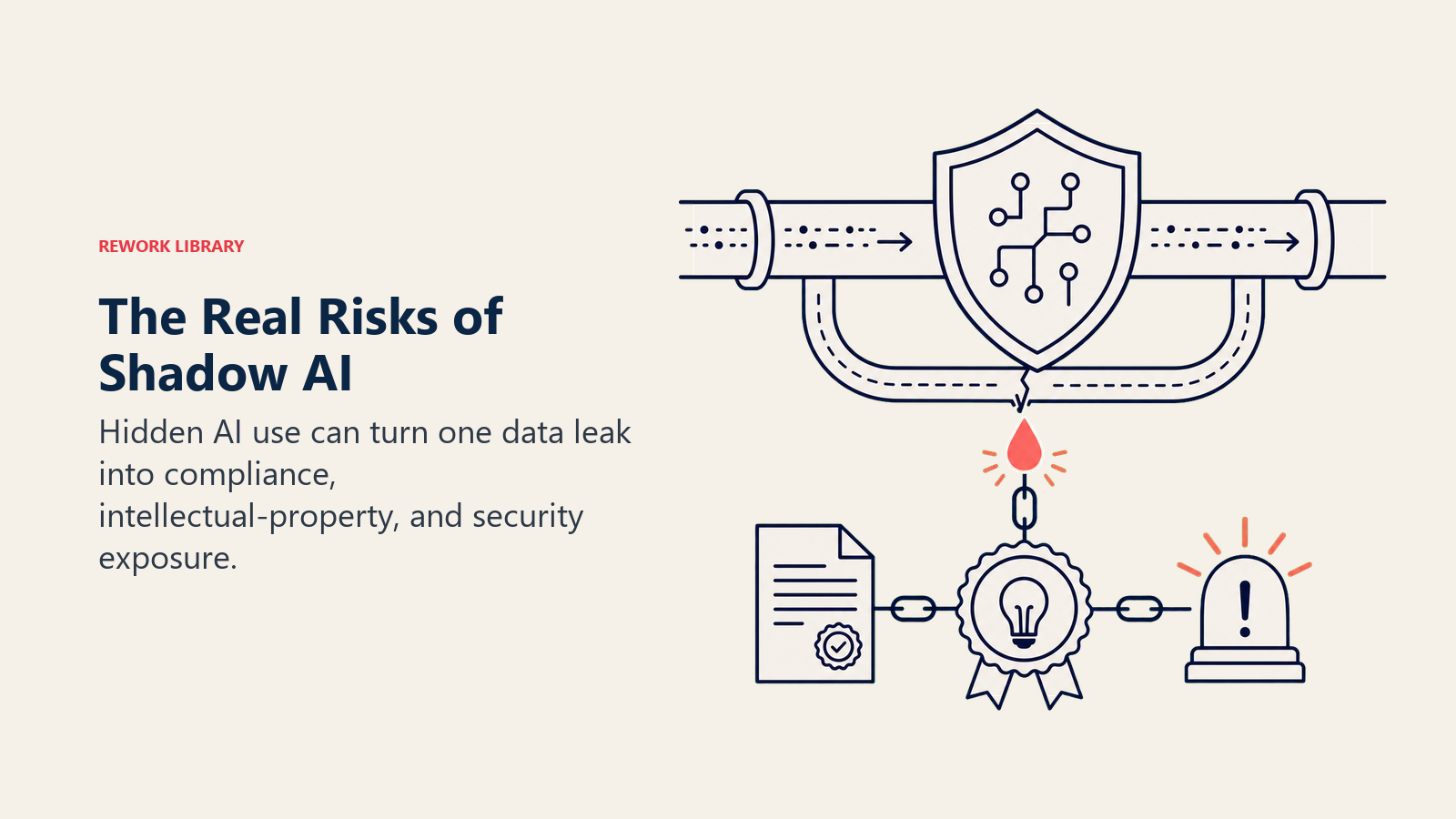
Data leakage. Once company data enters a public AI tool, the organization loses control over where it goes. Cyberhaven's research on real-world AI usage found that the volume of corporate data workers pasted into AI tools jumped 485% between March 2023 and March 2024, and that 27.4% of that data was classified as sensitive, up from 10.7% a year earlier. Most of that flowed through personal accounts with none of the data protection terms an enterprise license would include.
Compliance violations. Regulations like GDPR and the EU AI Act put specific requirements on how personal and regulated data gets processed. An employee pasting customer records into an unvetted AI tool can trigger a violation the company doesn't even know happened until an audit or a breach notification forces the issue. This is why AI governance programs increasingly treat shadow AI as a named risk category, not an edge case.
Intellectual property exposure. Source code, unreleased product plans, pricing models, and draft contracts are exactly the kind of content employees paste into AI tools to save time. Once that content leaves the company's controlled environment, there's no way to guarantee it stays confidential, and some AI tools' terms of service explicitly allow using submitted content to improve their models.
Security gaps. Shadow AI tools sit outside the access controls, logging, and monitoring that protect sanctioned systems. IBM's 2025 Cost of a Data Breach Report found that breaches involving shadow AI were more likely to expose sensitive information: 65% of shadow-AI-linked breaches compromised customer personal data, compared to 53% across breaches generally. The same report found only 37% of organizations had a policy in place to manage AI use or detect shadow AI at all.
Each of these risks compounds the others. A data leak becomes a compliance violation. A compliance violation becomes a security incident with a public disclosure requirement. None of it shows up on a dashboard until it's already happened, because by definition, shadow AI is invisible to the systems built to catch problems early.
How Organizations Detect Shadow AI
You can't govern what you can't see, so detection comes first. A few methods work well together.
Network and browser monitoring. Security teams can track which AI domains employees are visiting and how much data is flowing to them, using the same category of tools already deployed for data loss prevention (DLP). This surfaces usage patterns without needing employees to self-report anything.
Expense and SaaS spend audits. Paid AI subscriptions often show up on expense reports or corporate cards before anyone in IT knows the tool exists. A regular audit of SaaS spend catches these subscriptions early.
Employee surveys and amnesty programs. Asking employees directly, with no penalty attached, about which AI tools they actually use tends to surface a far more accurate picture than any technical scan alone. People are more candid when they're not worried about getting written up for admitting it.
Log analysis on approved AI platforms. Comparing sanctioned tool usage against expected department-level adoption highlights the gap. If a department shows minimal usage of the approved tool but productivity metrics suggest heavy AI reliance, that gap is worth investigating.
Detection tells you the scope of the problem. It doesn't fix it. That takes governance.
How Organizations Govern Shadow AI
The instinct to simply ban AI tools rarely works. Employees who are blocked from using AI for legitimate productivity gains tend to find workarounds, which pushes shadow AI further underground rather than eliminating it. Effective governance replaces prohibition with a clear, fast path to sanctioned use.
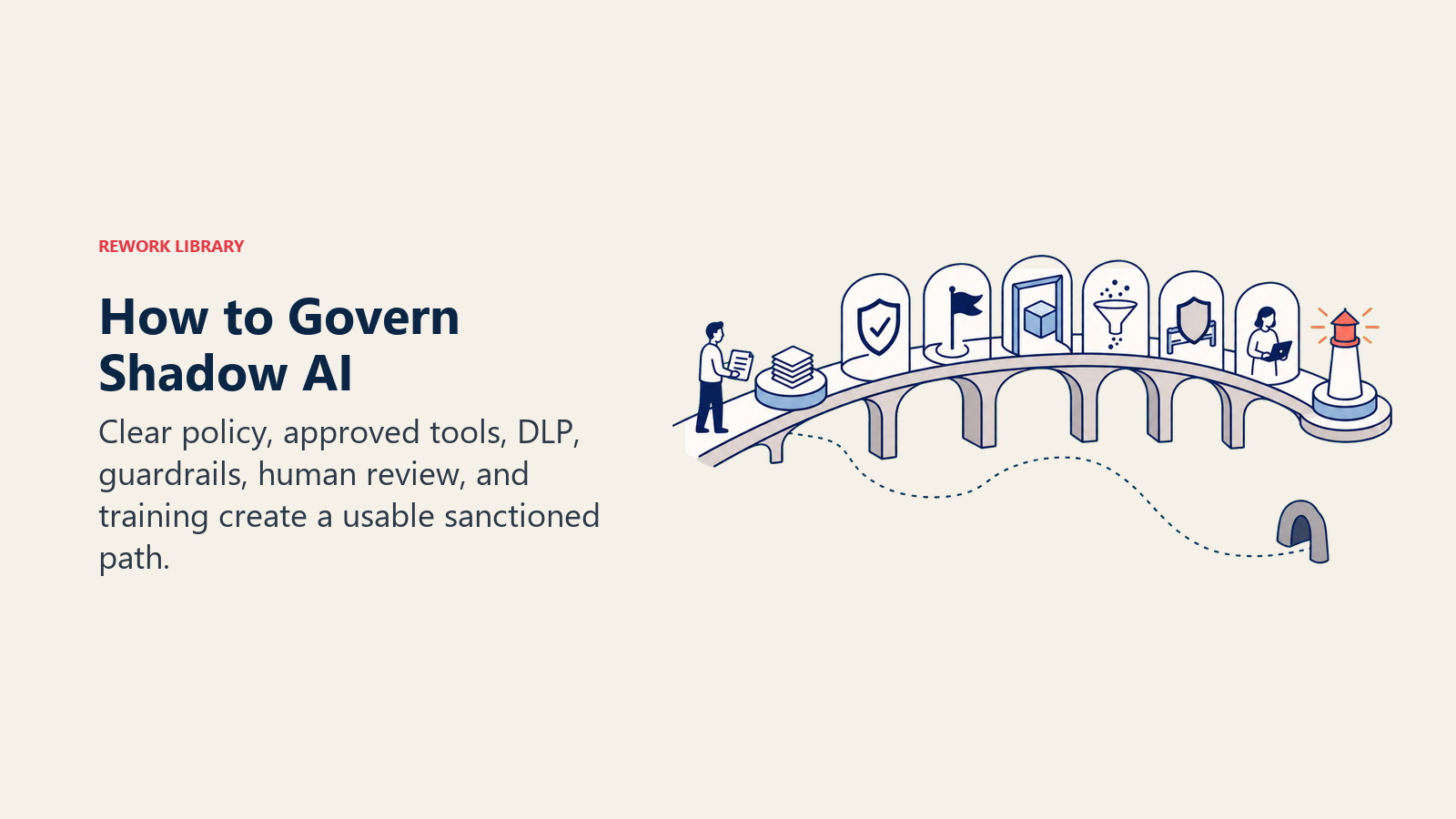
Write an explicit AI usage policy. Employees need a written answer to "what am I allowed to use, and for what." Vague guidance gets ignored. A specific policy covering approved tools, prohibited data types, and escalation paths gives people a real answer instead of a guess.
Offer a real approved alternative. A policy that says "don't use AI" without providing a sanctioned tool just guarantees shadow AI keeps growing. Give employees an enterprise-grade AI option with the data protections a free consumer account doesn't have, and adoption of the sanctioned path goes up dramatically.
Deploy DLP controls on AI traffic. Data loss prevention tools configured to flag sensitive data (customer records, source code, financial figures) headed toward unauthorized AI domains catch leaks before they happen, not after.
Build guardrails into approved AI systems. Sanctioned AI tools should have technical controls limiting what data they can access and what they can do with it, reducing the damage even a mistake can cause.
Keep a human in the loop for sensitive decisions. Approved AI workflows that touch customer data, legal documents, or financial decisions should route through human review before anything ships, which also reduces the temptation to route those workflows around an approved system that feels too slow.
Train, don't just police. Most shadow AI use comes from people trying to do good work faster, not from bad actors. Training that explains the actual risk (not just the rule) tends to change behavior more effectively than enforcement alone.
None of this eliminates shadow AI overnight. But it closes the gap between what employees need and what the company has actually provided, which is where shadow AI grows in the first place.
Shadow AI vs Sanctioned AI
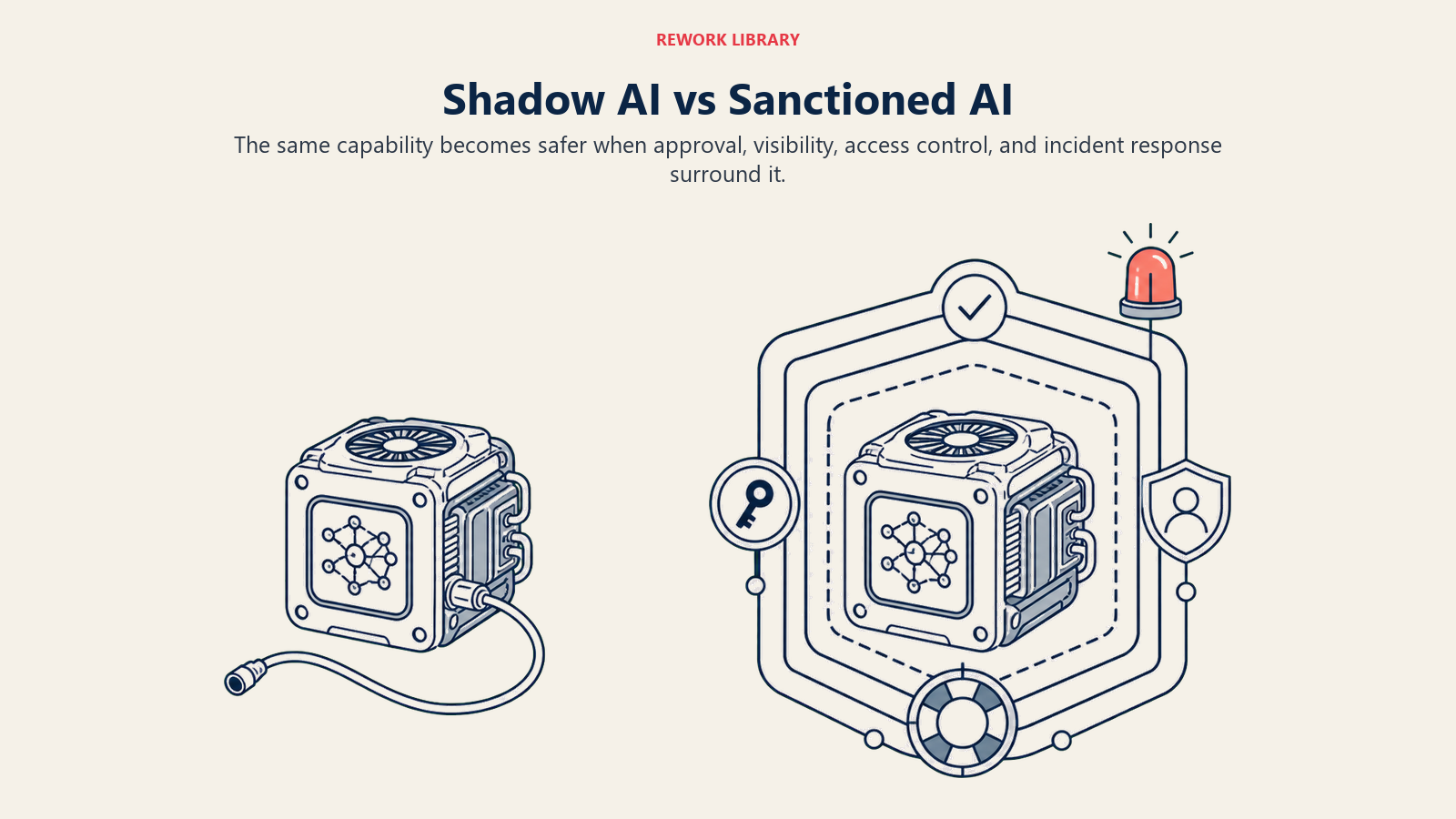
The practical difference is oversight: sanctioned AI puts approval, visibility, access control, and incident response around the same kinds of tools employees may otherwise use in the shadows.
| Shadow AI | Sanctioned AI | |
|---|---|---|
| Approval | None. Employee opts in independently | Reviewed and approved by IT/security |
| Data handling | Often a free consumer account with vague retention terms | Enterprise agreement with defined data protection terms |
| Visibility | Invisible to IT until discovered | Logged, monitored, and auditable |
| Access controls | None beyond the employee's own account | Role-based access tied to company identity systems |
| Compliance posture | Unknown, and often non-compliant with GDPR/EU AI Act by default | Reviewed against regulatory requirements before rollout |
| Incident response | No plan, because IT doesn't know it's in use | Covered under existing security and incident response processes |
| Cost accountability | Hidden in expense reports or unpaid free tiers | Tracked as a budgeted line item |
The tools on both sides of that table can be functionally identical. The difference is entirely about oversight, not capability, which is why banning specific AI products rarely solves the underlying problem.
Shadow AI questions tend to cluster around three themes: what counts as shadow AI, how risky it actually is, and what to do about it. Here are direct answers to the ones that come up most.
Frequently Asked Questions about Shadow AI
What is shadow AI in simple terms?
Shadow AI is any AI tool employees use for work without IT or security approval, tracking, or oversight. It includes free chatbots, personal AI subscriptions, unauthorized browser extensions, and AI features embedded in other unapproved software.
Is shadow AI the same thing as shadow IT?
They're related but not identical. Shadow IT covers any unauthorized software or service, from file storage to chat apps. Shadow AI is a subset focused specifically on AI tools, and it carries higher risk because AI tools actively process and can retain the data submitted to them, not just store it.
Why do employees use shadow AI if it's against policy?
Most employees aren't trying to break rules. They're trying to work faster, and sanctioned AI tools are often slower to roll out, harder to access, or simply don't exist yet at their company. When there's no fast, approved option, people default to whatever free tool is one click away.
What data is most at risk from shadow AI?
Customer personal information, financial figures, unreleased product details, source code, and contract terms are the most common categories employees paste into AI tools without realizing the exposure. Research from Cyberhaven found that more than a quarter of corporate data submitted to AI tools was classified as sensitive.
Can shadow AI cause a company to violate GDPR or the EU AI Act?
Yes. Both regulations impose specific requirements on how personal and regulated data is processed, and an employee submitting that data to an unvetted AI tool can trigger a violation the company isn't even aware of until an audit, complaint, or breach forces it into the open.
How common is shadow AI in the average company?
Very common. Multiple industry surveys put unsanctioned AI use at well over half of the workforce, and Gartner's 2025 survey of cybersecurity leaders found 69% suspected or had direct evidence that employees were using prohibited public generative AI tools.
What's the fastest way to reduce shadow AI risk?
Give employees a sanctioned AI tool that's actually easy to access, paired with a clear written policy on what's allowed. Banning AI outright without an approved alternative tends to push usage further underground rather than reducing it.
Does banning AI tools outright solve the problem?
Rarely. Employees who need AI to keep pace with their workload will generally find a way around a ban, which just removes the company's visibility into what's happening. A fast, approved alternative combined with monitoring works better than prohibition alone.
Who is responsible for managing shadow AI risk inside a company?
It's typically a shared responsibility between IT, security, legal, and department leaders, coordinated through the company's broader AI governance program. No single team can catch shadow AI alone, since it can originate in any department with access to a browser.
Learn More
- AI Governance - The organizational framework that formally addresses shadow AI as a named risk category
- AI Security - How unsanctioned AI tools expand an organization's attack surface
- AI Ethics - The principles that inform what responsible AI use looks like inside a company
- AI Audit Trail - Why logging and monitoring are impossible without visibility into which tools are in use
- API Security - Securing the integrations that often introduce AI features without a formal review
- AI Change Management - Rolling out sanctioned AI tools in a way employees actually adopt
- Large Language Models - The technology behind most of the consumer AI tools driving shadow AI adoption
External Resources
- Microsoft 2024 Work Trend Index: AI at Work Is Here - Source of the 78% BYOAI (bring your own AI) finding
- IBM Cost of a Data Breach Report 2025 - Data on shadow-AI-linked breach frequency and cost
- Gartner: Critical GenAI Blind Spots CIOs Must Address - Forecast on enterprises facing shadow AI security incidents by 2030
- Cyberhaven: Shadow AI and Employee AI Adoption Risk - Research on corporate data volume flowing into AI tools

Co-Founder, Rework.com