What is Meta AI?
Turn this article into takeaways for your work.


Each assistant summarizes the article only for you and suggests best practices for your work.
Meta AI is Meta's free AI assistant, built on its own Llama family of large language models, available inside WhatsApp, Instagram, Facebook, Messenger, and Ray-Ban Meta glasses, plus a standalone app. Unlike most rivals, Meta releases most Llama models as open weights developers can download and run, making Meta AI a product and a foundation others build on.
That single answer covers the basics, but "what is Meta AI" tends to come with follow-up questions: how it's different from Llama, who's building it, what it costs, and how it stacks up against ChatGPT and Gemini. This guide covers all of that: the assistant versus the model family, Meta Superintelligence Labs and the Scale AI investment behind it, where Meta AI actually shows up, 2026 pricing, the open-weight strategy and its licensing caveats, and where the product still falls short.
Meta AI the Assistant vs Llama the Model Family
It helps to separate two things Meta bundles under one name.
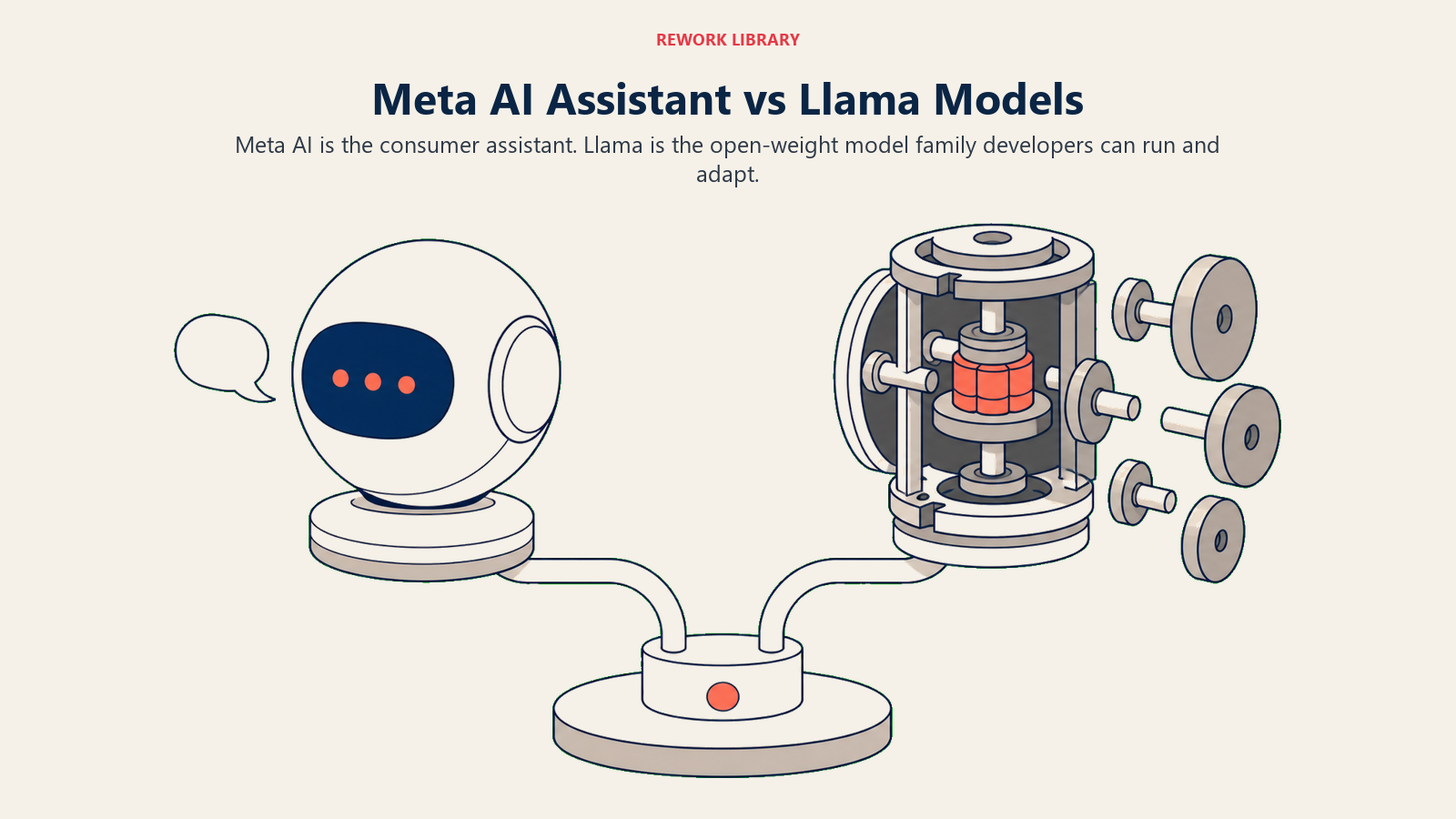
Llama is Meta's family of foundation models, the underlying technology. Llama models are released mostly as open weights, meaning Meta publishes the trained model files for anyone to download, run, and fine-tune, unlike closed models such as GPT or Gemini that are only accessible through an API or app. See foundation models and large language models for how this class of AI works generally.
Meta AI is the consumer-facing product built on top of Llama: the chat assistant you talk to inside WhatsApp, Instagram, Facebook, and Messenger, plus the standalone Meta AI app and meta.ai website. Most people who use Meta AI never touch Llama directly, the same way most Google Search users never think about the ranking models underneath it.
The distinction matters for business readers because it splits Meta's AI strategy into two audiences: consumers and creators who use the free assistant, and developers and enterprises who download and self-host Llama's open weights to build their own products.
Meta Superintelligence Labs and the Scale AI Investment
Meta's AI roadmap changed shape in mid-2025. In June 2025, Meta invested $14.3 billion for a 49% non-voting stake in Scale AI, the data-labeling and RLHF company, valuing Scale at roughly $29 billion. As part of the deal, Scale's founder and CEO, Alexandr Wang, left to become Meta's first-ever Chief AI Officer.
Days later, Mark Zuckerberg announced the creation of Meta Superintelligence Labs (MSL), the new organization Wang now leads alongside former GitHub CEO Nat Friedman, who serves as VP of product and applied research. MSL consolidated Meta's foundation-model teams, including the group working on Llama, under one roof, with a mandate to close the gap with OpenAI and Google DeepMind on frontier model capability. That reorganization is the direct reason Llama's release cadence and model sizes accelerated through late 2025 and into 2026, and it's why Scale AI now shows up in the same conversation as Meta AI even though most users never see the connection.
Where Meta AI Shows Up
Meta AI is built into the products Meta already has billions of users on, rather than asking people to adopt a new app:
- WhatsApp: chat with Meta AI directly or in group threads, the single largest source of Meta AI usage worldwide given WhatsApp's reach.
- Instagram and Facebook: search, caption help, and AI-generated replies inside the apps people already open daily.
- Messenger: the same assistant available in one-on-one and group chats.
- Standalone Meta AI app and meta.ai website: a dedicated chat interface similar to ChatGPT or Claude's own apps.
- Ray-Ban Meta and Oakley Meta smart glasses: voice-activated Meta AI answers questions, identifies what you're looking at, and translates language in real time, hands-free.
- Meta Horizon and mixed-reality devices: AI features extending into Meta's VR and MR headset lineup.
This distribution is Meta's core advantage: it doesn't need to win a new download, it just needs to turn on a feature inside apps people already use for hours a day.
Meta AI Pricing in 2026
Meta AI has been free since launch, and free access remains the default for the vast majority of users across WhatsApp, Instagram, Facebook, Messenger, and the standalone app.
That started to change in May 2026, when Meta began testing paid subscription tiers under the "Meta One" brand in a small set of markets (Singapore, Guatemala, and Bolivia at launch). The tiers add compute-intensive features rather than gating the core assistant:
| Plan | Price | What it adds |
|---|---|---|
| Meta AI (free) | $0 | Core assistant across WhatsApp, Instagram, Facebook, Messenger, standalone app, and glasses |
| Meta One Plus | $7.99/month | Higher usage limits on compute-intensive queries |
| Meta One Premium | $19.99/month | Deeper "thinking mode" reasoning, more image and video generation capacity |
For most business users, Meta AI functions as a free layer on top of tools they already pay for elsewhere, not a standalone subscription decision, though that could shift if Meta One expands beyond its initial test markets.
The Open-Weight Strategy: Why Meta Gives Llama Away
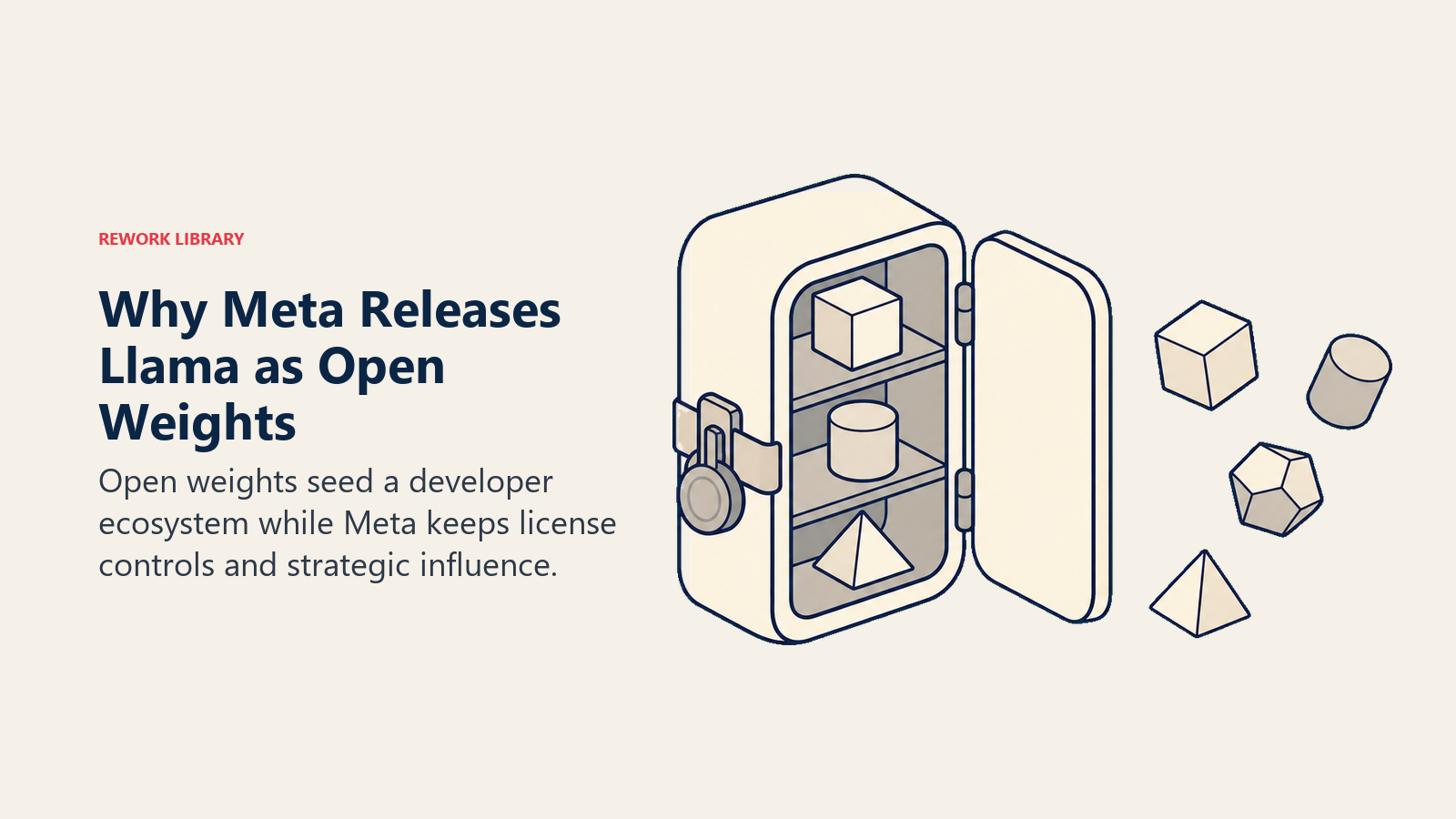
Meta's decision to release most Llama models as open weights, rather than keeping them closed like GPT or Gemini, is a deliberate business bet, not an act of charity. Zuckerberg has argued publicly that open models prevent any single company from building a walled garden around foundational AI, while also seeding an ecosystem of developers, cloud providers, and enterprises that build on Llama, which indirectly strengthens Meta's position and talent pipeline.
The strategy has scaled fast. Llama models passed 1 billion cumulative downloads by March 2025, then 1.2 billion by late April 2025, up from roughly 650 million downloads just three months earlier. Companies including Spotify, AT&T, and DoorDash have used Llama models in production. On April 8, 2026, Meta released Llama 5 as an open-weight model reported at roughly 600 billion parameters with a multi-million-token context window, while simultaneously keeping a separate model, Muse Spark, closed and available only through Meta's own app and a private API, splitting Meta's AI lineup into an open track and a closed track for the first time.
"Open weight" is not the same as "open source" in the strict software sense. Llama ships under Meta's own Llama Community License, which permits broad commercial and research use but restricts companies above roughly 700 million monthly active users from using Llama without a separate license from Meta, and it does not publish the training data or full training code the way a fully open-source project would. Businesses evaluating Llama for internal use should read the current license terms before deploying at scale, particularly around that large-company carve-out and any use-case restrictions tied to specific model versions. See open-weight and licensing considerations as part of any broader AI vendor review.
Why This Matters for Business Leaders
Meta AI itself is a consumer product most companies won't deploy directly, similar to how Scale AI sits upstream of the chatbots people actually use. But Llama, the model family underneath it, is genuinely relevant to teams evaluating AI vendor options: it's one of the few frontier-capability model families a company can download, self-host, and fine-tune on its own infrastructure instead of calling someone else's API. That matters for organizations with data residency requirements, cost-sensitive high-volume workloads, or a need to avoid vendor lock-in tied to a single foundation model provider.
At the same time, Meta AI's billion-plus user base makes it a useful signal of where consumer AI habits are heading, since it reaches people through apps they already use rather than a dedicated AI product they had to choose to install.
Meta AI vs ChatGPT vs Gemini
All three are AI assistants built on large language models, but they've settled into different roles by mid-2026.
| Meta AI (Meta) | ChatGPT (OpenAI) | Gemini (Google) | |
|---|---|---|---|
| Underlying models | Llama family (mostly open-weight) | GPT family (closed) | Gemini family (closed) |
| Distribution | WhatsApp, Instagram, Facebook, Messenger, standalone app, Ray-Ban Meta glasses | Standalone app, web, API, enterprise integrations | Search AI Mode, Workspace, Android, standalone app |
| Monthly active users | 1 billion-plus (crossed May 2025) | ~1.1 billion | ~662 million |
| Pricing | Free, with limited Meta One paid tiers in test markets ($7.99-$19.99/month) | Free tier plus paid plans | Free tier plus paid plans |
| Model access for developers | Open-weight downloads for most Llama versions, plus API | API only, closed weights | API only, closed weights |
| Best known for | Reach through existing social and messaging apps, open-weight models for self-hosting | Broadest consumer reach, agentic and coding tools | Deep integration with Google Search and Workspace |
Meta AI's edge is distribution: it's already installed on more phones than any dedicated AI app, because it rides inside apps people opened long before AI assistants existed. ChatGPT still leads on standalone AI-app usage and agentic depth. Gemini's advantage is Google's own product ecosystem. For a deeper side-by-side aimed at picking one for business use, see Claude vs ChatGPT vs Gemini and the broader best AI chatbots roundup.
Limitations of Meta AI
Meta AI is genuinely widely used, but it has real gaps businesses should weigh before relying on it:
- Consumer-first design: Meta AI is built for social and messaging contexts first, not enterprise workflows, so it lacks the admin controls, compliance certifications, and audit trails that dedicated business AI platforms offer.
- Licensing complexity for self-hosters: the open-weight Llama license restricts very large companies (roughly 700 million-plus monthly active users) and carries use-case conditions that differ by model version, so legal review is necessary before production deployment.
- Data and privacy context: because Meta AI runs inside apps like WhatsApp and Instagram, its data-handling questions are tied to Meta's broader advertising business model in ways that pure-play AI vendors don't carry.
- Hallucination risk: like every large language model, Meta AI can generate confident but incorrect answers, particularly on fast-moving or narrow topics.
- Uneven capability tier: Meta AI the assistant runs on whichever Llama version Meta has deployed to it at a given time, which can lag behind the very latest open-weight release available to developers directly.
Key Facts
- Meta AI crossed 1 billion monthly active users in May 2025, up from 700 million in March 2025, 500 million in October 2024, and 400 million in September 2024. CNBC, "Mark Zuckerberg says Meta AI has 1 billion monthly active users"
- Llama models passed 1 billion cumulative downloads by March 2025, up from roughly 650 million in December 2024, then reached 1.2 billion downloads by late April 2025 at Meta's first LlamaCon developer conference. Meta, "Celebrating 1 Billion Downloads of Llama"; TechCrunch, "Meta says its Llama AI models have been downloaded 1.2B times"
- Meta invested $14.3 billion for a 49% non-voting stake in Scale AI in June 2025, valuing Scale at roughly $29 billion, and Scale founder Alexandr Wang became Meta's Chief AI Officer leading the newly formed Meta Superintelligence Labs. Forbes, "Meta Invests $14 Billion In Scale AI To Strengthen Model Training"
- EssilorLuxottica sold more than 7 million Ray-Ban Meta AI smart glasses in 2025, more than triple its 2024 sales, bringing cumulative sales to roughly 9 million units since the glasses launched in October 2023. UploadVR, "Meta & EssilorLuxottica Sold 7 Million Smart Glasses In 2025"
- Meta released Llama 5 on April 8, 2026, an open-weight model reported at roughly 600 billion parameters with a multi-million-token context window, while keeping a separate model, Muse Spark, closed. CNBC, "Meta debuts new AI model, attempting to catch Google, OpenAI after spending billions"
- Meta began testing paid Meta One AI subscriptions in May 2026, starting at $7.99/month for Plus and $19.99/month for Premium in Singapore, Guatemala, and Bolivia, while keeping the core Meta AI assistant free elsewhere. CNBC, "Meta to start testing AI subscription services, with cheapest plan at $7.99 a month"
Related AI Concepts
- Foundation Models - The broader category of large pre-trained models Llama belongs to
- Large Language Models - The underlying technology behind Meta AI and Llama
- What is Scale AI? - The data-labeling company Meta invested $14.3 billion in, tying directly into Meta Superintelligence Labs
- What is Claude AI? - A closed-model competitor with a different approach to distribution and safety
- What is Google Gemini (Google's AI)? - Google's equivalent assistant and model family
- AI Vendor Evaluation - How to weigh open-weight versus closed AI models for business use
- Claude vs ChatGPT vs Gemini - A deeper side-by-side comparison for choosing an AI assistant
- Best AI Chatbots 2026 - A broader roundup including Meta AI and its competitors
External Resources
- Meta: Celebrating 1 Billion Downloads of Llama - Meta's own announcement of the Llama download milestone
- CNBC: Zuckerberg says Meta AI has 1 billion monthly active users - The user-growth milestone announcement
- Forbes: Meta Invests $14 Billion In Scale AI To Strengthen Model Training - Details on the Scale AI stake and Alexandr Wang's move to Meta
- UploadVR: Meta & EssilorLuxottica Sold 7 Million Smart Glasses In 2025 - Ray-Ban Meta AI glasses sales figures
- CNBC: Meta debuts new AI model, attempting to catch Google, OpenAI after spending billions - Llama 5 launch coverage
- CNBC: Meta to start testing AI subscription services - Meta One pricing test details
Part of the AI Terms Collection. Last updated: 2026-07-20

Co-Founder, Rework.com
On this page
- Meta AI the Assistant vs Llama the Model Family
- Meta Superintelligence Labs and the Scale AI Investment
- Where Meta AI Shows Up
- Meta AI Pricing in 2026
- The Open-Weight Strategy: Why Meta Gives Llama Away
- Why This Matters for Business Leaders
- Meta AI vs ChatGPT vs Gemini
- Limitations of Meta AI
- Key Facts
- Related AI Concepts
- External Resources