What is Manus AI?
Turn this article into takeaways for your work.


Each assistant summarizes the article only for you and suggests best practices for your work.
Manus AI is a general-purpose autonomous AI agent built by Butterfly Effect, the company behind the Monica browser extension. You give it a goal in plain language, and it plans the steps itself, opens a private cloud computer, browses the web, runs code, and hands back a finished report, spreadsheet, or working app.
For business leaders, Manus is one of the clearest public examples of what people mean when they say "agentic AI." Where a chatbot answers a question, Manus takes on the whole job: research a market, screen a stack of resumes, build a slide deck, or stand up a small web app, then check back with you once the work is done rather than after every step. It's also become a useful case study in how fast the agent category is moving, and how much scrutiny vendor claims in this space deserve.
Background: From Monica to Manus
Butterfly Effect launched its first product, Monica, in 2023: a browser extension that wrapped several commercial large language models behind one interface for translation, summarizing, and writing help. Manus, released in invitation-only beta on March 6, 2025, was the company's next step: a standalone agent rather than an assistant bolted onto a browser tab.
The launch was one of the loudest debuts the AI agent category has had. A demo video showing Manus autonomously screening job candidates and analyzing a stock portfolio passed a million views in under a day, and more than two million people joined the waitlist within a week (AIbase). Benchmark led a $75 million funding round that April at a roughly $500 million valuation, with Tencent and HSG (formerly Sequoia China) participating (TechCrunch). By December 2025, Manus said it had reached $100 million in annual recurring revenue and a $125 million total revenue run rate, about eight months after launch (Manus).
That same month, Meta agreed to acquire Butterfly Effect for roughly $2 billion, planning to fold Manus agents into Facebook, Instagram, and WhatsApp (TechCrunch). The deal didn't hold: China's National Development and Reform Commission opened a review in January 2026 and blocked the acquisition outright on April 27, 2026, and Meta severed operational ties by mid-June 2026 (CNBC). Manus continues to operate independently, now on its 1.6 model generation.
How Manus AI Works
Manus is built around the same perceive-plan-act loop that defines agentic AI generally, but with a distinctive execution layer: every task gets its own isolated cloud virtual machine, what Manus calls a sandbox.
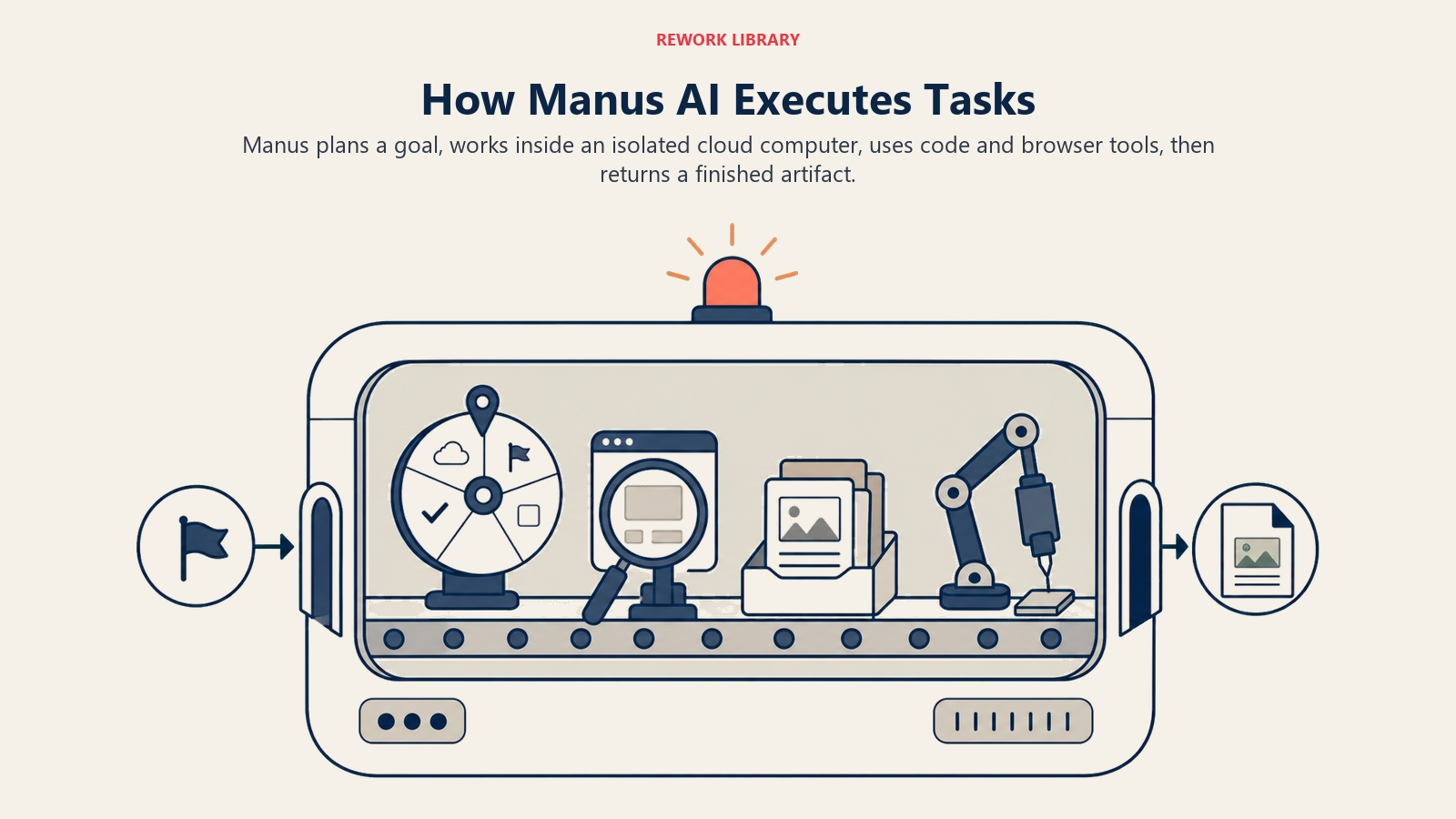
- You state a goal. "Research competitors in the mid-market CRM space and build me a comparison slide deck" is a typical prompt, not a single question.
- A planning module breaks the goal into steps. Rather than one model doing everything, Manus coordinates specialized components: a planner that sequences the work, a knowledge layer that applies domain conventions, and a data layer that pulls live information from APIs and the web.
- The agent gets a private computer. Each task spins up its own sandboxed cloud VM with a real file system, shell access, and a browser it can control directly, so it isn't limited to text generation. Under the hood, this runs on lightweight virtual machines similar to the Firecracker technology AWS built for serverless computing.
- It acts using code as the mechanism. Manus writes and executes actual Python, JavaScript, or Bash inside that sandbox to browse sites, extract data, manipulate files, and deploy small applications, an approach sometimes called "CodeAct." This is the same tool use pattern that underpins most modern agents, just applied through a full computing environment instead of a narrow set of API calls.
- You get a deliverable, not a transcript. Because everything happens in that sandbox, the end product is a real artifact: a hosted web page, a formatted spreadsheet, a written report, not just a chat reply describing what should exist.
Manus doesn't train its own foundation model. It orchestrates existing large language models (reporting from the time of launch pointed to models from Anthropic and Alibaba's Qwen family) and focuses its engineering on the planning, memory, and sandbox layers around them, the same AI orchestration problem every agent builder has to solve.
What Manus AI Can Do: Capabilities and Use Cases
Manus is marketed as general-purpose rather than tuned to one job function, which shows up in how varied its common use cases are:
- Research and analysis: Pull together a market landscape, summarize a stack of documents, or build a competitive comparison with sourced data rather than a generic summary.
- Document and deliverable creation: Generate formatted reports, spreadsheets with working formulas, and slide decks from a plain-language brief.
- Web app prototyping: Build and deploy a small working web app or landing page to a public URL without a developer writing the code by hand.
- Data-heavy busywork: Screen a batch of resumes against criteria, reconcile data across sources, or process spreadsheets that would otherwise eat an afternoon.
- Wide, parallelized research: Manus's "Wide Research" feature runs many sub-agents against a broad question in parallel and merges the results, useful for large-scope comparisons a single agent would work through sequentially.
These fall squarely into the agentic workflows category: multi-step, tool-using tasks with a real end deliverable, not single-turn Q&A.
Manus AI Pricing (July 2026)
Manus's own pricing page and help center describe three tiers, though as with most fast-moving AI products, the exact numbers are worth double-checking against manus.im/pricing before you buy:
| Plan | Price | Credits | Notes |
|---|---|---|---|
| Free | $0/month | 300 daily refresh credits | 1 concurrent task, access to the lighter "1.6 Lite" model in Agent Mode |
| Pro | From $20/month | 4,000 monthly credits, scaling to 8,000 and 40,000 credits at higher Pro price points ($40 and $200/month) | Full model access, higher concurrency, advanced research and deployment features |
| Team | From $20/seat/month | Shared team credit pool | 2-seat minimum, SSO, usage analytics, admin controls |
Every action, from a research pass to generating a slide, consumes credits, and unused monthly credits don't roll over (Manus Help Center). Annual billing knocks roughly 17% off the monthly rate on paid tiers. Because credit consumption scales with how long and complex a task is, budgeting for Manus looks more like budgeting for cloud compute than for a flat-fee software seat.
Who Manus AI Is For
Manus is built for individuals and small teams who need one-off or recurring research, analysis, and document work done end to end: analysts, consultants, marketers, founders, and operations staff who'd otherwise spend hours on research synthesis, report formatting, or basic prototyping. It's less suited to teams that need an agent embedded in a specific system of record with strict governance, audit trails, and role-based permissions baked in from day one.
A quick honest note on where this fits next to purpose-built work software: some teams get their first real exposure to agentic AI through general tools like Manus, then look for the same pattern inside the systems they already run. Rework, among others, now ships built-in AI copilots and agents scoped to specific jobs like lead follow-up and pipeline hygiene, which trades some of Manus's breadth for tighter integration with existing sales and operations data. Neither replaces the other; they solve different shapes of problem.
Manus AI vs ChatGPT Agent vs Other AI Agents
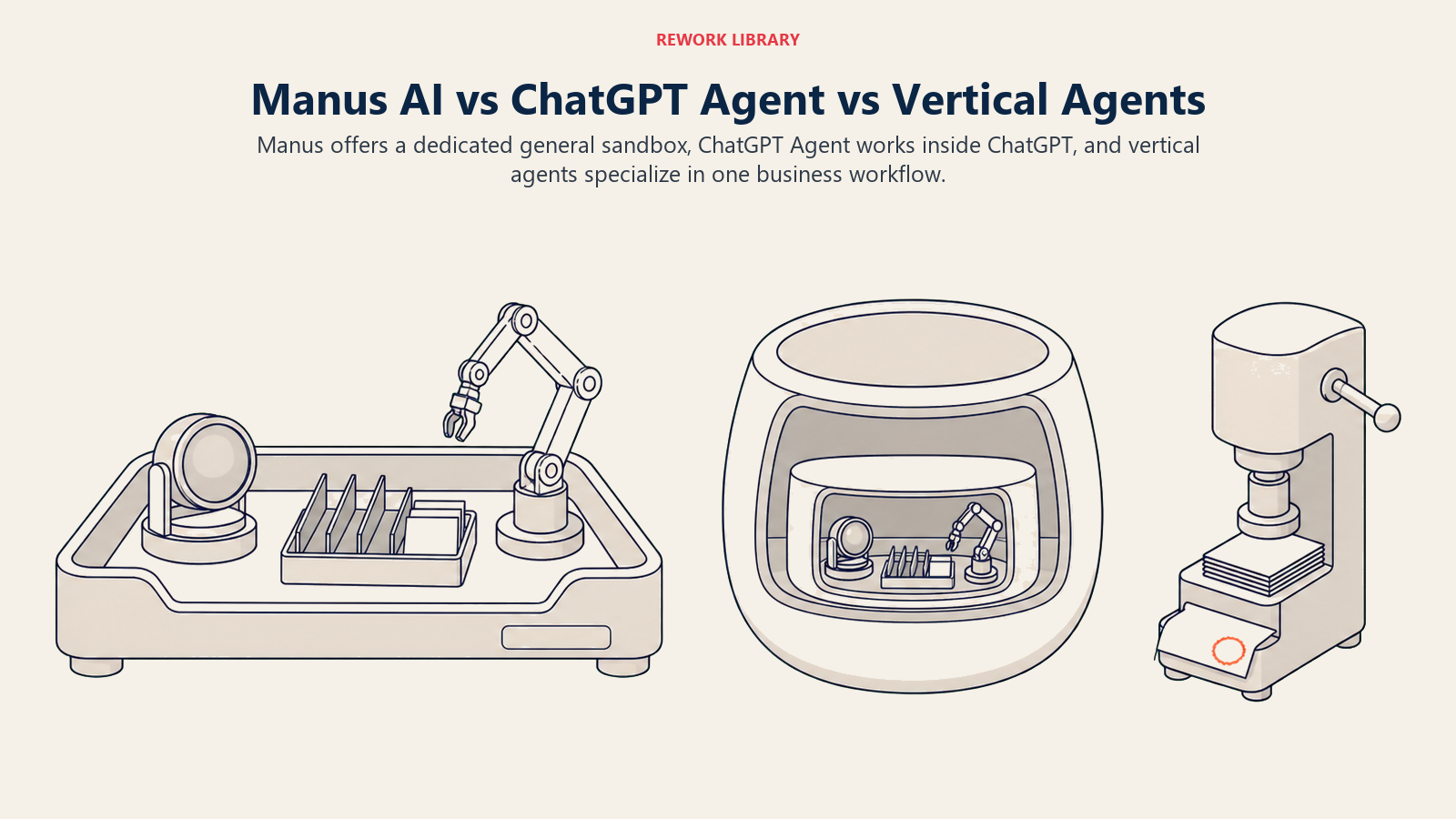
"AI agent" gets applied to a wide range of products with different levels of actual autonomy. Here's how Manus compares to the two other categories buyers run into most.
| Aspect | Manus AI | ChatGPT Agent (OpenAI) | Narrow/vertical AI agents |
|---|---|---|---|
| Scope | General-purpose, any research or deliverable task | General-purpose, built into ChatGPT's existing interface | Built for one job (sales follow-up, support triage, coding) |
| Execution environment | Dedicated cloud sandbox VM per task, full shell and browser | Its own virtual computer environment, blends prior Operator (browser) and Deep Research capabilities | Varies, usually scoped API access to one system |
| Output | Files, hosted web apps, formatted documents | Chat-embedded answers plus generated files and browser actions | A completed workflow step inside the parent product |
| Access model | Standalone product, invite or paid signup | Bundled into existing ChatGPT Plus/Pro/Team plans | Bundled into whatever SaaS platform ships it |
| Best fit | Cross-domain research and deliverable generation for individuals and small teams | Users already living inside ChatGPT who want agent tasks without switching tools | Teams that want autonomy inside one specific business process |
The practical read: Manus and ChatGPT's agent mode both aim at the same "give it a goal, get a finished result" experience, and the meaningful differences are less about raw capability and more about which ecosystem you're already in and how much you need a dedicated, general-purpose sandbox versus an agent that lives where your other AI work already happens. Narrow agents trade generality for depth in one workflow, which is often the safer starting point for regulated or high-stakes processes.
Limitations and Risks of Manus AI
Manus combines broad autonomy with a full sandbox, so its operating limits matter as much as its headline capabilities.
- Reliability drops on ambiguous goals. Manus performs best on well-scoped tasks with a clear "done" state. Vague or open-ended prompts increase the chance of a plausible-looking but wrong deliverable.
- Its headline benchmark numbers are self-reported. Manus's launch materials cited GAIA benchmark scores of 86.5% (Level 1), 70.1% (Level 2), and 57.7% (Level 3), ahead of the comparable OpenAI Deep Research scores at the time (arXiv). Those figures came from the vendor at launch and haven't been independently re-verified since; treat any agent's self-reported benchmark as a directional signal, not a guarantee.
- Cost is usage-based and can surprise you. Because credits scale with task length and complexity, a broad research request can burn through a monthly allotment faster than a flat-fee tool would.
- Corporate uncertainty. The blocked Meta acquisition and the resulting unwind leave open questions about long-term roadmap, data handling, and jurisdiction that are worth asking about directly before committing budget.
- Full sandbox access needs guardrails. An agent with shell access and browser control is powerful precisely because it isn't limited to a narrow API. That also means it needs the same human-in-the-loop review any high-autonomy system does before it touches anything sensitive.
- "Agentic" claims deserve scrutiny, including here. Gartner has warned that many products marketed as agents are really rebranded chatbots or automation, what the industry calls agent washing. Manus's sandbox-and-tool-use architecture clears that bar on the evidence available, but the same checklist you'd apply to any vendor's "agent" claim is worth applying here too.
Key Facts
- Manus launched in invitation-only beta on March 6, 2025, and its demo video passed 1 million views within 20 hours. TechCrunch
- More than 2 million people joined the Manus waitlist within seven days of launch. AIbase
- Benchmark led a $75 million funding round in April 2025 that valued Manus at roughly $500 million. TechCrunch
- Manus reported $100 million in annual recurring revenue and a $125 million total revenue run rate about eight months after launch, alongside 147 trillion tokens processed and 80 million sandbox virtual computers created. Manus
- Meta agreed to acquire Butterfly Effect (Manus's parent company) for roughly $2 billion in December 2025; China's NDRC blocked the deal on April 27, 2026, and Meta had unwound the relationship by mid-June 2026. CNBC
- At launch, Manus reported GAIA benchmark scores of 86.5% (Level 1), 70.1% (Level 2), and 57.7% (Level 3), figures that are self-reported and not independently re-verified since. arXiv
- Gartner predicts more than 40% of agentic AI projects will be canceled by the end of 2027 over cost, unclear value, or weak governance, a caution worth applying to any agent purchase, Manus included. Gartner
Frequently Asked Questions about Manus AI
What is Manus AI in simple terms?
Manus is a general-purpose AI agent that takes a goal you give it in plain language, plans the steps on its own, and carries them out in a private cloud computer, browsing the web and running code to produce a finished report, spreadsheet, or web app rather than just a chat answer.
Who built Manus AI?
Manus was built by Butterfly Effect, a company originally founded in China and now based in Singapore, and the same team behind the earlier Monica browser extension.
How does Manus AI actually work?
It runs a plan-then-act loop: a planning module breaks your goal into steps, then each task gets its own isolated cloud sandbox with shell access and a controllable browser where the agent writes and runs real code to complete the work.
How much does Manus AI cost?
Manus offers a free tier with 300 daily credits, Pro plans starting around $20 a month with higher tiers up to about $200 a month for more credits, and a Team plan from $20 per seat a month. Check manus.im/pricing directly, since AI pricing pages change often.
Is Manus AI the same as ChatGPT's agent mode?
No. They aim at a similar experience, give the system a goal and get a finished result, but Manus is a standalone product built around its own sandbox architecture, while ChatGPT's agent mode is built into OpenAI's existing ChatGPT interface and plans.
Is Manus AI safe to use for business tasks?
It can be, but any agent with shell and browser access needs guardrails and human review before it touches sensitive systems or data, the same human-in-the-loop practice any high-autonomy tool needs. Corporate uncertainty following the blocked Meta acquisition is also worth factoring into a vendor risk review.
What happened with Meta and Manus?
Meta agreed to acquire Manus's parent company for roughly $2 billion in December 2025, but Chinese regulators blocked the deal in April 2026, and Meta had unwound its involvement by mid-2026. Manus continues to operate independently.
What can I actually use Manus AI for?
Common uses include market and competitor research, building slide decks and reports from a brief, screening or reconciling data, and prototyping a small working web app, tasks that benefit from an agent doing the multi-step work rather than a person doing it manually.
Related AI Concepts
- What is Agentic AI? - The broader category Manus is a working example of
- AI Agents - How autonomous agents like Manus differ from chatbots
- What is Agent Washing? - The vendor-hype problem worth checking any "agentic" claim against
- What is Agentic RAG? - How agents combine retrieval with autonomous action
- Tool Use - The mechanism agents like Manus use to touch real systems
- AI Orchestration - Coordinating the planning, memory, and execution layers behind an agent
- Agentic Workflows - The multi-step business processes agents like Manus are built to handle
- AI Copilots - The collaborative, human-paced counterpart to autonomous agents
- Human-in-the-Loop - How businesses keep oversight over high-autonomy agents
- Best AI Agents 2026 - A broader roundup of agent products to compare against Manus
External Resources
- TechCrunch: Meta Just Bought Manus - Acquisition details and company background
- TechCrunch: Manus Series B Funding - Funding and valuation reporting
- CNBC: Meta Acquires Manus - Acquisition and regulatory outcome
- Manus: $100M ARR Update - Official revenue and usage milestones
- Manus Help Center: Membership Pricing - Current plan and credit details
- Gartner: Agentic AI Project Cancellations - Adoption forecasts and project failure risk
Part of the AI Terms Collection. Last updated: 2026-07-20

Co-Founder, Rework.com