What is Otter.ai?
Turn this article into takeaways for your work.


Each assistant summarizes the article only for you and suggests best practices for your work.
Otter.ai is an AI-powered meeting assistant and transcription tool that joins your Zoom, Microsoft Teams, and Google Meet calls to record, transcribe, and summarize conversations in real time. It turns spoken meetings into searchable text, automatically generates summaries and action items, and lets you ask questions about past meetings through AI Chat.
That's the short version. Below is a full breakdown of what Otter.ai actually does, who built it, what it costs as of July 2026, and how it compares to the two names people ask about most often in the same breath: Fireflies.ai and Fathom.
Company Background
Otter.ai was founded in 2016 as AISense by Sam Liang and Yun Fu, two engineers with a background in speech recognition and AI research. The company is headquartered in Mountain View, California, and Sam Liang serves as CEO. AISense raised a $3 million seed round later that year, followed by a $10 million Series A in 2017 and a $40 million Series B in February 2021, bringing total funding to roughly $80 million, according to Crunchbase.
The product started as a general-purpose voice note app before evolving into the meeting-focused assistant it is today. Otter for Teams launched in 2019, live meeting notes for Zoom arrived in 2020, and OtterPilot (the automated meeting-joining feature, since folded into what Otter now calls the Otter Meeting Agent) launched in February 2023. By its own April 2026 announcement, Otter reports more than 35 million users and over 1 billion meetings transcribed, and says 86% of Fortune 500 companies use the product in some form.
How Otter.ai Works
Otter's core workflow has four parts, and understanding them helps explain both what it's good at and where it falls short of purpose-built sales or coaching tools.
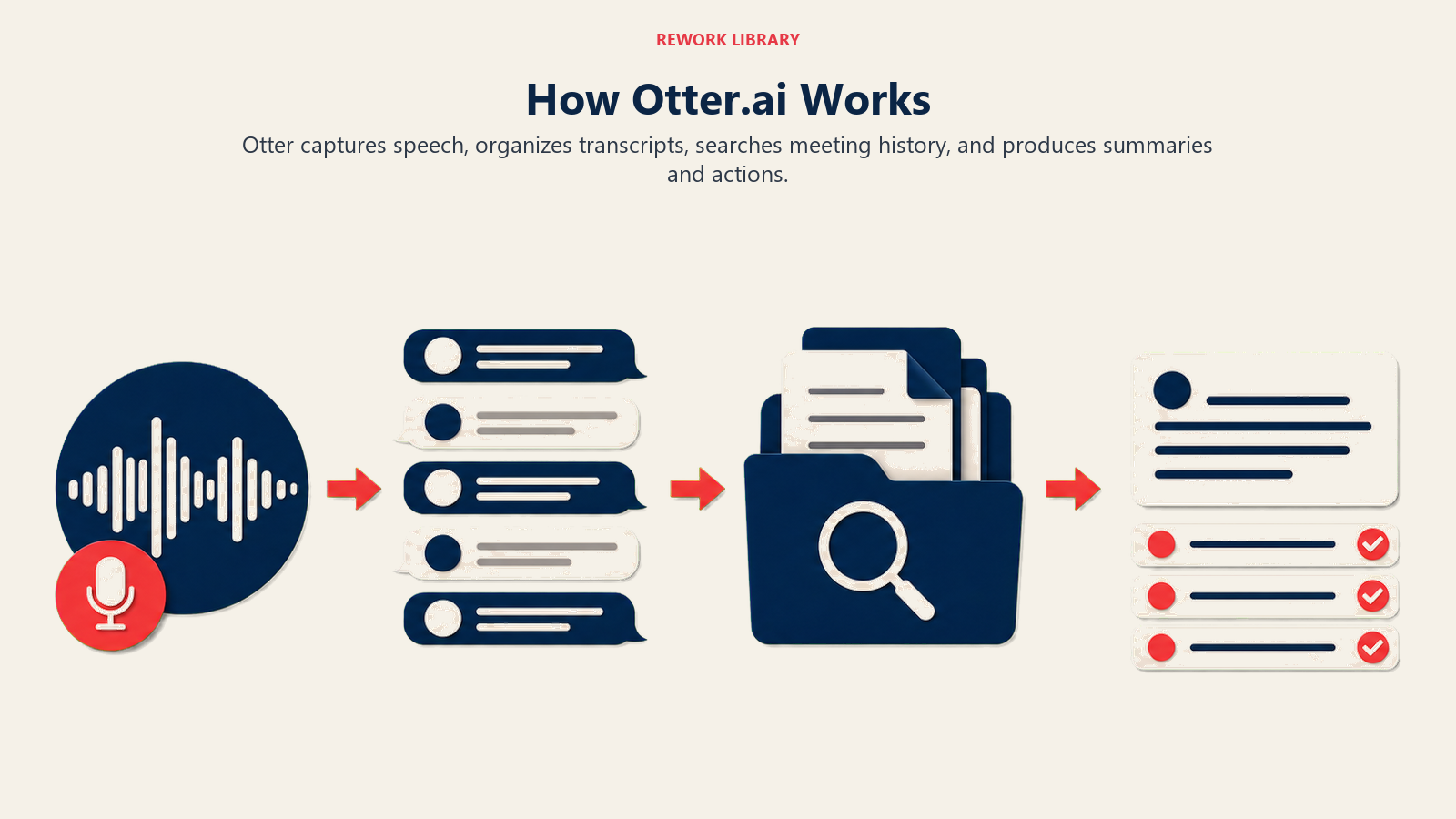
Live transcription. Otter transcribes speech to text as the conversation happens, not just after the meeting ends. It identifies individual speakers, supports multiple languages (English, French, Spanish, Japanese, German, and Mandarin among them), and produces a searchable transcript you can review, edit, or export once the call wraps.
Otter Meeting Agent. This is Otter's AI notetaker. It can join scheduled meetings automatically across Zoom, Microsoft Teams, and Google Meet through calendar integration, or you can run it through a desktop app that captures audio without a visible bot joining the call. Either way, it produces a transcript and post-meeting summary without anyone manually hitting record.
AI Chat. Otter AI Chat lets you query your own meeting history in natural language, pulling answers, follow-up drafts, and reports from across meetings you've recorded and apps you've connected. Instead of scrolling through a transcript to find what a specific person said last Tuesday, you ask the question directly.
Summaries and action items. After each meeting, Otter generates a written summary with key decisions and next steps, and it automatically pulls out action items and assigns them where speaker context makes ownership clear. Otter also connects to more than a dozen third-party tools, including Salesforce, HubSpot, Slack, Jira, Notion, and Dropbox, so meeting output can flow into the systems teams already use.
Key Facts
- Otter.ai reports more than 35 million users and over 1 billion meetings transcribed as of its April 2026 announcement, per Otter.ai's own company blog.
- Otter reports that 86% of Fortune 500 companies use the product in some capacity, per the same April 2026 announcement.
- Otter.ai was founded in 2016 as AISense and has raised approximately $80 million across a seed round, Series A, and Series B, per Crunchbase.
- The free Basic plan caps transcription at 300 minutes per month with a 30-minute limit per individual meeting, verified directly against Otter's pricing page in July 2026.
- A federal class-action lawsuit filed in California in August 2025 alleges Otter records private conversations without the consent of all participants and uses that audio to train its AI models, per NPR's reporting.
- The consolidated complaint against Otter was filed on December 5, 2025, and Otter's motion to dismiss was heard on May 20, 2026, with a ruling still pending per Recording Law's case summary.
- The average knowledge worker now spends 11.3 hours a week in meetings, 28% of the entire workweek, per Microsoft's 2026 Work Trend Index, a big part of why note-taking automation has become a mainstream category rather than a niche tool.
Otter.ai Pricing in July 2026
Prices below were checked directly against Otter's pricing page in July 2026. This category changes its pricing often, so confirm the current numbers before you buy.
| Plan | Price | Transcription Limit | Meeting Length Cap | Notable Features |
|---|---|---|---|---|
| Basic | Free | 300 min/month | 30 minutes | Zoom, Teams, and Meet support, AI Chat, speaker ID |
| Pro | $8.33/user/mo billed annually ($16.99 monthly) | 1,200 min/month | 90 minutes | Advanced templates, unlimited storage, Salesforce and HubSpot integrations |
| Business | $19.99/user/mo billed annually ($30 monthly) | Unlimited | 4 hours | Custom AI workflows, unlimited imports, 3 concurrent meetings, admin controls |
| Enterprise | Custom, contact sales | Unlimited | Unlimited | SSO/SCIM, HIPAA add-on, API and webhook access |
For a side-by-side view of how these tiers stack up against 13 other tools in the category, see our Best AI Meeting Assistants and Notetakers in 2026 roundup.
Who Otter.ai Is For
Otter is a general-purpose meeting documentation tool, not a sales-specific platform. That distinction matters when you're deciding whether it fits your team.
- Cross-functional teams that need searchable meeting history. Product, ops, HR, and leadership teams that run internal meetings, all-hands, and project syncs benefit from Otter's full-text search across every recorded meeting, without needing sales-specific deal fields.
- Education. Otter for Education targets students and lecture capture, a use case that has been part of the product since 2018.
- Individual professionals and small teams. The free Basic tier and low-friction Pro plan make Otter an easy first AI notetaker for people who don't control a company-wide software budget.
- Sales teams with light CRM needs. Otter can transcribe and summarize sales calls, but its native CRM write-back is thinner than tools built specifically for revenue teams. Our Otter vs Fireflies vs Fathom comparison breaks down exactly where that gap shows up for sales leaders evaluating deal visibility and CRM data quality.
If you're comparing Otter against a wider transcription category rather than just meeting notetakers, our Best AI Transcription Tools in 2026 guide covers tools built for interviews, podcasts, and longer-form audio, not just live meetings.
Otter.ai vs Fireflies vs Fathom
Otter, Fireflies, and Fathom get compared constantly because they solve overlapping problems in different ways. Here's the short version.
| Dimension | Otter.ai | Fireflies.ai | Fathom |
|---|---|---|---|
| Primary strength | Full-text search across all meetings, live transcription | Native CRM sync (Salesforce, HubSpot, Pipedrive, Zoho) | Most generous free tier in the category |
| Best fit | General teams needing searchable transcripts across departments | Sales orgs wanting call data in the CRM automatically | Individuals and small teams starting with no budget |
| Free tier | 300 min/month, 30-min meeting cap | Unlimited transcription, 800 min total storage cap | Unlimited recording, 5 AI summaries/month |
| Starting paid price | $8.33/user/mo (Pro, annual) | $10/seat/mo (Pro, annual) | $15/user/mo (Team, annual) |
| CRM depth | Basic native sync | Deep, with custom field mapping | Moderate, improving |
| Live transcription during the call | Yes | No, post-meeting only | No, post-meeting only |
The full picture, including enterprise controls, coaching features, and pricing at 10/25/100 seats, is in our dedicated Otter vs Fireflies vs Fathom breakdown. If you're specifically evaluating conversation intelligence for a revenue team rather than general meeting notes, our guide to choosing conversation intelligence software and Gong vs Chorus vs Fathom cover the tier above Otter and Fathom built for deal coaching and forecasting.
Privacy and Accuracy Limitations
Otter carries real limitations worth knowing before you deploy it broadly.
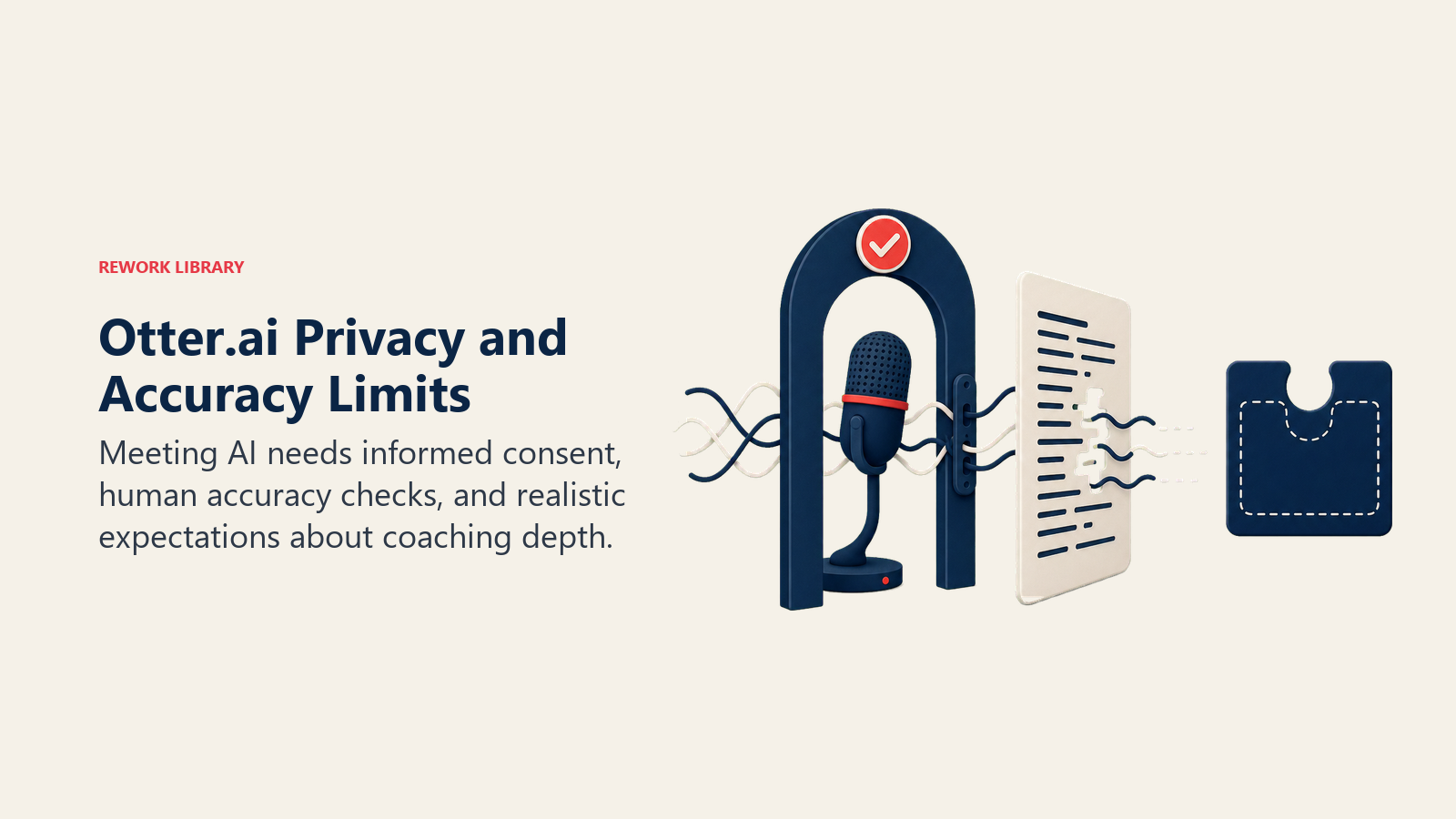
Recording consent. Otter's meeting bot records and transmits audio for every participant on a call, not just the person who added it, and consent laws vary by state and country. Otter was banned by the University of Massachusetts specifically for violating all-party consent recording requirements, and a class-action lawsuit filed in California in August 2025 alleges the company records conversations without proper consent to train its AI models. Otter's CEO has publicly disputed the allegations, arguing the practice is standard across the AI notetaker category. The case was still pending a ruling as of mid-2026. Check your state or country's consent laws, and your own company's recording policy, before rolling Otter out company-wide.
Transcription accuracy varies. Like any speech-to-text system, Otter's accuracy drops with heavy accents, technical jargon, overlapping speakers, and poor audio quality. Custom vocabulary settings help but don't eliminate the gap. Treat auto-generated summaries as a starting draft, not a verbatim legal record.
It isn't built for deal coaching. Otter has no native keyword tracker for objection handling, no rep scorecards, and no deal-stage automation. Teams that need those features consistently end up evaluating Fireflies, tl;dv, or Avoma instead, as covered in our ai meeting notes agent breakdown and the broader meeting intelligence pattern overview.
For teams weighing Otter against the wider category of embedded AI assistants rather than standalone notetakers, our explainer on AI copilots covers how tools like Otter relate to assistants built directly into other software, and our conversational AI explainer covers the underlying technology category. If you're thinking about meeting AI as part of a broader productivity rollout, AI meeting notes and summaries and sales call recording and transcript analysis go deeper into the surrounding use cases.
Frequently Asked Questions about Otter.ai
What is Otter.ai used for?
Otter.ai is used to automatically record, transcribe, and summarize meetings and conversations. It joins Zoom, Microsoft Teams, and Google Meet calls, produces a searchable transcript, generates action items, and lets users query past meetings through AI Chat.
Is Otter.ai free?
Otter offers a free Basic plan with 300 transcription minutes per month and a 30-minute cap per meeting. Paid plans start at $8.33/user/month (Pro, billed annually) and remove most of those limits.
Who owns Otter.ai?
Otter.ai was founded in 2016 as AISense by Sam Liang and Yun Fu. Sam Liang remains CEO. The company is privately held and headquartered in Mountain View, California, and has raised approximately $80 million in venture funding.
How accurate is Otter.ai's transcription?
Otter performs well on clear audio and standard accents but accuracy drops with heavy accents, technical jargon, background noise, and overlapping speakers. Custom vocabulary settings can improve accuracy for industry-specific terms but won't eliminate errors entirely.
Is Otter.ai safe and legal to use?
It depends on where you are and how you use it. Otter has faced privacy scrutiny, including a 2025 class-action lawsuit alleging it records conversations without full consent, and was previously banned at the University of Massachusetts for violating all-party consent laws. Check your local consent laws before recording calls with any participant who hasn't been informed.
How is Otter.ai different from Fireflies.ai?
Otter focuses on broad, searchable meeting transcription for any team. Fireflies focuses on routing call data directly into CRM systems like Salesforce and HubSpot for sales teams, with deeper native integrations and coaching features than Otter offers natively.
How is Otter.ai different from Fathom?
Fathom offers a more generous free tier (unlimited recording, capped only on AI summaries) and started as an individual-use tool, while Otter is built around team-wide search across a company's full meeting history. Otter also offers live transcription during the call, while Fathom processes audio after the meeting ends.
Does Otter.ai integrate with a CRM?
Otter has native integrations with Salesforce and HubSpot, but the field mapping and automation depth are lighter than sales-specific tools like Fireflies. Teams that need deal-stage automation from call data typically pair Otter with a dedicated sales intelligence tool or switch to one instead.
Part of the AI Terms Collection. Updated July 2026.
