What are Small Language Models? AI That Fits in Your Pocket
Turn this article into takeaways for your work.


Each assistant summarizes the article only for you and suggests best practices for your work.
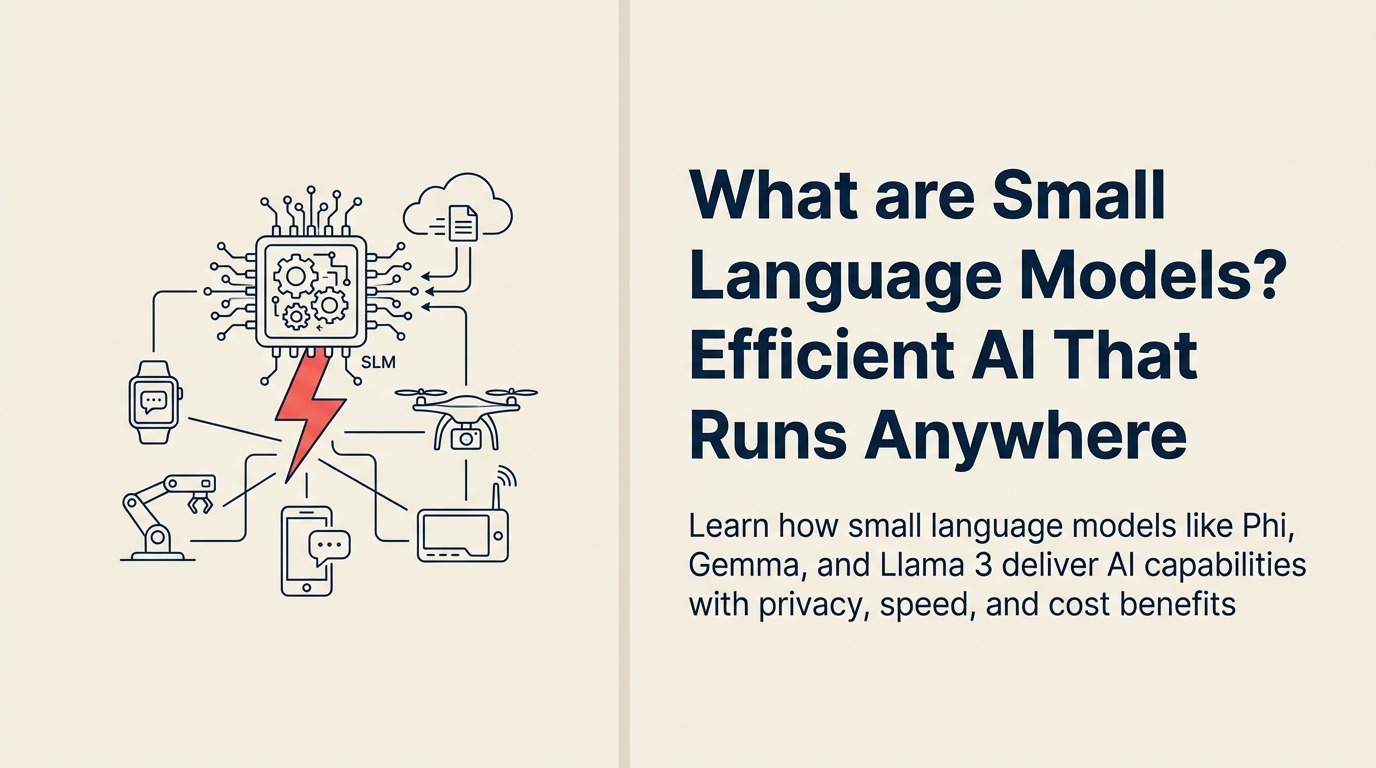
Every AI request you send to ChatGPT travels to distant servers, costs money per token, and shares your data with cloud providers. But what if capable AI ran entirely on your laptop, phone, or edge device, with zero latency, complete privacy, and no recurring costs? Small language models make this possible.
The Efficiency Revolution
Small Language Models (SLMs) emerged in 2023-2024 as researchers discovered that smaller, specialized models could match or exceed large models on specific tasks. Microsoft's Phi series, Google's Gemma, and Meta's Llama 3 demonstrated that billions of parameters aren't always necessary.
According to Hugging Face, SLMs are "language models typically ranging from 1-10 billion parameters, optimized for efficiency and task-specific performance, capable of running on consumer hardware while maintaining competitive capabilities for defined use cases."
The breakthrough challenged the assumption that bigger is always better, proving that careful training, high-quality data, and task focus could outperform brute-force scale.
SLMs in Business Terms
For business leaders, small language models mean deploying capable AI that runs on-device or in your private infrastructure, delivering privacy, speed, and cost savings while maintaining control over sensitive data.
Think of it as the difference between cloud software requiring constant internet connection and installed software running locally. SLMs enable AI capabilities without sending every request (and your data) to external servers, paying per-token costs, or depending on internet connectivity.
In practical terms, this means customer service agents with AI assistants that work offline, manufacturing facilities with on-device quality inspection AI, and healthcare systems analyzing patient data without it leaving the premises.
SLM Components
Small language model systems consist of these elements:
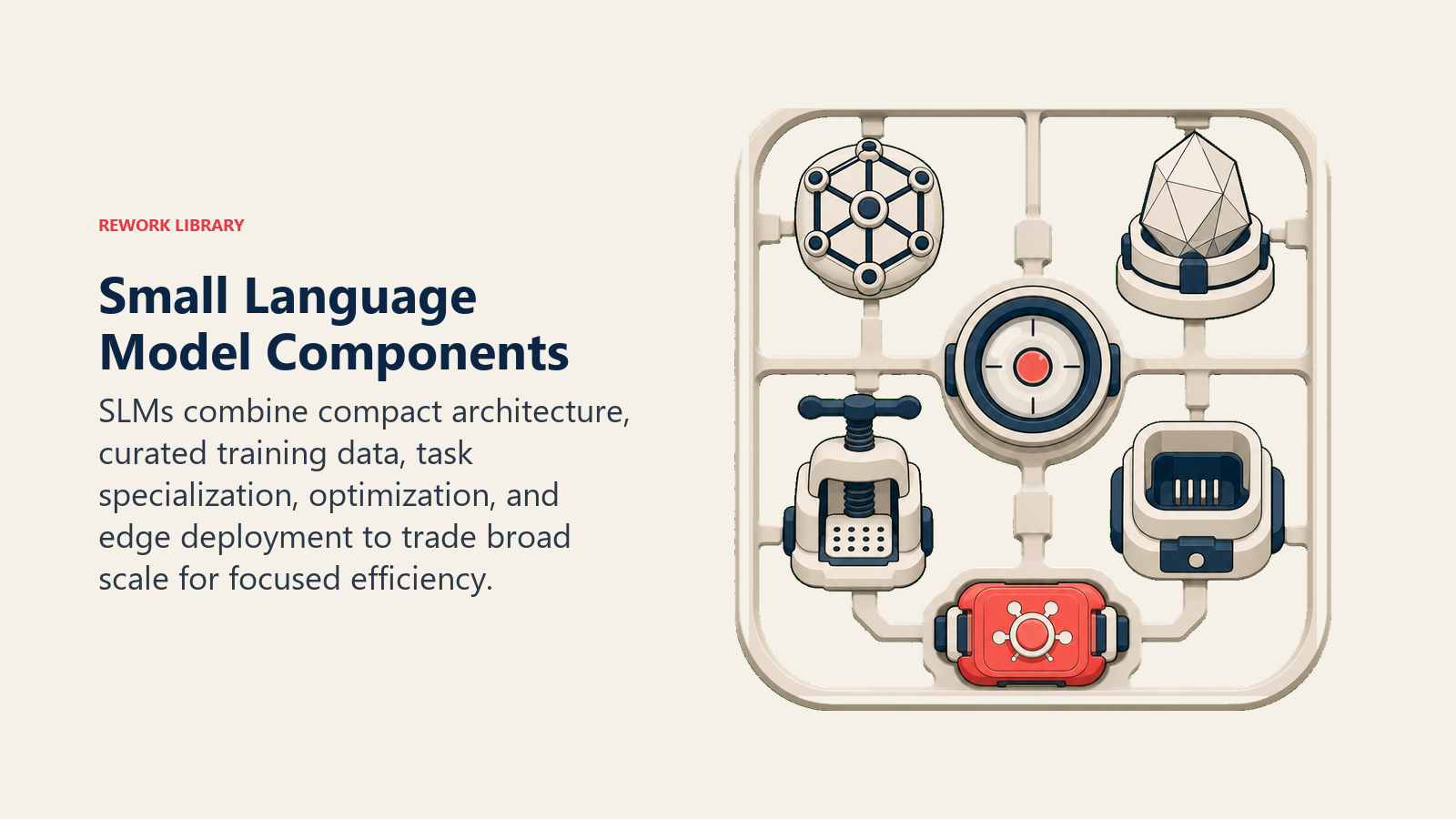
• Compact Architecture: Efficient neural network designs with 1-10B parameters versus 100B+ in large language models, optimized through techniques like distillation and pruning
• High-Quality Training Data: Carefully curated datasets that compensate for smaller size through better data quality and task relevance
• Task Specialization: Focus on specific capabilities rather than general-purpose knowledge, achieving expert-level performance in narrow domains
• Optimization Techniques: Quantization, compression, and efficient attention mechanisms enabling fast inference on limited hardware
• Edge Deployment: Capability to run on devices with limited memory and compute, from smartphones to IoT devices
How SLMs Work
Small language models achieve efficiency through:
Distillation: Learning from larger models through a teacher-student process, capturing capabilities in more compact form while maintaining performance
Focused Training: Specialized training on domain-specific data rather than general internet content, creating expert systems for particular tasks
Efficient Inference: Optimizations enabling fast processing on consumer hardware, running on M1 MacBooks, high-end smartphones, or edge servers without GPUs
This combination delivers AI capabilities locally with response times under 100ms, no internet dependency, and complete data privacy.
Types of Small Language Models
Different SLMs serve different purposes:
Type 1: Ultra-Small SLMs (1-3B parameters) Best for: Mobile and IoT deployment Key feature: Run on smartphones and edge devices Example: Microsoft Phi-3-mini, Google Gemma 2B
Type 2: Medium SLMs (3-7B parameters) Best for: Balanced capability and efficiency Key feature: Desktop and laptop deployment Example: Meta Llama 3 8B, Mistral 7B
Type 3: Large SLMs (7-10B parameters) Best for: Maximum on-premise capability Key feature: Server deployment without GPUs Example: Specialized industry models
Type 4: Task-Specific SLMs Best for: Highly specialized use cases Key feature: Expert-level narrow capabilities Example: Code generation, medical diagnosis
SLM Success Stories
Here's how businesses leverage small language models:
Healthcare Example: Epic Systems deployed Phi-3 models on hospital workstations for clinical documentation, processing patient notes entirely on-premises with zero latency and complete HIPAA compliance, handling 100K+ daily interactions.
Manufacturing Example: Siemens uses Gemma models on factory floor edge devices for real-time quality inspection, analyzing visual and sensor data locally with 50ms response times, reducing defects by 35% without cloud dependency.
Finance Example: Morgan Stanley equipped advisors with Llama 3 8B running locally on laptops, enabling document analysis and research queries during client meetings without internet access or data transmission.
Choosing Between SLMs and LLMs
Ready to evaluate the right model size?
Use SLMs when you need:
- Data privacy and on-premise processing
- Low latency (under 100ms)
- Offline capability
- Cost control (no per-token charges)
- Specialized task performance
Use LLMs when you need:
- Broad general knowledge
- Complex reasoning across domains
- Maximum capability regardless of cost
- Latest information via retrieval-augmented generation
External Resources
Explore authoritative resources on small language models:
- Microsoft Phi Models - Research on efficient small language models
- Hugging Face SLM Leaderboard - Comparing small model performance
- Meta Llama 3 Documentation - Technical details on deploying efficient language models
Learn More
Expand your understanding of model architecture and deployment:
- Large Language Models - Understanding the larger alternatives
- Model Parameters - How model size affects capabilities
- Fine-tuning - Customizing SLMs for your use case
- Edge AI - Deploying AI on local devices
Frequently Asked Questions about Small Language Models
What are Small Language Models?
Small Language Models (SLMs) are efficient language models typically ranging from 1-10 billion parameters, optimized for task-specific performance and capable of running on consumer hardware while maintaining competitive capabilities for defined use cases.
What's the difference between SLMs and LLMs?
LLMs (100B+ parameters) offer broad general knowledge but require cloud infrastructure. SLMs (1-10B parameters) specialize in specific tasks, run on local devices, provide complete privacy, and eliminate per-token costs.
What are the main types of small language models?
Ultra-Small SLMs (1-3B for mobile), Medium SLMs (3-7B for desktops), Large SLMs (7-10B for servers), and Task-Specific SLMs (optimized for particular use cases).
When should businesses use SLMs instead of LLMs?
Use SLMs for privacy-sensitive data, offline scenarios, cost control, low-latency requirements, and specialized tasks where focused models outperform general-purpose alternatives.
Part of the AI Terms Collection. Last updated: 2026-02-09
